
Exodus 6:20

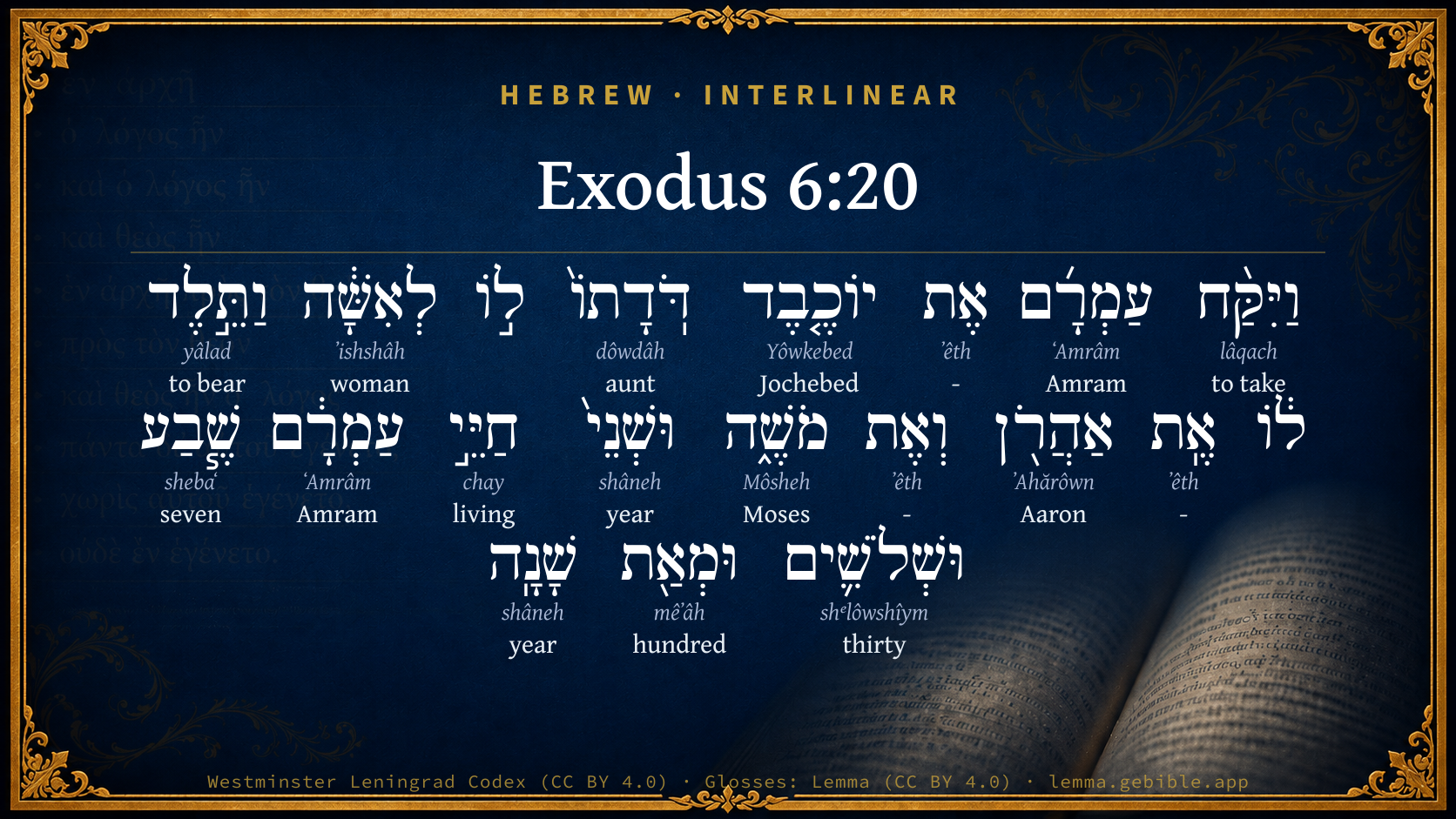
Hebrew (Westminster Leningrad Codex) Exodus 6:20 appears in the Hebrew Old Testament. The text above is from the Westminster Leningrad Codex. Each word links to its Strong’s number, a concise gloss, and parsing drawn from the Open Scriptures Hebrew Bible morphology. Click any word for its full Brown-Driver-Briggs (BDB) entry.
Download image
Cite this verse

Exodus 6:20 (World English Bible). Public Domain. Lemma interlinear Bible study tool, https://lemma.gebible.app/v/exodus/6/20.

Show BibTeX & RIS
BibTeX
RIS
English Translation
Amram took Jochebed his father's sister to himself as wife; and she bore him Aaron and Moses: and the years of the life of Amram were a hundred and thirty-seven years.
World English Bible · Public Domain
Highlights
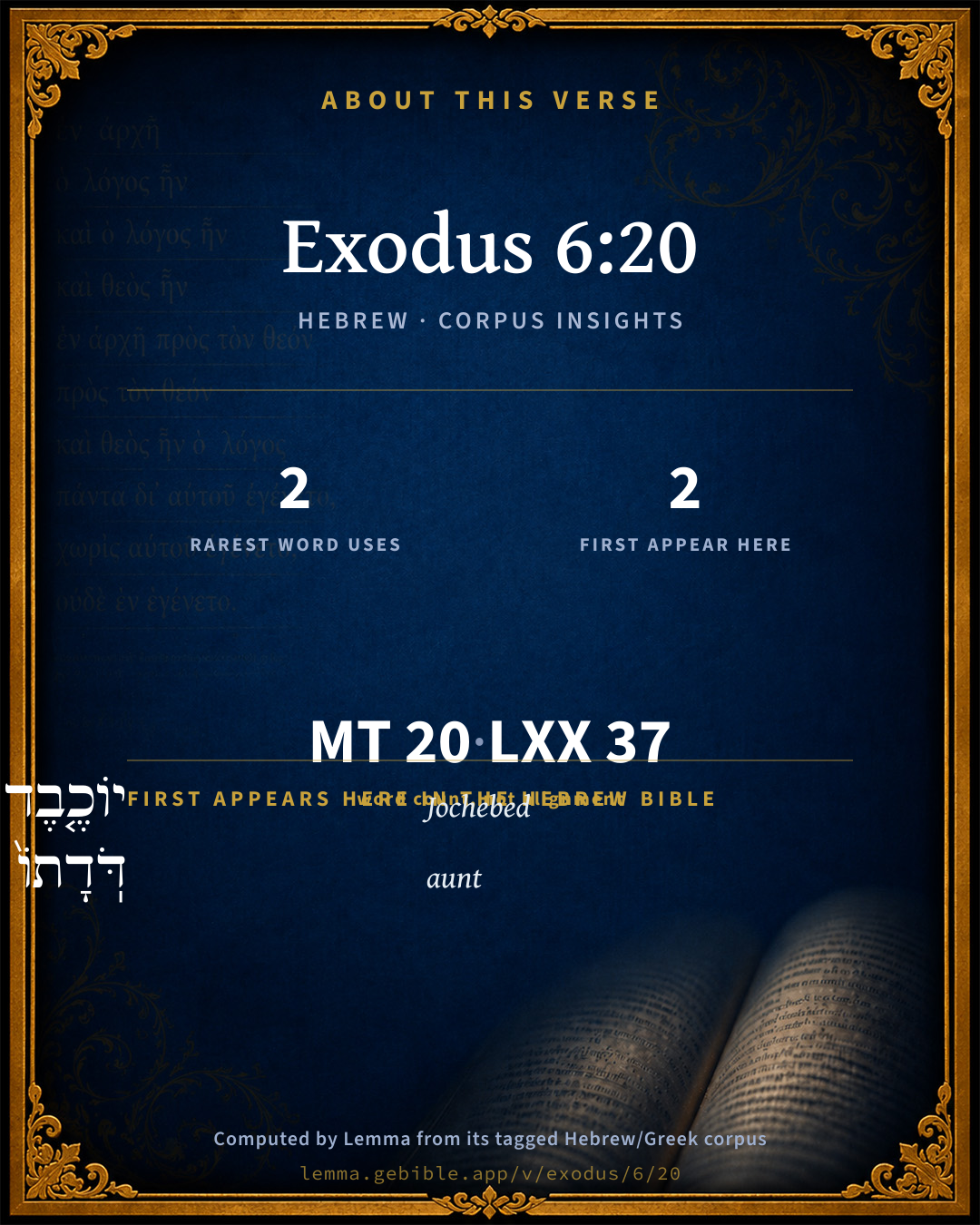
  • 2 first appearances in the Hebrew Bible
Full analysis ↓
Download a study sheet

One document with this verse’s original text, its word-by-word gloss line, the meaning frame, cross-references with their text, attributed commentary, and full source and license credits — printable, and it pastes into notes with its structure intact.

This verse Autodidact and up

Study sheet (.html) Plain text (.txt)

A passage Seminary Student

Up to 50 verses in one chapter. A passage sheet keeps up to 6 commentary sources and 12 cross-references per verse, in the order this page ranks them, and says so on the sheet whenever that leaves anything out. Ask for a single verse and you get the Autodidact verse sheet above.

Everything on this page stays free to read, with no account — the sheet is a download of what is already on screen, not access to it.

Want to remove ads? Support Godless Engineer
Compare translations 3

The same verse in 3 English versions, stacked beneath the original-language interlinear above. Click any original word for its lexicon entry.

Each is an independent rendering of the whole verse — the interlinear is not word-aligned to these translations.

Highlighted words mark where these versions differ — a whole-verse word diff, not a word-by-word alignment.

  • World English Bible Public Domain
    Amram took Jochebed his father's sister to himself as wife; and she bore him Aaron and Moses: and the years of the life of Amram were a hundred and thirty-seven years.
  • King James Version Public Domain
    And Amram took him Jochebed his father's sister to wife; and she bare him Aaron and Moses: and the years of the life of Amram were an hundred and thirty and seven years.
  • unfoldingWord Literal Text CC BY-SA 4.0
    And Amram took Jochebed, his aunt, as a wife for himself. And she bore him Aaron and Moses. And the years of the life of Amram were 137 years.

unfoldingWord Literal Text — © unfoldingWord, licensed CC BY-SA 4.0. Word-aligned USFM3 via Door43 (git.door43.org/unfoldingWord/en_ult).

Versions to compare (up to 4)

3 of 4 selected

Show all 18 translations

Every available English version of this verse, each an independent rendering of the whole verse.

  • World English Bible Public Domain
    Amram took Jochebed his father's sister to himself as wife; and she bore him Aaron and Moses: and the years of the life of Amram were a hundred and thirty-seven years.
  • Berean Standard Bible Public Domain
    And Amram married his father’s sister Jochebed, and she bore him Aaron and Moses. Amram lived 137 years.
  • Majority Standard Bible Public Domain
    And Amram married his father’s sister Jochebed, and she bore him Aaron and Moses. Amram lived 137 years.
  • King James Version Public Domain
    And Amram took him Jochebed his father's sister to wife; and she bare him Aaron and Moses: and the years of the life of Amram were an hundred and thirty and seven years.
  • American Standard Version (1901) Public Domain
    And Amram took him Jochebed his father's sister to wife; and she bare him Aaron and Moses: and the years of the life of Amram were a hundred and thirty and seven years.
  • Revised Version (1885) Public Domain
    And Amram took him Jochebed his father’s sister to wife; and she bare him Aaron and Moses: and the years of the life of Amram were an hundred and thirty and seven years.
  • Geneva Bible (1599) Public Domain
    And Amram tooke Iochebed his fathers sister to his wife, and shee bare him Aaron and Moses (and Amram liued an hundreth thirtie and seuen yeere)
  • Douay-Rheims (1899) Public Domain
    And Amram took to wife Jochabed his aunt by the father's side: and she bore him Aaron and Moses. And the years of Amram's life were a hundred and thirty-seven.
  • Young's Literal Translation Public Domain
    And Amram taketh Jochebed his aunt to himself for a wife, and she beareth to him Aaron and Moses: and the years of the life of Amram `are' a hundred and thirty and seven years.
  • Literal Standard Version CC BY-SA 4.0
    And Amram takes his aunt Jochebed to himself for a wife, and she bears Aaron and Moses to him; and the years of the life of Amram [are] one hundred and thirty-seven years.
  • Unlocked Literal Bible CC BY-SA 4.0
    Amram married Jochebed, his father's sister. She bore him Aaron and Moses. Amram lived 137 years and then died.
  • unfoldingWord Literal Text CC BY-SA 4.0
    And Amram took Jochebed, his aunt, as a wife for himself. And she bore him Aaron and Moses. And the years of the life of Amram were 137 years.
  • Darby Bible Public Domain
    And Amram took Jochebed his aunt as wife; and she bore him Aaron and Moses. And the years of the life of Amram were a hundred and thirty-seven years.
  • World Messianic Bible Public Domain
    Amram took Jochebed his father’s sister to himself as wife; and she bore him Aaron and Moses. The years of the life of Amram were one hundred thirty-seven years.
  • Webster's Bible Public Domain
    And Amram took him Jochebed, his father's sister, for a wife; and she bore him Aaron and Moses. And the years of the life of Amram were a hundred and thirty-seven years.
  • Free Bible Version CC BY-SA 4.0
    Amram married his father's sister Jochebed, and she had their sons Aaron and Moses. Amram lived for 137 years.
  • Bible in Basic English Public Domain
    And Amram took Jochebed, his father's sister, as wife; and she gave birth to Aaron and Moses: and the years of Amram's life were a hundred and thirty-seven.
  • JPS Tanakh (1917) Public Domain
    And Amram took him Jochebed his father's sister to wife; and she bore him Aaron and Moses. And the years of the life of Amram were a hundred and thirty and seven years.

Literal Standard Version (2020), Covenant Press — licensed CC BY-SA 4.0. Text via the HelloAO Bible API (eBible.org). Unlocked Literal Bible (unfoldingWord) — licensed CC BY-SA 4.0. Text via the HelloAO Bible API (eBible.org). unfoldingWord Literal Text — © unfoldingWord, licensed CC BY-SA 4.0. Word-aligned USFM3 via Door43 (git.door43.org/unfoldingWord/en_ult). Free Bible Version, Dr. Jonathan Gallagher — licensed CC BY-SA 4.0. Text via the HelloAO Bible API (eBible.org).

Word by word

More ways to search: Search by grammar → Find every occurrence → Compare this word →

Practice this passage: Drill this verse → Learn its vocabulary →

יוֹכֶ֤בֶד
Yôwkebed
H3115
“Jochebed”
Noun, Proper
Part of Speech
Noun
Type
Proper
Full BDB Definition

Origin: from H3068 contracted and H3513

TWOT: None

Jochebed = "Jehovah is glory" - the daughter of Levi, wife and at the same time aunt of Amram, and the mother of Moses, Aaron, and Miriam
  1. וַיִּקַּ֨ח lâqach H3947 “and · to take” Conjunction + Verb, Qal, Sequential Imperfect, 3rd Person, Masculine, Singular
  2. עַמְרָ֜ם ʻAmrâm H6019 “Amram” Noun, Proper
  3. אֶת ʼêth H853 “-” Particle, Direct Object
  4. דֹּֽדָתוֹ֙ dôwdâh H1733 “aunt · his” Noun, Common, Feminine, Singular, Construct + Suffix, Personal, 3rd Person, Masculine, Singular
  5. לְאִשָּׁ֔ה ʼishshâh H802 “to/for · woman” Preposition + Noun, Common, Feminine, Singular, Absolute
  6. וַתֵּ֣לֶד yâlad H3205 “and · to bear” Conjunction + Verb, Qal, Sequential Imperfect, 3rd Person, Feminine, Singular
  7. אֶֽת ʼêth H853 “-” Particle, Direct Object
  8. אַהֲרֹ֖ן ʼAhărôwn H175 “Aaron” Noun, Proper
  9. וְאֶת ʼêth H853 “and · -” Conjunction + Particle, Direct Object
  10. מֹשֶׁ֑ה Môsheh H4872 “Moses” Noun, Proper
  11. וּשְׁנֵי֙ shâneh H8141 “and · year” Conjunction + Adjective, Cardinal number, Masculine, Dual, Construct
  12. חַיֵּ֣י chay H2416 “living things of” Noun, Common, Masculine, Plural, Construct
  13. עַמְרָ֔ם ʻAmrâm H6019 “Amram” Noun, Proper
  14. שֶׁ֧בַע shebaʻ H7651 “seven” Adjective, Cardinal number, Feminine, Singular, Absolute
  15. וּשְׁלֹשִׁ֛ים shᵉlôwshîym H7970 “and · thirty” Conjunction + Adjective, Cardinal number, Both, Plural, Absolute
  16. וּמְאַ֖ת mêʼâh H3967 “and · hundred” Conjunction + Adjective, Cardinal number, Both, Singular, Construct
  17. שָׁנָֽה shâneh H8141 “year” Noun, Common, Feminine, Singular, Absolute

About this verse

These counts appear in no published source. They are computed here, from the morphology-tagged text and Lemma’s own curated glosses. What Lemma adds →

20
words
14
distinct lemmas
Pentateuch
section

Notable vocabulary

The rarest word here is יוֹכֶ֤בֶד Jochebed H3115 — appearing just 2 times in the whole Hebrew Bible.

First appearance in Scripture

These words make their first canonical appearance in the Hebrew Bible here:

  • יוֹכֶ֤בֶד Jochebed H3115
  • דֹּֽדָתוֹ֙ aunt H1733

Shared distinctive vocabulary

יוֹכֶ֤בֶד Jochebed H3115 occurs in 2 verses of the Hebrew Bible. Also found in:

Grammatical profile

  • 2 verbs
  • 9 nouns
  • 4 adjectives
  • 2 prepositions
  • 3 particles

Verb forms

  • וַיִּקַּ֨ח Qal · Sequential Imperfect
  • וַתֵּ֣לֶד Qal · Sequential Imperfect

Repetition

Words recur within this verse — often emphatic in Hebrew:

  • עַמְרָ֜ם Amram H6019 ×2
  • וּשְׁנֵי֙ year H8141 ×2

Hebrew & Septuagint length

In English translation the verse runs 31 words from the Hebrew and 39 from the Septuagint (LXX English) — closely comparable.

A rough comparison of the two English renderings, which tokenize alike — not a word-level alignment.

Word counts can differ between the Hebrew and the Greek without any difference in meaning — e.g. the Hebrew direct-object marker אֵת has no separate Greek word, and Greek often adds the article ὁ.

In the original languages it is 20 Hebrew tokens and 37 Greek tokens — but the two are counted differently (Hebrew bundles its prefixes and suffixes into one token; the Greek is in lemma form), so that isn’t a like-for-like length.

Cross-references

4

Topical passages linked to Exodus 6:20 in the Treasury of Scripture Knowledge — connected by theme and wording, ordered by reader-vote popularity; previews shown in the World English Bible.

  • Exodus 2:1–2 A man of the house of Levi went and took a daughter of Levi as his wife.
  • Numbers 26:59 The name of Amram's wife was Jochebed, the daughter of Levi, who was born to Levi in Egypt: and she bore to Amram Aaron and Moses, and Miriam their sister.
  • Exodus 6:16 These are the names of the sons of Levi according to their generations: Gershon, and Kohath, and Merari; and the years of the life of Levi were one hundred thirty-seven years.
  • Exodus 6:18 The sons of Kohath: Amram, and Izhar, and Hebron, and Uzziel; and the years of the life of Kohath were one hundred thirty-three years.

Cross-references courtesy of OpenBible.info (CC BY 4.0).

Hebrew and Greek witnesses Masoretic Hebrew ↔ Greek Septuagint

The same verse in the two great witnesses to the Old Testament, shown verse-for-verse.

These are two independent witnesses, not word-aligned to each other, and the Septuagint is shown in lemma (dictionary) form.

Hebrew Exodus 6:20 Masoretic · Westminster Leningrad Codex

וַיִּקַּ֨ח עַמְרָ֜ם אֶת יוֹכֶ֤בֶד דֹּֽדָתוֹ֙ ל֣וֹ לְאִשָּׁ֔ה וַתֵּ֣לֶד ל֔וֹ אֶֽת אַהֲרֹ֖ן וְאֶת מֹשֶׁ֑ה וּשְׁנֵי֙ חַיֵּ֣י עַמְרָ֔ם שֶׁ֧בַע וּשְׁלֹשִׁ֛ים וּמְאַ֖ת שָׁנָֽה

Amram took Jochebed his father's sister to himself as wife; and she bore him Aaron and Moses: and the years of the life of Amram were a hundred and thirty-seven years.

World English Bible · Public Domain

Greek LXX Exodus 6:20 Septuagint · lemma form

καί λαμβάνω αμβραμ ὁ ιωχαβεδ θυγάτηρ ὁ ἀδελφός ὁ πατήρ αὐτός ἑαυτοῦ εἰς γυνή καί γεννάω αὐτός ὁ τε ααρων καί μωυσῆς καί μαριαμ ὁ ἀδελφή αὐτός ὁ δέ ἔτος ὁ ζωή αμβραμ ἑκατόν τριάκοντα δύο ἔτος

And Ambram took as wife Jochabed the daughter of his father's brother, and she bore to him both Aaron and Moses, and Mariam their sister: and the years of the life of Ambram were a hundred and thirty-two years.

LXX2012 (modern English Septuagint) · Public Domain

On this verse, Jamieson, Fausset & Brown discusses the Septuagint’s reading. Read the note in Commentary ↓

Hebrew: Westminster Leningrad Codex (CC BY 4.0). Greek: Septuagint (public domain); English from LXX2012 (modern English Septuagint) (Public Domain). How the Septuagint differs from the Hebrew →

Targum (Aramaic paraphrase)

2

The Targum is the ancient Jewish Aramaic paraphrase of the Hebrew Scriptures — an interpretive translation, not the Hebrew text itself. Onkelos (literal) and Pseudo-Jonathan (expansive) render the Torah, and Jonathan the Prophets. Coverage is partial: where no permissively-licensed English translation exists for a verse, only the Aramaic is shown. This is verse-level text, not a word-by-word alignment to the Hebrew.

  1. Targum Onkelos Torah (Genesis–Deuteronomy)
    וּנְסִיב עַמְרָם יָת יוֹכֶבֶד אֲחַת אֲבוּהִי לֵהּ לְאִנְתּוּ וִילִידַת לֵהּ יָת אַהֲרֹן וְיָת משֶׁה וּשְׁנֵי חַיֵי עַמְרָם מְאָה וּתְלָתִין וּשְׁבַע שְׁנִין:

    (no public-domain English translation for this verse)

    Targum Onkelos — Aramaic: “Onkelos Genesis” (public domain); “Onkelos Exodus” (public domain); “Onkelos Leviticus” (public domain); “Onkelos Numbers” (public domain); “Onkelos Deuteronomy” (public domain). English: “Sefaria Community Translation” (CC0 1.0 (public-domain dedication)); “J.W. Etheridge. The Targums of Onkelos and Jonathan Ben Uzziel on the Pentateuch. London: Longmans, Green, 1862” (public domain). Text via Sefaria.

  2. Targum Pseudo-Jonathan Torah (Genesis–Deuteronomy)
    וּנְסֵיב עַמְרָם יַת יוֹכֶבֶד חֲבִבָתֵיהּ לֵיהּ לְאִנְתּוּ וִילֵידַת לֵיהּ יַת אַהֲרן וְיַת משֶׁה וּשְׁנֵי חַיוֹי דְעַמְרָם חֲסִידָא מְאָה וּתְלָתִין וּשְׁבַע שְׁנִין חַיָיא עַד דְחָמָא יַת בְּנֵי רְחַבְיָא בַּר גֵרְשׁוֹם בַּר משֶׁה

    And Amram took Jokeved his cousin to wife, and she bare him Aharon and Mosheh; and the years of Amram the saint were a hundred and thirty and seven years. He lived to see the children of Rechabia bar Gershom bar Mosheh.

    Targum Pseudo-Jonathan — Aramaic: “Targum Jonathan on Genesis” (public domain); “Targum Jonathan on Exodus” (public domain); “Targum Jonathan on Leviticus” (public domain); “Targum Jonathan on Numbers” (public domain); “Targum Jonathan on Deuteronomy” (public domain). English: “The Targum of Jonathan ben Uzziel, trans. J. W. Etheridge, London, 1862” (public domain). Text via Sefaria.

Commentary

Notes on Exodus 6:20 from classic Christian and Jewish commentators (each source and its license shown beneath its notes). The classic Christian expositions comment on the surrounding passage and are grouped to its opening verse, so a note may address several verses; the Jewish commentaries on the Tanakh (Rashi and others) are per-verse, so they appear only where the commentator wrote on this verse.

Lemma curates 59 commentaries, every one of them public domain or Creative Commons licensed, each selected and text-cleaned for this edition rather than reprinted as found. About our sources →

Trapp's Complete Commentary

John Trapp

Exo 6:20 And Amram took him Jochebed his father’s sister to wife; and she bare him Aaron and Moses: and the years of the life of Amram [were] an hundred and thirty and seven years.

Ver. 20. Jochebed his father’s sister.] See Exo 2:1.

John Trapp, A Commentary or Exposition upon All the Books of the Old and New Testament (1647–1656) — public domain. Text from a community e-Sword module.

Joseph Benson's Commentary

Exo 6:20-23. His father’s sister — That is, kinswoman, as the Hebrew word frequently means. Amminadab — A prince of the tribe of Judah. The Levites might marry into any tribe, there being no danger of confusion or loss of inheritance thereby.

Joseph Benson's Commentary on the Old and New Testaments (1811–1818) — public domain. Text from a community e-Sword module.

Tyndale Open Study Notes

Tyndale Open Resources

6:20-25 The descendants of Kohath’s sons now become the focus of the genealogy. The families of Aaron son of Amram and Korah son of Izhar are given a more detailed listing (6:23-24), followed by one of Aaron’s sons, Eleazar (6:25). The focus is clearly on Aaron’s line through Eleazar, who received the high priesthood. The fact that Aaron and Korah were cousins makes it easier to see why Aaron’s elevation to high priesthood was so galling to Korah (see Num 16:1-3); family rivalry is nothing new. The later rebellion might explain why Korah and his sons are given particular mention in this genealogy.

Tyndale Open Study Notes — © Tyndale Open Resources, licensed CC BY-SA 4.0. Text via the HelloAO Bible API.

Geneva Bible (1599)

Geneva Bible translators

Which kind of marriage was after in the law forbidden, Lev. 18:12.

Geneva Bible (1599) marginal notes — public domain. Text via Bolls.life.

Jamieson, Fausset & Brown

Robert Jamieson, A. R. Fausset & David Brown

Amram took him Jochebed his father's sister to wife--The Septuagint and Syriac versions render it "his cousin."

Jamieson, Fausset & Brown — Commentary Critical and Explanatory on the Whole Bible (1871) — public domain (CC PDM 1.0). Text via the HelloAO Bible API.

Adam Clarke's Commentary

Verse 20. His father's sister] דדתו dodatho. The true meaning of this word is uncertain. Parkhurst observes that דוד dod signifies an uncle in 1Sa 10:14; Le 10:4, and frequently elsewhere. It signifies also an uncle's son, a cousin-german: compare Jer 32:8 with Ex 6:12, where the Vulgate renders דדי dodi by patruelis mei, my paternal cousin; and in Am 6:10, for דודו dodo, the Targum has קריביה karibiah, his near relation. So the Vulgate, propinquus ejus, his relative, and the Septuagint, οι οικειοι αυτων, those of their household. The best critics suppose that Jochebed was the cousin-german of Amram, and not his aunt. See Clarke on Ex 2:1.

Bare him Aaron and Moses] The Samaritan, Septuagint, Syriac, and one Hebrew MS. add, And Miriam their sister. Some of the best critics suppose these words to have been originally in the Hebrew text.

Adam Clarke's Commentary on the Bible (1810–1826) — public domain. Text from a community e-Sword/MySword module.

Ellicott's Commentary for English Readers

(20) Amram took him Jocheoed his father’s sister to wife.—Marriages with aunts and nieces were not unlawful before the giving of the Law. They were common throughout the East, and at Sparta (Herod. vi. 71, 7:239).

The years of the life of Amram.—The long lives of Levi, Kohath, and Amram, the father of Moses, are not recorded for any chronological purpose, but to show that the blessing of God rested in an especial way on the house of Levi, even before it became the priestly tribe. Life in Egypt at the time not unfrequently reached 120 years; but the 137 of Levi, the 133 of Kohath, and the 137 of Amram, the father of Moses, would, even in Egypt, have been abnormal.

A Bible Commentary for English Readers, edited by Charles John Ellicott (1878–1897) — public domain. Text from a community e-Sword module.

The Cambridge Bible for Schools and Colleges

gen. ed. J. J. S. Perowne

20. The family of Kohath’s first son, Amram (v. 18), viz. Aaron and Moses.

Jochebed] Mentioned besides only Num_26:59 (P). The name means probably ‘Yahweh is glory’ [viz. to us or to our people] (cf. the Phoen. Kabd-melḳart, ‘Melḳart is glory’),—‘Yahweh’ being contracted (through Yahw, Yĕhaw, Yaw), as in many other proper names (e.g. Jo‘çzer, ‘Yahweh is help’), to Yô (Jo).

his father’s sister] and so the ‘daughter of Levi,’ Exo_2:1, cf. Num_26:59. Marriage with a father’s sister was afterwards forbidden, Lev_18:12; cf. another deviation from the later law in Gen_20:12. P must here preserve a genuine ancient tradition.

Aaron and Moses] Sam. LXX. Pesh. add, and Miriam; cf. Num_26:59. Aaron, according to P (Exo_7:7) was three years older than Moses (cf. Num_33:39 with Deu_34:7). Miriam’s age is nowhere stated: it may be inferred from Exo_2:8 (presuming her to be there referred to) that she was some years older than either of her brothers.

20–25. The descendants of Kohath’s sons.

The Cambridge Bible for Schools and Colleges (gen. ed. J. J. S. Perowne; Cambridge University Press, 1878–1918) — public domain. Text from a community e-Sword module.

John Gill's Exposition

And Aaron took him Elisheba,.... The same name we pronounce Elizabeth; and of this name was the wife of Zacharias, the father of John the Baptist, Luk 1:5, this woman Aaron took was

the daughter of Amminadab, the sister of Naashon; a prince of the tribe of Judah, Num 7:12, her he took to wife; or married; for though intermarriages with the several tribes were not allowed, nor used in after times, that they might be kept distinct, and the inheritances also, yet the tribe of Levi often took wives of other tribes, because they had no inheritance, and were to have none in the land of Canaan, so that confusion in tribes and inheritance was not made hereby; and it is observable, that these marriages were frequently with the tribe of Judah, as signifying the union of the kingly and priestly offices in Christ, who sprung from the tribe of Judah:

and she bare him Nadab, and Abihu, Eleazar, and Ithamar; the two first of these died by fire from heaven in their father's lifetime, for offering strange fire to the Lord, Lev 10:1. Eleazar succeeded his father in the priesthood, Num 20:26 and of the sons of Ithamar executing the priest's office, see Ch1 24:2.

John Gill's Exposition of the Whole Bible (1746–1763) — public domain (CC PDM 1.0). Text via the HelloAO Bible API.

Albert Barnes' Notes on the Bible

Amram - This can scarcely be the same person who is mentioned in Exo 6:18; but his descendant and representative in the generation immediately preceding that of Moses. The intervening links are omitted, as is the rule where they are not needed for some special purpose, and do not bear upon the history.

Jochebed - The name means “the glory of Jehovah (Yahweh),” one clear instance of the use of the sacred name before the Exodus.

Father’s sister - This was within the prohibited degrees after the law was given Lev 18:12 but not previously.

Albert Barnes' Notes on the Bible (1834–1885) — public domain. Text from a community e-Sword/MySword module.

Haydock's Catholic Bible Commentary

Aunt: Hebrew Doda is applied to various degrees of kindred. The Chaldean says, Jochabed was daughter of Amram’s sister, the Septuagint assert of his brother, and consequently his own cousin. But she might be his aunt, chap. ii. 1. (Calmet)

George Leo Haydock (1774–1849), Haydock's Catholic Family Bible and Commentary, 1859 edition — public domain. Excludes Psalms (Douay-Rheims chapter numbering differs from Protestant) and Deuterocanonical books (Catholic canon only).

Matthew Poole's English Annotations

His father’s sister or rather, kinswoman, or cousin, or niece; for so this Hebrew word is sometimes used, as appears from Jer 32:8,9,12.

Object. She is called the daughter of Levi, Exo 2:1.

Answ. Even nieces are oft called daughters, as we have showed. See Luk 1:5, and See Poole "Exo 2:1".

Matthew Poole's English Annotations on the Holy Bible (1683–1685) — public domain. Text from a community e-Sword/MySword module.

Whedon's Commentary on the Bible

Daniel D. Whedon

20. And Amram took him Jochebed his father’s sister to wife — דודה, here rendered father’s sister, we render daughter of father’s brother, or cousin, in this following the Septuagint, Syriac, Vulgate, and Targum Pal., thus understanding the text to declare that Amram married Jochebed his cousin. This is a much disputed text, furnishing a most important chronological item. Our Authorized Version and most modern commentators make Jochebed to have been Amram’s aunt and Levi’s daughter, so that Moses was thus Levi’s grandson. This view certainly is favoured by Num_26:59, “And the name of Amram’s wife was Jochebed, the daughter of Levi, whom her mother bare to Levi in Egypt;” as if Levi had a daughter born to him after the descent into Egypt, in addition to the three sons who went down with him from Canaan. But,

(1,) It is not probable that Moses’ own father and mother violated a law of nature which was in the next generation so expressly incorporated into the Mosaic ordinances, though it is, of course, possible. (2,) If Jochebed were Amram’s aunt, then Levi must have begotten, and Jochebed have borne, children at such an extreme age that the birth of Jochebed, Miriam, and Aaron, as well as of Moses, must all be set down as miraculous, while the record here gives no hint of a miracle. This may be seen thus: Take the shortest period of the sojourn, two hundred and fifteen years, which will make the difficulties least, and as Moses was eighty at the Exode, we have 215-80, or 135 years, as the time from Jacob’s descent into Egypt to the birth of Moses. Levi was about forty-five when the sojourn began, and as Jochebed was (on this supposition) his daughter, there were then one hundred and thirty-five years from Levi’s forty-fifth year to the birth of his grandson, Moses. Now wherever we divide this period of one hundred and thirty-five years we shall make Levi to have become a father, and Jochebed a mother, in extreme age. Thus, if Jochebed were born when Levi was one hundred, then it would have been fifty-five years after the arrival in Egypt, since 100-45=55. In that case Jochebed must have borne Moses at eighty, since 135-55=80; Aaron, therefore, at seventy-seven, and Miriam when past sixty. If we suppose Jochebed to have been herself born ten or twenty years later, we then make Levi one hundred and ten or one hundred and twenty at her birth, and make her so many years younger at the birth of her children, but we do not relieve the difficulties. If we take the long period of sojourn, four hundred and thirty years, it will be seen at once that all the difficulties are vastly increased. But all are completely obviated by considering Jochebed Amram’s cousin, for this inserts another generation into the one hundred and thirty-five years.

(3.) The Hebrew word דודה, here rendered father’s sister, is, as noted above, rendered daughter of the father’s brother by the Septuagint, followed by the Syriac, Vulgate, and Palestine Targum. The corresponding masculine, דוד, uncle, also means son of the uncle in Jer_32:12. It seems certain that if dodh may mean uncle’s son, dodha may mean uncle’s daughter. Accordingly it is here rendered cousin by Lyra, Estius, La Haye, and Adam Clarke.

(4.) The difficulty of the common translation may be relieved thus:

Num_26:59 states that her mother, not mentioning who, bore Jochebed to Levi in Egypt. Is it not a likely supposition that Levi in his old age adopted this granddaughter as his daughter? If so, she might have been considered as the sister of his three famous sons, and this fact was deemed worthy of special mention, since she was the mother of the line of the high priests. Thus she might have been considered Amram’s aunt, although really his cousin.

It is the opinion of Kurtz, Keil, Canon Cook, and others, that two Amrams are here referred to, and that several genealogical links are dropped between Amram the son of Kohath and Amram the father of Moses. But, (1,) The impression is certainly very strongly made, in reading Exo_6:18-20, that the same Amram is referred to throughout. (2,) It is a fact not noted by these scholars that in Lev_10:4, Uzziel, Amram’s brother, is called Aaron’s uncle; and though, as seen above, the word rendered uncle has much latitude, yet it would be necessary to suppose a second Uzziel also contemporary with the second Amram. As to the dropping of genealogical links, there is an undoubted example in Matthew i, where the names of three well known kings are omitted in the genealogy of our Lord; and a probable instance, yet more remarkable, in Ezr_7:1, where, if the parallel list in 1 Chronicles vi is correct, six names have been dropped out between Meraioth and Azariah. It is likewise certain that son often means simply descendant, as Christ is called “son of David.” If the sojourn in Egypt were four hundred and thirty years several generations must have been omitted here, but all the events can be brought within two hundred and fifteen years. See note on Exo_12:40.

Daniel D. Whedon (gen. ed.), Commentary on the Old and New Testaments (1874–1909) — public domain. Text from a community e-Sword module.

The Pulpit Commentary

Amram. That this Amram is the "man of the house of Levi" mentioned in Exo_2:1, cannot be doubted; but it is scarcely possible that he should be the Amram of ver. 18, the actual son of Kohath and contemporary of Joseph. He is probably a descendant of the sixth or seventh generation, who bore the same name, and was the head of the Amramite house. That house, at the time of the Exodus, numbered above two thousand males. (Num_3:27, Num_3:28) See the excellent remarks of Keil and Delitzsch, "Biblical Commentary," vol. 1. p. 470, E. T.; and compare Kurtz, "History of Old Covenant," vol. 2. p. 144, and Cook, in "Speaker"s Commentary," vol. 1. p. 274. Jochebed his father"s sister. Marriages with aunts and nieces have been common in many countries, and are not forbidden by any natural instinct. They first became unlawful by the positive command recorded in Lev_18:12. The name Jochebed is the earliest known compounded with Jah, or Jehovah. It means "the glory of Jehovah." She bare him Aaron and Moses. Aaron is placed first, as being older than Moses. (Exo_7:7) Miriam is omitted, since the object of the writer is confined to tracing descent in the male line.

The Pulpit Commentary (1880–1919), ed. H.D.M. Spence-Jones & Joseph S. Exell — public domain. Text from a community e-Sword module.

John Wesley's Explanatory Notes

His father's sister - That is, kins-woman. So the Hebrew word is frequently used.

John Wesley, Explanatory Notes Upon the Whole Bible (1754–1765) — public domain. Text via the GEBible commentary corpus.

unfoldingWord translationNotes

Door43 World Missions Community

137 years

"one hundred and thirty-seven years" (See: Numbers)

Izhar ... Korah ... Zichri

These are the names of men. (See: How to Translate Names)

Uzziel ... Mishael ... Sithri

These are the names of men. (See: How to Translate Names)

translationWords

die

unfoldingWord translationNotes — © Distant Shores Media and the Door43 World Missions Community, licensed CC BY-SA 4.0. Source: git.door43.org/Door43/en_tn.

Rashi

Rabbi Shlomo Yitzchaki (Rashi)

יוכבד דדתו JOCHEBED HIS AUNT — The Targum has: his father’s sister; she was daughter of Levi (cf. Exodus 2:1) and sister of Kohath.

Rashi on the Tanakh — English translations: “The Judaica Press complete Tanach with Rashi, translated by A. J. Rosenberg” (CC BY 4.0); “Pentateuch with Rashi's commentary by M. Rosenbaum and A.M. Silbermann, 1929-1934” (public domain); “The Metsudah Tanach series, Lakewood, N.J” (CC BY 4.0); and “The Book of Joshua, Metsudah Publications, 1997” (CC BY 4.0). Text via Sefaria.

Lesson kit

Teaching starters — assembled from the data on this page, not authored interpretation. Every prompt links to the verse data it draws on. Edit before teaching.

Exodus, in the Pentateuch, opens this verse with 20 words (14 distinct Hebrew lemmas). Its most distinctive word is Yôwkebed (“Jochebed”). A historical commentator’s framing appears above. Read the whole chapter for the surrounding context.

Discussion questions

  1. How does “Jochebed” (Yôwkebed) shape what this verse is saying?
  2. 2 words here appear for the first time in Scripture. What is being introduced at this debut?
  3. Numbers 26:59 shares the word «Jochebed» with this verse. How do the two illuminate each other?
  4. “Amram” occurs 2× in this one verse. What is the effect of the repetition?
  5. These translations render this verse differently. What is at stake in choosing one wording over another?
  6. The verb «וַיִּקַּ֨ח» is Qal Sequential Imperfect. How does its form color the action?
  7. Reading how Trapp's Complete Commentary and Joseph Benson's Commentary read this verse, where do the two commentators agree and where do they part?

Things to notice

Reading settings

Reading text

Shown beneath each verse's original-language words.

Old Testament
Old Testament edition

Read the OT as the Masoretic Hebrew (MT) or the Greek Septuagint (LXX).

English shown for the Greek Septuagint (in the Hebrew ↔ Greek comparison).

Comparing translations? Open the Compare panel on any verse page to stack up to four side by side.