
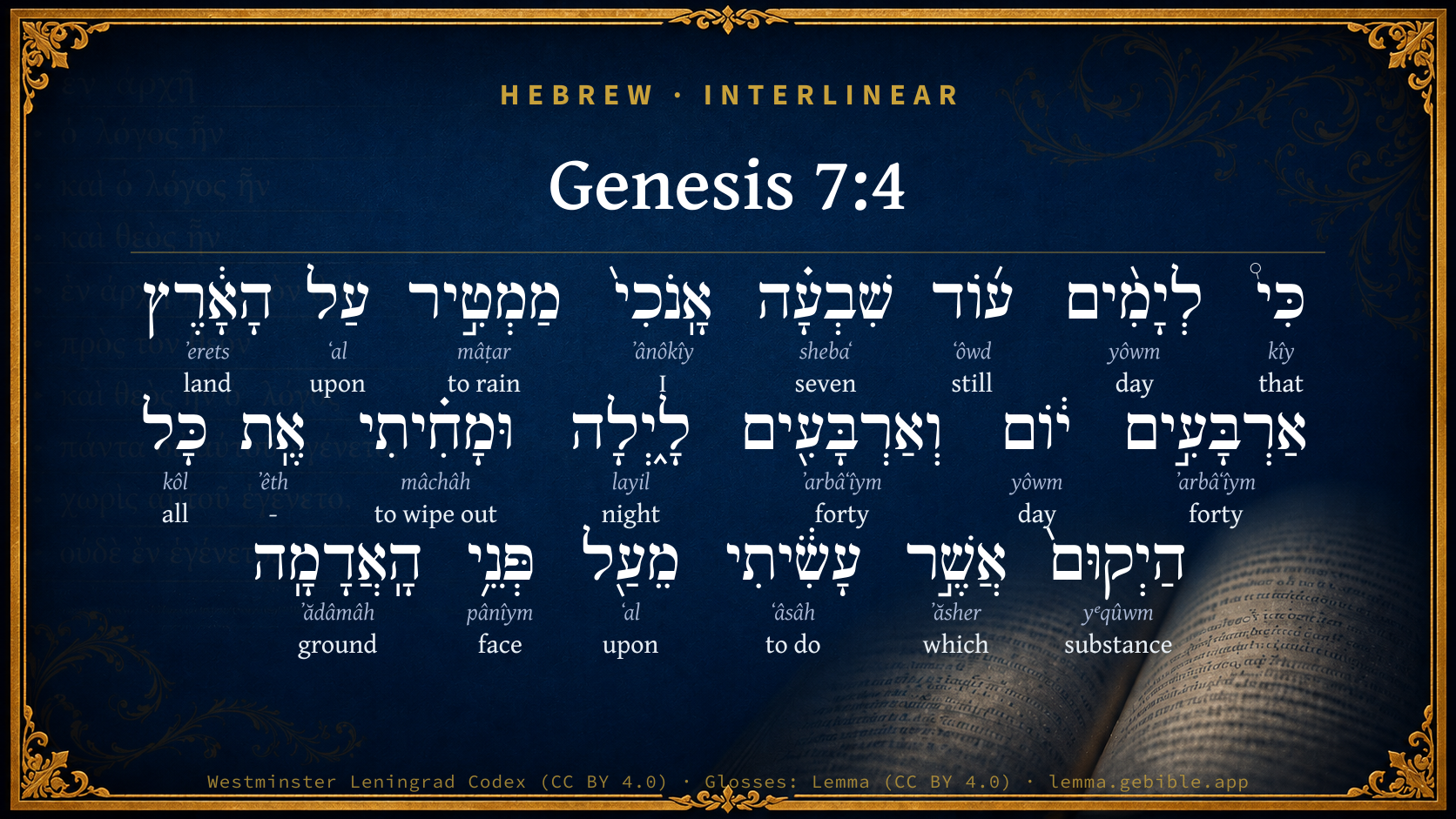
Genesis 7:4

Hebrew (Westminster Leningrad Codex) Genesis 7:4 appears in the Hebrew Old Testament. The text above is from the Westminster Leningrad Codex. Each word links to its Strong’s number, a concise gloss, and parsing drawn from the Open Scriptures Hebrew Bible morphology. Click any word for its full Brown-Driver-Briggs (BDB) entry.
Download image
Cite this verse

Genesis 7:4 (World English Bible). Public Domain. Lemma interlinear Bible study tool, https://lemma.gebible.app/v/genesis/7/4.

Show BibTeX & RIS
BibTeX
RIS
English Translation
In seven days, I will cause it to rain on the earth for forty days and forty nights. Every living thing that I have made, I will destroy from the surface of the ground."
World English Bible · Public Domain
Highlights
  • 1 first appearance in the Hebrew Bible
Full analysis ↓
Download a study sheet

One document with this verse’s original text, its word-by-word gloss line, the meaning frame, cross-references with their text, attributed commentary, and full source and license credits — printable, and it pastes into notes with its structure intact.

This verse Autodidact and up

Study sheet (.html) Plain text (.txt)

A passage Seminary Student

Up to 50 verses in one chapter. A passage sheet keeps up to 6 commentary sources and 12 cross-references per verse, in the order this page ranks them, and says so on the sheet whenever that leaves anything out. Ask for a single verse and you get the Autodidact verse sheet above.

Everything on this page stays free to read, with no account — the sheet is a download of what is already on screen, not access to it.

Want to remove ads? Support Godless Engineer
Compare translations 3

The same verse in 3 English versions, stacked beneath the original-language interlinear above. Click any original word for its lexicon entry.

Each is an independent rendering of the whole verse — the interlinear is not word-aligned to these translations.

Highlighted words mark where these versions differ — a whole-verse word diff, not a word-by-word alignment.

  • World English Bible Public Domain
    In seven days, I will cause it to rain on the earth for forty days and forty nights. Every living thing that I have made, I will destroy from the surface of the ground."
  • King James Version Public Domain
    For yet seven days, and I will cause it to rain upon the earth forty days and forty nights; and every living substance that I have made will I destroy from off the face of the earth.
  • unfoldingWord Literal Text CC BY-SA 4.0
    because in seven more days I will cause it to rain on the earth forty days and forty nights, and I will wipe every living thing that I have made off the surface of the ground.”

unfoldingWord Literal Text — © unfoldingWord, licensed CC BY-SA 4.0. Word-aligned USFM3 via Door43 (git.door43.org/unfoldingWord/en_ult).

Versions to compare (up to 4)

3 of 4 selected

Show all 18 translations

Every available English version of this verse, each an independent rendering of the whole verse.

  • World English Bible Public Domain
    In seven days, I will cause it to rain on the earth for forty days and forty nights. Every living thing that I have made, I will destroy from the surface of the ground."
  • Berean Standard Bible Public Domain
    For seven days from now I will send rain on the earth for forty days and forty nights, and I will wipe from the face of the earth every living thing I have made.”
  • Majority Standard Bible Public Domain
    For seven days from now I will send rain on the earth for forty days and forty nights, and I will wipe from the face of the earth every living thing I have made.”
  • King James Version Public Domain
    For yet seven days, and I will cause it to rain upon the earth forty days and forty nights; and every living substance that I have made will I destroy from off the face of the earth.
  • American Standard Version (1901) Public Domain
    For yet seven days, and I will cause it to rain upon the earth forty days and forty nights; and every living thing that I have made will I destroy from off the face of the ground.
  • Revised Version (1885) Public Domain
    For yet seven days, and I will cause it to rain upon the earth forty days and forty nights; and every living thing that I have made will I destroy from off the face of the ground.
  • Geneva Bible (1599) Public Domain
    For seuen dayes hence I will cause it raine vpon the earth fourtie dayes and fourtie nightes, and all the substance that I haue made, will I destroy from off the earth.
  • Douay-Rheims (1899) Public Domain
    For yet a while, and after seven days, I will rain upon the earth forty days and forty nights; and I will destroy every substance that I have made, from the face of the earth.
  • Young's Literal Translation Public Domain
    for after other seven days I am sending rain on the earth forty days and forty nights, and have wiped away all the substance that I have made from off the face of the ground.'
  • Literal Standard Version CC BY-SA 4.0
    for after seven more days I am sending rain on the earth [for] forty days and forty nights, and have wiped away all the substance that I have made from off the face of the ground.”
  • Unlocked Literal Bible CC BY-SA 4.0
    For in seven days I will cause it to rain upon the earth for forty days and forty nights. I will destroy from off the surface of the ground every living thing that I have made.”
  • unfoldingWord Literal Text CC BY-SA 4.0
    because in seven more days I will cause it to rain on the earth forty days and forty nights, and I will wipe every living thing that I have made off the surface of the ground.”
  • Darby Bible Public Domain
    For in yet seven days I will cause it to rain on the earth forty days and forty nights; and every living being which I have made will I destroy from the ground.
  • World Messianic Bible Public Domain
    In seven days, I will cause it to rain on the earth for forty days and forty nights. I will destroy every living thing that I have made from the surface of the ground.”
  • Webster's Bible Public Domain
    For yet seven days, and I will cause it to rain upon the earth forty days and forty nights: and every living substance that I have made will I destroy from the face of the earth.
  • Free Bible Version CC BY-SA 4.0
    In seven days I'm going to make it rain for forty days and nights. I'm going to wipe out from the surface of the earth all the living creatures I made.”
  • Bible in Basic English Public Domain
    For after seven days I will send rain on the earth for forty days and forty nights, for the destruction of every living thing which I have made on the face of the earth.
  • JPS Tanakh (1917) Public Domain
    For yet seven days, and I will cause it to rain upon the earth forty days and forty nights; and every living substance that I have made will I blot out from off the face of the earth.'

Literal Standard Version (2020), Covenant Press — licensed CC BY-SA 4.0. Text via the HelloAO Bible API (eBible.org). Unlocked Literal Bible (unfoldingWord) — licensed CC BY-SA 4.0. Text via the HelloAO Bible API (eBible.org). unfoldingWord Literal Text — © unfoldingWord, licensed CC BY-SA 4.0. Word-aligned USFM3 via Door43 (git.door43.org/unfoldingWord/en_ult). Free Bible Version, Dr. Jonathan Gallagher — licensed CC BY-SA 4.0. Text via the HelloAO Bible API (eBible.org).

Word by word

More ways to search: Search by grammar → Find every occurrence → Compare this word →

Practice this passage: Drill this verse → Learn its vocabulary →

הַיְקוּם֙
yᵉqûwm
H3351
“the · substance”
Particle, Definite Article + Noun, Common, Masculine, Singular, Absolute
Part of Speech
Particle + Noun
Type
Common
Gender
Masculine
Number
Singular
State
Absolute
Full BDB Definition

Origin: from H6965

TWOT: 1999f

living substance, that which stands or exists, existence, substance
  1. כִּי֩ kîy H3588 “that” Conjunction
  2. לְיָמִ֨ים yôwm H3117 “to/for · days” Preposition + Noun, Common, Masculine, Plural, Absolute
  3. ע֜וֹד ʻôwd H5750 “still” Adverb
  4. שִׁבְעָ֗ה shebaʻ H7651 “seven” Adjective, Cardinal number, Masculine, Singular, Absolute
  5. אָֽנֹכִי֙ ʼânôkîy H595 “I” Pronoun, Personal, 1st Person, Common, Singular
  6. מַמְטִ֣יר mâṭar H4305 “raining” Verb, Hiphil, Participle Active, Masculine, Singular, Absolute
  7. עַל ʻal H5921 “upon” Preposition
  8. הָאָ֔רֶץ ʼerets H776 “the · land” Particle, Definite Article + Noun, Common, Both, Singular, Absolute
  9. אַרְבָּעִ֣ים ʼarbâʻîym H705 “forty” Adjective, Cardinal number, Both, Plural, Absolute
  10. י֔וֹם yôwm H3117 “day” Noun, Common, Masculine, Singular, Absolute
  11. וְאַרְבָּעִ֖ים ʼarbâʻîym H705 “and · forty” Conjunction + Adjective, Cardinal number, Both, Plural, Absolute
  12. לָ֑יְלָה layil H3915 “night” Noun, Common, Masculine, Singular, Absolute
  13. וּמָחִ֗יתִי mâchâh H4229 “and · to wipe out” Conjunction + Verb, Qal, Perfect, 1st Person, Common, Singular
  14. אֶֽת ʼêth H853 “-” Particle, Direct Object
  15. כָּל kôl H3605 “all of” Noun, Common, Masculine, Singular, Construct
  16. אֲשֶׁ֣ר ʼăsher H834 “which” Particle, Relative
  17. עָשִׂ֔יתִי ʻâsâh H6213 “to do” Verb, Qal, Perfect, 1st Person, Common, Singular
  18. מֵעַ֖ל ʻal H5921 “from · upon” Preposition + Preposition
  19. פְּנֵ֥י pânîym H6440 “face(s) of” Noun, Common, Both, Plural, Construct
  20. הָֽאֲדָמָֽה ʼădâmâh H127 “the · ground” Particle, Definite Article + Noun, Common, Feminine, Singular, Absolute

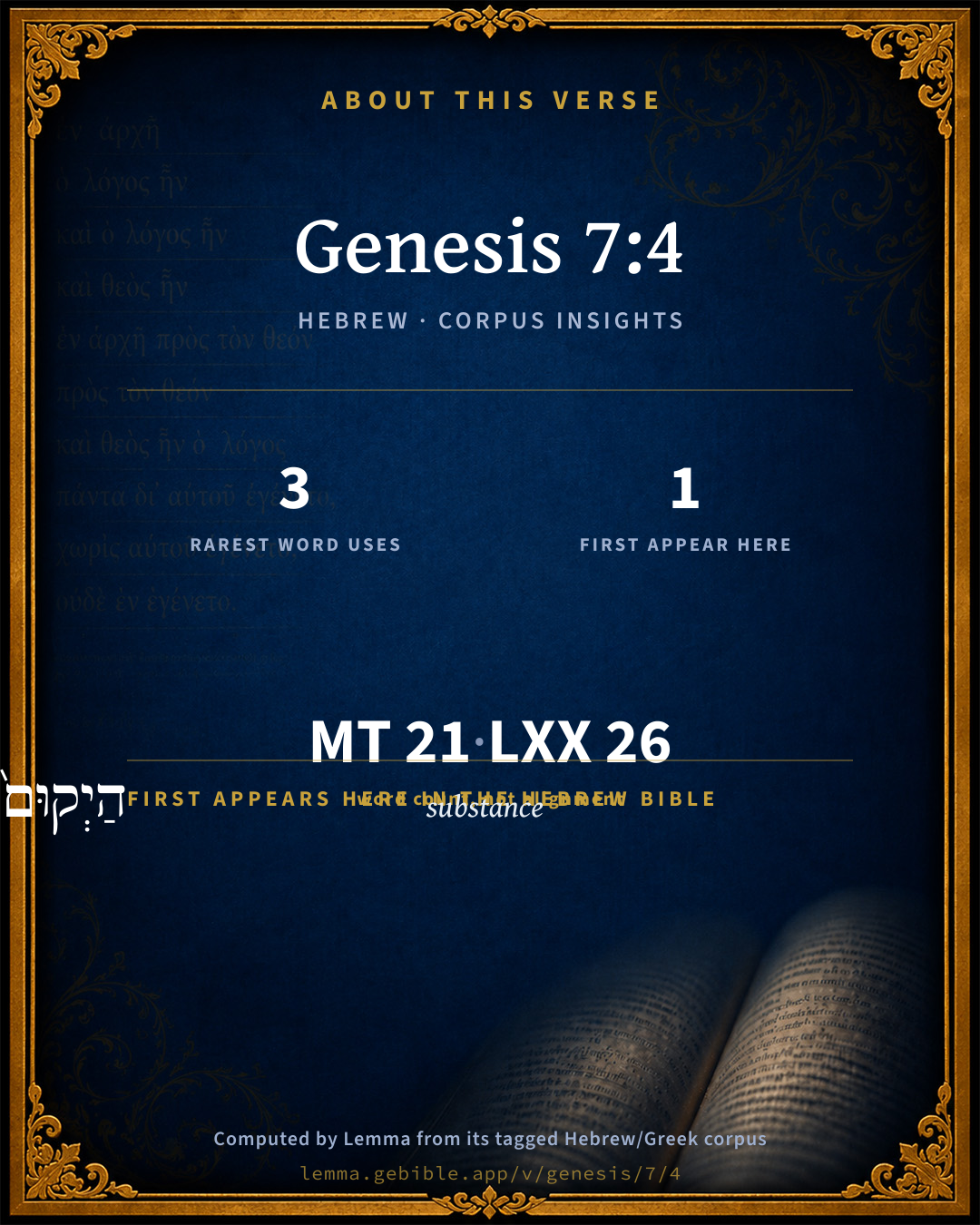
About this verse

These counts appear in no published source. They are computed here, from the morphology-tagged text and Lemma’s own curated glosses. What Lemma adds →

21
words
18
distinct lemmas
Pentateuch
section

Notable vocabulary

The rarest word here is הַיְקוּם֙ substance H3351 — appearing just 3 times in the whole Hebrew Bible.

First appearance in Scripture

This word makes its first canonical appearance in the Hebrew Bible here:

  • הַיְקוּם֙ substance H3351

Shared distinctive vocabulary

הַיְקוּם֙ substance H3351 occurs in 3 verses of the Hebrew Bible. Also found in:

Grammatical profile

  • 3 verbs
  • 8 nouns
  • 3 adjectives
  • 1 pronoun
  • 2 prepositions
  • 1 conjunction
  • 1 adverb
  • 2 particles

Verb forms

  • מַמְטִ֣יר Hiphil · Participle Active
  • וּמָחִ֗יתִי Qal · Perfect
  • עָשִׂ֔יתִי Qal · Perfect

Repetition

Words recur within this verse — often emphatic in Hebrew:

  • לְיָמִ֨ים day H3117 ×2
  • עַל upon H5921 ×2
  • אַרְבָּעִ֣ים forty H705 ×2

Hebrew & Septuagint length

In English translation the verse runs 34 words from the Hebrew and 35 from the Septuagint (LXX English) — closely comparable.

A rough comparison of the two English renderings, which tokenize alike — not a word-level alignment.

Word counts can differ between the Hebrew and the Greek without any difference in meaning — e.g. the Hebrew direct-object marker אֵת has no separate Greek word, and Greek often adds the article ὁ.

In the original languages it is 21 Hebrew tokens and 26 Greek tokens — but the two are counted differently (Hebrew bundles its prefixes and suffixes into one token; the Greek is in lemma form), so that isn’t a like-for-like length.

Cross-references

20

Topical passages linked to Genesis 7:4 in the Treasury of Scripture Knowledge — connected by theme and wording, ordered by reader-vote popularity; previews shown in the World English Bible.

  • Genesis 6:13 God said to Noah, "The end of all flesh has come before me, for the earth is filled with violence through them. Behold, I will destroy them with the earth.
  • Genesis 7:12 The rain was on the earth forty days and forty nights.
  • Genesis 7:17 The flood was forty days on the earth. The waters increased, and lifted up the ark, and it was lifted up above the earth.
  • Genesis 6:7 Yahweh said, "I will destroy man whom I have created from the surface of the ground; man, along with animals, creeping things, and birds of the sky; for I am sorry that I have made them."
  • Genesis 6:17 I, even, I do bring the flood of waters on this earth, to destroy all flesh having the breath of life from under the sky. Everything that is in the earth will die.
  • Psalms 69:28 Let them be blotted out of the book of life, And not be written with the righteous.
  • Genesis 8:12 He stayed yet another seven days, and sent forth the dove; and she didn't return to him any more.
  • Job 22:16 Who were snatched away before their time, Whose foundation was poured out as a stream,
  • Job 28:25 He establishes the force of the wind; Yes, he measures out the waters by measure.
  • Job 37:11–12 Yes, he loads the thick cloud with moisture. He spreads abroad the cloud of his lightning.
  • Amos 4:7 "I also have withheld the rain from you, When there were yet three months to the harvest; And I caused it to rain on one city, And caused it not to rain on another city. One place was rained on, And the piece where it didn't rain withered.
  • Revelation 3:5 He who overcomes will be arrayed in white garments, and I will in no way blot his name out of the book of life, and I will confess his name before my Father, and before his angels.
  • Genesis 7:10 It happened after the seven days, that the waters of the flood came on the earth.
  • Genesis 7:21–23 All flesh died that moved on the earth, including birds, cattle, animals, every creeping thing that creeps on the earth, and every man.
  • Genesis 2:5 No plant of the field was yet in the earth, and no herb of the field had yet sprung up; for Yahweh God had not caused it to rain on the earth. There was not a man to till the ground,
  • Genesis 6:3 Yahweh said, "My Spirit will not strive with man forever, because he also is flesh; yet will his days be one hundred twenty years."
  • Genesis 8:10 He stayed yet another seven days; and again he sent forth the dove out of the ark.
  • Genesis 29:27–28 Fulfill the week of this one, and we will give you the other also for the service which you will serve with me yet seven other years."
  • Exodus 32:32–33 Yet now, if you will, forgive their sin-- and if not, please blot me out of your book which you have written."
  • Job 36:27–32 For he draws up the drops of water, Which distill in rain from his vapor,

Cross-references courtesy of OpenBible.info (CC BY 4.0).

Hebrew and Greek witnesses Masoretic Hebrew ↔ Greek Septuagint

The same verse in the two great witnesses to the Old Testament, shown verse-for-verse.

These are two independent witnesses, not word-aligned to each other, and the Septuagint is shown in lemma (dictionary) form.

Hebrew Genesis 7:4 Masoretic · Westminster Leningrad Codex

כִּי֩ לְיָמִ֨ים ע֜וֹד שִׁבְעָ֗ה אָֽנֹכִי֙ מַמְטִ֣יר עַל הָאָ֔רֶץ אַרְבָּעִ֣ים י֔וֹם וְאַרְבָּעִ֖ים לָ֑יְלָה וּמָחִ֗יתִי אֶֽת כָּל הַיְקוּם֙ אֲשֶׁ֣ר עָשִׂ֔יתִי מֵעַ֖ל פְּנֵ֥י הָֽאֲדָמָֽה

In seven days, I will cause it to rain on the earth for forty days and forty nights. Every living thing that I have made, I will destroy from the surface of the ground."

World English Bible · Public Domain

Greek LXX Genesis 7:4 Septuagint · lemma form

ἔτι γάρ ἡμέρα ἑπτά ἐγώ ἐπιἄγω ὑετός ἐπί ὁ γῆ τεσσαράκοντα ἡμέρα καί τεσσαράκοντα νύξ καί ἐκἀλείφω πᾶς ὁ ἐξανάστασις ὅς ποιέω ἀπό πρόσωπον ὁ γῆ

For yet seven days having passed I bring rain upon the earth forty days and forty nights, and I will blot out every offspring which I have made from the face of all the earth.

LXX2012 (modern English Septuagint) · Public Domain

On this verse, The Cambridge Bible for Schools and Colleges discusses the Septuagint’s reading. Read the note in Commentary ↓

Hebrew: Westminster Leningrad Codex (CC BY 4.0). Greek: Septuagint (public domain); English from LXX2012 (modern English Septuagint) (Public Domain). How the Septuagint differs from the Hebrew →

Targum (Aramaic paraphrase)

2

The Targum is the ancient Jewish Aramaic paraphrase of the Hebrew Scriptures — an interpretive translation, not the Hebrew text itself. Onkelos (literal) and Pseudo-Jonathan (expansive) render the Torah, and Jonathan the Prophets. Coverage is partial: where no permissively-licensed English translation exists for a verse, only the Aramaic is shown. This is verse-level text, not a word-by-word alignment to the Hebrew.

  1. Targum Onkelos Torah (Genesis–Deuteronomy)
    אֲרֵי לִזְמַן יוֹמִין עוֹד שַׁבְעָא אֲנָא מָחֵת מִטְרָא עַל אַרְעָא אַרְבְּעִין יְמָמִין וְאַרְבְּעִין לֵילָוָן וְאֶמְחֵי יָת כָּל יְקוּמָא דִּי עַבְדֵת מֵעַל אַפֵּי אַרְעָא

    Because yet a time of seven days and I will cause rain to descend upon the earth forty days and forty nights, and I will blot out every subsistence which I have made upon all the face of the earth.

    Targum Onkelos — Aramaic: “Onkelos Genesis” (public domain); “Onkelos Exodus” (public domain); “Onkelos Leviticus” (public domain); “Onkelos Numbers” (public domain); “Onkelos Deuteronomy” (public domain). English: “Sefaria Community Translation” (CC0 1.0 (public-domain dedication)); “J.W. Etheridge. The Targums of Onkelos and Jonathan Ben Uzziel on the Pentateuch. London: Longmans, Green, 1862” (public domain). Text via Sefaria.

  2. Targum Pseudo-Jonathan Torah (Genesis–Deuteronomy)
    אֲרוּם הָא אֲנָא יָהִיב לְכוֹן אַרְכָּא שׁוּבְעָא יוֹמִין אִין יְתוּבוּן יִשְׁתְּבַק לְהוֹן וְאִין לָא יְתוּבוּן לִזְמַן יוֹמִין תּוּב שׁוּבְעָא אֲנָא מָחִית מִטְרָא עַל אַרְעָא אַרְבְּעִין יְמָמִין וְאַרְבְּעִין לֵילְוָן וְאֵישֵׁיצֵי יַת כָּל גְוִיַת אֵינַשׁ וּבְעִיר מִן אַרְעָא

    For, behold, I give you space of seven days; if they will be converted, it shall be forgiven them; but if they will not be converted, after a time of days yet seven, I will cause rain to come down upon the earth forty days and forty nights, and will destroy all bodies of man and of beast upon the earth.

    Targum Pseudo-Jonathan — Aramaic: “Targum Jonathan on Genesis” (public domain); “Targum Jonathan on Exodus” (public domain); “Targum Jonathan on Leviticus” (public domain); “Targum Jonathan on Numbers” (public domain); “Targum Jonathan on Deuteronomy” (public domain). English: “The Targum of Jonathan ben Uzziel, trans. J. W. Etheridge, London, 1862” (public domain). Text via Sefaria.

Commentary

Notes on Genesis 7:4 from classic Christian and Jewish commentators (each source and its license shown beneath its notes). The classic Christian expositions comment on the surrounding passage and are grouped to its opening verse, so a note may address several verses; the Jewish commentaries on the Tanakh (Rashi and others) are per-verse, so they appear only where the commentator wrote on this verse.

Lemma curates 59 commentaries, every one of them public domain or Creative Commons licensed, each selected and text-cleaned for this edition rather than reprinted as found. About our sources →

Trapp's Complete Commentary

John Trapp

Gen 7:4 For yet seven days, and I will cause it to rain upon the earth forty days and forty nights; and every living substance that I have made will I destroy from off the face of the earth.

Ver. 4. For yet seven days, &c.] God could have destroyed them by water, or otherwise, in a far shorter space: But, of his free grace, he gives them yet seven days further, and then rains upon the earth forty days, as, not willing that any should "eternally perish, but that all should come to repentance". {2Pe 3:9} The Hebrew doctors are very injurious to Noah, because we read not that he prayed for the old world, but only took care of himself, and his own family, censuring him therefore of self-love and hard-heartedness. So they judge very uncharitably of those that perished in the flood; sending them all to hell, and wresting some scriptures thereunto; as, that in this present verse, God saith, he will destroy them, or blot them out; that is, say they, {a} out of the land of the world to come, the land of the living. I deny not, but many of their "spirits are in prison"; so saith St Peter. {1Pe 3:19} But withal, in the next chapter, the same apostle tells us, that "for this cause the gospel was preached also to them that are dead, that they might be judged according to men in the flesh, but live according to God in the spirit". {1Pe 4:6} Compare these words with those in 1Pe 3:18-20, and it will appear, the apostle speaks of these antediluvians. All were not saved that were in the ark, nor all damned, we may well think, that were out of it. Could they see their "foundation overflown with a flood," as the phrase is, {Job 22:16} and "not lay for themselves a good foundation" by "laying hold on eternal life"? {1Ti 6:19} St Ambrose conceiveth, that Noah was seven days in the Ark, before the flood came; that as God was six days in creating the world, and rested the seventh; so these perishing persons, admonished by the number of the days of the creation, might "remember their creator," {Ecc 12:1} and make their peace. Nunquam sero, si serio .

{a} R. Menachem, in loc.

John Trapp, A Commentary or Exposition upon All the Books of the Old and New Testament (1647–1656) — public domain. Text from a community e-Sword module.

The Biblical Illustrator

Joseph S. Exell

Gen_7:4

For yet seven days, and I will cause it to rain upon the earth.

The Divine threat of destruction

I. VERY SOON TO BE EXECUTED.

II. VERY MERCIFUL IN ITS COMMENCEMENT.

III. VERY TERRIBLE IN ITS DESTRUCTION. And every living substance that I have made will I destroy from off the face of the earth.

1. The destruction was determined.

2. The destruction was universal.

3. The destruction was piteous.

IV. VERY SIGNIFICANT IN ITS INDICATION. The Fatherhood of God is not incompatible with the punishment of sinners. (J. S. Exell, M. A.)

Divine threatenings

1. That they will surely be executed.

2. At the time announced.

3. In the manner predicted.

4. With the result indicated. (J. S. Exell, M. A.)

The Biblical Illustrator, edited by Joseph S. Exell (c. 1880s–1900s) — public domain. Text from a community e-Sword module.

Joseph Benson's Commentary

Gen 7:4. Yet seven days — Or after seven days, which time the long- suffering of God (1Pe 3:20) granted to the world, as a further space for repentance, of which, therefore, it is probable, Noah gave them notice. And it is not unlikely that many of them, who slighted the threatening when it was at the distance of one hundred and twenty years, now hearing another threatening, and considering the nearness of their danger, might be more affected, and brought to repentance. And although destroyed, as to their bodies, by the flood, for their former and long-continued impenitence, yet might be saved in their spirits, 1Pe 4:6. And as it is likely that some, who were preserved from the waters by the ark, nevertheless, at last, perished in hell; so some that were drowned in the deluge might be eternally saved into heaven. With respect, however, to the generality, this reprieve was certainly in vain: see Luk 17:26, and 2Pe 2:5. These seven days were trifled away after all the rest, and they continued secure until the day that the flood came. While Noah told them of the judgment at a distance, they were tempted to put off their repentance: but now he is ordered to tell them that it is at the door; that they have but one week more to turn them in, to see if that will now at last awaken them to consider the things that belong to their peace. But it is common for those that have been careless for their souls during the years of their health, when they have looked upon death at a distance, to be as careless during the days, the seven days of their sickness, when they see it approaching, their hearts being hardened by the deceitfulness of sin. Reader, art thou the man?

Joseph Benson's Commentary on the Old and New Testaments (1811–1818) — public domain. Text from a community e-Sword module.

Tyndale Open Study Notes

Tyndale Open Resources

7:4 The number forty is often associated with affliction, trial, or punishment (see Exod 16:35; Judg 13:1; 1 Kgs 19:8; Ezek 4:6; Jon 3:4; Matt 4:2; Acts 1:3).

Tyndale Open Study Notes — © Tyndale Open Resources, licensed CC BY-SA 4.0. Text via the HelloAO Bible API.

Jamieson, Fausset & Brown

Robert Jamieson, A. R. Fausset & David Brown

For yet seven days--A week for a world to repent! What a solemn pause! Did they laugh and ridicule his folly still? He whose eyes saw and whose heart felt the full amount of human iniquity and perverseness has told us of their reckless disregard (Luk 17:27).

Jamieson, Fausset & Brown — Commentary Critical and Explanatory on the Whole Bible (1871) — public domain (CC PDM 1.0). Text via the HelloAO Bible API.

Adam Clarke's Commentary

Verse 4. For yet seven days] God spoke these words probably on the seventh or Sabbath day, and the days of the ensuing week were employed in entering the ark, in embarking the mighty troop, for whose reception ample provision had been already made.

Forty days] This period became afterwards sacred, and was considered a proper space for humiliation. Moses fasted forty days, De 9:9; De 9:11; so did Elijah, 1Kg 19:8; so did our Lord, Mt 4:2. Forty days' respite were given to the Ninevites that they might repent, Jon 3:4; and thrice forty (one hundred and twenty) years were given to the old world for the same gracious purpose, Ge 6:3. The forty days of Lent, in commemoration of our Lord's fasting, have a reference to the same thing; as each of these seems to be deduced from this primitive judgment.

Adam Clarke's Commentary on the Bible (1810–1826) — public domain. Text from a community e-Sword/MySword module.

Ellicott's Commentary for English Readers

(4) Forty days.—Henceforward forty became the sacred number of trial and patience, and, besides the obvious places in the Old Testament, it was the duration both of our Lord’s fast in the wilderness and of His sojourn on earth after the Resurrection.

Every living substance.—The word “living” is found neither in the Hebrew nor in the ancient versions, and limits the sense unnecessarily. The word is rare, being found only thrice, namely, here, in Gen_7:23, and in Deu_11:6. It means whatever stands erect. Thus God “destroys”—Heb., blots out (see on Gen_6:7)—not man and beast only, but the whole existent state of things—“from the face of the earth”—Heb., the adâmâh, the cultivated and inhabited ground. This section is much more limited in the extent which it gives to the flood, not including reptiles, or rather, small animals, among those saved in the ark, and confining the overflow of the waters to the inhabited region.

A Bible Commentary for English Readers, edited by Charles John Ellicott (1878–1897) — public domain. Text from a community e-Sword module.

The Cambridge Bible for Schools and Colleges

gen. ed. J. J. S. Perowne

4. seven days] Note the period of seven days, the same interval as occurs again, in the J narrative, in Gen_8:10; Gen_8:12.

forty days and forty nights] The duration of the Flood is here announced. Cf. Gen_7:12 and Gen_8:6. In the Babylonian version the rain lasts for six days.

every living thing] or rather, “every existing thing.” A peculiar word in the Heb. occurring only here and Deu_11:6. (LXX ἀνάστεμα, Lat. substantiam.) It is, therefore, different from the expression “living thing,” which is used by P in Gen_6:19, Gen_8:1; Gen_8:17; Gen_8:21.

destroy] Heb. blot out, so also Gen_7:23 (J): see note on Gen_6:7.

The Cambridge Bible for Schools and Colleges (gen. ed. J. J. S. Perowne; Cambridge University Press, 1878–1918) — public domain. Text from a community e-Sword module.

John Gill's Exposition

For yet seven days,.... Or one week more, after the above orders were given, which, the Jews say, were for the mourning at Methuselah's death; others, that they were an additional space to the one hundred and twenty given to the old world for repentance; in which time some might truly repent, finding that the destruction of the world was very near, and who might be saved from everlasting damnation, though not from perishing in the flood: but it rather was a space of time proper for Noah to have, to settle himself and family, and all the creatures in the ark, and dispose of everything there, in the best manner, for their sustenance and safety:

and I will cause it to rain upon the earth forty days and forty nights: this was not an ordinary but an extraordinary rain, in which the power and providence of God were eminently concerned, both with respect to the continuance of it, and the quantity of water that fell:

and every living substance that I have made will I destroy from off the face of the earth: not every substance that has a vegetative life, as plants, herbs, and trees, which were not destroyed, see Gen 8:11 but every substance that has animal life, as fowls, cattle, creeping things, and men.

John Gill's Exposition of the Whole Bible (1746–1763) — public domain (CC PDM 1.0). Text via the HelloAO Bible API.

Matthew Poole's English Annotations

Yet seven days, or, after seven days, the Hebrew Lamed being put for after, as it is Exo 16:1; Psa 19:3; Jer 41:4. Or, within seven days, which time God allowed to the world as a further space of repentance, whereof therefore it is probable Noah gave them notice; and it is not unlikely that many of them who slighted the threatening when it was at one hundred and twenty years distance, now hearing a second threatening, and considering the nearness of their danger, might be more affected and brought to true repentance; who though destroyed in their bodies by the flood for their former and long impenitency, which God would not so far pardon, yet might be saved in their spirits. See 1Pe 4:6. And as some preserved in the ark were damned, so others drowned in the deluge might be eternally saved.

And every living substance, all that hath in it the breath of life, as was said Gen 6:17.

Matthew Poole's English Annotations on the Holy Bible (1683–1685) — public domain. Text from a community e-Sword/MySword module.

Whedon's Commentary on the Bible

Daniel D. Whedon

4. Yet seven days — One full week yet remained for gathering all into the ark.

Seven… forty… forty — We naturally note here the occurrence of these significant numbers. Comp. also Gen_8:4; Gen_8:10; Gen_8:12 (notes); and Moses forty days on the mount; Israel forty years in the desert; the spies forty days in searching Canaan. But in these historical narratives there is no reason to question the literal significance of the numbers. Their prominence in history made them specially significant in prophecy.

Daniel D. Whedon (gen. ed.), Commentary on the Old and New Testaments (1874–1909) — public domain. Text from a community e-Sword module.

The Pulpit Commentary

Vers. 4, 5. For yet seven days. Literally, for today"s yet seven after seven days; thus giving Noah time to complete his preparations, and the world one more opportunity to repent, which Peele thinks many may have done, though their bodies were drowned for their former impenitency. And I will cause it to rain literally, I causing it, the participle indicating the certainty of the future action (cf. Gen_6:17; Pro_25:22; cf. Ewald"s "Hebrews Synt.," upon the earth forty days and forty nights. The importance assigned in subsequent Scripture to the number forty, probably from the circumstance here recorded, is too obvious to be overlooked. Israel wandered forty years in the wilderness. (Num_14:33) The scouts remained forty days in Canaan. (Num_13:26) Moses was forty days in the mount. (Exo_24:18) Elijah fasted forty days and forty nights in the wilderness of Beersheba. (1Ki_19:8) A respite of forty days was given to the Ninevites. (Jon_3:4) Christ fasted forty days before the temptation, (Mat_4:2) and sojourned forty, days on earth after his resurrection. (Act_1:3) It thus appears to have been regarded as symbolical of a period of trial, ending in victory to the good and in ruin to the evil. And every living substanceyekum; literally, standing thing, omne quod subsistit, i.e. "whatever is capable by a principle of life of maintaining an erect posture" (Bush); ajnasthma (LXX; cf. Deu_11:6; Job_22:20) that I have made will I destroy literally, blot out (cf. Gen_6:7) from off the face of the earth. And Noah did according to all that the Lord (Jehovah, the God of salvation, who now interposed for the patriarch"s safety; in Gen_6:22, where God is exhibited in his relations to all flesh, it is Elohim) had commanded him.

The Pulpit Commentary (1880–1919), ed. H.D.M. Spence-Jones & Joseph S. Exell — public domain. Text from a community e-Sword module.

John Wesley's Explanatory Notes

Yet seven days and I will cause it to rain - It shall be seven days yet before I do it, After the 120 years were expired, God grants them a reprieve of seven days longer, both to shew how slow he is to anger, and to give them some farther space for repentance. But all in vain; these seven days were trifled away after all the rest, they continued secure until the day that the flood came. While Noah told them of the judgment at a distance, they were tempted to put off their repentance: but now he is ordered to tell them that it is at the door; that they have but one week more to turn them in, to see if that will now at last awaken them to consider the things that belong to their peace. But it is common for those that have been careless for their souls during the years of their health, when they have looked upon death at a distance, to be as careless during the days, the seven days of their sickness, when they see it approaching, their hearts being hardened by the deceitfulness of sin.

John Wesley, Explanatory Notes Upon the Whole Bible (1754–1765) — public domain. Text via the GEBible commentary corpus.

unfoldingWord translationNotes

Door43 World Missions Community

forty days and forty nights

This was a full forty days. It was not a total of eighty days. AT: "forty days and nights"

living

This refers to physical life.

translationWords

life

Yahweh

command

unfoldingWord translationNotes — © Distant Shores Media and the Door43 World Missions Community, licensed CC BY-SA 4.0. Source: git.door43.org/Door43/en_tn.

Rashi

Rabbi Shlomo Yitzchaki (Rashi)

כי לימים עוד שבעה FOR YET SEVEN DAYS — These are the seven days of mourning for the righteous man Methuselah for whose honour the Holy One, blessed be He, had regard, and therefore postponed punishment. Go and calculate the years of Methuselah and you will find that they came to an end (i. e. he died) in the six hundredth year of Noah’s life (which coincided with the date of the Flood) (Sanhedrin 108b).

כי לימים עוד FOR YET [SEVEN] DAYS — What is meant by עוד "yet", "more"? A further period of time: this period (seven days) additional to the 120 years of respite that was promised (Sanhedrin 108b).

ארבעים יום FORTY DAYS — corresponding to the period of a child’s formation, for by their sinning they had troubled their Creator to form embryos of illegitimate children (Genesis Rabbah 32:5).

Rashi on the Tanakh — English translations: “The Judaica Press complete Tanach with Rashi, translated by A. J. Rosenberg” (CC BY 4.0); “Pentateuch with Rashi's commentary by M. Rosenbaum and A.M. Silbermann, 1929-1934” (public domain); “The Metsudah Tanach series, Lakewood, N.J” (CC BY 4.0); and “The Book of Joshua, Metsudah Publications, 1997” (CC BY 4.0). Text via Sefaria.

Radak

Rabbi David Kimhi (Radak)

כי לימים עוד שבעה, G’d commanded both Noach and the animals to enter the ark already seven days prior to the onset of the deluge in order to assign to them their various accommodations and in order to get them used to their change in diet, especially the flesh eating beasts which had to adjust to a vegetarian diet. According to the Midrash (Sanhedrin 108) Metushelach had died during these days and G’d suspended the decree until after the days of mourning for him had expired. He had been a righteous man and it was no more than appropriate that his passing should be noted with appropriate eulogies and mourning rites. We know that these eulogies were spread over a period of seven days from Genesis 50,10 where, even though Yaakov had already been mourned for 70 days in Egypt prior to the transfer of his remains to the cave of Machpelah in the land of Canaan, he was eulogized again. We had already demonstrated that according to the data provided by the Torah Metushelach must have died at the time the deluge commenced.

אנכי ממטיר, G’d did not make mention of the fountains of the earth bursting forth as it is a well known fact that this usually happens as a corollary to unusual amounts of rain falling on earth. The fact that the rainwater softens the earth’s crust, enables these subterranean wells held in check by the earth’s crust to burst forth without restraint. These additional waters then flood the surface of the globe. After all, as we explained already during the report of the creation, it is the natural tendency of water to inundate the dry areas of the globe. From a scientific perspective, all we have to remember is that the specific weight of water is lighter than that of earth, so that if allowed free reign, earth would always sink to the bottom of the water. The deluge therefore was not an unnatural event but it was a return to what had been natural until G’d had given a directive at the beginning of the third day that the waters concentrate in a single area to enable the earth to become visible. G’d had imposed unnatural restraints on the waters at that time, something that our sages have called an agreement made by Him with the waters, to comply with G’d’s commands when the need would arise.

היקום, an expression which covers all living phenomena on the face of the globe. The root of the word is קום, the letter י being an addition, just as the root of the word יריבי in Psalms 35,1 is really ריב, quarrel. The expression כל היקום refers to all that remained on the surface of the dray land, excluding fish and the living creatures inside the ark.

Radak on the Tanakh — English translations: “Sefaria Community Translation” (CC0 1.0 (public-domain dedication)); “Eliyahu Munk, HaChut Hameshulash” (CC BY 4.0); “Rabbi Mike Feuer, Jerusalem Anthology” (CC BY 4.0); and “R. David Kimhi on the first book of Psalms, Translated by R.G. Finch, London, 1919” (public domain). Text via Sefaria.

Lesson kit

Teaching starters — assembled from the data on this page, not authored interpretation. Every prompt links to the verse data it draws on. Edit before teaching.

Genesis, in the Pentateuch, opens this verse with 21 words (18 distinct Hebrew lemmas). Its most distinctive word is yᵉqûwm (“substance”). A historical commentator’s framing appears above. Read the whole chapter for the surrounding context.

Discussion questions

  1. The word yᵉqûwm carries the sense “substance.” How does it shape the verse?
  2. This is the first place “substance” appears in Scripture (first appears here). What does its debut here establish?
  3. How does Genesis 7:23, which shares the word «substance», read alongside this verse?
  4. What does the repetition of “day” (2× in this one verse) do in this verse?
  5. The translations on this page render this verse differently — a whole-verse word diff, not a word-by-word alignment. What might account for the different wordings?
  6. «מַמְטִ֣יר» is a Hiphil Participle Active verb. How does that grammatical form shape the action described?
  7. Compare how Trapp's Complete Commentary and The Biblical Illustrator read this verse. Where do they agree or differ?

Things to notice

Reading settings

Reading text

Shown beneath each verse's original-language words.

Old Testament
Old Testament edition

Read the OT as the Masoretic Hebrew (MT) or the Greek Septuagint (LXX).

English shown for the Greek Septuagint (in the Hebrew ↔ Greek comparison).

Comparing translations? Open the Compare panel on any verse page to stack up to four side by side.