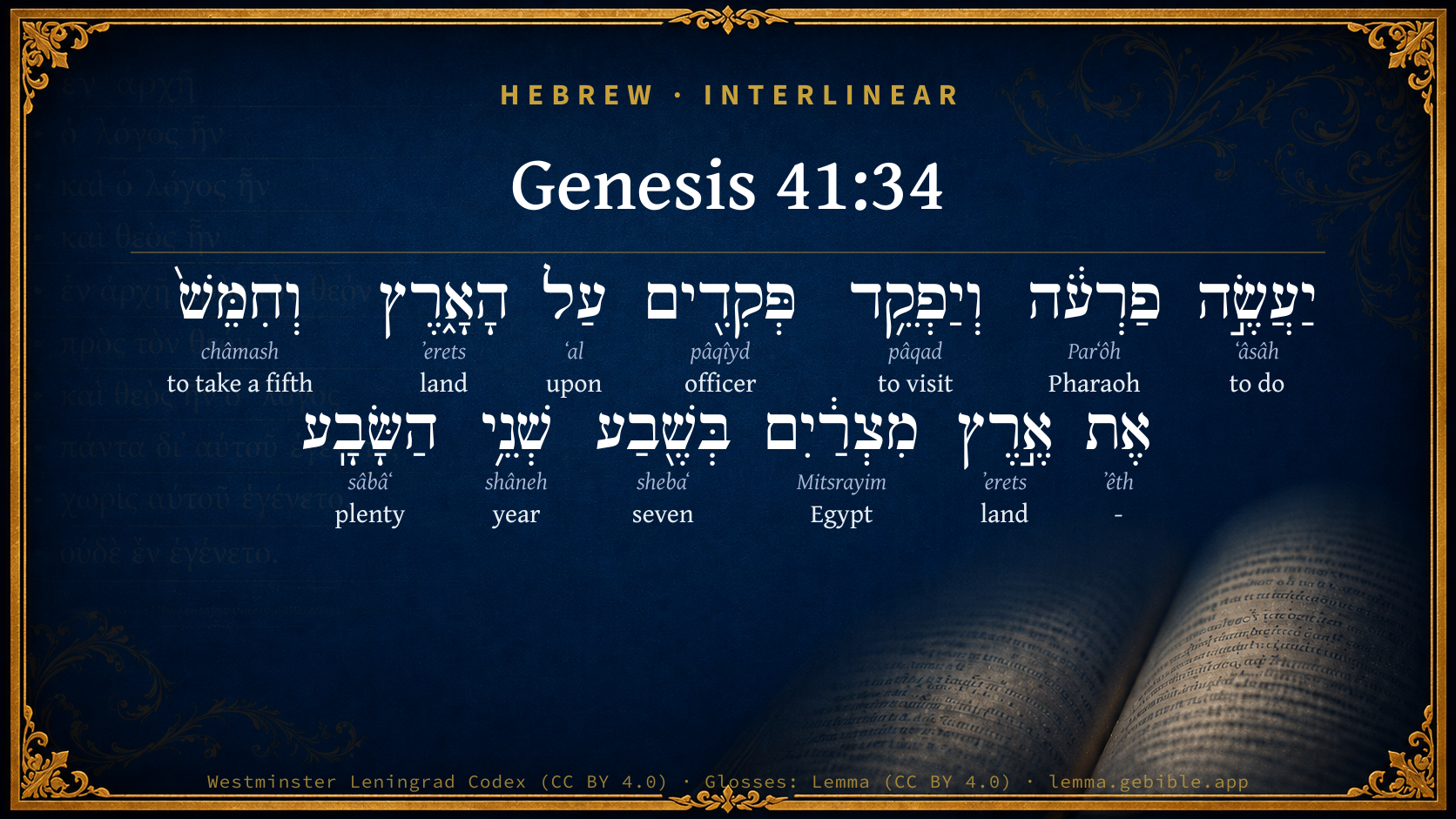
Genesis 41:34

Hebrew (Westminster Leningrad Codex) Genesis 41:34 appears in the Hebrew Old Testament. The text above is from the Westminster Leningrad Codex. Each word links to its Strong’s number, a concise gloss, and parsing drawn from the Open Scriptures Hebrew Bible morphology. Click any word for its full Brown-Driver-Briggs (BDB) entry.
Download image
Cite this verse

Genesis 41:34 (World English Bible). Public Domain. Lemma interlinear Bible study tool, https://lemma.gebible.app/v/genesis/41/34.

Show BibTeX & RIS
BibTeX
RIS
English Translation
Let Pharaoh do this, and let him appoint overseers over the land, and take up the fifth part of the land of Egypt's produce in the seven plenteous years.
World English Bible · Public Domain
Highlights
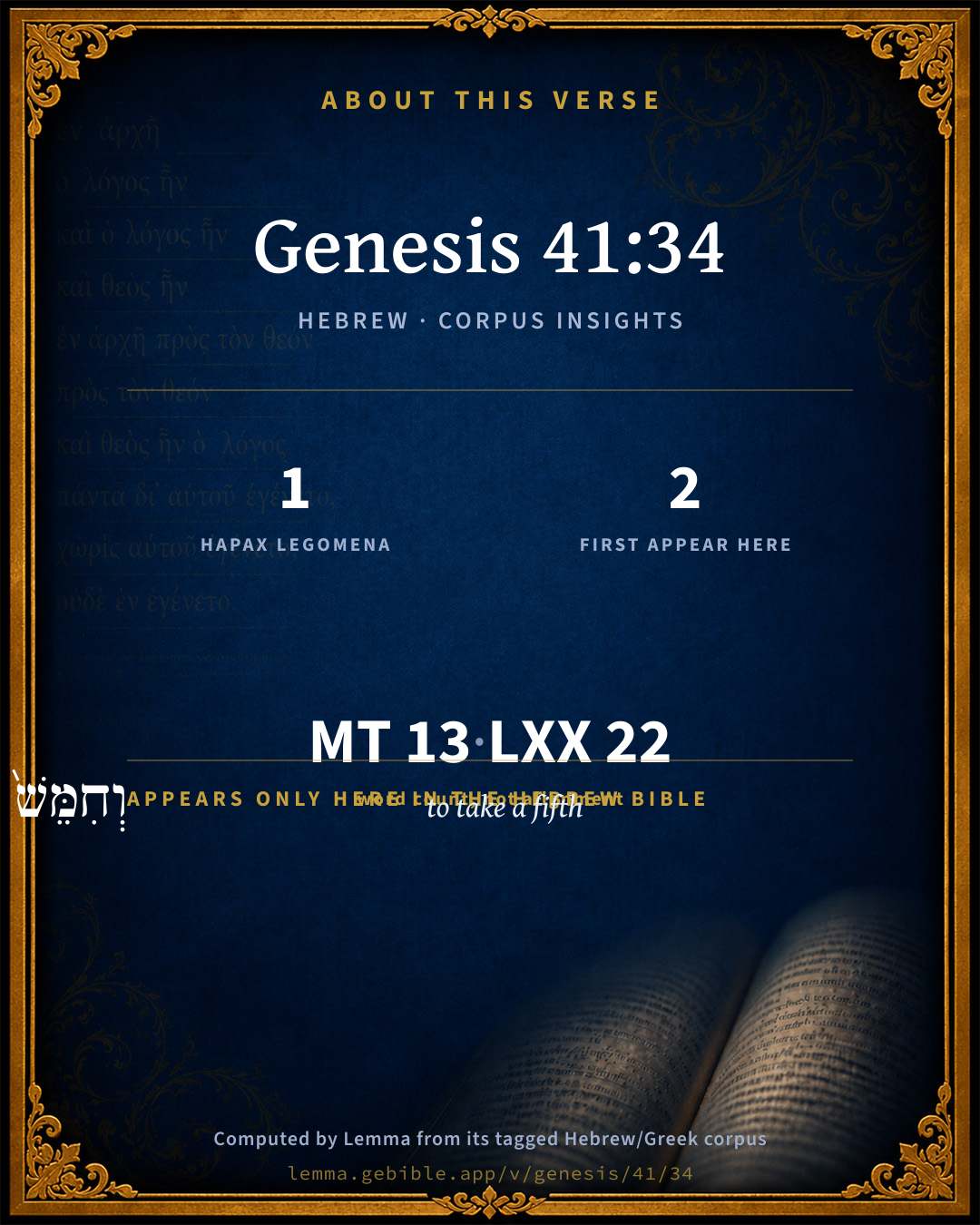
  • 1 hapax legomenon — only here in the Hebrew Bible
  • 2 first appearances in the Hebrew Bible
Full analysis ↓
Download a study sheet

One document with this verse’s original text, its word-by-word gloss line, the meaning frame, cross-references with their text, attributed commentary, and full source and license credits — printable, and it pastes into notes with its structure intact.

This verse Autodidact and up

Study sheet (.html) Plain text (.txt)

A passage Seminary Student

Up to 50 verses in one chapter. A passage sheet keeps up to 6 commentary sources and 12 cross-references per verse, in the order this page ranks them, and says so on the sheet whenever that leaves anything out. Ask for a single verse and you get the Autodidact verse sheet above.

Everything on this page stays free to read, with no account — the sheet is a download of what is already on screen, not access to it.

Want to remove ads? Support Godless Engineer
Compare translations 3

The same verse in 3 English versions, stacked beneath the original-language interlinear above. Click any original word for its lexicon entry.

Each is an independent rendering of the whole verse — the interlinear is not word-aligned to these translations.

Highlighted words mark where these versions differ — a whole-verse word diff, not a word-by-word alignment.

  • World English Bible Public Domain
    Let Pharaoh do this, and let him appoint overseers over the land, and take up the fifth part of the land of Egypt's produce in the seven plenteous years.
  • King James Version Public Domain
    Let Pharaoh do this, and let him appoint officers over the land, and take up the fifth part of the land of Egypt in the seven plenteous years.
  • unfoldingWord Literal Text CC BY-SA 4.0
    Let Pharaoh do: Let him set supervisors over the land, and let him take a fifth of the land of Egypt in the seven years of abundance.

unfoldingWord Literal Text — © unfoldingWord, licensed CC BY-SA 4.0. Word-aligned USFM3 via Door43 (git.door43.org/unfoldingWord/en_ult).

Versions to compare (up to 4)

3 of 4 selected

Show all 18 translations

Every available English version of this verse, each an independent rendering of the whole verse.

  • World English Bible Public Domain
    Let Pharaoh do this, and let him appoint overseers over the land, and take up the fifth part of the land of Egypt's produce in the seven plenteous years.
  • Berean Standard Bible Public Domain
    Let Pharaoh take action and appoint commissioners over the land to take a fifth of the harvest of Egypt during the seven years of abundance.
  • Majority Standard Bible Public Domain
    Let Pharaoh take action and appoint commissioners over the land to take a fifth of the harvest of Egypt during the seven years of abundance.
  • King James Version Public Domain
    Let Pharaoh do this, and let him appoint officers over the land, and take up the fifth part of the land of Egypt in the seven plenteous years.
  • American Standard Version (1901) Public Domain
    Let Pharaoh do `this', and let him appoint overseers over the land, and take up the fifth part of the land of Egypt in the seven plenteous years.
  • Revised Version (1885) Public Domain
    Let Pharaoh do this, and let him appoint overseers over the land, and take up the fifth part of the land of Egypt in the seven plenteous years.
  • Geneva Bible (1599) Public Domain
    Let Pharaoh make and appoynt officers ouer the lande, and take vp the fift part of the land of Egypt in the seuen plenteous yeeres.
  • Douay-Rheims (1899) Public Domain
    And for that thou didst see the second time a dream pertaining to the same thing: it is a token of the certainty, and that the word of God cometh to pass, and is fulfilled speedily.
  • Young's Literal Translation Public Domain
    let Pharaoh make and appoint overseers over the land, and receive a fifth of the land of Egypt in the seven years of plenty,
  • Literal Standard Version CC BY-SA 4.0
    let Pharaoh make and appoint overseers over the land, and receive a fifth of the land of Egypt in the seven years of plenty,
  • Unlocked Literal Bible CC BY-SA 4.0
    Let Pharaoh appoint officials over the land, and let them take a fifth of the crops of Egypt in the seven abundant years.
  • unfoldingWord Literal Text CC BY-SA 4.0
    Let Pharaoh do: Let him set supervisors over the land, and let him take a fifth of the land of Egypt in the seven years of abundance.
  • Darby Bible Public Domain
    Let Pharaoh do [this]: let him appoint overseers over the land, and take the fifth part of the land of Egypt during the seven years of plenty,
  • World Messianic Bible Public Domain
    Let Pharaoh do this, and let him appoint overseers over the land, and take up the fifth part of the land of Egypt’s produce in the seven plenteous years.
  • Webster's Bible Public Domain
    Let Pharaoh do this, and let him appoint officers over the land, and take up the fifth part of the land of Egypt in the seven plenteous years.
  • Free Bible Version CC BY-SA 4.0
    Your Majesty should also appoint officials to be in charge of the land, and have them collect one-fifth of the produce of the country during the seven years of plenty.
  • Bible in Basic English Public Domain
    Let Pharaoh do this, and let him put overseers over the land of Egypt to put in store a fifth part of the produce of the land in the good years.
  • JPS Tanakh (1917) Public Domain
    Let Pharaoh do this, and let him appoint overseers over the land, and take up the fifth part of the land of Egypt in the seven years of plenty.

Literal Standard Version (2020), Covenant Press — licensed CC BY-SA 4.0. Text via the HelloAO Bible API (eBible.org). Unlocked Literal Bible (unfoldingWord) — licensed CC BY-SA 4.0. Text via the HelloAO Bible API (eBible.org). unfoldingWord Literal Text — © unfoldingWord, licensed CC BY-SA 4.0. Word-aligned USFM3 via Door43 (git.door43.org/unfoldingWord/en_ult). Free Bible Version, Dr. Jonathan Gallagher — licensed CC BY-SA 4.0. Text via the HelloAO Bible API (eBible.org).

Word by word

More ways to search: Search by grammar → Find every occurrence → Compare this word →

Practice this passage: Drill this verse → Learn its vocabulary →

וְחִמֵּשׁ֙
châmash
H2567
“and · to take a fifth”
Conjunction + Verb, Piel, Sequential Perfect, 3rd Person, Masculine, Singular
Part of Speech
Conjunction + Verb
Stem
Piel
Form
Sequential Perfect
Person
3rd Person
Gender
Masculine
Number
Singular
Full BDB Definition

Origin: a denominative from H2568

TWOT: TWOT- 686

to arrange in multiples of five, take one fifth - (Piel) to take one fifth, tax a fifth of
  1. יַעֲשֶׂ֣ה ʻâsâh H6213 “to do” Verb, Qal, Imperfect, 3rd Person, Masculine, Singular
  2. פַרְעֹ֔ה Parʻôh H6547 “Pharaoh” Noun, Proper
  3. וְיַפְקֵ֥ד pâqad H6485 “and · to visit” Conjunction + Verb, Hiphil, Jussive, 3rd Person, Masculine, Singular
  4. פְּקִדִ֖ים pâqîyd H6496 “officers” Noun, Common, Masculine, Plural, Absolute
  5. עַל ʻal H5921 “upon” Preposition
  6. הָאָ֑רֶץ ʼerets H776 “the · land” Particle, Definite Article + Noun, Common, Both, Singular, Absolute
  7. אֶת ʼêth H853 “-” Particle, Direct Object
  8. אֶ֣רֶץ ʼerets H776 “land of” Noun, Common, Both, Singular, Construct
  9. מִצְרַ֔יִם Mitsrayim H4714 “Egypt” Noun, Proper
  10. בְּשֶׁ֖בַע shebaʻ H7651 “in/at · seven” Preposition + Adjective, Cardinal number, Feminine, Singular, Absolute
  11. שְׁנֵ֥י shâneh H8141 “year” Adjective, Cardinal number, Masculine, Dual, Construct
  12. הַשָּׂבָֽע sâbâʻ H7647 “the · plenty” Particle, Definite Article + Noun, Common, Masculine, Singular, Absolute

About this verse

These counts appear in no published source. They are computed here, from the morphology-tagged text and Lemma’s own curated glosses. What Lemma adds →

13
words
12
distinct lemmas
Pentateuch
section

Notable vocabulary

1 hapax legomenon — a word that appears only here in the entire Hebrew Bible:

  • וְחִמֵּשׁ֙ to take a fifth H2567

First appearance in Scripture

These words make their first canonical appearance in the Hebrew Bible here:

  • פְּקִדִ֖ים officer H6496
  • וְחִמֵּשׁ֙ to take a fifth H2567

Shared distinctive vocabulary

הַשָּׂבָֽע plenty H7647 occurs in 8 verses of the Hebrew Bible. Also found in:

Grammatical profile

  • 3 verbs
  • 6 nouns
  • 2 adjectives
  • 1 preposition
  • 1 particle

Verb forms

  • יַעֲשֶׂ֣ה Qal · Imperfect
  • וְיַפְקֵ֥ד Hiphil · Jussive
  • וְחִמֵּשׁ֙ Piel · Sequential Perfect

Repetition

A word recurs within this verse — often emphatic in Hebrew:

  • הָאָ֑רֶץ land H776 ×2

Hebrew & Septuagint length

In English translation the verse runs 29 words from the Hebrew and 35 from the Septuagint (LXX English) — closely comparable.

A rough comparison of the two English renderings, which tokenize alike — not a word-level alignment.

Word counts can differ between the Hebrew and the Greek without any difference in meaning — e.g. the Hebrew direct-object marker אֵת has no separate Greek word, and Greek often adds the article ὁ.

In the original languages it is 13 Hebrew tokens and 22 Greek tokens — but the two are counted differently (Hebrew bundles its prefixes and suffixes into one token; the Greek is in lemma form), so that isn’t a like-for-like length.

Cross-references

10

Topical passages linked to Genesis 41:34 in the Treasury of Scripture Knowledge — connected by theme and wording, ordered by reader-vote popularity; previews shown in the World English Bible.

  • Proverbs 6:6–8 Go to the ant, you sluggard. Consider her ways, and be wise;
  • Numbers 31:14 Moses was angry with the officers of the host, the captains of thousands and the captains of hundreds, who came from the service of the war.
  • 2 Kings 11:11–12 The guard stood, every man with his weapons in his hand, from the right side of the house to the left side of the house, along by the altar and the house, by the king round about.
  • 2 Chronicles 34:12 The men did the work faithfully: and the overseers of them were Jahath and Obadiah, the Levites, of the sons of Merari; and Zechariah and Meshullam, of the sons of the Kohathites, to set it forward; and [others of] the Levites, all who were skillful with instruments of music.
  • Nehemiah 11:9 Joel the son of Zichri was their overseer; and Judah the son of Hassenuah was second over the city.
  • Job 5:20 In famine he will redeem you from death; In war, from the power of the sword.
  • Psalms 33:19 To deliver their soul from death, To keep them alive in famine.
  • Proverbs 22:3 A prudent man sees danger, and hides himself; But the simple pass on, and suffer for it.
  • Proverbs 27:12 A prudent man sees danger and takes refuge; But the simple pass on, and suffer for it:
  • Luke 16:5 Calling each one of his lord's debtors to him, he said to the first, 'How much do you owe to my lord?'

Cross-references courtesy of OpenBible.info (CC BY 4.0).

Hebrew and Greek witnesses Masoretic Hebrew ↔ Greek Septuagint

The same verse in the two great witnesses to the Old Testament, shown verse-for-verse.

These are two independent witnesses, not word-aligned to each other, and the Septuagint is shown in lemma (dictionary) form.

Hebrew Genesis 41:34 Masoretic · Westminster Leningrad Codex

יַעֲשֶׂ֣ה פַרְעֹ֔ה וְיַפְקֵ֥ד פְּקִדִ֖ים עַל הָאָ֑רֶץ וְחִמֵּשׁ֙ אֶת אֶ֣רֶץ מִצְרַ֔יִם בְּשֶׁ֖בַע שְׁנֵ֥י הַשָּׂבָֽע

Let Pharaoh do this, and let him appoint overseers over the land, and take up the fifth part of the land of Egypt's produce in the seven plenteous years.

World English Bible · Public Domain

Greek LXX Genesis 41:34 Septuagint · lemma form

καί ποιέω φαραώ καί καταἵστημι τοπαρχής ἐπί ὁ γῆ καί ἀποπεμπτόω πᾶς ὁ γένημα ὁ γῆ αἴγυπτος ὁ ἑπτά ἔτος ὁ εὐθηνία

And let Pharao make and appoint local governors over the land; and let them take up a fifth part of all the produce of the land of Egypt for the seven years of the plenty.

LXX2012 (modern English Septuagint) · Public Domain

On this verse, The Cambridge Bible for Schools and Colleges discusses the Septuagint’s reading. Read the note in Commentary ↓

Hebrew: Westminster Leningrad Codex (CC BY 4.0). Greek: Septuagint (public domain); English from LXX2012 (modern English Septuagint) (Public Domain). How the Septuagint differs from the Hebrew →

Targum (Aramaic paraphrase)

2

The Targum is the ancient Jewish Aramaic paraphrase of the Hebrew Scriptures — an interpretive translation, not the Hebrew text itself. Onkelos (literal) and Pseudo-Jonathan (expansive) render the Torah, and Jonathan the Prophets. Coverage is partial: where no permissively-licensed English translation exists for a verse, only the Aramaic is shown. This is verse-level text, not a word-by-word alignment to the Hebrew.

  1. Targum Onkelos Torah (Genesis–Deuteronomy)
    יַעְבֵּד פַרְעֹה וִימַנֵּי מְהֵימְנִין עַל אַרְעָא וִיזָרֵז יָת אַרְעָא דְמִצְרַיִם בְּשֶׁבַע שְׁנֵי שׂוֹבְעָא

    (no public-domain English translation for this verse)

    Targum Onkelos — Aramaic: “Onkelos Genesis” (public domain); “Onkelos Exodus” (public domain); “Onkelos Leviticus” (public domain); “Onkelos Numbers” (public domain); “Onkelos Deuteronomy” (public domain). English: “Sefaria Community Translation” (CC0 1.0 (public-domain dedication)); “J.W. Etheridge. The Targums of Onkelos and Jonathan Ben Uzziel on the Pentateuch. London: Longmans, Green, 1862” (public domain). Text via Sefaria.

  2. Targum Pseudo-Jonathan Torah (Genesis–Deuteronomy)
    יַעֲבֵיד פַּרְעה וְיִמַנֵי אַפּוֹטְרוֹפִּין עַל אַרְעָא וְיִפְקוּן חַד מִן חַמְשָׁא מִן כָּל עִיבּוּרָא דְאַרְעָא דְמִצְרַיִם בִּשְׁבַע שְׁנֵי שׁוֹבְעָא

    Let Pharoh make superintendents over the land, and let them take out one part in five of all the produce of the land of Mizraim in the seven years of plenty.

    Targum Pseudo-Jonathan — Aramaic: “Targum Jonathan on Genesis” (public domain); “Targum Jonathan on Exodus” (public domain); “Targum Jonathan on Leviticus” (public domain); “Targum Jonathan on Numbers” (public domain); “Targum Jonathan on Deuteronomy” (public domain). English: “The Targum of Jonathan ben Uzziel, trans. J. W. Etheridge, London, 1862” (public domain). Text via Sefaria.

Commentary

Notes on Genesis 41:34 from classic Christian and Jewish commentators (each source and its license shown beneath its notes). The classic Christian expositions comment on the surrounding passage and are grouped to its opening verse, so a note may address several verses; the Jewish commentaries on the Tanakh (Rashi and others) are per-verse, so they appear only where the commentator wrote on this verse.

Lemma curates 59 commentaries, every one of them public domain or Creative Commons licensed, each selected and text-cleaned for this edition rather than reprinted as found. About our sources →

The Cambridge Bible for Schools and Colleges

gen. ed. J. J. S. Perowne

34. Let Pharaoh do this] Joseph’s advice is (1) to appoint a “grain administrator,” praefectus rei frumentariae; (2) to appoint local officers, “over-seers,” LXX τοπάρχαι, for the various districts of Egypt; (3) to exact for the crown 20 per cent., “the fifth part,” of the grain of the country.

Some think an inconsistency is involved in the recommendation of one supreme officer (Gen_41:33) and the recommendation of local overseers (Gen_41:34). The two, however, are practically inseparable elements in a sound administrative scheme.

take up the fifth part of the land] Lit. “let him fifth the land,” i.e. secure for the crown one-fifth of the annual grain produce of Egypt during the seven years of fertility. In this passage from E, the imposition of a 20 per cent. duty is a special regulation proposed by Joseph to meet the exigencies of the impending famine. In Gen_47:24, from J, it appears as a permanent Egyptian usage, owing its origin to the initiation of Joseph.

The Cambridge Bible for Schools and Colleges (gen. ed. J. J. S. Perowne; Cambridge University Press, 1878–1918) — public domain. Text from a community e-Sword module.

Trapp's Complete Commentary

John Trapp

Gen 41:34 Let Pharaoh do [this], and let him appoint officers over the land, and take up the fifth part of the land of Egypt in the seven plenteous years.

Ver. 34. And take up the fifth part of the land.] For so much money as it is worth. The Egyptians might well spare it, and the king might as well buy it, since he should sell it again for very good profit. Neither would Joseph advise, nor Pharaoh be advised, to take his subjects’ goods by violence. When Samuel tells the people that their king, whom they called for, would take their fields and vineyards, the best of them, and give them to his servants, &c., loquitur non tam de iure quam de more, he speaks not of the right of kings, as if all were theirs, and no man had anything of his own, but of the manner, and illimited power that some kings take over their subjects’ goods; as in Turkey, Persia, &c. Let it be the voice of a Nero, whensoever he put any one in office, Scis quid mihi opus sit, et hoc agamus, nequis quicquam habeat: {a} of a Seleucus, to proclaim that the king’s pleasure is the only law; {b} as if it were not enough to be above men, but above mankind: as those princes would be, saith our English chronicler, {c} that would have their will to be law. Melancthon tells us of a certain prince in those parts, that extorted money from his miserable subjects, by knocking out their teeth. First he knocked out one tooth, {d} threatening to do so by the rest, unless they brought him in such a sum, by such a time, as he demanded. The same author elsewhere {d} relates, that he was at a sermon on the birthday of our Saviour. The preacher took his text out of Luk 2:1, "There went out a decree from Caesar Augustus, that all the world should be taxed." And whereas the audience expected that the preacher should have discoursed of Christ’s nativity, of the hypostatical union, &c., he spent his whole hour (the weather being extremely cold) in this subject, that obedience must be yielded to the higher powers; that they must have as much money given them as they call for; with a great deal of such like stuff, little to the purpose, but much to the pleasure of some princes then and there present. Such court parasites many times do much mischief in a state; as well by seducing good princes, qui essent alii, si essent apud alios, as by stickling against them, when the world doth not favour them. When Edward II, surnamed Carnarvan, was pursued by his Queen and son, the Bishop of Hereford being to preach before her at Oxford, and to deliver the cause of her proceeding, took for his text, "My head acheth, my head acheth"; {2Ki 4:19} and concluded most undivinely, that an aching and sick head of a kingdom, was, of necessity, to be taken off, and no otherwise cured. {f}

{a} Sueton., in Nerone.

{b} Dικαιον ειναι το προς βασιλεως οριζομενον. - Appian.

{c} Dan., Hist. of Eng., fol. 144.

{d} Primo unum dentem evellebat, minitans, &c. - Manl., loc. com., 636.

{e} Eram aliquando in die Natali, in cuiusdam concione, &c. Erant παρεργα quibus gratificabatur et assentiebatur quorundam auribus, &c. - Ibid. 479.

{f} Dan., Hist. of Engl, fol. 216.

John Trapp, A Commentary or Exposition upon All the Books of the Old and New Testament (1647–1656) — public domain. Text from a community e-Sword module.

Joseph Benson's Commentary

Gen 41:34. Let him appoint officers to take up a fifth part — Not by force or violence, but by purchase at the common price, which would probably be very low during these years of plenty. But why only a fifth part, seeing the years of famine were to be as many as the years of plenty? 1st, Because people would live more sparingly in the time of the famine. 2d, It is likely that many persons, in all parts of the country, besides the king, would lay up great quantities of corn, both because they could not easily consume it all, and in expectation of a time of greater scarcity and dearness, when they might either use it themselves, or sell it to their advantage. Add to this, 3d, That even the fifth part of the produce of those years of plenty might be more than the half, yea, equal to the whole crop of ordinary years.

Joseph Benson's Commentary on the Old and New Testaments (1811–1818) — public domain. Text from a community e-Sword module.

Jamieson, Fausset & Brown

Robert Jamieson, A. R. Fausset & David Brown

and let him appoint officers over the land--overseers, equivalent to the beys of modern Egypt.

take up the fifth part of the land--that is, of the land's produce, to be purchased and stored by the government, instead of being sold to foreign corn merchants.

Jamieson, Fausset & Brown — Commentary Critical and Explanatory on the Whole Bible (1871) — public domain (CC PDM 1.0). Text via the HelloAO Bible API.

Adam Clarke's Commentary

Verse 34. Let him appoint officers] פקדים pekidim, visiters, overseers: translated by Ainsworth, bishops; see Ge 39:1.

Take up the fifth part of the land] What is still called the meery, or that part of the produce which is claimed by the king by way of tax. It is probable that in Joseph's time it was not so much as a fifth part, most likely a tenth: but as this was an extraordinary occasion, and the earth brought forth by handfuls, Ge 41:47, the king would be justified in requiring a fifth; and from the great abundance, the people could pay this increased tax without feeling it to be oppressive.

Adam Clarke's Commentary on the Bible (1810–1826) — public domain. Text from a community e-Sword/MySword module.

Ellicott's Commentary for English Readers

(34) Take up the fifth part of the land.—Heb., let him fifth the land, that is, exact a fifth part of the produce. It has been supposed that it had been usual in Egypt to pay to the king a tithe of the crop, and the doubling of the impost would not press very heavily on the people in these years of extraordinary abundance. As the reason of the enactment would be made known, it would also induce all careful people to store up a portion of their own superabundance for future need. Subsequently, a fifth of the produce was fixed by Joseph permanently as the king’s rent.

A Bible Commentary for English Readers, edited by Charles John Ellicott (1878–1897) — public domain. Text from a community e-Sword module.

John Gill's Exposition

And the thing was good in the eyes of Pharaoh,.... He approved of the advice Joseph gave, and of the scheme and plan which he proposed:

and in the eyes of all his servants; his nobles, ministers of state and courtiers, all highly commended and applauded it; and it was with the general and unanimous consent of all agreed that it should be put into execution: but then the next question, and the thing to be considered, was, who was a person fit to be engaged in such an affair?

John Gill's Exposition of the Whole Bible (1746–1763) — public domain (CC PDM 1.0). Text via the HelloAO Bible API.

Haydock's Catholic Bible Commentary

Fifth part. This was a tax laid upon all the Egyptians, (Calmet) unless Pharao paid for what corn was laid up. (Haydock) --- This quantity would be sufficient, as the people would be content with a smaller allowance during the famine; and the environs of the Nile would produce something, though not worth mentioning, chap. xlv. 6. (Menochius)

George Leo Haydock (1774–1849), Haydock's Catholic Family Bible and Commentary, 1859 edition — public domain. Excludes Psalms (Douay-Rheims chapter numbering differs from Protestant) and Deuterocanonical books (Catholic canon only).

Matthew Poole's English Annotations

Not by force or violence, for Joseph would never be the author of such unrighteous counsels; but by purchase at the common price, which was like to be very low in that case, and therefore might easily be compassed by that rich and mighty prince.

Quest. Why

the fifth part, and not half, seeing the years of famine were as many as the years of plenty?

Answ. Because,

1. Men would and should live more sparingly in times of famine.

2. It was likely that very many men would lay up great quantities of corn in those years, partly because they could not spend it all, and partly in expectation of a scarcer and dearer time, when they might either use it themselves, or sell it to their advantage.

3. The fifth part of those years of great plenty might be more than the half, yea, equal to the whole crop of ordinary years.

Matthew Poole's English Annotations on the Holy Bible (1683–1685) — public domain. Text from a community e-Sword/MySword module.

Whedon's Commentary on the Bible

Daniel D. Whedon

34. Take up the fifth part — Hebrews, let him fifth the land of Egypt. Perhaps tithing the produce of the land for the king was already in practice, but Joseph advises that one-fifth of their annual produce be set apart, and saved for the time of famine.

Daniel D. Whedon (gen. ed.), Commentary on the Old and New Testaments (1874–1909) — public domain. Text from a community e-Sword module.

Rashi

Rabbi Shlomo Yitzchaki (Rashi)

וחמש — render it as the Targum does “and they shall prepare”. Similar is (Exodus 13:18) “וחמושים and prepared (for war)”.

Rashi on the Tanakh — English translations: “The Judaica Press complete Tanach with Rashi, translated by A. J. Rosenberg” (CC BY 4.0); “Pentateuch with Rashi's commentary by M. Rosenbaum and A.M. Silbermann, 1929-1934” (public domain); “The Metsudah Tanach series, Lakewood, N.J” (CC BY 4.0); and “The Book of Joshua, Metsudah Publications, 1997” (CC BY 4.0). Text via Sefaria.

Radak

Rabbi David Kimhi (Radak)

וחמש, he should confiscate one fifth of the harvest.

Radak on the Tanakh — English translations: “Sefaria Community Translation” (CC0 1.0 (public-domain dedication)); “Eliyahu Munk, HaChut Hameshulash” (CC BY 4.0); “Rabbi Mike Feuer, Jerusalem Anthology” (CC BY 4.0); and “R. David Kimhi on the first book of Psalms, Translated by R.G. Finch, London, 1919” (public domain). Text via Sefaria.

Lesson kit

Teaching starters — assembled from the data on this page, not authored interpretation. Every prompt links to the verse data it draws on. Edit before teaching.

Genesis, in the Pentateuch, opens this verse with 13 words (12 distinct Hebrew lemmas). Its most distinctive word is châmash (“to take a fifth”). A historical commentator’s framing appears above. Read the whole chapter for the surrounding context.

Discussion questions

  1. How does “to take a fifth” (châmash) shape what this verse is saying?
  2. This verse holds 1 word here found nowhere else in the Hebrew Bible. What might the rare word draw attention to?
  3. 2 words here appear for the first time in Scripture. What is being introduced at this debut?
  4. Genesis 41:29 shares the word «plenty» with this verse. How do the two illuminate each other?
  5. “land” occurs 2× in this one verse. What is the effect of the repetition?
  6. These translations render this verse differently. What is at stake in choosing one wording over another?
  7. The verb «יַעֲשֶׂ֣ה» is Qal Imperfect. How does its form color the action?
  8. Reading how The Cambridge Bible for Schools and Colleges and Trapp's Complete Commentary read this verse, where do the two commentators agree and where do they part?

Things to notice

  • 1 word in this verse appears nowhere else in the Hebrew Bible.
  • 2 words make their first canonical appearance in Scripture here.
  • This verse counts 13 Hebrew ↔ 22 Greek words.
  • These translations choose different wording for 12 words in this verse.
  • “land” occurs 2× in this single verse.

Reading settings

Reading text

Shown beneath each verse's original-language words.

Old Testament
Old Testament edition

Read the OT as the Masoretic Hebrew (MT) or the Greek Septuagint (LXX).

English shown for the Greek Septuagint (in the Hebrew ↔ Greek comparison).

Comparing translations? Open the Compare panel on any verse page to stack up to four side by side.