1 Chronicles 5:13

Hebrew (Westminster Leningrad Codex) 1 Chronicles 5:13 appears in the Hebrew Old Testament. The text above is from the Westminster Leningrad Codex. Each word links to its Strong’s number, a concise gloss, and parsing drawn from the Open Scriptures Hebrew Bible morphology. Click any word for its full Brown-Driver-Briggs (BDB) entry.
Download image
Cite this verse

1 Chronicles 5:13 (World English Bible). Public Domain. Lemma interlinear Bible study tool, https://lemma.gebible.app/v/1-chronicles/5/13.

Show BibTeX & RIS
BibTeX
RIS
English Translation
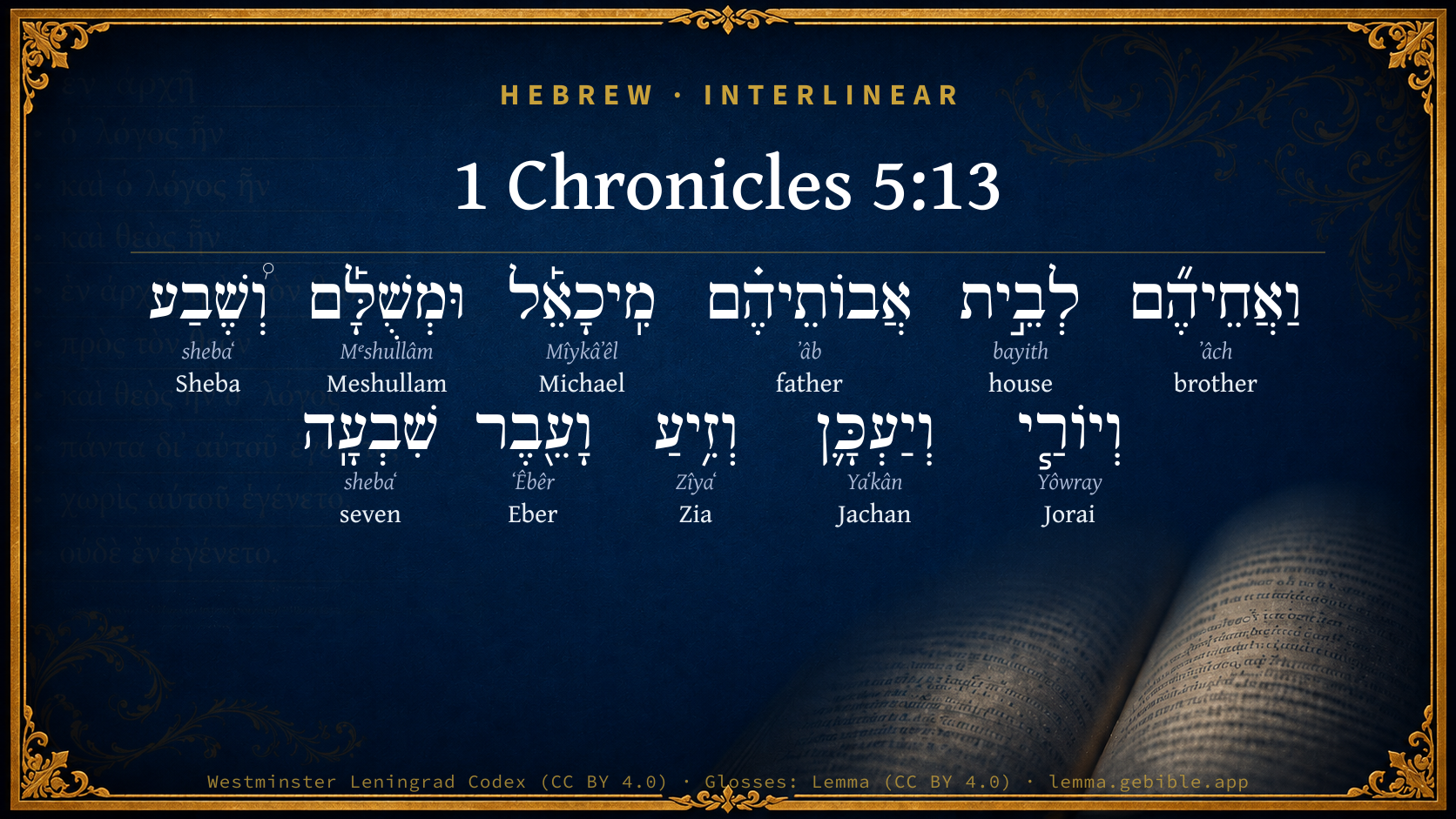
Their brothers of their fathers' houses: Michael, and Meshullam, and Sheba, and Jorai, and Jacan, and Zia, and Eber, seven.
World English Bible · Public Domain
Highlights
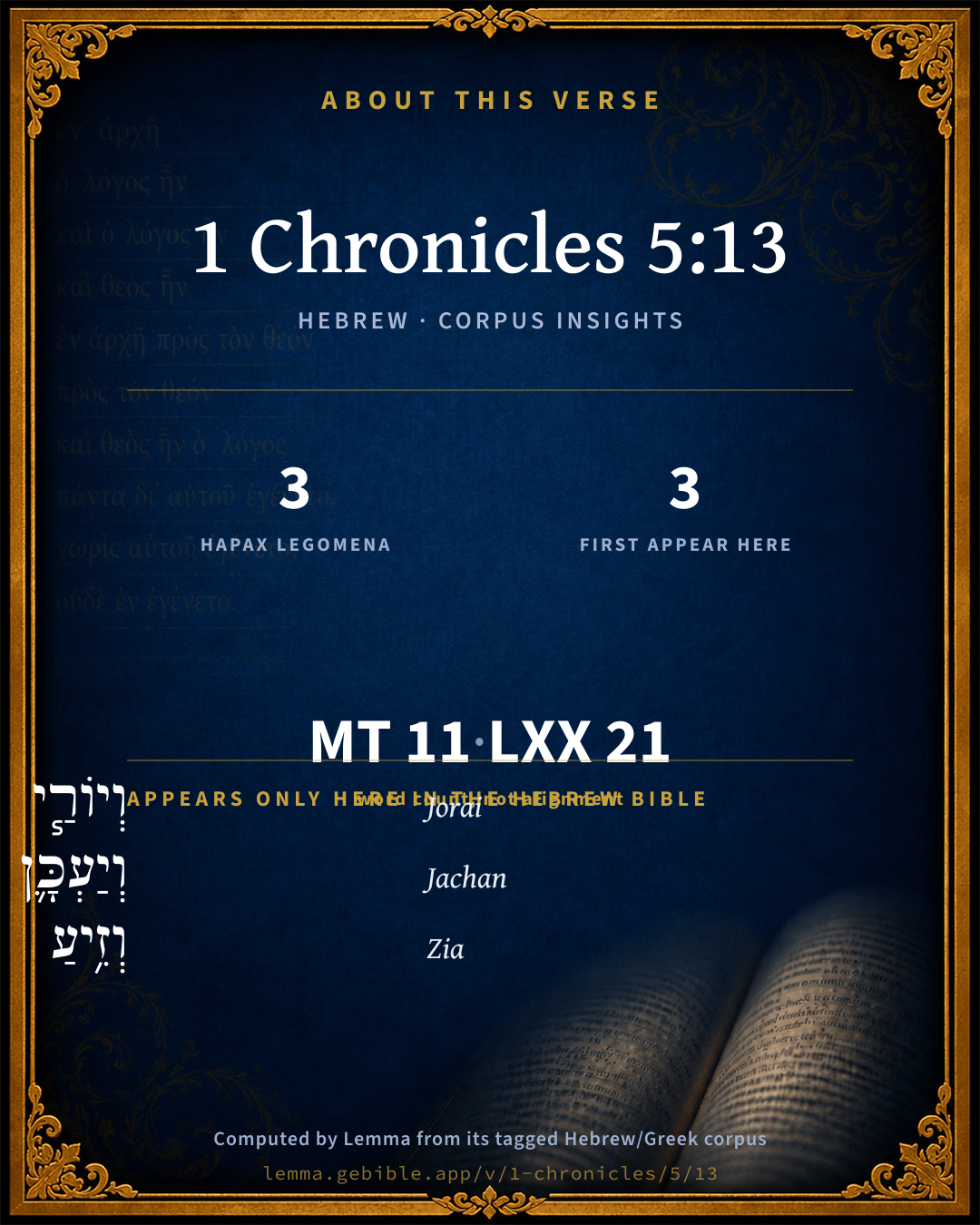
  • 3 hapax legomena — only here in the Hebrew Bible
  • 3 first appearances in the Hebrew Bible
Full analysis ↓
Download a study sheet

One document with this verse’s original text, its word-by-word gloss line, the meaning frame, cross-references with their text, attributed commentary, and full source and license credits — printable, and it pastes into notes with its structure intact.

This verse Autodidact and up

Study sheet (.html) Plain text (.txt)

A passage Seminary Student

Up to 50 verses in one chapter. A passage sheet keeps up to 6 commentary sources and 12 cross-references per verse, in the order this page ranks them, and says so on the sheet whenever that leaves anything out. Ask for a single verse and you get the Autodidact verse sheet above.

Everything on this page stays free to read, with no account — the sheet is a download of what is already on screen, not access to it.

Want to remove ads? Support Godless Engineer
Compare translations 3

The same verse in 3 English versions, stacked beneath the original-language interlinear above. Click any original word for its lexicon entry.

Each is an independent rendering of the whole verse — the interlinear is not word-aligned to these translations.

Highlighted words mark where these versions differ — a whole-verse word diff, not a word-by-word alignment.

  • World English Bible Public Domain
    Their brothers of their fathers' houses: Michael, and Meshullam, and Sheba, and Jorai, and Jacan, and Zia, and Eber, seven.
  • King James Version Public Domain
    And their brethren of the house of their fathers were, Michael, and Meshullam, and Sheba, and Jorai, and Jachan, and Zia, and Heber, seven.
  • unfoldingWord Literal Text CC BY-SA 4.0
    And their brothers, according to the house of their fathers: Michael and Meshullam and Sheba and Jorai and Jakan and Zia and Eber—seven.

unfoldingWord Literal Text — © unfoldingWord, licensed CC BY-SA 4.0. Word-aligned USFM3 via Door43 (git.door43.org/unfoldingWord/en_ult).

Versions to compare (up to 4)

3 of 4 selected

Show all 18 translations

Every available English version of this verse, each an independent rendering of the whole verse.

  • World English Bible Public Domain
    Their brothers of their fathers' houses: Michael, and Meshullam, and Sheba, and Jorai, and Jacan, and Zia, and Eber, seven.
  • Berean Standard Bible Public Domain
    Their kinsmen by families were Michael, Meshullam, Sheba, Jorai, Jacan, Zia, and Eber—seven in all.
  • Majority Standard Bible Public Domain
    Their kinsmen by families were Michael, Meshullam, Sheba, Jorai, Jacan, Zia, and Eber—seven in all.
  • King James Version Public Domain
    And their brethren of the house of their fathers were, Michael, and Meshullam, and Sheba, and Jorai, and Jachan, and Zia, and Heber, seven.
  • American Standard Version (1901) Public Domain
    And their brethren of their fathers' houses: Michael, and Meshullam, and Sheba, and Jorai, and Jacan, and Zia, and Eber, seven.
  • Revised Version (1885) Public Domain
    And their brethren of their fathers’ houses; Michael, and Meshullam, and Sheba, and Jorai, and Jacan, and Zia, and Eber, seven.
  • Geneva Bible (1599) Public Domain
    And their brethren of the house of their fathers were Michael, and Meshullam, and Sheba, and Sorai, and Iacan, and Zia and Eber, seuen.
  • Douay-Rheims (1899) Public Domain
    And their brethren according to the houses of their kindreds, were Michael, and Mosollam, and Sebe, and Jorai, and Jacan, and Zie, and Heber, seven.
  • Young's Literal Translation Public Domain
    and their brethren of the house of their fathers `are' Michael, and Meshullam, and Sheba, and Jorai, and Jachan, and Zia, and Heber, seven.
  • Literal Standard Version CC BY-SA 4.0
    and their brothers of the house of their fathers [are] Michael, and Meshullam, and Sheba, and Jorai, and Jachan, and Zia, and Heber—seven.
  • Unlocked Literal Bible CC BY-SA 4.0
    Their relatives, by their fathers' families, were Michael, Meshullam, Sheba, Jorai, Jakan, Zia, and Eber—seven in all.
  • unfoldingWord Literal Text CC BY-SA 4.0
    And their brothers, according to the house of their fathers: Michael and Meshullam and Sheba and Jorai and Jakan and Zia and Eber—seven.
  • Darby Bible Public Domain
    And their brethren according to their fathers' houses were Michael, and Meshullam, and Sheba, and Jorai, and Jaachan, and Zia, and Eber, seven.
  • World Messianic Bible Public Domain
    Their brothers of their fathers’ houses: Michael, Meshullam, Sheba, Jorai, Jacan, Zia, and Eber, seven.
  • Webster's Bible Public Domain
    And their brethren of the house of their fathers were, Michael, and Meshullam, and Sheba, and Jorai, and Jachan, and Zia, and Heber, seven.
  • Free Bible Version CC BY-SA 4.0
    Their relatives, according to family, were: Michael, Meshullam, Sheba, Jorai, Jacan, Zia, and Eber—a total of seven.
  • Bible in Basic English Public Domain
    And their brothers, the men of their family: Michael and Meshullam and Sheba and Jorai and Jacan and Zia and Eber, seven of them.
  • JPS Tanakh (1917) Public Domain
    and their brethren of their fathers' houses: Michael, and Meshullam, and Sheba, and Jorai, and Jacan, and Zia, and Eber, seven.

Literal Standard Version (2020), Covenant Press — licensed CC BY-SA 4.0. Text via the HelloAO Bible API (eBible.org). Unlocked Literal Bible (unfoldingWord) — licensed CC BY-SA 4.0. Text via the HelloAO Bible API (eBible.org). unfoldingWord Literal Text — © unfoldingWord, licensed CC BY-SA 4.0. Word-aligned USFM3 via Door43 (git.door43.org/unfoldingWord/en_ult). Free Bible Version, Dr. Jonathan Gallagher — licensed CC BY-SA 4.0. Text via the HelloAO Bible API (eBible.org).

Word by word

More ways to search: Search by grammar → Find every occurrence → Compare this word →

Practice this passage: Drill this verse → Learn its vocabulary →

וְיוֹרַ֧י
Yôwray
H3140
“and · Jorai”
Conjunction + Noun, Proper
Part of Speech
Conjunction + Noun
Type
Proper
Full BDB Definition

Origin: from H3384

TWOT: None

Jorai = "Jehovah has taught me" - one of the Gadites dwelling at Gilead in Bashan in the reign of king Jotham of Judah
  1. וַאֲחֵיהֶ֞ם ʼâch H251 “and · brothers · their” Conjunction + Noun, Common, Masculine, Plural, Construct + Suffix, Personal, 3rd Person, Masculine, Plural
  2. לְבֵ֣ית bayith H1004 “to/for · house of” Preposition + Noun, Common, Masculine, Singular, Construct
  3. אֲבוֹתֵיהֶ֗ם ʼâb H1 “fathers · their” Noun, Common, Masculine, Plural, Construct + Suffix, Personal, 3rd Person, Masculine, Plural
  4. מִֽיכָאֵ֡ל Mîykâʼêl H4317 “Michael” Noun, Proper
  5. וּמְשֻׁלָּ֡ם Mᵉshullâm H4918 “and · Meshullam” Conjunction + Noun, Proper
  6. וְ֠שֶׁבַע shebaʻ H7652 “and · Sheba” Conjunction + Adjective, Cardinal number, Feminine, Singular, Absolute
  7. וְיַעְכָּ֛ן Yaʻkân H3275 “and · Jachan” Conjunction + Noun, Proper
  8. וְזִ֥יעַ Zîyaʻ H2127 “and · Zia” Conjunction + Noun, Proper
  9. וָעֵ֖בֶר ʻÊbêr H5677 “and · Eber” Conjunction + Noun, Proper
  10. שִׁבְעָֽה shebaʻ H7651 “seven” Adjective, Cardinal number, Masculine, Singular, Absolute

About this verse

These counts appear in no published source. They are computed here, from the morphology-tagged text and Lemma’s own curated glosses. What Lemma adds →

11
words
11
distinct lemmas
Historical
section

Notable vocabulary

3 hapax legomena — words that appear only here in the entire Hebrew Bible:

  • וְיוֹרַ֧י Jorai H3140
  • וְיַעְכָּ֛ן Jachan H3275
  • וְזִ֥יעַ Zia H2127

First appearance in Scripture

These words make their first canonical appearance in the Hebrew Bible here:

  • וְיוֹרַ֧י Jorai H3140
  • וְיַעְכָּ֛ן Jachan H3275
  • וְזִ֥יעַ Zia H2127

Shared distinctive vocabulary

וְ֠שֶׁבַע Sheba H7652 occurs in 10 verses of the Hebrew Bible. Also found in:

Grammatical profile

  • 9 nouns
  • 2 adjectives

Hebrew & Septuagint length

In English translation the verse runs 20 words from the Hebrew and 23 from the Septuagint (LXX English) — closely comparable.

A rough comparison of the two English renderings, which tokenize alike — not a word-level alignment.

Word counts can differ between the Hebrew and the Greek without any difference in meaning — e.g. the Hebrew direct-object marker אֵת has no separate Greek word, and Greek often adds the article ὁ.

In the original languages it is 11 Hebrew tokens and 21 Greek tokens — but the two are counted differently (Hebrew bundles its prefixes and suffixes into one token; the Greek is in lemma form), so that isn’t a like-for-like length.

Hebrew and Greek witnesses Masoretic Hebrew ↔ Greek Septuagint

The same verse in the two great witnesses to the Old Testament, shown verse-for-verse.

These are two independent witnesses, not word-aligned to each other, and the Septuagint is shown in lemma (dictionary) form.

Hebrew 1 Chronicles 5:13 Masoretic · Westminster Leningrad Codex

וַאֲחֵיהֶ֞ם לְבֵ֣ית אֲבוֹתֵיהֶ֗ם מִֽיכָאֵ֡ל וּמְשֻׁלָּ֡ם וְ֠שֶׁבַע וְיוֹרַ֧י וְיַעְכָּ֛ן וְזִ֥יעַ וָעֵ֖בֶר שִׁבְעָֽה

Their brothers of their fathers' houses: Michael, and Meshullam, and Sheba, and Jorai, and Jacan, and Zia, and Eber, seven.

World English Bible · Public Domain

Greek LXX 1 Chronicles 5:13 Septuagint · lemma form

καί ὁ ἀδελφός αὐτός κατά οἶκος πατριά αὐτός μιχαηλ μοσολλαμ καί σεβεε καί ιωρεε καί ιαχαν καί ζουε καί ωβηδ ἑπτά

And their brethren according to the houses of their fathers; Michael, Mosollam, and Sebee, and Joree, and Joachan, and Zue, and Obed, seven.

LXX2012 (modern English Septuagint) · Public Domain

Hebrew: Westminster Leningrad Codex (CC BY 4.0). Greek: Septuagint (public domain); English from LXX2012 (modern English Septuagint) (Public Domain). How the Septuagint differs from the Hebrew →

Commentary

Notes on 1 Chronicles 5:13 from classic Christian and Jewish commentators (each source and its license shown beneath its notes). The classic Christian expositions comment on the surrounding passage and are grouped to its opening verse, so a note may address several verses; the Jewish commentaries on the Tanakh (Rashi and others) are per-verse, so they appear only where the commentator wrote on this verse.

Lemma curates 59 commentaries, every one of them public domain or Creative Commons licensed, each selected and text-cleaned for this edition rather than reprinted as found. About our sources →

Adam Clarke's Commentary

Verse 13. And their brethren] This verse is wanting both in the Syriac and in the Arabic.

Adam Clarke's Commentary on the Bible (1810–1826) — public domain. Text from a community e-Sword/MySword module.

The Cambridge Bible for Schools and Colleges

gen. ed. J. J. S. Perowne

13. of the house of their fathers … Jachan … and Heber] R.V. of their fathers’ houses … Jacan … and Eber.

The Cambridge Bible for Schools and Colleges (gen. ed. J. J. S. Perowne; Cambridge University Press, 1878–1918) — public domain. Text from a community e-Sword module.

John Gill's Exposition

These are the children of Abihail the son of Huri,.... That is, the seven before mentioned; they were the posterity of Abihail, whose pedigree is traced from his father Huri to Buz, the intermediate progenitors being Jaroah, Gilead, Michael, Jeshishai, Jahdo.

These are the children of Abihail the son of Huri,.... That is, the seven before mentioned; they were the posterity of Abihail, whose pedigree is traced from his father Huri to Buz, the intermediate progenitors being Jaroah, Gilead, Michael, Jeshishai, Jahdo.

1 Chronicles 5:15

ch1 5:15

ch1 5:15

ch1 5:15Ahi the son of Abdiel, the son of Guni, chief of the house of their fathers. Which Ahi was a principal man in the families the seven above men belonged to; besides them, or those three, were everyone of them heads of families.

John Gill's Exposition of the Whole Bible (1746–1763) — public domain (CC PDM 1.0). Text via the HelloAO Bible API.

The Pulpit Commentary

And their brethren. This chapter (see ver. 7) seems to introduce the use of this word, which must be understood generically. The seven persons are nowhere else mentioned.

The Pulpit Commentary (1880–1919), ed. H.D.M. Spence-Jones & Joseph S. Exell — public domain. Text from a community e-Sword module.

Keil & Delitzsch

C. F. Keil & F. Delitzsch

These are the children of Abihail the son of Huri,.... That is, the seven before mentioned; they were the posterity of Abihail, whose pedigree is traced from his father Huri to Buz, the intermediate progenitors being Jaroah, Gilead, Michael, Jeshishai, Jahdo.

These are the children of Abihail the son of Huri,.... That is, the seven before mentioned; they were the posterity of Abihail, whose pedigree is traced from his father Huri to Buz, the intermediate progenitors being Jaroah, Gilead, Michael, Jeshishai, Jahdo.

1 Chronicles 5:15

ch1 5:15

ch1 5:15

ch1 5:15Ahi the son of Abdiel, the son of Guni, chief of the house of their fathers. Which Ahi was a principal man in the families the seven above men belonged to; besides them, or those three, were everyone of them heads of families.

Keil & Delitzsch — Biblical Commentary on the Old Testament (1861–1891) — public domain (CC PDM 1.0). Text via the HelloAO Bible API. (Old Testament only.)

Rashi

Rabbi Shlomo Yitzchaki (Rashi)

And their brothers to the house of their fathers in the place of their genealogy.

Michael and Meshullam These were the heads of their fathers of that genealogy, for they all traced their genealogy in the days of Jotham the king of Judah and in the days of Jeroboam the king of Israel.

Rashi on the Tanakh — English translations: “The Judaica Press complete Tanach with Rashi, translated by A. J. Rosenberg” (CC BY 4.0); “Pentateuch with Rashi's commentary by M. Rosenbaum and A.M. Silbermann, 1929-1934” (public domain); “The Metsudah Tanach series, Lakewood, N.J” (CC BY 4.0); and “The Book of Joshua, Metsudah Publications, 1997” (CC BY 4.0). Text via Sefaria.

Lesson kit

Teaching starters — assembled from the data on this page, not authored interpretation. Every prompt links to the verse data it draws on. Edit before teaching.

1 Chronicles, in the Historical, opens this verse with 11 words (11 distinct Hebrew lemmas). Its most distinctive word is Yôwray (“Jorai”). A historical commentator’s framing appears above. Read the whole chapter for the surrounding context.

Discussion questions

  1. What does “Jorai” (Yôwray) contribute to the verse as a whole?
  2. This verse holds 3 words here found nowhere else in the Hebrew Bible. What might the rare words draw attention to?
  3. 3 words here appear for the first time in Scripture. What is being introduced at this debut?
  4. Joshua 19:2 shares the word «Sheba» with this verse. How do the two illuminate each other?
  5. The translations on this page render this verse differently — a whole-verse word diff, not a word-by-word alignment. What might account for the different wordings?
  6. Reading how Adam Clarke's Commentary and The Cambridge Bible for Schools and Colleges read this verse, where do the two commentators agree and where do they part?

Things to notice

Reading settings

Reading text

Shown beneath each verse's original-language words.

Old Testament
Old Testament edition

Read the OT as the Masoretic Hebrew (MT) or the Greek Septuagint (LXX).

English shown for the Greek Septuagint (in the Hebrew ↔ Greek comparison).

Comparing translations? Open the Compare panel on any verse page to stack up to four side by side.