
Deuteronomy 16:3

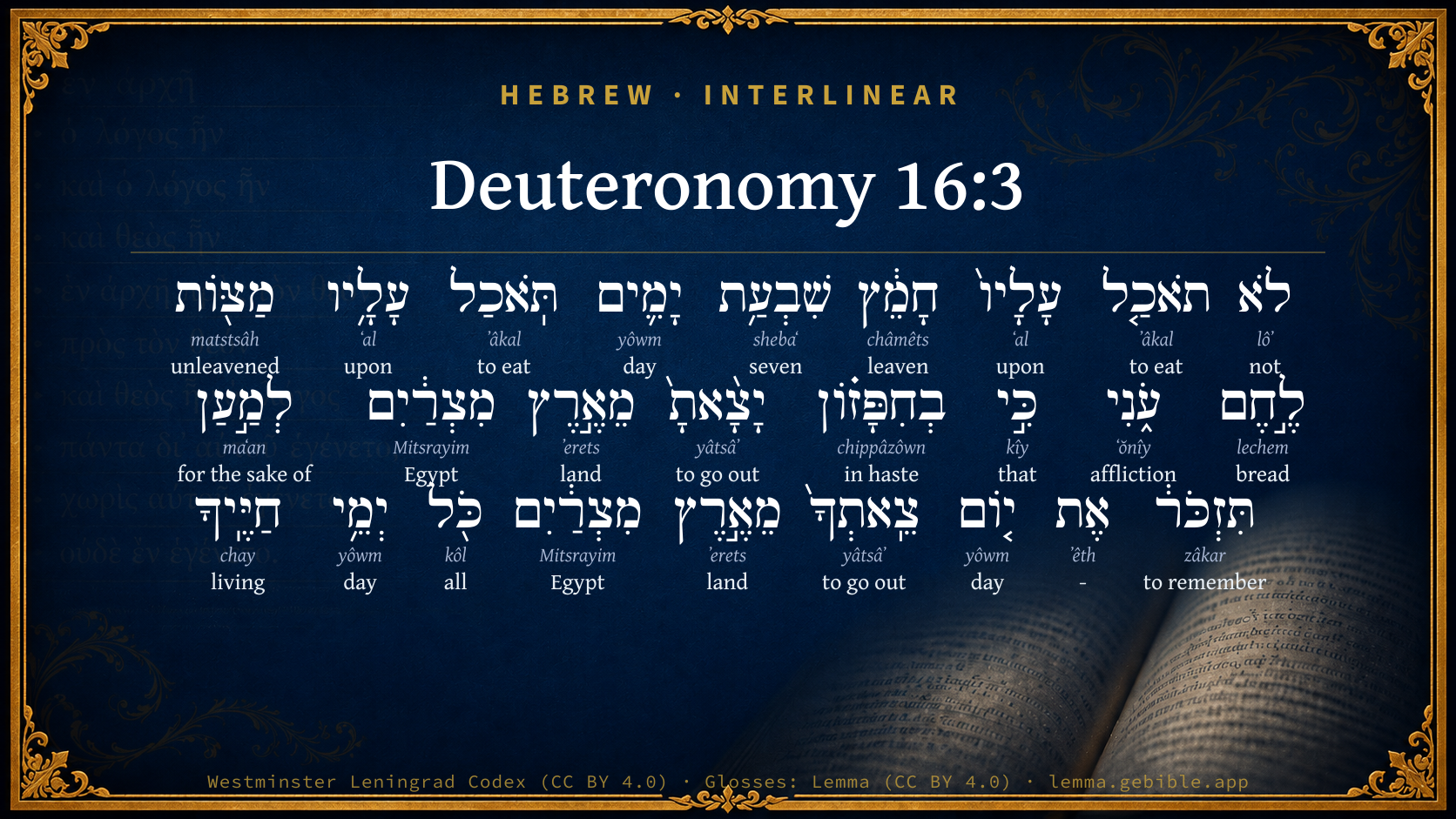
Hebrew (Westminster Leningrad Codex) Deuteronomy 16:3 appears in the Hebrew Old Testament. The text above is from the Westminster Leningrad Codex. Each word links to its Strong’s number, a concise gloss, and parsing drawn from the Open Scriptures Hebrew Bible morphology. Click any word for its full Brown-Driver-Briggs (BDB) entry.
Download image
Cite this verse

Deuteronomy 16:3 (World English Bible). Public Domain. Lemma interlinear Bible study tool, https://lemma.gebible.app/v/deuteronomy/16/3.

Show BibTeX & RIS
BibTeX
RIS
English Translation
You shall eat no leavened bread with it; seven days shall you eat unleavened bread therewith, even the bread of affliction; for you came forth out of the land of Egypt in haste: that you may remember the day when you came forth out of the land of Egypt all the days of your life.
World English Bible · Public Domain
Download a study sheet

One document with this verse’s original text, its word-by-word gloss line, the meaning frame, cross-references with their text, attributed commentary, and full source and license credits — printable, and it pastes into notes with its structure intact.

This verse Autodidact and up

Study sheet (.html) Plain text (.txt)

A passage Seminary Student

Up to 50 verses in one chapter. A passage sheet keeps up to 6 commentary sources and 12 cross-references per verse, in the order this page ranks them, and says so on the sheet whenever that leaves anything out. Ask for a single verse and you get the Autodidact verse sheet above.

Everything on this page stays free to read, with no account — the sheet is a download of what is already on screen, not access to it.

Want to remove ads? Support Godless Engineer
Compare translations 3

The same verse in 3 English versions, stacked beneath the original-language interlinear above. Click any original word for its lexicon entry.

Each is an independent rendering of the whole verse — the interlinear is not word-aligned to these translations.

Highlighted words mark where these versions differ — a whole-verse word diff, not a word-by-word alignment.

  • World English Bible Public Domain
    You shall eat no leavened bread with it; seven days shall you eat unleavened bread therewith, even the bread of affliction; for you came forth out of the land of Egypt in haste: that you may remember the day when you came forth out of the land of Egypt all the days of your life.
  • King James Version Public Domain
    Thou shalt eat no leavened bread with it; seven days shalt thou eat unleavened bread therewith, even the bread of affliction; for thou camest forth out of the land of Egypt in haste: that thou mayest remember the day when thou camest forth out of the land of Egypt all the days of thy life.
  • unfoldingWord Literal Text CC BY-SA 4.0
    You shall not eat with it leavened bread, seven days you shall eat unleavened bread on it, the bread of affliction, for you came out from the land of Egypt in haste. Thus, you will remember the day of your exit from the land of Egypt all the days of your life.

unfoldingWord Literal Text — © unfoldingWord, licensed CC BY-SA 4.0. Word-aligned USFM3 via Door43 (git.door43.org/unfoldingWord/en_ult).

Versions to compare (up to 4)

3 of 4 selected

Show all 18 translations

Every available English version of this verse, each an independent rendering of the whole verse.

  • World English Bible Public Domain
    You shall eat no leavened bread with it; seven days shall you eat unleavened bread therewith, even the bread of affliction; for you came forth out of the land of Egypt in haste: that you may remember the day when you came forth out of the land of Egypt all the days of your life.
  • Berean Standard Bible Public Domain
    You must not eat leavened bread with it; for seven days you are to eat with it unleavened bread, the bread of affliction, because you left the land of Egypt in haste—so that you may remember for the rest of your life the day you left the land of Egypt.
  • Majority Standard Bible Public Domain
    You must not eat leavened bread with it; for seven days you are to eat with it unleavened bread, the bread of affliction, because you left the land of Egypt in haste—so that you may remember for the rest of your life the day you left the land of Egypt.
  • King James Version Public Domain
    Thou shalt eat no leavened bread with it; seven days shalt thou eat unleavened bread therewith, even the bread of affliction; for thou camest forth out of the land of Egypt in haste: that thou mayest remember the day when thou camest forth out of the land of Egypt all the days of thy life.
  • American Standard Version (1901) Public Domain
    Thou shalt eat no leavened bread with it; seven days shalt thou eat unleavened bread therewith, even the bread of affliction; for thou camest forth out of the land of Egypt in haste: that thou mayest remember the day when thou camest forth out of the land of Egypt all the days of thy life.
  • Revised Version (1885) Public Domain
    Thou shalt eat no leavened bread with it; seven days shalt thou eat unleavened bread therewith, even the bread of affliction; for thou camest forth out of the land of Egypt in haste: that thou mayest remember the day when thou camest forth out of the land of Egypt all the days of thy life.
  • Geneva Bible (1599) Public Domain
    Thou shalt eate no leauened bread with it: but seuen dayes shalt thou eate vnleauened bread therewith, euen the bread of tribulation: for thou camest out of the land of Egypt in haste, that thou maist remember ye day whe thou camest out of the land of Egypt, all the dayes of thy life.
  • Douay-Rheims (1899) Public Domain
    Thou shalt not eat with it leavened bread: seven days shalt thou eat without leaven, the bread of affliction, because thou camest out of Egypt in fear: that thou mayst remember the day of thy coming out of Egypt, all the days of thy life.
  • Young's Literal Translation Public Domain
    `Thou dost not eat with it any fermented thing, seven days thou dost eat with it unleavened things, bread of affliction; for in haste thou hast come out of the land of Egypt; so that thou dost remember the day of thy coming out of the land of Egypt all days of thy life;
  • Literal Standard Version CC BY-SA 4.0
    You do not eat any fermented thing with it; [for] seven days you eat unleavened things with it, bread of affliction (for you have come out of the land of Egypt in haste), so that you remember the day of your coming out of the land of Egypt all [the] days of your life;
  • Unlocked Literal Bible CC BY-SA 4.0
    You will eat no leavened bread with it; seven days will you eat unleavened bread with it, the bread of affliction; for you came out of the land of Egypt in haste. Do this all the days of your life so that you may call to mind the day when you came out of the land of Egypt.
  • unfoldingWord Literal Text CC BY-SA 4.0
    You shall not eat with it leavened bread, seven days you shall eat unleavened bread on it, the bread of affliction, for you came out from the land of Egypt in haste. Thus, you will remember the day of your exit from the land of Egypt all the days of your life.
  • Darby Bible Public Domain
    Thou shalt eat no leavened bread along with it; seven days shalt thou eat unleavened bread with it, bread of affliction; for thou camest forth out of the land of Egypt in haste, -- that thou mayest remember the day when thou camest forth out of the land of Egypt, all the days of thy life.
  • World Messianic Bible Public Domain
    You shall eat no leavened bread with it. You shall eat unleavened bread with it seven days, even the bread of affliction (for you came out of the land of Egypt in haste) that you may remember the day when you came out of the land of Egypt all the days of your life.
  • Webster's Bible Public Domain
    Thou shalt eat no leavened bread with it; seven days shalt thou eat unleavened bread with it, even the bread of affliction; for thou camest forth from the land of Egypt in haste: that thou mayest remember the day when thou camest forth from the land of Egypt, all the days of thy life.
  • Free Bible Version CC BY-SA 4.0
    Don't eat ordinary bread with it. For seven days you are to eat bread made without yeast, the bread of hardship, because you had to leave Egypt in such a hurry. This way you'll remember the day you left Egypt for the rest of your lives.
  • Bible in Basic English Public Domain
    Take no leavened bread with it; for seven days let your food be unleavened bread, that is, the bread of sorrow; for you came out of the land of Egypt quickly: so the memory of that day, when you came out of the land of Egypt, will be with you all your life.
  • JPS Tanakh (1917) Public Domain
    Thou shalt eat no leavened bread with it; seven days shalt thou eat unleavened bread therewith, even the bread of affliction; for in haste didst thou come forth out of the land of Egypt; that thou mayest remember the day when thou camest forth out of the land of Egypt all the days of thy life.

Literal Standard Version (2020), Covenant Press — licensed CC BY-SA 4.0. Text via the HelloAO Bible API (eBible.org). Unlocked Literal Bible (unfoldingWord) — licensed CC BY-SA 4.0. Text via the HelloAO Bible API (eBible.org). unfoldingWord Literal Text — © unfoldingWord, licensed CC BY-SA 4.0. Word-aligned USFM3 via Door43 (git.door43.org/unfoldingWord/en_ult). Free Bible Version, Dr. Jonathan Gallagher — licensed CC BY-SA 4.0. Text via the HelloAO Bible API (eBible.org).

Word by word

More ways to search: Search by grammar → Find every occurrence → Compare this word →

Practice this passage: Drill this verse → Learn its vocabulary →

בְחִפָּז֗וֹן
chippâzôwn
H2649
“in/at · in haste”
Preposition + Noun, Common, Masculine, Singular, Absolute
Part of Speech
Preposition + Noun
Type
Common
Gender
Masculine
Number
Singular
State
Absolute
Full BDB Definition

Origin: from H2468

TWOT: 708a

hurriedly, in haste, trepidation, hurried flight
  1. לֹא lôʼ H3808 “not” Particle, Negative
  2. תֹאכַ֤ל ʼâkal H398 “to eat” Verb, Qal, Imperfect, 2nd Person, Masculine, Singular
  3. עָלָיו֙ ʻal H5921 “upon · him” Preposition + Suffix, Personal, 3rd Person, Masculine, Singular
  4. חָמֵ֔ץ châmêts H2557 “leaven” Noun, Common, Masculine, Singular, Absolute
  5. שִׁבְעַ֥ת shebaʻ H7651 “seven” Adjective, Cardinal number, Masculine, Singular, Construct
  6. יָמִ֛ים yôwm H3117 “days” Noun, Common, Masculine, Plural, Absolute
  7. תֹּֽאכַל ʼâkal H398 “to eat” Verb, Qal, Imperfect, 2nd Person, Masculine, Singular
  8. עָלָ֥יו ʻal H5921 “upon · him” Preposition + Suffix, Personal, 3rd Person, Masculine, Singular
  9. מַצּ֖וֹת matstsâh H4682 “unleavened bread” Noun, Common, Feminine, Plural, Absolute
  10. לֶ֣חֶם lechem H3899 “bread of” Noun, Common, Both, Singular, Construct
  11. עֹ֑נִי ʻŏnîy H6040 “affliction” Noun, Common, Masculine, Singular, Absolute
  12. כִּ֣י kîy H3588 “that” Conjunction
  13. יָצָ֨אתָ֙ yâtsâʼ H3318 “to go out” Verb, Qal, Perfect, 2nd Person, Masculine, Singular
  14. מֵאֶ֣רֶץ ʼerets H776 “from · land of” Preposition + Noun, Common, Both, Singular, Construct
  15. מִצְרַ֔יִם Mitsrayim H4714 “Egypt” Noun, Proper
  16. לְמַ֣עַן maʻan H4616 “for the sake of” Preposition
  17. תִּזְכֹּר֔ zâkar H2142 “to remember” Verb, Qal, Imperfect, 2nd Person, Masculine, Singular
  18. אֶת ʼêth H853 “-” Particle, Direct Object
  19. י֤וֹם yôwm H3117 “day of” Noun, Common, Masculine, Singular, Construct
  20. צֵֽאתְךָ֙ yâtsâʼ H3318 “to go out · you” Verb, Qal, Infinitive Construct + Suffix, Personal, 2nd Person, Masculine, Singular
  21. מֵאֶ֣רֶץ ʼerets H776 “from · land of” Preposition + Noun, Common, Both, Singular, Construct
  22. מִצְרַ֔יִם Mitsrayim H4714 “Egypt” Noun, Proper
  23. כֹּ֖ל kôl H3605 “all of” Noun, Common, Masculine, Singular, Construct
  24. יְמֵ֥י yôwm H3117 “days of” Noun, Common, Masculine, Plural, Construct
  25. חַיֶּֽיךָ chay H2416 “living things · your” Noun, Common, Masculine, Plural, Construct + Suffix, Personal, 2nd Person, Masculine, Singular

About this verse

These counts appear in no published source. They are computed here, from the morphology-tagged text and Lemma’s own curated glosses. What Lemma adds →

26
words
19
distinct lemmas
Pentateuch
section

Notable vocabulary

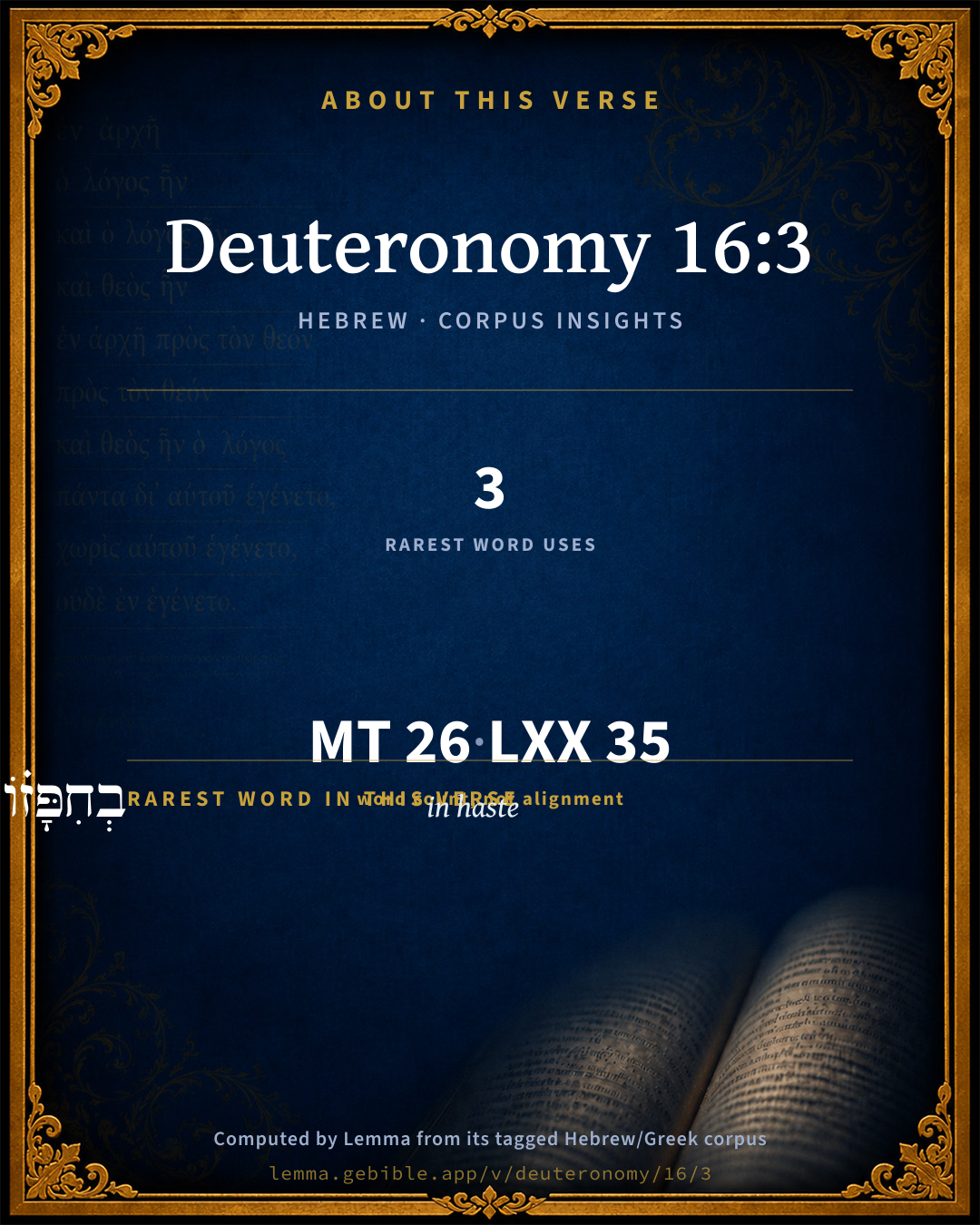
The rarest word here is בְחִפָּז֗וֹן in haste H2649 — appearing just 3 times in the whole Hebrew Bible.

Shared distinctive vocabulary

בְחִפָּז֗וֹן in haste H2649 occurs in 3 verses of the Hebrew Bible. Also found in:

Grammatical profile

  • 5 verbs
  • 14 nouns
  • 1 adjective
  • 3 prepositions
  • 1 conjunction
  • 2 particles

Verb forms

  • תֹאכַ֤ל Qal · Imperfect
  • תֹּֽאכַל Qal · Imperfect
  • יָצָ֨אתָ֙ Qal · Perfect
  • תִּזְכֹּר֔ Qal · Imperfect
  • צֵֽאתְךָ֙ Qal · Infinitive Construct

Repetition

Words recur within this verse — often emphatic in Hebrew:

  • יָמִ֛ים day H3117 ×3
  • תֹאכַ֤ל to eat H398 ×2
  • עָלָיו֙ upon H5921 ×2
  • יָצָ֨אתָ֙ to go out H3318 ×2
  • מֵאֶ֣רֶץ land H776 ×2
  • מִצְרַ֔יִם Egypt H4714 ×2

Hebrew & Septuagint length

In English translation the verse runs 55 words from the Hebrew and 50 from the Septuagint (LXX English) — closely comparable.

A rough comparison of the two English renderings, which tokenize alike — not a word-level alignment.

Word counts can differ between the Hebrew and the Greek without any difference in meaning — e.g. the Hebrew direct-object marker אֵת has no separate Greek word, and Greek often adds the article ὁ.

In the original languages it is 26 Hebrew tokens and 35 Greek tokens — but the two are counted differently (Hebrew bundles its prefixes and suffixes into one token; the Greek is in lemma form), so that isn’t a like-for-like length.

Cross-references

22

Topical passages linked to Deuteronomy 16:3 in the Treasury of Scripture Knowledge — connected by theme and wording, ordered by reader-vote popularity; previews shown in the World English Bible.

  • Exodus 12:39 They baked unleavened cakes of the dough which they brought forth out of Egypt; for it wasn't leavened, because they were thrust out of Egypt, and couldn't wait, neither had they prepared for themselves any food.
  • Exodus 12:19–20 Seven days shall there be no yeast found in your houses, for whoever eats that which is leavened, that soul shall be cut off from the congregation of Israel, whether he be a foreigner, or one who is born in the land.
  • Exodus 34:18 "You shall keep the feast of unleavened bread. Seven days you shall eat unleavened bread, as I commanded you, at the time appointed in the month Abib; for in the month Abib you came out from Egypt.
  • Exodus 12:8 They shall eat the flesh in that night, roasted with fire, and unleavened bread. They shall eat it with bitter herbs.
  • Numbers 9:11 In the second month, on the fourteenth day at evening they shall keep it; they shall eat it with unleavened bread and bitter herbs.
  • Luke 22:19 He took bread, and when he had given thanks, he broke it, and gave to them, saying, "This is my body which is given for you. Do this in memory of me."
  • Exodus 12:11 This is how you shall eat it: with your loins girded, your shoes on your feet, and your staff in your hand; and you shall eat it in haste: it is Yahweh's Passover.
  • Exodus 12:14–15 This day shall be to you for a memorial, and you shall keep it a feast to Yahweh: throughout your generations you shall keep it a feast by an ordinance forever.
  • Exodus 12:26–27 It will happen, when your children ask you, 'What do you mean by this service?'
  • Exodus 12:32–33 Take both your flocks and your herds, as you have said, and be gone; and bless me also!"
  • Exodus 13:3–9 Moses said to the people, "Remember this day, in which you came out from Egypt, out of the house of bondage; for by strength of hand Yahweh brought you out from this place. No leavened bread shall be eaten.
  • Leviticus 23:6 On the fifteenth day of the same month is the feast of unleavened bread to Yahweh. Seven days you shall eat unleavened bread.
  • Numbers 28:17 On the fifteenth day of this month shall be a feast: seven days shall unleavened bread be eaten.
  • 1 Kings 22:27 and say, Thus says the king, Put this fellow in the prison, and feed him with bread of affliction and with water of affliction, until I come in peace.
  • Psalms 102:9 For I have eaten ashes like bread, And mixed my drink with tears,
  • Psalms 111:4 He has caused his wonderful works to be remembered. Yahweh is gracious and merciful.
  • Psalms 127:2 It is vain for you to rise up early, To stay up late, Eating the bread of toil; For he gives sleep to his loved ones.
  • Zechariah 12:10 I will pour on the house of David, and on the inhabitants of Jerusalem, the spirit of grace and of supplication; and they will look to me whom they have pierced; and they shall mourn for him, as one mourns for his only son, and will grieve bitterly for him, as one grieves for his firstborn.
  • 1 Corinthians 5:8 Therefore let us keep the feast, not with old yeast, neither with the yeast of malice and wickedness, but with the unleavened bread of sincerity and truth.
  • 1 Corinthians 11:24–26 When he had given thanks, he broke it, and said, "Take, eat. This is my body, which is broken for you. Do this in memory of me."
  • 2 Corinthians 7:10–11 For godly sorrow works repentance to salvation, which brings no regret. But the sorrow of the world works death.
  • 1 Thessalonians 1:6 You became imitators of us, and of the Lord, having received the word in much affliction, with joy of the Holy Spirit,

Cross-references courtesy of OpenBible.info (CC BY 4.0).

Hebrew and Greek witnesses Masoretic Hebrew ↔ Greek Septuagint

The same verse in the two great witnesses to the Old Testament, shown verse-for-verse.

These are two independent witnesses, not word-aligned to each other, and the Septuagint is shown in lemma (dictionary) form.

Hebrew Deuteronomy 16:3 Masoretic · Westminster Leningrad Codex

לֹא תֹאכַ֤ל עָלָיו֙ חָמֵ֔ץ שִׁבְעַ֥ת יָמִ֛ים תֹּֽאכַל עָלָ֥יו מַצּ֖וֹת לֶ֣חֶם עֹ֑נִי כִּ֣י בְחִפָּז֗וֹן יָצָ֨אתָ֙ מֵאֶ֣רֶץ מִצְרַ֔יִם לְמַ֣עַן תִּזְכֹּר֔ אֶת י֤וֹם צֵֽאתְךָ֙ מֵאֶ֣רֶץ מִצְרַ֔יִם כֹּ֖ל יְמֵ֥י חַיֶּֽיךָ

You shall eat no leavened bread with it; seven days shall you eat unleavened bread therewith, even the bread of affliction; for you came forth out of the land of Egypt in haste: that you may remember the day when you came forth out of the land of Egypt all the days of your life.

World English Bible · Public Domain

Greek LXX Deuteronomy 16:3 Septuagint · lemma form

οὐ ἐσθίω ἐπί αὐτός ζυμή ἑπτά ἡμέρα ἐσθίω ἐπί αὐτός ἄζυμος ἄρτος κάκωσις ὅτι ἐν σπουδή ἐκἔρχομαι ἐκ αἴγυπτος ἵνα μιμνήσκω ὁ ἡμέρα ὁ ἐξοδία σύ ἐκ γῆ αἴγυπτος πᾶς ὁ ἡμέρα ὁ ζωή σύ

You shall not eat leaven with it; seven days shall you eat unleavened bread with it, bread of affliction, because you⌃ came forth out of Egypt in haste; that you⌃ may remember the day of your coming forth out of the land of Egypt all the days of your life.

LXX2012 (modern English Septuagint) · Public Domain

On this verse, Haydock's Catholic Bible Commentary discusses the Septuagint’s reading. Read the note in Commentary ↓

Hebrew: Westminster Leningrad Codex (CC BY 4.0). Greek: Septuagint (public domain); English from LXX2012 (modern English Septuagint) (Public Domain). How the Septuagint differs from the Hebrew →

Targum (Aramaic paraphrase)

2

The Targum is the ancient Jewish Aramaic paraphrase of the Hebrew Scriptures — an interpretive translation, not the Hebrew text itself. Onkelos (literal) and Pseudo-Jonathan (expansive) render the Torah, and Jonathan the Prophets. Coverage is partial: where no permissively-licensed English translation exists for a verse, only the Aramaic is shown. This is verse-level text, not a word-by-word alignment to the Hebrew.

  1. Targum Onkelos Torah (Genesis–Deuteronomy)
    לָא תֵיכוּל עֲלוֹהִי חֲמִיעַ שִׁבְעָא יוֹמִין תֵּיכוּל עֲלוֹהִי פַטִיר לְחֵם עֹנִי אֲרֵי בִּבְהִילוּ נְפַקְתָּא מֵאַרְעָא דְמִצְרַיִם בְּדִיל דְתִדְכַּר יָת יוֹמָא מִפְּקָךְ מֵאַרְעָא דְמִצְרַיִם כָּל יוֹמֵי חַיָיךְ

    (no public-domain English translation for this verse)

    Targum Onkelos — Aramaic: “Onkelos Genesis” (public domain); “Onkelos Exodus” (public domain); “Onkelos Leviticus” (public domain); “Onkelos Numbers” (public domain); “Onkelos Deuteronomy” (public domain). English: “Sefaria Community Translation” (CC0 1.0 (public-domain dedication)); “J.W. Etheridge. The Targums of Onkelos and Jonathan Ben Uzziel on the Pentateuch. London: Longmans, Green, 1862” (public domain). Text via Sefaria.

  2. Targum Pseudo-Jonathan Torah (Genesis–Deuteronomy)
    לָא תֵיכְלוּן עַל פִּסְחָא חֲמִיעַ שׁוּבְעָא יוֹמִין תֵּיכְלוּן לִשְׁמֵיהּ פַּטִּיר לַחֲמָא עַנְיָא אֲרוּם בִּבְהִילוּ נְפַקְתּוּן מֵאַרְעָא דְמִצְרַיִם מִן בִּגְלַל דְּתִידְכְּרוּן יַת יוֹם מַפְקְכוֹן מֵאַרְעָא דְמִצְרַיִם כָּל יוֹמֵי חַיֵּיכוֹן

    You shall not eat leavened bread with the pascha; seven days you shall eat unleavened bread unto His Name, the unleavened bread of humiliation; for with haste you went forth from the land of Mizraim; that you may remember the day of your outgoing from the land of Mizraim all the days of your life.

    Targum Pseudo-Jonathan — Aramaic: “Targum Jonathan on Genesis” (public domain); “Targum Jonathan on Exodus” (public domain); “Targum Jonathan on Leviticus” (public domain); “Targum Jonathan on Numbers” (public domain); “Targum Jonathan on Deuteronomy” (public domain). English: “The Targum of Jonathan ben Uzziel, trans. J. W. Etheridge, London, 1862” (public domain). Text via Sefaria.

Commentary

Notes on Deuteronomy 16:3 from classic Christian and Jewish commentators (each source and its license shown beneath its notes). The classic Christian expositions comment on the surrounding passage and are grouped to its opening verse, so a note may address several verses; the Jewish commentaries on the Tanakh (Rashi and others) are per-verse, so they appear only where the commentator wrote on this verse.

Lemma curates 59 commentaries, every one of them public domain or Creative Commons licensed, each selected and text-cleaned for this edition rather than reprinted as found. About our sources →

Trapp's Complete Commentary

John Trapp

Deu 16:3 Thou shalt eat no leavened bread with it; seven days shalt thou eat unleavened bread therewith, [even] the bread of affliction; for thou camest forth out of the land of Egypt in haste: that thou mayest remember the day when thou camest forth out of the land of Egypt all the days of thy life.

Ver. 3. Even the bread of afliction.] Or, Of poverty; as who should say, poor folk’s bread, illleavened, ill-prepared.

John Trapp, A Commentary or Exposition upon All the Books of the Old and New Testament (1647–1656) — public domain. Text from a community e-Sword module.

Tyndale Open Study Notes

Tyndale Open Resources

16:3 Although yeast frequently symbolizes corruption (Lev 6:14-17; Matt 16:11-12), it was avoided at the original Passover because the Israelites had no time to wait for yeast bread to rise (see Exod 12:10-14). The elements of the yearly Passover celebration reminded the Israelites of what God had done for them.

Tyndale Open Study Notes — © Tyndale Open Resources, licensed CC BY-SA 4.0. Text via the HelloAO Bible API.

Geneva Bible (1599)

Geneva Bible translators

Which signified that affliction, which thou hadst in Egypt.

Geneva Bible (1599) marginal notes — public domain. Text via Bolls.life.

Jamieson, Fausset & Brown

Robert Jamieson, A. R. Fausset & David Brown

seven days shalt thou eat unleavened bread--a sour, unpleasant, unwholesome kind of bread, designed to be a memorial of their Egyptian misery and of the haste with which they departed, not allowing time for their morning dough to ferment.

Jamieson, Fausset & Brown — Commentary Critical and Explanatory on the Whole Bible (1871) — public domain (CC PDM 1.0). Text via the HelloAO Bible API.

Adam Clarke's Commentary

Verse 3. Bread of affliction] Because, being baked without leaven, it was unsavoury, and put them in mind of their afflictive bondage in Egypt.

Adam Clarke's Commentary on the Bible (1810–1826) — public domain. Text from a community e-Sword/MySword module.

The Cambridge Bible for Schools and Colleges

gen. ed. J. J. S. Perowne

3, 4. See introd. note.

bread of affliction] The affliction of Israel in Egypt, Exo_3:7; Exo_4:31, culminating in the haste or trepidation (Driver) with which they ate their last meal there. So P, Exo_12:11; cp. for the meaning of the word, Deu_20:3; 1Sa_23:26; Isa_52:12.

no leaven … neither shall any of the flesh … remain] The two prohibitions are connected because anything fermenting or putrefying was not admissible in sacrifice (W. R. Smith, Rel. Sem. 221 n.). Cp. P, Exo_12:19.

The Cambridge Bible for Schools and Colleges (gen. ed. J. J. S. Perowne; Cambridge University Press, 1878–1918) — public domain. Text from a community e-Sword module.

John Gill's Exposition

Thou shalt eat no leavened bread with it,.... With the passover, as the Targum of Jonathan expresses it; that is, with the passover lamb, nor indeed with any of the passover, or peace offerings, as follows; see Exo 12:8.

seven days shall ye eat unleavened bread therewith; with the passover; this plainly shows, that by the passover in the preceding verse is not meant strictly the passover lamb, for that was eaten at once on the night of the fourteenth of the month, and not seven days running, and therefore must be put for the whole solemnity of the feast, and all the sacrifices of it, both the lamb of the fourteenth, and the Chagigah of the fifteenth, and every of the peace offerings of the rest of the days were to be eaten with unleavened bread:

even the bread of affliction; so called either from the nature of its being heavy and lumpish, not grateful to the taste nor easy of digestion, and was mortifying and afflicting to be obliged to eat of it seven days together; or rather from the use of it, which was, as Jarchi observes, to bring to remembrance the affliction they were afflicted with in Egypt:

for thou camest forth out of the land of Egypt in haste; and had not time to leaven their dough; so that at first they were obliged through necessity to eat unleavened bread, and afterwards by the command of God in remembrance of it; see Exo 12:33,

that thou mayest remember the day when thou camest forth out of the land of Egypt all the days of thy life; how it was with them then, how they were hurried out with their unleavened dough; and that this might be imprinted on their minds, the master of the family used (p), at the time of the passover, to break a cake of unleavened bread, and say, this is the bread of affliction, &c. or bread of poverty; as it is the way of poor men to have broken bread, so here is broken bread.

(p) Haggadah Shel Pesach, in Seder Tephillot, fol. 242. Maimon. Chametz Umetzah, c. 8. sect. 6.

John Gill's Exposition of the Whole Bible (1746–1763) — public domain (CC PDM 1.0). Text via the HelloAO Bible API.

Haydock's Catholic Bible Commentary

Affliction. Hebrew also, "of poverty." Syriac, "of humility." Septuagint, "of evil treatment;" or such bread as the poorest sort of people and slaves are forced to eat. The Jews serve the bread in small pieces, to denote their former poverty. This unleavened bread is also less palatable, and less wholesome. --- Fear. Septuagint, "in haste," Exodus xii. 11. The psalmist (Psalm civ. 43,) mentions the exultation and joy of the Hebrews, but it was mixed with fear, lest they should lose so great a benefit.

George Leo Haydock (1774–1849), Haydock's Catholic Family Bible and Commentary, 1859 edition — public domain. Excludes Psalms (Douay-Rheims chapter numbering differs from Protestant) and Deuterocanonical books (Catholic canon only).

Matthew Poole's English Annotations

With it, to wit, with the passover, in the sense delivered; or, in it, i.e. during the time of the feast of the passover.

The bread of affliction, i.e. bread which is not usual nor pleasant, but unsavoury and unwholesome, to put thee in mind both of thy miseries endured in Egypt, and of thy hasty coming out of it, which allowed thee no time to leaven or to prepare thy bread.

Matthew Poole's English Annotations on the Holy Bible (1683–1685) — public domain. Text from a community e-Sword/MySword module.

Whedon's Commentary on the Bible

Daniel D. Whedon

3. The bread of affliction — The people left Egypt in haste, and, no doubt, with anxiety and dread. The unleavened bread was a symbol to them of their flight and of the burdens and servile life that preceded it.

Daniel D. Whedon (gen. ed.), Commentary on the Old and New Testaments (1874–1909) — public domain. Text from a community e-Sword module.

The Pulpit Commentary

Bread of affliction; bread such as is prepared in circumstances of trial and pressure, when there is no time or opportunity for the application of all the means required for the preparation of bread of the better sort. The Israelites had in haste and amid anxiety to prepare the Passover meal on the evening of their flight from Egypt, and so had to omit the leavening of their bread; and this usage they had to observe during the seven days of the festival in subsequent times, to remind them of the oppression the nation had suffered in Egypt, and the circumstances of difficulty and peril amidst which their deliverance had been effected.

The Pulpit Commentary (1880–1919), ed. H.D.M. Spence-Jones & Joseph S. Exell — public domain. Text from a community e-Sword module.

John Wesley's Explanatory Notes

With it - Or, in it, that is, during the time of the feast of the passover. Bread of affliction - Bread which is not usual nor pleasant, to put thee in mind both of thy miseries endured in Egypt; and of thy hasty coming out of it, which allowed thee no time to leaven or prepare thy bread.

John Wesley, Explanatory Notes Upon the Whole Bible (1754–1765) — public domain. Text via the GEBible commentary corpus.

unfoldingWord translationNotes

Door43 World Missions Community

with it

Here "it" refers to the animal they will sacrifice and eat.

seven days

"7 days" (See: Numbers)

the bread of affliction

This was the name of the unleavened bread. The full meaning can be stated explicitly. AT: "this bread will remind you of how much you suffered while in Egypt" (See: Assumed Knowledge and Implicit Information)

out of the land of Egypt in haste

The people had to leave Egypt so quickly that they did not have enough time to make bread with yeast in it. The full meaning of this statement can be made explicit. AT: "out of the land of Egypt in such hurry you did not have time to make bread with yeast in it" (See: Assumed Knowledge and Implicit Information)

Do this all the days of your life

"Do this as long as you live"

call to mind

This is an idiom. AT: "remember" (See: Idiom)

No yeast must be seen among you

This can be stated in active form. AT: "You must not have any yeast among you" (See: Active or Passive)

within all your borders

"inside all your territory" or "in all your land"

first day

This "first" is the ordinal number for one. (See: Ordinal Numbers)

translationWords

unleavened bread

day

bread

afflicted

Egypt

mind

yeast

sacrifice

unfoldingWord translationNotes — © Distant Shores Media and the Door43 World Missions Community, licensed CC BY-SA 4.0. Source: git.door43.org/Door43/en_tn.

Rashi

Rabbi Shlomo Yitzchaki (Rashi)

לחם עני THE BREAD OF AFFLICTION — i.e. bread that calls to mind the affliction to which they were subjected in Egypt (Sifrei Devarim 130:5).

כי בחפזון יצאת FOR THOU CAMEST FORTH [FROM THE LAND OF EGYPT] IN HASTE, and the dough therefore had no time to become leavened, and this (the eating of unleavened bread) shall be unto you as reminder of this. The haste, spoken of here, was not on thy part, but on Egypt’s part, for so it states, (Exodus 12:33) “And Egypt was urgent upon the people [hastening to send them out of the land]” (Sifrei Devarim 130:6; cf. Berakhot 9a).

למען תזכר THAT THOU MAYEST REMEMBER through the eating of the Passover sacrifice and the unleavened bread, את יום צאתך THE DAY WHEN THOU CAMEST FORTH [OUT OF THE LAND OF EGYPT].

Rashi on the Tanakh — English translations: “The Judaica Press complete Tanach with Rashi, translated by A. J. Rosenberg” (CC BY 4.0); “Pentateuch with Rashi's commentary by M. Rosenbaum and A.M. Silbermann, 1929-1934” (public domain); “The Metsudah Tanach series, Lakewood, N.J” (CC BY 4.0); and “The Book of Joshua, Metsudah Publications, 1997” (CC BY 4.0). Text via Sefaria.

Lesson kit

Teaching starters — assembled from the data on this page, not authored interpretation. Every prompt links to the verse data it draws on. Edit before teaching.

Deuteronomy, in the Pentateuch, opens this verse with 26 words (19 distinct Hebrew lemmas). Its most distinctive word is chippâzôwn (“in haste”). A historical commentator’s framing appears above. Read the whole chapter for the surrounding context.

Discussion questions

  1. The word chippâzôwn carries the sense “in haste.” How does it shape the verse?
  2. How does Exodus 12:11, which shares the word «in haste», read alongside this verse?
  3. What does the repetition of “day” (3× in this one verse) do in this verse?
  4. The translations on this page render this verse differently — a whole-verse word diff, not a word-by-word alignment. What might account for the different wordings?
  5. «תֹאכַ֤ל» is a Qal Imperfect verb. How does that grammatical form shape the action described?
  6. Compare how Trapp's Complete Commentary and Tyndale Open Study Notes read this verse. Where do they agree or differ?

Things to notice

Reading settings

Reading text

Shown beneath each verse's original-language words.

Old Testament
Old Testament edition

Read the OT as the Masoretic Hebrew (MT) or the Greek Septuagint (LXX).

English shown for the Greek Septuagint (in the Hebrew ↔ Greek comparison).

Comparing translations? Open the Compare panel on any verse page to stack up to four side by side.