Leviticus 15:24

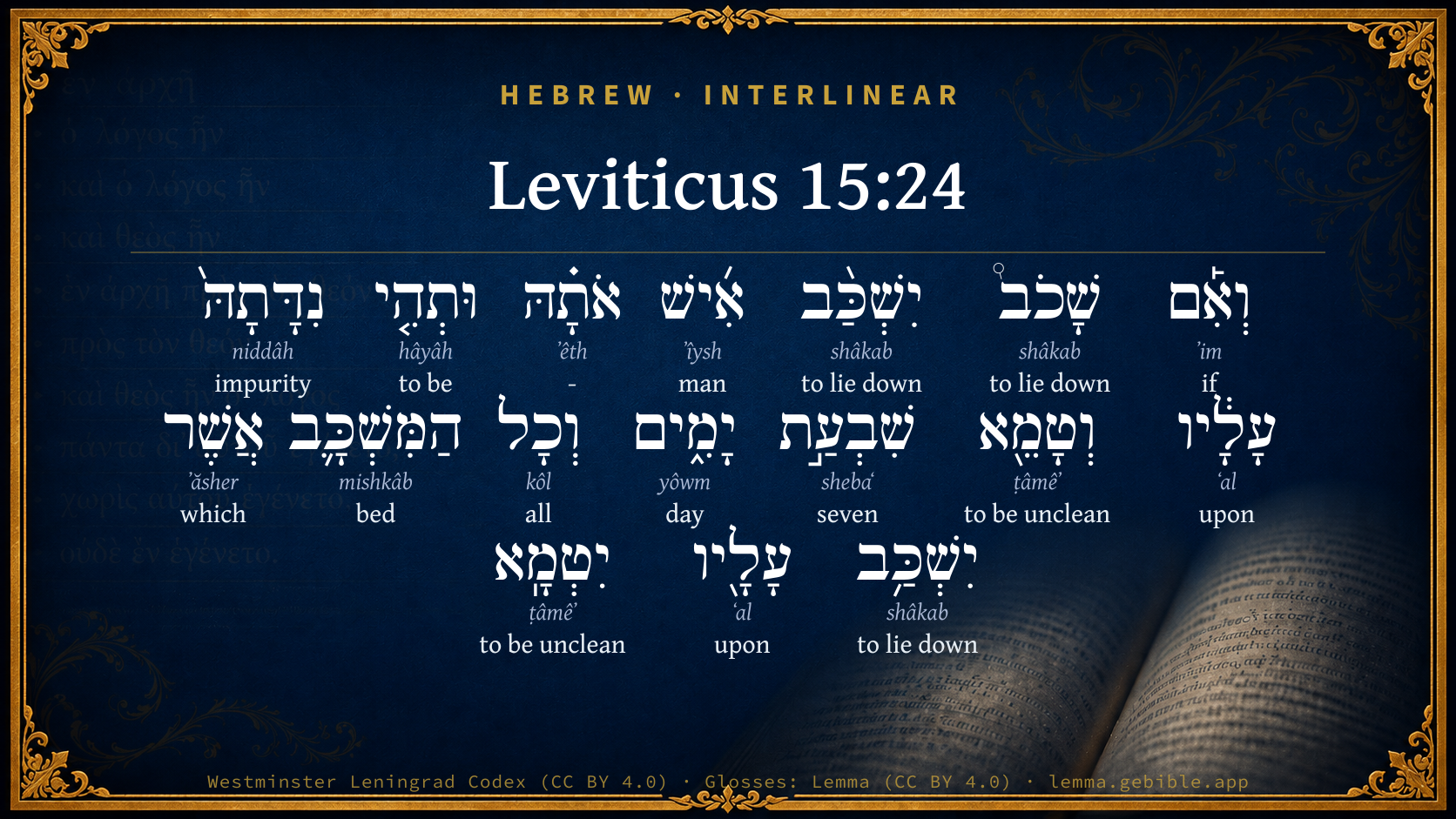
Hebrew (Westminster Leningrad Codex) Leviticus 15:24 appears in the Hebrew Old Testament. The text above is from the Westminster Leningrad Codex. Each word links to its Strong’s number, a concise gloss, and parsing drawn from the Open Scriptures Hebrew Bible morphology. Click any word for its full Brown-Driver-Briggs (BDB) entry.
Download image
Cite this verse

Leviticus 15:24 (World English Bible). Public Domain. Lemma interlinear Bible study tool, https://lemma.gebible.app/v/leviticus/15/24.

Show BibTeX & RIS
BibTeX
RIS
English Translation
"'If any man lies with her, and her monthly flow is on him, he shall be unclean seven days; and every bed whereon he lies shall be unclean.
World English Bible · Public Domain
Download a study sheet

One document with this verse’s original text, its word-by-word gloss line, the meaning frame, cross-references with their text, attributed commentary, and full source and license credits — printable, and it pastes into notes with its structure intact.

This verse Autodidact and up

Study sheet (.html) Plain text (.txt)

A passage Seminary Student

Up to 50 verses in one chapter. A passage sheet keeps up to 6 commentary sources and 12 cross-references per verse, in the order this page ranks them, and says so on the sheet whenever that leaves anything out. Ask for a single verse and you get the Autodidact verse sheet above.

Everything on this page stays free to read, with no account — the sheet is a download of what is already on screen, not access to it.

Want to remove ads? Support Godless Engineer
Compare translations 3

The same verse in 3 English versions, stacked beneath the original-language interlinear above. Click any original word for its lexicon entry.

Each is an independent rendering of the whole verse — the interlinear is not word-aligned to these translations.

Highlighted words mark where these versions differ — a whole-verse word diff, not a word-by-word alignment.

  • World English Bible Public Domain
    "'If any man lies with her, and her monthly flow is on him, he shall be unclean seven days; and every bed whereon he lies shall be unclean.
  • King James Version Public Domain
    And if any man lie with her at all, and her flowers be upon him, he shall be unclean seven days; and all the bed whereon he lieth shall be unclean.
  • unfoldingWord Literal Text CC BY-SA 4.0
    And if, lying, a man lies with her, and her menstruation is on him, then he shall be unclean seven days, and every bed on which he lies shall be unclean.

unfoldingWord Literal Text — © unfoldingWord, licensed CC BY-SA 4.0. Word-aligned USFM3 via Door43 (git.door43.org/unfoldingWord/en_ult).

Versions to compare (up to 4)

3 of 4 selected

Show all 18 translations

Every available English version of this verse, each an independent rendering of the whole verse.

  • World English Bible Public Domain
    "'If any man lies with her, and her monthly flow is on him, he shall be unclean seven days; and every bed whereon he lies shall be unclean.
  • Berean Standard Bible Public Domain
    If a man lies with her and her menstrual flow touches him, he will be unclean for seven days, and any bed on which he lies will become unclean.
  • Majority Standard Bible Public Domain
    If a man lies with her and her menstrual flow touches him, he will be unclean for seven days, and any bed on which he lies will become unclean.
  • King James Version Public Domain
    And if any man lie with her at all, and her flowers be upon him, he shall be unclean seven days; and all the bed whereon he lieth shall be unclean.
  • American Standard Version (1901) Public Domain
    And if any man lie with her, and her impurity be upon him, he shall be unclean seven days; and every bed whereon he lieth shall be unclean.
  • Revised Version (1885) Public Domain
    And if any man lie with her, and her impurity be upon him, he shall be unclean seven days; and every bed whereon he lieth shall be unclean.
  • Geneva Bible (1599) Public Domain
    And if a man lye with her, and the flowers of her separation touch him, he shalbe vncleane seuen dayes, and all the whole bed whereon he lieth, shalbe vncleane.
  • Douay-Rheims (1899) Public Domain
    If a man copulateth with her in the time of her flowers, he shall be unclean seven days: and every bed on which he shall sleep shall be defiled.
  • Young's Literal Translation Public Domain
    `And if a man really lie with her, and her separation is on him, then he hath been unclean seven days, and all the bed on which he lieth is unclean.
  • Literal Standard Version CC BY-SA 4.0
    And if a man really lies with her, and her separation is on him, then he has been unclean [for] seven days, and all the bed on which he lies is unclean.
  • Unlocked Literal Bible CC BY-SA 4.0
    If any man sleeps with her, and if her impure flow touches him, he will be unclean for seven days. Every bed on which he lies will be unclean.
  • unfoldingWord Literal Text CC BY-SA 4.0
    And if, lying, a man lies with her, and her menstruation is on him, then he shall be unclean seven days, and every bed on which he lies shall be unclean.
  • Darby Bible Public Domain
    And if a man lie with her at all, and the uncleanness of her separation come upon him, he shall be unclean seven days; and every bed whereon he lieth shall be unclean.
  • World Messianic Bible Public Domain
    “‘If any man lies with her, and her monthly flow is on him, he shall be unclean seven days; and every bed he lies on shall be unclean.
  • Webster's Bible Public Domain
    And if any man shall lie with her at all, and her flowers be upon him, he shall be unclean seven days: and all the bed on which he lieth shall be unclean.
  • Free Bible Version CC BY-SA 4.0
    If a man sleeps with her and the blood from her period touches him, he will be unclean for seven days, and any bed he lies on will be unclean.
  • Bible in Basic English Public Domain
    And if any man has sex relations with her so that her blood comes on him, he will be unclean for seven days and every bed on which he has been resting will be unclean.
  • JPS Tanakh (1917) Public Domain
    And if any man lie with her, and her impurity be upon him, he shall be unclean seven days; and every bed whereon he lieth shall be unclean.

Literal Standard Version (2020), Covenant Press — licensed CC BY-SA 4.0. Text via the HelloAO Bible API (eBible.org). Unlocked Literal Bible (unfoldingWord) — licensed CC BY-SA 4.0. Text via the HelloAO Bible API (eBible.org). unfoldingWord Literal Text — © unfoldingWord, licensed CC BY-SA 4.0. Word-aligned USFM3 via Door43 (git.door43.org/unfoldingWord/en_ult). Free Bible Version, Dr. Jonathan Gallagher — licensed CC BY-SA 4.0. Text via the HelloAO Bible API (eBible.org).

Word by word

More ways to search: Search by grammar → Find every occurrence → Compare this word →

Practice this passage: Drill this verse → Learn its vocabulary →

נִדָּתָהּ֙
niddâh
H5079
“impurity · her”
Noun, Common, Feminine, Singular, Construct + Suffix, Personal, 3rd Person, Feminine, Singular
Part of Speech
Noun
Type
Common
Gender
Feminine
Number
Singular
State
Construct
Full BDB Definition

Origin: from H5074

TWOT: 1302a

impurity, filthiness, menstruous, set apart - impurity - of ceremonial impurity - of menstruation - impure thing (figuratively) - of idolatry, immorality
  1. וְאִ֡ם ʼim H518 “and · if” Conjunction + Conjunction
  2. שָׁכֹב֩ shâkab H7901 “to lie down” Verb, Qal, Infinitive Absolute
  3. יִשְׁכַּ֨ב shâkab H7901 “to lie down” Verb, Qal, Imperfect, 3rd Person, Masculine, Singular
  4. אִ֜ישׁ ʼîysh H376 “man” Noun, Common, Masculine, Singular, Absolute
  5. אֹתָ֗הּ ʼêth H853 “- · her” Particle, Direct Object + Suffix, Personal, 3rd Person, Feminine, Singular
  6. וּתְהִ֤י hâyâh H1961 “and · to be” Conjunction + Verb, Qal, Jussive, 3rd Person, Feminine, Singular
  7. עָלָ֔יו ʻal H5921 “upon · him” Preposition + Suffix, Personal, 3rd Person, Masculine, Singular
  8. וְטָמֵ֖א ṭâmêʼ H2930 “and · to be unclean” Conjunction + Verb, Qal, Sequential Perfect, 3rd Person, Masculine, Singular
  9. שִׁבְעַ֣ת shebaʻ H7651 “seven” Adjective, Cardinal number, Masculine, Singular, Construct
  10. יָמִ֑ים yôwm H3117 “days” Noun, Common, Masculine, Plural, Absolute
  11. וְכָל kôl H3605 “and · all of” Conjunction + Noun, Common, Masculine, Singular, Construct
  12. הַמִּשְׁכָּ֛ב mishkâb H4904 “the · bed” Particle, Definite Article + Noun, Common, Masculine, Singular, Absolute
  13. אֲשֶׁר ʼăsher H834 “which” Particle, Relative
  14. יִשְׁכַּ֥ב shâkab H7901 “to lie down” Verb, Qal, Imperfect, 3rd Person, Masculine, Singular
  15. עָלָ֖יו ʻal H5921 “upon · him” Preposition + Suffix, Personal, 3rd Person, Masculine, Singular
  16. יִטְמָֽא ṭâmêʼ H2930 “to be unclean” Verb, Qal, Imperfect, 3rd Person, Masculine, Singular

About this verse

These counts appear in no published source. They are computed here, from the morphology-tagged text and Lemma’s own curated glosses. What Lemma adds →

17
words
13
distinct lemmas
Pentateuch
section

Shared distinctive vocabulary

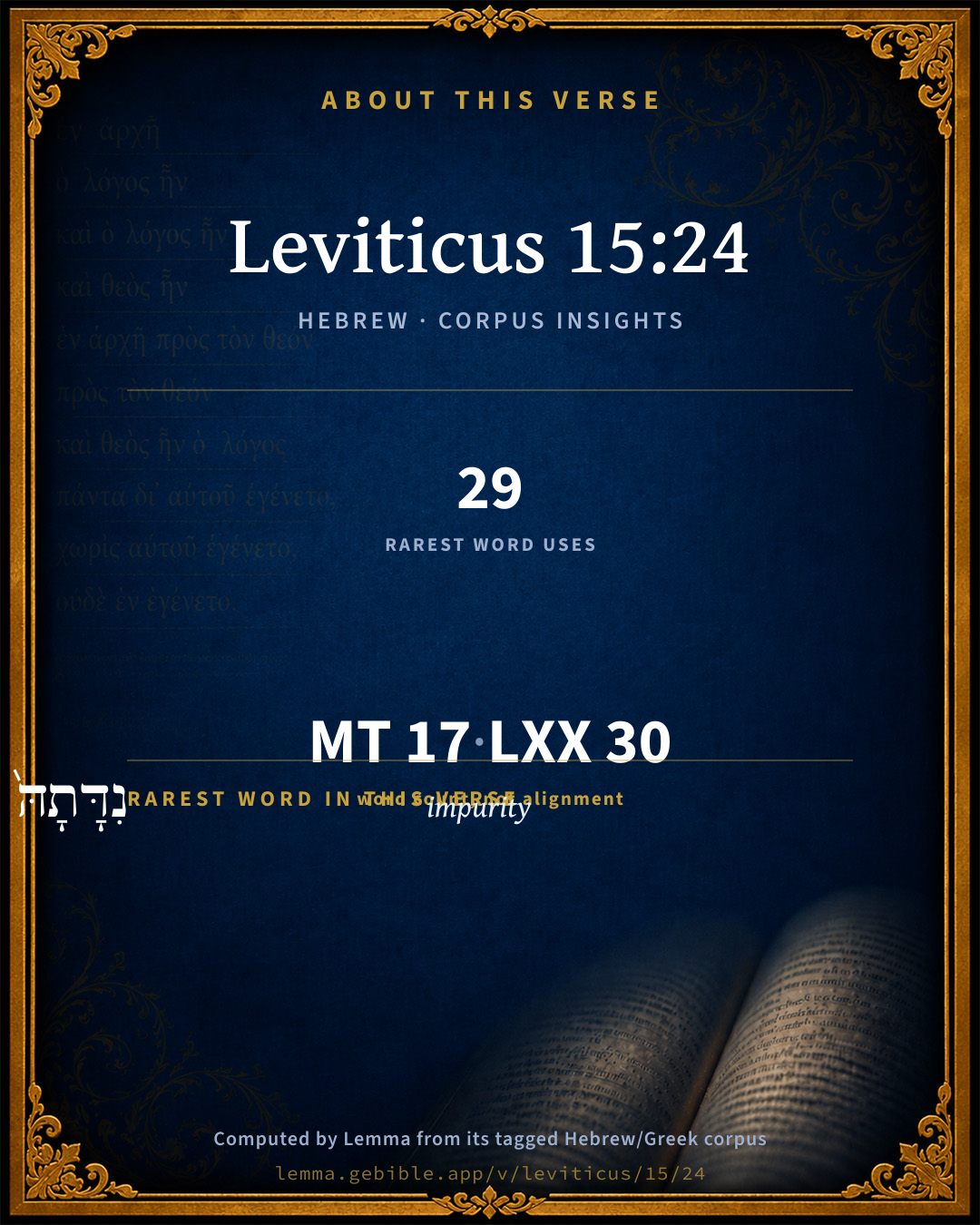
נִדָּתָהּ֙ impurity H5079 occurs in 24 verses of the Hebrew Bible. Also found in:

Grammatical profile

  • 6 verbs
  • 5 nouns
  • 1 adjective
  • 2 prepositions
  • 1 conjunction
  • 2 particles

Verb forms

  • שָׁכֹב֩ Qal · Infinitive Absolute
  • יִשְׁכַּ֨ב Qal · Imperfect
  • וּתְהִ֤י Qal · Jussive
  • וְטָמֵ֖א Qal · Sequential Perfect
  • יִשְׁכַּ֥ב Qal · Imperfect
  • יִטְמָֽא Qal · Imperfect

Repetition

Words recur within this verse — often emphatic in Hebrew:

  • שָׁכֹב֩ to lie down H7901 ×3
  • עָלָ֔יו upon H5921 ×2
  • וְטָמֵ֖א to be unclean H2930 ×2

Hebrew & Septuagint length

In English translation the verse runs 28 words from the Hebrew and 32 from the Septuagint (LXX English) — closely comparable.

A rough comparison of the two English renderings, which tokenize alike — not a word-level alignment.

Word counts can differ between the Hebrew and the Greek without any difference in meaning — e.g. the Hebrew direct-object marker אֵת has no separate Greek word, and Greek often adds the article ὁ.

In the original languages it is 17 Hebrew tokens and 30 Greek tokens — but the two are counted differently (Hebrew bundles its prefixes and suffixes into one token; the Greek is in lemma form), so that isn’t a like-for-like length.

Cross-references

8

Topical passages linked to Leviticus 15:24 in the Treasury of Scripture Knowledge — connected by theme and wording, ordered by reader-vote popularity; previews shown in the World English Bible.

  • Leviticus 20:18 "'If a man lies with a woman having her monthly period, and uncovers her nakedness; he has made naked her fountain, and she has uncovered the fountain of her blood: and both of them shall be cut off from among their people.
  • Leviticus 18:19 "'You shall not approach a woman to uncover her nakedness, as long as she is impure by her uncleanness.
  • 1 Peter 2:11 Beloved, I beg you as foreigners and pilgrims, to abstain from fleshly lusts, which war against the soul;
  • Ezekiel 18:6 and has not eaten on the mountains, neither has lifted up his eyes to the idols of the house of Israel, neither has defiled his neighbor's wife, neither has come near to a woman in her impurity,
  • Hebrews 13:4 Let marriage be held in honor among all, and let the bed be undefiled: but God will judge the sexually immoral and adulterers.
  • Leviticus 15:33 and of her who has her period, and of a man or woman who has a discharge, and of him who lies with her who is unclean.
  • Ezekiel 22:10 In you have they uncovered their fathers' nakedness; in you have they humbled her who was unclean in her impurity.
  • 1 Thessalonians 5:22 Abstain from every form of evil.

Cross-references courtesy of OpenBible.info (CC BY 4.0).

Hebrew and Greek witnesses Masoretic Hebrew ↔ Greek Septuagint

The same verse in the two great witnesses to the Old Testament, shown verse-for-verse.

These are two independent witnesses, not word-aligned to each other, and the Septuagint is shown in lemma (dictionary) form.

Hebrew Leviticus 15:24 Masoretic · Westminster Leningrad Codex

וְאִ֡ם שָׁכֹב֩ יִשְׁכַּ֨ב אִ֜ישׁ אֹתָ֗הּ וּתְהִ֤י נִדָּתָהּ֙ עָלָ֔יו וְטָמֵ֖א שִׁבְעַ֣ת יָמִ֑ים וְכָל הַמִּשְׁכָּ֛ב אֲשֶׁר יִשְׁכַּ֥ב עָלָ֖יו יִטְמָֽא

"'If any man lies with her, and her monthly flow is on him, he shall be unclean seven days; and every bed whereon he lies shall be unclean.

World English Bible · Public Domain

Greek LXX Leviticus 15:24 Septuagint · lemma form

ἐάν δέ κοίτη τις κοιμάω μετά αὐτός καί γίγνομαι ὁ ἀκαθαρσία αὐτός ἐπί αὐτός καί ἀκάθαρτος εἰμί ἑπτά ἡμέρα καί πᾶς κοίτη ἐπί ὅς ἄν κοιμάω ἐπί αὐτός ἀκάθαρτος εἰμί

And if any one shall lie with her, and her uncleanness be upon him, he shall be unclean seven days; and every bed on which he shall have lain shall be unclean.

LXX2012 (modern English Septuagint) · Public Domain

Hebrew: Westminster Leningrad Codex (CC BY 4.0). Greek: Septuagint (public domain); English from LXX2012 (modern English Septuagint) (Public Domain). How the Septuagint differs from the Hebrew →

Targum (Aramaic paraphrase)

2

The Targum is the ancient Jewish Aramaic paraphrase of the Hebrew Scriptures — an interpretive translation, not the Hebrew text itself. Onkelos (literal) and Pseudo-Jonathan (expansive) render the Torah, and Jonathan the Prophets. Coverage is partial: where no permissively-licensed English translation exists for a verse, only the Aramaic is shown. This is verse-level text, not a word-by-word alignment to the Hebrew.

  1. Targum Onkelos Torah (Genesis–Deuteronomy)
    וְאִם מִשְׁכַּב יִשְׁכּוּב גְבַר יָתָהּ וּתְהֵי רִחוּקָהּ עֲלוֹהִי וִיהֵי מְסָאָב שִׁבְעַת יוֹמִין וְכָל מִשְׁכָּב דִי יִשְׁכּוּב עֲלוֹהִי יְהֵי מְסָאָב

    (no public-domain English translation for this verse)

    Targum Onkelos — Aramaic: “Onkelos Genesis” (public domain); “Onkelos Exodus” (public domain); “Onkelos Leviticus” (public domain); “Onkelos Numbers” (public domain); “Onkelos Deuteronomy” (public domain). English: “Sefaria Community Translation” (CC0 1.0 (public-domain dedication)); “J.W. Etheridge. The Targums of Onkelos and Jonathan Ben Uzziel on the Pentateuch. London: Longmans, Green, 1862” (public domain). Text via Sefaria.

  2. Targum Pseudo-Jonathan Torah (Genesis–Deuteronomy)
    וְאִין שַׁמָשָׁא יְשַׁמֵשׁ גְבַר עִמָהּ וְתֶהֱוֵי רִיחוּקָהּ עֲלוֹי וִיהֵי מְסָאָב שׁוּבְעָא יוֹמִין וְכָל מִשְׁכָּבָא דִמְיַיחֵד לְמִשְׁכְּבֵי עֲלוֹי יְהֵי מְסָאָב

    If a man lie with her in the time of her separation, he shall be unclean seven days; and any bed upon which he lieth shall be unclean.

    Targum Pseudo-Jonathan — Aramaic: “Targum Jonathan on Genesis” (public domain); “Targum Jonathan on Exodus” (public domain); “Targum Jonathan on Leviticus” (public domain); “Targum Jonathan on Numbers” (public domain); “Targum Jonathan on Deuteronomy” (public domain). English: “The Targum of Jonathan ben Uzziel, trans. J. W. Etheridge, London, 1862” (public domain). Text via Sefaria.

Commentary

Notes on Leviticus 15:24 from classic Christian and Jewish commentators (each source and its license shown beneath its notes). The classic Christian expositions comment on the surrounding passage and are grouped to its opening verse, so a note may address several verses; the Jewish commentaries on the Tanakh (Rashi and others) are per-verse, so they appear only where the commentator wrote on this verse.

Lemma curates 59 commentaries, every one of them public domain or Creative Commons licensed, each selected and text-cleaned for this edition rather than reprinted as found. About our sources →

Trapp's Complete Commentary

John Trapp

Lev 15:24 And if any man lie with her at all, and her flowers be upon him, he shall be unclean seven days; and all the bed whereon he lieth shall be unclean.

Ver. 24. And if any man lie with her.] Unawares, or secretly. For to do it presumptuously, and upon public notice, it was death. {Lev 20:18 Eze 22:10} And God often punisheth such unclean copulations now-a-days, with monstrous, deformed, or diseased births.

John Trapp, A Commentary or Exposition upon All the Books of the Old and New Testament (1647–1656) — public domain. Text from a community e-Sword module.

Joseph Benson's Commentary

Lev 15:24. Seven days — If he did this ignorantly; but if it were done with his own knowledge, and that of the woman, they were both, after being accused and convicted, to be punished with death, Lev 20:18; for as there was a turpitude in the action, so it would be very prejudicial to the children should any be then begotten, as they would probably be weak or leprous. Hence an excellent author is of opinion that this law was given for this very reason, to prevent the Jews from contracting and propagating some grievous disorder. Moses, or rather God, the author of the Mosaic law, by this prohibition, as in many other instances, consulted the health and safety of his people. To this we may add, that it would have redounded to the dishonour of God, and of the true religion, if the professors thereof should give such public evidence of their intemperance.

Joseph Benson's Commentary on the Old and New Testaments (1811–1818) — public domain. Text from a community e-Sword module.

Tyndale Open Study Notes

Tyndale Open Resources

15:24 Sexual intercourse with a woman during her menstrual period will later be forbidden and given a harsh penalty (18:19). This verse probably describes a case in which the woman’s menstrual flow went unnoticed when the sexual activity began or in which the woman’s period began during intercourse. The regulations required the man who came into contact with her blood to share the woman’s seven-day quarantine.

Tyndale Open Study Notes — © Tyndale Open Resources, licensed CC BY-SA 4.0. Text via the HelloAO Bible API.

Geneva Bible (1599)

Geneva Bible translators

If any of her uncleanness did only touch him in the bed: for else the man that companied with such a woman, should die, Lev. 20:18.

Geneva Bible (1599) marginal notes — public domain. Text via Bolls.life.

Adam Clarke's Commentary

Verse 24. The common sense of all mankind has led them to avoid the gross impropriety referred to in this verse; and it has been a general opinion, that off-spring obtained in this way has been infected with leprous, scrofulous, and other deeply radicated diseases, from which they and their posterity have been scarcely ever freed. In Le 20:18, persons guilty of this are condemned to death; here only to a seven days' separation; because, in the former case, Moses speaks of the act when both the man and woman were acquainted with the situation: in the latter, he speaks of a case where the circumstance was not known till afterwards; at least, so it appears these two places should be understood, so as to be reconciled.

Adam Clarke's Commentary on the Bible (1810–1826) — public domain. Text from a community e-Sword/MySword module.

Ellicott's Commentary for English Readers

(24) And if any man lie with her.—For committing this gross act presumptuously, both parties to it were visited with death. (See Lev_18:19; Lev_20:18.)

A Bible Commentary for English Readers, edited by Charles John Ellicott (1878–1897) — public domain. Text from a community e-Sword module.

The Cambridge Bible for Schools and Colleges

gen. ed. J. J. S. Perowne

24. It is generally supposed that the case treated in this verse is different from that contemplated in Lev_18:19, Lev_20:18. If, as some think, the three passages refer to the same act, they cannot all be from the same source.

The Cambridge Bible for Schools and Colleges (gen. ed. J. J. S. Perowne; Cambridge University Press, 1878–1918) — public domain. Text from a community e-Sword module.

John Gill's Exposition

And if a woman have an issue of her blood many days out of the time of her separation,.... Not an ordinary but an extraordinary one, not within that time, but out of it, and which continued three days at least; so the Targum of Jonathan, and sometimes many years; as the poor woman Christ cured, which she had had twelve years; see Gill on Mat 9:20,

or if it run beyond the time of her separation; beyond the seven days of her separation, and so out of the usual way and time of it; whereby it appears to be somewhat extraordinary and unusual:

all the days of the issue of her uncleanness shall be as the days of her separation: all the while it was upon her, be it ever so many days or years, she was kept apart from her husband, and in all respects in the same condition and circumstances, as in the seven days of her separation because of her monthly courses:

she shall be unclean; as long as it is upon her, and neither be admitted to her husband's bed, nor to the house of God, which made her condition a very deplorable one.

John Gill's Exposition of the Whole Bible (1746–1763) — public domain (CC PDM 1.0). Text via the HelloAO Bible API.

Albert Barnes' Notes on the Bible

This must refer to an unexpected occurrence. Intercourse during the acknowledged period was a heavy crime, and was to be punished by “cutting off” Lev 18:19; Lev 20:18; Eze 18:6.

Albert Barnes' Notes on the Bible (1834–1885) — public domain. Text from a community e-Sword/MySword module.

Haydock's Catholic Bible Commentary

Days, supposing the case was not brought before the judge, and the man did it through ignorance: otherwise it was death, chap. xx. 18.

George Leo Haydock (1774–1849), Haydock's Catholic Family Bible and Commentary, 1859 edition — public domain. Excludes Psalms (Douay-Rheims chapter numbering differs from Protestant) and Deuterocanonical books (Catholic canon only).

Matthew Poole's English Annotations

He shall be unclean seven days, if he did this unwitingly; but if the man and woman did this knowingly, this was a gross sin, Eze 18:6; and they being accused and convicted were punished with death, Lev 20:18; for as there was a turpitude in the action, so it was very prejudicial to the children then begotten, who were commonly weak, or leprous, or otherwise disordered; which was also an injury to the commonwealth of Israel, and redounded to the dishonour of God, and of the true religion, that the professors thereof gave such public evidence of their intemperance.

Matthew Poole's English Annotations on the Holy Bible (1683–1685) — public domain. Text from a community e-Sword/MySword module.

Whedon's Commentary on the Bible

Daniel D. Whedon

24. Flowers — Menstrual impurity ignorantly contracted. See Lev_15:19, note.

Daniel D. Whedon (gen. ed.), Commentary on the Old and New Testaments (1874–1909) — public domain. Text from a community e-Sword module.

John Wesley's Explanatory Notes

Seven days - If he did this ignorantly; but if the man and woman did this knowingly, being accused and convicted, they were punished with death, chap. xx, 18, for as there was a turpitude in the action, so it was very prejudicial to the children then begotten, who were commonly weak, or leprous; which was also an injury to the commonwealth of Israel, and redounded to the dishonour of God and of the true religion, that the professors thereof gave such public evidence of their intemperance.

John Wesley, Explanatory Notes Upon the Whole Bible (1754–1765) — public domain. Text via the GEBible commentary corpus.

Keil & Delitzsch

C. F. Keil & F. Delitzsch

If a man lay with her and her uncleanness came upon him, he became unclean for seven days, and the bed upon which he lay became unclean as well. The meaning cannot be merely if he lie upon the same bed with her, but if he have conjugal intercourse, as is evident from Lev 20:18 and Num 5:13 (cf. Gen 26:10; Gen 34:2; Gen 35:22; Sa1 2:22). It cannot be adduced as an objection to this explanation, which is the only admissible one, that according to Lev 18:19 and Lev 20:18 intercourse with a woman during her menses was an accursed crime, to be punished by extermination. For the law in Lev 20:18 refers partly to conjugal intercourse during the hemorrhage of a woman after child-birth, as the similarity of the words in Lev 20:18 and Lev 12:7 (דּמיה מקור) clearly proves, and to the case of a man attempting cohabitation with a woman during her menstruation. The verse before us, on the contrary, refers simply to the possibility of menstruation commencing during the act of conjugal intercourse, when the man would be involuntarily defiled through the unexpected uncleanness of the woman.

Keil & Delitzsch — Biblical Commentary on the Old Testament (1861–1891) — public domain (CC PDM 1.0). Text via the HelloAO Bible API. (Old Testament only.)

unfoldingWord translationNotes

Door43 World Missions Community

her impure flow

"her unclean flow" or "the blood from her womb"

will be unclean

People and objects that other people must not touch are spoken of as if they were physically unclean. (See: Metaphor)

translationWords

had relations with

unfoldingWord translationNotes — © Distant Shores Media and the Door43 World Missions Community, licensed CC BY-SA 4.0. Source: git.door43.org/Door43/en_tn.

Rashi

Rabbi Shlomo Yitzchaki (Rashi)

ותהי נדתה עליו [AND IF ANY MAN LIE WITH HER AT ALL] THEN SHALL HER UNCLEANLINESS OF SEPARATION BE UPON HIM — One might think that he follows in her wake — that if he had intercourse with her e. g. on the fifth day of her separation he shall become unclean for three days only (for the fifth, sixth and seventh) like herself (i. e. because these are the remaining days during which she is unclean)! Scripture, however, states: "he shall be unclean seven days”. Therefore these words cannot refer to the duration of her uncleanness. What then is the force of ותהי נדתה עליו? They mean: her state of uncleanness as a נדה shall be upon him. How is it in the case of her? She, being an אב הטומאה, makes man unclean, and also earthen vessels by means of ‎‎היסט! So, too, he becomes an אב הטומאה (not a ולד הטומאה), and makes man unclean, and also earthen vessels by means‎ of היסט! (Niddah 33a)

Rashi on the Tanakh — English translations: “The Judaica Press complete Tanach with Rashi, translated by A. J. Rosenberg” (CC BY 4.0); “Pentateuch with Rashi's commentary by M. Rosenbaum and A.M. Silbermann, 1929-1934” (public domain); “The Metsudah Tanach series, Lakewood, N.J” (CC BY 4.0); and “The Book of Joshua, Metsudah Publications, 1997” (CC BY 4.0). Text via Sefaria.

Lesson kit

Teaching starters — assembled from the data on this page, not authored interpretation. Every prompt links to the verse data it draws on. Edit before teaching.

Leviticus, in the Pentateuch, opens this verse with 17 words (13 distinct Hebrew lemmas). Its most distinctive word is niddâh (“impurity”). A historical commentator’s framing appears above. Read the whole chapter for the surrounding context.

Discussion questions

  1. What does “impurity” (niddâh) contribute to the verse as a whole?
  2. Leviticus 12:2 shares the word «impurity» with this verse. How do the two illuminate each other?
  3. “to lie down” occurs 3× in this one verse. What is the effect of the repetition?
  4. These translations render this verse differently. What is at stake in choosing one wording over another?
  5. The verb «שָׁכֹב֩» is Qal Infinitive Absolute. How does its form color the action?
  6. Reading how Trapp's Complete Commentary and Joseph Benson's Commentary read this verse, where do the two commentators agree and where do they part?

Things to notice

Reading settings

Reading text

Shown beneath each verse's original-language words.

Old Testament
Old Testament edition

Read the OT as the Masoretic Hebrew (MT) or the Greek Septuagint (LXX).

English shown for the Greek Septuagint (in the Hebrew ↔ Greek comparison).

Comparing translations? Open the Compare panel on any verse page to stack up to four side by side.