Numbers 26:51

Hebrew (Westminster Leningrad Codex) Numbers 26:51 appears in the Hebrew Old Testament. The text above is from the Westminster Leningrad Codex. Each word links to its Strong’s number, a concise gloss, and parsing drawn from the Open Scriptures Hebrew Bible morphology. Click any word for its full Brown-Driver-Briggs (BDB) entry.
Download image
Cite this verse

Numbers 26:51 (World English Bible). Public Domain. Lemma interlinear Bible study tool, https://lemma.gebible.app/v/numbers/26/51.

Show BibTeX & RIS
BibTeX
RIS
English Translation
These are those who were numbered of the children of Israel, six hundred one thousand seven hundred thirty.
World English Bible · Public Domain
Download a study sheet

One document with this verse’s original text, its word-by-word gloss line, the meaning frame, cross-references with their text, attributed commentary, and full source and license credits — printable, and it pastes into notes with its structure intact.

This verse Autodidact and up

Study sheet (.html) Plain text (.txt)

A passage Seminary Student

Up to 50 verses in one chapter. A passage sheet keeps up to 6 commentary sources and 12 cross-references per verse, in the order this page ranks them, and says so on the sheet whenever that leaves anything out. Ask for a single verse and you get the Autodidact verse sheet above.

Everything on this page stays free to read, with no account — the sheet is a download of what is already on screen, not access to it.

Want to remove ads? Support Godless Engineer
Compare translations 3

The same verse in 3 English versions, stacked beneath the original-language interlinear above. Click any original word for its lexicon entry.

Each is an independent rendering of the whole verse — the interlinear is not word-aligned to these translations.

Highlighted words mark where these versions differ — a whole-verse word diff, not a word-by-word alignment.

  • World English Bible Public Domain
    These are those who were numbered of the children of Israel, six hundred one thousand seven hundred thirty.
  • King James Version Public Domain
    These were the numbered of the children of Israel, six hundred thousand and a thousand seven hundred and thirty.
  • unfoldingWord Literal Text CC BY-SA 4.0
    These were the counted ones of the sons of Israel: 601, 730.

unfoldingWord Literal Text — © unfoldingWord, licensed CC BY-SA 4.0. Word-aligned USFM3 via Door43 (git.door43.org/unfoldingWord/en_ult).

Versions to compare (up to 4)

3 of 4 selected

Show all 18 translations

Every available English version of this verse, each an independent rendering of the whole verse.

  • World English Bible Public Domain
    These are those who were numbered of the children of Israel, six hundred one thousand seven hundred thirty.
  • Berean Standard Bible Public Domain
    These men of Israel numbered 601,730 in all.
  • Majority Standard Bible Public Domain
    These men of Israel numbered 601,730 in all.
  • King James Version Public Domain
    These were the numbered of the children of Israel, six hundred thousand and a thousand seven hundred and thirty.
  • American Standard Version (1901) Public Domain
    These are they that were numbered of the children of Israel, six hundred thousand and a thousand seven hundred and thirty.
  • Revised Version (1885) Public Domain
    These are they that were numbered of the children of Israel, six hundred thousand and a thousand seven hundred and thirty.
  • Geneva Bible (1599) Public Domain
    These are the nombers of the children of Israel: sixe hundreth and one thousand, seuen hundreth and thirtie.
  • Douay-Rheims (1899) Public Domain
    This is the sum of the children of Israel, that were reckoned up, six hundred and one thousand seven hundred and thirty.
  • Young's Literal Translation Public Domain
    These `are' numbered ones of the sons of Israel, six hundred thousand, and a thousand, seven hundred and thirty.
  • Literal Standard Version CC BY-SA 4.0
    These [are] numbered ones of the sons of Israel—six hundred thousand and one thousand seven hundred and thirty.
  • Unlocked Literal Bible CC BY-SA 4.0
    This was the complete count of men among the people of Israel: 601,730.
  • unfoldingWord Literal Text CC BY-SA 4.0
    These were the counted ones of the sons of Israel: 601, 730.
  • Darby Bible Public Domain
    These were the numbered of the children of Israel, six hundred and one thousand seven hundred and thirty.
  • World Messianic Bible Public Domain
    These are those who were counted of the children of Israel, six hundred one thousand seven hundred thirty.
  • Webster's Bible Public Domain
    These were the numbered of the children of Israel, six hundred thousand and a thousand seven hundred and thirty.
  • Free Bible Version CC BY-SA 4.0
    The total of all those counted was 601,730.
  • Bible in Basic English Public Domain
    Those who were numbered of the children of Israel were six hundred and one thousand, seven hundred and thirty.
  • JPS Tanakh (1917) Public Domain
    These are they that were numbered of the children of Israel, six hundred thousand and a thousand and seven hundred and thirty.

Literal Standard Version (2020), Covenant Press — licensed CC BY-SA 4.0. Text via the HelloAO Bible API (eBible.org). Unlocked Literal Bible (unfoldingWord) — licensed CC BY-SA 4.0. Text via the HelloAO Bible API (eBible.org). unfoldingWord Literal Text — © unfoldingWord, licensed CC BY-SA 4.0. Word-aligned USFM3 via Door43 (git.door43.org/unfoldingWord/en_ult). Free Bible Version, Dr. Jonathan Gallagher — licensed CC BY-SA 4.0. Text via the HelloAO Bible API (eBible.org).

Word by word

More ways to search: Search by grammar → Find every occurrence → Compare this word →

Practice this passage: Drill this verse → Learn its vocabulary →

וּשְׁלֹשִֽׁים
shᵉlôwshîym
H7970
“and · thirty”
Conjunction + Adjective, Cardinal number, Both, Plural, Absolute
Part of Speech
Conjunction + Adjective
Type
Cardinal number
Gender
Both
Number
Plural
State
Absolute
Full BDB Definition

Origin: multiple of H7969

TWOT: 2403d

thirty, thirtieth
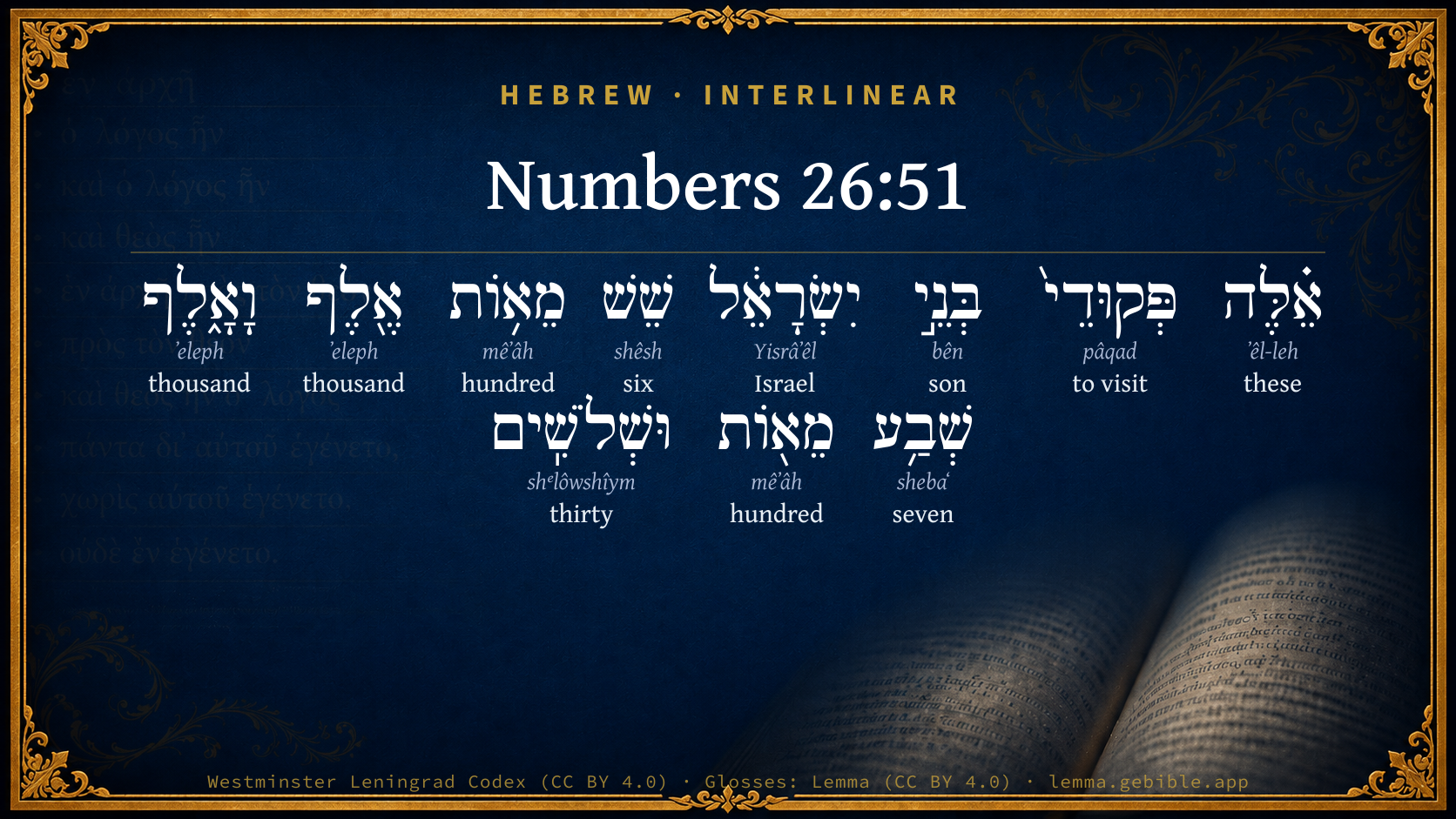
  1. אֵ֗לֶּה ʼêl-leh H428 “these” Pronoun, Demonstrative, Common, Plural
  2. פְּקוּדֵי֙ pâqad H6485 “visited” Verb, Qal, Participle Passive, Masculine, Plural, Construct
  3. בְּנֵ֣י bên H1121 “sons of” Noun, Common, Masculine, Plural, Construct
  4. יִשְׂרָאֵ֔ל Yisrâʼêl H3478 “Israel” Noun, Proper
  5. שֵׁשׁ shêsh H8337 “six” Adjective, Cardinal number, Feminine, Singular, Absolute
  6. מֵא֥וֹת mêʼâh H3967 “hundred” Adjective, Cardinal number, Both, Plural, Absolute
  7. אֶ֖לֶף ʼeleph H505 “thousand” Adjective, Cardinal number, Both, Singular, Absolute
  8. וָאָ֑לֶף ʼeleph H505 “and · thousand” Conjunction + Adjective, Cardinal number, Both, Singular, Absolute
  9. שְׁבַ֥ע shebaʻ H7651 “seven” Adjective, Cardinal number, Feminine, Singular, Absolute
  10. מֵא֖וֹת mêʼâh H3967 “hundred” Adjective, Cardinal number, Both, Plural, Absolute

About this verse

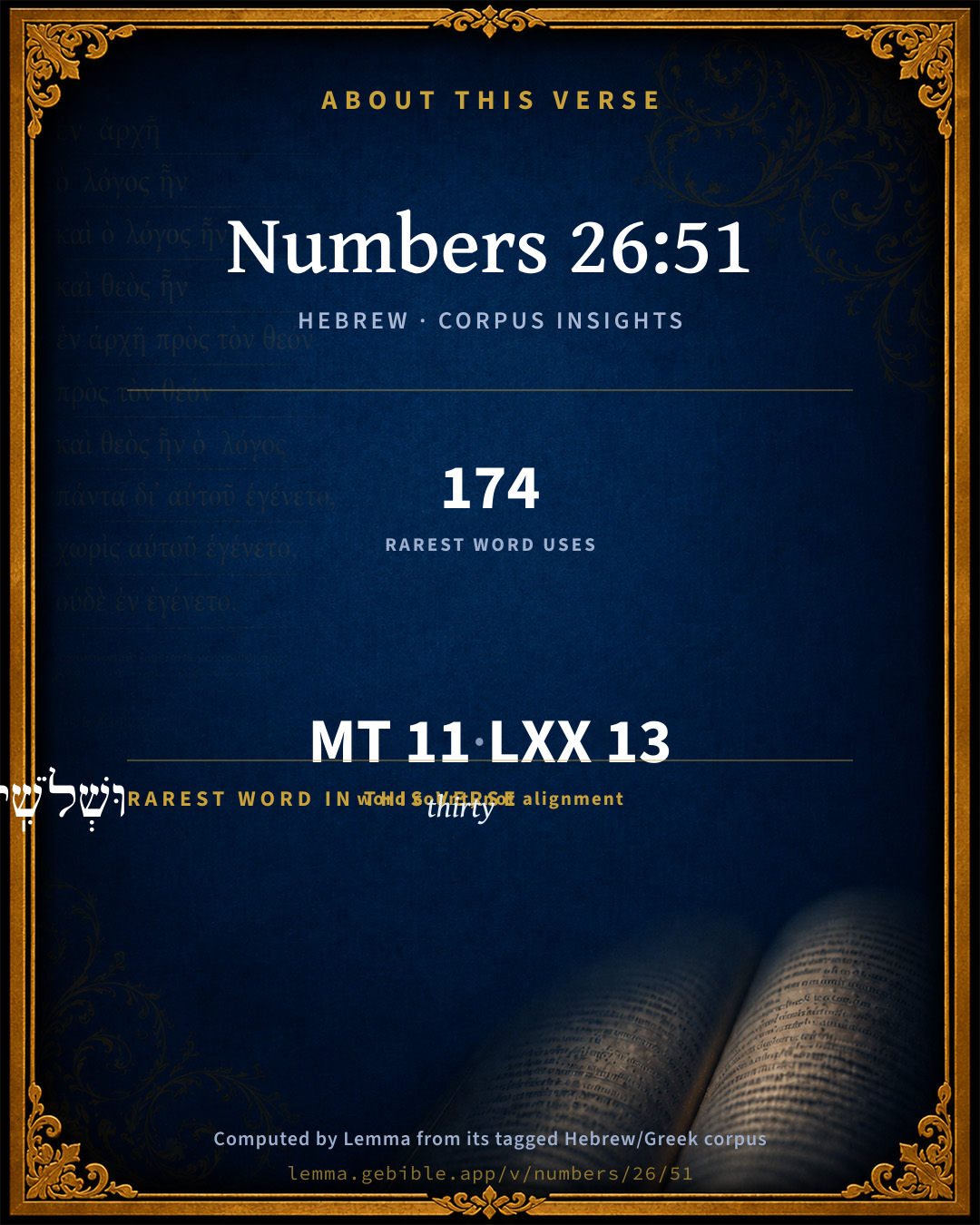
These counts appear in no published source. They are computed here, from the morphology-tagged text and Lemma’s own curated glosses. What Lemma adds →

11
words
9
distinct lemmas
Pentateuch
section

Grammatical profile

  • 1 verb
  • 2 nouns
  • 7 adjectives
  • 1 pronoun

Verb forms

  • פְּקוּדֵי֙ Qal · Participle Passive

Repetition

Words recur within this verse — often emphatic in Hebrew:

  • מֵא֥וֹת hundred H3967 ×2
  • אֶ֖לֶף thousand H505 ×2

Hebrew & Septuagint length

In English translation the verse runs 18 words from the Hebrew and 19 from the Septuagint (LXX English) — closely comparable.

A rough comparison of the two English renderings, which tokenize alike — not a word-level alignment.

Word counts can differ between the Hebrew and the Greek without any difference in meaning — e.g. the Hebrew direct-object marker אֵת has no separate Greek word, and Greek often adds the article ὁ.

In the original languages it is 11 Hebrew tokens and 13 Greek tokens — but the two are counted differently (Hebrew bundles its prefixes and suffixes into one token; the Greek is in lemma form), so that isn’t a like-for-like length.

Cross-references

10

Topical passages linked to Numbers 26:51 in the Treasury of Scripture Knowledge — connected by theme and wording, ordered by reader-vote popularity; previews shown in the World English Bible.

  • Numbers 1:46 even all those who were numbered were six hundred three thousand five hundred fifty.
  • Exodus 12:37 The children of Israel traveled from Rameses to Succoth, about six hundred thousand on foot who were men, besides children.
  • Exodus 38:26 a beka a head, that is, half a shekel, after the shekel of the sanctuary, for everyone who passed over to those who were numbered, from twenty years old and upward, for six hundred three thousand five hundred fifty men.
  • Numbers 2:32 These are those who were numbered of the children of Israel by their fathers' houses. All who were numbered of the camps according to their hosts were six hundred three thousand five hundred fifty.
  • Numbers 11:21 Moses said, The people, among whom I am, are six hundred thousand footmen; and you have said, I will give them flesh, that they may eat a whole month.
  • Nehemiah 9:23 Their children also multiplied you as the stars of the sky, and brought them into the land concerning which you did say to their fathers, that they should go in to possess it.
  • Job 12:9–10 Who doesn't know that in all these, The hand of Yahweh has done this,
  • Job 12:14 Behold, he breaks down, and it can't be built again; He imprisons a man, and there can be no release.
  • Job 12:20–23 He removes the speech of those who are trusted, And takes away the understanding of the elders.
  • Psalms 77:20 You led your people like a flock, By the hand of Moses and Aaron.

Cross-references courtesy of OpenBible.info (CC BY 4.0).

Hebrew and Greek witnesses Masoretic Hebrew ↔ Greek Septuagint

The same verse in the two great witnesses to the Old Testament, shown verse-for-verse.

These are two independent witnesses, not word-aligned to each other, and the Septuagint is shown in lemma (dictionary) form.

Hebrew Numbers 26:51 Masoretic · Westminster Leningrad Codex

אֵ֗לֶּה פְּקוּדֵי֙ בְּנֵ֣י יִשְׂרָאֵ֔ל שֵׁשׁ מֵא֥וֹת אֶ֖לֶף וָאָ֑לֶף שְׁבַ֥ע מֵא֖וֹת וּשְׁלֹשִֽׁים

These are those who were numbered of the children of Israel, six hundred one thousand seven hundred thirty.

World English Bible · Public Domain

Greek LXX Numbers 26:51 Septuagint · lemma form

οὗτος ὁ ἐπίσκεψις υἱός ἰσραήλ ἑξακόσιοι χιλιάς καί χίλιοι καί ἑπτακόσιοι καί τριάκοντα

This is the numbering of the children of Israel, six hundred and one thousand and seven hundred and thirty.

LXX2012 (modern English Septuagint) · Public Domain

Hebrew: Westminster Leningrad Codex (CC BY 4.0). Greek: Septuagint (public domain); English from LXX2012 (modern English Septuagint) (Public Domain). How the Septuagint differs from the Hebrew →

Targum (Aramaic paraphrase)

2

The Targum is the ancient Jewish Aramaic paraphrase of the Hebrew Scriptures — an interpretive translation, not the Hebrew text itself. Onkelos (literal) and Pseudo-Jonathan (expansive) render the Torah, and Jonathan the Prophets. Coverage is partial: where no permissively-licensed English translation exists for a verse, only the Aramaic is shown. This is verse-level text, not a word-by-word alignment to the Hebrew.

  1. Targum Onkelos Torah (Genesis–Deuteronomy)
    אִלֵין מִנְיָנֵי בְּנֵי יִשְׂרָאֵל שִׁית מְאָה וְחַד אַלְפִין שְׁבַע מְאָה וּתְלָתִין

    (no public-domain English translation for this verse)

    Targum Onkelos — Aramaic: “Onkelos Genesis” (public domain); “Onkelos Exodus” (public domain); “Onkelos Leviticus” (public domain); “Onkelos Numbers” (public domain); “Onkelos Deuteronomy” (public domain). English: “Sefaria Community Translation” (CC0 1.0 (public-domain dedication)); “J.W. Etheridge. The Targums of Onkelos and Jonathan Ben Uzziel on the Pentateuch. London: Longmans, Green, 1862” (public domain). Text via Sefaria.

  2. Targum Pseudo-Jonathan Torah (Genesis–Deuteronomy)
    אִלֵין סְכוּמֵי בְּנֵי יִשְרָאֵל שִׁית מְאָה וְחַד אַלְפִין וּשְׁבַע מְאָה וּתְלָתִין

    These are the numbers of the sons of Israel, six hundred and one thousand seven hundred and thirty.

    Targum Pseudo-Jonathan — Aramaic: “Targum Jonathan on Genesis” (public domain); “Targum Jonathan on Exodus” (public domain); “Targum Jonathan on Leviticus” (public domain); “Targum Jonathan on Numbers” (public domain); “Targum Jonathan on Deuteronomy” (public domain). English: “The Targum of Jonathan ben Uzziel, trans. J. W. Etheridge, London, 1862” (public domain). Text via Sefaria.

Commentary

Notes on Numbers 26:51 from classic Christian and Jewish commentators (each source and its license shown beneath its notes). The classic Christian expositions comment on the surrounding passage and are grouped to its opening verse, so a note may address several verses; the Jewish commentaries on the Tanakh (Rashi and others) are per-verse, so they appear only where the commentator wrote on this verse.

Lemma curates 59 commentaries, every one of them public domain or Creative Commons licensed, each selected and text-cleaned for this edition rather than reprinted as found. About our sources →

Joseph Benson's Commentary

Num 26:51. Six hundred thousand and a thousand seven hundred, &c. — Very nigh as many as they were before, Num 1:46. So wisely and marvellously did God at the same time manifest his justice in cutting off so vast a number, his mercy in giving such a speedy and numerous supply, and his truth in both.

Joseph Benson's Commentary on the Old and New Testaments (1811–1818) — public domain. Text from a community e-Sword module.

Tyndale Open Study Notes

Tyndale Open Resources

26:51 In spite of warfare, plagues, and punishments, God had been faithful to Israel. The number of male warriors had shrunk by 1,820 compared to the first registration (cp. 2:32), a difference of 0.3 percent.

Tyndale Open Study Notes — © Tyndale Open Resources, licensed CC BY-SA 4.0. Text via the HelloAO Bible API.

Geneva Bible (1599)

Geneva Bible translators

This is the third time that they are numbered.

Geneva Bible (1599) marginal notes — public domain. Text via Bolls.life.

Adam Clarke's Commentary

Verse 51. These were the numbered of the children of Israel, six hundred thousand and a thousand seven hundred and thirty.] The following comparative statement will show how much some of the tribes had increased, and others had diminished, since the enumeration in Nu 1:2, c.

Now

Before

Reuben

43,730

46,500

2,770

decrease

Simeon

22,200

59,300

37,100

decrease

Gad

40,500

45,650

5,150

decrease

Judah

76,500

74,600

1,900

increase

Issachar

64,300

54,400

9,900

increase

Zebulun

60,500

57,400

3,100

increase

Manasseh

52,700

32,200

20,500

increase

Ephraim

32,500

40,500

8,000

decrease

Benjamin

45,600

35,400

10,200

increase

Dan

64,400

62,700

1,700

increase

Asher

53,400

41,500

11,900

increase

Naphtali

45,400

53,400

8,000

decrease

Total

601,730

603,550

1,820

decrease on the whole, in 38 years.

Decrease in all, 61,020.

Increase in all, 59,200.

Let it be observed,

1. That among these there was not a man of the former census, save Joshua and Caleb, see Nu 26:64-65.

2. That though there was an increase in seven tribes of not less than 74,800 men, yet so great was the decrease in the other five tribes, that the balance against the present census is 1,820, as appears above: thus we find that there was an in crease of 601,728 from 603,550 in the space of thirty-eight years.

Notwithstanding the amazing increase in some and decrease in other tribes, the same sort of proportion is preserved in the east, west, north, and south divisions, as before so as to keep the division of Judah, which was always in the front or van, the largest; and the division of Dan, which was always in the rear, the next in number. But it is worthy of remark that as they are now, properly speaking, to commence their grand military operations, so their front, or advanced division, is increased from 186,400 to 201,300; and their rear from 157,600 to 163,200. The first division is strengthened 14,900 men, and the last division 5,600 men. The reasons for this are sufficiently obvious.

Mr. Ainsworth has a curious remark on the number of families in the 12 tribes. "Here are families

1. Of Manasseh

8

7. Of Reuben

4

2. Of Benjamin

7

8. Of Issachar

4

3. Of Gad

7

9. Of Ephraim

4

4. Of Simeon

5

10. Of Naphtali

4

5. Of Judah

5

11. Of Zebulun

3

6. Of Asher

5

12. Of Dan

1

"In all 57; to whom if we add the 12 patriarchs, and Jacob their father, the whole number is 70, the exact number of the souls in Jacob's house that went down to Egypt, Ge 46:27." In a variety of things in this ancient economy there is a most surprising proportion kept up, which never could have been a fortuitous effect of general causes. But proportion, harmony, and order distinguish all the works of God, both in the natural and moral world.

Adam Clarke's Commentary on the Bible (1810–1826) — public domain. Text from a community e-Sword/MySword module.

Ellicott's Commentary for English Readers

(51) Six hundred thousand and a thousand seven hundred and thirty.—The sum total exhibits a decrease of 1,820, as compared with the census taken at Sinai thirty-eight years previously. On this decrease Bishop Wordsworth observes as follows:—“When the Israelites were suffering persecution in Egypt they ‘multiplied exceedingly’ (Exo_1:7; Exo_1:20); but after their deliverance from Egypt they rebelled against God, and ‘He consumed their days in vanity, and their years in trouble’ (Psa_78:33). . . . Here there is comfort and warning to the Church and every soul in it—comfort in time of affliction, and warning in days of prosperity.”

A Bible Commentary for English Readers, edited by Charles John Ellicott (1878–1897) — public domain. Text from a community e-Sword module.

John Gill's Exposition

But among these there was not a man of them whom Moses and Aaron the priest numbered..... About thirty eight years before this time: this, as Aben Ezra observes, respects the numbering of the Israelites, not of the Levites; for there were some of the tribe of Levi numbered then who were living, as Eleazar, and very probably Ithamar, and perhaps some few more, though it may be Eleazar, being now a numberer, was not reckoned among the numbered:

when they numbered the children of Israel in the wilderness of Sinai; see Num 1:1 for as there were none of the tribe of Levi among the spies, there might be but few of them among the murmurers.

John Gill's Exposition of the Whole Bible (1746–1763) — public domain (CC PDM 1.0). Text via the HelloAO Bible API.

Albert Barnes' Notes on the Bible

This shows a decrease of 1,820 from the number at Sinai; a decrease due to the recent plague.

Albert Barnes' Notes on the Bible (1834–1885) — public domain. Text from a community e-Sword/MySword module.

Matthew Poole's English Annotations

Very nigh as many as there were before, Num 1:46. So wisely and marvellously did God at the same time manifest his justice in cutting off so vast a number, and his mercy in giving such a speedy and numerous supply, and his truth in both.

Matthew Poole's English Annotations on the Holy Bible (1683–1685) — public domain. Text from a community e-Sword/MySword module.

Whedon's Commentary on the Bible

Daniel D. Whedon

51. These were the numbered — The results of the two enumerations are tabulated by tribes and in their totals in chap. Num_1:21, note. The decrease was caused in part by the judgments of Jehovah sweeping off thousands at a stroke, (Num_11:1-3; Num_11:33-35; Num_16:31-35; Num_16:49; Num_25:9,) and partly by hardships endured while under the sentence of exclusion from Canaan. Num_14:32-33.

Reuben2,770 decrease.Simeon37,100 decrease.Gad5,150 decrease.Judah1,900 increase.Issachar9,900 increase.Zebulun3,100 increase.Manasseh20,500 increase.Ephraim8,000 decrease.Benjamin10,200 increase.Dan1,700 increase.Asher11,900 increase.Naphtali8,000 decrease.Total decrease61,020Total increase59,200Decrease on the whole1,820

Daniel D. Whedon (gen. ed.), Commentary on the Old and New Testaments (1874–1909) — public domain. Text from a community e-Sword module.

The Pulpit Commentary

These were the numbered of the children of Israel. The results of this census as compared with the former may be tabulated thus:

Tribe. (No. of families.)First Census. Reuben. (4)46, 500 Simeon. (5)59, 300 Gad. (7)45, 650 Judah. (5)74, 600 Issachar. (4)54, 400 Zebulun. (3)57, 400 Ephraim. (4)40, 500 Manasseh. (8)32, 200 Benjamin. (7)35, 400 Dan. (1)62, 700 Asher. (5)41, 500 Naphtali. (4)53, 400 Total603, 550

Tribe. Second Census. Reuben. 43, 730 6% Decrease Simeon. 22, 200 63% Decrease Gad. 40, 500 11% Decrease Judah. 76, 500 2.5% Increase Issachar. 64, 300 18% Increase Zebulun. 60, 500 20 Decrease Manasseh. 52, 700 63% Increase

Benjamin. 45, 600 29% Increase

Dan. 64, 400 2.5% Increase

Asher. 53, 400 28% Increase

Naphtali. 45, 400 15% Decrease

Total 601, 730

It is evident that the numbers were taken by centuries, as before, although an odd thirty appears now in the return for Reuben, as an odd fifty appeared then in the return for Gad. It has been proposed to explain this on the ground of their both being pastoral tribes; but if the members of these tribes were more scattered than the rest, it would be just in their case that we should expect to find round numbers. The one fact which these figures establish in a startling way is, that while the nation as a whole remained heady stationary in point of numbers, the various tribes show a most unexpected variation. Manasseh, e.g., has increased his population 63 per cent. in spite of the fact that there is not one man left of sixty years of age, while Simeon has decreased in the same proportion. There is indeed little difficulty in accounting for diminishing numbers amidst so many hardships, and after so many plagues. The fact that Zimri belonged to the tribe of Simeon, and that this tribe was omitted soon after from the blessing of Moses, (De 33) may easily lead to the conclusion that Simeon was more than any other tribe involved in the sin of Baal-Peor and the punishment which followed. But when we compare, e. g., the twin tribes of Ephraim and Manasseh, concerning whom nothing distinctive is either stated or hinted, whether bad or good; and when we find that the one has decreased 20 percent and the other increased 63 percent during the same interval, and under the same general circumstances, we cannot even guess at the causes which must have been at work to produce so striking a difference. It is evident that each tribe had its own history apart from the general history of the nation a history which had the most important results for its own members, but of which we know almost nothing. It is observable, however, that all the tribes under the leadership of Judah increased, whilst all those in the camp of Reuben decreased.

The Pulpit Commentary (1880–1919), ed. H.D.M. Spence-Jones & Joseph S. Exell — public domain. Text from a community e-Sword module.

John Wesley's Explanatory Notes

These were the numbered - Very nigh as many as there were before, chap. i, 46. So wisely and marvelously did God at the same time manifest his justice in cutting off so vast a number; his mercy in giving such a speedy and numerous supply; and his truth in both.

John Wesley, Explanatory Notes Upon the Whole Bible (1754–1765) — public domain. Text via the GEBible commentary corpus.

unfoldingWord translationNotes

Door43 World Missions Community

the complete count

"the total number"

601,730

"six-hundred and one thousand, seven hundred and thirty" (See: Numbers)

translationWords

people group

Israel

unfoldingWord translationNotes — © Distant Shores Media and the Door43 World Missions Community, licensed CC BY-SA 4.0. Source: git.door43.org/Door43/en_tn.

Lesson kit

Teaching starters — assembled from the data on this page, not authored interpretation. Every prompt links to the verse data it draws on. Edit before teaching.

Numbers, in the Pentateuch, opens this verse with 11 words (9 distinct Hebrew lemmas). Its most distinctive word is shᵉlôwshîym (“thirty”). A historical commentator’s framing appears above. Read the whole chapter for the surrounding context.

Discussion questions

  1. The word shᵉlôwshîym carries the sense “thirty.” How does it shape the verse?
  2. Numbers 1:46 shares this passage’s theme. How do the two illuminate each other?
  3. “hundred” occurs 2× in this one verse. What is the effect of the repetition?
  4. The translations on this page render this verse differently — a whole-verse word diff, not a word-by-word alignment. What might account for the different wordings?
  5. The verb «פְּקוּדֵי֙» is Qal Participle Passive. How does its form color the action?
  6. Reading how Joseph Benson's Commentary and Tyndale Open Study Notes read this verse, where do the two commentators agree and where do they part?

Things to notice

Reading settings

Reading text

Shown beneath each verse's original-language words.

Old Testament
Old Testament edition

Read the OT as the Masoretic Hebrew (MT) or the Greek Septuagint (LXX).

English shown for the Greek Septuagint (in the Hebrew ↔ Greek comparison).

Comparing translations? Open the Compare panel on any verse page to stack up to four side by side.