
Ezekiel 39:9

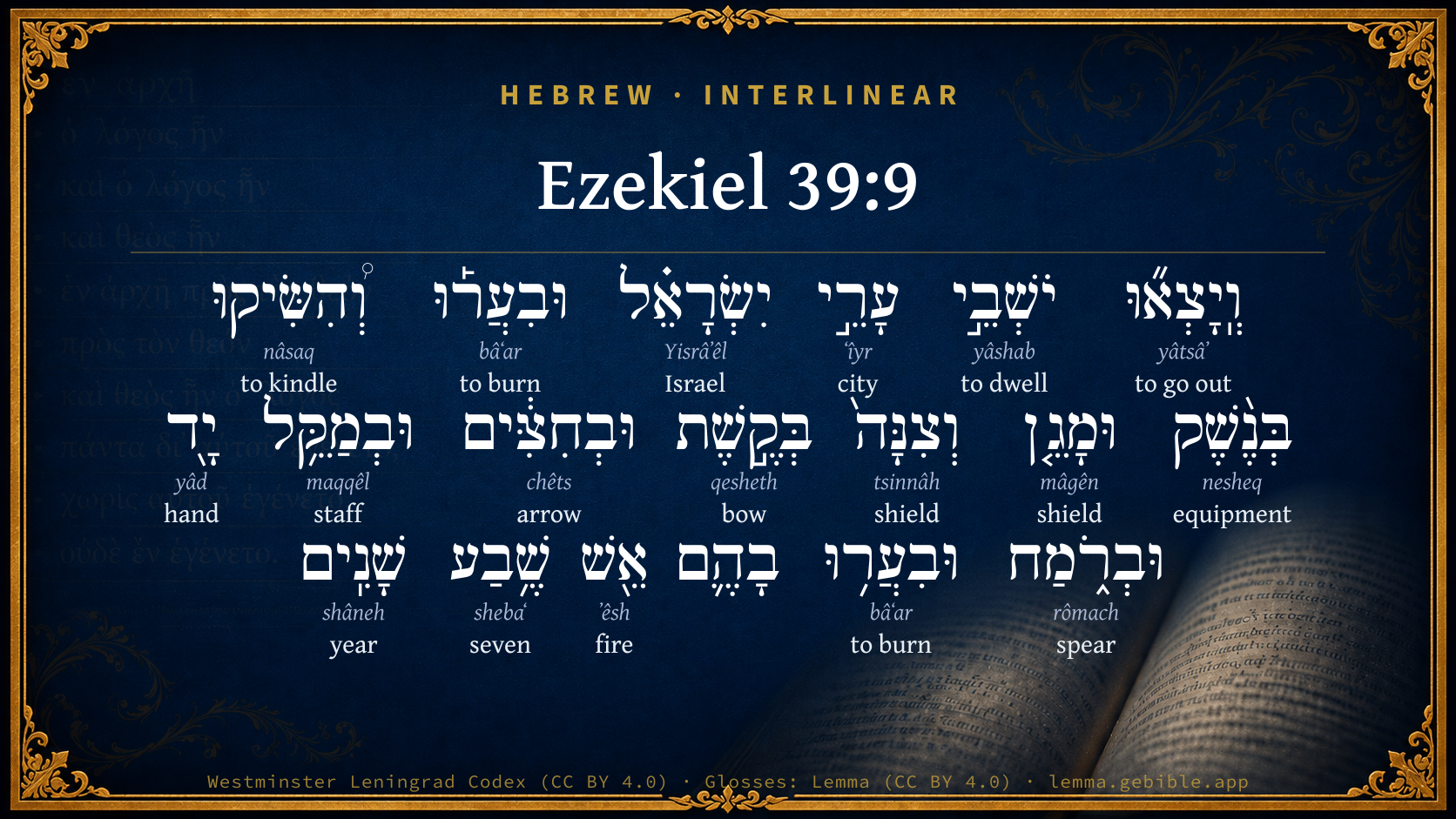
Hebrew (Westminster Leningrad Codex) Ezekiel 39:9 appears in the Hebrew Old Testament. The text above is from the Westminster Leningrad Codex. Each word links to its Strong’s number, a concise gloss, and parsing drawn from the Open Scriptures Hebrew Bible morphology. Click any word for its full Brown-Driver-Briggs (BDB) entry.
Download image
Cite this verse

Ezekiel 39:9 (World English Bible). Public Domain. Lemma interlinear Bible study tool, https://lemma.gebible.app/v/ezekiel/39/9.

Show BibTeX & RIS
BibTeX
RIS
English Translation
Those who dwell in the cities of Israel shall go forth, and shall make fires of the weapons and burn them, both the shields and the bucklers, the bows and the arrows, and the war clubs, and the spears, and they shall make fires of them seven years;
World English Bible · Public Domain
Download a study sheet

One document with this verse’s original text, its word-by-word gloss line, the meaning frame, cross-references with their text, attributed commentary, and full source and license credits — printable, and it pastes into notes with its structure intact.

This verse Autodidact and up

Study sheet (.html) Plain text (.txt)

A passage Seminary Student

Up to 50 verses in one chapter. A passage sheet keeps up to 6 commentary sources and 12 cross-references per verse, in the order this page ranks them, and says so on the sheet whenever that leaves anything out. Ask for a single verse and you get the Autodidact verse sheet above.

Everything on this page stays free to read, with no account — the sheet is a download of what is already on screen, not access to it.

Want to remove ads? Support Godless Engineer
Compare translations 3

The same verse in 3 English versions, stacked beneath the original-language interlinear above. Click any original word for its lexicon entry.

Each is an independent rendering of the whole verse — the interlinear is not word-aligned to these translations.

Highlighted words mark where these versions differ — a whole-verse word diff, not a word-by-word alignment.

  • World English Bible Public Domain
    Those who dwell in the cities of Israel shall go forth, and shall make fires of the weapons and burn them, both the shields and the bucklers, the bows and the arrows, and the war clubs, and the spears, and they shall make fires of them seven years;
  • King James Version Public Domain
    And they that dwell in the cities of Israel shall go forth, and shall set on fire and burn the weapons, both the shields and the bucklers, the bows and the arrows, and the handstaves, and the spears, and they shall burn them with fire seven years:
  • unfoldingWord Literal Text CC BY-SA 4.0
    The ones living in the cities of Israel will go out and they will use weapons to kindle and make fires and burn them—small shields, large shields, bows, arrows, the clubs and spears; they will make fires with them for seven years.

unfoldingWord Literal Text — © unfoldingWord, licensed CC BY-SA 4.0. Word-aligned USFM3 via Door43 (git.door43.org/unfoldingWord/en_ult).

Versions to compare (up to 4)

3 of 4 selected

Show all 18 translations

Every available English version of this verse, each an independent rendering of the whole verse.

  • World English Bible Public Domain
    Those who dwell in the cities of Israel shall go forth, and shall make fires of the weapons and burn them, both the shields and the bucklers, the bows and the arrows, and the war clubs, and the spears, and they shall make fires of them seven years;
  • Berean Standard Bible Public Domain
    Then those who dwell in the cities of Israel will go out, kindle fires, and burn up the weapons—the bucklers and shields, the bows and arrows, the clubs and spears. For seven years they will use them for fuel.
  • Majority Standard Bible Public Domain
    Then those who dwell in the cities of Israel will go out, kindle fires, and burn up the weapons—the bucklers and shields, the bows and arrows, the clubs and spears. For seven years they will use them for fuel.
  • King James Version Public Domain
    And they that dwell in the cities of Israel shall go forth, and shall set on fire and burn the weapons, both the shields and the bucklers, the bows and the arrows, and the handstaves, and the spears, and they shall burn them with fire seven years:
  • American Standard Version (1901) Public Domain
    And they that dwell in the cities of Israel shall go forth, and shall make fires of the weapons and burn them, both the shields and the bucklers, the bows and the arrows, and the handstaves, and the spears, and they shall make fires of them seven years;
  • Revised Version (1885) Public Domain
    And they that dwell in the cities of Israel shall go forth, and shall make fires of the weapons and burn them, both the shields and the bucklers, the bows and the arrows, and the handstaves, and the spears, and they shall make fires of them seven years.
  • Geneva Bible (1599) Public Domain
    And they that dwell in the cities of Israel, shall goe forth, and shall burne and set fire vpon the weapons, and on the shieldes, and bucklers, vpon the bowes, and vpon the arrowes, and vpon the staues in their handes, and vpon the speares, and they shall burne them with fire seuen yeeres.
  • Douay-Rheims (1899) Public Domain
    And the inhabitants shall go forth of the cities of Israel, and shall set on fire and burn the weapons, the shields, and the spears, the bows and the arrows, and the handstaves and the pikes: and they shall burn them with fire seven years.
  • Young's Literal Translation Public Domain
    And gone out have the inhabitants of cities of Israel, And they have burned and kindled `a fire', With armour, and shield, and buckler, With bow, and with arrows, And with hand-staves, and with javelins, And they have caused a fire to burn with them seven years,
  • Literal Standard Version CC BY-SA 4.0
    And those dwelling [in the] cities of Israel have gone out, || And they have burned and kindled [a fire], || With armor, and shield, and buckler, || With bow, and with arrows, || And with hand weapon, and with javelin, || And they have caused a fire to burn seven years with them,
  • Unlocked Literal Bible CC BY-SA 4.0
    The ones living in the cities of Israel will go out and they will use weapons to kindle and make fires and burn them—small shields, large shields, bows, arrows, the clubs and spears; they will make fires with them for seven years.
  • unfoldingWord Literal Text CC BY-SA 4.0
    The ones living in the cities of Israel will go out and they will use weapons to kindle and make fires and burn them—small shields, large shields, bows, arrows, the clubs and spears; they will make fires with them for seven years.
  • Darby Bible Public Domain
    And they that dwell in the cities of Israel shall go forth, and shall kindle fire, and burn weapons, and shields, and targets, bows, and arrows, and hand-staves, and spears: and they shall make fires with them seven years.
  • World Messianic Bible Public Domain
    “‘“Those who dwell in the cities of Israel will go out and will make fires of the weapons and burn them, both the shields and the bucklers, the bows and the arrows, and the war clubs and the spears, and they will make fires with them for seven years;
  • Webster's Bible Public Domain
    And they that dwell in the cities of Israel shall go forth, and shall set on fire and burn the weapons, both the shields and the bucklers, the bows and the arrows, and the handstaffs, and the spears, and they shall burn them with fire seven years:
  • Free Bible Version CC BY-SA 4.0
    Then those living in the towns of Israel will go out to light fires and burn the weapons—the large and small shields, the bows and arrows, the clubs and spears. They will use the weapons to make fires for seven years.
  • Bible in Basic English Public Domain
    And those who are living in the towns of Israel will go out and make fires of the instruments of war, burning the body-covers and the breastplates, the bows and the arrows and the sticks and the spears, and for seven years they will make fires of them:
  • JPS Tanakh (1917) Public Domain
    And they that dwell in the cities of Israel shall go forth, and shall make fires of the weapons and use them as fuel, both the shields and the bucklers, the bows and the arrows, and the hand-staves, and the spears, and they shall make fires of them seven years;

Literal Standard Version (2020), Covenant Press — licensed CC BY-SA 4.0. Text via the HelloAO Bible API (eBible.org). Unlocked Literal Bible (unfoldingWord) — licensed CC BY-SA 4.0. Text via the HelloAO Bible API (eBible.org). unfoldingWord Literal Text — © unfoldingWord, licensed CC BY-SA 4.0. Word-aligned USFM3 via Door43 (git.door43.org/unfoldingWord/en_ult). Free Bible Version, Dr. Jonathan Gallagher — licensed CC BY-SA 4.0. Text via the HelloAO Bible API (eBible.org).

Word by word

More ways to search: Search by grammar → Find every occurrence → Compare this word →

Practice this passage: Drill this verse → Learn its vocabulary →

וְ֠הִשִּׂיקוּ
nâsaq
H5400
“and · to kindle”
Conjunction + Verb, Hiphil, Sequential Perfect, 3rd Person, Common, Plural
Part of Speech
Conjunction + Verb
Stem
Hiphil
Form
Sequential Perfect
Person
3rd Person
Gender
Common
Number
Plural
Full BDB Definition

Origin: a primitive root

TWOT: 2266

to kindle, burn - (Niphal) to be kindled - (Hiphil) to make a fire, burn
  1. וְֽיָצְא֞וּ yâtsâʼ H3318 “and · to go out” Conjunction + Verb, Qal, Sequential Perfect, 3rd Person, Common, Plural
  2. יֹשְׁבֵ֣י yâshab H3427 “dwelling” Verb, Qal, Participle Active, Masculine, Plural, Construct
  3. עָרֵ֣י ʻîyr H5892 “cities of” Noun, Common, Feminine, Plural, Construct
  4. יִשְׂרָאֵ֗ל Yisrâʼêl H3478 “Israel” Noun, Proper
  5. וּבִעֲר֡וּ bâʻar H1197 “and · to burn” Conjunction + Verb, Piel, Sequential Perfect, 3rd Person, Common, Plural
  6. בְּנֶ֨שֶׁק nesheq H5402 “in/at · equipment” Preposition + Noun, Common, Masculine, Singular, Absolute
  7. וּמָגֵ֤ן mâgên H4043 “and · shield” Conjunction + Noun, Common, Both, Singular, Absolute
  8. וְצִנָּה֙ tsinnâh H6793 “and · shield” Conjunction + Noun, Common, Feminine, Singular, Absolute
  9. בְּקֶ֣שֶׁת qesheth H7198 “in/at · bow” Preposition + Noun, Common, Feminine, Singular, Absolute
  10. וּבְחִצִּ֔ים chêts H2671 “and · in/at · arrows” Conjunction + Preposition + Noun, Common, Masculine, Plural, Absolute
  11. וּבְמַקֵּ֥ל maqqêl H4731 “and · in/at · staff of” Conjunction + Preposition + Noun, Common, Masculine, Singular, Construct
  12. יָ֖ד yâd H3027 “hand” Noun, Common, Both, Singular, Absolute
  13. וּבְרֹ֑מַח rômach H7420 “and · in/at · spear” Conjunction + Preposition + Noun, Common, Masculine, Singular, Absolute
  14. וּבִעֲר֥וּ bâʻar H1197 “and · to burn” Conjunction + Verb, Piel, Sequential Perfect, 3rd Person, Common, Plural
  15. אֵ֖שׁ ʼêsh H784 “fire” Noun, Common, Both, Singular, Absolute
  16. שֶׁ֥בַע shebaʻ H7651 “seven” Adjective, Cardinal number, Feminine, Singular, Absolute
  17. שָׁנִֽים shâneh H8141 “years” Noun, Common, Feminine, Plural, Absolute

About this verse

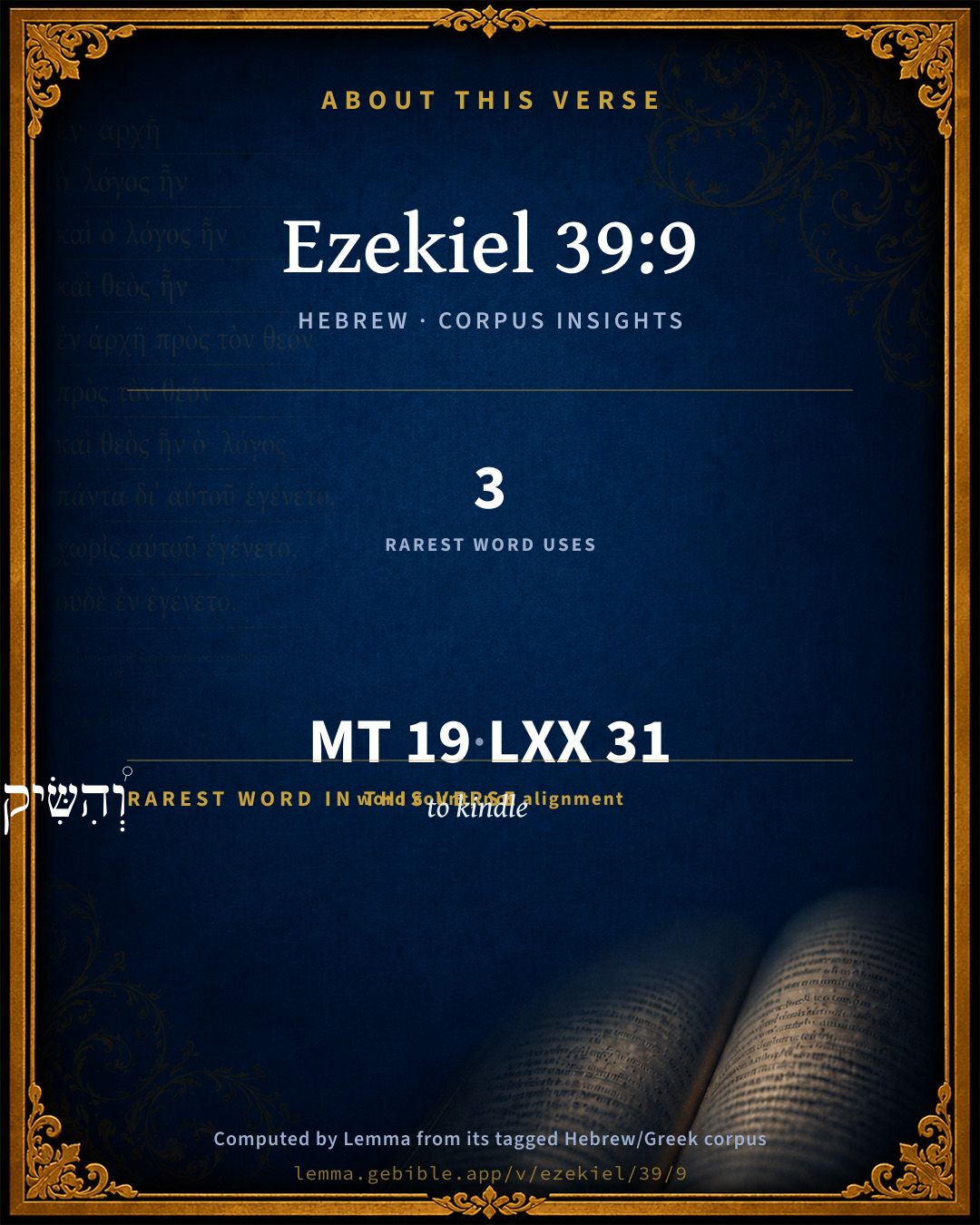
These counts appear in no published source. They are computed here, from the morphology-tagged text and Lemma’s own curated glosses. What Lemma adds →

19
words
17
distinct lemmas
Prophets
section

Notable vocabulary

The rarest word here is וְ֠הִשִּׂיקוּ to kindle H5400 — appearing just 3 times in the whole Hebrew Bible.

Shared distinctive vocabulary

וְ֠הִשִּׂיקוּ to kindle H5400 occurs in 3 verses of the Hebrew Bible. Also found in:

Grammatical profile

  • 5 verbs
  • 12 nouns
  • 1 adjective
  • 1 preposition

Verb forms

  • וְֽיָצְא֞וּ Qal · Sequential Perfect
  • יֹשְׁבֵ֣י Qal · Participle Active
  • וּבִעֲר֡וּ Piel · Sequential Perfect
  • וְ֠הִשִּׂיקוּ Hiphil · Sequential Perfect
  • וּבִעֲר֥וּ Piel · Sequential Perfect

Repetition

A word recurs within this verse — often emphatic in Hebrew:

  • וּבִעֲר֡וּ to burn H1197 ×2

Hebrew & Septuagint length

In English translation the verse runs 48 words from the Hebrew and 42 from the Septuagint (LXX English) — closely comparable.

A rough comparison of the two English renderings, which tokenize alike — not a word-level alignment.

Word counts can differ between the Hebrew and the Greek without any difference in meaning — e.g. the Hebrew direct-object marker אֵת has no separate Greek word, and Greek often adds the article ὁ.

In the original languages it is 19 Hebrew tokens and 31 Greek tokens — but the two are counted differently (Hebrew bundles its prefixes and suffixes into one token; the Greek is in lemma form), so that isn’t a like-for-like length.

Cross-references

7

Topical passages linked to Ezekiel 39:9 in the Treasury of Scripture Knowledge — connected by theme and wording, ordered by reader-vote popularity; previews shown in the World English Bible.

  • Psalms 46:9 He makes wars cease to the end of the earth. He breaks the bow, and shatters the spear. He burns the chariots in the fire.
  • Isaiah 66:24 They shall go forth, and look on the dead bodies of the men who have transgressed against me: for their worm shall not die, neither shall their fire be quenched; and they shall be an abhorring to all flesh.
  • Malachi 1:5 Your eyes will see, and you will say, "Yahweh is great--even beyond the border of Israel!"
  • Joshua 11:6 Yahweh said to Joshua, Don't be afraid because of them; for tomorrow at this time will I deliver them up all slain before Israel: you shall hamstring their horses, and burn their chariots with fire.
  • Psalms 111:2–3 Yahweh's works are great, Pondered by all those who delight in them.
  • Ezekiel 39:10 so that they shall take no wood out of the field, neither cut down any out of the forests; for they shall make fires of the weapons; and they shall plunder those who plundered them, and rob those who robbed them, says the Lord Yahweh.
  • Zechariah 9:10 I will cut off the chariot from Ephraim, And the horse from Jerusalem; And the battle bow will be cut off; And he will speak peace to the nations: And his dominion will be from sea to sea, And from the River to the ends of the earth.

Cross-references courtesy of OpenBible.info (CC BY 4.0).

Hebrew and Greek witnesses Masoretic Hebrew ↔ Greek Septuagint

The same verse in the two great witnesses to the Old Testament, shown verse-for-verse.

These are two independent witnesses, not word-aligned to each other, and the Septuagint is shown in lemma (dictionary) form.

Hebrew Ezekiel 39:9 Masoretic · Westminster Leningrad Codex

וְֽיָצְא֞וּ יֹשְׁבֵ֣י עָרֵ֣י יִשְׂרָאֵ֗ל וּבִעֲר֡וּ וְ֠הִשִּׂיקוּ בְּנֶ֨שֶׁק וּמָגֵ֤ן וְצִנָּה֙ בְּקֶ֣שֶׁת וּבְחִצִּ֔ים וּבְמַקֵּ֥ל יָ֖ד וּבְרֹ֑מַח וּבִעֲר֥וּ בָהֶ֛ם אֵ֖שׁ שֶׁ֥בַע שָׁנִֽים

Those who dwell in the cities of Israel shall go forth, and shall make fires of the weapons and burn them, both the shields and the bucklers, the bows and the arrows, and the war clubs, and the spears, and they shall make fires of them seven years;

World English Bible · Public Domain

Greek LXX Ezekiel 39:9 Septuagint · lemma form

καί ἐκἔρχομαι ὁ καταοἰκέω ὁ πόλις ἰσραήλ καί καίω ἐν ὁ ὅπλον πέλτη καί κοντός καί τόξον καί τόξευμα καί ῥάβδος χείρ καί λόγχη καί καίω ἐν αὐτός πῦρ ἑπτά ἔτος

And they that inhabit the cities of Israel shall come forth, and make a fire with the arms, the shields and the spears, and bows and arrows, and hand-staves, and lances, and they shall keep fire burning with them for seven years:

LXX2012 (modern English Septuagint) · Public Domain

Hebrew: Westminster Leningrad Codex (CC BY 4.0). Greek: Septuagint (public domain); English from LXX2012 (modern English Septuagint) (Public Domain). How the Septuagint differs from the Hebrew →

Targum (Aramaic paraphrase)

1

The Targum is the ancient Jewish Aramaic paraphrase of the Hebrew Scriptures — an interpretive translation, not the Hebrew text itself. Onkelos (literal) and Pseudo-Jonathan (expansive) render the Torah, and Jonathan the Prophets. Coverage is partial: where no permissively-licensed English translation exists for a verse, only the Aramaic is shown. This is verse-level text, not a word-by-word alignment to the Hebrew.

  1. Targum Jonathan Prophets (Joshua–Malachi)
    וְיִפְקוּן יַתְבֵי קִרְוֵי אַרְעָא דְיִשְׂרָאֵל וִיהוֹן שַׁגְרִין וּמִסְתּוֹבָרִין בְּמָנֵי זְיָנֵי בַעֲגָלִין וּתְרֵיסִין בְּקַשְׁתָּן וּבְגִירְרִין וּבְעָאֵי מוּרְנִין וְרוֹמְחִין וְיַדְלְקוּן בְּהוֹן נוּרָא שְׁבַע שְׁנִין:

    (no public-domain English translation for this verse)

    Targum Jonathan — Aramaic: “Mikraot Gedolot” (public domain). English: “Sefaria Community Translation” (CC0 1.0 (public-domain dedication)); “London "Chaldee Paraphrase," 1871” (public domain). Text via Sefaria.

Commentary

Notes on Ezekiel 39:9 from classic Christian and Jewish commentators (each source and its license shown beneath its notes). The classic Christian expositions comment on the surrounding passage and are grouped to its opening verse, so a note may address several verses; the Jewish commentaries on the Tanakh (Rashi and others) are per-verse, so they appear only where the commentator wrote on this verse.

Lemma curates 59 commentaries, every one of them public domain or Creative Commons licensed, each selected and text-cleaned for this edition rather than reprinted as found. About our sources →

Ellicott's Commentary for English Readers

(9) Shall burn them with fire seven years.—The representation of this and the following verse, that the weapons of the army of Gog shall furnish the whole nation of Israel with fuel for seven years, cannot, of course, be understood literally, and seems to have been inserted by the prophet to show that we are to look for the meaning of his prophecy beyond any literal event of earthly warfare.

Eze_39:11-16 again present the magnitude of the attack upon the Church by describing the burial of the host after it is slain. The language, if it could be supposed it was meant to be literally understood, would be even more extravagant than that of Eze_39:9-10. The whole nation of Israel is represented as engaged for seven months in burying the bodies (Eze_39:12-13); after this an indefinite time is to be occupied by one corps of men appointed to search the land for still remaining bones, and by another who are to bury them.

A Bible Commentary for English Readers, edited by Charles John Ellicott (1878–1897) — public domain. Text from a community e-Sword module.

Trapp's Complete Commentary

John Trapp

Eze 39:9 And they that dwell in the cities of Israel shall go forth, and shall set on fire and burn the weapons, both the shields and the bucklers, the bows and the arrows, and the handstaves, and the spears, and they shall burn them with fire seven years:

Ver. 9. And they that dwell.] Hyperbolical expressions; though the Jews hold otherwise. See on Eze 39:1.

Shall set on fire and burn the weapons.] Do not the Church’s champions so at this day, ever since they proclaimed and proved the Pope to be that antichrist; burning up his weapons - his false doctrines and heresies - by the fire of God’s Word, and giving their bodies to be burned for the testimony of Jesus?

And they shall burn them with fire seven years,] i.e., Diutissime et saepissime! Most long and most often. This seven years is not yet out. The Jesuits say Satan sent Luther, and God sent them to withstand him. But there is a succession of Luthers to find them work enough still, and to burn up their weapons that the churches may be at rest.

John Trapp, A Commentary or Exposition upon All the Books of the Old and New Testament (1647–1656) — public domain. Text from a community e-Sword module.

Keil & Delitzsch

C. F. Keil & F. Delitzsch

Total Destruction of Gog and his Hosts

Eze 39:9. Then will the inhabitants of the cities of Israel go forth, and burn and heat with armour and shield and target, with bow and arrows and hand-staves and spears, and will burn fire with them for seven years; Eze 39:10. And will not fetch wood from the field, nor cut wood out of the forests, but will burn fire with the armour, and will spoil those who spoiled them, and plunder those who plundered them, is the saying of the Lord Jehovah. Eze 39:11. And it will come to pass in that day, that I will give Gog a place where his grave in Israel shall be, the valley of the travellers, and there will they bury Gog and all his multitude, and will call it the valley of Gog's multitude. Eze 39:12. They of the house of Israel will bury them, to purify the land for seven months. V.1 3. And all the people of the land will bury, and it will be to them for a name on the day when I glorify myself, is the saying of the Lord Jehovah. Eze 39:14. And they will set apart constant men, such as rove about in the land, and such as bury with them that rove about those who remain upon the surface of the ground, to cleanse it, after the lapse of seven months will they search it through. Eze 39:15. And those who rove about will pass through the land; and if one sees a man's bone, he will set up a sign by it, till the buriers of the dead bury it in the valley of the multitude of Gog. Eze 39:16. The name of a city shall also be called Hamonah (multitude). And thus will they cleanse the land. Eze 39:17. And thou, son of man, thus saith the Lord Jehovah, Say to the birds of every plumage, and to all the beasts of the field, Assemble yourselves, and come, gather together from round about to my sacrifice, which I slaughter for you, to a great sacrifice upon the mountains of Israel, and eat flesh and drink blood. Eze 39:18. Flesh of heroes shall ye eat, and drink blood of princes of the earth; rams, lambs, and he-goats, bullocks, all fattened in Bashan. Eze 39:9. And ye shall eat fat to satiety, and drink blood to intoxication, of my sacrifice which I have slaughtered for you. Eze 39:20. And ye shall satiate yourselves at my table with horses and riders, heroes and all kinds of men of war, is the saying of the Lord Jehovah. - To show how terrible the judgment upon Gog will be, Ezekiel depicts in three special ways the total destruction of his powerful forces. In the first place, the burning of all the weapons of the fallen foe will furnish the inhabitants of the land of Israel with wood for firing for seven years, so that there will be no necessity for them to fetch fuel from the field or from the forest (Eze 39:9 and Eze 39:10). But Hvernick is wrong in supposing that the reason for burning the weapons is that, according to Isa 9:5, weapons of war are irreconcilable with the character of the Messianic times of peace. This is not referred to here; but the motive is the complete annihilation of the enemy, the removal of every trace of him. The prophet therefore crowds the words together for the purpose of enumerating every kind of weapon that was combustible, even to the hand-staves which men were accustomed to carry (cf. Num 22:27). The quantity of the weapons will be so great, that they will supply the Israelites with all the fuel they need for seven years. The number seven in the seven years as well as in the seven months of burying (Eze 39:11) is symbolical, stamping the overthrow as a punishment inflicted by God, the completion of a divine judgment.

With the gathering of the weapons for burning there is associated the plundering of the fallen foe (Eze 39:10), by which the Israelites do to the enemy what he intended to do to them (Eze 38:12), and the people of God obtain possession of the wealth of their foes (cf. Jer 30:16). In the second place, God will assign a large burying-place for the army of Gog in a valley of Israel, which is to be named in consequence "the multitude of Gog;" just as a city in that region will also be called Hamonah from this event. The Israelites will bury the fallen of Gog there for seven months long, and after the expiration of that time they will have the land explored by men specially appointed for the purpose, and bones that may still have been left unburied will be sought out, and they will have them interred by buriers of the dead, that the land may be thoroughly cleansed (Eze 39:11-16). מקום שׁם, a place where there was a grave in Israel, i.e., a spot in which he might be buried in Israel. There are different opinions as to both the designation and the situation of this place. There is no foundation for the supposition that גּי העברים derives its name from the mountains of Abarim in Num 27:12 and Deu 32:49 (Michaelis, Eichhorn), or that it signifies valley of the haughty ones (Ewald), or that there is an allusion to the valley mentioned in Zac 14:4 (Hitzig), or the valley of Jehoshaphat (Kliefoth). The valley cannot even have derived its name (העברים) from the עברים, who passed through the land to search out the bones of the dead that still remained unburied, and have them interred (Eze 39:14, Eze 39:15). For העברים cannot have any other meaning here than that which it has in the circumstantial clause which follows, where those who explored the land cannot possibly be intended, although even this clause is also obscure. The only other passage in which חסם occurs is Deu 25:4, where it signifies a muzzle, and in the Arabic it means to obstruct, or cut off; and hence, in the passage before us, probably, to stop the way. העברים are not the Scythians (Hitzig), for the word עבר is never applied to their invasion of the land, but generally the travellers who pass through the land, or more especially those who cross from Peraea to Canaan. The valley of העברים is no doubt the valley of the Jordan above the Dead Sea. The definition indicates this, viz., קדמת, on the front of the sea; not to the east of the sea, as it is generally rendered, for קדמת never has this meaning (see the comm. on Gen 2:14). By היּם we cannot understand "the Mediterranean,"as the majority of the commentators have done, as there would then be no meaning in the words, since the whole of the land of Israel was situated to the east of the Mediterranean Sea. היּם is the Dead Sea, generally called היּם הקּדמוני (Eze 47:18); and קדמת, "on the front side of the (Dead) Sea," as looked at from Jerusalem, the central point of the land, is probably the valley of the Jordan, the principal crossing place from Gilead into Canaan proper, and the broadest part of the Jordan-valley, which was therefore well adapted to be the burial-place for the multitude of slaughtered foes. But in consequence of the army of Gog having there found its grave, this valley will in future block up the way to the travellers who desire to pass to and fro. This appears to be the meaning of the circumstantial clause.

From the fact that Gog's multitude is buried there, the valley itself will receive the name of Hamon-Gog. The Israelites will occupy seven months in burying them, so enormously great will be the number of the dead to be buried (Eze 39:12), and this labour will be for a name, i.e., for renown, to the whole nation. This does not mean, of course, "that it will be a source of honour to them to assist in this work;" nor is the renown to be sought in the fact, that as a privileged people, protected by God, they can possess the grave of Gog in their land (Hitzig), - a thought which is altogether remote, and perfectly foreign to Israelitish views; but the burying of Gog's multitude of troops will be for a name to the people of Israel, inasmuch as they thereby cleanse the land and manifest their zeal to show themselves a holy people by sweeping all uncleanness away. יום is an accusative of time: on the day when I glorify myself. - Eze 39:14, Eze 39:15. The effort made to cleanse the land perfectly from the uncleanness arising from the bones of the dead will be so great, that after the great mass of the slain have been buried in seven months, there will be men specially appointed to bury the bones of the dead that still lie scattered here and there about the land. אנשׁי תּמיד are people who have a permanent duty to discharge. The participles עברים and מקבּרים are co-ordinate, and are written together asyndetos, men who go about the land, and men who bury with those who go about. That the words are to be understood in this sense is evident from Eze 39:15, according to which those who go about do not perform the task of burying, but simply search for bones that have been left, and put up a sign for the buriers of the dead. ראה, with the subject indefinite; if one sees a human bone, he builds (erects) a ציּוּן, or stone, by the side of it (cf. Kg2 23:17). - Eze 39:16. A city shall also receive the name of Hamonah, i.e., multitude or tumult. To שׁם־עיר we may easily supply יהיה from the context, since this puts in the future the statement, "the name of the city is," for which no verb was required in Hebrew. In the last words, וטהרוּ הארץ, the main thought is finally repeated and the picture brought to a close. - Eze 39:17-20. In the third place, God will provide the birds of prey and beasts of prey with an abundant meal from this slaughter. This cannot be understood as signifying that only what remain of the corpses, and have not been cleared away in the manner depicted in Eze 39:11-16, will become the prey of wild beasts; but the beasts of prey will make their meal of the corpses before it is possible to bury them, since the burying cannot be effected immediately or all at once. - The several features in the picture, of the manner in which the enemies are to be destroyed till the last trace of them is gone, are not arranged in chronological order, but according to the subject-matter; and the thought that the slaughtered foes are to become the prey of wild beasts is mentioned last as being the more striking, because it is in this that their ignominious destruction culminates. To give due prominence to this thought, the birds and beasts of prey are summoned by God to gather together to the meal prepared for them. The picture given of it as a sacrificial meal is based upon Isa 34:6 and Jer 46:10. In harmony with this picture the slaughtered foes are designated as fattened sacrificial beasts, rams, lambs, he-goats, bullocks; on which Grotius has correctly remarked, that "these names of animals, which were generally employed in the sacrifices, are to be understood as signifying different orders of men, chiefs, generals, soldiers, as the Chaldee also observes."

Keil & Delitzsch — Biblical Commentary on the Old Testament (1861–1891) — public domain (CC PDM 1.0). Text via the HelloAO Bible API. (Old Testament only.)

Tyndale Open Study Notes

Tyndale Open Resources

39:9-10 Israel would be called upon to act only after Gog had been completely defeated and destroyed. As in some of their great battles in the past, Israel would be able to watch the Lord act and then pick up the spoils (e.g., 2 Kgs 6:1–7:20; 2 Chr 20). Ironically, the only items to survive the fire from heaven that destroyed Gog’s army would be wooden weaponry that would now be fuel for Israel’s fires for seven years, a number that often represents completeness in the Old Testament. Those who came to plunder would become plunder. Their weapons would be unnecessary now that Israel’s last enemy had been destroyed.

Tyndale Open Study Notes — © Tyndale Open Resources, licensed CC BY-SA 4.0. Text via the HelloAO Bible API.

Geneva Bible (1599)

Geneva Bible translators

After this destruction the Church shall have great peace and tranquility, and burn all their weapons, because they shall no more fear the enemies, and this is chiefly meant of the accomplishment of Christ’s kingdom when by their head Christ, all enemies shall be overcome.

Geneva Bible (1599) marginal notes — public domain. Text via Bolls.life.

Jamieson, Fausset & Brown

Robert Jamieson, A. R. Fausset & David Brown

The burning of the foe's weapons implies that nothing belonging to them should be left to pollute the land. The seven years (seven being the sacred number) spent on this work, implies the completeness of the cleansing, and the people's zeal for purity. How different from the ancient Israelites, who left not merely the arms, but the heathen themselves, to remain among them [FAIRBAIRN], (Jdg 1:27-28; Jdg 2:2-3; Psa 106:34-36). The desolation by Antiochus began in the one hundred and forty-first year of the Seleucidæ. From this date to 148, a period of six years and four months ("2300 days," Dan 8:14), when the temple-worship was restored (1 Maccabees 4:52), God vouchsafed many triumphs to His people; from this time to the death of Antiochus, early in 149, a period of seven months, the Jews had rest from Antiochus, and purified their land, and on the twenty-fifth day of the ninth month celebrated the Encænia, or feast of dedication (Joh 10:22) and purification of the temple. The whole period, in round numbers, was seven years. Mattathias was the patriotic Jewish leader, and his third son, Judas, the military commander under whom the Syrian generals were defeated. He retook Jerusalem and purified the temple. Simon and Jonathan, his brothers, succeeded him: the independence of the Jews was secured, and the crown vested in the Asmonean family, in which it continued till Herod the Great.

Jamieson, Fausset & Brown — Commentary Critical and Explanatory on the Whole Bible (1871) — public domain (CC PDM 1.0). Text via the HelloAO Bible API.

Adam Clarke's Commentary

Verse 9. And shall set on fire - the weapons] The Israelites shall make bonfires and fuel of the weapons, tents, c., which the defeated Syrians shall leave behind them, as expressive of the joy which they shall feel for the destruction of their enemies and to keep up, in their culinary consumption, the memory of this great event.

They shall burn them with fire seven years] These may be figurative expressions, after the manner of the Asiatics, whose language abounds with such descriptions. They occur every where in the prophets. As to the number seven, it is only a certain for an indeterminate number. But as the slaughter was great, and the bows, arrows, quivers, shields, bucklers, handstaves, and spears were in vast multitudes, it must have taken a long time to gather them up in the different parts of the fields of battle, and the roads in which the Syrians had retreated, throwing away their arms as they proceeded; so there might have been a long time employed in collecting and burning them. And as all seem to have been doomed to the fire, there might have been some found at different intervals and burned, during the seven years here mentioned. Mariana, in his History of Spain, lib. xi., c. 24, says, that after the Spaniards had given that signal overthrow to the Saracens, A.D. 1212, they found such a vast quantity of lances, javelins, and such like, that they served them for four years for fuel. And probably these instruments obtained by the Israelites were used in general for culinary firewood, and might literally have served them for seven years; so that during that time they should take no wood out of the fields, nor out of the forests for the purpose of fuel, Eze 39:10.

Adam Clarke's Commentary on the Bible (1810–1826) — public domain. Text from a community e-Sword/MySword module.

The Cambridge Bible for Schools and Colleges

gen. ed. J. J. S. Perowne

9. The wood of the weapons of Gog’s warriors shall serve the people of Israel as fuel for seven years, they shall go neither to gather faggots for fire in the fields nor to cut down any wood out of the forests (Eze_39:10).

set on fire and burn] make fire of the weapons and burn them—i.e. they shall use them as fuel. The “handstaves” are probably those with which the animals ridden upon or others were driven.

burn them with fire] make fire of them.

The Cambridge Bible for Schools and Colleges (gen. ed. J. J. S. Perowne; Cambridge University Press, 1878–1918) — public domain. Text from a community e-Sword module.

John Gill's Exposition

And they that dwell in the cities of Israel shall go forth,.... Out of their houses into the streets, where Gog's soldiers will lie dead, and their armour by them; or rather out of their cities, where they dwelt safely, and where they kept themselves, and were secure from the enemy: these seem to be distinct from the militia of Israel, engaged in battle with Gog; these were the inhabitants that will stay at home, and yet share in the spoil and plunder; see Psa 68:12, these, after the battle is over, and the victory obtained, of which they will have information, will then march out without fear into the open fields and mountains, where the army of Gog will fall, Eze 39:4,

and shall set on fire and burn the weapons; the armour of Gog's army, which they shall find lie by the dead, or upon them; or which they that flee will cast away; these they shall gather together, and lay on a heap, and burn, as sometimes has been the practice of conquerors; or rather they shall take them to their own houses, and make fuel of them, and burn them, instead of wood out of the fields and forests, as the following verse shows:

both the shields and the bucklers, the bows and the arrows; which were the weapons that Gog and his associates used; see Eze 38:4,

and the handstaves, and the spears; the "handstaves" were either half pikes or truncheons, as some think; or javelins, as others:

and they shall burn them with fire seven years; which some take to be a certain number for an uncertain, and others an hyperbolical expression; but when it is considered what a vast army this of Gog's will be, and what prodigious numbers of weapons of all sorts must be carried by them, and the little use of fire in those hot countries: it may be very well taken in a literal sense, and the meaning be, that so great will be the quantity of warlike weapons that will be found and gathered, that they will serve for fuel for the space of seven years.

John Gill's Exposition of the Whole Bible (1746–1763) — public domain (CC PDM 1.0). Text via the HelloAO Bible API.

Albert Barnes' Notes on the Bible

Burn them with fire - Or, “kindle fire with them;” or, as in the margin. The weapons of the army left on the field of battle shall be so numerous as to supply fuel for the people of the land for seven years. Seven was a number connected with cleansing after contact with the dead (Num 19:11 ff), and this purification of the land by the clearance of paganish spoils was a holy work (compare Eze 39:12).

Albert Barnes' Notes on the Bible (1834–1885) — public domain. Text from a community e-Sword/MySword module.

Haydock's Catholic Bible Commentary

Years; for a long time, ver. 12. Little fuel is necessary there. Mariana (Hist. xi. 24. A.[The year of the Lord] 1212.) mentions, that the arms of the Moors supplied Spain four years with fuel. (Calmet)

George Leo Haydock (1774–1849), Haydock's Catholic Family Bible and Commentary, 1859 edition — public domain. Excludes Psalms (Douay-Rheims chapter numbering differs from Protestant) and Deuterocanonical books (Catholic canon only).

Matthew Poole's English Annotations

Shall go forth, out of their houses and out of the cities, with joy to see and admire the great goodness of God towards them, and the greatness of his power against their enemies. Shall set on fire: this expression seems to intimate that they should burn these things in the open field or mountains, where they found them; here is no mention made of the carrying any into city or houses, to burn in their chimneys: it may be they should make those fires in token of joy.

The weapons; the warlike provision, instruments, engines, carriages, and waggons, &c., as well as those recounted.

The shields: see Eze 38:4.

The hand-staves, that either their leaders used, like our halfpikes, or perhaps such as they cast like darts at the enemy.

They shall burn them with fire seven years: it may be wondered they burn these weapons, which might be of use to them for defence and safety; but it was done, partly, because they were weapons of the uncircumcised; partly, because they were anathemata, as all Jericho was; but chiefly, in testimony that God was their safety and defence, on which they relied, and would ever since he had so wonderfully delivered, We might read the words thus, they shall kindle with them a fire of seven years, and then the sense would be plain, that there should be such store of weapons and warlike utensils, that, heaped together, they would last so long, being cast into the fire still by such as found them; for it is not unlike they gathered up the weapons, as they did scattered bones, on their walks, as they lighted on them. Others tell us it is a certain number for an uncertain; others, that it is somewhat a proverbial speech, they shall have enough by the spoil of the enemy to make them and keep them warm, much as we sometimes say of one well provided, He is a warm gentleman; and some others tell us it is an expression of the Jews, who love to use this number in extraordinary cases, though they intend not precisely the same, as we say of a thing delayed, It will be seven years ere it come, or of a thing that will serve us a good while, It will last seven years. Or else, since the Hebrew hath not a distinct way of declaring what might be, or the potential mood, as the Latin, but they express possible by future, and say, that shall be, which we express by that may be, the meaning of these futures, they shall, in this and the next verse, is no more than,

they may or might burn for seven years; and so Kimchi glosseth it as to countenance this last guess. They shall be sufficient; and in such a country, where the need of fire is much less than with us, it will not seem very incredible that the warlike utensils of so numerous an army might be enough to furnish them with fuel for so many years, or more.

Matthew Poole's English Annotations on the Holy Bible (1683–1685) — public domain. Text from a community e-Sword/MySword module.

The Pulpit Commentary

Vers. 9, 10 set forth as the first proof of the greatness of Gog"s overthrow the immense booty in the shape of weapons of war which should be obtained by the inhabitants of the cities of Israel. So huge should be the quantity of weapons left behind by the slain, that the Israelites should burn them with fire seven years. This burning of the weapons has been explained by Havernick, on the ground that weapons of war, as incompatible with Messianic times, should be no more required; (cf. Isa_2:4) by Ewald, as in accordance with the custom of the Hebrews (Isa_9:5) and other ancient peoples (Livy, 38:23; Virgil, "AEneid," 8:562); by Hitzig and Smend, as prompted by the consideration that Israel, for whom Jehovah had fought, should have no further need of weapons; by Schroder, as indicating that for Israel these warlike instruments should then so completely lose their power to terrify that they might be looked upon simply as so much firewood; and by Keil, as designed to annihilate the enemy and remove every trace of him. Kliefoth appears nearest the mark, in suggesting that the emphasis lies upon the length of time the burning should continue; and that this was intended, by conveying an idea of the vastness of the spoil, to represent the thoroughness of Gog"s destruction and of Israel"s deliverance. That the whole delineation is symbolical appears from the number of years the weapons are said to serve for fuel, viz. seven, and from the character of the weapons themselves, which, if not entirely wooden, were at least all combustible. Of the "armor" generally (qvn "something joined," from a root signifying "to join") the pieces mentionedthe shields and the bucklers, (see Eze_38:4) the bows and arrows (see ver. 3), the hand-staves, or, javelins (margin), perhaps, as Hitzig and Smend suggest, the staff with which a horseman strikes his beast, (see Num_22:27) and the spears were mostly composed of timber. When all should have been given to the flames, it would then appear that on their late owners the lex talionis had worked out its literal avengement, that they who had intended to despoil Israel were themselves spoiled; and they who hoped to plunder Israel were themselves plundered. (comp. Isa_17:14)

The Pulpit Commentary (1880–1919), ed. H.D.M. Spence-Jones & Joseph S. Exell — public domain. Text from a community e-Sword module.

John Wesley's Explanatory Notes

The weapons - The warlike provision, instruments, engines, carriages and wagons. Shall burn - It may be wondered why they burn these weapons, which might be of use to them for defense; but it was done in testimony that God was their defense, on whom only they relied. With fire - In such a country where the need of fire is much less than with us, it will not seem incredible, that the warlike utensils of so numerous an army might be enough to furnish them with fuel for many years.

John Wesley, Explanatory Notes Upon the Whole Bible (1754–1765) — public domain. Text via the GEBible commentary corpus.

unfoldingWord translationNotes

Door43 World Missions Community

Connecting Statement:

Yahweh continues giving Ezekiel his message to Gog.

to kindle and make fires

These two phrases mean the same thing. The Israelites will use the wood from the weapons as kindling for fires. AT: "to start fires" (See: Doublet)

small shields, large shields, bows, arrows, the clubs and spears

This list includes all the typical weapons of war of that day. It may represent weapons in general.

clubs

wooden sticks used as a weapon

wanted to take ... wanted to plunder

Here "to take" and "to plunder" mean the same thing. Gog intended to take Israel's possessions, but Yahweh prevented him so that he was not able to do that. (See: Doublet)

will plunder ... wanted to plunder

Translate "plunder" as in Ezekiel 23:46.

translationWords

shield

spear

declare

unfoldingWord translationNotes — © Distant Shores Media and the Door43 World Missions Community, licensed CC BY-SA 4.0. Source: git.door43.org/Door43/en_tn.

Rashi

Rabbi Shlomo Yitzchaki (Rashi)

and heat up [Heb. וְהִשִּׂיקוּ,] like (Orlah 3:5): “An oven that they heated up (שֶּׁהִטִיקוּהָ)” in the language of the Mishnah.

with the weapons [Heb. בַנֶשֶּׁק,] an armures in Old French, with weapons.

Rashi on the Tanakh — English translations: “The Judaica Press complete Tanach with Rashi, translated by A. J. Rosenberg” (CC BY 4.0); “Pentateuch with Rashi's commentary by M. Rosenbaum and A.M. Silbermann, 1929-1934” (public domain); “The Metsudah Tanach series, Lakewood, N.J” (CC BY 4.0); and “The Book of Joshua, Metsudah Publications, 1997” (CC BY 4.0). Text via Sefaria.

Lesson kit

Teaching starters — assembled from the data on this page, not authored interpretation. Every prompt links to the verse data it draws on. Edit before teaching.

Ezekiel, in the Prophets, opens this verse with 19 words (17 distinct Hebrew lemmas). Its most distinctive word is nâsaq (“to kindle”). A historical commentator’s framing appears above. Read the whole chapter for the surrounding context.

Discussion questions

  1. What does “to kindle” (nâsaq) contribute to the verse as a whole?
  2. Psalms 78:21 shares the word «to kindle» with this verse. How do the two illuminate each other?
  3. “to burn” occurs 2× in this one verse. What is the effect of the repetition?
  4. The translations on this page render this verse differently — a whole-verse word diff, not a word-by-word alignment. What might account for the different wordings?
  5. The verb «וְֽיָצְא֞וּ» is Qal Sequential Perfect. How does its form color the action?
  6. Reading how Ellicott's Commentary for English Readers and Trapp's Complete Commentary read this verse, where do the two commentators agree and where do they part?

Things to notice

Reading settings

Reading text

Shown beneath each verse's original-language words.

Old Testament
Old Testament edition

Read the OT as the Masoretic Hebrew (MT) or the Greek Septuagint (LXX).

English shown for the Greek Septuagint (in the Hebrew ↔ Greek comparison).

Comparing translations? Open the Compare panel on any verse page to stack up to four side by side.