

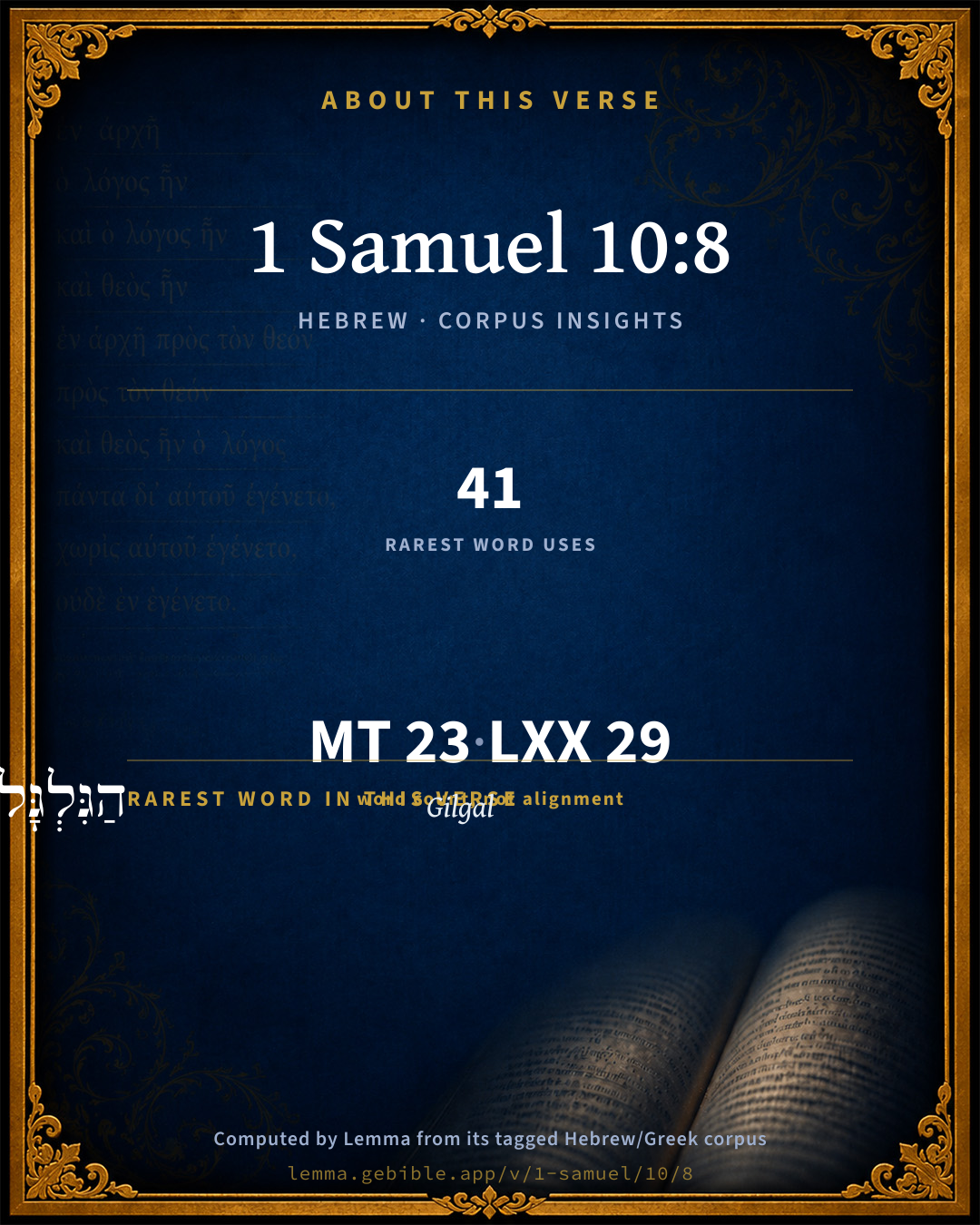
1 Samuel 10:8

Hebrew (Westminster Leningrad Codex) 1 Samuel 10:8 appears in the Hebrew Old Testament. The text above is from the Westminster Leningrad Codex. Each word links to its Strong’s number, a concise gloss, and parsing drawn from the Open Scriptures Hebrew Bible morphology. Click any word for its full Brown-Driver-Briggs (BDB) entry.
Download image
Cite this verse

1 Samuel 10:8 (World English Bible). Public Domain. Lemma interlinear Bible study tool, https://lemma.gebible.app/v/1-samuel/10/8.

Show BibTeX & RIS
BibTeX
RIS
English Translation
You shall go down before me to Gilgal; and, behold, I will come down to you, to offer burnt offerings, and to sacrifice sacrifices of peace-offerings: seven days shall you wait, until I come to you, and show you what you shall do.
World English Bible · Public Domain
Download a study sheet

One document with this verse’s original text, its word-by-word gloss line, the meaning frame, cross-references with their text, attributed commentary, and full source and license credits — printable, and it pastes into notes with its structure intact.

This verse Autodidact and up

Study sheet (.html) Plain text (.txt)

A passage Seminary Student

Up to 50 verses in one chapter. A passage sheet keeps up to 6 commentary sources and 12 cross-references per verse, in the order this page ranks them, and says so on the sheet whenever that leaves anything out. Ask for a single verse and you get the Autodidact verse sheet above.

Everything on this page stays free to read, with no account — the sheet is a download of what is already on screen, not access to it.

Want to remove ads? Support Godless Engineer
Compare translations 3

The same verse in 3 English versions, stacked beneath the original-language interlinear above. Click any original word for its lexicon entry.

Each is an independent rendering of the whole verse — the interlinear is not word-aligned to these translations.

Highlighted words mark where these versions differ — a whole-verse word diff, not a word-by-word alignment.

  • World English Bible Public Domain
    You shall go down before me to Gilgal; and, behold, I will come down to you, to offer burnt offerings, and to sacrifice sacrifices of peace-offerings: seven days shall you wait, until I come to you, and show you what you shall do.
  • King James Version Public Domain
    And thou shalt go down before me to Gilgal; and, behold, I will come down unto thee, to offer burnt offerings, and to sacrifice sacrifices of peace offerings: seven days shalt thou tarry, till I come to thee, and show thee what thou shalt do.
  • unfoldingWord Literal Text CC BY-SA 4.0
    But go down to my face Gilgal. And behold, I will be coming down to you to offer burnt offerings, to sacrifice sacrifices of peace offerings. May you wait seven days until my coming to you, and I will make known to you what you shall do.”

unfoldingWord Literal Text — © unfoldingWord, licensed CC BY-SA 4.0. Word-aligned USFM3 via Door43 (git.door43.org/unfoldingWord/en_ult).

Versions to compare (up to 4)

3 of 4 selected

Show all 18 translations

Every available English version of this verse, each an independent rendering of the whole verse.

  • World English Bible Public Domain
    You shall go down before me to Gilgal; and, behold, I will come down to you, to offer burnt offerings, and to sacrifice sacrifices of peace-offerings: seven days shall you wait, until I come to you, and show you what you shall do.
  • Berean Standard Bible Public Domain
    And you shall go before me to Gilgal, and surely I will come to you to offer burnt offerings and to sacrifice peace offerings. Wait seven days until I come to you and show you what you are to do.”
  • Majority Standard Bible Public Domain
    And you shall go before me to Gilgal, and surely I will come to you to offer burnt offerings and to sacrifice peace offerings. Wait seven days until I come to you and show you what you are to do.”
  • King James Version Public Domain
    And thou shalt go down before me to Gilgal; and, behold, I will come down unto thee, to offer burnt offerings, and to sacrifice sacrifices of peace offerings: seven days shalt thou tarry, till I come to thee, and show thee what thou shalt do.
  • American Standard Version (1901) Public Domain
    And thou shalt go down before me to Gilgal; and, behold, I will come down unto thee, to offer burnt-offerings, and to sacrifice sacrifices of peace-offerings: seven days shalt thou tarry, till I come unto thee, and show thee what thou shalt do.
  • Revised Version (1885) Public Domain
    And thou shalt go down before me to Gilgal; and, behold, I will come down unto thee, to offer burnt offerings, and to sacrifice sacrifices of peace offerings: seven days shalt thou tarry, till I come unto thee, and shew thee what thou shalt do.
  • Geneva Bible (1599) Public Domain
    And thou shalt goe downe before me to Gilgal: and I also will come downe vnto thee to offer burnt offerings, and to sacrifice sacrifices of peace. Tary for me seuen dayes, till I come to thee and shewe thee what thou shalt doe.
  • Douay-Rheims (1899) Public Domain
    And thou shalt go down before me to Galgal, (for I will come down to thee,) that thou mayest offer an oblation, and sacrifice victims of peace: seven days shalt thou wait, O till I come to thee, and I will shew thee what thou art to do.
  • Young's Literal Translation Public Domain
    `And thou hast gone down before me to Gilgal, and lo, I am going down unto thee, to cause to ascend burnt-offerings, to sacrifice sacrifices of peace-offerings; seven days thou dost wait till my coming in unto thee, and I have made known to thee that which thou dost do.'
  • Literal Standard Version CC BY-SA 4.0
    And you have gone down before me to Gilgal, and behold, I am going down to you, to cause burnt-offerings to ascend, to sacrifice sacrifices of peace-offerings; you wait [for] seven days until my coming to you, and I have made known to you that which you do.”
  • Unlocked Literal Bible CC BY-SA 4.0
    Go down before me to Gilgal. Then I will come down to you to offer burnt offerings and to sacrifice peace offerings. Wait seven days until I come to you and show you what you must do.”
  • unfoldingWord Literal Text CC BY-SA 4.0
    But go down to my face Gilgal. And behold, I will be coming down to you to offer burnt offerings, to sacrifice sacrifices of peace offerings. May you wait seven days until my coming to you, and I will make known to you what you shall do.”
  • Darby Bible Public Domain
    And thou shalt go down before me to Gilgal; and behold, I will come down to thee, to offer up burnt-offerings, [and] to sacrifice sacrifices of peace-offerings: seven days shalt thou wait, until I come to thee and inform thee what thou shalt do.
  • World Messianic Bible Public Domain
    “Go down ahead of me to Gilgal; and behold, I will come down to you to offer burnt offerings and to sacrifice sacrifices of peace offerings. Wait seven days, until I come to you and show you what you are to do.”
  • Webster's Bible Public Domain
    And thou shalt go down before me to Gilgal; and behold, I will come down to thee, to offer burnt-offerings, and to sacrifice sacrifices of peace-offerings: seven days shalt thou tarry, till I come to thee, and show thee what thou shalt do.
  • Free Bible Version CC BY-SA 4.0
    Then go ahead of me to Gilgal. I assure you I will come and join you to present burnt offerings and friendship offerings. Wait there seven days until I come to you, and let you know what you should do.”
  • Bible in Basic English Public Domain
    Then you are to go down before me to Gilgal, where I will come to you, for the offering of burned offerings and peace-offerings: go on waiting there for seven days till I come to you and make clear to you what you have to do.
  • JPS Tanakh (1917) Public Domain
    And thou shalt go down before me to Gilgal; and, behold, I will come down unto thee, to offer burnt-offerings, and to sacrifice sacrifices of peace-offerings; seven days shalt thou tarry, till I come unto thee, and tell thee what thou shalt do.'

Literal Standard Version (2020), Covenant Press — licensed CC BY-SA 4.0. Text via the HelloAO Bible API (eBible.org). Unlocked Literal Bible (unfoldingWord) — licensed CC BY-SA 4.0. Text via the HelloAO Bible API (eBible.org). unfoldingWord Literal Text — © unfoldingWord, licensed CC BY-SA 4.0. Word-aligned USFM3 via Door43 (git.door43.org/unfoldingWord/en_ult). Free Bible Version, Dr. Jonathan Gallagher — licensed CC BY-SA 4.0. Text via the HelloAO Bible API (eBible.org).

Word by word

More ways to search: Search by grammar → Find every occurrence → Compare this word →

Practice this passage: Drill this verse → Learn its vocabulary →

הַגִּלְגָּל֒
Gilgâl
H1537
“the · Gilgal”
Particle, Definite Article + Noun, Proper
Part of Speech
Particle + Noun
Type
Proper
Full BDB Definition

Origin: the same as H1536

TWOT: None

Gilgal = "a wheel, rolling" - the first site of an Israelite camp west of the Jordan, east of Jericho, here Samuel was judge, and Saul was made king; later used for illicit worship - dwelling place of prophets in northern Israel about four miles - a region conquered by Joshua, site unsure
  1. וְיָרַדְתָּ֣ yârad H3381 “and · to go down” Conjunction + Verb, Qal, Sequential Perfect, 2nd Person, Masculine, Singular
  2. לְפָנַי֮ pânîym H6440 “to/for · face(s) · my” Preposition + Noun, Common, Both, Plural, Construct + Suffix, Personal, 1st Person, Common, Singular
  3. וְהִנֵּ֤ה hinnêh H2009 “and · behold” Conjunction + Particle, Demonstrative
  4. אָֽנֹכִי֙ ʼânôkîy H595 “I” Pronoun, Personal, 1st Person, Common, Singular
  5. יֹרֵ֣ד yârad H3381 “going down” Verb, Qal, Participle Active, Masculine, Singular, Absolute
  6. אֵלֶ֔יךָ ʼêl H413 “to · you” Preposition + Suffix, Personal, 2nd Person, Masculine, Singular
  7. לְהַעֲל֣וֹת ʻâlâh H5927 “to go up” Preposition + Verb, Hiphil, Infinitive Construct
  8. עֹל֔וֹת ʻôlâh H5930 “burnt offerings” Noun, Common, Feminine, Plural, Absolute
  9. לִזְבֹּ֖חַ zâbach H2076 “to sacrifice” Preposition + Verb, Qal, Infinitive Construct
  10. זִבְחֵ֣י zebach H2077 “sacrifices of” Noun, Common, Masculine, Plural, Construct
  11. שְׁלָמִ֑ים shelem H8002 “peace offerings” Noun, Common, Masculine, Plural, Absolute
  12. שִׁבְעַ֨ת shebaʻ H7651 “seven” Adjective, Cardinal number, Masculine, Singular, Construct
  13. יָמִ֤ים yôwm H3117 “days” Noun, Common, Masculine, Plural, Absolute
  14. תּוֹחֵל֙ yâchal H3176 “to wait” Verb, Hiphil, Jussive, 2nd Person, Masculine, Singular
  15. עַד ʻad H5704 “until” Preposition
  16. בּוֹאִ֣י bôwʼ H935 “to enter · me” Verb, Qal, Infinitive Construct + Suffix, Personal, 1st Person, Common, Singular
  17. אֵלֶ֔יךָ ʼêl H413 “to · you” Preposition + Suffix, Personal, 2nd Person, Masculine, Singular
  18. וְהוֹדַעְתִּ֣י yâdaʻ H3045 “and · to know” Conjunction + Verb, Hiphil, Sequential Perfect, 1st Person, Common, Singular
  19. אֵ֖ת ʼêth H853 “-” Particle, Direct Object
  20. אֲשֶׁ֥ר ʼăsher H834 “which” Particle, Relative
  21. תַּעֲשֶֽׂה ʻâsâh H6213 “to do” Verb, Qal, Imperfect, 2nd Person, Masculine, Singular

About this verse

These counts appear in no published source. They are computed here, from the morphology-tagged text and Lemma’s own curated glosses. What Lemma adds →

23
words
20
distinct lemmas
Historical
section

Shared distinctive vocabulary

הַגִּלְגָּל֒ Gilgal H1537 occurs in 39 verses of the Hebrew Bible. Also found in:

Grammatical profile

  • 8 verbs
  • 6 nouns
  • 1 adjective
  • 1 pronoun
  • 4 prepositions
  • 3 particles

Verb forms

  • וְיָרַדְתָּ֣ Qal · Sequential Perfect
  • יֹרֵ֣ד Qal · Participle Active
  • לְהַעֲל֣וֹת Hiphil · Infinitive Construct
  • לִזְבֹּ֖חַ Qal · Infinitive Construct
  • תּוֹחֵל֙ Hiphil · Jussive
  • בּוֹאִ֣י Qal · Infinitive Construct
  • וְהוֹדַעְתִּ֣י Hiphil · Sequential Perfect
  • תַּעֲשֶֽׂה Qal · Imperfect

Repetition

Words recur within this verse — often emphatic in Hebrew:

  • וְיָרַדְתָּ֣ to go down H3381 ×2
  • אֵלֶ֔יךָ to H413 ×2

Hebrew & Septuagint length

In English translation the verse runs 43 words from the Hebrew and 46 from the Septuagint (LXX English) — closely comparable.

A rough comparison of the two English renderings, which tokenize alike — not a word-level alignment.

Word counts can differ between the Hebrew and the Greek without any difference in meaning — e.g. the Hebrew direct-object marker אֵת has no separate Greek word, and Greek often adds the article ὁ.

In the original languages it is 23 Hebrew tokens and 29 Greek tokens — but the two are counted differently (Hebrew bundles its prefixes and suffixes into one token; the Greek is in lemma form), so that isn’t a like-for-like length.

Cross-references

4

Topical passages linked to 1 Samuel 10:8 in the Treasury of Scripture Knowledge — connected by theme and wording, ordered by reader-vote popularity; previews shown in the World English Bible.

  • 1 Samuel 11:14–15 Then said Samuel to the people, Come, and let us go to Gilgal, and renew the kingdom there.
  • 1 Samuel 13:4 All Israel heard say that Saul had struck the garrison of the Philistines, and also that Israel was had in abomination with the Philistines. The people were gathered together after Saul to Gilgal.
  • 1 Samuel 13:8–15 He stayed seven days, according to the set time that Samuel [had appointed]: but Samuel didn't come to Gilgal; and the people were scattered from him.
  • 1 Samuel 15:33 Samuel said, As your sword has made women childless, so shall your mother be childless among women. Samuel hewed Agag in pieces before Yahweh in Gilgal.

Cross-references courtesy of OpenBible.info (CC BY 4.0).

Hebrew and Greek witnesses Masoretic Hebrew ↔ Greek Septuagint

The same verse in the two great witnesses to the Old Testament, shown verse-for-verse.

These are two independent witnesses, not word-aligned to each other, and the Septuagint is shown in lemma (dictionary) form.

Hebrew 1 Samuel 10:8 Masoretic · Westminster Leningrad Codex

וְיָרַדְתָּ֣ לְפָנַי֮ הַגִּלְגָּל֒ וְהִנֵּ֤ה אָֽנֹכִי֙ יֹרֵ֣ד אֵלֶ֔יךָ לְהַעֲל֣וֹת עֹל֔וֹת לִזְבֹּ֖חַ זִבְחֵ֣י שְׁלָמִ֑ים שִׁבְעַ֨ת יָמִ֤ים תּוֹחֵל֙ עַד בּוֹאִ֣י אֵלֶ֔יךָ וְהוֹדַעְתִּ֣י לְךָ֔ אֵ֖ת אֲשֶׁ֥ר תַּעֲשֶֽׂה

You shall go down before me to Gilgal; and, behold, I will come down to you, to offer burnt offerings, and to sacrifice sacrifices of peace-offerings: seven days shall you wait, until I come to you, and show you what you shall do.

World English Bible · Public Domain

Greek LXX 1 Samuel 10:8 Septuagint · lemma form

καί καταβαίνω ἔμπροσθεν ὁ γάλγαλα καί ἰδού καταβαίνω πρός σύ ἀναφέρω ὁλοκαύτωσις καί θυσία εἰρηνικός ἑπτά ἡμέρα διαλείπω ἕως ὁ ἔρχομαι ἐγώ πρός σύ καί γνωρίζω σύ ὅς ποιέω

And you shall go down in front of Galgal, and behold, I come down to you to offer a whole burnt offering and peace-offerings: seven days shall you wait until I shall come to you, and I will make known to you what you shall do.

LXX2012 (modern English Septuagint) · Public Domain

On this verse, Haydock's Catholic Bible Commentary discusses the Septuagint’s reading. Read the note in Commentary ↓

Hebrew: Westminster Leningrad Codex (CC BY 4.0). Greek: Septuagint (public domain); English from LXX2012 (modern English Septuagint) (Public Domain). How the Septuagint differs from the Hebrew →

Targum (Aramaic paraphrase)

1

The Targum is the ancient Jewish Aramaic paraphrase of the Hebrew Scriptures — an interpretive translation, not the Hebrew text itself. Onkelos (literal) and Pseudo-Jonathan (expansive) render the Torah, and Jonathan the Prophets. Coverage is partial: where no permissively-licensed English translation exists for a verse, only the Aramaic is shown. This is verse-level text, not a word-by-word alignment to the Hebrew.

  1. Targum Jonathan Prophets (Joshua–Malachi)
    וְתֵיחוֹת קֳדָמַי לְגִלְגָלָא וְהָא אֲנָא נָחִית לְוָתָךְ לְאַסָקָא עֲלַוָן וּלְנַכְסָא נִכְסַת קוּדְשִׁין שַׁבְעָא יוֹמִין תּוֹרִיךְ עַד מֵיתֵי לְוָתָךְ וַאֲחַוֵי לָךְ יַת דְתַעֲבֵּיד:

    (no public-domain English translation for this verse)

    Targum Jonathan — Aramaic: “Mikraot Gedolot” (public domain). English: “Sefaria Community Translation” (CC0 1.0 (public-domain dedication)); “London "Chaldee Paraphrase," 1871” (public domain). Text via Sefaria.

Commentary

Notes on 1 Samuel 10:8 from classic Christian and Jewish commentators (each source and its license shown beneath its notes). The classic Christian expositions comment on the surrounding passage and are grouped to its opening verse, so a note may address several verses; the Jewish commentaries on the Tanakh (Rashi and others) are per-verse, so they appear only where the commentator wrote on this verse.

Lemma curates 59 commentaries, every one of them public domain or Creative Commons licensed, each selected and text-cleaned for this edition rather than reprinted as found. About our sources →

Ellicott's Commentary for English Readers

(8) And shew thee what thou shalt do.—Considerable doubt exists among expositors as to the exact meaning and reference of these words of Samuel. In 1 Samuel 13., 1Sa_10:8 and following, a well-known and most important event in Saul’s life and reign is related, in which the circumstances strangely fit in with the words of the warning of Samuel. Only between this first meeting of the seer and the future king and the Gilgal meeting, described in 1 Samuel 13., two years—perhaps even a much longer period—elapsed (the dates of this age are most uncertain); besides which, that famous meeting at Gilgal was not by any means the first meeting of Samuel and Saul at that place. Yet, in spite of these difficulties, it seems best to refer to this meeting between the prophet and king at Gilgal, related in 1 Samuel 13, as the trial of faith especially looked on to by Samuel here. The solemn warning here given was, doubtless, repeated in a much more detailed form by the prophet some time before the appointed Gilgal meeting. So much for the reference; the signification of the warning is best explained in the following way:—Samuel had bidden the future king to advance along the paths of glory and difficulty which lay before him in all confidence and trust, acting in each emergency according to the dictates of his own heart—only in one thing he must be ever on his guard. In his future great work for the regeneration and advancement of Israel, he must, for the sake of the faith of Israel, be on his guard against infringing the sacred privileges of the religion of the Eternal. In the plenitude of his kingly power, the day would come when the temptation would assault him to disregard the ancient sanctity of the sacrifice, and to assume as king, functions which belonged alone to men like Samuel set apart for the sacred office, and thus publicly to dishonour the commandments of God, and by his reckless example of unbelief in revelation to weaken the faith of the people.

Such a temptation presented itself to Saul, we believe, some two or more years from this time, when, as related in 1 Samuel 13, a solemn assembly of the people was summoned to Gilgal, before the commencement of the war of independence. This great enterprise for the people of the Lord must necessarily be begun with solemn religious rites and sacrifices. These the king was forbidden to officiate at without the presence of the Divinely appointed seer. We shall see how King Saul acted under the temptation to set himself and his royal power above the prophet of the Lord and the direct command of God. Whether or no King Saul with his own hand offered the Gilgal sacrifice is uncertain; at all events, the great sin he seemed to have been guilty of having committed, is to have declined to wait for the presence of the prophet of the Lord, although publicly required by the word of the Lord to do so. (See Notes on 1 Samuel 13)

The “heart” is mentioned as changed by God, because, according to the conception of the Divine writings, the heart is represented as the centre of the whole mental and physical life—of will, desire, thought, perception, and feeling. It was one thing for Samuel the seer to put before the young Benjamite the brilliant destiny which lay before him, but it was another and different thing to transform one like Saul, brought up to merely agricultural pursuits, into a fit and worthy recipient of such honours and powers. We know how utterly incapable are all such things as wealth and rank and power in themselves of inspiring the heart with any noble patriotic aspirations, or with any high religious longings, or lofty patriotic aims; a higher influence is needed to awaken the heart, or to rouse it from merely earthly and sordid contemplations.

This is the work which God worked in the heart. of the young Saul as, in the early morning, he left “Ramah of the Watchers,” his ears tingling with the burning words of the great seer all through that day and many succeeding days. In quiet humility, and, no doubt, with many a silent prayer, he watched and waited; when he returned home there was no sign of exultation visible in the man, no mark of impatience. His lips were sealed; he seems to have whispered to no one what the prophet had told him; he made no sign even when events came crowding thick about him—such as the popular assembly for the choice of a king, presided over by the prophet-judge, whose mind Saul alone in Israel knew: the drawing of the lots: the narrowing of the fateful circle: the designation of his tribe, his family, then himself. We see, indeed, God had changed his heart. Was there not in these early days a promise of a noble king—a man after God’s own heart?

And all those signs came to pass that day.—Of the first two signs which were to meet him no further details are given; we are simply told that in the order predicted by Samuel Saul came across them. The third alone gives occasion for a special mention, because it had a great effect on the life of the future king.

A Bible Commentary for English Readers, edited by Charles John Ellicott (1878–1897) — public domain. Text from a community e-Sword module.

Trapp's Complete Commentary

John Trapp

1Sa 10:8 And thou shalt go down before me to Gilgal; and, behold, I will come down unto thee, to offer burnt offerings, [and] to sacrifice sacrifices of peace offerings: seven days shalt thou tarry, till I come to thee, and shew thee what thou shalt do.

Ver. 8. And thou shalt go down before me to Gilgal.] This do also as occasion shall serve thee but see thou do it; for thy kingdom lieth upon it. He that believeth maketh not haste. Compare 1Sa 13:1-2; 1Sa 13:8.

And show thee what thou shalt do.] Happy Saul in such a monitor! far better than Polybius was to Scipio, whose counsel whilst he followed, he never miscarried, saith Pausanius, in any enterprise.

John Trapp, A Commentary or Exposition upon All the Books of the Old and New Testament (1647–1656) — public domain. Text from a community e-Sword module.

Joseph Benson's Commentary

1Sa 10:8. Seven days shalt thou tarry till I come — This, though now mentioned and commanded, was not immediately to be performed; as is evident, partly from the whole course of the story, (which shows that Saul and Samuel, and the people, first met at Mizpeh, 1Sa 10:17, &c., where Saul was chosen of God, and accepted by the people as king; and afterward went to Gilgal once before the time here spoken of, 1Sa 11:14-15,) and partly by comparing this place with 1Sa 13:8, &c., where we find Saul charged with the violation of this command, two years after the giving of it. It seems this was given as a standing rule for Saul to observe while Samuel and he lived; that in case of any great future difficulties, as the invasion of enemies, Saul should resort to Gilgal, and call the people thither, and tarry there seven days, which was but a necessary time for gathering the people, and for the coming of Samuel thither. And Gilgal was chosen for this purpose, because that place was famous for the solemn renewing of the covenant between God and Israel, (Joshua 4.,) and for other eminent instances of God’s favour to them, the remembrance whereof was a confirmation of their faith; and because it was a very convenient place for the tribes within and without Jordan to assemble in, and consult, and unite their forces together upon such occasions.

Joseph Benson's Commentary on the Old and New Testaments (1811–1818) — public domain. Text from a community e-Sword module.

Tyndale Open Study Notes

Tyndale Open Resources

10:8 Gilgal: See study note on 7:16. • wait for seven days: Saul apparently fulfilled this instruction in 11:14-15 (cp. 13:8).

Tyndale Open Study Notes — © Tyndale Open Resources, licensed CC BY-SA 4.0. Text via the HelloAO Bible API.

Jamieson, Fausset & Brown

Robert Jamieson, A. R. Fausset & David Brown

thou shalt go down before me to Gilgal--This, according to JOSEPHUS, was to be a standing rule for the observance of Saul while the prophet and he lived; that in every great crisis, such as a hostile incursion on the country, he should repair to Gilgal, where he was to remain seven days, to afford time for the tribes on both sides Jordan to assemble, and Samuel to reach it.

Jamieson, Fausset & Brown — Commentary Critical and Explanatory on the Whole Bible (1871) — public domain (CC PDM 1.0). Text via the HelloAO Bible API.

Adam Clarke's Commentary

Verse 8. Seven days shalt thou tarry] I will come to thee within seven days, offer sacrifices, receive directions from the Lord, and deliver them to thee. It is likely that these seven days referred to the time in which Samuel came to Saul to Gilgal, offered sacrifices, and confirmed the kingdom to him, after he had defeated the Ammonites. See 1Sa 11:14-15.

Adam Clarke's Commentary on the Bible (1810–1826) — public domain. Text from a community e-Sword/MySword module.

The Cambridge Bible for Schools and Colleges

gen. ed. J. J. S. Perowne

8. thou shalt go down before me to Gilgal] Better, and when thou goest down before me to Gilgal. This is not to be understood as a direction to meet Samuel at Gilgal at once. The injunction applies to some future occasion whenever it might be, of which they had been talking. Doubtless Samuel and Saul had been discussing the best means of shaking off the Philistine yoke, and had agreed upon a muster of the people at Gilgal, as the national centre furthest from the Philistine power. Samuel’s parting injunction to Saul is to take no step independently. The king must wait for the prophet’s sanction to strike the blow. The fitting opportunity for the muster did not come for several years, and when it came Saul disobeyed Samuel’s command. See 1Sa_13:8 ff.

The Cambridge Bible for Schools and Colleges (gen. ed. J. J. S. Perowne; Cambridge University Press, 1878–1918) — public domain. Text from a community e-Sword module.

John Gill's Exposition

And thou shall go down before me to Gilgal,.... Not immediately; for the first summons of the people, and of Saul, and the first meeting of them by Samuel, were at Mizpeh, where Saul was chosen by lot; nor the first time of Saul's being at Gilgal, when the kingdom was renewed; for Saul had no need to wait seven days there, since he and Samuel went together, Sa1 11:14 rather at the second time of his being there, where not staying the time quite up, was reproved for it, which was two years after this, Sa1 13:1, though it may be this was a general rule to be observed by Saul, that whenever anything turned up of importance to the children of Israel, and was a difficulty with him, he should go to Gilgal, and there wait seven days for Samuel, from the time he gave him notice of it, who would come at the appointed time, and would give him what advice and instructions were necessary; and this place was the rather appointed, because it was the place where the Israelites first pitched their camp when they came over Jordan, and where the tabernacle first was; and where prayer and sacrifices were wont to be made; and where the kingdom of Saul was renewed; and which lay convenient for all the tribes, both on the one and the other side of Jordan:

and, behold, I will come down to thee to offer burnt offerings, and to sacrifice sacrifices of peace offerings; so he did when the kingdom was renewed, and Saul was confirmed in it, Sa1 11:15 but two years after, Saul not staying the full time, he offered them himself by another, for which he was reproved, Sa1 13:9.

seven days shalt thou tarry till I come to thee; either from the time of the notice he should give to Samuel of his going thither, or from the time of his arrival there; for it can by no means be understood as from the time of his present departure from him, for the reasons before given:

and show thee what thou shalt do; in the then present emergency or difficulty on his hands; and this he said to encourage him under the weight and burden of government laid upon him.

John Gill's Exposition of the Whole Bible (1746–1763) — public domain (CC PDM 1.0). Text via the HelloAO Bible API.

Albert Barnes' Notes on the Bible

Seven days shalt thou tarry ... - The appointment here made is not to be confounded with that mentioned in marginal reference.

Albert Barnes' Notes on the Bible (1834–1885) — public domain. Text from a community e-Sword/MySword module.

Haydock's Catholic Bible Commentary

Galgal. Here also by dispensation was an altar of God. (Challoner) --- To do. Saul went thither, after the victory which he had obtained over the Ammonites, when he was confirmed in his dignity, chap. xi. 14. But the mention of seven days, seems to indicate that Samuel is here speaking of that event, when the war against the Philistines was at hand, and Saul neglected to wait the appointed term, before he ventured to offer sacrifice, chap. xiii. 8. (Calmet) --- Some think that Samuel engages always to meet him at Galgal, on any important business, within the space of seven days. (Serarius) --- Others translate, "I will be at Galgal with thee, and we will offer sacrifices, for seven days." (Calmet) --- Protestants, "I will come down to thee to offer burnt-offerings," &c., which is conformable to the Septuagint. Indeed Saul was probably blamed for offering the victims himself. (Haydock) --- Obedience was enjoined him to try his humility. (St. Gregory) (Worthington)

George Leo Haydock (1774–1849), Haydock's Catholic Family Bible and Commentary, 1859 edition — public domain. Excludes Psalms (Douay-Rheims chapter numbering differs from Protestant) and Deuterocanonical books (Catholic canon only).

Matthew Poole's English Annotations

Seven days shalt thou tarry till I come to thee: this, though now mentioned and commanded, yet was not immediately to be performed; as is evident, partly from the whole course of the story, which shows that Saul, and Samuel, and the people first met at Mizpeh, 1Sa 10:17, &c., where Saul was chosen by God and accepted by the people as king; and afterwards went to Gilgal, once before the time here spoken of, 1Sa 11:14,15; and partly by comparing this place with 1Sa 13:8, &c., where we find Saul charged with the violation of this command two years after the giving of it, as appears from 1Sa 13:1,2.

Quest. How then is this to be understood?

Answ. 1. This may be given as a standing rule for Saul to observe while Samuel and he lived; that in case of any great future difficulties, as the invasion of enemies, Saul should resort to Gilgal, and call the people thither, and tarry there seven days, which was but a reasonable and necessary time for the gathering of the people, and for the coming of Samuel thither. For though this be related as but once done, 1Sa 13, yet Josephus affirms that it was to be constantly practised upon all such occasions. And Gilgal was chosen for this purpose as a very fit place; partly because that place was famous for the solemn renewing of the covenant between God and Israel, Jos 4, and for other eminent instances of God’s favour to them, the remembrance whereof was a notable confirmation of their faith; and partly because it was a very convenient place for the tribes within and without Jordan to assemble, and consult, and unite their forces together upon such occasions. If you ask, Why then Saul did not practise this precept upon the first invasion of the Ammonites? it may be answered, that this was a rule for Saul when he and Samuel were asunder, whereas they were together in that expedition, 1Sa 11:7. And further, that necessity did excuse the violation of this precept then, because Saul could not wait for Samuel, nor forbear his action for seven days, as is evident from 1Sa 11:3,9,10. Or,

2. (which I propose with submission to the learned and judicious) This may be here added as another sign to confirm his faith, which having strengthened by three foregoing signs, he now fortifies it by another sign which was to follow afterwards; it being very usual for God to give men signs to confirm their faith from future events; as Exo 3:12; 2Ki 19:29; Isa 7:13,14. So the meaning maybe this, Another sign will I add to strengthen thy faith: Thou shalt in due time, and upon a great occasion which shall then happen,

go down before me to Gilgal, and there

I will come down unto thee to offer—sacrifices, & c. But when thou comest thither, be sure thou tarry there seven days, and then I will come, as I have said, and give thee necessary instructions and assistance, as the matter shall require.

Matthew Poole's English Annotations on the Holy Bible (1683–1685) — public domain. Text from a community e-Sword/MySword module.

Whedon's Commentary on the Bible

Daniel D. Whedon

8. Thou shalt go down before me to Gilgal — This is not a command, but a prediction. Samuel’s prophetic eye fastens upon the future turning point in Saul’s career, when, threatened by an attack from the Philistines, and forsaken by many of his soldiers, he shall be called upon to show his faith in God. Perhaps Samuel added other instructions not recorded here; but it was sufficient now for Saul to know that there would come a time when he would be waiting at Gilgal for Samuel’s arrival, and when that occasion came he must wait for special instruction from the Lord. For the manner in which this prophecy was fulfilled, and how Saul failed to observe these instructions, see 1Sa_13:8. It was fitting that at this first interview Samuel should drop a word of warning and counsel for Saul’s guidance at that coming time of his greatest danger.

Daniel D. Whedon (gen. ed.), Commentary on the Old and New Testaments (1874–1909) — public domain. Text from a community e-Sword module.

The Pulpit Commentary

Thou shalt go down before me to Gilgal. We find in 1Sa_13:8-13 a meeting at Gilgal so exactly parallel to what is arranged here that we cannot help looking upon this, again, as a sort of sign to be fulfilled at a later period. It is no argument against it that Gilgal was the place where in the mean while Saul was solemnly inaugurated king; for he was appointed in order that he might deliver Israel from the Philistines, (1Sa_9:16) and we may feel sure that this grand purpose would form the subject of conversation between the prophet and the soldier, either on the house-top or the next morning. In this conversation Gilgal would be selected as the place where Saul would assemble Israel for the war of independence (so Rashi and other Jewish interpreters); and so great an enterprise must necessarily be begun with religious rites, and Saul was to wait a full week for the prophet"s coming, both to try his faith, which ought to have been confirmed by the fulfilment of the three appointed signs, and in order that the war might be undertaken under the same holy auspices as his own election to the kingdom. The two years" interval, were it really so long, would give time for Saul"s character to develop under the forcing influences of royalty, and it would then be proved, when he felt himself every inch a king, whether he was still as amenable to the Divine authority as when he was first summoned from obscurity to mount a kingly throne. But, really, the words in 1Sa_13:1 do not justify this conclusion, and most probably the occurrences mentioned in that chapter followed immediately upon Saul"s confirmation as king.

The Pulpit Commentary (1880–1919), ed. H.D.M. Spence-Jones & Joseph S. Exell — public domain. Text from a community e-Sword module.

John Wesley's Explanatory Notes

Till I come - This, though now mentioned and commanded, was not immediately to be performed; as is evident, partly from the whole course of the story, (which shews, that Saul and Samuel, and the people, first met at Mizpeh, ver. 17, &c. where Saul was chosen by God, and accepted by the people as king; and afterwards went to Gilgal once before the time here spoken of, chap. xi, 14, 15,) and partly, by comparing this place with chap. xiii, 8, &c. where we find Saul charged with the violation of this command, two years after the giving of it. It seems this is given as a standing rule for Saul to observe while Samuel and he lived; that in case of any great future difficulties, as the invasion of enemies, Saul should resort to Gilgal, and call the people thither, and tarry there seven days, which was but a necessary time for gathering the people, and for the coming of Samuel thither. And Gilgal was chosen for this purpose, because that place was famous for the solemn renewing of the covenant between God and Israel, Josh. iv, 19-24, and for other eminent instances of God's favour to them, the remembrance whereof was a confirmation of their faith; and because it was a very convenient place for he tribes within and without Jordan to assemble, and consult, and unite their forces together upon such occasions.

John Wesley, Explanatory Notes Upon the Whole Bible (1754–1765) — public domain. Text via the GEBible commentary corpus.

Keil & Delitzsch

C. F. Keil & F. Delitzsch

In conclusion, Samuel gave him an important hint with regard to his future attitude: "And goest thou before me down to Gilgal; and, behold, I am coming down to thee, to offer burnt-offerings, and to sacrifice peace-offerings: thou shalt wait seven days, till I come to thee, that I may show thee what thou art to do." The infinitive clause וגו להעלות is undoubtedly dependent upon the main clause וירדתּ, and not upon the circumstantial clause which is introduced as a parenthesis. The thought therefore is the following: If Saul went down to Gilgal to offer sacrifice there, he was to wait till Samuel arrived. The construction of the main clause itself, however, is doubtful, since, grammatically considered, ירדתּ can either be a continuation of the imperative עשׂה (Sa1 10:7), or can be regarded as independent, and in fact conditional. The latter view, according to which ירדתּ supposes his going down as a possible thing that may take place at a future time, is the one required by the circumstantial clause which follows, and which is introduced by והנּה; for if וירדתּ were intended to be a continuation of the imperative which precedes it, so that Samuel commanded Saul to go down to Gilgal before him, he would have simply announced his coming, that is to say, he would either have said וירדתּי or ארד ואני. The circumstantial clause "and behold I am coming down to thee" evidently presupposes Saul's going down as a possible occurrence, in the event of which Samuel prescribes the course he is to pursue. But the conditional interpretation of וירדתּ is still more decidedly required by the context. For instance, when Samuel said to Saul that after the occurrence of the three signs he was to do what came to his hand, he could hardly command him immediately afterwards to go to Gilgal, since the performance of what came to his hand might prevent him from going to Gilgal. If, however, Samuel meant that after Saul had finished what came to his hand he was to go down to Gilgal, he would have said, "And after thou hast done this, go down to Gilgal," etc. But as he does not express himself in this manner, he can only have referred to Saul's going to Gilgal as an occurrence which, as he foresaw, would take place at some time or other. And to Saul himself this must not only have presented itself as a possible occurrence, but under the existing circumstances as one that was sure to take place; so that the whole thing was not so obscure to him as it is to us, who are only able to form our conclusions from the brief account which lies before us. If we suppose that in the conversation which Samuel had with Saul upon the roof (Sa1 9:25), he also spoke about the manner in which the Philistines, who had pushed their outposts as far as Gibeah, could be successfully attacked, he might also have mentioned that Gilgal was the most suitable place for gathering an army together, and for making the necessary preparations for a successful engagement with their foes. If we just glance at the events narrated in the following chapters, for the purpose of getting a clear idea of the thing which Samuel had in view; we find that the three signs announced by Samuel took place on Saul's return to Gibeah (Sa1 10:9-16). Samuel then summoned the people to Mizpeh, where Saul was elected king by lot (Sa1 10:17-27); but Saul returned to Gibeah to his own house even after this solemn election, and was engaged in ploughing the field, when messengers came from Jabesh with the account of the siege of that town by the Ammonites. On receiving this intelligence the Spirit of Jehovah came upon him, so that he summoned the whole nation with energy and without delay to come to battle, and proceeded to Jabesh with the assembled army, and smote the Ammonites (Sa1 11:1-11). Thereupon Samuel summoned the people to come to Gilgal and renew the monarchy there (Sa1 11:12-15); and at the same time he renewed his office of supreme judge (1 Samuel 12), so that now for the first time Saul actually commenced his reign, and began the war against the Philistines (Sa1 13:1), in which, as soon as the latter advanced to Michmash with a powerful army after Jonathan's victorious engagement, he summoned the people to Gilgal to battle, and after waiting there seven days for Samuel in vain, had the sacrifices offered, on which account as soon as Samuel arrived he announced to him that his rule would not last (Sa1 13:13.).

Now, it cannot have been the first of these two gatherings at Gilgal that Samuel had in his mind, but must have been the second. The first is precluded by the simple fact that Samuel summoned the people to go to Gilgal for the purpose of renewing the monarchy; and therefore, as the words "come and let us go to Gilgal" (Sa1 11:14) unquestionably imply, he must have gone thither himself along with the people and the king, so that Saul was never in a position to have to wait for Samuel's arrival. The second occurrence at Gilgal, on the other hand, is clearly indicated in the words of Sa1 13:8, "Saul tarried seven days, according to the set time that Samuel had appointed," in which there is almost an express allusion to the instructions given to Saul in the verse before us. But whilst we cannot but regard this as the only true explanation, we cannot agree with Seb. Schmidt, who looks upon the instructions given to Saul in this verse as "a rule to be observed throughout the whole of Samuel's life," that is to say, who interprets ירדתּ in the sense of "as often as thou goest down to Gilgal." For this view cannot be grammatically sustained, although it is founded upon the correct idea, that Samuel's instructions cannot have been intended as a solitary and arbitrary command, by which Saul was to be kept in a condition of dependence. According to our explanation, however, this is not the case; but there was an inward necessity for them, so far as the government of Saul was concerned. Placed as he was by Jehovah as king over His people, for the purpose of rescuing them out of the power of those who were at that time its most dangerous foes, Saul was not at liberty to enter upon the war against these foes simply by his own will, but was directed to wait till Samuel, the accredited prophet of Jehovah, had completed the consecration through the offering of a solemn sacrifice, and had communicated to him the requisite instructions from God, even though he should have to wait for seven days.

(Note: The difficulty in question has been solved on the whole quite correctly by Brentius. "It is not to be supposed," he says, "that Samuel was directing Saul to go at once to Gilgal as soon as he should go away from him, and wait there for seven days; but that he was to do this after he had been chosen king by public lot, and having conquered the Ammonites and been confirmed in the kingdom, was about to prepare to make war upon the Philistines, on whose account chiefly it was that he had been called to the kingdom. For the Lord had already spoken thus to Samuel concerning Saul: 'He will save my people from the hands of the Philistines, because I have looked upon my people.' This is the meaning therefore of Samuel's command: Thou hast been called to the kingdom chiefly for this purpose, that thou mayest deliver Israel from the tyranny of the Philistines. When therefore thou shalt enter upon this work, go down into Gilgal and wait there seven days, until I shall come to thee: for thou shalt then offer a holocaust, though not before I come to thee, and I will show thee what must be done in order that our enemies the Philistines may be conquered. The account of this is given below in 1 Samuel 13, where we learn that Saul violated this command.")

Keil & Delitzsch — Biblical Commentary on the Old Testament (1861–1891) — public domain (CC PDM 1.0). Text via the HelloAO Bible API. (Old Testament only.)

Rashi

Rabbi Shlomo Yitzchaki (Rashi)

Then you shall go down to Gilgol ahead of me. After you reign, you shall come down to Gilgol before me, i.e., before I go down.

And I will go down to you. At the end of seven days after you will have gone down.

Wait. You shall wait.

Rashi on the Tanakh — English translations: “The Judaica Press complete Tanach with Rashi, translated by A. J. Rosenberg” (CC BY 4.0); “Pentateuch with Rashi's commentary by M. Rosenbaum and A.M. Silbermann, 1929-1934” (public domain); “The Metsudah Tanach series, Lakewood, N.J” (CC BY 4.0); and “The Book of Joshua, Metsudah Publications, 1997” (CC BY 4.0). Text via Sefaria.

Lesson kit

Teaching starters — assembled from the data on this page, not authored interpretation. Every prompt links to the verse data it draws on. Edit before teaching.

1 Samuel, in the Historical, opens this verse with 23 words (20 distinct Hebrew lemmas). Its most distinctive word is Gilgâl (“Gilgal”). A historical commentator’s framing appears above. Read the whole chapter for the surrounding context.

Discussion questions

  1. How does “Gilgal” (Gilgâl) shape what this verse is saying?
  2. How does Deuteronomy 11:30, which shares the word «Gilgal», read alongside this verse?
  3. What does the repetition of “to go down” (2× in this one verse) do in this verse?
  4. The translations on this page render this verse differently — a whole-verse word diff, not a word-by-word alignment. What might account for the different wordings?
  5. «וְיָרַדְתָּ֣» is a Qal Sequential Perfect verb. How does that grammatical form shape the action described?
  6. Compare how Ellicott's Commentary for English Readers and Trapp's Complete Commentary read this verse. Where do they agree or differ?

Things to notice

Reading settings

Reading text

Shown beneath each verse's original-language words.

Old Testament
Old Testament edition

Read the OT as the Masoretic Hebrew (MT) or the Greek Septuagint (LXX).

English shown for the Greek Septuagint (in the Hebrew ↔ Greek comparison).

Comparing translations? Open the Compare panel on any verse page to stack up to four side by side.