
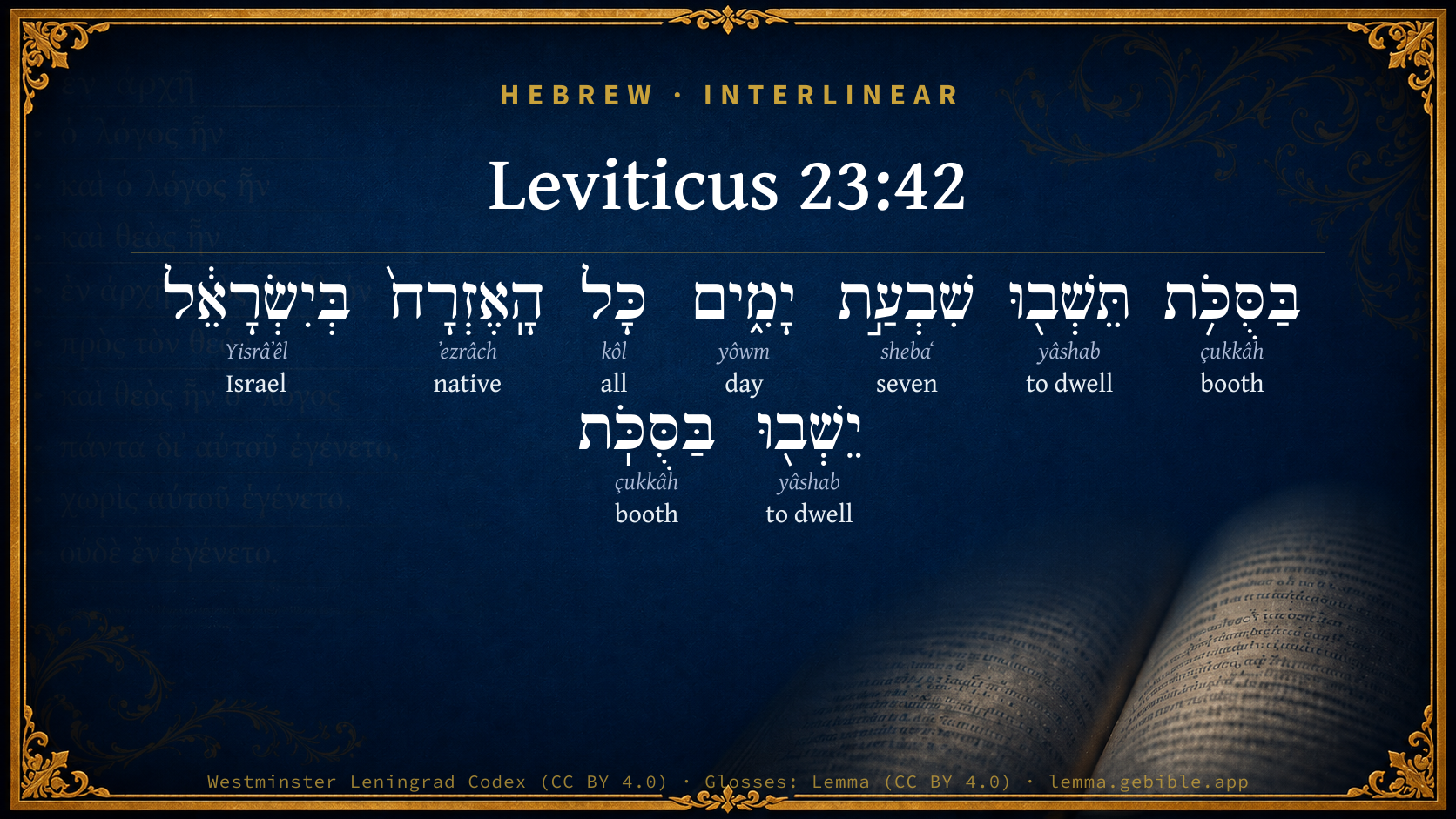
Leviticus 23:42

Hebrew (Westminster Leningrad Codex) Leviticus 23:42 appears in the Hebrew Old Testament. The text above is from the Westminster Leningrad Codex. Each word links to its Strong’s number, a concise gloss, and parsing drawn from the Open Scriptures Hebrew Bible morphology. Click any word for its full Brown-Driver-Briggs (BDB) entry.
Download image
Cite this verse

Leviticus 23:42 (World English Bible). Public Domain. Lemma interlinear Bible study tool, https://lemma.gebible.app/v/leviticus/23/42.

Show BibTeX & RIS
BibTeX
RIS
English Translation
You shall dwell in booths seven days. All who are native-born in Israel shall dwell in booths,
World English Bible · Public Domain
Download a study sheet

One document with this verse’s original text, its word-by-word gloss line, the meaning frame, cross-references with their text, attributed commentary, and full source and license credits — printable, and it pastes into notes with its structure intact.

This verse Autodidact and up

Study sheet (.html) Plain text (.txt)

A passage Seminary Student

Up to 50 verses in one chapter. A passage sheet keeps up to 6 commentary sources and 12 cross-references per verse, in the order this page ranks them, and says so on the sheet whenever that leaves anything out. Ask for a single verse and you get the Autodidact verse sheet above.

Everything on this page stays free to read, with no account — the sheet is a download of what is already on screen, not access to it.

Want to remove ads? Support Godless Engineer
Compare translations 3

The same verse in 3 English versions, stacked beneath the original-language interlinear above. Click any original word for its lexicon entry.

Each is an independent rendering of the whole verse — the interlinear is not word-aligned to these translations.

Highlighted words mark where these versions differ — a whole-verse word diff, not a word-by-word alignment.

  • World English Bible Public Domain
    You shall dwell in booths seven days. All who are native-born in Israel shall dwell in booths,
  • King James Version Public Domain
    Ye shall dwell in booths seven days; all that are Israelites born shall dwell in booths:
  • unfoldingWord Literal Text CC BY-SA 4.0
    You shall dwell in booths seven days. All the native-born in Israel shall dwell in booths,

unfoldingWord Literal Text — © unfoldingWord, licensed CC BY-SA 4.0. Word-aligned USFM3 via Door43 (git.door43.org/unfoldingWord/en_ult).

Versions to compare (up to 4)

3 of 4 selected

Show all 18 translations

Every available English version of this verse, each an independent rendering of the whole verse.

  • World English Bible Public Domain
    You shall dwell in booths seven days. All who are native-born in Israel shall dwell in booths,
  • Berean Standard Bible Public Domain
    You are to dwell in booths for seven days. All the native-born of Israel must dwell in booths,
  • Majority Standard Bible Public Domain
    You are to dwell in booths for seven days. All the native-born of Israel must dwell in booths,
  • King James Version Public Domain
    Ye shall dwell in booths seven days; all that are Israelites born shall dwell in booths:
  • American Standard Version (1901) Public Domain
    Ye shall dwell in booths seven days; all that are home-born in Israel shall dwell in booths;
  • Revised Version (1885) Public Domain
    Ye shall dwell in booths seven days; all that are homeborn in Israel shall dwell in booths:
  • Geneva Bible (1599) Public Domain
    Ye shall dwell in boothes seuen daies: all that are Israelites borne, shall dwel in boothes,
  • Douay-Rheims (1899) Public Domain
    And you shall dwell in bowers seven days: every one that is of the race of Israel, shall dwell in tabernacles:
  • Young's Literal Translation Public Domain
    `In booths ye dwell seven days; all who are natives in Israel dwell in booths,
  • Literal Standard Version CC BY-SA 4.0
    You dwell in shelters [for] seven days; all who are natives in Israel dwell in shelters,
  • Unlocked Literal Bible CC BY-SA 4.0
    You must live in small shelters for seven days. All native-born Israelites must live in small shelters for seven days,
  • unfoldingWord Literal Text CC BY-SA 4.0
    You shall dwell in booths seven days. All the native-born in Israel shall dwell in booths,
  • Darby Bible Public Domain
    In booths shall ye dwell seven days; all born in Israel shall dwell in booths;
  • World Messianic Bible Public Domain
    You shall dwell in temporary shelters for seven days. All who are native-born in Israel shall dwell in temporary shelters,
  • Webster's Bible Public Domain
    Ye shall dwell in booths seven days: all that are Israelites born shall dwell in booths:
  • Free Bible Version CC BY-SA 4.0
    You are to live in temporary shelters for seven days. Every Israelite born in the country must live in shelters,
  • Bible in Basic English Public Domain
    For seven days you will be living in tents; all those who are Israelites by birth are to make tents their living-places:
  • JPS Tanakh (1917) Public Domain
    Ye shall dwell in booths seven days; all that are home-born in Israel shall dwell in booths;

Literal Standard Version (2020), Covenant Press — licensed CC BY-SA 4.0. Text via the HelloAO Bible API (eBible.org). Unlocked Literal Bible (unfoldingWord) — licensed CC BY-SA 4.0. Text via the HelloAO Bible API (eBible.org). unfoldingWord Literal Text — © unfoldingWord, licensed CC BY-SA 4.0. Word-aligned USFM3 via Door43 (git.door43.org/unfoldingWord/en_ult). Free Bible Version, Dr. Jonathan Gallagher — licensed CC BY-SA 4.0. Text via the HelloAO Bible API (eBible.org).

Word by word

More ways to search: Search by grammar → Find every occurrence → Compare this word →

Practice this passage: Drill this verse → Learn its vocabulary →

הָֽאֶזְרָח֙
ʼezrâch
H249
“the · native”
Particle, Definite Article + Noun, Common, Masculine, Singular, Absolute
Part of Speech
Particle + Noun
Type
Common
Gender
Masculine
Number
Singular
State
Absolute
Full BDB Definition

Origin: from H2224 (in the sense of springing up)

TWOT: 580b

a native (one rising from the soil) - of man, native Israelites - of tree, native (to Israel)
  1. בַּסֻּכֹּ֥ת çukkâh H5521 “in/at the · booths” Preposition, Determined + Noun, Common, Feminine, Plural, Absolute
  2. תֵּשְׁב֖וּ yâshab H3427 “to dwell” Verb, Qal, Imperfect, 2nd Person, Masculine, Plural
  3. שִׁבְעַ֣ת shebaʻ H7651 “seven” Adjective, Cardinal number, Masculine, Singular, Construct
  4. יָמִ֑ים yôwm H3117 “days” Noun, Common, Masculine, Plural, Absolute
  5. כָּל kôl H3605 “all of” Noun, Common, Masculine, Singular, Construct
  6. בְּיִשְׂרָאֵ֔ל Yisrâʼêl H3478 “in/at · Israel” Preposition + Noun, Proper
  7. יֵשְׁב֖וּ yâshab H3427 “to dwell” Verb, Qal, Imperfect, 3rd Person, Masculine, Plural
  8. בַּסֻּכֹּֽת çukkâh H5521 “in/at the · booths” Preposition, Determined + Noun, Common, Feminine, Plural, Absolute

About this verse

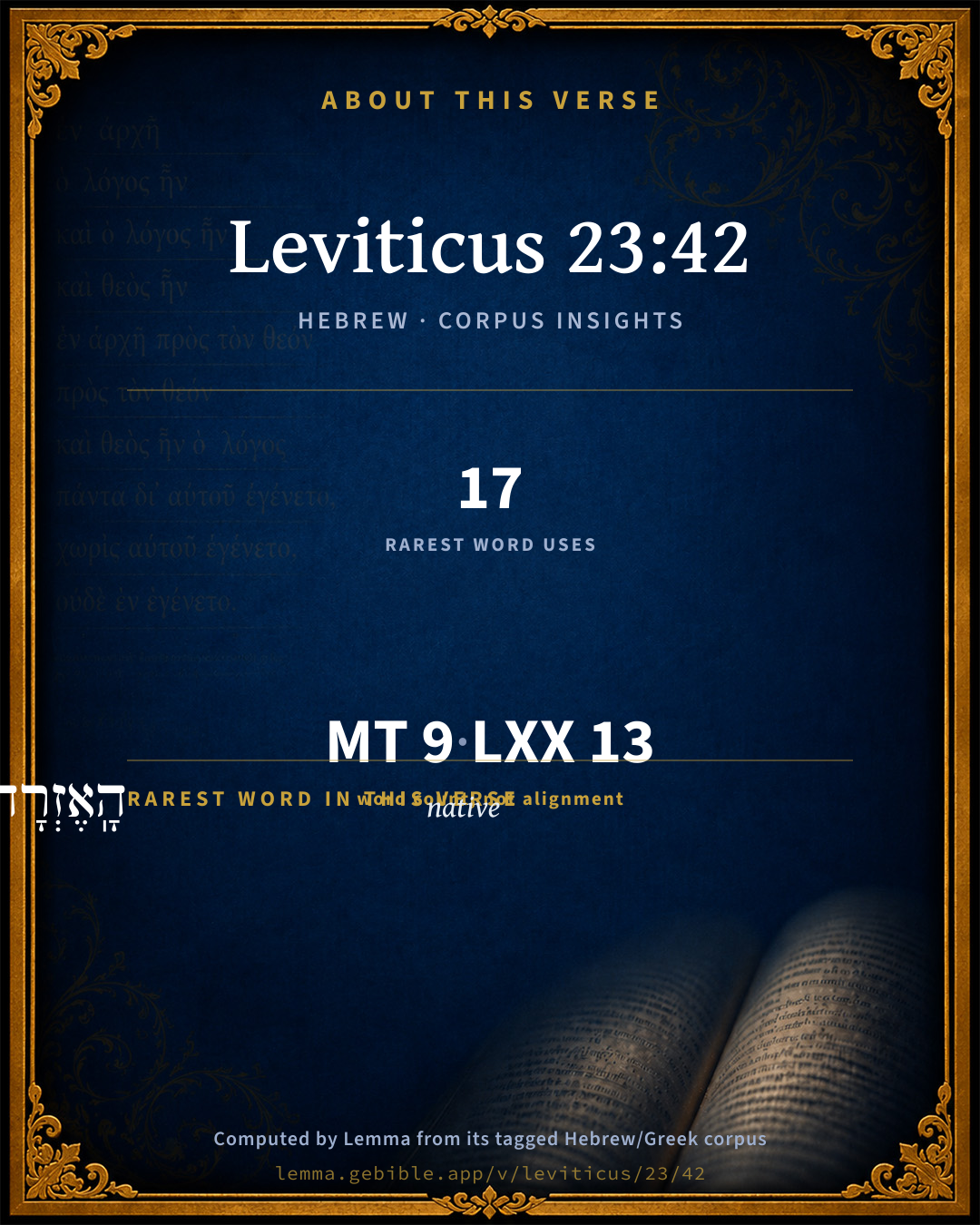
These counts appear in no published source. They are computed here, from the morphology-tagged text and Lemma’s own curated glosses. What Lemma adds →

9
words
7
distinct lemmas
Pentateuch
section

Notable vocabulary

The rarest word here is הָֽאֶזְרָח֙ native H249 — appearing just 17 times in the whole Hebrew Bible.

Shared distinctive vocabulary

הָֽאֶזְרָח֙ native H249 occurs in 17 verses of the Hebrew Bible. Also found in:

Grammatical profile

  • 2 verbs
  • 6 nouns
  • 1 adjective

Verb forms

  • תֵּשְׁב֖וּ Qal · Imperfect
  • יֵשְׁב֖וּ Qal · Imperfect

Repetition

Words recur within this verse — often emphatic in Hebrew:

  • בַּסֻּכֹּ֥ת booth H5521 ×2
  • תֵּשְׁב֖וּ to dwell H3427 ×2

Hebrew & Septuagint length

In English translation the verse runs 17 words from the Hebrew and 15 from the Septuagint (LXX English) — closely comparable.

A rough comparison of the two English renderings, which tokenize alike — not a word-level alignment.

Word counts can differ between the Hebrew and the Greek without any difference in meaning — e.g. the Hebrew direct-object marker אֵת has no separate Greek word, and Greek often adds the article ὁ.

In the original languages it is 9 Hebrew tokens and 13 Greek tokens — but the two are counted differently (Hebrew bundles its prefixes and suffixes into one token; the Greek is in lemma form), so that isn’t a like-for-like length.

Cross-references

7

Topical passages linked to Leviticus 23:42 in the Treasury of Scripture Knowledge — connected by theme and wording, ordered by reader-vote popularity; previews shown in the World English Bible.

  • Nehemiah 8:14–17 They found written in the law, how that Yahweh had commanded by Moses, that the children of Israel should dwell in booths in the feast of the seventh month;
  • Genesis 33:17 Jacob traveled to Succoth, built himself a house, and made shelters for his cattle. Therefore the name of the place is called Succoth.
  • Numbers 24:2 Balaam lifted up his eyes, and he saw Israel dwelling according to their tribes; and the Spirit of God came on him.
  • Numbers 24:5 How goodly are your tents, Jacob, Your tents, Israel!
  • Jeremiah 35:10 but we have lived in tents, and have obeyed, and done according to all that Jonadab our father commanded us.
  • Hebrews 11:13–16 These all died in faith, not having received the promises, but having seen them and embraced them from afar, and having confessed that they were strangers and pilgrims on the earth.
  • 2 Corinthians 5:1 For we know that if the earthly house of our tent is dissolved, we have a building from God, a house not made with hands, eternal, in the heavens.

Cross-references courtesy of OpenBible.info (CC BY 4.0).

Hebrew and Greek witnesses Masoretic Hebrew ↔ Greek Septuagint

The same verse in the two great witnesses to the Old Testament, shown verse-for-verse.

These are two independent witnesses, not word-aligned to each other, and the Septuagint is shown in lemma (dictionary) form.

Hebrew Leviticus 23:42 Masoretic · Westminster Leningrad Codex

בַּסֻּכֹּ֥ת תֵּשְׁב֖וּ שִׁבְעַ֣ת יָמִ֑ים כָּל הָֽאֶזְרָח֙ בְּיִשְׂרָאֵ֔ל יֵשְׁב֖וּ בַּסֻּכֹּֽת

You shall dwell in booths seven days. All who are native-born in Israel shall dwell in booths,

World English Bible · Public Domain

Greek LXX Leviticus 23:42 Septuagint · lemma form

ἐν σκηνή καταοἰκέω ἑπτά ἡμέρα πᾶς ὁ αὐτόχθων ἐν ἰσραήλ καταοἰκέω ἐν σκηνή

Seven days you⌃ shall dwell in tabernacles: every native in Israel shall dwell in tents,

LXX2012 (modern English Septuagint) · Public Domain

Hebrew: Westminster Leningrad Codex (CC BY 4.0). Greek: Septuagint (public domain); English from LXX2012 (modern English Septuagint) (Public Domain). How the Septuagint differs from the Hebrew →

Targum (Aramaic paraphrase)

2

The Targum is the ancient Jewish Aramaic paraphrase of the Hebrew Scriptures — an interpretive translation, not the Hebrew text itself. Onkelos (literal) and Pseudo-Jonathan (expansive) render the Torah, and Jonathan the Prophets. Coverage is partial: where no permissively-licensed English translation exists for a verse, only the Aramaic is shown. This is verse-level text, not a word-by-word alignment to the Hebrew.

  1. Targum Onkelos Torah (Genesis–Deuteronomy)
    בִּמְטַלַיָא תֵיתְבוּן שַׁבְעַת יוֹמִין כָּל יַצִיבָא בְּיִשְׂרָאֵל יֵתְבוּן בִּמְטַלַיָא

    (no public-domain English translation for this verse)

    Targum Onkelos — Aramaic: “Onkelos Genesis” (public domain); “Onkelos Exodus” (public domain); “Onkelos Leviticus” (public domain); “Onkelos Numbers” (public domain); “Onkelos Deuteronomy” (public domain). English: “Sefaria Community Translation” (CC0 1.0 (public-domain dedication)); “J.W. Etheridge. The Targums of Onkelos and Jonathan Ben Uzziel on the Pentateuch. London: Longmans, Green, 1862” (public domain). Text via Sefaria.

  2. Targum Pseudo-Jonathan Torah (Genesis–Deuteronomy)
    בִּמְטַלַלְתָּ דִתְרֵי דוֹפְנַיָיהָא כְּהִלְכַתְהוֹן וּתְלִיתַיָיא עַד פּוּשְׁכָא וְטוּלָהּ סַגִי מִשִׁימְשָׁהּ מִתְעַבְדָא לְטוּלָא לְשׁוּם חַגָא מִן זַיינִין דְמַרְבְּיַין מִן אַרְעָא וּתְלִישִׁין מְשַׁחֲתָהָא עַד שַׁבְעָא פּוּשְׁכֵי וַחֲלָלָא דְרוֹמָא עַשְרָא פּוּשְׁכֵי תֵּיתְבוּן בָּהּ שׁוּבְעָא יוֹמִין כָּל דְכוּרַיָא בְּיִשְרָאֵל וַאֲפִילוּ זְעִירֵי דְלָא צְרִיכִין לְאִימְהוֹן יֵתְבוּן בִּמְטָלַיָא מְבָרְכִין לְבַרְיֵיהוֹן כָּל אֵימַת דְעַיְילִין תַּמָן

    In tabernacles of two sides according to their rule, and the third a handbreadth (higher), that its shaded part may be greater than that into which cometh the sunshine; to be made for a bower (or shade) for the feast, from different kinds (of materials) which spring from the earth and are uprooted: in measure seven palms, but the height within ten palms. In it you shall sit seven days; the males in Israel, and children who need not their mothers, shall sit in the tabernacles, blessing their Creator whenever they enter thereinto.

    Targum Pseudo-Jonathan — Aramaic: “Targum Jonathan on Genesis” (public domain); “Targum Jonathan on Exodus” (public domain); “Targum Jonathan on Leviticus” (public domain); “Targum Jonathan on Numbers” (public domain); “Targum Jonathan on Deuteronomy” (public domain). English: “The Targum of Jonathan ben Uzziel, trans. J. W. Etheridge, London, 1862” (public domain). Text via Sefaria.

Commentary

Notes on Leviticus 23:42 from classic Christian and Jewish commentators (each source and its license shown beneath its notes). The classic Christian expositions comment on the surrounding passage and are grouped to its opening verse, so a note may address several verses; the Jewish commentaries on the Tanakh (Rashi and others) are per-verse, so they appear only where the commentator wrote on this verse.

Lemma curates 59 commentaries, every one of them public domain or Creative Commons licensed, each selected and text-cleaned for this edition rather than reprinted as found. About our sources →

Trapp's Complete Commentary

John Trapp

Lev 23:42 Ye shall dwell in booths seven days; all that are Israelites born shall dwell in booths:

Ver. 42. Ye shall dwell in booths.] The siege of Jerusalem by the Romans lasted six months. It began at the passover, and ended at this feast of tabernacles. Ita festum illud fuit finis istius politiae.

John Trapp, A Commentary or Exposition upon All the Books of the Old and New Testament (1647–1656) — public domain. Text from a community e-Sword module.

Joseph Benson's Commentary

Lev 23:42. In booths — Which were erected in their cities or towns, either in their streets, or gardens, or the tops of their houses. These were made flat, and therefore were fit for this use.

Joseph Benson's Commentary on the Old and New Testaments (1811–1818) — public domain. Text from a community e-Sword module.

Ellicott's Commentary for English Readers

(42) Dwell in booths seven days.—Because the eighth day was a separate festival, when the booths were no more used. (See Lev_23:36.)

A Bible Commentary for English Readers, edited by Charles John Ellicott (1878–1897) — public domain. Text from a community e-Sword module.

John Gill's Exposition

Ye shall dwell in booths seven days,.... So that it seems they were not obliged to dwell in them on the eighth day, which was an holy convocation, a sabbath in which no servile work was to be done as the first, Lev 23:36. The eighth day was a day by itself, a sort of an appendage to the feast of tabernacles, when they went into their houses again, and kept it as an holy day; and perhaps principally in giving thanks for the ingathering of the fruits of the earth, to which this seems to be appropriated from Lev 23:39. According to the Jewish writers, they did not go out of their booths until they had dined in them on this day; and as they went out used to say,"may it be the will of God that we may be worthy the next year to dwell in the booth of Leviathan (c);''that is, to feast with the Messiah in the world to come. And to those days the Jews have added a ninth, which they call "the joy of the law", and which they keep for joy of having finished the reading of the law; which being divided into as many sections or lessons as weeks in the year, were so ordered to be read as to be finished at this time (d):

all that are Israelites born shall dwell in booths; the Targum of Jonathan is,"all the males in Israel, and even the little ones, that do not need their mothers, sit in the shades blessing their Creator, when they enter there.''And, according to the Misnah (e), women, servants, and little ones, are free from the booths (i.e. are not obliged to dwelt in one), but a little one, who hath no need of its mother, is obliged to dwell in the booths: and elsewhere it is said, that sick persons, and such as wait upon them, are not obliged, nor messengers upon any business, nor travellers and watchmen in cities, and keepers of gardens and orchards; if such travel, or keep watch in the day, they are obliged to be in them at night, and if in the night, then they are to dwell in them in the day (f). Jarchi says, that everyone born in Israel comprehends proselytes, who were bound by this law.

(c) Lebush, par. 2. c. 668. sect. 5. (d) Buxtorf. Synagog. Jud. c. 27. Leo Moden's History of the Rites of the Jews, par. 3. c. 7. sect. 6. (e) Misn. Succah, c. 2. sect. 6. (f) R. Alphes, par. 1. Succah, c. 2. fol. 374. 2. 375. 1.

John Gill's Exposition of the Whole Bible (1746–1763) — public domain (CC PDM 1.0). Text via the HelloAO Bible API.

Albert Barnes' Notes on the Bible

Booths - According to Jewish tradition, what were used at the Feast of Tabernacles were strictly “tabernacula,” structures of boards, with a covering of boughs.

The “booth” in which the Israelite kept the Feast, and the “tent” which was his ordinary abode in the wilderness, had this in common - they were temporary places of sojourn, they belonged to camp-life. The seven days of abode in the booths of the festival was thus a fair symbol of the forty years of abode in tents in the wilderness. The Feast might well become the appointed memorial of this period of their history for the ages to come.

All that are Israelites born - The omission of the foreigners in this command is remarkable. Perhaps the intention was that on this joyous occasion they were to be hospitably entertained as guests. Compare Deu 16:14.

Albert Barnes' Notes on the Bible (1834–1885) — public domain. Text from a community e-Sword/MySword module.

Haydock's Catholic Bible Commentary

Days. Tostat affirms they might pass the nights in their houses; but most people suppose, the Jews spent the whole octave in bowers.

George Leo Haydock (1774–1849), Haydock's Catholic Family Bible and Commentary, 1859 edition — public domain. Excludes Psalms (Douay-Rheims chapter numbering differs from Protestant) and Deuterocanonical books (Catholic canon only).

Matthew Poole's English Annotations

Booths were erected in their cities or towns, either in their streets or gardens, or the tops of their houses, Neh 8:16, which were made flat, and therefore were proper and fit for that use.

Matthew Poole's English Annotations on the Holy Bible (1683–1685) — public domain. Text from a community e-Sword/MySword module.

Whedon's Commentary on the Bible

Daniel D. Whedon

42. Ye shall dwell in booths — This command excludes a cloth or skin covering, according to the decisions of Jewish expounders, and every thing pertaining to the animal and mineral kingdoms. Every thing withered, or faded, or of ill savour, or unclean, was also prohibited. The booths must be fresh and fragrant, in correspondence with the gladness of their tenants.

The first part of October, when this feast was celebrated, the weather in Palestine is neither hot nor cold, nor subject to storms, but admirably adapted to outdoor life.

All… Israelites… shall dwell — The word “shall” is here altogether too strong a translation of the Hebrew future, which is often rendered by may or can. “To insist on the absolute universality is to become a bond-slave to the letter.”

Daniel D. Whedon (gen. ed.), Commentary on the Old and New Testaments (1874–1909) — public domain. Text from a community e-Sword module.

John Wesley's Explanatory Notes

In booths - Which were erected in their cities or towns, either in their streets, or gardens, or the tops of their houses. These were made flat, and therefore were fit for the use.

John Wesley, Explanatory Notes Upon the Whole Bible (1754–1765) — public domain. Text via the GEBible commentary corpus.

Scofield Reference Notes

C. I. Scofield

booths

The feast of Tabernacles, Lev 23:34-44 is (like the Lord’s Supper for the church) both memorial and prophetic --memorial as to redemption out of Egypt Lev 23:43 prophetic as to the kingdom-rest of Israel after her regathering and restoration, when the feast again becomes memorial, not for Israel alone, but for all nations. Zec 14:16-21.

The Scofield Reference Bible (1917 edition), notes by C. I. Scofield — public domain. Text from a community e-Sword module.

unfoldingWord translationNotes

Door43 World Missions Community

General Information:

Yahweh continues his instructions for the Festival of Shelters.

your descendants, generation after generation, may learn

"Generation after generation" here is an idiom that refers to each generation that lives after another. AT: "your descendants belonging to all future generations may learn" or "all your descendants may learn forever" (See: Idiom)

translationWords

Israel

descend

generation

Egypt

Yahweh

God

appoint

festival

unfoldingWord translationNotes — © Distant Shores Media and the Door43 World Missions Community, licensed CC BY-SA 4.0. Source: git.door43.org/Door43/en_tn.

Rashi

Rabbi Shlomo Yitzchaki (Rashi)

האזרח THE NATIVE — Since this word means native-born, the word בישראל, ANYONE IN ISRAEL, serves to include the proselytes (cf. Sifra, Emor, Chapter 17 9).

Rashi on the Tanakh — English translations: “The Judaica Press complete Tanach with Rashi, translated by A. J. Rosenberg” (CC BY 4.0); “Pentateuch with Rashi's commentary by M. Rosenbaum and A.M. Silbermann, 1929-1934” (public domain); “The Metsudah Tanach series, Lakewood, N.J” (CC BY 4.0); and “The Book of Joshua, Metsudah Publications, 1997” (CC BY 4.0). Text via Sefaria.

Ramban (Nachmanides)

Rabbi Moshe ben Nachman (Ramban / Nachmanides)

ALL ‘HA’EZRACH’ (THAT ARE NATIVE) IN ISRAEL SHALL DWELL IN BOOTHS. “Ezrach means native-born. Ha’ezrach [literally: ‘the’ native-born], this is to exclude women [from the obligation of dwelling in the booth, since the definite article denotes an exclusion. It was necessary that this exclusion be stated] so that you should not deduce from a similarity of expressions of the fifteenth day stated with reference to the Festival of Unleavened Bread, that women are obliged to dwell in a booth just as they are obliged to eat unleavened bread [on the night of Passover]. In Israel, this includes proselytes” [that they are obliged to dwell in a booth]. This is Rashi’s language. And in the Torath Kohanim it is stated: 17:9. “Ezrach, this is the native-born. Ha’ezrach, this is intended to exclude women. ‘All’ that are home-born, this is to include the proselytes and liberated slaves.” And in line with the plain meaning of Scripture, by way of tradition [there is no need for a special source in Scripture here to include proselytes]. For since Scripture has stated, ye shall have one law, both for the stranger, and for him that is born in the Land, 9:14. and it is further said, as ye are, so shall the stranger be before the Eternal, 15:15. there is no need to mention again in every place: “all that are native-born and the stranger.” Therefore He says all that are native in Israel, meaning all who are of Israel, from the greatest of them even to the least of them, [to teach] that it is not sufficient that one of a household should dwell in a booth and the rest dwell in homes, but they should all dwell in booths. It is possible that the verse [uses the word ezrach] to teach that all who are like a leafy tree in its native soil in their homes [are obliged to dwell in booths], except for those who are on a sea voyage, and those who travel on the road [who are exempt from dwelling in a booth].

Ramban (Nachmanides) on the Tanakh — English translation: “Commentary on the Torah by Ramban (Nachmanides). Translated and annotated by Charles B. Chavel. New York, Shilo Pub. House, 1971-1976” (CC BY 4.0). Text via Sefaria.

Lesson kit

Teaching starters — assembled from the data on this page, not authored interpretation. Every prompt links to the verse data it draws on. Edit before teaching.

Leviticus, in the Pentateuch, opens this verse with 9 words (7 distinct Hebrew lemmas). Its most distinctive word is ʼezrâch (“native”). A historical commentator’s framing appears above. Read the whole chapter for the surrounding context.

Discussion questions

  1. The word ʼezrâch carries the sense “native.” How does it shape the verse?
  2. How does Exodus 12:19, which shares the word «native», read alongside this verse?
  3. What does the repetition of “booth” (2× in this one verse) do in this verse?
  4. These translations render this verse differently; the difference is in the English rendering, not the original. What questions does that raise?
  5. «תֵּשְׁב֖וּ» is a Qal Imperfect verb. How does that grammatical form shape the action described?
  6. Compare how Trapp's Complete Commentary and Joseph Benson's Commentary read this verse. Where do they agree or differ?

Things to notice

Reading settings

Reading text

Shown beneath each verse's original-language words.

Old Testament
Old Testament edition

Read the OT as the Masoretic Hebrew (MT) or the Greek Septuagint (LXX).

English shown for the Greek Septuagint (in the Hebrew ↔ Greek comparison).

Comparing translations? Open the Compare panel on any verse page to stack up to four side by side.