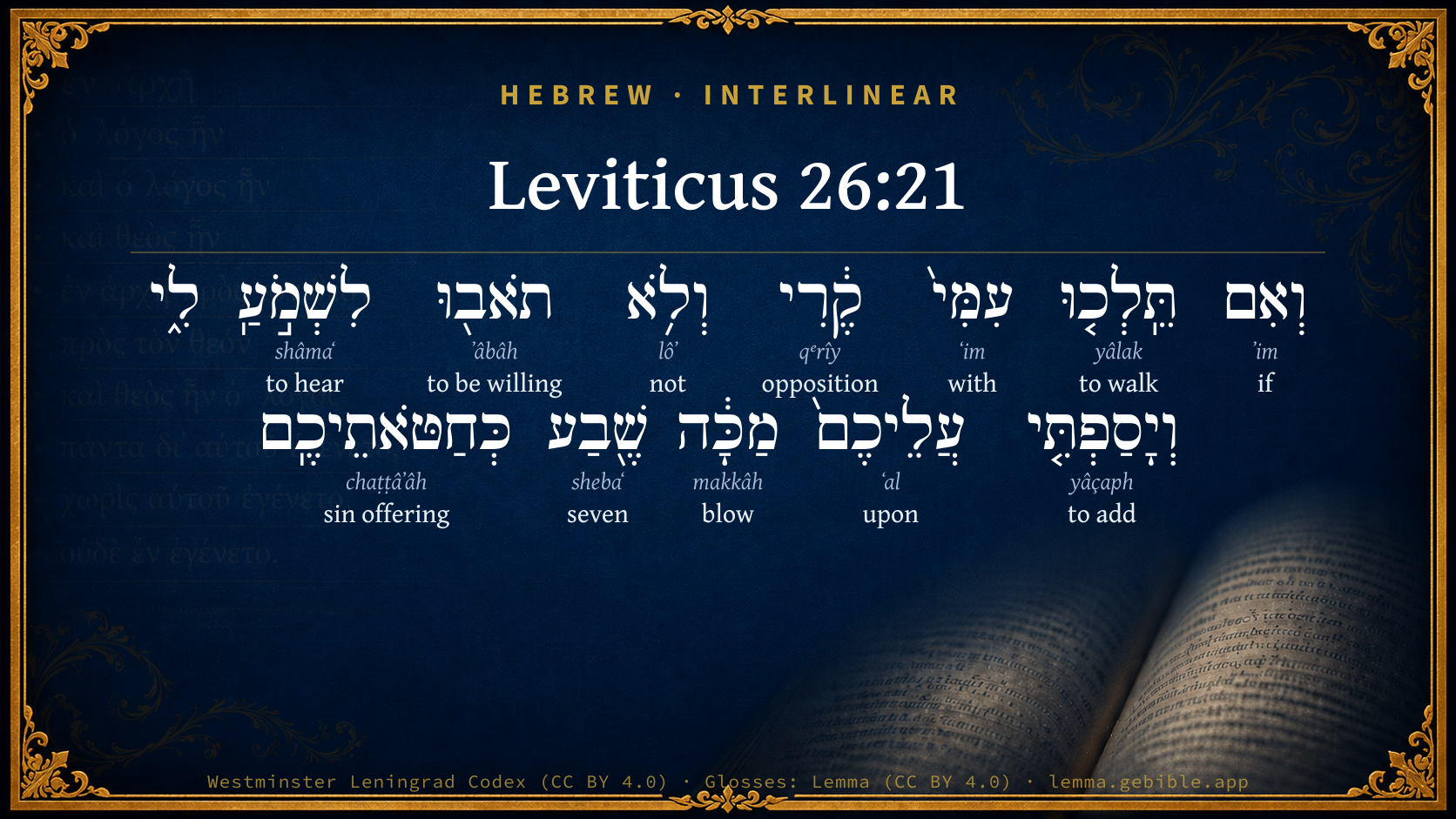
Leviticus 26:21

Hebrew (Westminster Leningrad Codex) Leviticus 26:21 appears in the Hebrew Old Testament. The text above is from the Westminster Leningrad Codex. Each word links to its Strong’s number, a concise gloss, and parsing drawn from the Open Scriptures Hebrew Bible morphology. Click any word for its full Brown-Driver-Briggs (BDB) entry.
Download image
Cite this verse

Leviticus 26:21 (World English Bible). Public Domain. Lemma interlinear Bible study tool, https://lemma.gebible.app/v/leviticus/26/21.

Show BibTeX & RIS
BibTeX
RIS
English Translation
"'If you walk contrary to me, and won't listen to me, then I will bring seven times more plagues on you according to your sins.
World English Bible · Public Domain
Highlights
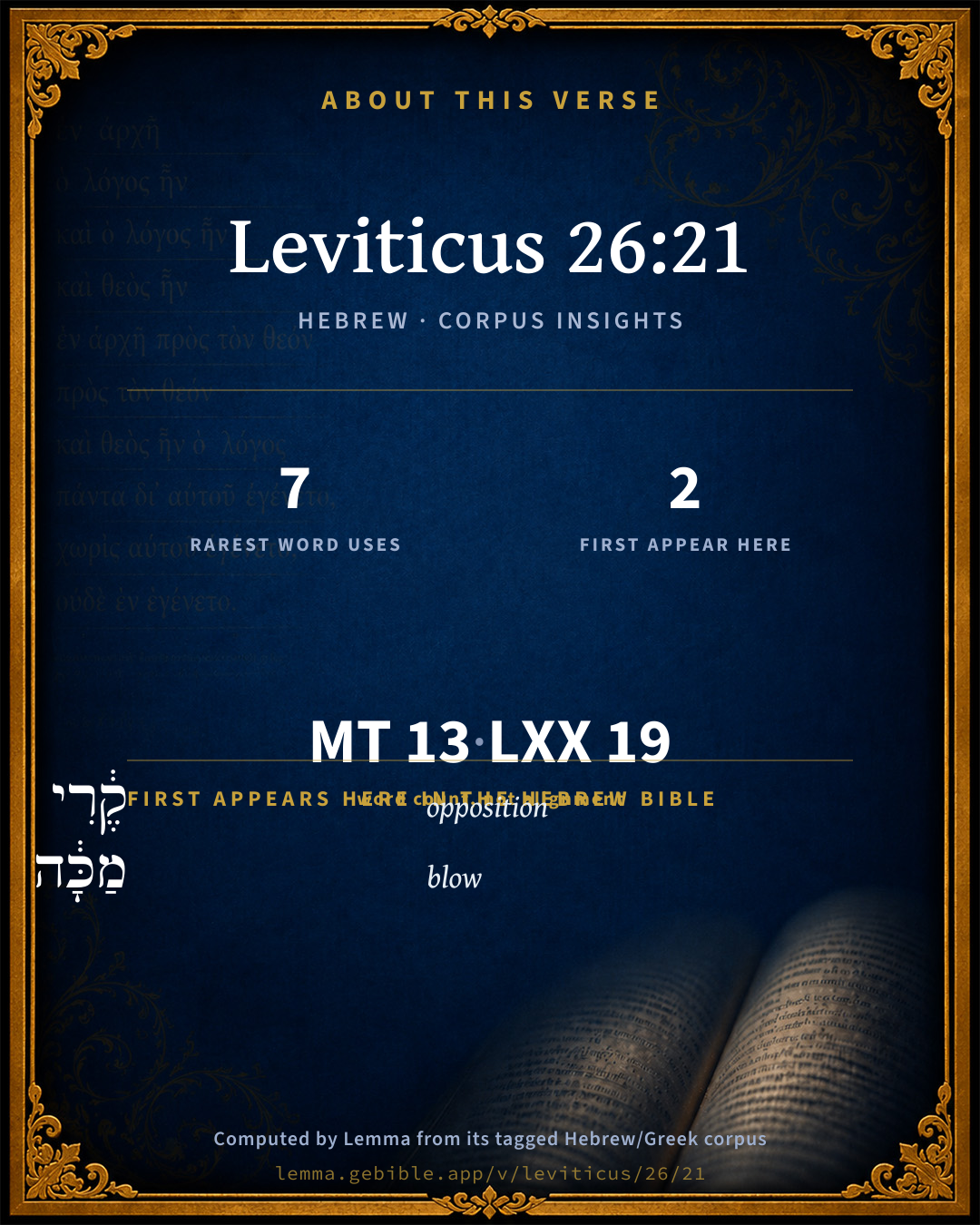
  • 2 first appearances in the Hebrew Bible
Full analysis ↓
Download a study sheet

One document with this verse’s original text, its word-by-word gloss line, the meaning frame, cross-references with their text, attributed commentary, and full source and license credits — printable, and it pastes into notes with its structure intact.

This verse Autodidact and up

Study sheet (.html) Plain text (.txt)

A passage Seminary Student

Up to 50 verses in one chapter. A passage sheet keeps up to 6 commentary sources and 12 cross-references per verse, in the order this page ranks them, and says so on the sheet whenever that leaves anything out. Ask for a single verse and you get the Autodidact verse sheet above.

Everything on this page stays free to read, with no account — the sheet is a download of what is already on screen, not access to it.

Want to remove ads? Support Godless Engineer
Compare translations 3

The same verse in 3 English versions, stacked beneath the original-language interlinear above. Click any original word for its lexicon entry.

Each is an independent rendering of the whole verse — the interlinear is not word-aligned to these translations.

Highlighted words mark where these versions differ — a whole-verse word diff, not a word-by-word alignment.

  • World English Bible Public Domain
    "'If you walk contrary to me, and won't listen to me, then I will bring seven times more plagues on you according to your sins.
  • King James Version Public Domain
    And if ye walk contrary unto me, and will not hearken unto me; I will bring seven times more plagues upon you according to your sins.
  • unfoldingWord Literal Text CC BY-SA 4.0
    And if you walk with me hostility and are not willing to listen to me, then I will add on you a plague seven according to your sins.

unfoldingWord Literal Text — © unfoldingWord, licensed CC BY-SA 4.0. Word-aligned USFM3 via Door43 (git.door43.org/unfoldingWord/en_ult).

Versions to compare (up to 4)

3 of 4 selected

Show all 18 translations

Every available English version of this verse, each an independent rendering of the whole verse.

  • World English Bible Public Domain
    "'If you walk contrary to me, and won't listen to me, then I will bring seven times more plagues on you according to your sins.
  • Berean Standard Bible Public Domain
    If you walk in hostility toward Me and refuse to obey Me, I will multiply your plagues seven times, according to your sins.
  • Majority Standard Bible Public Domain
    If you walk in hostility toward Me and refuse to obey Me, I will multiply your plagues seven times, according to your sins.
  • King James Version Public Domain
    And if ye walk contrary unto me, and will not hearken unto me; I will bring seven times more plagues upon you according to your sins.
  • American Standard Version (1901) Public Domain
    And if ye walk contrary unto me, and will not hearken unto me, I will bring seven times more plagues upon you according to your sins.
  • Revised Version (1885) Public Domain
    And if ye walk contrary unto me, and will not hearken unto me; I will bring seven times more plagues upon you according to your sins.
  • Geneva Bible (1599) Public Domain
    And if ye walke stubburnly against me, and will not obey mee, I will then bring seuen times more plagues vpon you, according to your sinnes.
  • Douay-Rheims (1899) Public Domain
    If you walk contrary to me, and will not hearken to me, I will bring seven times more plagues upon you for your sins:
  • Young's Literal Translation Public Domain
    `And if ye walk with Me `in' opposition, and are not willing to hearken to Me, then I have added to you a plague seven times, according to your sins,
  • Literal Standard Version CC BY-SA 4.0
    And if you walk with Me [in] opposition, and are not willing to listen to Me, then I have added to you a plague sevenfold, according to your sins,
  • Unlocked Literal Bible CC BY-SA 4.0
    If you walk against me and will not listen to me, I will bring seven times more blows on you, in proportion to your sins.
  • unfoldingWord Literal Text CC BY-SA 4.0
    And if you walk with me hostility and are not willing to listen to me, then I will add on you a plague seven according to your sins.
  • Darby Bible Public Domain
    And if ye walk contrary unto me, and will not hearken unto me, I will bring sevenfold more plagues upon you according to your sins.
  • World Messianic Bible Public Domain
    “‘If you walk contrary to me, and won’t listen to me, then I will bring seven times more plagues on you according to your sins.
  • Webster's Bible Public Domain
    And if ye shall walk contrary to me, and will not hearken to me, I will bring seven times more plagues upon you according to your sins.
  • Free Bible Version CC BY-SA 4.0
    If you go on opposing me and refusing to do what I tell you, I will make your punishments seven times worse, based on your sins.
  • Bible in Basic English Public Domain
    And if you still go against me and will not give ear to me, I will put seven times more punishments on you because of your sins.
  • JPS Tanakh (1917) Public Domain
    And if ye walk contrary unto Me, and will not hearken unto Me; I will bring seven times more plagues upon you according to your sins.

Literal Standard Version (2020), Covenant Press — licensed CC BY-SA 4.0. Text via the HelloAO Bible API (eBible.org). Unlocked Literal Bible (unfoldingWord) — licensed CC BY-SA 4.0. Text via the HelloAO Bible API (eBible.org). unfoldingWord Literal Text — © unfoldingWord, licensed CC BY-SA 4.0. Word-aligned USFM3 via Door43 (git.door43.org/unfoldingWord/en_ult). Free Bible Version, Dr. Jonathan Gallagher — licensed CC BY-SA 4.0. Text via the HelloAO Bible API (eBible.org).

Word by word

More ways to search: Search by grammar → Find every occurrence → Compare this word →

Practice this passage: Drill this verse → Learn its vocabulary →

קֶ֔רִי
qᵉrîy
H7147
“opposition”
Noun, Common, Masculine, Singular, Absolute
Part of Speech
Noun
Type
Common
Gender
Masculine
Number
Singular
State
Absolute
Full BDB Definition

Origin: from H7136

TWOT: 2068b

opposition, contrariness, encounter, contrary or hostile encounter
  1. וְאִם ʼim H518 “and · if” Conjunction + Conjunction
  2. תֵּֽלְכ֤וּ yâlak H3212 “to walk” Verb, Qal, Imperfect, 2nd Person, Masculine, Plural
  3. עִמִּי֙ ʻim H5973 “with · me” Preposition + Suffix, Personal, 1st Person, Common, Singular
  4. וְלֹ֥א lôʼ H3808 “and · not” Conjunction + Particle, Negative
  5. תֹאב֖וּ ʼâbâh H14 “to be willing” Verb, Qal, Imperfect, 2nd Person, Masculine, Plural
  6. לִשְׁמֹ֣עַֽ shâmaʻ H8085 “to hear” Preposition + Verb, Qal, Infinitive Construct
  7. וְיָסַפְתִּ֤י yâçaph H3254 “and · to add” Conjunction + Verb, Qal, Sequential Perfect, 1st Person, Common, Singular
  8. עֲלֵיכֶם֙ ʻal H5921 “upon · you” Preposition + Suffix, Personal, 2nd Person, Masculine, Plural
  9. מַכָּ֔ה makkâh H4347 “blow” Noun, Common, Feminine, Singular, Absolute
  10. שֶׁ֖בַע shebaʻ H7651 “seven” Adjective, Cardinal number, Feminine, Singular, Absolute
  11. כְּחַטֹּאתֵיכֶֽם chaṭṭâʼâh H2403 “like/as · sin offerings · your” Preposition + Noun, Common, Feminine, Plural, Construct + Suffix, Personal, 2nd Person, Masculine, Plural

About this verse

These counts appear in no published source. They are computed here, from the morphology-tagged text and Lemma’s own curated glosses. What Lemma adds →

13
words
12
distinct lemmas
Pentateuch
section

Notable vocabulary

The rarest word here is קֶ֔רִי opposition H7147 — appearing just 7 times in the whole Hebrew Bible.

First appearance in Scripture

These words make their first canonical appearance in the Hebrew Bible here:

  • קֶ֔רִי opposition H7147
  • מַכָּ֔ה blow H4347

Shared distinctive vocabulary

קֶ֔רִי opposition H7147 occurs in 7 verses of the Hebrew Bible. Also found in:

Grammatical profile

  • 4 verbs
  • 3 nouns
  • 1 adjective
  • 3 prepositions
  • 1 conjunction
  • 1 particle

Verb forms

  • תֵּֽלְכ֤וּ Qal · Imperfect
  • תֹאב֖וּ Qal · Imperfect
  • לִשְׁמֹ֣עַֽ Qal · Infinitive Construct
  • וְיָסַפְתִּ֤י Qal · Sequential Perfect

Hebrew & Septuagint length

In English translation the verse runs 25 words from the Hebrew and 27 from the Septuagint (LXX English) — closely comparable.

A rough comparison of the two English renderings, which tokenize alike — not a word-level alignment.

Word counts can differ between the Hebrew and the Greek without any difference in meaning — e.g. the Hebrew direct-object marker אֵת has no separate Greek word, and Greek often adds the article ὁ.

In the original languages it is 13 Hebrew tokens and 19 Greek tokens — but the two are counted differently (Hebrew bundles its prefixes and suffixes into one token; the Greek is in lemma form), so that isn’t a like-for-like length.

Cross-references

2

Topical passages linked to Leviticus 26:21 in the Treasury of Scripture Knowledge — connected by theme and wording, ordered by reader-vote popularity; previews shown in the World English Bible.

  • Leviticus 26:18 "'If you in spite of these things will not listen to me, then I will chastise you seven times more for your sins.
  • Leviticus 26:27 "'If you in spite of this won't listen to me, but walk contrary to me;

Cross-references courtesy of OpenBible.info (CC BY 4.0).

Hebrew and Greek witnesses Masoretic Hebrew ↔ Greek Septuagint

The same verse in the two great witnesses to the Old Testament, shown verse-for-verse.

These are two independent witnesses, not word-aligned to each other, and the Septuagint is shown in lemma (dictionary) form.

Hebrew Leviticus 26:21 Masoretic · Westminster Leningrad Codex

וְאִם תֵּֽלְכ֤וּ עִמִּי֙ קֶ֔רִי וְלֹ֥א תֹאב֖וּ לִשְׁמֹ֣עַֽ לִ֑י וְיָסַפְתִּ֤י עֲלֵיכֶם֙ מַכָּ֔ה שֶׁ֖בַע כְּחַטֹּאתֵיכֶֽם

"'If you walk contrary to me, and won't listen to me, then I will bring seven times more plagues on you according to your sins.

World English Bible · Public Domain

Greek LXX Leviticus 26:21 Septuagint · lemma form

καί ἐάν μετά οὗτος πορεύομαι πλάγιος καί μή βούλομαι ὑποἀκούω ἐγώ προςτίθημι σύ πληγή ἑπτά κατά ὁ ἁμαρτία σύ

And if after this you⌃ should walk perversely, and not be willing to obey me, I will further bring upon you seven plagues according to your sins.

LXX2012 (modern English Septuagint) · Public Domain

Hebrew: Westminster Leningrad Codex (CC BY 4.0). Greek: Septuagint (public domain); English from LXX2012 (modern English Septuagint) (Public Domain). How the Septuagint differs from the Hebrew →

Targum (Aramaic paraphrase)

2

The Targum is the ancient Jewish Aramaic paraphrase of the Hebrew Scriptures — an interpretive translation, not the Hebrew text itself. Onkelos (literal) and Pseudo-Jonathan (expansive) render the Torah, and Jonathan the Prophets. Coverage is partial: where no permissively-licensed English translation exists for a verse, only the Aramaic is shown. This is verse-level text, not a word-by-word alignment to the Hebrew.

  1. Targum Onkelos Torah (Genesis–Deuteronomy)
    וְאִם תְּהָכוּן קֳדָמַי בְּקַשְׁיוּ וְלָא תֵיבוּן לְקַבָּלָא לְמֵימְרִי וְאוֹסֵף לֶאֱתָאָה עֲלֵיכוֹן מָחָא שְׁבַע כְּחוֹבֵיכוֹן

    (no public-domain English translation for this verse)

    Targum Onkelos — Aramaic: “Onkelos Genesis” (public domain); “Onkelos Exodus” (public domain); “Onkelos Leviticus” (public domain); “Onkelos Numbers” (public domain); “Onkelos Deuteronomy” (public domain). English: “Sefaria Community Translation” (CC0 1.0 (public-domain dedication)); “J.W. Etheridge. The Targums of Onkelos and Jonathan Ben Uzziel on the Pentateuch. London: Longmans, Green, 1862” (public domain). Text via Sefaria.

  2. Targum Pseudo-Jonathan Torah (Genesis–Deuteronomy)
    וְאִין תַּהֲכוּן עִמִי בְּעַרְאַי וְלָא תִצְבּוּן לְמִשְׁמַע לְאוּלְפַן אוֹרַיְיתִי וְאוֹסִיף לְאַיְיתָאָה עֲלֵיכוֹן שִׁבְעָתָא מְחָא עַל שְׁבַע עֲבֵירָן דִי חֲטֵיתוּן קֳדָמָי

    And if you still walk perversely with Me, and will not hearken to the doctrine of My law, I will add to bring upon you (yet) seven plagues, for the seven transgressions with which ye have sinned before Me;

    Targum Pseudo-Jonathan — Aramaic: “Targum Jonathan on Genesis” (public domain); “Targum Jonathan on Exodus” (public domain); “Targum Jonathan on Leviticus” (public domain); “Targum Jonathan on Numbers” (public domain); “Targum Jonathan on Deuteronomy” (public domain). English: “The Targum of Jonathan ben Uzziel, trans. J. W. Etheridge, London, 1862” (public domain). Text via Sefaria.

Commentary

Notes on Leviticus 26:21 from classic Christian and Jewish commentators (each source and its license shown beneath its notes). The classic Christian expositions comment on the surrounding passage and are grouped to its opening verse, so a note may address several verses; the Jewish commentaries on the Tanakh (Rashi and others) are per-verse, so they appear only where the commentator wrote on this verse.

Lemma curates 59 commentaries, every one of them public domain or Creative Commons licensed, each selected and text-cleaned for this edition rather than reprinted as found. About our sources →

Ellicott's Commentary for English Readers

(21) And if ye walk contrary unto me.—That is, continue the defiance of the Divine law, and rebel against God’s authority. The third warning, contained in Lev_26:21-22, threatens them with destruction by wild beasts.

Seven times more plagues.—That is, a still greater number. (See Lev_26:18.)

According to your sins.—This increased number of scourges will be in proportion to their sins, since their defiance, in spite of the two preceding classes of punishments, aggravates and enhances their guilt.

A Bible Commentary for English Readers, edited by Charles John Ellicott (1878–1897) — public domain. Text from a community e-Sword module.

Trapp's Complete Commentary

John Trapp

Lev 26:21 And if ye walk contrary unto me, and will not hearken unto me; I will bring seven times more plagues upon you according to your sins.

Ver. 21. Contrary unto me.] Or, Carelessly before me; as our ungirt Christians, profligate professors do.

Seven times more Plagues.] God cannot be exhausted, neither need we fear, as he did of his Jupiter.

“ Si quoties peccent homines, sua fulmina mittat

Iupiter, exiguo tempore inermis erit. ”

John Trapp, A Commentary or Exposition upon All the Books of the Old and New Testament (1647–1656) — public domain. Text from a community e-Sword module.

Joseph Benson's Commentary

Lev 26:21. If ye walk contrary to me — Hebrews קרי, keri, from קרה, karah, it happened. If ye walk with me by accident, or chance, or, as it happens. The ancient versions, however, favour our translation: according to which rendering, the word implies contumacy, or continuing to rebel against God after he should chastise them for their sins, Job 15:25. The Jews follow the other sense, and expound it of those who, when they are afflicted by God, look on their sufferings as casual and contingent things, rather than as divine chastisements, to correct, amend, and bring them to repentance. Seven times more plagues — I will visit your obstinate impenitence with new and more grievous plagues.

Joseph Benson's Commentary on the Old and New Testaments (1811–1818) — public domain. Text from a community e-Sword module.

Keil & Delitzsch

C. F. Keil & F. Delitzsch

The second stage. - But if the people's resistance amounted to a hostile rebellion against God, He would smite them sevenfold for their sin by sending beasts of prey and childlessness. By beasts of prey He would destroy their cattle, and by barrenness He would make the nation so small that the ways would be deserted, that high roads would cease because there would be no traveller upon them on account of the depopulation of the land (Isa 33:8; Zep 3:6), and the few inhabitants who still remained would be afraid to venture because of the wild beasts (Eze 14:15). עם קרי הלך ("to go a meeting with a person," i.e., to meet a person in a hostile manner, to fight against him) only occurs here in Lev 26:21 and Lev 26:23, and is strengthened in Lev 26:24, Lev 26:27, Lev 26:28, Lev 26:40, Lev 26:41 into עם בּקרי הלך, to engage in a hostile encounter with a person. שׁבע מכּה, a sevenfold blow. "According to your sins," i.e., answering to them sevenfold. In Lev 26:22 the first clause corresponds to the third, and the second to the fourth, so that Nos. 3 and 4 contain the effects of Nos. 1 and 2.

Keil & Delitzsch — Biblical Commentary on the Old Testament (1861–1891) — public domain (CC PDM 1.0). Text via the HelloAO Bible API. (Old Testament only.)

Geneva Bible (1599)

Geneva Bible translators

Or as some read, by fortune, imputing my plagues to chance and fortune.

Geneva Bible (1599) marginal notes — public domain. Text via Bolls.life.

The Cambridge Bible for Schools and Colleges

gen. ed. J. J. S. Perowne

21. plagues] See on Lev_13:2.

The Cambridge Bible for Schools and Colleges (gen. ed. J. J. S. Perowne; Cambridge University Press, 1878–1918) — public domain. Text from a community e-Sword module.

John Gill's Exposition

I will also send wild beasts among you,.... Either in a literal sense, as lions, bears, wolves, &c. and so is the reverse of what is promised to them on their doing well, Lev 26:6; or figuratively, mighty monarchs and cruel oppressors, such as were the kings of Assyria and Babylon, Jer 50:17,

which shall rob you of your children; as the bears, in a literal sense, destroyed the children of them in the times of Elisha, Kg2 2:24,

and destroy your cattle; the tame beasts, who often become a prey to the wild ones, as both those of the flock, and of the herd, sheep and oxen, do to lions, wolves, &c.

and make you few in number; or diminish them, their number, by bereaving them of their children, and their wealth and substance, by destroying their cattle:

and your high ways shall be desolate; or ways, the word high not being in the text, and may signify both their public and private ones, which would be all forsaken, none caring to venture to walk in them for fear of beasts of prey.

John Gill's Exposition of the Whole Bible (1746–1763) — public domain (CC PDM 1.0). Text via the HelloAO Bible API.

Matthew Poole's English Annotations

Contrary unto me, or, carelessly or heedlessly with me, or

before me, i.e. so as to be careless and unconcerned whether you please me or offend me. This is opposed to exact and circumspect walking with God, as Abraham did, Gen 17:1, and all are to do, Eph 5:15.

Matthew Poole's English Annotations on the Holy Bible (1683–1685) — public domain. Text from a community e-Sword/MySword module.

Whedon's Commentary on the Bible

Daniel D. Whedon

21. Walk contrary unto me — Literally, go into encounter with me. Sin against the divine law is collision with the divine Person. Hence pantheism, in teaching the impersonality of God, destroys the sense of the guilt of sin.

Plagues — Smitings. Not merely natural consequences of disobedience, but positive inflictions. The more aggravated the sin, the more severe the chastisement, though even then not equal to the demerit of their transgression.

According to your sins — All this is spoken of temporal inflictions, else the nation had perished. See Psa_130:3.

Daniel D. Whedon (gen. ed.), Commentary on the Old and New Testaments (1874–1909) — public domain. Text from a community e-Sword module.

The Pulpit Commentary

Vers. 21, 22. Punishment in its third degree. I will also send wild beasts among you, which shall rob you of your children, and destroy your cattle, and make you few in number. So in the case of the Assyrians transported to Palestine, "At the beginning of their dwelling there, they feared not the Lord: therefore the Lord sent lions among them, which slew some of them" (2Ki_17:25) and your high ways shall be desolate. Cf. Jud_1:5:6, "In the days of Shamgar the son of Anath, in the days of Jael, the highways were unoccupied, and the travelers walked through byways.

Threatenings.

I Actually fulfilled in history of the Jews, especially at siege of Jerusalem, A.D. 70.

II Illustrating the moral nature of man as connected with a moral government.

III Taken in order of announcement after the promises, reminding us that God willeth not the death of a sinner. The brightness of the love on the background of righteousness. R.

The Pulpit Commentary (1880–1919), ed. H.D.M. Spence-Jones & Joseph S. Exell — public domain. Text from a community e-Sword module.

unfoldingWord translationNotes

Door43 World Missions Community

walk against me

Walking represents behavior. Walking against God represents opposing him or rebelling against him. AT: "rebel against me" (See: Metaphor)

I will bring seven times more blows on you

The abstract noun "blows" can be stated as the verb "hit." AT: "I will hit you seven times as much" (See: Abstract Nouns)

I will bring seven times more blows on you

Yahweh causing disasters to happen to the Israelites is spoken of as if he would strike them with blows or hit them. AT: "I will cause seven times as many disasters to come against you" or "I will punish you seven times more severely" (See: Metaphor)

seven times

Here "seven times" is not literal. It means Yahweh will increase the severity of his punishment. (See: Idiom)

in proportion to your sins

The noun "sins" can be expressed with the verb "sin." AT: "according to how much you have sinned" (See: Abstract Nouns)

which will steal your children

Stealing represents attacking or attacking and dragging them away. AT: "which will attack your children" or "which will drag your children away" (See: Metaphor)

So your roads will become deserted

"So no one will travel on your roads." Deserted means that there is no one there.

translationWords

walk

cow

unfoldingWord translationNotes — © Distant Shores Media and the Door43 World Missions Community, licensed CC BY-SA 4.0. Source: git.door43.org/Door43/en_tn.

Rashi

Rabbi Shlomo Yitzchaki (Rashi)

ואם תלכו עמי קרי — Our Rabbis said (Sifra, Bechukotai, Chapter 5 5): this word signifies “irregularly”, “by chance” (מקרה), which is a thing that happens only occasionally; thus this means: if you will follow the commandments irregularly. Menachem explains it as an expression for “refraining”. Similar is, (Proverbs 25:17) “Refrain (הוקר) thy foot [from thy neighbour’s house]”; (Proverbs 17:27) “of a refraining (יקר) spirit”. This meaning approximates to the translation given by Onkelos which is a term denoting “stubbornness” (קושי) — that they harden their hearts so as to refrain from coming near unto Me.

שבע כחטאתיכם SEVEN ACCORDING TO YOUR SINS — i. e. seven other punishments. These words mean: I will bring upon you more plagues (ויספתי עליכם מכה) in number, seven, corresponding to your sins (Sifra, Bechukotai, Chapter 5 5).

Rashi on the Tanakh — English translations: “The Judaica Press complete Tanach with Rashi, translated by A. J. Rosenberg” (CC BY 4.0); “Pentateuch with Rashi's commentary by M. Rosenbaum and A.M. Silbermann, 1929-1934” (public domain); “The Metsudah Tanach series, Lakewood, N.J” (CC BY 4.0); and “The Book of Joshua, Metsudah Publications, 1997” (CC BY 4.0). Text via Sefaria.

Lesson kit

Teaching starters — assembled from the data on this page, not authored interpretation. Every prompt links to the verse data it draws on. Edit before teaching.

Leviticus, in the Pentateuch, opens this verse with 13 words (12 distinct Hebrew lemmas). Its most distinctive word is qᵉrîy (“opposition”). A historical commentator’s framing appears above. Read the whole chapter for the surrounding context.

Discussion questions

  1. The word qᵉrîy carries the sense “opposition.” How does it shape the verse?
  2. 2 words make their first appearance in Scripture here. What does this debut establish?
  3. How does Leviticus 26:23, which shares the word «opposition», read alongside this verse?
  4. These translations render this verse differently; the difference is in the English rendering, not the original. What questions does that raise?
  5. «תֵּֽלְכ֤וּ» is a Qal Imperfect verb. How does that grammatical form shape the action described?
  6. Compare how Ellicott's Commentary for English Readers and Trapp's Complete Commentary read this verse. Where do they agree or differ?

Things to notice

Reading settings

Reading text

Shown beneath each verse's original-language words.

Old Testament
Old Testament edition

Read the OT as the Masoretic Hebrew (MT) or the Greek Septuagint (LXX).

English shown for the Greek Septuagint (in the Hebrew ↔ Greek comparison).

Comparing translations? Open the Compare panel on any verse page to stack up to four side by side.