Leviticus 13:33

Hebrew (Westminster Leningrad Codex) Leviticus 13:33 appears in the Hebrew Old Testament. The text above is from the Westminster Leningrad Codex. Each word links to its Strong’s number, a concise gloss, and parsing drawn from the Open Scriptures Hebrew Bible morphology. Click any word for its full Brown-Driver-Briggs (BDB) entry.
Download image
Cite this verse

Leviticus 13:33 (World English Bible). Public Domain. Lemma interlinear Bible study tool, https://lemma.gebible.app/v/leviticus/13/33.

Show BibTeX & RIS
BibTeX
RIS
English Translation
then he shall be shaved, but he shall not shave the itch; and the priest shall shut him up who has the itch seven more days.
World English Bible · Public Domain
Download a study sheet

One document with this verse’s original text, its word-by-word gloss line, the meaning frame, cross-references with their text, attributed commentary, and full source and license credits — printable, and it pastes into notes with its structure intact.

This verse Autodidact and up

Study sheet (.html) Plain text (.txt)

A passage Seminary Student

Up to 50 verses in one chapter. A passage sheet keeps up to 6 commentary sources and 12 cross-references per verse, in the order this page ranks them, and says so on the sheet whenever that leaves anything out. Ask for a single verse and you get the Autodidact verse sheet above.

Everything on this page stays free to read, with no account — the sheet is a download of what is already on screen, not access to it.

Want to remove ads? Support Godless Engineer
Compare translations 3

The same verse in 3 English versions, stacked beneath the original-language interlinear above. Click any original word for its lexicon entry.

Each is an independent rendering of the whole verse — the interlinear is not word-aligned to these translations.

Highlighted words mark where these versions differ — a whole-verse word diff, not a word-by-word alignment.

  • World English Bible Public Domain
    then he shall be shaved, but he shall not shave the itch; and the priest shall shut him up who has the itch seven more days.
  • King James Version Public Domain
    He shall be shaven, but the scall shall he not shave; and the priest shall shut up him that hath the scall seven days more:
  • unfoldingWord Literal Text CC BY-SA 4.0
    Then he shall shave himself, but the scall shall not be shaved. And the priest shall separate the scall a second seven days.

unfoldingWord Literal Text — © unfoldingWord, licensed CC BY-SA 4.0. Word-aligned USFM3 via Door43 (git.door43.org/unfoldingWord/en_ult).

Versions to compare (up to 4)

3 of 4 selected

Show all 18 translations

Every available English version of this verse, each an independent rendering of the whole verse.

  • World English Bible Public Domain
    then he shall be shaved, but he shall not shave the itch; and the priest shall shut him up who has the itch seven more days.
  • Berean Standard Bible Public Domain
    then the person must shave himself except for the scaly area. Then the priest shall isolate him for another seven days.
  • Majority Standard Bible Public Domain
    then the person must shave himself except for the scaly area. Then the priest shall isolate him for another seven days.
  • King James Version Public Domain
    He shall be shaven, but the scall shall he not shave; and the priest shall shut up him that hath the scall seven days more:
  • American Standard Version (1901) Public Domain
    then he shall be shaven, but the scall shall he not shave; and the priest shall shut up `him that hath' the scall seven days more:
  • Revised Version (1885) Public Domain
    then he shall be shaven, but the scall shall he not shave; and the priest shall shut up him that hath the scall seven days more:
  • Geneva Bible (1599) Public Domain
    Then he shalbe shauen, but the place of the blacke spot shall he not shaue: but the Priest shall shut vp him, that hath the blacke spot, seuen dayes more.
  • Douay-Rheims (1899) Public Domain
    The man shall be shaven all but the place of the spot, and he shall be shut up other seven days:
  • Young's Literal Translation Public Domain
    then he hath shaved himself, but the scall he doth not shave; and the priest hath shut up `him who hath' the scall a second seven days.
  • Literal Standard Version CC BY-SA 4.0
    then he has shaved himself, but he does not shave the scale; and the priest has shut up [him who has] the scale [for] a second seven days.
  • Unlocked Literal Bible CC BY-SA 4.0
    then he must be shaved, but the diseased area must not be shaved, and the priest must isolate the person with the itching disease for seven more days.
  • unfoldingWord Literal Text CC BY-SA 4.0
    Then he shall shave himself, but the scall shall not be shaved. And the priest shall separate the scall a second seven days.
  • Darby Bible Public Domain
    he [that hath the sore] shall shave himself; but the scall shall he not shave; and the priest shall shut up [him that hath] the scall seven days a second time.
  • World Messianic Bible Public Domain
    then he shall be shaved, but he shall not shave the itch. Then the priest shall isolate the one who has the itch seven more days.
  • Webster's Bible Public Domain
    He shall be shaven, but the scall shall he not shave; and the priest shall shut up him that hath the scall seven days more:
  • Free Bible Version CC BY-SA 4.0
    then the person must shave themselves except for the scaly area. The priest is to place the person in isolation for another seven days.
  • Bible in Basic English Public Domain
    Then his hair is to be cut off, but not on the diseased place, and he is to be shut up for seven days more:
  • JPS Tanakh (1917) Public Domain
    then he shall be shaven, but the scall shall he not shave; and the priest shall shut up him that hath the scall seven days more.

Literal Standard Version (2020), Covenant Press — licensed CC BY-SA 4.0. Text via the HelloAO Bible API (eBible.org). Unlocked Literal Bible (unfoldingWord) — licensed CC BY-SA 4.0. Text via the HelloAO Bible API (eBible.org). unfoldingWord Literal Text — © unfoldingWord, licensed CC BY-SA 4.0. Word-aligned USFM3 via Door43 (git.door43.org/unfoldingWord/en_ult). Free Bible Version, Dr. Jonathan Gallagher — licensed CC BY-SA 4.0. Text via the HelloAO Bible API (eBible.org).

Word by word

More ways to search: Search by grammar → Find every occurrence → Compare this word →

Practice this passage: Drill this verse → Learn its vocabulary →

הַנֶּ֖תֶק
netheq
H5424
“the · scab”
Particle, Definite Article + Noun, Common, Masculine, Singular, Absolute
Part of Speech
Particle + Noun
Type
Common
Gender
Masculine
Number
Singular
State
Absolute
Full BDB Definition

Origin: from H5423

TWOT: 1447a

scab, skin eruption, scall (of leprosy)
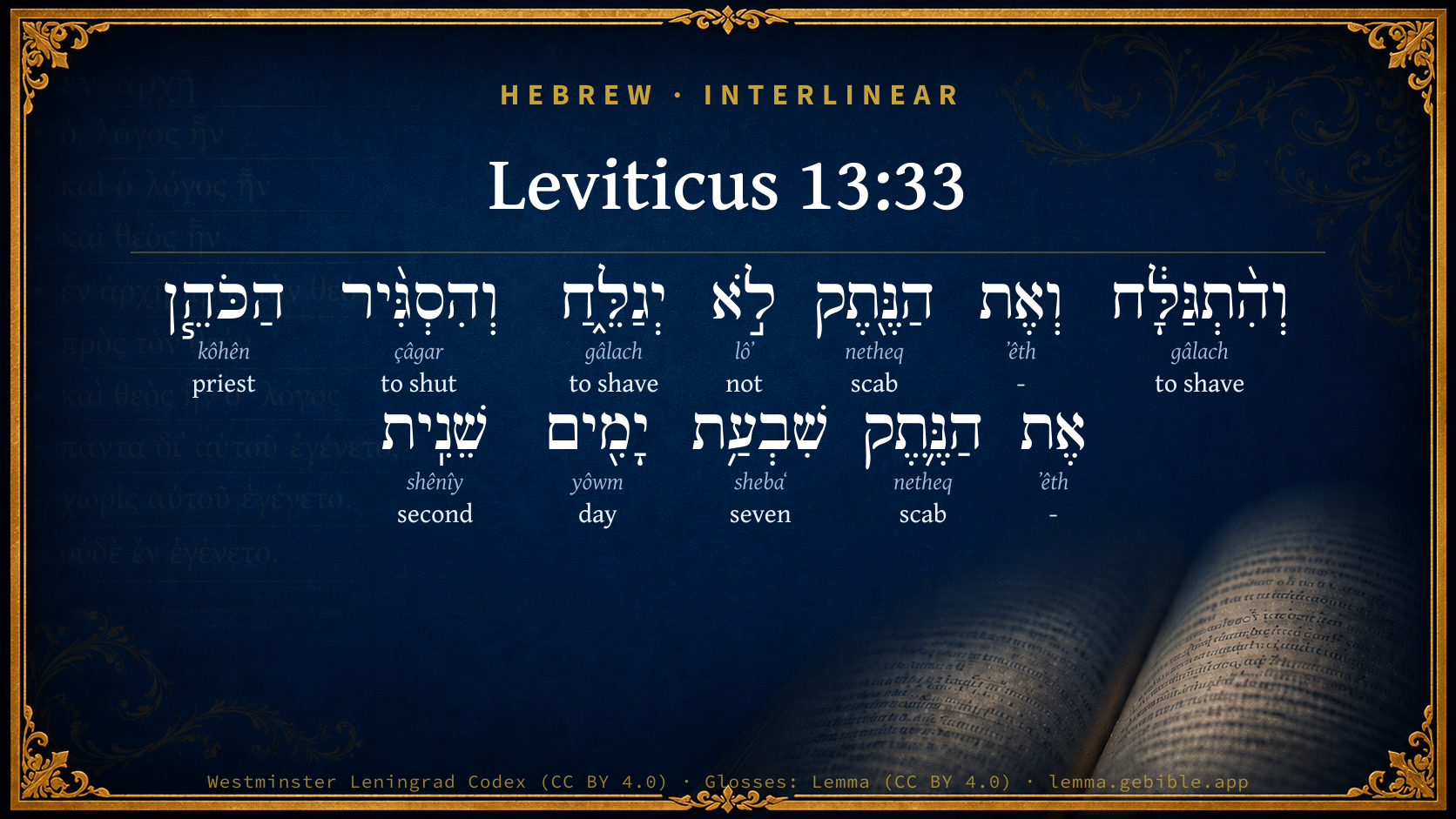
  1. וְהִ֨תְגַּלָּ֔ח gâlach H1548 “and · to shave” Conjunction + Verb, Hithpael, Sequential Perfect, 3rd Person, Masculine, Singular
  2. וְאֶת ʼêth H853 “and · -” Conjunction + Particle, Direct Object
  3. לֹ֣א lôʼ H3808 “not” Particle, Negative
  4. יְגַלֵּ֑חַ gâlach H1548 “to shave” Verb, Piel, Imperfect, 3rd Person, Masculine, Singular
  5. וְהִסְגִּ֨יר çâgar H5462 “and · to shut” Conjunction + Verb, Hiphil, Sequential Perfect, 3rd Person, Masculine, Singular
  6. הַכֹּהֵ֧ן kôhên H3548 “the · priest” Particle, Definite Article + Noun, Common, Masculine, Singular, Absolute
  7. אֶת ʼêth H853 “-” Particle, Direct Object
  8. הַנֶּ֛תֶק netheq H5424 “the · scab” Particle, Definite Article + Noun, Common, Masculine, Singular, Absolute
  9. שִׁבְעַ֥ת shebaʻ H7651 “seven” Adjective, Cardinal number, Masculine, Singular, Construct
  10. יָמִ֖ים yôwm H3117 “days” Noun, Common, Masculine, Plural, Absolute
  11. שֵׁנִֽית shênîy H8145 “second” Adjective, Ordinal number, Feminine, Singular, Absolute

About this verse

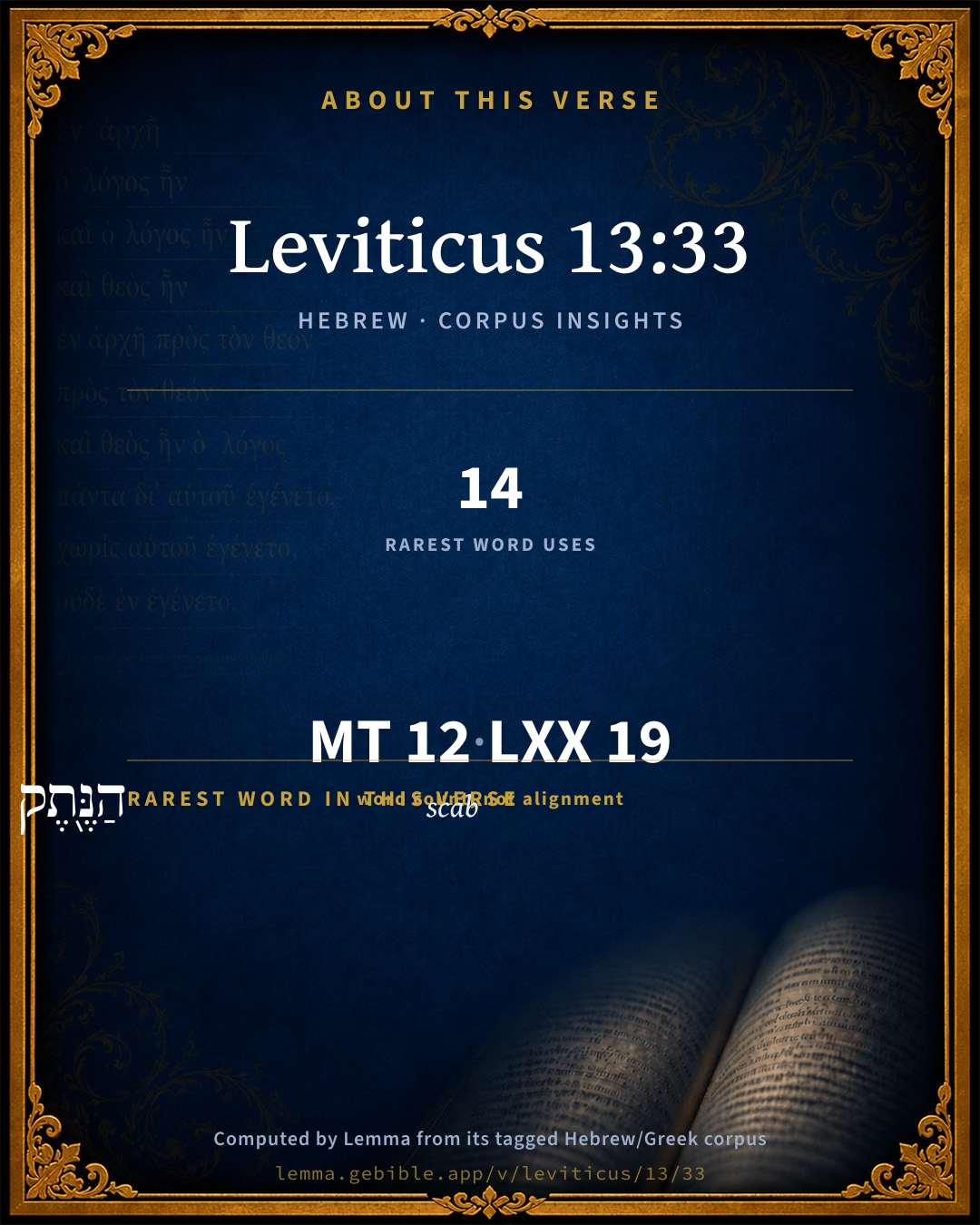
These counts appear in no published source. They are computed here, from the morphology-tagged text and Lemma’s own curated glosses. What Lemma adds →

12
words
9
distinct lemmas
Pentateuch
section

Notable vocabulary

The rarest word here is הַנֶּ֖תֶק scab H5424 — appearing just 14 times in the whole Hebrew Bible.

Shared distinctive vocabulary

הַנֶּ֖תֶק scab H5424 occurs in 9 verses of the Hebrew Bible. Also found in:

Grammatical profile

  • 3 verbs
  • 4 nouns
  • 2 adjectives
  • 3 particles

Verb forms

  • וְהִ֨תְגַּלָּ֔ח Hithpael · Sequential Perfect
  • יְגַלֵּ֑חַ Piel · Imperfect
  • וְהִסְגִּ֨יר Hiphil · Sequential Perfect

Repetition

Words recur within this verse — often emphatic in Hebrew:

  • וְהִ֨תְגַּלָּ֔ח to shave H1548 ×2
  • הַנֶּ֖תֶק scab H5424 ×2

Hebrew & Septuagint length

In English translation the verse runs 26 words from the Hebrew and 30 from the Septuagint (LXX English) — closely comparable.

A rough comparison of the two English renderings, which tokenize alike — not a word-level alignment.

Word counts can differ between the Hebrew and the Greek without any difference in meaning — e.g. the Hebrew direct-object marker אֵת has no separate Greek word, and Greek often adds the article ὁ.

In the original languages it is 12 Hebrew tokens and 19 Greek tokens — but the two are counted differently (Hebrew bundles its prefixes and suffixes into one token; the Greek is in lemma form), so that isn’t a like-for-like length.

Hebrew and Greek witnesses Masoretic Hebrew ↔ Greek Septuagint

The same verse in the two great witnesses to the Old Testament, shown verse-for-verse.

These are two independent witnesses, not word-aligned to each other, and the Septuagint is shown in lemma (dictionary) form.

Hebrew Leviticus 13:33 Masoretic · Westminster Leningrad Codex

וְהִ֨תְגַּלָּ֔ח וְאֶת הַנֶּ֖תֶק לֹ֣א יְגַלֵּ֑חַ וְהִסְגִּ֨יר הַכֹּהֵ֧ן אֶת הַנֶּ֛תֶק שִׁבְעַ֥ת יָמִ֖ים שֵׁנִֽית

then he shall be shaved, but he shall not shave the itch; and the priest shall shut him up who has the itch seven more days.

World English Bible · Public Domain

Greek LXX Leviticus 13:33 Septuagint · lemma form

καί ξυράω ὁ δέρμα ὁ δέ θραῦσμα οὐ ξυράω καί ἀποὁρίζω ὁ ἱερεύς ὁ θραῦσμα ἑπτά ἡμέρα ὁ δεύτερος

then the skin shall be shaven, but the scurf shall not be shaven; and the priest shall set aside the person having the scurf the second time for seven days.

LXX2012 (modern English Septuagint) · Public Domain

Hebrew: Westminster Leningrad Codex (CC BY 4.0). Greek: Septuagint (public domain); English from LXX2012 (modern English Septuagint) (Public Domain). How the Septuagint differs from the Hebrew →

Targum (Aramaic paraphrase)

2

The Targum is the ancient Jewish Aramaic paraphrase of the Hebrew Scriptures — an interpretive translation, not the Hebrew text itself. Onkelos (literal) and Pseudo-Jonathan (expansive) render the Torah, and Jonathan the Prophets. Coverage is partial: where no permissively-licensed English translation exists for a verse, only the Aramaic is shown. This is verse-level text, not a word-by-word alignment to the Hebrew.

  1. Targum Onkelos Torah (Genesis–Deuteronomy)
    וִיגַלַח סָחֳרָנֵי נִתְקָא וּדְעִם נִתְקָא לָא יְגַלַח וְיַסְגַר כַּהֲנָא יָת נִתְקָא שִׁבְעָא יוֹמִין תִּנְיָנוּת

    (no public-domain English translation for this verse)

    Targum Onkelos — Aramaic: “Onkelos Genesis” (public domain); “Onkelos Exodus” (public domain); “Onkelos Leviticus” (public domain); “Onkelos Numbers” (public domain); “Onkelos Deuteronomy” (public domain). English: “Sefaria Community Translation” (CC0 1.0 (public-domain dedication)); “J.W. Etheridge. The Targums of Onkelos and Jonathan Ben Uzziel on the Pentateuch. London: Longmans, Green, 1862” (public domain). Text via Sefaria.

  2. Targum Pseudo-Jonathan Torah (Genesis–Deuteronomy)
    וִיסַפֵּר יַת שַעֲרָא דְחַזְרָנוּת נִיתְקָא בְּרַם דְעִם נִיתְקָא לָא יַסְפֵּר וְיַסְגֵר כַּהֲנָא יַת נִיתְקָא שַׁבְעָא יוֹמִין

    he shall cut away the hair which surrounds the scar, but the scurfed part he must not shave; and the priest shall shut him who hath the scurf, seven days.

    Targum Pseudo-Jonathan — Aramaic: “Targum Jonathan on Genesis” (public domain); “Targum Jonathan on Exodus” (public domain); “Targum Jonathan on Leviticus” (public domain); “Targum Jonathan on Numbers” (public domain); “Targum Jonathan on Deuteronomy” (public domain). English: “The Targum of Jonathan ben Uzziel, trans. J. W. Etheridge, London, 1862” (public domain). Text via Sefaria.

Commentary

Notes on Leviticus 13:33 from classic Christian and Jewish commentators (each source and its license shown beneath its notes). The classic Christian expositions comment on the surrounding passage and are grouped to its opening verse, so a note may address several verses; the Jewish commentaries on the Tanakh (Rashi and others) are per-verse, so they appear only where the commentator wrote on this verse.

Lemma curates 59 commentaries, every one of them public domain or Creative Commons licensed, each selected and text-cleaned for this edition rather than reprinted as found. About our sources →

Adam Clarke's Commentary

Verse 33. The scall shall he not shave] Lest the place should be irritated and inflamed, and assume in consequence other appearances besides those of a leprous infection; in which case the priest might not be able to form an accurate judgment.

Adam Clarke's Commentary on the Bible (1810–1826) — public domain. Text from a community e-Sword/MySword module.

Ellicott's Commentary for English Readers

(33) He shall be shaven.—The priest, for the sake of making sure, and to be able to examine the patient more thoroughly, is to have his head and beard shaved. This operation was performed by professional barbers, who were always on the spot.

But the scall shall he not shave.—The place, however, where the scall appeared was not to be shaved, so that the priest might be able to see the colour of the hair. The manner in which the shaving was performed during the second Temple was as follows: The hair round the scall was all shaved off, except two hairs on each side, which were close to the affected spot, to enable the priest to see whether the spot is spreading or not.

A Bible Commentary for English Readers, edited by Charles John Ellicott (1878–1897) — public domain. Text from a community e-Sword module.

The Cambridge Bible for Schools and Colleges

gen. ed. J. J. S. Perowne

33. It is enjoined in the Mishna (Tal. Bab. Neg. x. § 5) that two hairs on each side of the scall should be left so that the priest might judge whether the disease had spread.

The Cambridge Bible for Schools and Colleges (gen. ed. J. J. S. Perowne; Cambridge University Press, 1878–1918) — public domain. Text from a community e-Sword module.

John Gill's Exposition

And in the seventh day the priest shall look on the scall,.... That is, according to Ben Gersom, on the thirteenth day from the first inspection of him by the priest:

and, behold, if the scall be not spread in the skin, nor be in sight deeper than the skin; neither appears spread on the surface of the skin, nor to have eaten into the flesh under it; also no thin yellow hair, though it is not expressed, for that made a person unclean, though there was no spreading:

then the priest shall pronounce him clean; free from a leprosy:

and he shall wash his clothes, and be clean; there was no need to say he shall wash them in water, as Aben Ezra observes, that is supposed; and then he was looked upon as a clean person, and might go into the sanctuary, and have conversation with men, both in a civil and religious way, and not defile anything he sat upon.

John Gill's Exposition of the Whole Bible (1746–1763) — public domain (CC PDM 1.0). Text via the HelloAO Bible API.

Matthew Poole's English Annotations

He shall be shaven, for the more certain discovery of the growth or stay of the plague.

Matthew Poole's English Annotations on the Holy Bible (1683–1685) — public domain. Text from a community e-Sword/MySword module.

Whedon's Commentary on the Bible

Daniel D. Whedon

33. He shall be shaven — This would afford a better opportunity to determine the question of the spread of the disease. The scall was exempted from being shaven, probably out of mercy to the patient, and as a safeguard against spreading it all over the head and of infecting others by the use of the same razor.

Daniel D. Whedon (gen. ed.), Commentary on the Old and New Testaments (1874–1909) — public domain. Text from a community e-Sword module.

John Wesley's Explanatory Notes

He shall be shaven - For the more certain discovery of the growth or stay of the plague.

John Wesley, Explanatory Notes Upon the Whole Bible (1754–1765) — public domain. Text via the GEBible commentary corpus.

Rashi

Rabbi Shlomo Yitzchaki (Rashi)

והתגלח AND HE SHALL CUT HIS HAIR around the scall,

ואת הנתק לא יגלח BUT THE SCALL ITSELF HE SHALL NOT CUT THE HAIR OF — this means that he leaves a row of two hairs quite close to it around it in order that it may become discernible if it (the scall) spreads, for if it spreads it passes the hair and will extend to the spot where the hair has been cut off (Mishnah Negaim 10:5; Sifra, Tazria Parashat Nega'im, Chapter 9 7).

Rashi on the Tanakh — English translations: “The Judaica Press complete Tanach with Rashi, translated by A. J. Rosenberg” (CC BY 4.0); “Pentateuch with Rashi's commentary by M. Rosenbaum and A.M. Silbermann, 1929-1934” (public domain); “The Metsudah Tanach series, Lakewood, N.J” (CC BY 4.0); and “The Book of Joshua, Metsudah Publications, 1997” (CC BY 4.0). Text via Sefaria.

Ramban (Nachmanides)

Rabbi Moshe ben Nachman (Ramban / Nachmanides)

THEN SHALL HE BE SHAVEN, BUT ‘V’ETH HANETHEK’ (THE SCALL) SHALL HE NOT SHAVE. In line with the plain meaning of Scripture the verse warns that he should not use a razor on the place of the nethek, for even though there is no hair on it, yet if he passes the razor over it the skin will be scratched causing hair to grow in it; for such is the nature of people who have scabs on their heads, and all those who make their hair to fall off, to scratch the place on the head and also to make certain cuts in it with a knife.But in the Torath Kohanim the Sages interpreted the verse as follows: “But the ‘nethek’ shall he not shave. But what is there to shave there?” That is to say, has not the hair fallen off from it? [So what need is there for Scripture to warn him not to shave it?] “Rather, the verse means, around the nethek he is not to shave. How can we explain this? He shaves the space outside it, but leaves [a circle] of two hairs [width] next to the nethek, so that it should be possible to discern if it spreads.” It is this which Onkelos translated: “and he shall shave around the scall, and that which is within the scall he shall not shave,” for he is to leave on all its sides a row of two hairs in order to recognize [at the end of seven days] if the nethek has spread [in which case the priest will pronounce him impure]. And the meaning of the word v’eth [v’eth hanethek] is then like the expression, and David came near ‘eth’ the people, and he saluted them, which means that he came near them but he did not enter into their midst. [Here too it would mean, “and ‘in’ the nethek itself he shall not shave.”] Or it may be that the meaning of v’eth is like im (with), with the word asher (which) missing, the verse thus stating: “and that [i.e., the hair] which is ‘with’ the nethek he shall not shave.” There are many such cases in Scripture.

Ramban (Nachmanides) on the Tanakh — English translation: “Commentary on the Torah by Ramban (Nachmanides). Translated and annotated by Charles B. Chavel. New York, Shilo Pub. House, 1971-1976” (CC BY 4.0). Text via Sefaria.

Lesson kit

Teaching starters — assembled from the data on this page, not authored interpretation. Every prompt links to the verse data it draws on. Edit before teaching.

Leviticus, in the Pentateuch, opens this verse with 12 words (9 distinct Hebrew lemmas). Its most distinctive word is netheq (“scab”). A historical commentator’s framing appears above. Read the whole chapter for the surrounding context.

Discussion questions

  1. What does “scab” (netheq) contribute to the verse as a whole?
  2. Leviticus 13:30 shares the word «scab» with this verse. How do the two illuminate each other?
  3. “to shave” occurs 2× in this one verse. What is the effect of the repetition?
  4. These translations render this verse differently; the difference is in the English rendering, not the original. What questions does that raise?
  5. The verb «וְהִ֨תְגַּלָּ֔ח» is Hithpael Sequential Perfect. How does its form color the action?
  6. Reading how Adam Clarke's Commentary and Ellicott's Commentary for English Readers read this verse, where do the two commentators agree and where do they part?

Things to notice

Reading settings

Reading text

Shown beneath each verse's original-language words.

Old Testament
Old Testament edition

Read the OT as the Masoretic Hebrew (MT) or the Greek Septuagint (LXX).

English shown for the Greek Septuagint (in the Hebrew ↔ Greek comparison).

Comparing translations? Open the Compare panel on any verse page to stack up to four side by side.