
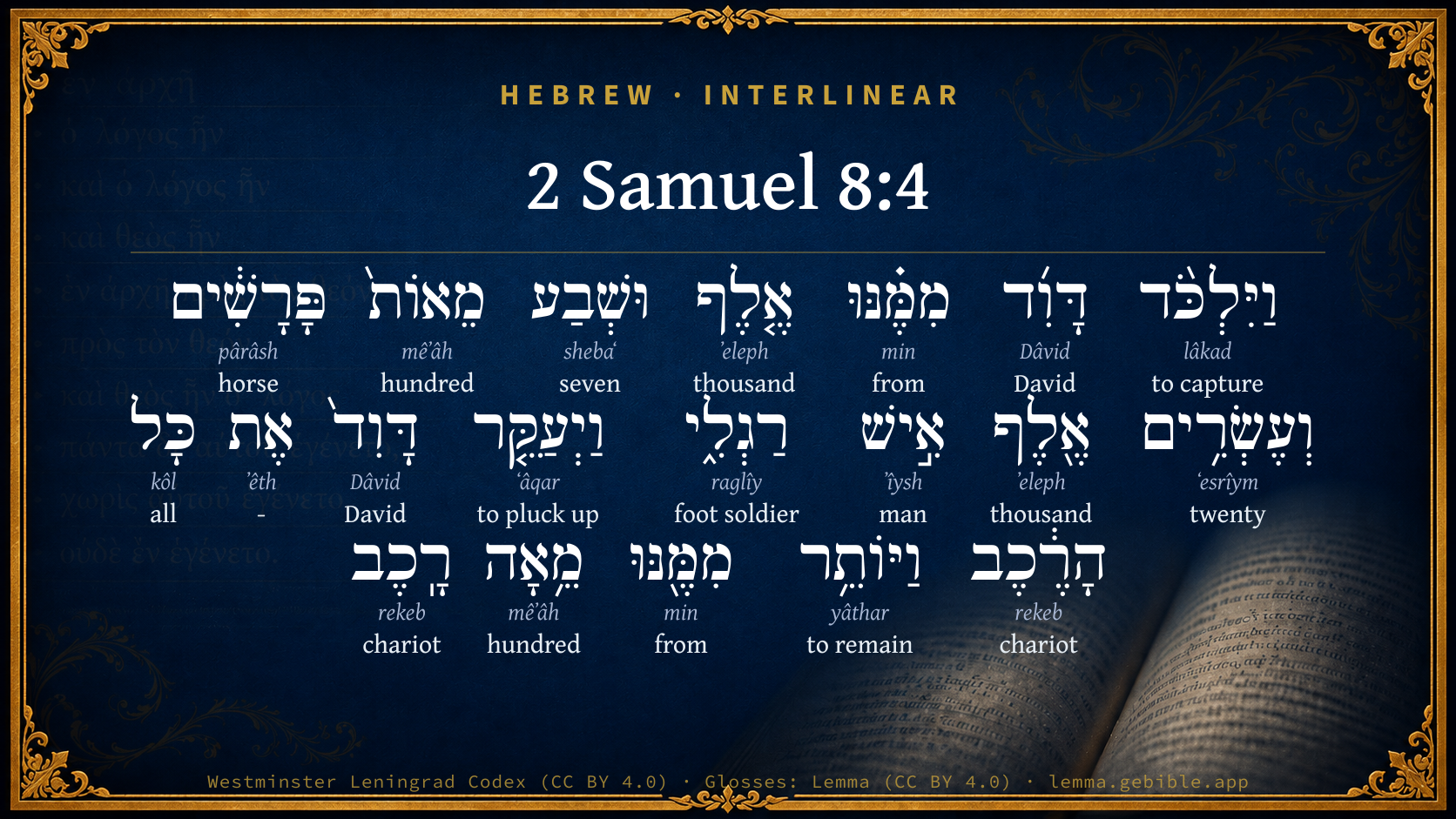
2 Samuel 8:4

Hebrew (Westminster Leningrad Codex) 2 Samuel 8:4 appears in the Hebrew Old Testament. The text above is from the Westminster Leningrad Codex. Each word links to its Strong’s number, a concise gloss, and parsing drawn from the Open Scriptures Hebrew Bible morphology. Click any word for its full Brown-Driver-Briggs (BDB) entry.
Download image
Cite this verse

2 Samuel 8:4 (World English Bible). Public Domain. Lemma interlinear Bible study tool, https://lemma.gebible.app/v/2-samuel/8/4.

Show BibTeX & RIS
BibTeX
RIS
English Translation
David took from him one thousand seven hundred horsemen, and twenty thousand footmen: and David hamstrung all the chariot horses, but reserved of them for one hundred chariots.
World English Bible · Public Domain
Download a study sheet

One document with this verse’s original text, its word-by-word gloss line, the meaning frame, cross-references with their text, attributed commentary, and full source and license credits — printable, and it pastes into notes with its structure intact.

This verse Autodidact and up

Study sheet (.html) Plain text (.txt)

A passage Seminary Student

Up to 50 verses in one chapter. A passage sheet keeps up to 6 commentary sources and 12 cross-references per verse, in the order this page ranks them, and says so on the sheet whenever that leaves anything out. Ask for a single verse and you get the Autodidact verse sheet above.

Everything on this page stays free to read, with no account — the sheet is a download of what is already on screen, not access to it.

Want to remove ads? Support Godless Engineer
Compare translations 3

The same verse in 3 English versions, stacked beneath the original-language interlinear above. Click any original word for its lexicon entry.

Each is an independent rendering of the whole verse — the interlinear is not word-aligned to these translations.

Highlighted words mark where these versions differ — a whole-verse word diff, not a word-by-word alignment.

  • World English Bible Public Domain
    David took from him one thousand seven hundred horsemen, and twenty thousand footmen: and David hamstrung all the chariot horses, but reserved of them for one hundred chariots.
  • King James Version Public Domain
    And David took from him a thousand chariots, and seven hundred horsemen, and twenty thousand footmen: and David houghed all the chariot horses, but reserved of them for an hundred chariots.
  • unfoldingWord Literal Text CC BY-SA 4.0
    And David took from him 1,700 horsemen and 20,000 men on foot. And David hamstrung all of the chariots, but he left from them 100 chariots.

unfoldingWord Literal Text — © unfoldingWord, licensed CC BY-SA 4.0. Word-aligned USFM3 via Door43 (git.door43.org/unfoldingWord/en_ult).

Versions to compare (up to 4)

3 of 4 selected

Show all 18 translations

Every available English version of this verse, each an independent rendering of the whole verse.

  • World English Bible Public Domain
    David took from him one thousand seven hundred horsemen, and twenty thousand footmen: and David hamstrung all the chariot horses, but reserved of them for one hundred chariots.
  • Berean Standard Bible Public Domain
    David captured from him a thousand chariots, seven thousand charioteers, and twenty thousand foot soldiers, and he hamstrung all the horses except a hundred he kept for the chariots.
  • Majority Standard Bible Public Domain
    David captured from him a thousand chariots, seven thousand charioteers, and twenty thousand foot soldiers, and he hamstrung all the horses except a hundred he kept for the chariots.
  • King James Version Public Domain
    And David took from him a thousand chariots, and seven hundred horsemen, and twenty thousand footmen: and David houghed all the chariot horses, but reserved of them for an hundred chariots.
  • American Standard Version (1901) Public Domain
    And David took from him a thousand and seven hundred horsemen, and twenty thousand footmen: and David hocked all the chariot horses, but reserved of them for a hundred chariots.
  • Revised Version (1885) Public Domain
    And David took from him a thousand and seven hundred horsemen, and twenty thousand footmen: and David houghed all the chariot horses, but reserved of them for an hundred chariots.
  • Geneva Bible (1599) Public Domain
    And Dauid tooke of them a thousand and seuen hundreth horsemen, and twenty thousande footemen, and Dauid destroyed all the charets, but he reserued an hundreth charets of them.
  • Douay-Rheims (1899) Public Domain
    And David took from him a thousand and seven hundred horsemen, and twenty thousand footmen, and houghed all the chariot horses: and only reserved of them for one hundred chariots.
  • Young's Literal Translation Public Domain
    and David captureth from him a thousand and seven hundred horsemen, and twenty thousand footmen, and David destroyeth utterly the whole of the charioteers, only he leaveth of them a hundred charioteers.
  • Literal Standard Version CC BY-SA 4.0
    and David captures from him one thousand and seven hundred horsemen, and twenty thousand footmen, and David utterly destroys the whole of the charioteers; he leaves only one hundred of their charioteers.
  • Unlocked Literal Bible CC BY-SA 4.0
    David captured from him 1,700 chariots and twenty thousand footmen. David hamstrung all the chariot horses, but reserved enough of them for a hundred chariots.
  • unfoldingWord Literal Text CC BY-SA 4.0
    And David took from him 1,700 horsemen and 20,000 men on foot. And David hamstrung all of the chariots, but he left from them 100 chariots.
  • Darby Bible Public Domain
    And David took from him one thousand seven hundred horsemen, and twenty thousand footmen; and David houghed all the chariot [horses], but reserved of them [for] a hundred chariots.
  • World Messianic Bible Public Domain
    David took from him one thousand seven hundred horsemen and twenty thousand footmen. David hamstrung the chariot horses, but reserved enough of them for one hundred chariots.
  • Webster's Bible Public Domain
    And David took from him a thousand chariots, and seven hundred horsemen, and twenty thousand footmen: and David houghed all the chariot-horses, but reserved of them for a hundred chariots.
  • Free Bible Version CC BY-SA 4.0
    David captured from him 1,000 chariots, 7,000 charioteers, and 20,000 foot soldiers. David hamstrung all the chariot horses—except he saved enough for 100 chariots.
  • Bible in Basic English Public Domain
    And David took from him one thousand, seven hundred horsemen and twenty thousand footmen: and David had the leg-muscles of the horses cut, only keeping enough of them for a hundred war-carriages.
  • JPS Tanakh (1917) Public Domain
    And David took from him a thousand and seven hundred horsemen, and twenty thousand footmen; and David houghed all the chariot horses, but reserved of them for a hundred chariots.

Literal Standard Version (2020), Covenant Press — licensed CC BY-SA 4.0. Text via the HelloAO Bible API (eBible.org). Unlocked Literal Bible (unfoldingWord) — licensed CC BY-SA 4.0. Text via the HelloAO Bible API (eBible.org). unfoldingWord Literal Text — © unfoldingWord, licensed CC BY-SA 4.0. Word-aligned USFM3 via Door43 (git.door43.org/unfoldingWord/en_ult). Free Bible Version, Dr. Jonathan Gallagher — licensed CC BY-SA 4.0. Text via the HelloAO Bible API (eBible.org).

Word by word

More ways to search: Search by grammar → Find every occurrence → Compare this word →

Practice this passage: Drill this verse → Learn its vocabulary →

וַיְעַקֵּ֤ר
ʻâqar
H6131
“and · to pluck up”
Conjunction + Verb, Piel, Sequential Imperfect, 3rd Person, Masculine, Singular
Part of Speech
Conjunction + Verb
Stem
Piel
Form
Sequential Imperfect
Person
3rd Person
Gender
Masculine
Number
Singular
Full BDB Definition

Origin: a primitive root

TWOT: 1681 , 1682

to pluck up, root up - (Qal) to pluck up, root up - (Niphal) to be plucked up - to cut, hamstring - (Piel) to cut, hamstring
  1. וַיִּלְכֹּ֨ד lâkad H3920 “and · to capture” Conjunction + Verb, Qal, Sequential Imperfect, 3rd Person, Masculine, Singular
  2. דָּוִ֜ד Dâvid H1732 “David” Noun, Proper
  3. מִמֶּ֗נּוּ min H4480 “from · us” Preposition + Suffix, Personal, 1st Person, Common, Plural
  4. אֶ֤לֶף ʼeleph H505 “thousand” Adjective, Cardinal number, Both, Singular, Absolute
  5. וּשְׁבַע shebaʻ H7651 “and · seven” Conjunction + Adjective, Cardinal number, Feminine, Singular, Absolute
  6. מֵאוֹת֙ mêʼâh H3967 “hundred” Adjective, Cardinal number, Both, Plural, Absolute
  7. פָּרָשִׁ֔ים pârâsh H6571 “horses” Noun, Common, Masculine, Plural, Absolute
  8. וְעֶשְׂרִ֥ים ʻesrîym H6242 “and · twenty” Conjunction + Adjective, Cardinal number, Both, Plural, Absolute
  9. אֶ֖לֶף ʼeleph H505 “thousand” Adjective, Cardinal number, Both, Singular, Absolute
  10. אִ֣ישׁ ʼîysh H376 “man” Noun, Common, Masculine, Singular, Absolute
  11. רַגְלִ֑י raglîy H7273 “foot soldier” Adjective, Adjective, Masculine, Singular, Absolute
  12. דָּוִד֙ Dâvid H1732 “David” Noun, Proper
  13. אֶת ʼêth H853 “-” Particle, Direct Object
  14. כָּל kôl H3605 “all of” Noun, Common, Masculine, Singular, Construct
  15. הָרֶ֔כֶב rekeb H7393 “the · chariot” Particle, Definite Article + Noun, Common, Masculine, Singular, Absolute
  16. וַיּוֹתֵ֥ר yâthar H3498 “and · to remain” Conjunction + Verb, Hiphil, Sequential Imperfect, 3rd Person, Masculine, Singular
  17. מִמֶּ֖נּוּ min H4480 “from · us” Preposition + Suffix, Personal, 1st Person, Common, Plural
  18. מֵ֥אָה mêʼâh H3967 “hundred” Adjective, Cardinal number, Both, Singular, Absolute
  19. רָֽכֶב rekeb H7393 “chariot” Noun, Common, Masculine, Singular, Absolute

About this verse

These counts appear in no published source. They are computed here, from the morphology-tagged text and Lemma’s own curated glosses. What Lemma adds →

20
words
15
distinct lemmas
Historical
section

Notable vocabulary

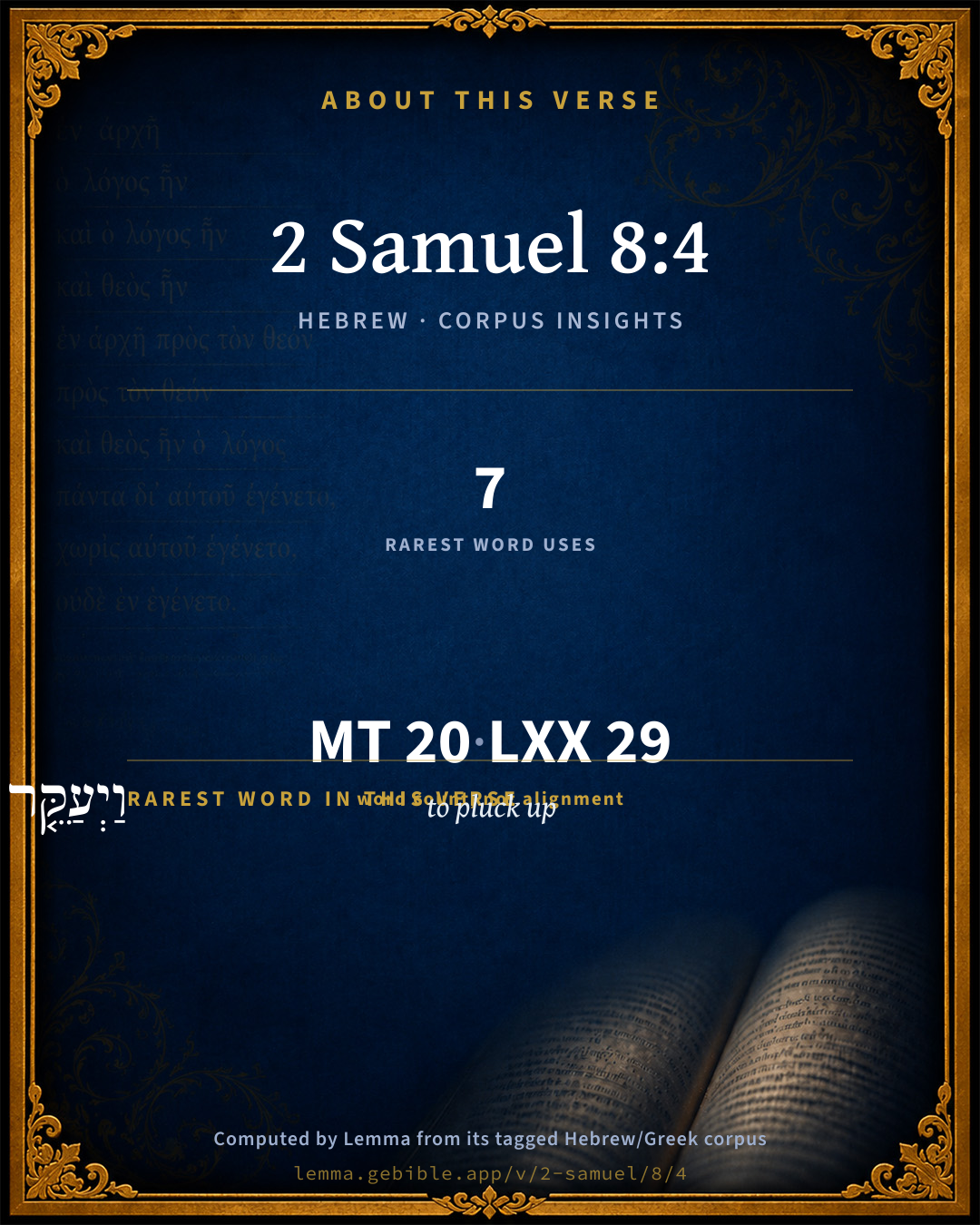
The rarest word here is וַיְעַקֵּ֤ר to pluck up H6131 — appearing just 7 times in the whole Hebrew Bible.

Shared distinctive vocabulary

וַיְעַקֵּ֤ר to pluck up H6131 occurs in 7 verses of the Hebrew Bible. Also found in:

Grammatical profile

  • 3 verbs
  • 7 nouns
  • 7 adjectives
  • 2 prepositions
  • 1 particle

Verb forms

  • וַיִּלְכֹּ֨ד Qal · Sequential Imperfect
  • וַיְעַקֵּ֤ר Piel · Sequential Imperfect
  • וַיּוֹתֵ֥ר Hiphil · Sequential Imperfect

Repetition

Words recur within this verse — often emphatic in Hebrew:

  • דָּוִ֜ד David H1732 ×2
  • אֶ֤לֶף thousand H505 ×2
  • מֵאוֹת֙ hundred H3967 ×2
  • הָרֶ֔כֶב chariot H7393 ×2
  • מִמֶּ֗נּוּ from H4480 ×2

Hebrew & Septuagint length

In English translation the verse runs 28 words from the Hebrew and 31 from the Septuagint (LXX English) — closely comparable.

A rough comparison of the two English renderings, which tokenize alike — not a word-level alignment.

Word counts can differ between the Hebrew and the Greek without any difference in meaning — e.g. the Hebrew direct-object marker אֵת has no separate Greek word, and Greek often adds the article ὁ.

In the original languages it is 20 Hebrew tokens and 29 Greek tokens — but the two are counted differently (Hebrew bundles its prefixes and suffixes into one token; the Greek is in lemma form), so that isn’t a like-for-like length.

Cross-references

7

Topical passages linked to 2 Samuel 8:4 in the Treasury of Scripture Knowledge — connected by theme and wording, ordered by reader-vote popularity; previews shown in the World English Bible.

  • Joshua 11:6 Yahweh said to Joshua, Don't be afraid because of them; for tomorrow at this time will I deliver them up all slain before Israel: you shall hamstring their horses, and burn their chariots with fire.
  • Joshua 11:9 Joshua did to them as Yahweh bade him: he hamstrung their horses, and burnt their chariots with fire.
  • Deuteronomy 17:16 Only he shall not multiply horses to himself, nor cause the people to return to Egypt, to the end that he may multiply horses; because Yahweh has said to you, You shall henceforth return no more that way.
  • 1 Kings 10:26 Solomon gathered together chariots and horsemen: and he had a thousand and four hundred chariots, and twelve thousand horsemen, that he bestowed in the chariot cities, and with the king at Jerusalem.
  • 1 Chronicles 18:4 David took from him one thousand chariots, and seven thousand horsemen, and twenty thousand footmen; and David hamstrung all the chariot horses, but reserved of them for one hundred chariots.
  • Psalms 20:7 Some trust in chariots, and some in horses, But we trust the name of Yahweh our God.
  • Psalms 33:16–17 There is no king saved by the multitude of a host. A mighty man is not delivered by great strength.

Cross-references courtesy of OpenBible.info (CC BY 4.0).

Hebrew and Greek witnesses Masoretic Hebrew ↔ Greek Septuagint

The same verse in the two great witnesses to the Old Testament, shown verse-for-verse.

These are two independent witnesses, not word-aligned to each other, and the Septuagint is shown in lemma (dictionary) form.

Hebrew 2 Samuel 8:4 Masoretic · Westminster Leningrad Codex

וַיִּלְכֹּ֨ד דָּוִ֜ד מִמֶּ֗נּוּ אֶ֤לֶף וּשְׁבַע מֵאוֹת֙ פָּרָשִׁ֔ים וְעֶשְׂרִ֥ים אֶ֖לֶף אִ֣ישׁ רַגְלִ֑י וַיְעַקֵּ֤ר דָּוִד֙ אֶת כָּל הָרֶ֔כֶב וַיּוֹתֵ֥ר מִמֶּ֖נּוּ מֵ֥אָה רָֽכֶב

David took from him one thousand seven hundred horsemen, and twenty thousand footmen: and David hamstrung all the chariot horses, but reserved of them for one hundred chariots.

World English Bible · Public Domain

Greek LXX 2 Samuel 8:4 Septuagint · lemma form

καί προ καταλαμβάνω δαυίδ ὁ αὐτός χίλιοι ἅρμα καί ἑπτά χιλίας ἱππεύς καί εἴκοσι χιλίας ἀνήρ πεζός καί παραλύω δαυίδ πᾶς ὁ ἅρμα καί ὑπολείπω ἐκ αὐτός ἑκατόν ἅρμα

And David took a thousand of his chariots, and seven thousand horsemen, and twenty thousand footmen: and David houghed all his chariot horses, and he reserved to himself one hundred chariots.

LXX2012 (modern English Septuagint) · Public Domain

On this verse, Adam Clarke's Commentary discusses the Septuagint’s reading. Read the note in Commentary ↓

Hebrew: Westminster Leningrad Codex (CC BY 4.0). Greek: Septuagint (public domain); English from LXX2012 (modern English Septuagint) (Public Domain). How the Septuagint differs from the Hebrew →

Targum (Aramaic paraphrase)

1

The Targum is the ancient Jewish Aramaic paraphrase of the Hebrew Scriptures — an interpretive translation, not the Hebrew text itself. Onkelos (literal) and Pseudo-Jonathan (expansive) render the Torah, and Jonathan the Prophets. Coverage is partial: where no permissively-licensed English translation exists for a verse, only the Aramaic is shown. This is verse-level text, not a word-by-word alignment to the Hebrew.

  1. Targum Jonathan Prophets (Joshua–Malachi)
    וַאֲסַר דָוִד מִנֵיהּ אֲלַף וּשְׁבַע מְאָה פְּרָשִׁין וְעַשְׂרִין אַלְפִין גְבַר רַגְלִי וַעֲקַד דָוִד יַת כָּל רְתִיכַיָא וְאַשְׁאַר מִנְהוֹן מְאָה רְתִיכִין:

    (no public-domain English translation for this verse)

    Targum Jonathan — Aramaic: “Mikraot Gedolot” (public domain). English: “Sefaria Community Translation” (CC0 1.0 (public-domain dedication)); “London "Chaldee Paraphrase," 1871” (public domain). Text via Sefaria.

Commentary

Notes on 2 Samuel 8:4 from classic Christian and Jewish commentators (each source and its license shown beneath its notes). The classic Christian expositions comment on the surrounding passage and are grouped to its opening verse, so a note may address several verses; the Jewish commentaries on the Tanakh (Rashi and others) are per-verse, so they appear only where the commentator wrote on this verse.

Lemma curates 59 commentaries, every one of them public domain or Creative Commons licensed, each selected and text-cleaned for this edition rather than reprinted as found. About our sources →

Trapp's Complete Commentary

John Trapp

2Sa 8:4 And David took from him a thousand [chariots], and seven hundred horsemen, and twenty thousand footmen: and David houghed all the chariot [horses], but reserved of them [for] an hundred chariots.

Ver. 4. And David took from him a thousand chariots.] As 1Ch 18:4. And the seven hundred horsemen were ranks of horsemen, ten in a rank, and so make seven thousand (ib.). Josephus saith that he slew five thousand horsemen, and twenty thousand footmen. Of David’s houghing the horses he maketh no mention, because it might seem to have been unwisely done, though in obedience to God’s will, and according to Joshua’s practice. It is well observed concerning Josephus, that writing the antiquities of his own nation with an intention to communicate them to others, he described them as stately as he could; and when he thought the simplicity of the Scripture did not suffice to the commendation of things done amongst his Hebrews, he either added or detracted from the holy history; and therefore he is to be read with discretion.

John Trapp, A Commentary or Exposition upon All the Books of the Old and New Testament (1647–1656) — public domain. Text from a community e-Sword module.

Joseph Benson's Commentary

2Sa 8:4. David took from him a thousand chariots — The word chariot is not in the Hebrew, but is well supplied by our translators from 1Ch 18:4, in which book many things are explained which are briefly related here; seven hundred horsemen — Or rather, seven hundred companies of horsemen, that is, in all, seven thousand, as it is 1Ch 18:4, there being ten in each company, and each ten having a ruler or captain. David houghed all the chariot-horses — That is, cut the sinews of their legs, or their hamstrings, that they might be of no use in war; but reserved of them for a hundred chariots — Probably, as a monument of his victory, not for war; God having forbid them to multiply horses, Deu 17:16.

Joseph Benson's Commentary on the Old and New Testaments (1811–1818) — public domain. Text from a community e-Sword module.

Tyndale Open Study Notes

Tyndale Open Resources

8:4 David would have crippled . . . horses to prevent their reuse by the enemy and because kings in Israel were not to accumulate horses (Deut 17:16).

Tyndale Open Study Notes — © Tyndale Open Resources, licensed CC BY-SA 4.0. Text via the HelloAO Bible API.

Geneva Bible (1599)

Geneva Bible translators

Or, bought the horses of the chariots.

Geneva Bible (1599) marginal notes — public domain. Text via Bolls.life.

Adam Clarke's Commentary

Verse 4. A thousand chariots] It is strange that there were a thousand chariots, and only seven hundred horsemen taken, and twenty thousand foot. But as the discomfiture appears complete, we may suppose that the chariots, being less manageable, might be more easily taken, while the horsemen might, in general, make their escape. The infantry also seem to have been surrounded, when twenty thousand of them were taken prisoners.

David houghed all the chariot horses] If he did so, it was both unreasonable and inhuman; for, as he had so complete a victory, there was no danger of these horses falling into the enemy's hands; and if he did not choose to keep them, which indeed the law would not permit, he should have killed them outright; and then the poor innocent creatures would have been put out of pain. But does the text speak of houghing horses at all? It does not. Let us hear; ויעקר דוד את כל הרכב vayeakker David eth col harecheb, And David disjointed all the chariots, except a hundred chariots which he reserved for himself. Now, this destruction of the chariots, was a matter of sound policy, and strict piety. God had censured those who trusted in chariots; piety therefore forbade David the use of them: and lest they should fall into the enemy's hands, and be again used against him, policy induced him to destroy them. The Septuagint render the words nearly as I have done, και παρελυσε Δαυιδ παντα τα ἁρματα.

He kept however one hundred; probably as a sort of baggage or forage wagons.

Adam Clarke's Commentary on the Bible (1810–1826) — public domain. Text from a community e-Sword/MySword module.

Ellicott's Commentary for English Readers

(4) A thousand chariots.—The word chariots has evidently dropped out of the text here, but is rightly inserted, following the LXX. and 1 Chron.; 700 horsemen should also be changed to 7,000, in accordance with 1 Chron., this being a more fitting proportion to 20,000 infantry in the plains of Syria, and the difference being only in two dots over the letter marking the numeral in Hebrew.

Houghed, i.e., hamstrung, to render them incapable of use in war. (Comp. Jos_11:6; Jos_11:9.) This is meant to apply not only to the chariot horses, but to all those of the cavalry. Whether David’s reservation of the number needed for 100 chariots was wrong or not, is not said. David probably felt the need of these horses as a means of more rapid communication with the distant parts of his increasing empire; yet this act may have been the entering wedge for Solomon’s direct violation of Deu_17:16, by sending to Egypt to “multiply horses to himself.”

A Bible Commentary for English Readers, edited by Charles John Ellicott (1878–1897) — public domain. Text from a community e-Sword module.

The Cambridge Bible for Schools and Colleges

gen. ed. J. J. S. Perowne

4. a thousand chariots, and seven hundred horsemen] The Heb. text as it stands can only mean a thousand and seven hundred horsemen; but it seems best to follow the text of the LXX. and of 1Ch_18:4 in reading a thousand chariots and seven thousand horsemen.

houghed] Or hamstrung; disabled by cutting the back sinews of their hind legs. Cp. Jos_11:6; Jos_11:9.

reserved] To grace his triumph.

The Cambridge Bible for Schools and Colleges (gen. ed. J. J. S. Perowne; Cambridge University Press, 1878–1918) — public domain. Text from a community e-Sword module.

John Gill's Exposition

And David took from him a thousand chariots, and seven hundred horsemen,.... "Chariots" are not in the text here, it is only 1700 "horsemen"; but it is supplied from Ch1 18:4; where the word is expressly mentioned, and there the horsemen are said to be seven thousand as in the Septuagint version here, and in Josephus (m); which may be reconciled by observing, with Kimchi and Abarbinel, that here the chief officers are meant, there all the chariots and horsemen that were under their command are mentioned, which together made up that large number; or else here are meant the ranks and companies of horse David took, which were seven hundred; and these having ten in a company or rank, made seven thousand; and there the complement of soldiers in those companies and ranks are intended:

and twenty thousand footmen; the same as in Ch1 18:4; and so in Josephus (n):

and David houghed all the chariot horses; or hamstrung them, as Joshua was ordered to do with respect to the Canaanites, Jos 11:6; he did not kill them, which might seem cruel and unmerciful to the brute creatures, but hamstrung them, that they might be useless for war; and the reason of it was, that horses might not be multiplied in Israel for that purpose, that so their trust and confidence might not be placed in them; see Deu 17:16,

but reserved of them for an hundred chariots; for his own use, not for war, but for grandeur; which accounts in some measure for the number of chariots and horses Solomon had, Kg1 4:26; the number of horses reserved is supposed to be four hundred, four horses being used in a chariot, which Jarchi gathers from Ch2 1:17.

(m) Ut supra. (Antiqu. l. 7. c. 5. sect. 1.) (n) Ut supra. (Antiqu. l. 7. c. 5. sect. 1.)

John Gill's Exposition of the Whole Bible (1746–1763) — public domain (CC PDM 1.0). Text via the HelloAO Bible API.

Albert Barnes' Notes on the Bible

Seven hundred horsemen - It should be seven thousand, as in 1Ch 18:4.

Albert Barnes' Notes on the Bible (1834–1885) — public domain. Text from a community e-Sword/MySword module.

Haydock's Catholic Bible Commentary

A thousand. Protestants supply chariots, (Haydock) after the Septuagint and 1 Paralipomenon (xviii. 4.) which have 7000 horsemen. See how we have attempted to reconcile these texts, 1 Kings xiii. 5. Perhaps the numbers were expressed by single letters; and the Hebrew final n, (700) has been mistaken for z, (7000) both here and [in] chap. x. 18. Literis numeralibus non verbis antiquitus numeri concipiebantur. (Scaliger, apud Walton prol.) --- "Will any other hypothesis so naturally solve this repeated difficulty?" (Kennicott, Diss. on 1 Chronicles xi. p. 96 and 463.) --- Kimchi thinks that the king’s horse-guards are only specified here; and Salien supposes, that those who fought on chariots are also included in Chronicles, as they are often styled horsemen, Isaias xxi. 7, 9. (Menochius) --- Houghed. Aquila, "destroyed." He rendered them unfit for war, as Josue had don, (Josue xi. 6.) supposing that this was the import of the decree, forbidding many horses to be kept, Deuteronomy xvii. 16. --- Horses is not expressed in Hebrew, though the Protestants supply the word; as also, for. We should translate literally, "He left out of them 100 chariots;" (Haydock) as we read elsewhere, that Adarezer had 1000. (Menochius) --- But this expression being unintelligible, no less than, "he houghed all the chariots," as the text stands at present in the original, may lead us to suspect that this verse has been inaccurately printed. Septuagint, "David paralyzed, (or rendered useless) all the chariots; and 100 chariots were reserved for himself out of them." Josephus says the rest of the 1000 chariots were burnt, 5000 horse slain, and 20,000 foot. (Haydock)

George Leo Haydock (1774–1849), Haydock's Catholic Family Bible and Commentary, 1859 edition — public domain. Excludes Psalms (Douay-Rheims chapter numbering differs from Protestant) and Deuterocanonical books (Catholic canon only).

Matthew Poole's English Annotations

Chariots; which word is fitly supplied out of 1Ch 18:4, such substantives being oft understood in the Hebrew language, as Gen 26:30; 2Sa 21:16.

Seven hundred horsemen, or seven hundred companies of horsemen, i. e. in all seven thousand; as it is 1Ch 18:4; there being ten on each company, and each ten having a ruler or captain, Exo 18:21; Deu 1:15. Or these seven hundred were the chief and the rulers of the rest, and the remaining six thousand three hundred were the common horsemen, subject to their commanders.

Houghed, i.e. cut the sinews of their legs, that they might be useless for war. Compare Jos 11:6.

All the chariot horses, except the following reserve. Chariots are here put for chariot horses, as they are 1Sa 13:5; 2Sa 10:18; Psa 76:6. David did this because he could not keep them for his own use, Deu 17:16.

Matthew Poole's English Annotations on the Holy Bible (1683–1685) — public domain. Text from a community e-Sword/MySword module.

Whedon's Commentary on the Bible

Daniel D. Whedon

4. Houghed all the chariot horses — Cut the tendons of the ham, or the sinews of the hinder hoofs — a practice of ancient warfare. See Jos_11:6; Jos_11:9. But the word horses is not in the Hebrew, and עקר, to root up, may also mean to destroy. Hence Clarke, Parkhurst, and Furst render:

David destroyed (or disjointed) all the chariots. Josephus also says: “He took a thousand of his chariots and destroyed the greater part of them, and ordered that no more than one hundred should be kept.” He would not have Israel trust in chariots. Compare Psa_20:7; Isa_30:1. Keil translates and explains as follows: “David lamed all the cavalry; that is, he made the war chariots and cavalry perfectly useless by laming the horses.”

Daniel D. Whedon (gen. ed.), Commentary on the Old and New Testaments (1874–1909) — public domain. Text from a community e-Sword module.

The Pulpit Commentary

David took from him a thousand chariots, and seven hundred horsemen, and twenty thousand footmen. The word "chariots" is inserted in the Authorized Version after "thousand," from the parallel place in 1Ch_18:4, where also it is said that David captured seven thousand horsemen. The numbers of the Chronicler are more in proportion to one another than those mentioned here, provided we assume that the word "chariots" ought to be supplied, which, as it is not the only difference, is uncertain. Until the Arabs invented our present system of notation, the ancient methods of representing numbers were so liable to error that little dependence can be placed upon them. The Hebrews used their letters for numerals, but after 400 their system breaks down. Any number higher than 400 can be represented only by long sums in arithmetic, or by an intricate system of points above and below, which were sure to get into confusion. David houghed all the chariot horses.

There is good reason for concluding that the word used here, recheb, is a collective, and signifies animals used either for riding or driving. What David reserved was not a hundred chariots, but a hundred riding horses, which would be useful to him for rapid communication, and could scarcely be regarded as a violation of the command in Deu_17:16. Both the Authorized and Revised Versions are wrong, but the Authorized Version at least makes the word recheb have the same meaning in both clauses, whereas the Revised Version makes it signify chariot horses in the first clause, and the chariots themselves in the second. The defeat by David, with infantry only, of an army provided with so powerful a force of cavalry and chariots, proves his great military skill, and their capture hears even more emphatic testimony to his generalship. In the Psalms we find horses often referred to as objects regarded with terror, and which gave a great advantage to their enemies, (Psa_20:7 Psa_33:17 Psa_76:6 Psa_147:10) but over which they had triumphed by Jehovah"s aid. This method, however, of rendering them useless, though practised by Joshua, (Jos_11:6) was most cruel; as the poor things, unable to move about with the sinews of their hind legs severed, would perish of hunger.

The Pulpit Commentary (1880–1919), ed. H.D.M. Spence-Jones & Joseph S. Exell — public domain. Text from a community e-Sword module.

John Wesley's Explanatory Notes

Seven hundred - Or, seven hundred companies of horsemen, that is, in all seven thousand; as it is 1 Chron. xviii, 4, there being ten in each company, and each ten having a ruler or captain. Houghed - That is, cut the sinews of their legs, that they might be useless for war.

John Wesley, Explanatory Notes Upon the Whole Bible (1754–1765) — public domain. Text via the GEBible commentary corpus.

Rashi

Rabbi Shlomo Yitzchaki (Rashi)

Dovid destroyed all the chariot [horses]. Because [of the verse], "He must not acquire an abundance of horses for himself"

[With] one hundred chariot [horses] remaining. That he required for his riding entourage. [The word] chariot [refers to] four horses as it is said, (Divrei Hayomim II, 1:17) "Chariot for six hundred silver pieces and horses for one hundred and fifty." From here we learn that a chariot refers to four horses.

Rashi on the Tanakh — English translations: “The Judaica Press complete Tanach with Rashi, translated by A. J. Rosenberg” (CC BY 4.0); “Pentateuch with Rashi's commentary by M. Rosenbaum and A.M. Silbermann, 1929-1934” (public domain); “The Metsudah Tanach series, Lakewood, N.J” (CC BY 4.0); and “The Book of Joshua, Metsudah Publications, 1997” (CC BY 4.0). Text via Sefaria.

Lesson kit

Teaching starters — assembled from the data on this page, not authored interpretation. Every prompt links to the verse data it draws on. Edit before teaching.

2 Samuel, in the Historical, opens this verse with 20 words (15 distinct Hebrew lemmas). Its most distinctive word is ʻâqar (“to pluck up”). A historical commentator’s framing appears above. Read the whole chapter for the surrounding context.

Discussion questions

  1. The word ʻâqar carries the sense “to pluck up.” How does it shape the verse?
  2. How does Genesis 49:6, which shares the word «to pluck up», read alongside this verse?
  3. What does the repetition of “David” (2× in this one verse) do in this verse?
  4. These translations render this verse differently; the difference is in the English rendering, not the original. What questions does that raise?
  5. «וַיִּלְכֹּ֨ד» is a Qal Sequential Imperfect verb. How does that grammatical form shape the action described?
  6. Compare how Trapp's Complete Commentary and Joseph Benson's Commentary read this verse. Where do they agree or differ?

Things to notice

Reading settings

Reading text

Shown beneath each verse's original-language words.

Old Testament
Old Testament edition

Read the OT as the Masoretic Hebrew (MT) or the Greek Septuagint (LXX).

English shown for the Greek Septuagint (in the Hebrew ↔ Greek comparison).

Comparing translations? Open the Compare panel on any verse page to stack up to four side by side.