
Leviticus 25:8

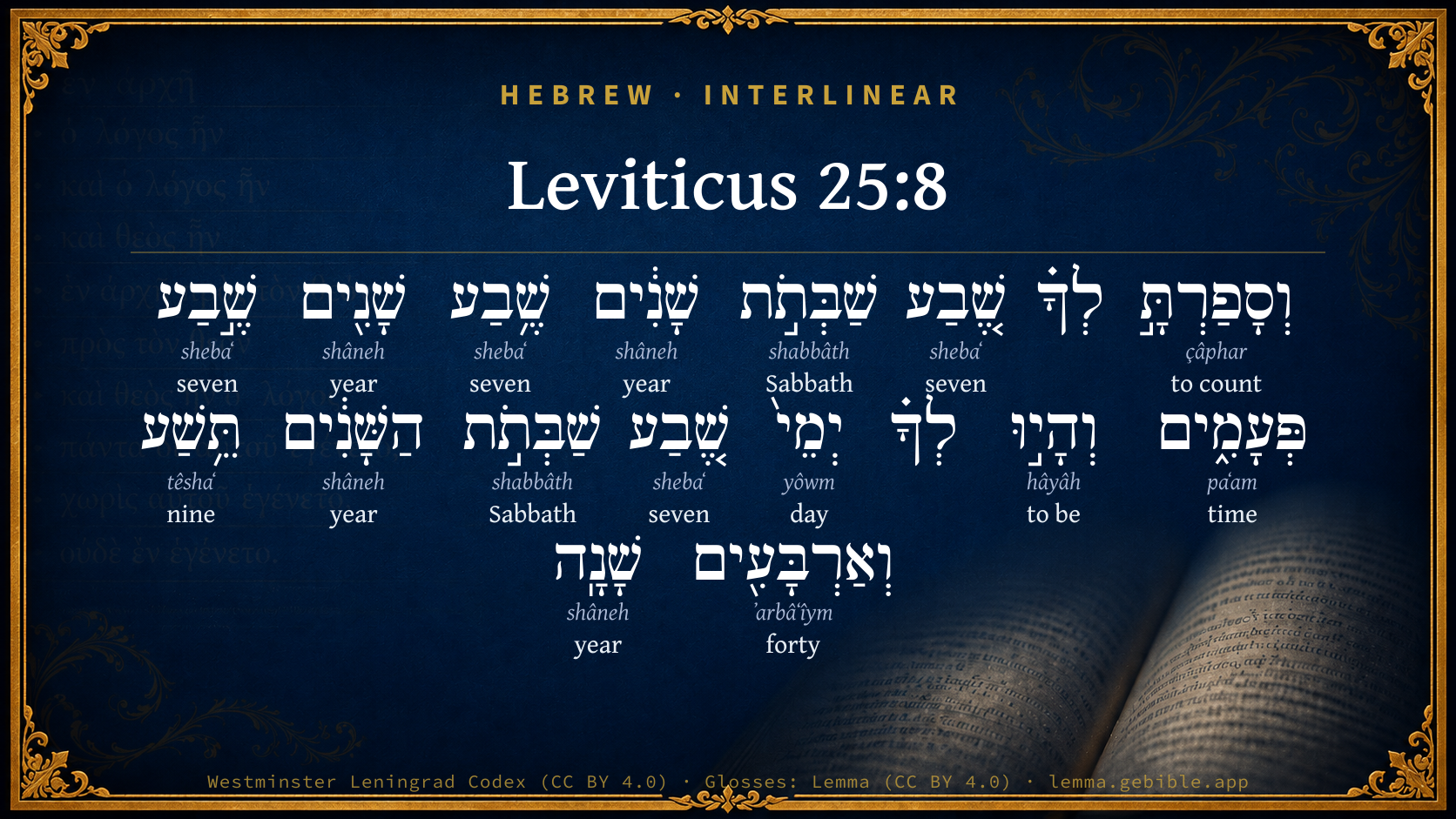
Hebrew (Westminster Leningrad Codex) Leviticus 25:8 appears in the Hebrew Old Testament. The text above is from the Westminster Leningrad Codex. Each word links to its Strong’s number, a concise gloss, and parsing drawn from the Open Scriptures Hebrew Bible morphology. Click any word for its full Brown-Driver-Briggs (BDB) entry.
Download image
Cite this verse

Leviticus 25:8 (World English Bible). Public Domain. Lemma interlinear Bible study tool, https://lemma.gebible.app/v/leviticus/25/8.

Show BibTeX & RIS
BibTeX
RIS
English Translation
"'You shall count off seven Sabbaths of years, seven times seven years; and there shall be to you the days of seven Sabbaths of years, even forty-nine years.
World English Bible · Public Domain
Download a study sheet

One document with this verse’s original text, its word-by-word gloss line, the meaning frame, cross-references with their text, attributed commentary, and full source and license credits — printable, and it pastes into notes with its structure intact.

This verse Autodidact and up

Study sheet (.html) Plain text (.txt)

A passage Seminary Student

Up to 50 verses in one chapter. A passage sheet keeps up to 6 commentary sources and 12 cross-references per verse, in the order this page ranks them, and says so on the sheet whenever that leaves anything out. Ask for a single verse and you get the Autodidact verse sheet above.

Everything on this page stays free to read, with no account — the sheet is a download of what is already on screen, not access to it.

Want to remove ads? Support Godless Engineer
Compare translations 3

The same verse in 3 English versions, stacked beneath the original-language interlinear above. Click any original word for its lexicon entry.

Each is an independent rendering of the whole verse — the interlinear is not word-aligned to these translations.

Highlighted words mark where these versions differ — a whole-verse word diff, not a word-by-word alignment.

  • World English Bible Public Domain
    "'You shall count off seven Sabbaths of years, seven times seven years; and there shall be to you the days of seven Sabbaths of years, even forty-nine years.
  • King James Version Public Domain
    And thou shalt number seven sabbaths of years unto thee, seven times seven years; and the space of the seven sabbaths of years shall be unto thee forty and nine years.
  • unfoldingWord Literal Text CC BY-SA 4.0
    And you shall count for yourself seven sabbaths of years, seven years seven times, and they shall be for you the days of seven sabbaths of years: 49 years.

unfoldingWord Literal Text — © unfoldingWord, licensed CC BY-SA 4.0. Word-aligned USFM3 via Door43 (git.door43.org/unfoldingWord/en_ult).

Versions to compare (up to 4)

3 of 4 selected

Show all 18 translations

Every available English version of this verse, each an independent rendering of the whole verse.

  • World English Bible Public Domain
    "'You shall count off seven Sabbaths of years, seven times seven years; and there shall be to you the days of seven Sabbaths of years, even forty-nine years.
  • Berean Standard Bible Public Domain
    And you shall count off seven Sabbaths of years—seven times seven years—so that the seven Sabbaths of years amount to forty-nine years.
  • Majority Standard Bible Public Domain
    And you shall count off seven Sabbaths of years—seven times seven years—so that the seven Sabbaths of years amount to forty-nine years.
  • King James Version Public Domain
    And thou shalt number seven sabbaths of years unto thee, seven times seven years; and the space of the seven sabbaths of years shall be unto thee forty and nine years.
  • American Standard Version (1901) Public Domain
    And thou shalt number seven sabbaths of years unto thee, seven times seven years; and there shall be unto thee the days of seven sabbaths of years, even forty and nine years.
  • Revised Version (1885) Public Domain
    And thou shalt number seven sabbaths of years unto thee, seven times seven years; and there shall be unto thee the days of seven sabbaths of years, even forty and nine years.
  • Geneva Bible (1599) Public Domain
    Also thou shalt number seuen Sabbaths of yeeres vnto thee, euen seuen times seuen yeere: and the space of the seuen Sabbaths of yeeres will be vnto thee nine and fourtie yeere.
  • Douay-Rheims (1899) Public Domain
    Thou shalt also number to thee seven weeks of years, that is to say, seven times seven, which together make forty-nine years:
  • Young's Literal Translation Public Domain
    `And thou hast numbered to thee seven sabbaths of years, seven years seven times, and the days of the seven sabbaths of years have been to thee nine and forty years,
  • Literal Standard Version CC BY-SA 4.0
    And you have numbered seven Sabbaths of years for yourself, seven times seven years, and the days of the seven Sabbaths of years have been forty-nine years for you,
  • Unlocked Literal Bible CC BY-SA 4.0
    You must count off seven Sabbaths of years, that is, seven times seven years, so that there will be seven Sabbaths of years, totaling forty-nine years.
  • unfoldingWord Literal Text CC BY-SA 4.0
    And you shall count for yourself seven sabbaths of years, seven years seven times, and they shall be for you the days of seven sabbaths of years: 49 years.
  • Darby Bible Public Domain
    And thou shalt count seven sabbaths of years, seven times seven years; so that the days of the seven sabbaths of years be unto thee forty-nine years.
  • World Messianic Bible Public Domain
    “‘You shall count off seven Sabbaths of years, seven times seven years; and there shall be to you the days of seven Sabbaths of years, even forty-nine years.
  • Webster's Bible Public Domain
    And thou shalt number seven sabbaths of years to thee, seven times seven years; and the space of the seven sabbaths of years shall be to thee forty and nine years.
  • Free Bible Version CC BY-SA 4.0
    Count seven ‘sabbaths’ of years, in other words, seven times seven years, so that the seven sabbaths of years come to forty-nine years.
  • Bible in Basic English Public Domain
    And let seven Sabbaths of years be numbered to you, seven times seven years; even the days of seven Sabbaths of years, that is forty-nine years;
  • JPS Tanakh (1917) Public Domain
    And thou shalt number seven sabbaths of years unto thee, seven times seven years; and there shall be unto thee the days of seven sabbaths of years, even forty and nine years.

Literal Standard Version (2020), Covenant Press — licensed CC BY-SA 4.0. Text via the HelloAO Bible API (eBible.org). Unlocked Literal Bible (unfoldingWord) — licensed CC BY-SA 4.0. Text via the HelloAO Bible API (eBible.org). unfoldingWord Literal Text — © unfoldingWord, licensed CC BY-SA 4.0. Word-aligned USFM3 via Door43 (git.door43.org/unfoldingWord/en_ult). Free Bible Version, Dr. Jonathan Gallagher — licensed CC BY-SA 4.0. Text via the HelloAO Bible API (eBible.org).

Word by word

More ways to search: Search by grammar → Find every occurrence → Compare this word →

Practice this passage: Drill this verse → Learn its vocabulary →

תֵּ֥שַׁע
têshaʻ
H8672
“nine”
Adjective, Cardinal number, Feminine, Singular, Absolute
Part of Speech
Adjective
Type
Cardinal number
Gender
Feminine
Number
Singular
State
Absolute
Full BDB Definition

Origin: perhaps from H8159 through the idea of a turn to the next or full number ten

TWOT: 2550

nine, nonad - nine (as cardinal number) - ninth (as ordinal number) - in combination with other numbers
  1. וְסָפַרְתָּ֣ çâphar H5608 “and · to count” Conjunction + Verb, Qal, Sequential Perfect, 2nd Person, Masculine, Singular
  2. שֶׁ֚בַע shebaʻ H7651 “seven” Adjective, Cardinal number, Feminine, Singular, Absolute
  3. שַׁבְּתֹ֣ת shabbâth H7676 “Sabbaths of” Noun, Common, Both, Plural, Construct
  4. שָׁנִ֔ים shâneh H8141 “years” Noun, Common, Feminine, Plural, Absolute
  5. שֶׁ֥בַע shebaʻ H7651 “seven” Adjective, Cardinal number, Feminine, Singular, Absolute
  6. שָׁנִ֖ים shâneh H8141 “years” Noun, Common, Feminine, Plural, Absolute
  7. שֶׁ֣בַע shebaʻ H7651 “seven” Adjective, Cardinal number, Feminine, Singular, Absolute
  8. פְּעָמִ֑ים paʻam H6471 “times” Noun, Common, Feminine, Plural, Absolute
  9. וְהָי֣וּ hâyâh H1961 “and · to be” Conjunction + Verb, Qal, Sequential Perfect, 3rd Person, Common, Plural
  10. יְמֵי֙ yôwm H3117 “days of” Noun, Common, Masculine, Plural, Construct
  11. שֶׁ֚בַע shebaʻ H7651 “seven” Adjective, Cardinal number, Feminine, Singular, Absolute
  12. שַׁבְּתֹ֣ת shabbâth H7676 “Sabbaths of” Noun, Common, Both, Plural, Construct
  13. הַשָּׁנִ֔ים shâneh H8141 “the · years” Particle, Definite Article + Noun, Common, Feminine, Plural, Absolute
  14. וְאַרְבָּעִ֖ים ʼarbâʻîym H705 “and · forty” Conjunction + Adjective, Cardinal number, Both, Plural, Absolute
  15. שָׁנָֽה shâneh H8141 “year” Noun, Common, Feminine, Singular, Absolute

About this verse

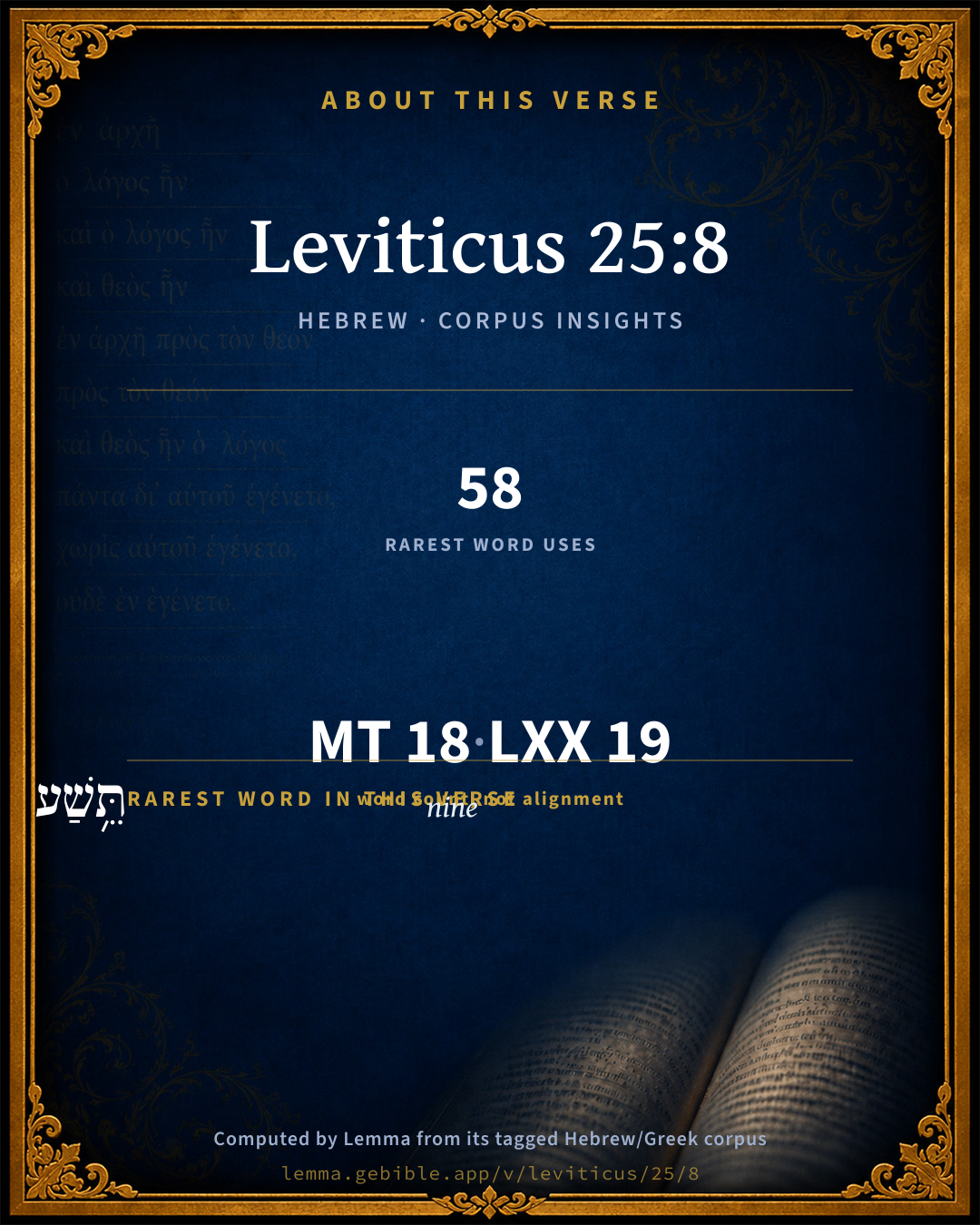
These counts appear in no published source. They are computed here, from the morphology-tagged text and Lemma’s own curated glosses. What Lemma adds →

18
words
9
distinct lemmas
Pentateuch
section

Shared distinctive vocabulary

תֵּ֥שַׁע nine H8672 occurs in 57 verses of the Hebrew Bible. Also found in:

Grammatical profile

  • 2 verbs
  • 8 nouns
  • 6 adjectives
  • 2 prepositions

Verb forms

  • וְסָפַרְתָּ֣ Qal · Sequential Perfect
  • וְהָי֣וּ Qal · Sequential Perfect

Repetition

Words recur within this verse — often emphatic in Hebrew:

  • שֶׁ֚בַע seven H7651 ×4
  • שָׁנִ֔ים year H8141 ×4
  • שַׁבְּתֹ֣ת Sabbath H7676 ×2

Hebrew & Septuagint length

In English translation the verse runs 28 words from the Hebrew and 28 from the Septuagint (LXX English) — the same length.

A rough comparison of the two English renderings, which tokenize alike — not a word-level alignment.

Word counts can differ between the Hebrew and the Greek without any difference in meaning — e.g. the Hebrew direct-object marker אֵת has no separate Greek word, and Greek often adds the article ὁ.

In the original languages it is 18 Hebrew tokens and 19 Greek tokens — but the two are counted differently (Hebrew bundles its prefixes and suffixes into one token; the Greek is in lemma form), so that isn’t a like-for-like length.

Cross-references

2

Topical passages linked to Leviticus 25:8 in the Treasury of Scripture Knowledge — connected by theme and wording, ordered by reader-vote popularity; previews shown in the World English Bible.

  • Leviticus 23:15 "'You shall count from the next day after the Sabbath, from the day that you brought the sheaf of the wave offering; seven Sabbaths shall be completed:
  • Genesis 2:2 On the seventh day God finished his work which he had made; and he rested on the seventh day from all his work which he had made.

Cross-references courtesy of OpenBible.info (CC BY 4.0).

Hebrew and Greek witnesses Masoretic Hebrew ↔ Greek Septuagint

The same verse in the two great witnesses to the Old Testament, shown verse-for-verse.

These are two independent witnesses, not word-aligned to each other, and the Septuagint is shown in lemma (dictionary) form.

Hebrew Leviticus 25:8 Masoretic · Westminster Leningrad Codex

וְסָפַרְתָּ֣ לְךָ֗ שֶׁ֚בַע שַׁבְּתֹ֣ת שָׁנִ֔ים שֶׁ֥בַע שָׁנִ֖ים שֶׁ֣בַע פְּעָמִ֑ים וְהָי֣וּ לְךָ֗ יְמֵי֙ שֶׁ֚בַע שַׁבְּתֹ֣ת הַשָּׁנִ֔ים תֵּ֥שַׁע וְאַרְבָּעִ֖ים שָׁנָֽה

"'You shall count off seven Sabbaths of years, seven times seven years; and there shall be to you the days of seven Sabbaths of years, even forty-nine years.

World English Bible · Public Domain

Greek LXX Leviticus 25:8 Septuagint · lemma form

καί ἐκἀριθμέω σεαυτοῦ ἑπτά ἀνάπαυσις ἔτος ἑπτά ἔτος ἑπτάκις καί εἰμί σύ ἑπτά ἑβδομάς ἔτος ἐννέα καί τεσσαράκοντα ἔτος

And you shall reckon to yourself seven sabbaths of years, seven times seven years; and they shall be to you seven weeks of years, nine and forty years.

LXX2012 (modern English Septuagint) · Public Domain

Hebrew: Westminster Leningrad Codex (CC BY 4.0). Greek: Septuagint (public domain); English from LXX2012 (modern English Septuagint) (Public Domain). How the Septuagint differs from the Hebrew →

Targum (Aramaic paraphrase)

2

The Targum is the ancient Jewish Aramaic paraphrase of the Hebrew Scriptures — an interpretive translation, not the Hebrew text itself. Onkelos (literal) and Pseudo-Jonathan (expansive) render the Torah, and Jonathan the Prophets. Coverage is partial: where no permissively-licensed English translation exists for a verse, only the Aramaic is shown. This is verse-level text, not a word-by-word alignment to the Hebrew.

  1. Targum Onkelos Torah (Genesis–Deuteronomy)
    וְתִמְנֵי לָךְ שְׁבַע שְׁמִיטִין דִשְׁנִין שְׁבַע שְׁנִין שְׁבַע זִמְנִין וִיהוֹן לָךְ יוֹמֵי שְּׁבַע שְׁמִטִין דִשְׁנִין אַרְבְּעִין וְתֵשַׁע שְׁנִין

    (no public-domain English translation for this verse)

    Targum Onkelos — Aramaic: “Onkelos Genesis” (public domain); “Onkelos Exodus” (public domain); “Onkelos Leviticus” (public domain); “Onkelos Numbers” (public domain); “Onkelos Deuteronomy” (public domain). English: “Sefaria Community Translation” (CC0 1.0 (public-domain dedication)); “J.W. Etheridge. The Targums of Onkelos and Jonathan Ben Uzziel on the Pentateuch. London: Longmans, Green, 1862” (public domain). Text via Sefaria.

  2. Targum Pseudo-Jonathan Torah (Genesis–Deuteronomy)
    וְתִמְנֵי לָךְ שְׁבַע שְׁמִיטִין דִשְׁנִין שְׁבַע שְׁנִין שְׁבַע זִימְנִין וִיהוֹן לָךְ סְכוּם שְׁבַע שְׁמִיטִין דִשְׁנִין אַרְבְּעִין וּתְשַׁע שְׁנִין

    And thou shalt number to thee seven Sabbaths of years, seven times seven years, and they shall be to thee the sum of the days of seven Sabbaths (or remissions, shemittin) of years, forty and nine years.

    Targum Pseudo-Jonathan — Aramaic: “Targum Jonathan on Genesis” (public domain); “Targum Jonathan on Exodus” (public domain); “Targum Jonathan on Leviticus” (public domain); “Targum Jonathan on Numbers” (public domain); “Targum Jonathan on Deuteronomy” (public domain). English: “The Targum of Jonathan ben Uzziel, trans. J. W. Etheridge, London, 1862” (public domain). Text via Sefaria.

Commentary

Notes on Leviticus 25:8 from classic Christian and Jewish commentators (each source and its license shown beneath its notes). The classic Christian expositions comment on the surrounding passage and are grouped to its opening verse, so a note may address several verses; the Jewish commentaries on the Tanakh (Rashi and others) are per-verse, so they appear only where the commentator wrote on this verse.

Lemma curates 59 commentaries, every one of them public domain or Creative Commons licensed, each selected and text-cleaned for this edition rather than reprinted as found. About our sources →

Matthew Henry's Commentary

Here is, I. The general institution of the jubilee, Lev 25:8. etc.

1. When it was to be observed: after seven sabbaths of years (Lev 25:8), whether the forty-ninth or fiftieth is a great question among learned men: that it should be the seventh sabbatical year, that is, the forty-ninth (which by a very common form of speech is called the fiftieth), seems to me most probable, and is, I think, made pretty clear and the objections removed by that learned chronologer Calvisius; but this is not a place for arguing the question. Seven sabbaths of weeks were reckoned from the passover to the feast of pentecost (or fiftieth day, for so pentecost signifies), and so seven sabbaths of years from one jubilee to another, and the seventh is called the fiftieth; and all this honour is put upon the sevenths for the sake of God's resting the seventh day from the work of creation.

2. How it was to be proclaimed, with sound of trumpet in all parts of the country (Lev 25:5), both to give notice to all persons of it, and to express their joy and triumph in it; and the word jobel, or jubilee, is supposed to signify some particular sound of the trumpet distinguishable from any other; for the trumpet that gives an uncertain sound is of little service, Co1 14:8. The trumpet was sounded in the close of the day of atonement; thence the jubilee commenced, and very fitly; when they had been humbling and afflicting their souls for sin, then they were made to hear this voice of joy and gladness, Psa 51:8. When their peace was made with God, then liberty was proclaimed; for the removal of guilt is necessary to make way for the entrance of all true comfort, Rom 5:1, Rom 5:2. In allusion to this solemn proclamation of the jubilee, it was foretold concerning our Lord Jesus that he should preach the acceptable year of the Lord, Isa 61:2. He sent his apostles to proclaim it with the trumpet of the everlasting gospel, which they were to preach to every creature. And it stands still foretold that at the last day the trumpet shall sound, which shall release the dead out of the bondage of the grave, and restore us to our possessions.

3. What was to be done in that year extraordinary; besides the common rest of the land, which was observed every sabbatical year (Lev 25:11, Lev 25:12), and the release of personal debts (Deu 15:2, Deu 15:3), there was to be the legal restoration of every Israelite to all the property, and all the liberty, which had been alienated from him since the last jubilee; so that never was any people so secured in their liberty and property (those glories of a people) as Israel was. Effectual care was taken that while they kept close to God these should not only not be taken from them by the violence of others, but not thrown away by their own folly.

(1.) The property which every man had in his dividend of the land of Canaan could not be alienated any longer than till the year of jubilee, and then he or his should return to it, and have a title to it as undisputed, and the possession of it as undisturbed, as ever (Lev 25:10, Lev 25:13): "You shall return every man to his possession; so that if a man had sold or mortgaged his estate, or any part of it, it should then return to him or his heirs, free of all charge and encumbrance. Now this was no wrong to the purchaser, because the year of jubilee was fixed, and every man knew when it would come, and made his bargain accordingly. By our law indeed, if lands be granted to a man and his heirs, upon condition that he should never sell or alienate them, the grant is good, but the condition is void and repugnant: Iniquum est ingenuis hominibus (say the lawyers) non esse liberam rerum suarum alienationem - It is unjust to prevent free men from alienating their own possessions. Yet it is agreed in the books that if the king grant lands to a man in fee upon condition he shall not alienate, the condition is good. Now God would show his people Israel that their land was his, and they were his tenants; and therefore he ties them up that they shall not have power to sell, but only to make leases for any term of years, not going beyond the next jubilee. By this means it was provided, [1.] That their genealogies should be carefully preserved, which would be of use for clearing our Saviour's pedigree. [2.] That the distinction of tribes should be kept up; for, though a man might purchase lands in another tribe, yet he could not retain them longer than till the year of jubilee, and then they would revert of course. [3.] That none should grow exorbitantly rich, by laying house to house, and field to field (Isa 5:8), but should rather apply themselves to the cultivating of what they had than the enlarging of their possessions. The wisdom of the Roman commonwealth sometimes provided that no man should be master of above 500 acres. [4.] That no family should be sunk and ruined, and condemned to perpetual poverty. This particular care God took for the support of the honour of that people, and the preserving, not only of that good land to the nation in general, but of every man's share to his family in particular, for a perpetual inheritance, that it might the better typify that good part which shall never be taken away from those that have it.

(2.) The liberty which every man was born to, if it were sold or forfeited, should likewise return at the year of jubilee: You shall return every man to his family, Lev 25:10. Those that were sold into other families thereby became strangers to their own; but in this year of redemption they were to return. This was typical of our redemption by Christ from the slavery of sin and Satan, and our restoration to the glorious liberty of the children of God. Some compute that the very year in which Christ died was a year of jubilee, and the last that ever was kept. But, however that be, we are sure it is the Son that makes us free, and then we are free indeed.

II. A law upon this occasion against oppression in buying and selling of land; neither the buyer nor the seller must overreach, Lev 25:14-17. In short, the buyer must not give less, nor the seller take more, than the just value of the thing, considered as necessarily returning at the year of jubilee. It must be settled what the clear yearly value of the land was, and then how many years' purchase it was worth till the year of jubilee. But they must reckon only the years of the fruits (Lev 25:15), and therefore must discount for the sabbatical years. It is easy to observe that the nearer the jubilee was the less must the value of the land be. According to the fewness of the years thou shalt diminish the price. But we do not find it so easy practically to infer thence that the nearer the world comes to its period the less value we should put upon the things of it: because the time is short, and the fashion of the world passeth away, let those that buy be as though they possessed not. One would put little value on an old house, that is ready to drop down. All bargains ought to be made by this rule, You shall not oppress one another, nor take advantage of one another's ignorance or necessity, but thou shalt fear thy God. Note, The fear of God reigning in the heart would effectually restrain us from doing any wrong to our neighbour in word or deed; for, though man be not, God is the avenger of those that go beyond or defraud their brethren, Th1 4:6. Perhaps Nehemiah refers to this very law (Neh 5:15), where he tells us that he did not oppress those he had under his power, because of the fear of God.

III. Assurance given them that they should be no losers, but great gainers, by observing these years of rest. It is promised, 1. That they should be safe: You shall dwell in the land in safety, Lev 25:18. and again, Lev 25:19. The word signifies both outward safety and inward security and confidence of spirit, that they should be quiet both from evil and from the fear of evil. 2. That they should be rich: You shall eat your fill. Note, If we be careful to do our duty, we may cheerfully trust God with our comfort. 3. That they should not want food convenient that year in which they did neither sow nor reap: I will command my blessing in the sixth year, and it shall bring forth fruit for three years, Lev 25:21. This was, (1.) A standing miracle, that, whereas at other times one year did but serve to bring in another, the productions of the sixth year should serve to bring in the ninth. Note, The blessing of God upon our provision will make a little go a great way, and satisfy even the poor with bread, Psa 132:15. (2.) A lasting memorial of the manna which was given double on the sixth day for two days. (3.) It was intended for an encouragement to all God's people, in all ages, to trust him in the way of duty, and to cast their care upon him. There is nothing lost by faith and self-denial in our obedience.

Matthew Henry's Commentary on the Whole Bible (1708–1710) — public domain (CC PDM 1.0). Text via the HelloAO Bible API.

Jamieson, Fausset & Brown

Robert Jamieson, A. R. Fausset & David Brown

THE JUBILEE. (Lev. 25:8-23)

thou shalt number seven sabbaths of years--This most extraordinary of all civil institutions, which received the name of "Jubilee" from a Hebrew word signifying a musical instrument, a horn or trumpet, began on the tenth day of the seventh month, or the great day of atonement, when, by order of the public authorities, the sound of trumpets proclaimed the beginning of the universal redemption. All prisoners and captives obtained their liberties, slaves were declared free, and debtors were absolved. The land, as on the sabbatic year, was neither sowed nor reaped, but allowed to enjoy with its inhabitants a sabbath of repose; and its natural produce was the common property of all. Moreover, every inheritance throughout the land of Judea was restored to its original owner.

Jamieson, Fausset & Brown — Commentary Critical and Explanatory on the Whole Bible (1871) — public domain (CC PDM 1.0). Text via the HelloAO Bible API.

Adam Clarke's Commentary

Verse 8. Thou shalt number seven Sabbaths of years] This seems to state that the jubilee was to be celebrated on the forty-ninth year; but in Lev 25:10; Lev 25:11 it is said, Ye shall hallow the fiftieth year, and, A jubilee shall this fiftieth year be. Probably in this verse Moses either includes the preceding jubilee, and thus with the forty-ninth makes up the number fifty; or he speaks of proclaiming the jubilee on the forty-ninth, and celebrating it on the fiftieth year current. Some think it was celebrated on the forty-ninth year, as is stated in Le 25:8; and this prevented the Sabbatical year, or seventh year of rest, from being confounded with the jubilee, which it must otherwise have been, had the celebration of this great solemnity taken place on the fiftieth year; but it is most likely that the fiftieth was the real jubilee.

Adam Clarke's Commentary on the Bible (1810–1826) — public domain. Text from a community e-Sword/MySword module.

Trapp's Complete Commentary

John Trapp

Lev 25:8 And thou shalt number seven sabbaths of years unto thee, seven times seven years; and the space of the seven sabbaths of years shall be unto thee forty and nine years.

Ver. 8. Seven Sabbaths of years.] See on Lev 25:4.

John Trapp, A Commentary or Exposition upon All the Books of the Old and New Testament (1647–1656) — public domain. Text from a community e-Sword module.

Albert Barnes' Notes on the Bible

The land was to be divided by lot among the families of the Israelites when the possession of it was obtained. Num 26:52-56; Num 33:54, etc. At the end of every seventh sabbatical cycle of years, in the year of Jubilee, each field or estate that might have been alienated was to be restored to the family to which it had been originally allotted.

Lev 25:8

Seven sabbaths of years - seven weeks of years.

Lev 25:9

Cause the trumpet of the jubile to sound - Rather, cause the sound of the cornet to go through (the land). The word jubile does not occur in this verse in the Hebrew. The trumpet is the shofar שׁפר shôphār, i. e. the cornet (rendered “shawm” in the Prayer-Book version of Psa 98:7), either the horn of some animal or a tube of metal shaped like one. As the sound of the cornet (see Lev 25:10 note) was the signal of the descent of Yahweh when He came down upon Sinai to take Israel into covenant with Himself Exo 19:13, Exo 19:16, Exo 19:19; Exo 20:18, so the same sound announced, at the close of the great day of atonement, after the Evening sacrifice, the year which restored each Israelite to the freedom and the blessings of the covenant.

Lev 25:10

The fiftieth year - The Jubilee probably coincided with each seventh sabbatical year, and was called the fiftieth, as being the last of a series of which the first was the preceding Jubilee.

A jubile - Commonly spelled jubilee. The original word first occurs in Exo 19:13, where it is rendered “trumpet,” margin “cornet.” It most probably denotes the sound of the cornet, not the cornet itself, and is derived from a root, signifying to flow abundantly, which by a familiar metaphor might be applied to sound.

Albert Barnes' Notes on the Bible (1834–1885) — public domain. Text from a community e-Sword/MySword module.

Joseph Benson's Commentary

Lev 25:8. Thou shalt number seven sabbaths of years unto thee — Besides the rest of the seventh year, God now appoints, as another perpetual ordinance, that every fiftieth year should be celebrated as an extraordinary year of rest, freedom, and rejoicing, of which public notice was to be given through the whole country, by sound of trumpet. On this year every ancient owner of lands and estates, that had been alienated by sale, was to be restored to his possession; and every Israelitish slave set at perfect liberty, to return to the family to which he belonged. So that how often soever an estate had been sold or alienated between one jubilee and another, or how many hands soever it had passed through, yet, in fifty years, or at the next jubilee, it must return to the heirs of the persons who were first possessed of it. All this was intended to shadow forth that true liberty from men’s spiritual debts and slaveries which was to be purchased by Christ, and to be published to the world by the sound of the gospel.

Joseph Benson's Commentary on the Old and New Testaments (1811–1818) — public domain. Text from a community e-Sword module.

Whedon's Commentary on the Bible

Daniel D. Whedon

THE YEAR OF JUBILEE, Lev_25:8-55.

Twice in each century occurred a year of renewal and restoration, in which all lands which had been alienated reverted to the families of those to whom they had been originally allotted by Joshua; all bondmen of Hebrew blood were liberated, and, according to Josephus, all debts due from one Israelite to another were remitted, as were all debts due from one Israelite to another in the sabbatical year, (Deu_15:1-2,) an item omitted in the full account of the jubilee by Philo, and positively negatived by Maimonides and the Mishna, though the reference of the latter to the jubilee is denied by Kitto’s Cyclopaedia. There were no special sacrifices appointed, nor even the reading of the law to the people, as in the sabbatical year. It is impossible for us to conceive the general outburst of joy that gladdened all the land when the bondmen tasted again the sweets of liberty, and returned to their ancestral possessions, their families, and the graves of their sires. “In vain would sleep invite them to repose — their hearts would be too full to feel the lassitude of nature; and the night would be spent in gratitude and praise. What a lively emblem of the Gospel of Christ, which is peculiarly addressed to the poor!” — Bush. There is no mention of the jubilee in the book of Deuteronomy, and the only other reference to it in the Pentateuch is quite incidental, in the appeal of the tribe of Manasseh for some legal enactment against the alienation of their lands by heiresses marrying out of their tribe. Num_36:4.

8. Seven sabbaths of years — The jubilee occurred immediately after the seventh sabbatical year. Hence, as will be seen in Lev_25:11, there were two successive years in which the land kept a sabbath. Ewald and others quote Isa_37:30 in proof of the jubilee succeeding the sabbath year, from which reference Gesenius dissents.

Daniel D. Whedon (gen. ed.), Commentary on the Old and New Testaments (1874–1909) — public domain. Text from a community e-Sword module.

Keil & Delitzsch

C. F. Keil & F. Delitzsch

The law for the Year of Jubilee refers first of all to its observance (Lev 25:8-12), and secondly to its effects (a) upon the possession of property (vv. 13-34), and (b) upon the personal freedom of the Israelites (vv. 35-55).

Lev 25:8-9

Keeping the year of jubilee. Lev 25:8, Lev 25:9. Seven Sabbaths of years - i.e., year-Sabbaths or sabbatical years, or seven times seven years, the time of seven year-Sabbaths, that is to say, 49 years - they were to count, and then at the expiration of that time to cause the trumpet of jubilee to go (sound) through the whole land on the tenth of the seventh month, i.e., the day of atonement, to proclaim the entrance of the year of jubilee. This mode of announcement was closely connected with the idea of the year itself. The blowing of trumpets, or blast of the far-sounding horn (shophar, see at Lev 23:24), was the signal of the descent of the Lord upon Sinai, to raise Israel to be His people, to receive them into His covenant, to unite them to Himself, and bless them through His covenant of grace (Exo 19:13, Exo 19:16, Exo 19:19; Exo 20:18). Just as the people were to come up to the mountain at the sounding of the יובל, or the voice of the shophar, to commemorate its union with the Lord, so at the expiration of the seventh sabbatical year the trumpet-blast was to announce to the covenant nation the gracious presence of its God, and the coming of the year which was to bring "liberty throughout the land to all that dwelt therein" (Lev 25:10), - deliverance from bondage (Lev 25:40.), return to their property and family (Lev 25:10, Lev 25:13), and release from the bitter labour of cultivating the land (Lev 25:11, Lev 25:12). This year of grace as proclaimed and began with the day of atonement of every seventh sabbatical year, to show that it was only with the full forgiveness of sins that the blessed liberty of the children of God could possibly commence. This grand year of grace was to return after seven times seven years; i.e., as is expressly stated in Lev 25:10, every fiftieth year was to be sanctified as a year of jubilee. By this regulation of the time, the view held by R. Jehuda, and the chronologists and antiquarians who have followed him, that every seventh sabbatical year, i.e., the 49th year, was to be kept as the year of jubilee, is proved to be at variance with the text, and the fiftieth year is shown to be the year of rest, in which the sabbatical idea attained its fullest realization, and reached its earthly temporal close.

Lev 25:10

The words, "Ye shall proclaim liberty throughout all the land unto all the inhabitants thereof," are more closely defined by the two clauses commencing with היא יובל in Lev 25:10 and Lev 25:11. "A trumpet-blast shall it be to you, that ye return every one to his own possession, and every one to his family:" a still further explanation is given in Lev 25:23-34 and 39-55. This was to be the fruit or effect of the blast, i.e., of the year commencing with the blast, and hence the year was called "the year of liberty," or free year, in Eze 46:17. יובל, from יבל to flow with a rushing noise, does not mean jubilation or the time of jubilation (Ges., Kn., and others); but wherever it is not applied to the year of jubilee, it signifies only the loud blast of a trumpet (Exo 19:13; Jos 6:5). This meaning also applies here in Lev 25:10, Lev 25:11 and Lev 25:12; whilst in Lev 25:15, Lev 25:28, Lev 25:30, Lev 25:31, Lev 25:33, Lev 27:18, and Num 36:4, it is used as an abbreviated expression for יובל שׁנת, the year of the trumpet-blast.

Lev 25:11-12

The other effect of the fiftieth year proclaimed with the trumpet-blast consisted in the fact that the Israelites were not to sow or reap, just as in the sabbatical year (see Lev 25:4, Lev 25:5). "For it is יובל," i.e., not "jubilation or time of jubilation," but "the time or year of the trumpet-blast, it shall be holy to you," i.e., a sabbatical time, which is to be holy to you like the day of the trumpet-blast (Lev 25:23, Lev 25:24).

Leviticus 25:13-34

One of the effects of the year of freedom is mentioned here, viz., the return of every man to his own possession; and the way is prepared for it by a warning against overreaching in the sale of land, and the assignment of a reason for this.

Lev 25:14-17

In the purchase and sale of pieces of land no one was to oppress another, i.e., to overreach him by false statements as to its value and produce. הונה applies specially to the oppression of foreigners (Lev 19:33; Exo 22:20), of slaves (Deu 23:17), of the poor, widows, and orphans (Jer 22:3; Eze 18:8) in civil matters, by overreaching them or taking their property away. The inf. abs. קנה: as in Gen 41:43. The singular suffix in עמיתך is to be understood distributively of a particular Israelite.

Lev 25:15-16

The purchase and sale were to be regulated by the number of years that had elapsed since the year of jubilee, so that they were only to sell the produce of the yearly revenues up to the next jubilee year, and made the price higher or lower according to the larger or smaller number of the years.

Lev 25:17-19

Overreaching and oppression God would avenge; they were therefore to fear before Him. On the other hand, if they kept His commandments and judgments, He would take care that they should dwell in the land in safety (secure, free from anxiety), and be satisfied with the abundance of its produce. In this way Lev 25:18-22 fit on exceedingly well to what precedes.

(Note: To prove that this verse is an interpolation made by the Jehovist into the Elohistic writings, Knobel is obliged to resort to two groundless assumptions: viz., (1) to regard Lev 25:23 and Lev 25:24, which belong to what follows (Lev 25:25.) and lay down the general rule respecting the possession and redemption of land, as belonging to what precedes and connected with Lev 25:14-17; and (2) to explain Lev 25:18-22 in the most arbitrary manner, as a supplementary clause relating to the sabbatical year, whereas the promise that the sixth year should yield produce enough for three years (Lev 25:21, Lev 25:22) shows as clearly as possible that they treat of the year of jubilee together with the seventh sabbatical year which preceded it, and in Lev 25:20 the seventh year is mentioned simply as the beginning of the two years' Sabbath which the land was to keep without either sowing or reaping.)

Lev 25:20-22

Jehovah would preserve them from want, without their sowing or reaping. He would bestow His blessing upon them in the sixth year, so that it should bear the produce of three (עשׂת for עשׂתה as in Gen 33:11); and when they sowed in the eighth year, they should eat the produce of the old year up to the ninth year, that is to say, till the harvest of that year. It is quite evident from Lev 25:21 and Lev 25:22, according to which the sixth year was to produce enough for three years, and the sowing for the ninth was to take place in the eighth, that not only the year of jubilee, but the sabbatical year also, commenced in the autumn, when they first began to sow for the coming year; so that the sowing was suspended from the autumn of the sixth year till the autumn of the seventh, and even till the autumn of the eighth, whenever the jubilee year came round, in which case both sowing and reaping were omitted for two years in succession, and consequently the produce of the sixth year, which was harvested in the seventh month of that year, must have sufficed for three years, not merely till the sowing in the autumn of the eight or fiftieth year, but till the harvest of the ninth or fifty-first year, as the Talmud and Rabbins of every age have understood the law.

Lev 25:23-27

What was already implied in the laws relating to the purchase and sale of the year's produce (Lev 25:15, Lev 25:16), namely, that the land could not be alienated, is here clearly expressed; and at the same time the rule is laid down, showing how a man, who had been compelled by poverty to sell his patrimony, was to recover possession of it by redemption. In the first place, Lev 25:23 contains the general rule, "the land shall not be sold לצמיתת" (lit., to annihilation), i.e., so as to vanish away from, or be for ever lost to, the seller. For "the land belongs to Jehovah:" the Israelites, to whom He would give it (Lev 25:2), were not actual owners or full possessors, so that they could do what they pleased with it, but "strangers and sojourners with Jehovah" in His land. Consequently (Lev 25:24) throughout the whole of the land of their possession they were to grant גּאלּה release, redemption to the land. There were three ways in which this could be done. The first case (Lev 25:25) was this: if a brother became poor and sold his property, his nearest redeemer was to come and release what his brother had sold, i.e., buy it back from the purchaser and restore it to its former possessor. The nearest redeemer was the relative upon whom this obligation rested according to the series mentioned in Lev 25:48, Lev 25:49. - The second case (Lev 25:26, Lev 25:27) was this: if any one had no redeemer, either because there were no relatives upon whom the obligation rested, or because they were all too poor, and he had earned and acquired sufficient to redeem it, he was to calculate the years of purchase, and return the surplus to the man who had bought it, i.e., as much as he had paid for the years that still remained up to the next year of jubilee, that so he might come into possession of it again. As the purchaser had only paid the amount of the annual harvests till the next year of jubilee, all that he could demand back was as much as he had paid for the years that still remained.

Lev 25:28

The third case was this: if a man had not earned as much as was required to make compensation for the recovery of the land, what he had sold was to remain in the possession of the buyer till the year of jubilee, and then it was to "go out," i.e., to become free again, so that the impoverished seller could enter into possession without compensation. The buyer lost nothing by this, for he had fully recovered all that he paid for the annual harvests up to the year of jubilee, from the amount which those harvests yielded. Through these legal regulations every purchase of land became simply a lease for a term of years.

Lev 25:29-30

Alienation and redemption of houses. - Lev 25:29, Lev 25:30. On the sale of a dwelling-house in a wall-town (a town surrounded by a wall) there was to be redemption till the completion of the year of its purchase. ימים, "days (i.e., a definite period) shall its redemption be;" that is to say, the right of redemption or repurchase should be retained. If it was not redeemed within the year, it remained to the buyer for ever for his descendants, and did not go out free in the year of jubilee. קם to arise for a possession, i.e., to become a fixed standing possession, as in Gen 23:17. לא אשׁר for לו אשׁר as in Lev 11:21 (see at Exo 21:8). This law is founded upon the assumption, that the houses in unwalled towns are not so closely connected with the ownership of the land, as that the alienation of the houses would alter the portion originally assigned to each family for a possession. Having been built by men, they belonged to their owners in full possession, whether they had received them just as they were at the conquest of the land, or had erected them for themselves. This last point of view, however, was altogether a subordinate one; for in the case of "the houses of the villages" (i.e., farm-buildings and villages, see Jos 13:23, etc.), which had no walls round them, it was not taken into consideration at all.

Lev 25:31

Such houses as these were to be reckoned as part of the land, and to be treated as landed property, with regard to redemption and restoration at the year of jubilee.

Lev 25:32

On the other hand, so far as the Levitical towns, viz., the houses of the Levites in the towns belonging to them, were concerned, there was to be eternal redemption for the Levites; that is to say, when they were parted with, the right of repurchase was never lost. עולם (eternal) is to be understood as a contrast to the year allowed in the case of other houses (Lev 25:29, Lev 25:30).

Lev 25:33

"And whoever (if any one) redeems, i.e., buys, of the Levites, the house that is sold and (indeed in) the town of his possession is to go out free in the year of jubilee; for the houses of the Levitical towns are their (the Levites') possession among the children of Israel." The meaning is this: If any one bought a Levite's house in one of the Levitical towns, the house he had bought was to revert to the Levite without compensation in the year of jubilee. The difficulty connected with the first clause is removed, if we understand the word גּאל (to redeem, i.e., to buy back), as the Rabbins do, in the sense of קנה to buy, acquire. The use of גּאל for קנה may be explained from the fact, that when the land was divided, the Levites did not receive either an inheritance in the land, or even the towns appointed for them to dwell in as their own property. The Levitical towns were allotted to the different tribes in which they were situated, with the simple obligation to set apart a certain number of dwelling-houses for the Levites, together with pasture-ground for their cattle in the precincts of the towns (cf. Num 35:1. and my Commentary on Joshua, p. 453 translation). If a non-Levite, therefore, bought a Levite's house, it was in reality a repurchase of property belonging to his tribe, or the redemption of what the tribe had relinquished to the Levites as their dwelling and for their necessities.

(Note: This is the way in which it is correctly explained by Hiskuni: Utitur scriptura verbo redimendi non emendi, quia quidquid Levitae vendunt ex Israelitarum haereditate est, non ex ipsorum haerediatate. Nam ecce non habent partes in terra, unde omnis qui accipit aut emit ab illis est acsi redimeret, quoniam ecce initio ipsius possessio fuit. On the other hand, the proposal made by Ewald, Knobel, etc., after the example of the Vulgate, to supply לא before גּאל is not only an unnecessary conjecture, but is utterly unsuitable, inasmuch as the words "if one of the Levites does not redeem it" would restrict the right to the Levites without any perceptible reason; just as if a blood-relation on the female side, belonging to any other tribe, might not have done this.)

The words אח ועיר are an explanatory apposition - "and that in the town of his possession," - and do not mean "whatever he had sold of his house-property or anything else in his town," for the Levites had no other property in the town besides the houses, but "the house which he had sold, namely, in the town of his possession." This implies that the right of reversion was only to apply to the houses ceded to the Levites in their own towns, and not to houses which they had acquired in other towns either by purchase or inheritance. The singular היא is used after a subject in the plural, because the copula agrees with the object (see Ewald, 319c). As the Levites were to have no hereditary property in the land except the houses in the towns appointed for them, it was necessary that the possession of their houses should be secured to them for all time, if they were not to fall behind the other tribes.

Lev 25:34

The field of the pasture-ground of the Levitical towns was not to be sold. Beside the houses, the Levites were also to receive מגרשׁ pasturage for their flocks (from גּרשׁ to drive, to drive out the cattle) round about these cities (Num 35:2-3). These meadows were not to be saleable, and not even to be let till the year of jubilee; because, if they were sold, the Levites would have nothing left upon which to feed their cattle.

Leviticus 25:35-55

The second effect of the jubilee year, viz., the return of an Israelite, who had become a slave, to liberty and to his family, is also introduced with an exhortation to support an impoverished brother (Lev 25:35-38), and preserve to him his personal freedom.

Lev 25:35

"If thy brother (countryman, or member of the same tribe) becomes poor, and his hand trembles by thee, thou shalt lay hold of him;" i.e., if he is no longer able to sustain himself alone, thou shalt take him by the arm to help him out of his misfortune. "Let him live with thee as a stranger and sojourner." וחי introduces the apodosis (see Ges. 126, note 1).

Lev 25:36-41

If he borrowed money, they were not to demand interest; or if food, they were not to demand any addition, any larger quantity, when it was returned (cf. Exo 22:24; Deu 23:20-21), from fear of God, who had redeemed Israel out of bondage, to give them the land of Canaan. In Lev 25:37 וחי is an abbreviation of וחי, which only occurs here. - From Lev 25:39 onwards there follow the laws relating to the bondage of the Israelite, who had been obliged to sell himself from poverty. Lev 25:36-46 relate to his service in bondage to an (other) Israelite. The man to whom he had sold himself as servant was not to have slave-labour performed by him (Exo 1:14), but to keep him as a day-labourer and sojourner, and let him serve with him till the year of jubilee. He was then to go out free with his children, and return to his family and the possession of his fathers (his patrimony). This regulation is a supplement to the laws relating to the rights of Israel (Exo 21:2-6), though without a contradiction arising, as Knobel maintains, between the different rules laid down. In Ex 21 nothing at all is determined respecting the treatment of an Israelitish servant; it is simply stated that in the seventh year of his service he was to recover his liberty. This limit is not mentioned here, because the chapter before us simply treats of the influence of the year of jubilee upon the bondage of the Israelites. On this point it is decided, that the year of jubilee was to bring freedom even to the Israelite who had been brought into slavery by his poverty, - of course only to the man who was still in slavery when it commenced and had not served seven full years, provided, that is to say, that he had not renounced his claim to be set free at the end of his seven years' service, according to Exo 21:5-6. We have no right to expect this exception to be expressly mentioned here, because it did not interfere with the idea of the year of jubilee. For whoever voluntarily renounced the claim to be set free, whether because the year of jubilee was still so far off that he did not expect to live to see it, or because he had found a better lot with his master than he could secure for himself in a state of freedom, had thereby made a voluntary renunciation of the liberty which the year of jubilee might have brought to him (see Oehler's art. in Herzog's Cycl., where the different views on this subject are given).

Lev 25:42-43

Because the Israelites were servants of Jehovah, who had redeemed them out of Pharaoh's bondage and adopted them as His people (Exo 19:5; Exo 18:10, etc.), they were not to be sold "a selling of slaves," i.e., not to be sold into actual slavery, and no one of them was to rule over another with severity (Lev 25:43, cf. Exo 1:13-14). "Through this principle slavery was completely abolished, so far as the people of the theocracy were concerned"' (Oehler).

Lev 25:44-46

As the Israelites could only hold in slavery servants and maid-servants whom they had bought of foreign nations, or foreigners who had settled in the land, these they might leave as an inheritance to their children, and "through them they might work," i.e., have slave-labour performed, but not through their brethren the children of Israel (Lev 25:46, cf. Lev 25:43).

Lev 25:47-50

The servitude of an Israelite to a settler who had come to the possession of property, or a non-Israelite dwelling in the land, was to be redeemable at any time. If an Israelite had sold himself because of poverty to a foreign settler (תּושׁב גּר, to distinguish the non-Israelitish sojourner from the Israelitish, Lev 25:35), or to a stock of a foreigner, then one of his brethren, or his uncle, or his uncle's son or some one of his kindred, was to redeem him; or if he came into the possession of property, he was to redeem himself. When this was done, the time was to be calculated from the year of purchase to the year of jubilee, and "the money of his purchase was to be according to the number of the years," i.e., the price at which he had sold himself was to be distributed over the number of years that he would have to serve to the year of jubilee; and "according to the days of a day-labourer shall he be with him," i.e., the time that he had worked was to be estimated as that of a day-labourer, and be put to the credit of the man to be redeemed.

Lev 25:51-52

According as there were few or many years to the year of jubilee would the redemption-money be paid be little or much. בּשּׁנים רבּות much in years: רבּות neuter, and בּ as in Gen 7:21; Gen 8:17 etc. לפיחן according to the measure of the same.

Lev 25:53

During the time of service the buyer was to keep him as a day-labourer year by year, i.e., as a labourer engaged for a term of years, and not rule over him with severe oppression. "In thine eyes," i.e., so that thou (the nation addressed) seest it.

Lev 25:54-55

If he were not redeemed by these (the relations mentioned in Lev 25:48, Lev 25:49), he was to go out free in the year of jubilee along with his children, i.e., to be liberated without compensation. For (Lev 25:55) he was not to remain in bondage, because the Israelites were the servants of Jehovah (cf. Lev 25:42).

But although, through these arrangements, the year of jubilee helped every Israelite, who had fallen into poverty and slavery, to the recovery of his property and personal freedom, and thus the whole community was restored to its original condition as appointed by God, through the return of all the landed property that had been alienated in the course of years to its original proprietor the restoration of the theocratical state to its original condition was not the highest or ultimate object of the year of jubilee. The observance of sabbatical rest throughout the whole land, and by the whole nation, formed part of the liberty which it was to bring to the land and its inhabitants. In the year of jubilee, as in the sabbatical year, the land of Jehovah was to enjoy holy rest, and the nation of Jehovah to be set free from the bitter labour of cultivating the soil, and to live and refresh itself in blessed rest with the blessing which had been given to it by the Lord its God. In this way the year of jubilee became to the poor, oppressed, and suffering, in fact to the whole nation, a year of festivity and grace, which not only brought redemption to the captives and deliverance to the poor out of their distresses, but release to the whole congregation of the Lord from the bitter labour of this world; a time of refreshing, in which all oppression was to cease, and every member of the covenant nation find his redeemer in the Lord, who brought every one back to his own property and home. Because Jehovah had brought the children of Israel out of Egypt to give them the land of Canaan, where they were to live as His servants and serve Him, in the year of jubilee the nation and land of Jehovah were to celebrate a year of holy rest and refreshing before the Lord, and in this celebration to receive foretaste of the times of refreshing from the presence of the Lord, which were to be brought to all men by One anointed with the Spirit of the Lord, who would come to preach the Gospel to the poor, to bind up the broken-hearted, to bring liberty to the captives and the opening of the prisons to them that were bound, to proclaim to all that mourn a year of grace from the Lord (Isa 61:1-3; Luk 4:17-21); and who will come again from heaven in the times of the restitution of all things to complete the ἀποκατάστασις τῆς βασιλείας τοῦ Θεοῦ, to glorify the whole creation into a kingdom of God, to restore everything that has been destroyed by sin from the beginning of the world, to abolish all the slavery of sin, establish the true liberty of the children of God, emancipate every creature from the bondage of vanity, under which it sighs on account of the sin of man, and introduce all His chosen into the kingdom of peace and everlasting blessedness, which was prepared for their inheritance before the foundation of the world (Act 3:19-20; Rom 8:19.; Mat 25:34; Col 1:12; Pe1 1:4).

Keil & Delitzsch — Biblical Commentary on the Old Testament (1861–1891) — public domain (CC PDM 1.0). Text via the HelloAO Bible API. (Old Testament only.)

The Expositor's Bible

THE JUBILEE

Lev_25:8-12

"And thou shalt number seven sabbaths of years unto thee, seven times seven years; and there shall be unto thee the days of seven sabbaths of years, even forty and nine years. Then shalt thou send abroad the loud trumpet on the tenth day of the seventh month; in the day of atonement shall ye send abroad the trumpet throughout all your land. And ye shall hallow the fiftieth year, and proclaim liberty throughout the land unto all the inhabitants thereof: it shall be a jubilee unto you; and ye shall return every man unto his possession, and ye shall return every man unto his family. A jubilee shall that fiftieth year be unto you: ye shall not sow, neither reap that which groweth of itself in it, nor gather the grapes in it of the undressed vines. For it is a jubilee; it shall be holy unto you: ye shall eat the increase thereof out of the field."

The remainder of this chapter, Lev 25:8-55, is occupied with this ordinance of the jubilee year; an observance absolutely without a parallel in any nation, and which has to do with the solution of some of the most difficult social problems, not only of that time, but also of our own. Seven weeks of years, each terminating with the sabbatic year of solemn rest for the land, were to be numbered, i.e., forty-nine full years, of which the last was a sabbatic year, beginning, as always, with the feast of atonement in the tenth day of the seventh month. And then when, at its expiration, the day of atonement came round again, at the beginning of the fiftieth year of this reckoning, at the close, as would appear, of the solemn expiatory ritual of the day, throughout all the land of Israel the loud trumpet was to be sounded, proclaiming "liberty throughout the land unto all the inhabitants thereof." The ordinance is given in Lev_25:8-12 above.

It appears that the liberty thus proclaimed was threefold:

(1) liberty to the man who, through the reverses of life, had become dispossessed from his family inheritance in the land, to return to it again;

(2) liberty to every Hebrew slave, so that in the jubilee he became a free man again;

(3) the liberty of release from toil in the cultivation of the land, -a feature, in this case, even more remarkable than in the sabbatic year, because already one such sabbatic year had but just closed when the jubilee year immediately succeeded.

Why this year should be called a jubilee (Hebrews yobel) is a vexed question, on which scholars are far from unanimous; but as it is of no practical importance, there is no need to enter on the discussion here. To suppose that these enactments should have originated, as the radical critics claim, in post-exilian days, when, under the existing social and political conditions, their observance was impossible, is utterly absurd. Not only so, but in view of the admitted neglect even of the sabbatic year, -an ordinance certainly less difficult to carry out in practice, -during four hundred and ninety years of Israels history, the supposition that the law of the jubilee should have been first promulgated at any earlier post-Mosaic period is scarcely less incredible.

William Robertson Nicoll, ed., The Expositor's Bible (London: Hodder & Stoughton, 1887–1910) — public domain. 65 of 66 books (1 Corinthians is not separately keyed, as that volume carries no machine-parseable verse references); section-level commentary keyed to the opening verse. Introductory and overview sections not keyed to a specific passage are excluded.

Tyndale Open Study Notes

Tyndale Open Resources

25:8-17 The Year of Jubilee took place every fiftieth year as a release from obligations and servitude. The same year was also treated as a Sabbath year with no farming. Some scholars argue that the forty-ninth year served as both Sabbath (seventh) and jubilee (fiftieth) years. A simple count of fifty years would place the Year of Jubilee immediately after the seventh Sabbath year, which would mean two consecutive years without harvests. • Each Year of Jubilee the land was to revert to the clan or tribe that had originally received it under Joshua (Josh 13–21). Land had two functions: (1) It provided an economic basis for existence; and (2) it tied the landowner to his ancestors and, through them, to the land allocation under Joshua and even to the covenant with Moses. The return of the land was to prevent powerful land monopolies that would close out the poor.

Tyndale Open Study Notes — © Tyndale Open Resources, licensed CC BY-SA 4.0. Text via the HelloAO Bible API.

Geneva Bible (1599)

Geneva Bible translators

Or, weeks.

Geneva Bible (1599) marginal notes — public domain. Text via Bolls.life.

Ellicott's Commentary for English Readers

(8) And thou shalt number.—Better, And thou shalt count unto thee, as the Authorised Version renders the same phrase in Lev_23:15.

Number seven sabbaths of years.—Better, count seven weeks of years (see Lev_23:15). The seven days of each week stand for so many years, so that seven weeks of years make forty-nine years. Hence the explanation in the next clause: “Seven times seven years.” As the observance of the jubile, like that of the sabbatical year, was only to become obligatory when the Israelites had taken possession of the promised land (see Lev_25:2), and as the first sabbatical year, according to the authorities during the second Temple, came into operation in the twenty-first year after their entrance into Canaan (see Lev_25:2), the first jubile was celebrated in the sixty-fourth year after they came into the land of promise.

A Bible Commentary for English Readers, edited by Charles John Ellicott (1878–1897) — public domain. Text from a community e-Sword module.

The Cambridge Bible for Schools and Colleges

gen. ed. J. J. S. Perowne

8–17. The 50th year or year of Jubile. In each such year landed property shall revert to its original owner, and the price to be paid in buying and selling such possessions shall be estimated in accordance with the distance of the transaction from that year.

The Cambridge Bible for Schools and Colleges (gen. ed. J. J. S. Perowne; Cambridge University Press, 1878–1918) — public domain. Text from a community e-Sword module.

John Gill's Exposition

And thou shalt number seven sabbaths of years unto thee,.... Or weeks of years; and there being seven days in a week, and a day being put for a year, seven weeks of years made forty nine years; the Targums of Onkelos and Jonathan, and Jarchi, interpret it seven "shemittas", or sabbatical years; and a sabbatical year being every seventh year, made the same number:

seven times seven years: or forty nine years, as follows:

and the space of the seven sabbaths of years shall be forty and nine years; just such a space of years there was between each jubilee, which, as afterwards said, was the fiftieth year; so as there were a seventh day sabbath, and a fiftieth day sabbath, the day of Pentecost, so there were a seventh year sabbath, or sabbatical year, and a fiftieth year sabbath.

John Gill's Exposition of the Whole Bible (1746–1763) — public domain (CC PDM 1.0). Text via the HelloAO Bible API.

Haydock's Catholic Bible Commentary

Years. It is dubious whether the 49th or the 50th year was appointed for the jubilee. The former year is fixed upon by many able chronologers, who remark, that if two years of rest had occurred together, it would have been a serious inconvenience; and Moses might have said the 50th year for a round number, or comprise therein the year of the former jubilee, as we give five years to the olympiad, and eight days to the week, though the former consists only of four years, and the latter of seven days. (Rader; Scaliger; &c.) But others decide for the fiftieth year, ver. 10. (Philo; Josephus, [Antiquities] iii. 10.; St. Augustine, q. 92.; Salien; &c.) (Calmet) --- On the feast of expiation of the 49th year, they promulgated the following to be the year of jubilee. (Menochius) --- Usher places the first in the year of the world 2609, 49 years after the partition of the land by Josue in 2560: Salien dates 50 years from the entrance (ver. 2,) of the Hebrews into Chanaan, in the year of the world 2583, six years sooner; and places the first jubilee 2633, immediately after the sabbatic year, which fell in the 32nd year of Othoniel. He supposes that both were proclaimed at the same time, on the 1st of Tisri, Ros Hassana, "the head of the year;" though the heralds went about the country only on the 10th. The writers both of the Synagogue and of the Church generally adopt the 50th for the year of jubilee; and the pretended inconvenience of two years’ rest is nugatory, since God promised a three years’ crop, ver. 21. (Haydock)

George Leo Haydock (1774–1849), Haydock's Catholic Family Bible and Commentary, 1859 edition — public domain. Excludes Psalms (Douay-Rheims chapter numbering differs from Protestant) and Deuterocanonical books (Catholic canon only).

The Pulpit Commentary

Vers. 8, 9. The word jubile (as it is always spelt in the Authorized Version) is taken from the Hebrew word yovel, and it came to mean a year of liberty (Eze_46:17; Josephus, "Ant.," 3:12, 3), because it freed men and lands from the obligations to which they would otherwise have been liable; but originally it signified no more than a cornet-blast, and thence the year of the cornet-blast. The way to find the jubilee year was to number seven sabbaths of years, that is, seven weeks of years, (Lev_22:15) seven times seven years; and the space of the seven sabbaths of years shall be unto thee forty and nine years: then by a blast of the cornet (the word is inexactly rendered trumpet) on the tenth day of the seventh month, in the day of atonement, the approach of the jubilee in the following year was announced.

Vers. 8-34. The jubilee, being a year of deliverance and joy, came to be a type of the Messianic dispensation, and of the final deliverance and state of happiness which is still to come. "The Spirit of the Lord God is upon me; because the Lord hath anointed me to preach good tidings unto the meek; he hath sent me to bind up the brokenhearted, to proclaim liberty to the captives, and the opening of the prison to them that are bound; to proclaim the acceptable year of the Lord". (Isa_61:1, Isa_61:2) We have our Lord"s authority for saying that these words bear spiritual reference to his ministry on earth. (Luk_4:21) They are partially fulfilled in his kingdom here, and will be fully accomplished at "the restitution of all things" (Act_3:21) in his kingdom hereafter, when his people shall "rest from their labours" and be delivered from the burden of their debts and emancipated for ever from slavery.

Vers. 8-55The jubilee.

Cf. Isa_61:1 Luk_4:18, Luk_4:19. We have here a further appendix to the fourth commandment. After seven sabbatic years there came another year, called the jubilee, which was also sabbatic, and during which there was to be a universal restitution. The trumpet was to be blown on the Day of Atonement, and the captives were then to be released, the unfortunate ones who had been compelled to part with their inheritance had it restored to them, and there was a general restoration of heart and of hope throughout the land. It was the year of liberty, of comfort, of restoration; in one word, it was every half-century a bloodless revolution, giving to the entire nation the opportunity of a new departure.

I THE JUBILEE WAS PRE-EMINENTLY THE LORD"S, AND AS SUCH WAS A HALLOWED YEAR. The fallow year was a year of rest unto the land, the jubilee was a year of liberty and release unto the people, and, as the year which was reached after a series of seven sabbatic years, it was hallowed as no other year was hallowed, to the service of the Lord. His will ruled all the year, just as his will is pre-eminently regarded on the sabbath days. Now, the principle embodied in the jubilee was this: "All members of the community are the direct servants of Jehovah, not the servants of men, and they must therefore have an unfettered body and unencumbered estate, in order to live worthy of their vocation." Hence God gave his people in the jubilee who had become "servants of men" through the pressure of the times, release from their bondage; he gave those of them who had disposed of their estates, which they could only dispose of until the jubilee, a new gift of their inheritance; he gave every exile from his home and family through the exigencies of the times, right to return to his family and begin life amid the old associations and without encumbrance. This was surely to show that his service is perfect freedom, and that when his will is done on earth as it ought to be, men shall have such social privileges and such adequate temporal provision as will make life an antepast of heaven!

The only exception to the law of restoration was the case of a house in a walled town, which, if not redeemed within a year, might become the inalienable inheritance of the buyer. It was only by some little possibility of this kind that the stranger could have any footing in the holy land at all. The growth of cities, and of the civilization which cities bring, was thus provided for. If every house as well as field reverted to its former owners, every jubilee would have witnessed an emigration of all but the descendants of the old proprietors, and business would have been brought to n utter standstill. We see in this exception the possibility of a foreign and advantageous element amid the native population.

II THERE WAS A SLAVERY WHICH TERMINATED, AND A SLAVERY WHICH DID NOT TERMINATE, IN THE YEAR OF THE JUBILEE. The slavery which did terminate was that into which a Jewish debtor had entered, in order to give his service in lieu of the debt. In fact, slavery was the form that the bankruptcy laws took in Palestine. It would be well if some such system were engrafted on our own jurisprudence. A man who has got unfortunately into difficulties might thus honourably redeem his position and his character, instead of compromising both by availing himself of present legal facilities.

On the other hand, foreigners or natives of Canaan might become perpetual slaves to the Jews. In so doing, they shared in Jewish privileges, and had the advantage of Jewish training. This was compensation for the loss of their freedom. Besides, their considerate treatment was carefully secured by the Law of God. It was right, therefore, that it should thus be unmistakably exhibited that other nations were only "hewers of wood and drawers of water" to the Lord"s own people. This was what slavery among the Jews embodied.

III THE JUBILEE WAS THE TYPE OF GOSPEL TIMES. Our Lord appropriated the prophecy delivered by Isaiah, "The Spirit of the Lord God is upon me; because the Lord hath anointed me to preach good tidings unto the meek; he hath sent me to bind up the brokenhearted, to proclaim liberty to the captives, and the opening of the prison to them that are bound; to proclaim the acceptable year of the Lord". (Isa_61:1, Isa_61:2; cf. Luk_4:18, Luk_4:19) We are living consequently amid the glorious privileges of the Lord"s acceptable year. The gospel, as preached to men, is the trumpet blown at the beginning of the jubilee. It is blown over the completed atoning sacrifice of Christ.

It proclaims, therefore

1. The pardon of sin. Sin constitutes the great debt, and as sin-burdened hearts feel, the pardon of sin is the great release. What a liberty forgiveness brings!

2. The gospel proclaims freedom from the power of sin. For if God gave us liberty to sin with impunity, it would be no real blessing. He gives us through Christ and his Spirit freedom from the dominion of sin. He takes away the love of sin, which is the real liberty.

3. The gospel proclaims the sanctity of family life. Just as in the jubilee broken family circles were restored again, and social enjoyments regained, so the gospel exalts the family as the unit, and sets its highest sanctions round the home.

4. The gospel has wrought steadily towards the liberties of men. For while there was no "servile war" proclaimed in the apostolic time, but seeds of liberty were left to fructify in the bosom of the race, we know they have sprung into vigorous being, and that it is pre-eminently to the force of gospel truth and principle the battle of freedom and its victory are due.

5. And the gospel is the charter of all wise reform. It might be shown that true progress and the bloodless revolutions of such countries as England and America are due to the force of gospel principles making their hallowed way among men. It is only so far as the will of God is regarded in the politics and policy of nations that true progress and needful revolutions shall be secured.

IV THE JUBILEE IS ALSO THE TYPE OF THE EVERLASTING REST. "There remaineth," we are told, "a sabbatism to the people of God". (Heb_4:9) This jubilee of Creation is to be ushered in by the trump of God. (1Th_4:16) And regarding the heavenly state, we may in this connection remark

1. That heaven will be an everlasting sabbath. If the jubilee was a sabbath extending over a year, heaven is to be a sabbath extending over an eternity. All time, if such an element is recognized in eternity, will prove consecrated there.

2. All wrongs shall then be righted. All the burdens and injustices and sorrows which we endure here will give place in the jubilee of heaven to the utmost justice and the most scrupulous reward.

3. The Divine family shall be complete. The scattered children of God shall be restored to their rightful place in the great family circle, and the home-feeling shall be the heritage of all.

4. And everlasting progress shall characterize the everlasting rest. For if progress towards perfection is life"s most real joy, we can see how heaven itself can afford a field for it. God"s infinite nature and boundless operations will not be comprehended in a flash of intuition; but insight will be, let us thankfully believe, the steady growth of ages. R.M.E.

Vers. 8-17. The jubilee.

The sabbath of the seventh day is commemorative of the rest of God after the work of creation, and anticipative of the rest in heaven for his people after the world"s great week of toil and sorrow. (see Heb 3 Heb 4) The more to impress these things upon us, to keep alive our gratitude, and to stimulate our faith and hope, he also instituted the sabbaths of the Levitical system. Conspicuous amongst these are the grand sabbaths mentioned in this chapter, viz. that of the seventh year and that of the week of years. This last comes now under review; and we notice

I THE TIME OF THE JUBILEE.

1. In its astronomical aspect.

(1) It was regulated by the sun. It was reckoned from the entrance of the children of Israel into Canaan, and recurred at the time of the autumnal harvest.

(2) It was also regulated by the moon. It was counted from the tenth day of the first month, that being the month in which Israel crossed the Jordan.

(3) It was itself an important factor in reconciling solar and lunar time. Forty-nine years is a soli-lunar cycle. The interval from the tenth day of the first month of the year to the tenth of the seventh month of the forty-ninth year is exactly six hundred lunations. The sabbaths are all worked in, as elements of intercalation, and the intercalations of the Levitical system are very superior to those of the Gregorian (see "Dissertation Concerning the Sabbath; and a Sabbatical Era," in the third volume of King"s "Morsels of Criticism"). Who but God could have instituted a system so scientifically perfect?. (see Gen_1:14)

2. In its theological aspect.

(1) The jubilee dated from the great Day of Atonement. Some compute that the very year in which Christ suffered was the year of jubilee, and the last of the Levitical series.

(2) Its provisions were typical of gospel mysteries. As the jubilee ended the yoke and burden of the slave, so the bringing in of the gospel released us from the yoke and burden even of the ceremonial Law itself.

(3) When the gospel is received by faith, it introduces us into a spiritual rest from the burden and yoke of sin.

(4) The rest of the soul in Christ is an earnest of the rest in heaven. This last also springs from the great atonement of Calvary.

II THE PROCLAMATION OF THE JUBILEE.

1. This foreshadowed the preaching of the gospel.

(1) It was by sound of trumpet. Some suppose that the jubilee had its name (lbwy) from a particular sound of the trumpet.. The word jobel (lby) is used for a trumpet in Exo_19:13. The gospel should have a certain sound. (see 1Co_14:8)

(2) The trumpet was sounded over the sacrifices. This foreshowed the connection between the great atonement of Christ and the blessings of salvation. The preaching of the gospel is the preaching of the cross. "The great liberty or redemption from thraldom, published under the gospel, could not take place till the great atonement the sacrifice of the Lord Jesus had been offered up (Clarke).

(3) The trumpet was sounded throughout the land (verse 9).

(a) If the land of Canaan be taken as a specimen of the world at large, then was this a prophecy of the proclamation of the gospel to the ends of the earth. (Mat_28:19 Mar_16:16 Col_1:23)

(b) But if the land be taken in a restricted sense as applicable to the people of the Law in contradistinction to the heathen, then the teaching is that those only who renounce sin by repentance are concerned in the blessings of the gospel.

2. The trumpet also suggests the judgment.

(1) The jobel, or trumpet, sounded the giving of the Law. (Exo_19:13) It called attention to the Law as the standard by which we shall be judged. The trumpet will sound at the last day,

(a) to awaken the dead; (1Co_15:52)

(b) to summon all men to the tribunal.

(2) The jubilee trumpet was the trumpet of a seventh period. There was the trumpet of the seventh day; again, of the seventh year; and now again, of the sabbath of a week of sabbatic periods. To these correspond the seventh of the seven great trumpets of the Apocalypse, which proclaims the judgment.

(3) While to the wicked the trumpet of the judgment is a fearful alarm, to the good it is a joyful sound. If we sing of judgment we must also sing of mercy. (Psa_101:1) The seventh trumpet heralds in the reign of peace.

III THE BLESSINGS OF THE JUBILEE.

1. It proclaimed a release.

(1) As to the person. The slave was released from the hand of his brother; from the hand of the stranger. Whom the Son maketh free is free indeed.

(2) As to the land. Every man returned to his possession. Adam Clarke derives the word jubilee (lbwy) from hobil (lybwh), to cause to bring back, because estates, etc., which had been alienated, were then brought back to their primitive owners. No true believer can be deprived of his share in the land of promise. (see Eph_1:14 Heb_11:9-14)

2. It was a season of joy.

(1) The poor then rejoiced in plenty. In the sabbatic year the fruit of the Lord"s laud was free. In the year of jubilee every man returned to his possession.

(2) The generous rejoiced in the prosperity of the poor. No doubt there were churls. Such persons are never to be envied; least of all in a season of rejoicing. Heaven would be hell to the churl.

(3) The spectacle of blessedness periodically witnessed in sabbatic years and jubilees encouraged generous habits of thought, feeling, and action. Happy is the people whose God is the Lord. J.A.M.

Vers. 8-55. Year of jubilee:

1. A nation"s joy. On every fiftieth year of national life, as the sun went down on the great Day of Atonement, when the sins of the nation had been forgiven, and peace with God was once more assured, the sound of many trumpets ushered in the blessed year of jubilee. Then

(1) the forfeited patrimony was restored to its rightful heir (verses 10, 13, 28, 41); then

(2) the bondsmen were free once more (verses 10, 41-54); then

(3) members of the same family, long separated, were reunited (verses 10, 41); then

(4) the ties which bound man to man throughout all classes and conditions of the nation were to be recognized and honoured (verses 12-14, 17, 35, 36); then

(5) the relation in which Israel stood to Jehovah was to be distinctly and peculiarly realized (verses 17, 18, 23, 38, 55); and then

(6) in holy joy the favoured nation was to be glad in the prosperity which came from God (verse 19).

No nation now can expect to enjoy such an institution as this; we must learn to dispense with such miraculous arrangements as that which made the year of jubilee a possible thing to Israel (verses 20-22). It is our national wisdom to bring about, by

(1) wise and equal laws, and by

(2) virtuous and godly lives, the happy estate in which the people of God found themselves when the trumpets of jubilee announced that a new era of liberty, sufficiency, piety, prosperity, had begun.

A nation may truly rejoice, and may feel that its jubilee is approaching, when it is attaining to:

1. Freedom from degrading poverty; the community not being constituted of a few wealthy men and a multitude of paupers, but being composed of those who earn an honourable livelihood by self-respectful industry, there being general, widespread prosperity.

2. The possession of liberty individual and national, civil and religious; every cruel, degrading, injurious bond being broken, and all men being free to exercise their God-given faculties without hindrance or restraint.

3. Domestic well-being; purity, love, order in the household.

4. Piety; the recognition of indebtedness to God, and a full and deep understanding that we are, above all things, his servants.

5. Charity; a kind and generous regard to those who are "waxen poor and fallen into decay;" a ready hand to help the needy, and give them a new start in the race of life. Let a nation only be advancing in these elements of goodness and prosperity, and it may rejoice greatly in its inheritance, for then "God, even our own God, will bless it;" and though no trumpet sound the note of jubilee, then shall its "light break forth as the morning... and its righteousness shall go before it; and the glory of the Lord shall be its reward". C. (Isa_58:8)

Vers. 8-55. Year of jubilee: II The world"s redemption.

The whole Christian era is one long year of jubilee. It is "the acceptable year of the Lord". (Luk_4:19) That "acceptable year," the fiftieth year in the Jewish calendar, was a year of

(1) emancipation (verse 10);

(2) readjustment of social relations (verses 10, 39-41, 43, 54);

(3) national regeneration (verses 10, 13). The land rested a second year, and recovered any virtue it may have lost, and the old patrimonies reverted to the heirs of the original owners;

(4) rest from cultivation (verse 11);

(5) abounding joy.

These, in a deeper, a spiritual sense, are the characteristics of the Christian era:

1. It is a time of spiritual emancipation. Sin is the slavery of the soul; "men are "holden with the cords of their sins". (Pro_5:22) They are in the bondage of selfishness, or of worldliness, or of one or other (or more than one) of the vices, or of the fear of man, or of a foolish and frivolous procrastination. To accept Jesus Christ as Saviour of the soul and Lord of the life is to be released from these spiritual fetters.

2. Social readjustment. Christianity, indeed, effects no immediate revolution in the forms of social life. It does not say to the slave, "Escape from thy master"; (1Co_7:20) it does not give directions as to the way in which human relations are to be organized. But it infuses a new spirit into the minds of men; it introduces those principles of righteousness and those feelings of considerateness which silently, but most effectually, "make all things new." It drops the seed of "charity" in the soil of human nature, and behold a goodly tree springs therefrom, the leaves of which are for the healing of the social sores of all the nations.

3. Individual and national regeneration. The soul that receives Jesus Christ as its Lord, and the nation that surrenders itself to his holy and beneficent rule, make an entirely new departure in their course. So great and radical is the change which is thereby effected, that the Truth himself speaks of it as a "regeneration". (Joh 3) In Christ we are born again, or born from above. We enter on a new life, the life of faith, love, humility, zeal, holy service, godliness, anticipation of future blessedness.

4. Rest of soul. The rest of body enjoyed in the year of jubilee has its analogue in the rest of soul which we enjoy in the acceptable year of the Lord rest from

a. a burdensome sense of condemnation;

b. self-reproach, remorse;

c. spiritual struggle and disquietude;

d. anxious, torturing fears.

5. Joy in God. In this "acceptable time" we have not only peace, but we also "joy in God through our Lord Jesus Christ". (Rom_5:11) We are bidden to "rejoice in the Lord alway"; (Php_4:4) and though there may be found in the sorrows of others as well as in our own and in the difficulties and depressions that attend us here too much of cloud and shadow to feel that it is always jubilee-time with us in our homeward journey, yet the felt presence of our Saviour, his unchanging friendship, the blessedness of doing his work, honouring his Name, and even hearing his holy will, the view of the heavenly land, these will "put a new song into our mouth," a real gladness into our heart, the brightness and music of the "acceptable year" into our Christian life. C.

Vers. 8-55. Year of jubilee: III The blessed kingdom.

It may be thought that, while it is indeed true that the year of jubilee has a true counterpart in that dispensation of spiritual emancipation, social readjustment, regeneration, rest, joy, in which we stand; yet, on the other hand, there is so much of detraction in the sins and sorrows of the present time as to make the one but a very imperfect picture of the other. There is truth in this thought: it is only in a qualified sense that we can speak of the Christian era as a time of jubilee. Its perfect realization is yet to come; its true and glorious fulfillment awaits us, when the blessed kingdom of the Son of God shall have come in all its fullness and the latter-day glory shall appear; then there shall be

1. Emancipation from all bondage. Every fetter shall be struck from the soul, as well as from the body, and we ourselves shall be free in all "the glorious liberty of the children of God.

2. Restitution. We shall recover the heritage forfeited by sin; the estate which our Father intended to bestow originally on all his human children will then revert to us, and we shall "return every man unto his possession" (verse 13). We shall know by blessed experience what God designed for holy manhood.

3. Regeneration. So great and blessed will be the change, the new conditions under which we shall live, that we shall feel that a "new heaven and a new earth" have been created. God will have made "all things new" to us.

4. Reunion. We shall "return every man unto his family" (verse 10). Parents and children, brothers and sisters, pastor and people, long-separated friends, will gather again in the same home, and "join inseparable hands" of holy, heavenly reunion.

5. Reign of love. If there be gradation, inferiority, rule, and service there, all "rigour" will be unknown (verse 46). Our "brother will live with us" (verses 35, 36) in love; all rule will be beneficent; all service sweet and cheerful.

6. Perfect service of the Supreme. "Unto me the children of Israel are servants; they are my servants" (verse 55). There is no fairer promise in the Word of God concerning the future than this servants shall serve him". (Rev_22:3) Then shall we attain to the ideal of our humanity when, escaping from ourselves, we shall, in thought and feeling, in word and deed, consciously and unconsciously, be serving God in stainless, uninterrupted ministry. Then God will be "all in all.

7. Rest and joy. The toil and care of earth will be left behind, will be lost in the endless sabbath, and we shall "enter into rest." Only those happy activities will await us in which we shall engage with untiring energy and unfading joy. C.

Vers. 8-34. The year of jubilee.

Accumulation of sabbaths and sabbatical years; climax of rest. Proclaimed on Day of Atonement. Outcome of the original covenant. Specially soul-stirring and delightful, "waked up the nation from the very center of its moral being." "All estates and conditions of the people were permitted to feel the hallowed and refreshing influence of this most noble institution. The exile returned; the captive was emancipated; the debtor set flee; each family opened its bosom to receive once more its long-lost members; each inheritance received back its exiled owner. The sound of the trumpet was the welcome and soul-thrilling signal for the captive to escape; for the slave to cast aside the chains of his bondage; for the man-slayer to return to his home; for the ruined and poverty-stricken to rise to the possession of that which had been forfeited. No sooner had the trumpet"s thrice-welcome sound fallen upon the ear than the mighty tide of blessing rose majestically, and sent its refreshing undulations into the most remote corners of Jehovah"s highly favoured land." Regard it

(1) socially,

(2) morally,

(3) spiritually.

I SOCIALLY. An example of wise and beneficent legislation. As:

1. Security against accumulation of property in the hands of the few, to the oppression of the many.

2. Relief to inevitable reverses of fortune.

3. Maintenance of family life and bonds of natural affection.

4. Destruction of slavery.

5. Promotion of equality of condition and opportunity.

6. Preservation of hopefulness and cheerfulness in society.

7. Avoidance of litigation and social strife.

II MORALLY. An abiding support of the higher moral sentiments.

1. Benevolence and compassion.

2. Patriotism.

3. Personal liberty.

4. Moderation.

5. Brotherhood.

6. Industry.

III SPIRITUALLY. A type of realized salvation by Divine grace.

1. Proclaimed on Day of Atonement; fruit of reconciliation with God.

2. Universality of the offered deliverance, independent of human merits.

a. Promise of restored human condition the "meek inheriting the earth.

b. The jubilee of heaven liberty of the children of God". (Rom_8:21; cf. Isa_66:12-23 Luk_4:16-22 Rev_11:15 Rev_14:6, 7 Re 21) R.

The Pulpit Commentary (1880–1919), ed. H.D.M. Spence-Jones & Joseph S. Exell — public domain. Text from a community e-Sword module.

Kretzmann's Popular Commentary

Paul E. Kretzmann

The Year of Jubilee

v. 8. And thou shalt number seven Sabbaths of years unto thee, seven times seven years; and the space of the seven Sabbaths of years shall be unto thee forty and nine years.

v. 9. Then shalt thou cause the trumpet of the jubilee to sound on the tenth day of the seventh month, which formally opened this special Sabbatical Year; in the Day of Atonement shall ye make the trumpet sound throughout all your land. After the solemn quiet of the day on which all the people afflicted their souls, and after the great rites of the annual propitiation had been completed, probably at the end of the evening sacrifices, the glad sounding of the trumpets proclaimed the Year of Jubilee.

v. 10. And ye shall hallow the fiftieth year, and proclaim liberty throughout all the land unto all the inhabitants thereof. This proclamation of freedom from the toil and drudgery which came into the world as a consequence of sin was most fitting just after the great reconciliation of the people with the covenant God had been completed. Twice in every century two fallow years followed upon each other, and the land had an opportunity to recover its strength. It shall be a jubilee unto you; and ye shall return every man unto his possession, and ye shall return every man unto his family, as the further ordinances prescribed.

v. 11. A jubilee shall that fiftieth year be unto you; ye shall not sow, neither reap that which groweth of itself in it, nor gather the grapes in it of thy vine undressed, as in the Sabbatical Year, v. 4.

v. 12. For it is the jubilee; it shall be holy unto you; ye shall eat the increase thereof out of the field, directly from the stalks, from the vine, from the trees, without harvesting or storing in granaries.

v. 13. In the year of this jubilee ye shall return every man unto his possession, to the land which had been in the possession of his family from the beginning.

v. 14. And if thou sell aught unto thy neighbor, or buyest aught of thy neighbor’s hand, ye shall not oppress one another, not overreach or practice fraud;

v. 15. according to the number of years after the jubilee thou shalt buy of thy neighbor, and according unto the number of years of the fruits he shall sell unto thee;

v. 16. according to the multitude of years thou shalt increase the price thereof, and according to the fewness of years thou shalt diminish the price of it; for according to the number of the years of the fruits doth he sell unto thee. By this rule the price of the land was regulated according to the number of crops still remaining till the next Tear of Jubilee: if the buyer would get many crop, the prince was high; if the purchaser would get but a few crops until the land had to be restored to its original owner, the price was low.

v. 17. Ye shall not therefore oppress one another by overreaching contrary to this commandment; but thou shalt fear thy God; for I am the Lord, your God, whose punishment was sure to strike the offender.

v. 18. Wherefore ye shall do My statutes and keep My judgments, both the special precepts and those based upon the natural law of love, and do them; and ye shall dwell in the land in safety, securely, free from all care and worry.

v. 19. And the land shall yield her fruit, and ye shall eat your fill, not merely enough to sustain life, but a surplus, and dwell therein in safety.

v. 20. And if ye shall say, What shall we eat the seventh year? Behold, we shall not sow, nor gather in our increase.

v. 21. Then I will command My blessing upon you in the sixth year, and it shall bring forth fruit for three years. The crop of the forty-eighth year would be sufficient for all their needs, not only during the forty-ninth, as a regular Sabbatical Tear, but also during the fiftieth, as the Jubilee Year, to the harvest of the fifty-first year, in fact.

v. 22. And ye shall sow the eighth year, at the time of the fall rains, and eat yet of old fruit until the ninth year; until her fruits come in, ye shall eat of the old store.

v. 23. The land shall not be sold forever, with a clear, absolute title to the purchaser; for the land is Mine; for ye are strangers and sojourners with Me, the Lord’s lessees in holding any real estate. No person could hold farm land absolutely, if he purchased it between years of jubilee, any purchase in reality being only a temporary lease for a number of years.

v. 24. And in all the land of your possession ye shall grant a redemption for the land; the seller was always to have the right of redeeming the land which he had sold, as shown in the regulations following to the end of the Chapter. Christians mill also never lose sight of the fact that they are but strangers and pilgrims here on earth, that they hold their possessions only by the bounty of the Lord, and that their true home is above.

Paul E. Kretzmann, Popular Commentary of the Bible (1921–1924) — public domain. Text from a community e-Sword module.

unfoldingWord translationNotes

Door43 World Missions Community

General Information:

Yahweh continues telling Moses what the people must do.

there will be seven Sabbaths of years

"they will be seven sets of seven years"

forty-nine years

"49 years" (See: Numbers)

the tenth day of the seventh month

This is the seventh month of the Hebrew calendar. The tenth day is near the end of September on Western calendars. (See: Hebrew Months and Ordinal Numbers)

the Day of Atonement

On this day each year the high priest would make a sacrifice to Yahweh so that Yahweh would forgive all the sins of the people of Israel. See how you translated this in Leviticus 23:27.

translationWords

year

trumpet

day

atonement

unfoldingWord translationNotes — © Distant Shores Media and the Door43 World Missions Community, licensed CC BY-SA 4.0. Source: git.door43.org/Door43/en_tn.

Rashi

Rabbi Shlomo Yitzchaki (Rashi)

שבתות שנים [AND THOU SHALT NUMBER] SEVEN SABBATHS OF YEARS [UNTO THEE] — seven Shemittah-periods of years (cf. Onkelos). One might think that one may keep seven successive years as “Shemittah” and keep the year immediately following them as the “Jubilee”, Scripture therefore states “seven years, seven times”, consequently you are bound to say that each of these seven years of release has to be kept in its proper time (i, e. at the end of six years of work) (Sifra, Behar, Section 1 1).

'והיו לך ימי שבע וגו‎‎ AND THE PERIOD OF SEVEN [SABBATHS OF YEARS] SHALL BE UNTO THEE [FORTY AND NINE YEARS] — This mention of the sum total tells you that even if you have not kept the years of “Shemittah” keep the “Jubilee” at the end of forty-nine years (Sifra, Behar, Section 1 2). (The translation according to this Midrashic explanation therefore is: When seven Sabbaths of years (i. e. the seven seven-year periods) will be unto thee forty-nine years, thou shalt cause the horn to be blown etc. — no matter whether you have kept the intervening שמיטות or not.) The plain sense of the verse, however, is: The sum total of the periods of which each ends in a “Shemittah” (or, the sum total of these Shemittah-periods) will give thee forty-nine years.

Rashi on the Tanakh — English translations: “The Judaica Press complete Tanach with Rashi, translated by A. J. Rosenberg” (CC BY 4.0); “Pentateuch with Rashi's commentary by M. Rosenbaum and A.M. Silbermann, 1929-1934” (public domain); “The Metsudah Tanach series, Lakewood, N.J” (CC BY 4.0); and “The Book of Joshua, Metsudah Publications, 1997” (CC BY 4.0). Text via Sefaria.

Lesson kit

Teaching starters — assembled from the data on this page, not authored interpretation. Every prompt links to the verse data it draws on. Edit before teaching.

Leviticus, in the Pentateuch, opens this verse with 18 words (9 distinct Hebrew lemmas). Its most distinctive word is têshaʻ (“nine”). A historical commentator’s framing appears above. Read the whole chapter for the surrounding context.

Discussion questions

  1. What does “nine” (têshaʻ) contribute to the verse as a whole?
  2. How does Genesis 5:5, which shares the word «nine», read alongside this verse?
  3. What does the repetition of “seven” (4× in this one verse) do in this verse?
  4. These translations render this verse differently; the difference is in the English rendering, not the original. What questions does that raise?
  5. «וְסָפַרְתָּ֣» is a Qal Sequential Perfect verb. How does that grammatical form shape the action described?
  6. Compare how Matthew Henry's Commentary and Jamieson, Fausset & Brown read this verse. Where do they agree or differ?

Things to notice

Reading settings

Reading text

Shown beneath each verse's original-language words.

Old Testament
Old Testament edition

Read the OT as the Masoretic Hebrew (MT) or the Greek Septuagint (LXX).

English shown for the Greek Septuagint (in the Hebrew ↔ Greek comparison).

Comparing translations? Open the Compare panel on any verse page to stack up to four side by side.