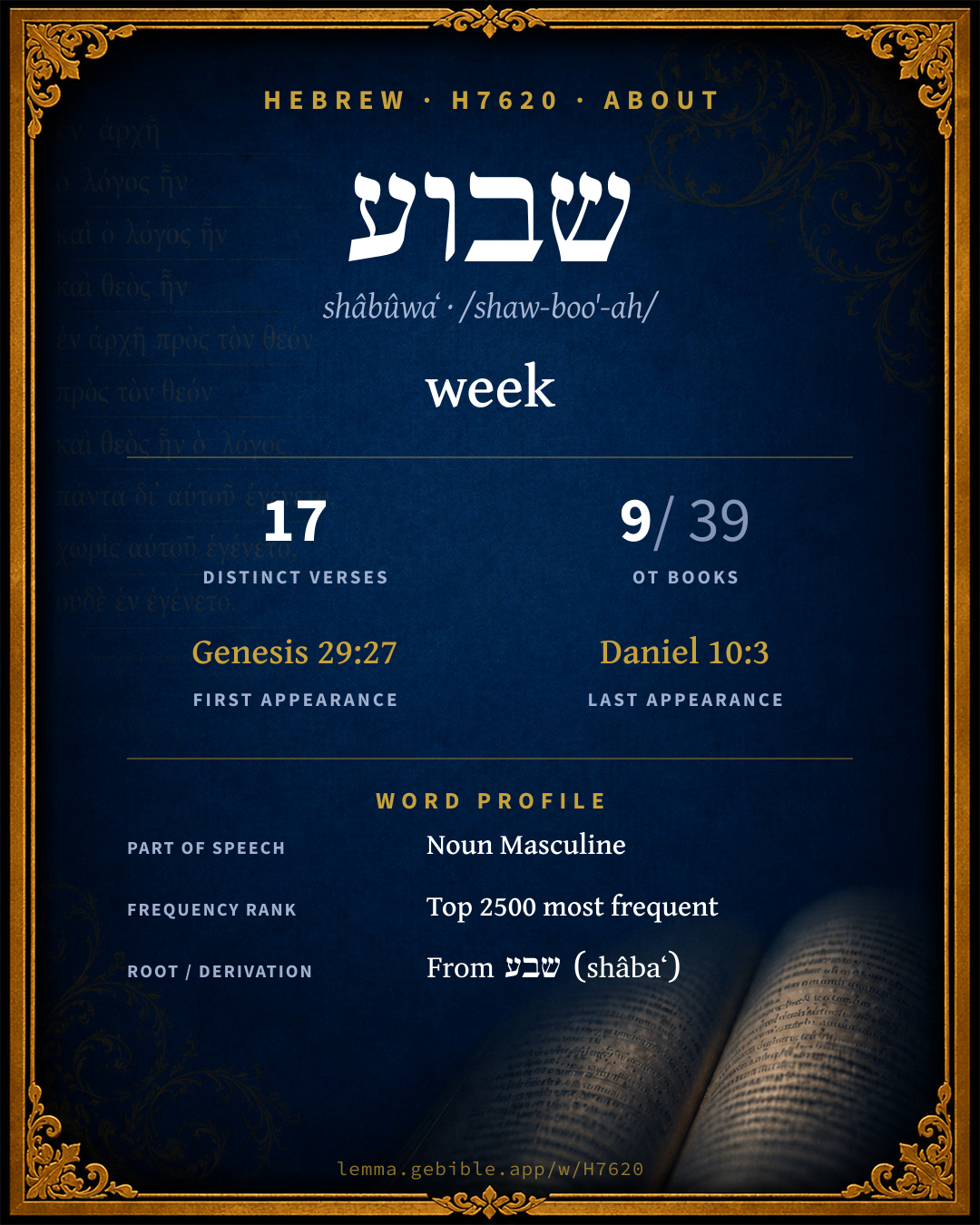
שָׁבוּעַ
week
also: seven, period of seven, heptad fuller range ↓
Full lexicon entry — Brown-Driver-Briggs (BDB)
From Brown-Driver-Briggs (BDB)
Where this word appears
See every Absolute-state word in the Hebrew Bible →
Grammar key — what these labels mean
Part of speech
- Noun
- A naming word — a person, place, thing, or idea.
Noun type
- Common
- A common noun — a general class of person, place, or thing (“king,” “city,” “water”), not a specific name.
State
- Absolute
- The independent form of a noun, not bound to a following word.
- Construct
- A noun bound to a following noun in a possessive / “of” relationship (the construct chain).
Gender
- Masculine
- Grammatically masculine.
Number
- Plural
- More than one (in Hebrew, generally three or more).
- Singular
- One.
- Dual
- Exactly two — for natural pairs and some measures of time.
Grammatical forms
- Noun, Common, Masculine, Plural, Absolute 12 times (60%)
- Noun, Common, Masculine, Plural, Construct 3 times (15%)
- Noun, Common, Masculine, Singular, Absolute 3 times (15%)
- Noun, Common, Masculine, Dual, Absolute 1 time (5%)
- Noun, Common, Masculine, Singular, Construct 1 time (5%)
Parsed forms decoded from the imported morphology (morphhb / Westminster Leningrad Codex — WLC text public domain, morphhb tagging CC BY 4.0), counted across 20 parsed occurrences — not distinct verses.
Every verse where H7620 appears — 17 distinct verses across 9 books. Click any verse to open its interlinear word-by-word view. Verse text shown in the World English Bible for context — . Each verse’s Hebrew form is shown with its reference; the English is not keyword-highlighted, since the data carries no word-level English alignment. Use “Compare translations” on any verse to read it across multiple English versions. This concordance covers the Hebrew Bible; Septuagint (Greek Old Testament) occurrences are not indexed here.
Genesis 2 verses
Exodus 1 verse
Leviticus 1 verse
Numbers 1 verse
Deuteronomy 3 verses
- Deuteronomy 16:9 שָׁבֻעֹ֖ת שָׁבֻעֽוֹת n c mp n c mp Seven weeks shall you number to you: from the time you begin to put the sickle to the standing grain shall you begin to number seven weeks.
- Deuteronomy 16:10 שָׁבֻעוֹת֙ n c mp You shall keep the feast of weeks to Yahweh your God with a tribute of a freewill-offering of your hand, which you shall give, according as Yahweh your God blesses you:
- Deuteronomy 16:16 הַ/שָּׁבֻע֖וֹת ptcl def.art + n c mp Three times in a year shall all your males appear before Yahweh your God in the place which he shall choose: in the feast of unleavened bread, and in the feast of weeks, and in the feast of tents; and they shall not appear before Yahweh empty:
2 Chronicles 1 verse
Jeremiah 1 verse
Ezekiel 1 verse
Daniel 6 verses
- Daniel 9:24 שָׁבֻעִ֨ים n c mp Seventy weeks are decreed on your people and on your holy city, to finish disobedience, and to make an end of sins, and to make reconciliation for iniquity, and to bring in everlasting righteousness, and to seal up vision and prophecy, and to anoint the most holy.
- Daniel 9:25 שָׁבֻעִ֖ים וְ/שָׁבֻעִ֞ים n c mp conj + n c mp Know therefore and discern, that from the going forth of the commandment to restore and to build Jerusalem to the Anointed One, the prince, shall be seven weeks, and sixty-two weeks: it shall be built again, with street and moat, even in troubled times.
- Daniel 9:26 הַ/שָּׁבֻעִים֙ ptcl def.art + n c mp After the sixty-two weeks the Anointed One shall be cut off, and shall have nothing: and the people of the prince who shall come shall destroy the city and the sanctuary; and the end of it shall be with a flood, and even to the end shall be war; desolations are determined.
- Daniel 9:27 שָׁב֣וּעַ הַ/שָּׁב֜וּעַ n c ms ptcl def.art + n c ms He shall make a firm covenant with many for one week: and in the midst of the week he shall cause the sacrifice and the offering to cease; and on the wing of abominations [shall come] one who makes desolate; and even to the full end, and that determined, shall [wrath] be poured out on the desolate.
- Daniel 10:2 שָׁבֻעִ֖ים n c mp In those days I, Daniel, was mourning three whole weeks.
- Daniel 10:3 שָׁבֻעִ֖ים n c mp I ate no pleasant bread, neither came flesh nor wine into my mouth, neither did I anoint myself at all, until three whole weeks were fulfilled.
About this entry
At a glance — auto-summarized from this page’s data, not written by a person. Every figure links to its source below. This summary describes the numbers; it doesn’t interpret them.
At its core, שבוע (shâbûwaʻ) means “week.” Scripture first uses it in Genesis 29:27. It appears 17 verses across 9 books of the Hebrew Bible, among its uncommon vocabulary. The word gravitates to Daniel (35%), then Deuteronomy and Genesis. Beyond its headline sense, its full sense range takes in “seven”, “period of seven”, and “heptad”. Each statement above links to its evidence; the full detail follows below.
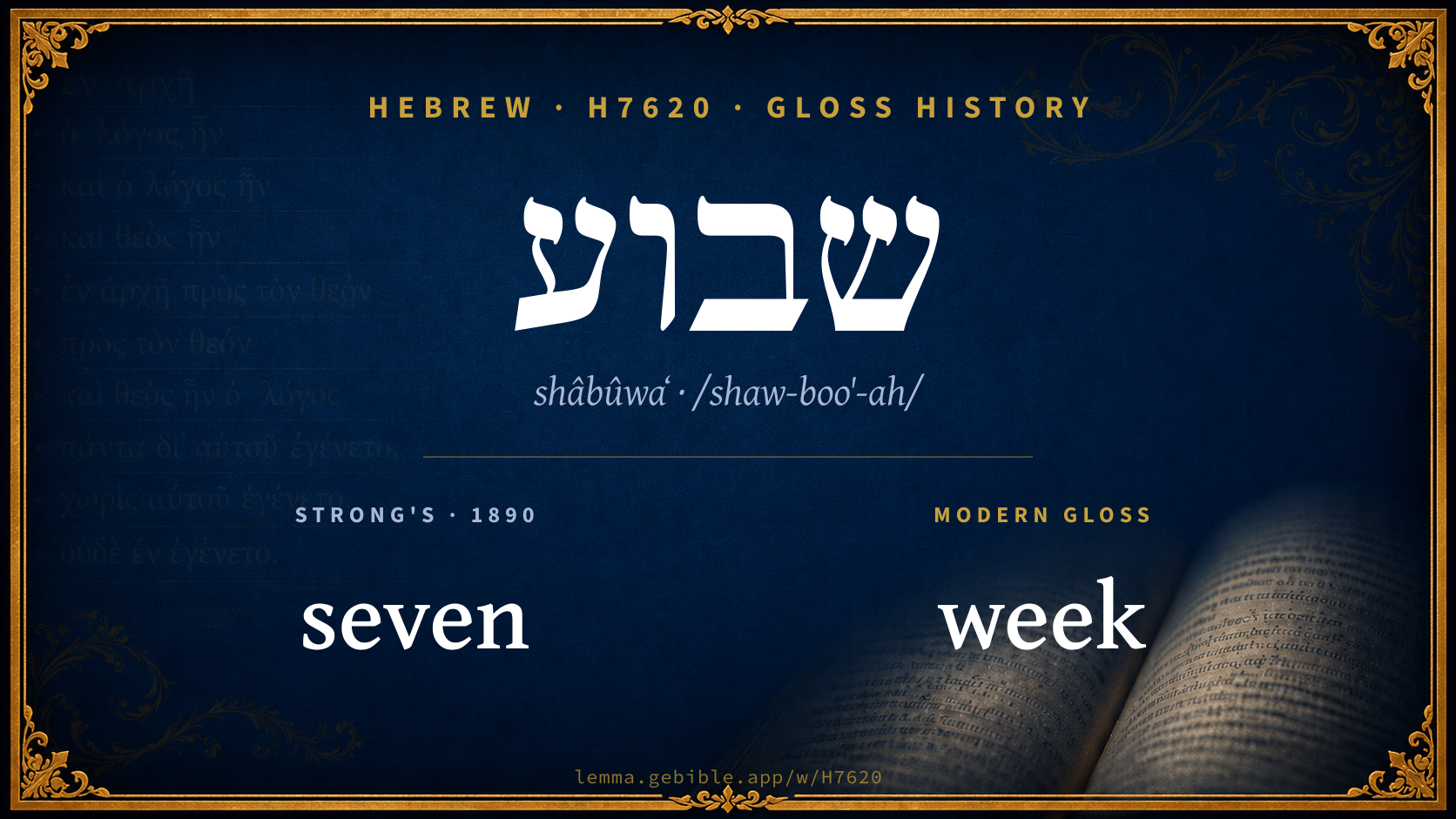
Gloss history
Strong's 1890 vs modern scholarship
About this word
Strong's H7620 catalogs a Hebrew word from the Hebrew Old Testament.
These counts are not copied from any lexicon or concordance. They are computed here, from the morphology-tagged Hebrew Old Testament. What Lemma adds →
- 17
- distinct verses
- The word appears in 17 distinct verses.
- 9 / 39
- OT books
- The word appears in 9 of 39 Old Testament books.
- #1,513
- by frequency
- Top 2500 most frequent Hebrew words (rank 1,513 of 8,640 Hebrew words by occurrence).
View all 17 occurrences in the concordance →
Most concentrated in
- Daniel 6 verses 35%
- Deuteronomy 3 verses 18%
- Genesis 2 verses 12%
By section of the Old Testament
By traditional corpus
Conventional, traditional groupings — biblical authorship is debated, so this is a traditional corpus grouping, not an authorship claim. Each share is this word’s portion of its verses in that division of the Hebrew canon. Each figure is a share of the word’s 17 distinct verses.
- Torah (Pentateuch) 8 verses · 47%
- Writings (Ketuvim) 7 verses · 41%
- Prophets (Nevi'im) 2 verses · 12%
How translations render this word
Counts come from each version’s own published word-to-Strong’s tagging or interlinear alignment — an approximate guide to how each version renders this word, not a word-level alignment the data otherwise carries. Because each total is that version’s own tagged count, the per-version totals vary from one another and need not match the appearance or distinct-verse counts above. These counts may also differ from a printed concordance because Lemma counts each distinctly tagged rendering and does not collapse phrase taggings into a single head-word total. This is a fixed set of word-tagged versions (KJV, ASV, BSB, ULT) and does not change with the reading translation you choose elsewhere. Each version’s license is shown beside its name below (and on Sources).
- King James Version: Weeks 13×, Week 4×
- American Standard Version: Weeks 13×, Week 3×
- Berean Standard Bible: Weeks 12×, Week 2×, Week’s celebration 2×
- unfoldingWord Literal Text: Weeks 8×, Sevens 4×, For 2×
King James Version Public Domain
Renders H7620 across 20 tagged occurrences — most commonly:
Plus 3 renderings that appear only once — usually multi-word phrases or single function words the recovered tagging swept in, not distinct renderings.
American Standard Version Public Domain
Renders H7620 across 20 tagged occurrences — most commonly:
Plus 4 renderings that appear only once — usually multi-word phrases or single function words the recovered tagging swept in, not distinct renderings.
Berean Standard Bible Public Domain
Renders H7620 across 19 tagged occurrences — most commonly:
Plus 3 renderings that appear only once — usually multi-word phrases or single function words the recovered tagging swept in, not distinct renderings. Not rendered by a distinct English word in 1 further occurrence.
unfoldingWord Literal Text CC BY-SA 4.0
Renders H7620 across 26 tagged occurrences — most commonly:
Plus 8 renderings that appear only once — usually multi-word phrases or single function words the recovered tagging swept in, not distinct renderings.
Senses in the full BDB
What do BDB’s symbols mean?
BDB uses these scholarly abbreviations:
| Symbol | Meaning |
|---|---|
| 𝔊 | the Septuagint (the ancient Greek translation, LXX) |
| 𝔙 | the Vulgate (the Latin translation) |
| 𝔖 | the Syriac version (the Peshitta) |
| 𝔗 | the Targum (the Aramaic translation) |
| ψ | the Psalms |
| √ | root (the underlying root or stem) |
| ‖ | parallel passage (a synonymous or contrasted parallel) |
| † | the dagger: every passage where the word occurs is cited |
The 2 senses and sub-senses the full Brown-Driver-Briggs lexicon distinguishes for this word, in lexicon order (not ranked by frequency), with BDB’s own verbatim wording and sub-sense lettering. Shown in Hebrew script with BDB’s own scholarly abbreviations. The condensed entry is in the Lexicon Entry tab. See also the Forms in the corpus table below.
- 1. period of seven days (from a given time), week: Dt 16:9(×2); Lv 12:5 (P); of marriage feast Gn 29:27, 28 (E; cf. Ju 14:12 Tob 11:19); שָׁבֻעִים יָמִים Dn 10:2, 3 three weeks, days (three weeks long); שׁ׳ חֻקּוֹת קָצִיר Je 5:24 weeks of statutes (i.e. weeks appointed by י׳) for harvest; term. techn. חַג שָֽׁבֻעֹת Ex 34:22 (J) feast of weeks (ending seven weeks of harvest), Dt 16:10, 16, 2 Ch 8:13, so שׁ׳ alone Nu 28:26 (P). e.g. Deuteronomy 16:9
- 2. heptad or seven of years, late, Dn 9:24, 25, 26, 27(×2).—שְׁבֻעֵי שְׁבֻעוֹת Ez 21:28 v. [שָׁבַע]. e.g. Daniel 9:24
Senses from the full Brown-Driver-Briggs lexicon (Brown, Driver, Briggs; Oxford 1906 — public domain), digitized via Sefaria, supplemented by the OpenScriptures HebrewLexicon (CC BY 4.0). Full attribution on Sources.
Word origin
n.m. Dn 9:27 period of seven (days, years), heptad, week (on format. v. LagBN 67);—abs. שׁ׳ Dn 9:27(×2); cstr. שְׁבֻעַ Gn 29:27, 28; du. שְׁבֻעַיִם Lv 12:5; pl. שָֽׁבֻע(וֹ)ת Ex 34:22 + 4 times Dt + (in term. techn.) 2 Ch 8:13; late שָֽׁבֻעִים Dn 9:24 + 4 times Dn; cstr. שְׁבֻעֹת Je 5:24 (Ez 45:21 read שִׁבְעַת with Vrss and all mod., v. שֶׁבַע); sf. שָׁבֻעֹתֵיכֶם Nu 28:26;—
— Brown-Driver-Briggs (Oxford 1906, public domain), digitized via Sefaria, supplemented by the OpenScriptures HebrewLexicon (CC BY 4.0). See Sources.
Derived from שבע (shâbaʻ) (H7650) — to swear.
Jastrow Dictionary
A second Hebrew/Aramaic lexicon for comparison, covering Aramaic and post-biblical (Talmudic, Targumic, Midrashic) usage that the biblical-Hebrew BDB does not. Matched by lemma rather than by Strong’s number, so a lemma may carry more than one Jastrow headword (shown separately below), and the entries cover usage well beyond the Bible.
שָׁבוּעַ
- 1. a period of seven days, week.—שְׁבוּעַ הַבֵּן, v. בֵּן.—Pl. שָׁבוּעוֹת. Lev. R. s. 28 שבע ש׳ שבין וכ׳ the seven weeks between Passover and the Feast of Weeks; a. e.
- 2. “year-week”, a period of seven years, septennate (the jubilee being divided into seven septennates); also the seventh year, Sabbatical year. Snh. V, 1, v. חֲקִירָה. Gitt. 77ᵃ לאחר ש׳ שנה if a person says, ‘give my wife a letter of divorce (or to his wife, ‘be thou divorced’), if I do not come back after the septennate’, we must wait one year (after the Sabbatical year). Ned. VIII, 1 ש׳ זה אסור בכל הש׳ וכ׳ (not השבועה) if a person, during a Sabbatical year, vows abstinence, using the word ‘this shabu‘aʾ, he is bound the entire coming septennial period and the seventh year of the expiring Sabbatical period. Ib. ש׳ אחד אסור וכ׳ but if he says, ‘one septennate’, he is bound from date to date, i.e. counting seven years from the day of the vow; a. fr.—Pl. as ab. Y. Sabb. X, 17ᵃ top אי אפשר לשני ש׳ שלא חל וכ׳ it is not possible that during fourteen years the fourteenth day of Nisan should not occur on a Sabbath; Y. Pes. VI, 33ᵃ bot. לשני שביעית שיחול (corr. acc.).
A Dictionary of the Targumim, the Talmud Babli and Yerushalmi, and the Midrashic Literature (Marcus Jastrow; London, Luzac, 1903) — Public Domain. Digitized via Sefaria. Digitized via Sefaria. Full attribution on Sources.
Forms in the corpus
The 16 distinct written forms H7620 takes in the Hebrew Bible, most frequent first — each parse links to that state’s occurrences in the concordance. Hebrew forms include their vowel points and cantillation, so a single lemma takes many written forms.
Same root — word family
Other BDB entries built from the same root as H7620, grouped by Strong’s listed origin. These share a root / origin per the lexicon — not necessarily a shared meaning. Each links to that word’s own entry.
Derives from
Shares the same root
Proper names from this root
People and places named from this root — a name, not an additional meaning of the word.
Compare all same-root words → Showing 4 of 5 — not the complete family. 1 of the same-root words is a proper name (a person or place). They share a root, not necessarily a meaning.
Septuagint verse parallels
This word appears in 17 verses that also exist in the Greek Old Testament (Septuagint), out of the 17 Hebrew verses it occurs in. You can read those verses in Greek by switching the Old Testament edition to the Septuagint.
Read these verses in the Septuagint
- Genesis 29:27
- Exodus 34:22
- Leviticus 12:5
- Numbers 28:26
- Deuteronomy 16:9
- 2 Chronicles 8:13
- Jeremiah 5:24
- Ezekiel 45:21
- Daniel 9:24
This is a verse-level parallel only — the same verses exist in both the Hebrew and Greek Old Testaments. No word-level Hebrew↔Greek correspondence is claimed: the data carries no such alignment, so no Greek word is shown as this Hebrew word’s translation. Coverage is not total — the Septuagint omits the deuterocanon and renumbers the Psalms, so some Hebrew verses have no direct Greek parallel.