
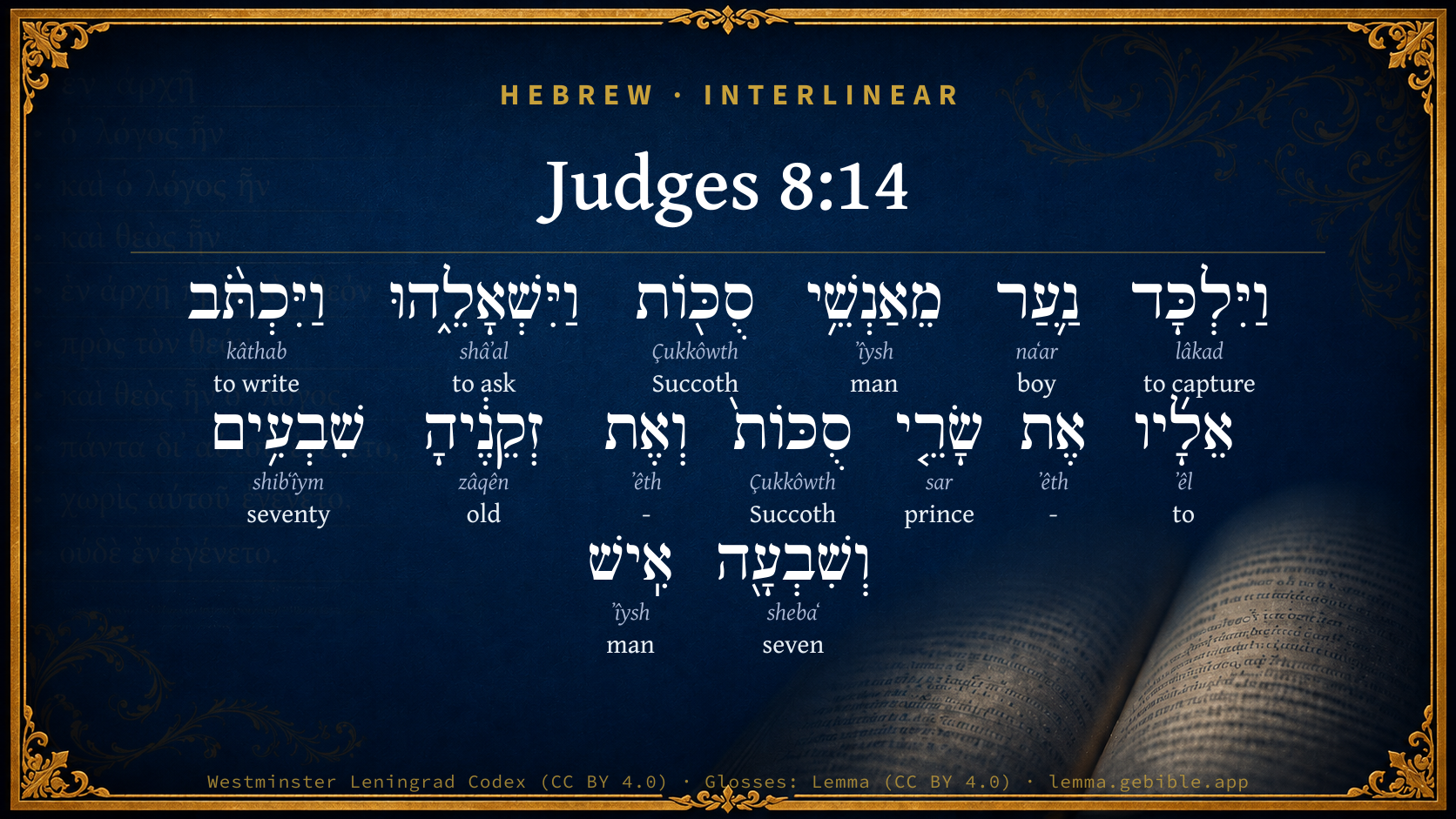
Judges 8:14

Hebrew (Westminster Leningrad Codex) Judges 8:14 appears in the Hebrew Old Testament. The text above is from the Westminster Leningrad Codex. Each word links to its Strong’s number, a concise gloss, and parsing drawn from the Open Scriptures Hebrew Bible morphology. Click any word for its full Brown-Driver-Briggs (BDB) entry.
Download image
Cite this verse

Judges 8:14 (World English Bible). Public Domain. Lemma interlinear Bible study tool, https://lemma.gebible.app/v/judges/8/14.

Show BibTeX & RIS
BibTeX
RIS
English Translation
He caught a young man of the men of Succoth, and inquired of him: and he described for him the princes of Succoth, and the elders of it, seventy-seven men.
World English Bible · Public Domain
Download a study sheet

One document with this verse’s original text, its word-by-word gloss line, the meaning frame, cross-references with their text, attributed commentary, and full source and license credits — printable, and it pastes into notes with its structure intact.

This verse Autodidact and up

Study sheet (.html) Plain text (.txt)

A passage Seminary Student

Up to 50 verses in one chapter. A passage sheet keeps up to 6 commentary sources and 12 cross-references per verse, in the order this page ranks them, and says so on the sheet whenever that leaves anything out. Ask for a single verse and you get the Autodidact verse sheet above.

Everything on this page stays free to read, with no account — the sheet is a download of what is already on screen, not access to it.

Want to remove ads? Support Godless Engineer
Compare translations 3

The same verse in 3 English versions, stacked beneath the original-language interlinear above. Click any original word for its lexicon entry.

Each is an independent rendering of the whole verse — the interlinear is not word-aligned to these translations.

Highlighted words mark where these versions differ — a whole-verse word diff, not a word-by-word alignment.

  • World English Bible Public Domain
    He caught a young man of the men of Succoth, and inquired of him: and he described for him the princes of Succoth, and the elders of it, seventy-seven men.
  • King James Version Public Domain
    And caught a young man of the men of Succoth, and inquired of him: and he described unto him the princes of Succoth, and the elders thereof, even threescore and seventeen men.
  • unfoldingWord Literal Text CC BY-SA 4.0
    And he captured a youth from the men of Succoth and he questioned him. And he wrote for him the leaders of Succoth and its elders, 77 men.

unfoldingWord Literal Text — © unfoldingWord, licensed CC BY-SA 4.0. Word-aligned USFM3 via Door43 (git.door43.org/unfoldingWord/en_ult).

Versions to compare (up to 4)

3 of 4 selected

Show all 18 translations

Every available English version of this verse, each an independent rendering of the whole verse.

  • World English Bible Public Domain
    He caught a young man of the men of Succoth, and inquired of him: and he described for him the princes of Succoth, and the elders of it, seventy-seven men.
  • Berean Standard Bible Public Domain
    There he captured a young man of Succoth and interrogated him. The young man wrote down for him the names of the seventy-seven leaders and elders of Succoth.
  • Majority Standard Bible Public Domain
    There he captured a young man of Succoth and interrogated him. The young man wrote down for him the names of the seventy-seven leaders and elders of Succoth.
  • King James Version Public Domain
    And caught a young man of the men of Succoth, and inquired of him: and he described unto him the princes of Succoth, and the elders thereof, even threescore and seventeen men.
  • American Standard Version (1901) Public Domain
    And he caught a young man of the men of Succoth, and inquired of him: and he described for him the princes of Succoth, and the elders thereof, seventy and seven men.
  • Revised Version (1885) Public Domain
    And he caught a young man of the men of Succoth, and inquired of him: and he described for him the princes of Succoth, and the elders thereof, seventy and seven men.
  • Geneva Bible (1599) Public Domain
    And tooke a seruant of the me of Succoth, and inquired of him: and he wrote to him the princes of Succoth and the Elders thereof, euen seuentie and seuen men.
  • Douay-Rheims (1899) Public Domain
    He took a boy of the men of Soccoth: and he asked him the names of the princes and ancients of Soccoth, and he described unto him seventy-seven men.
  • Young's Literal Translation Public Domain
    and captureth a young man of the men of Succoth, and asketh him, and he describeth unto him the heads of Succoth, and its elders -- seventy and seven men.
  • Literal Standard Version CC BY-SA 4.0
    and captures a young man of the men of Succoth, and asks him, and he describes to him the heads of Succoth, and its elderly—seventy-seven men.
  • Unlocked Literal Bible CC BY-SA 4.0
    He caught a young man of Succoth and questioned him. The young man wrote down the names of seventy-seven officials and elders of Succoth.
  • unfoldingWord Literal Text CC BY-SA 4.0
    And he captured a youth from the men of Succoth and he questioned him. And he wrote for him the leaders of Succoth and its elders, 77 men.
  • Darby Bible Public Domain
    And he caught a young man of Succoth, and questioned him; and he wrote down for him the officials and elders of Succoth, seventy-seven men.
  • World Messianic Bible Public Domain
    He caught a young man of the men of Succoth, and inquired of him; and he described for him the princes of Succoth, and its elders, seventy-seven men.
  • Webster's Bible Public Domain
    And caught a young man of the men of Succoth, and inquired of him: and he described to him the princes of Succoth, and its elders, even seventy seven men.
  • Free Bible Version CC BY-SA 4.0
    There he captured a young man from Succoth and questioned him. The man wrote down for him the names of the seventy-seven leaders and elders of Succoth.
  • Bible in Basic English Public Domain
    And taking prisoner a young man of the people of Succoth, he got from him, in answer to his questions, a list of the chiefs of Succoth and the responsible men, seventy-seven men.
  • JPS Tanakh (1917) Public Domain
    And he caught a young man of the men of Succoth, and inquired of him; and he wrote down for him the princes of Succoth, and the elders thereof, seventy and seven men.

Literal Standard Version (2020), Covenant Press — licensed CC BY-SA 4.0. Text via the HelloAO Bible API (eBible.org). Unlocked Literal Bible (unfoldingWord) — licensed CC BY-SA 4.0. Text via the HelloAO Bible API (eBible.org). unfoldingWord Literal Text — © unfoldingWord, licensed CC BY-SA 4.0. Word-aligned USFM3 via Door43 (git.door43.org/unfoldingWord/en_ult). Free Bible Version, Dr. Jonathan Gallagher — licensed CC BY-SA 4.0. Text via the HelloAO Bible API (eBible.org).

Word by word

More ways to search: Search by grammar → Find every occurrence → Compare this word →

Practice this passage: Drill this verse → Learn its vocabulary →

סֻכּ֖וֹת
Çukkôwth
H5523
“Succoth”
Noun, Proper
Part of Speech
Noun
Type
Proper
Full BDB Definition

Origin: from H5521

TWOT: 1492e

Succoth = "booths" - the site where Jacob put up booths for his cattle and built a house for himself; apparently east of the Jordan near the ford of the torrent Jabbok and later allotted to the tribe of Gad - the 1st stopping place of the Israelites when they left Egypt
  1. וַיִּלְכָּד lâkad H3920 “and · to capture” Conjunction + Verb, Qal, Sequential Imperfect, 3rd Person, Masculine, Singular
  2. נַ֛עַר naʻar H5288 “boy” Noun, Common, Masculine, Singular, Absolute
  3. מֵאַנְשֵׁ֥י ʼîysh H376 “from · men of” Preposition + Noun, Common, Masculine, Plural, Construct
  4. וַיִּשְׁאָלֵ֑הוּ shâʼal H7592 “and · to ask · him” Conjunction + Verb, Qal, Sequential Imperfect, 3rd Person, Masculine, Singular + Suffix, Personal, 3rd Person, Masculine, Singular
  5. וַיִּכְתֹּ֨ב kâthab H3789 “and · to write” Conjunction + Verb, Qal, Sequential Imperfect, 3rd Person, Masculine, Singular
  6. אֵלָ֜יו ʼêl H413 “to · him” Preposition + Suffix, Personal, 3rd Person, Masculine, Singular
  7. אֶת ʼêth H853 “-” Particle, Direct Object
  8. שָׂרֵ֤י sar H8269 “princes of” Noun, Common, Masculine, Plural, Construct
  9. סֻכּוֹת֙ Çukkôwth H5523 “Succoth” Noun, Proper
  10. וְאֶת ʼêth H853 “and · -” Conjunction + Particle, Direct Object
  11. זְקֵנֶ֔יהָ zâqên H2205 “old · her” Adjective, Adjective, Masculine, Plural, Construct + Suffix, Personal, 3rd Person, Feminine, Singular
  12. שִׁבְעִ֥ים shibʻîym H7657 “seventy” Adjective, Cardinal number, Both, Plural, Absolute
  13. וְשִׁבְעָ֖ה shebaʻ H7651 “and · seven” Conjunction + Adjective, Cardinal number, Masculine, Singular, Absolute
  14. אִֽישׁ ʼîysh H376 “man” Noun, Common, Masculine, Singular, Absolute

About this verse

These counts appear in no published source. They are computed here, from the morphology-tagged text and Lemma’s own curated glosses. What Lemma adds →

15
words
12
distinct lemmas
Historical
section

Notable vocabulary

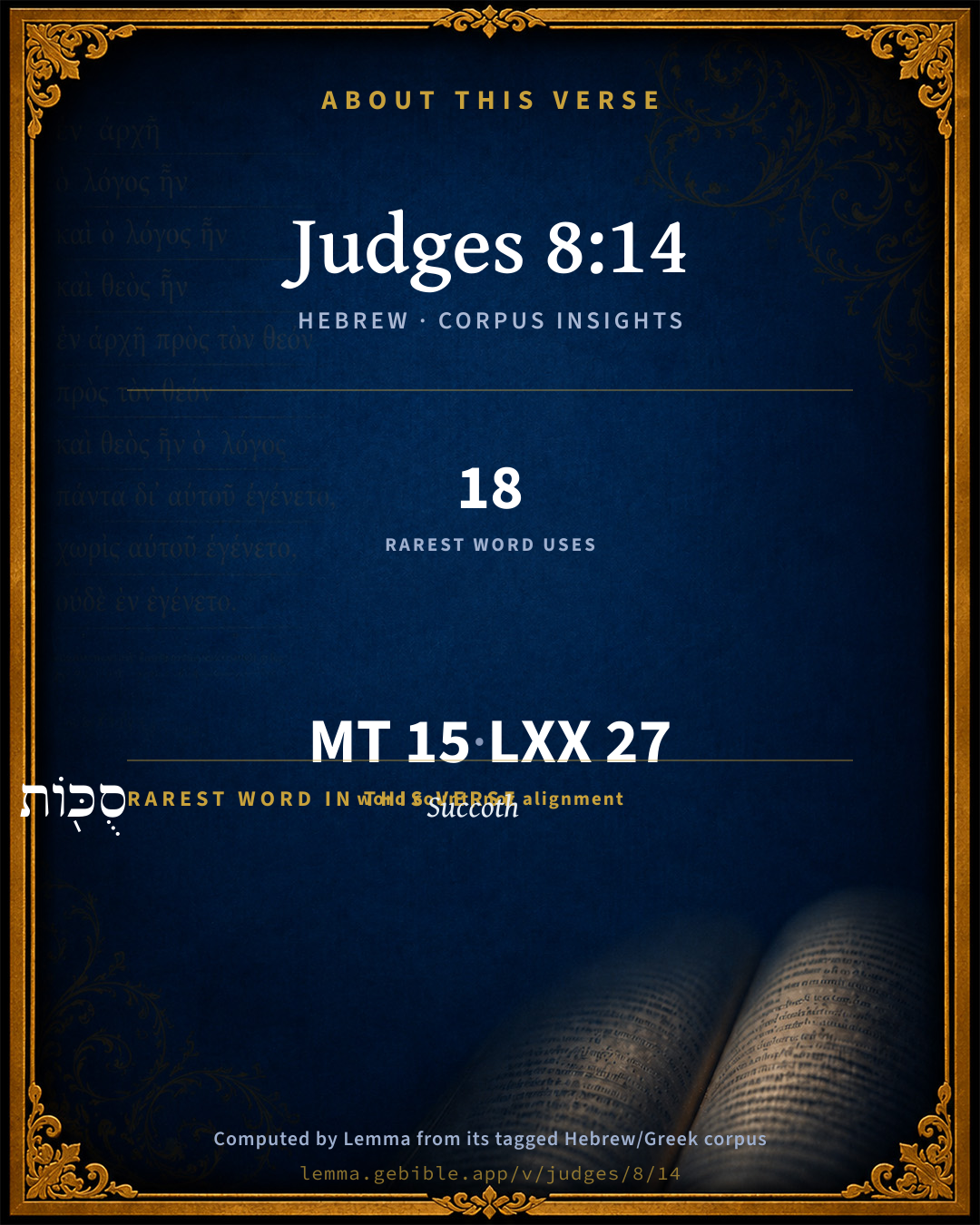
The rarest word here is סֻכּ֖וֹת Succoth H5523 — appearing just 18 times in the whole Hebrew Bible.

Shared distinctive vocabulary

סֻכּ֖וֹת Succoth H5523 occurs in 16 verses of the Hebrew Bible. Also found in:

Grammatical profile

  • 3 verbs
  • 6 nouns
  • 3 adjectives
  • 1 preposition
  • 2 particles

Verb forms

  • וַיִּלְכָּד Qal · Sequential Imperfect
  • וַיִּשְׁאָלֵ֑הוּ Qal · Sequential Imperfect
  • וַיִּכְתֹּ֨ב Qal · Sequential Imperfect

Repetition

Words recur within this verse — often emphatic in Hebrew:

  • מֵאַנְשֵׁ֥י man H376 ×2
  • סֻכּ֖וֹת Succoth H5523 ×2

Hebrew & Septuagint length

In English translation the verse runs 30 words from the Hebrew and 33 from the Septuagint (LXX English) — closely comparable.

A rough comparison of the two English renderings, which tokenize alike — not a word-level alignment.

Word counts can differ between the Hebrew and the Greek without any difference in meaning — e.g. the Hebrew direct-object marker אֵת has no separate Greek word, and Greek often adds the article ὁ.

In the original languages it is 15 Hebrew tokens and 27 Greek tokens — but the two are counted differently (Hebrew bundles its prefixes and suffixes into one token; the Greek is in lemma form), so that isn’t a like-for-like length.

Cross-references

2

Topical passages linked to Judges 8:14 in the Treasury of Scripture Knowledge — connected by theme and wording, ordered by reader-vote popularity; previews shown in the World English Bible.

  • Judges 1:24–25 The watchers saw a man come forth out of the city, and they said to him, Show us, we pray you, the entrance into the city, and we will deal kindly with you.
  • 1 Samuel 30:11–15 They found an Egyptian in the field, and brought him to David, and gave him bread, and he ate; and they gave him water to drink.

Cross-references courtesy of OpenBible.info (CC BY 4.0).

Hebrew and Greek witnesses Masoretic Hebrew ↔ Greek Septuagint

The same verse in the two great witnesses to the Old Testament, shown verse-for-verse.

These are two independent witnesses, not word-aligned to each other, and the Septuagint is shown in lemma (dictionary) form.

Hebrew Judges 8:14 Masoretic · Westminster Leningrad Codex

וַיִּלְכָּד נַ֛עַר מֵאַנְשֵׁ֥י סֻכּ֖וֹת וַיִּשְׁאָלֵ֑הוּ וַיִּכְתֹּ֨ב אֵלָ֜יו אֶת שָׂרֵ֤י סֻכּוֹת֙ וְאֶת זְקֵנֶ֔יהָ שִׁבְעִ֥ים וְשִׁבְעָ֖ה אִֽישׁ

He caught a young man of the men of Succoth, and inquired of him: and he described for him the princes of Succoth, and the elders of it, seventy-seven men.

World English Bible · Public Domain

Greek LXX Judges 8:14 Septuagint · lemma form

καί συνλαμβάνω παιδάριον ἀπό ὁ ἀνήρ σοκχωθ καί ἐπιἐρωτάω αὐτός καί γράφω πρός αὐτός ὁ ὄνομα ὁ ἄρχων σοκχωθ καί ὁ πρεσβύτερος αὐτός ἑβδομήκοντα καί ἑπτά ἀνήρ

And he took prisoner a young lad of the men of Socchoth, and questioned him; and he wrote to him the names of the princes of Socchoth and of their elders, seventy-seven men.

LXX2012 (modern English Septuagint) · Public Domain

On this verse, Ellicott's Commentary for English Readers discusses the Septuagint’s reading. Read the note in Commentary ↓

Hebrew: Westminster Leningrad Codex (CC BY 4.0). Greek: Septuagint (public domain); English from LXX2012 (modern English Septuagint) (Public Domain). How the Septuagint differs from the Hebrew →

Targum (Aramaic paraphrase)

1

The Targum is the ancient Jewish Aramaic paraphrase of the Hebrew Scriptures — an interpretive translation, not the Hebrew text itself. Onkelos (literal) and Pseudo-Jonathan (expansive) render the Torah, and Jonathan the Prophets. Coverage is partial: where no permissively-licensed English translation exists for a verse, only the Aramaic is shown. This is verse-level text, not a word-by-word alignment to the Hebrew.

  1. Targum Jonathan Prophets (Joshua–Malachi)
    וַאֲחַד עוּלֵימָא מֵאֱנָשֵׁי סֻכּוֹת וְשַׁאֲלֵיהּ וּכְתַב לֵיהּ יַת רַבְרְבֵי סֻכּוֹת וְיַת סָבָהָא שַׁבְעִין וְשִׁבְעָה גוּבְרִין:

    (no public-domain English translation for this verse)

    Targum Jonathan — Aramaic: “Mikraot Gedolot” (public domain). English: “Sefaria Community Translation” (CC0 1.0 (public-domain dedication)); “London "Chaldee Paraphrase," 1871” (public domain). Text via Sefaria.

Commentary

Notes on Judges 8:14 from classic Christian and Jewish commentators (each source and its license shown beneath its notes). The classic Christian expositions comment on the surrounding passage and are grouped to its opening verse, so a note may address several verses; the Jewish commentaries on the Tanakh (Rashi and others) are per-verse, so they appear only where the commentator wrote on this verse.

Lemma curates 59 commentaries, every one of them public domain or Creative Commons licensed, each selected and text-cleaned for this edition rather than reprinted as found. About our sources →

Trapp's Complete Commentary

John Trapp

Jdg 8:14 And caught a young man of the men of Succoth, and enquired of him: and he described unto him the princes of Succoth, and the elders thereof, [even] threescore and seventeen men.

Ver. 14. And he described unto him the princes.] Who had denied him refreshing in his pursuit of the enemy, and were therefore to be punished; though it is seldom seen that princes fall alone, since their sins do much harm, (I.) By imitation; (2.) By imputation: for pleotuntur Achivi, as 2Sa 24:1-25

John Trapp, A Commentary or Exposition upon All the Books of the Old and New Testament (1647–1656) — public domain. Text from a community e-Sword module.

Joseph Benson's Commentary

Jdg 8:14. He described unto him, &c. — Hebrews יכתב, jichtob, he wrote down, probably the names and dwellings, and perhaps also the qualities of the great men of the city, and of the judges, who were the persons that derided Gideon, and whom alone he intended to punish, and not all the people who were not guilty.

Joseph Benson's Commentary on the Old and New Testaments (1811–1818) — public domain. Text from a community e-Sword module.

Geneva Bible (1599)

Geneva Bible translators

Or, described.

Geneva Bible (1599) marginal notes — public domain. Text via Bolls.life.

Jamieson, Fausset & Brown

Robert Jamieson, A. R. Fausset & David Brown

he described--wrote the names of the seventy princes or elders. It was from them he had received so inhospitable a treatment.

Jamieson, Fausset & Brown — Commentary Critical and Explanatory on the Whole Bible (1871) — public domain (CC PDM 1.0). Text via the HelloAO Bible API.

Adam Clarke's Commentary

Verse 14. He described unto him the princes of Succoth] The young man probably gave him the names of seventy persons, the chief men of Succoth, who were those who were most concerned in refusing him and his men the refreshment he requested.

Adam Clarke's Commentary on the Bible (1810–1826) — public domain. Text from a community e-Sword/MySword module.

Ellicott's Commentary for English Readers

(14) Caught a young man.—Comp. Jdg_1:24.

Described.—Marg. writ, i.e.: the boy wrote down their names (LXX., apegrapsato; Vulg., descripsit).

Threescore and seventeen.—Perhaps a sort of local Sanhedrin of Seventy (Num_11:16), with their presiding sheykhs. The number shows that Succoth was a place of considerable importance.

A Bible Commentary for English Readers, edited by Charles John Ellicott (1878–1897) — public domain. Text from a community e-Sword module.

The Cambridge Bible for Schools and Colleges

gen. ed. J. J. S. Perowne

14. he described for him] he wrote down (and gave) unto him. The knowledge of writing must have been widely spread even at this early period. Cf. the similar incidents in Jdg_1:24 f.; 1Sa_30:11-16.

the elders] Cf. Jdg_8:16; the leading inhabitants and representatives of a district or city, e.g. Jdg_11:5-11; they constituted the local authority and transacted public business, e. g. 1Ki_21:8; 1Ki_21:11. Elders and princes—the latter perhaps the executive of the local authority—are mentioned together in 2Ki_10:1; Psa_105:22; Ezr_10:8; Ezr_10:14.

The Cambridge Bible for Schools and Colleges (gen. ed. J. J. S. Perowne; Cambridge University Press, 1878–1918) — public domain. Text from a community e-Sword module.

John Gill's Exposition

And caught a young man of the men of Succoth, and inquired of him,.... Just before he came to the city, he spied a young man which belonged to it, and laid hold on him, and inquired of him about the chief magistrates of the city, who they were, what their names, and their places of abode:

and he described unto him the princes of Succoth, and the elders thereof, even seventy seven men; by which it appears that this was no inconsiderable city to have so many princes and elders in it; these the young man described to Gideon, what sort of men they were, what their names, and where they dwelt: or "he wrote unto him" (y); wrote down their names, and what part of the city they dwelt in; or Gideon took down in writing for himself their names and places of abode from the young man, that he might not forget: and in this Gideon showed great wisdom, and strict justice; being desirous to punish only the delinquents, and not the innocent with the wicked, the people with their rulers; for though he asked bread of the men of Succoth, the answer was returned in the ill natured manner it was by the princes.

(y) "et scripsit ad eum", Montanus, Piscator; "et scripsit sibi", Pagninus, Munster; so some in Drusius.

John Gill's Exposition of the Whole Bible (1746–1763) — public domain (CC PDM 1.0). Text via the HelloAO Bible API.

Albert Barnes' Notes on the Bible

The written (see the margin) list would enable Gideon to punish the guilty and spare the innocent people. Succoth was governed by a sanhedrim or council of seventy elders (compare Num 11:16), with perhaps seven others of superior rank called princes.

Albert Barnes' Notes on the Bible (1834–1885) — public domain. Text from a community e-Sword/MySword module.

Matthew Poole's English Annotations

He told him their names and qualities.

Matthew Poole's English Annotations on the Holy Bible (1683–1685) — public domain. Text from a community e-Sword/MySword module.

Whedon's Commentary on the Bible

Daniel D. Whedon

14. Described unto him the princes — Literally, wrote for him the princes. The young man probably gave him the names of the chiefs and elders in writing, and all other necessary information.

Threescore and seventeen men — Succoth must have been an important city to have so many princes and elders.

Daniel D. Whedon (gen. ed.), Commentary on the Old and New Testaments (1874–1909) — public domain. Text from a community e-Sword module.

The Pulpit Commentary

He described. Rather, he wrote down, i.e. gave him a list of the princes and elders.

The Pulpit Commentary (1880–1919), ed. H.D.M. Spence-Jones & Joseph S. Exell — public domain. Text from a community e-Sword module.

John Wesley's Explanatory Notes

He described - He told him their names and qualities.

John Wesley, Explanatory Notes Upon the Whole Bible (1754–1765) — public domain. Text via the GEBible commentary corpus.

Lesson kit

Teaching starters — assembled from the data on this page, not authored interpretation. Every prompt links to the verse data it draws on. Edit before teaching.

Judges, in the Historical, opens this verse with 15 words (12 distinct Hebrew lemmas). Its most distinctive word is Çukkôwth (“Succoth”). A historical commentator’s framing appears above. Read the whole chapter for the surrounding context.

Discussion questions

  1. How does “Succoth” (Çukkôwth) shape what this verse is saying?
  2. How does Genesis 33:17, which shares the word «Succoth», read alongside this verse?
  3. What does the repetition of “man” (2× in this one verse) do in this verse?
  4. These translations render this verse differently; the difference is in the English rendering, not the original. What questions does that raise?
  5. «וַיִּלְכָּד» is a Qal Sequential Imperfect verb. How does that grammatical form shape the action described?
  6. Compare how Trapp's Complete Commentary and Joseph Benson's Commentary read this verse. Where do they agree or differ?

Things to notice

Reading settings

Reading text

Shown beneath each verse's original-language words.

Old Testament
Old Testament edition

Read the OT as the Masoretic Hebrew (MT) or the Greek Septuagint (LXX).

English shown for the Greek Septuagint (in the Hebrew ↔ Greek comparison).

Comparing translations? Open the Compare panel on any verse page to stack up to four side by side.