Joshua 18:2

Hebrew (Westminster Leningrad Codex) Joshua 18:2 appears in the Hebrew Old Testament. The text above is from the Westminster Leningrad Codex. Each word links to its Strong’s number, a concise gloss, and parsing drawn from the Open Scriptures Hebrew Bible morphology. Click any word for its full Brown-Driver-Briggs (BDB) entry.
Download image
Cite this verse

Joshua 18:2 (World English Bible). Public Domain. Lemma interlinear Bible study tool, https://lemma.gebible.app/v/joshua/18/2.

Show BibTeX & RIS
BibTeX
RIS
English Translation
There remained among the children of Israel seven tribes, which had not yet divided their inheritance.
World English Bible · Public Domain
Download a study sheet

One document with this verse’s original text, its word-by-word gloss line, the meaning frame, cross-references with their text, attributed commentary, and full source and license credits — printable, and it pastes into notes with its structure intact.

This verse Autodidact and up

Study sheet (.html) Plain text (.txt)

A passage Seminary Student

Up to 50 verses in one chapter. A passage sheet keeps up to 6 commentary sources and 12 cross-references per verse, in the order this page ranks them, and says so on the sheet whenever that leaves anything out. Ask for a single verse and you get the Autodidact verse sheet above.

Everything on this page stays free to read, with no account — the sheet is a download of what is already on screen, not access to it.

Want to remove ads? Support Godless Engineer
Compare translations 3

The same verse in 3 English versions, stacked beneath the original-language interlinear above. Click any original word for its lexicon entry.

Each is an independent rendering of the whole verse — the interlinear is not word-aligned to these translations.

Highlighted words mark where these versions differ — a whole-verse word diff, not a word-by-word alignment.

  • World English Bible Public Domain
    There remained among the children of Israel seven tribes, which had not yet divided their inheritance.
  • King James Version Public Domain
    And there remained among the children of Israel seven tribes, which had not yet received their inheritance.
  • unfoldingWord Literal Text CC BY-SA 4.0
    And seven tribes remained among the sons of Israel which they had not divided their inheritance.

unfoldingWord Literal Text — © unfoldingWord, licensed CC BY-SA 4.0. Word-aligned USFM3 via Door43 (git.door43.org/unfoldingWord/en_ult).

Versions to compare (up to 4)

3 of 4 selected

Show all 18 translations

Every available English version of this verse, each an independent rendering of the whole verse.

  • World English Bible Public Domain
    There remained among the children of Israel seven tribes, which had not yet divided their inheritance.
  • Berean Standard Bible Public Domain
    there were still seven tribes of Israel who had not yet received their inheritance.
  • Majority Standard Bible Public Domain
    there were still seven tribes of Israel who had not yet received their inheritance.
  • King James Version Public Domain
    And there remained among the children of Israel seven tribes, which had not yet received their inheritance.
  • American Standard Version (1901) Public Domain
    And there remained among the children of Israel seven tribes, which had not yet divided their inheritance.
  • Revised Version (1885) Public Domain
    And there remained among the children of Israel seven tribes, which had not yet divided their inheritance.
  • Geneva Bible (1599) Public Domain
    Nowe there remained among the children of Israel seuen tribes, to whom they had not deuided their inheritance.
  • Douay-Rheims (1899) Public Domain
    But there remained seven tribes of the children of Israel, which as yet had not received their possessions.
  • Young's Literal Translation Public Domain
    And there are left among the sons of Israel who have not shared their inheritance, seven tribes,
  • Literal Standard Version CC BY-SA 4.0
    And there are seven tribes left among the sons of Israel who have not shared their inheritance,
  • Unlocked Literal Bible CC BY-SA 4.0
    There were still seven tribes among the people of Israel whose inheritance had not been assigned.
  • unfoldingWord Literal Text CC BY-SA 4.0
    And seven tribes remained among the sons of Israel which they had not divided their inheritance.
  • Darby Bible Public Domain
    And there remained among the children of Israel seven tribes whose inheritance had not been distributed to them.
  • World Messianic Bible Public Domain
    Seven tribes remained among the children of Israel, which had not yet divided their inheritance.
  • Webster's Bible Public Domain
    And there remained among the children of Israel seven tribes, which had not yet received their inheritance.
  • Free Bible Version CC BY-SA 4.0
    However, seven of the Israelite tribes had not received their land allocations.
  • Bible in Basic English Public Domain
    But there were still seven tribes among the children of Israel who had not taken up their heritage.
  • JPS Tanakh (1917) Public Domain
    And there remained among the children of Israel seven tribes, which had not yet received their inheritance.

Literal Standard Version (2020), Covenant Press — licensed CC BY-SA 4.0. Text via the HelloAO Bible API (eBible.org). Unlocked Literal Bible (unfoldingWord) — licensed CC BY-SA 4.0. Text via the HelloAO Bible API (eBible.org). unfoldingWord Literal Text — © unfoldingWord, licensed CC BY-SA 4.0. Word-aligned USFM3 via Door43 (git.door43.org/unfoldingWord/en_ult). Free Bible Version, Dr. Jonathan Gallagher — licensed CC BY-SA 4.0. Text via the HelloAO Bible API (eBible.org).

Word by word

More ways to search: Search by grammar → Find every occurrence → Compare this word →

Practice this passage: Drill this verse → Learn its vocabulary →

חָלְק֖וּ
châlaq
H2505
“to divide”
Verb, Qal, Perfect, 3rd Person, Common, Plural
Part of Speech
Verb
Stem
Qal
Form
Perfect
Person
3rd Person
Gender
Common
Number
Plural
Full BDB Definition

Origin: a primitive root

TWOT: 669

to divide, share, plunder, allot, apportion, assign - (Qal) - to divide, apportion - to assign, distribute - to assign, impart - to share - to divide up, plunder - (Niphal) - to divide oneself - to be divided - to assign, distribute - (Piel) - to divide, apportion - to assign, distribute - to scatter - (Pual) to be divided - (Hiphil) to receive a portion or part - (Hithpael) to divide among themselves - to be smooth, slippery, deceitful - (Qal) to be smooth, slippery - (Hiphil) - to be smooth - to flatter
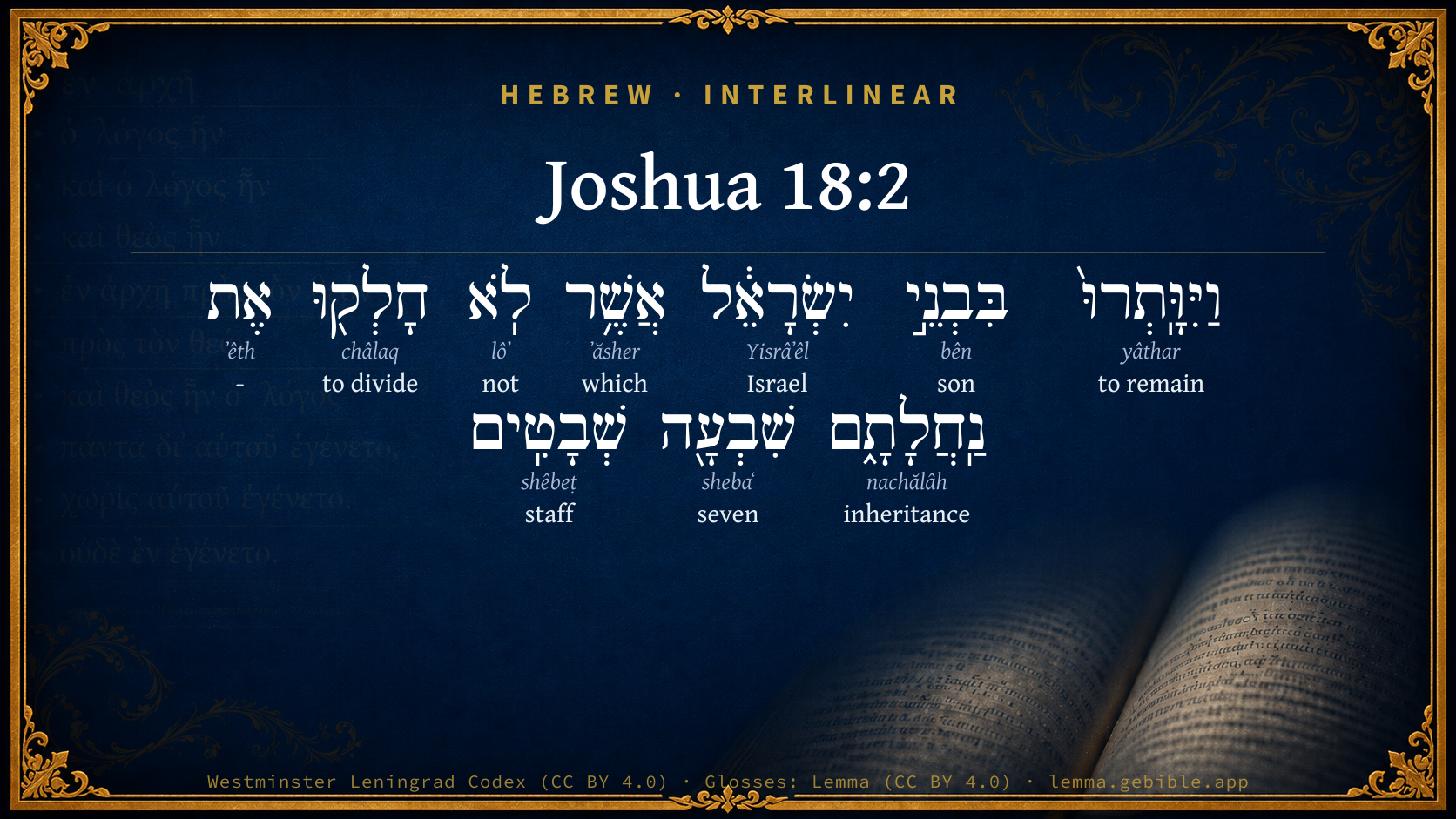
  1. וַיִּוָּֽתְרוּ֙ yâthar H3498 “and · to remain” Conjunction + Verb, Niphal, Sequential Imperfect, 3rd Person, Masculine, Plural
  2. בִּבְנֵ֣י bên H1121 “in/at · sons of” Preposition + Noun, Common, Masculine, Plural, Construct
  3. יִשְׂרָאֵ֔ל Yisrâʼêl H3478 “Israel” Noun, Proper
  4. אֲשֶׁ֥ר ʼăsher H834 “which” Particle, Relative
  5. לֹֽא lôʼ H3808 “not” Particle, Negative
  6. אֶת ʼêth H853 “-” Particle, Direct Object
  7. נַֽחֲלָתָ֑ם nachălâh H5159 “inheritance · their” Noun, Common, Feminine, Singular, Construct + Suffix, Personal, 3rd Person, Masculine, Plural
  8. שִׁבְעָ֖ה shebaʻ H7651 “seven” Adjective, Cardinal number, Masculine, Singular, Absolute
  9. שְׁבָטִֽים shêbeṭ H7626 “staffs” Noun, Common, Masculine, Plural, Absolute

About this verse

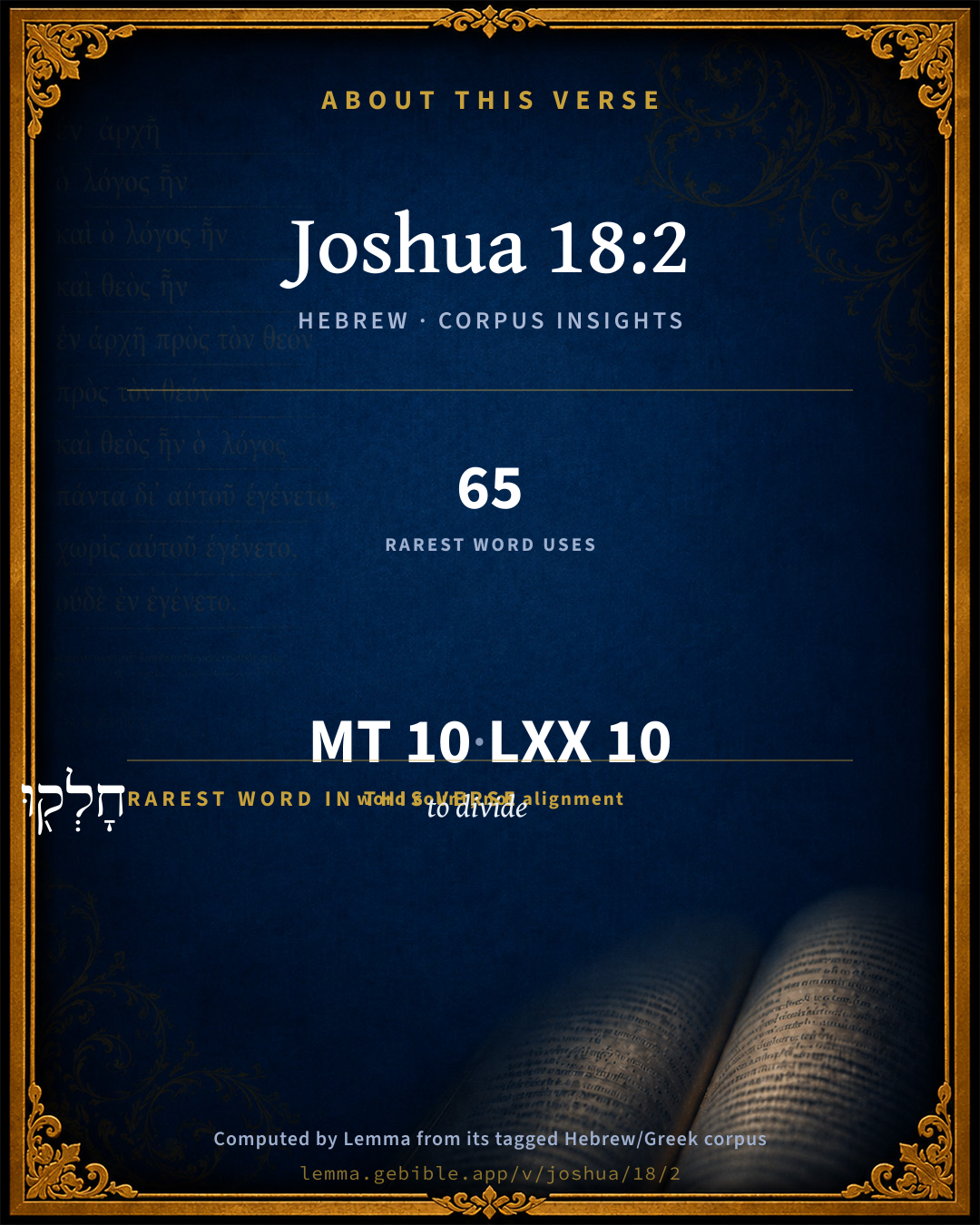
These counts appear in no published source. They are computed here, from the morphology-tagged text and Lemma’s own curated glosses. What Lemma adds →

10
words
10
distinct lemmas
Historical
section

Grammatical profile

  • 2 verbs
  • 4 nouns
  • 1 adjective
  • 3 particles

Verb forms

  • וַיִּוָּֽתְרוּ֙ Niphal · Sequential Imperfect
  • חָלְק֖וּ Qal · Perfect

Hebrew & Septuagint length

In English translation the verse runs 16 words from the Hebrew and 16 from the Septuagint (LXX English) — the same length.

A rough comparison of the two English renderings, which tokenize alike — not a word-level alignment.

Word counts can differ between the Hebrew and the Greek without any difference in meaning — e.g. the Hebrew direct-object marker אֵת has no separate Greek word, and Greek often adds the article ὁ.

In the original languages it is 10 Hebrew tokens and 10 Greek tokens — but the two are counted differently (Hebrew bundles its prefixes and suffixes into one token; the Greek is in lemma form), so that isn’t a like-for-like length.

Hebrew and Greek witnesses Masoretic Hebrew ↔ Greek Septuagint

The same verse in the two great witnesses to the Old Testament, shown verse-for-verse.

These are two independent witnesses, not word-aligned to each other, and the Septuagint is shown in lemma (dictionary) form.

Hebrew Joshua 18:2 Masoretic · Westminster Leningrad Codex

וַיִּוָּֽתְרוּ֙ בִּבְנֵ֣י יִשְׂרָאֵ֔ל אֲשֶׁ֥ר לֹֽא חָלְק֖וּ אֶת נַֽחֲלָתָ֑ם שִׁבְעָ֖ה שְׁבָטִֽים

There remained among the children of Israel seven tribes, which had not yet divided their inheritance.

World English Bible · Public Domain

Greek LXX Joshua 18:2 Septuagint · lemma form

καί καταλείπω ὁ υἱός ἰσραήλ ὅς οὐ κληρονομέω ἑπτά φυλή

And the sons of Israel remained, even those who had not received their inheritance, seven tribes.

LXX2012 (modern English Septuagint) · Public Domain

Hebrew: Westminster Leningrad Codex (CC BY 4.0). Greek: Septuagint (public domain); English from LXX2012 (modern English Septuagint) (Public Domain). How the Septuagint differs from the Hebrew →

Targum (Aramaic paraphrase)

1

The Targum is the ancient Jewish Aramaic paraphrase of the Hebrew Scriptures — an interpretive translation, not the Hebrew text itself. Onkelos (literal) and Pseudo-Jonathan (expansive) render the Torah, and Jonathan the Prophets. Coverage is partial: where no permissively-licensed English translation exists for a verse, only the Aramaic is shown. This is verse-level text, not a word-by-word alignment to the Hebrew.

  1. Targum Jonathan Prophets (Joshua–Malachi)
    וְאִשְׁתָּאֲרוּ בִּבְנֵי יִשְׂרָאֵל דְלָא פַּלִיגוּ יַת אַחְסַנְתְּהוֹן שַׁבְעָה שִׁבְטִין:

    (no public-domain English translation for this verse)

    Targum Jonathan — Aramaic: “Mikraot Gedolot” (public domain). English: “Sefaria Community Translation” (CC0 1.0 (public-domain dedication)); “London "Chaldee Paraphrase," 1871” (public domain). Text via Sefaria.

Commentary

Notes on Joshua 18:2 from classic Christian and Jewish commentators (each source and its license shown beneath its notes). The classic Christian expositions comment on the surrounding passage and are grouped to its opening verse, so a note may address several verses; the Jewish commentaries on the Tanakh (Rashi and others) are per-verse, so they appear only where the commentator wrote on this verse.

Lemma curates 59 commentaries, every one of them public domain or Creative Commons licensed, each selected and text-cleaned for this edition rather than reprinted as found. About our sources →

Matthew Henry's Commentary

Here, I. Joshua reproves those tribes which were yet unsettled that they did not bestir themselves to gain a settlement in the land which God had given them. Seven tribes were yet unprovided for, though sure of an inheritance, yet uncertain where it should be, and it seems in no great care about it, Jos 18:2. And with them Joshua reasons (Jos 18:3): How long are you slack? 1. They were too well pleased with their present condition, liked well enough to live in a body together, the more the merrier, and, like the Babel-builders, had no mind to be scattered abroad and break good company. The spoil of the cities they had taken served them to live plentifully upon for the present, and they banished the thoughts of time to come. Perhaps the tribes of Judah and Joseph, who had already received their inheritance in the countries next adjoining, were generous in entertaining their brethren who were yet unprovided for, so that they went from one good house to another among their friends, with which, instead of grudging that they were postponed, they were so well pleased that they cared not for going to houses of their own. 2. They were slothful and dilatory. It may be they wished the thing done, but had not spirit to stir in it, or move towards the doing of it, though it was so much for their own advantage; like the sluggard, that hides his hand in his bosom, and it grieves him to bring it to his mouth again. The countries that remained to be divided lay at a distance, and some parts of them in the hands of the Canaanites. If they go to take possession of them, the cities must be rebuilt or repaired, they must drive their flocks and herds a great way, and carry their wives and children to strange places, and this will not be done without care and pains, and breaking through some hardships; thus he that observes the wind shall not sow, and he that regards the clouds shall not reap, Ecc 11:4. Note, Many are diverted from real duties, and debarred from real comforts, by seeming difficulties. God by his grace has given us a title to a good land, the heavenly Canaan, but we are slack to take possession; we enter not into that rest, as we might by faith, and hope, and holy joy; we live not in heaven, as we might by setting our affections on things above and having our conversation there. How long shall it be thus with us? How long shall we thus stand in our own light, and forsake our own mercies for lying vanities? Joshua was sensible of the inconveniences of this delay, that, while they neglected to take possession of the land that was conquered, the Canaanites were recovering strength and spirit, and fortifying themselves in the places that were yet in their hands, which would make the total expulsion of them the more difficult. They would lose their advantages by not following their blow; and therefore, as an eagle stirreth up her nest, so Joshua stirs them up to take possession of their lot. He is ready to do his part, if they will but do theirs.

II. He puts them in a way to settle themselves.

1. The land that remained must be surveyed, an account taken of the cities, and the territories belonging to them, Jos 18:4. These must be divided into seven equal parts, as near as they could guess at their true value, which they must have an eye to, and not merely to the number of the cities and extent of the country. Judah is fixed on the south and Joseph on the north of Shiloh, to protect the tabernacle (Jos 18:5), and therefore they need not describe their country, but those countries only that were yet undisposed of. He gives a reason (Jos 18:7) why they must divide it into seven parts only, because the Levites were to have no temporal estate (as we say), but their benefices only, which were entailed upon their families: The priesthood of the Lord is their inheritance, and a very honourable, comfortable, plentiful inheritance it was. Gad and Reuben, with half of the tribe of Manasseh, were already fixed, and needed not to have any further care taken of them. Now, (1.) The surveyors were three men out of each of the seven tribes that were to be provided for (Jos 18:4), one-and-twenty in all, who perhaps for greater expedition, because they had already lost time, divided themselves into three companies, one of each tribe in each company, and took each their district to survey. The matter was thus referred equally, that there might be neither any partiality used in making up the seven lots, nor any shadow of suspicion given, but all might be satisfied that they had right done them. (2.) The survey was accordingly made, and brought in to Joshua, Jos 18:8, Jos 18:9. Josephus says it was seven months in the doing. And we must in it observe, [1.] The faith and courage of the persons employed: abundance of Canaanites remained in the land, and all raging against Israel, as a bear robbed of her whelps; the business of these surveyors would soon be known, and what could they expect but to be way-laid, and have their brains knocked out by the fierce observers? But in obedience to Joshua's command, and in dependence upon God's power, they thus put their lives in their hands to serve their country. [2.] The good providence of God in protecting them from the many deaths they were exposed to, and bringing them all safely again to the host at Shiloh. When we are in the way of our duty we are under the special protection of the Almighty.

2. When it was surveyed, and reduced to seven lots, then Joshua would, by appeal to God, and direction from him, determine which of these lots should belong to each tribe (Jos 18:6): That I may cast lots for you here at the tabernacle (because it was a sacred transaction) before the Lord our God, to whom each tribe must have an eye, with thankfulness for the conveniences and submission to the inconveniences of their allotment. What we have in the world we must acknowledge God's property in, and dispose of it as before him, with justice, and charity, and dependence upon Providence. The heavenly Canaan is described to us in a book, the book of the scriptures, and there are in it mansions and portions sufficient for all God's spiritual Israel. Christ is our Joshua that divides it to us. On him we must attend, and to him we must apply for an inheritance with the saints in light. See Joh 17:2, Joh 17:3.

Matthew Henry's Commentary on the Whole Bible (1708–1710) — public domain (CC PDM 1.0). Text via the HelloAO Bible API.

Jamieson, Fausset & Brown

Robert Jamieson, A. R. Fausset & David Brown

THE REMAINDER OF THE LAND DESCRIBED. (Jos 18:2-9)

there remained . . . seven tribes, which had not yet received their inheritance--The selection of Shiloh for the seat of worship, together with the consequent removal of the camp thither, had necessarily interrupted the casting of lots, which was commenced by fixing localities for the tribes of Judah and Joseph. Various causes led to a long delay in resuming it. The satisfaction of the people with their change to so pleasant and fertile a district, their preference of a nomad life, a love of ease, and reluctance to renew the war, seem to have made them indifferent to the possession of a settled inheritance. But Joshua was too much alive to the duty laid on him by the Lord to let matters continue in that state; and accordingly, since a general conquest of the land had been made, he resolved to proceed immediately with the lot, believing that when each tribe should receive its inheritance, a new motive would arise to lead them to exert themselves in securing the full possession.

Jamieson, Fausset & Brown — Commentary Critical and Explanatory on the Whole Bible (1871) — public domain (CC PDM 1.0). Text via the HelloAO Bible API.

Trapp's Complete Commentary

John Trapp

Jos 18:2 And there remained among the children of Israel seven tribes, which had not yet received their inheritance.

Ver. 2. Seven tribes which had not yet received their inheritance.] Nor, as it may seem by the next verse, cared to do, because they saw there would be a necessity of waging a new war. Hence it was seven years, say expositors, ere they set upon this second division of the land, living on the spoils they had taken in the conquest of the country, and giving themselves to ease and pleasure.

John Trapp, A Commentary or Exposition upon All the Books of the Old and New Testament (1647–1656) — public domain. Text from a community e-Sword module.

Joseph Benson's Commentary

Jos 18:2. Seven tribes who had not received their inheritance — For whom no lot had been drawn at Gilgal. The reason of which, perhaps, was, that the last-mentioned tribes of the house of Joseph were not satisfied with the division which was begun to be made there; and therefore Joshua discontinued his proceedings till he had made a new survey of the whole country, which, being now in the middle of it, he might make with greater facility than he could when at Gilgal.

Joseph Benson's Commentary on the Old and New Testaments (1811–1818) — public domain. Text from a community e-Sword module.

Whedon's Commentary on the Bible

Daniel D. Whedon

THE FURTHER SURVEY AND DIVISION OF THE LAND, Jos_18:2-10.

[We are not to understand that this survey consisted of an exact geographical measurement of the land, nor that it was made with a view to define the precise boundaries of the remaining tribes. It was to gain a fuller information on the topography of the country and the qualities of the different sections. See note on Jos_18:4. Hence the objection of some, that the Canaanites still remaining in the land would not have allowed twenty-one men to pass through and measure their districts, is of no force. These men passed through the land, and took a list of the cities, arranging them into seven groups or parts, (Jos_18:9,) and thus prepared the way for casting lots for them at Shiloh. Whether they were at all molested in taking this survey is not said.]

2. Seven tribes — There seem to have been two causes for this delay in the allotment to these tribes: (1) The fondness for a roving life which these tribes had acquired, and their indisposition to settle down in agricultural pursuits; (2) But chiefly the fact that from the hasty character of the first survey it was found that the lot of Judah, already assigned, was too large, and a new and more accurate survey must be made. With respect to the first cause Bush says: “What a striking picture of the too common apathy and sluggishness of the candidate for the heavenly inheritance! Who does not find that corruptions gather strength by indulgence, and that graces decay for want of exercise? Therefore let us look to ourselves that we lose not the things that we have wrought.”

Daniel D. Whedon (gen. ed.), Commentary on the Old and New Testaments (1874–1909) — public domain. Text from a community e-Sword module.

Keil & Delitzsch

C. F. Keil & F. Delitzsch

Survey of the Land that had yet to be Divided. - Jos 18:2. After the tabernacle had been set up, the casting of the lots and division of the land among the other seven tribes were to be continued; namely at Shiloh, to which the congregation had removed with the sanctuary.

Jos 18:3-4

But, for the reasons explained in Jos 14:1, these tribes showed themselves "slack to go to possess the land which the Lord had given them," i.e., not merely to conquer it, but to have it divided by lot, and to enter in and take possession. Joshua charged them with this, and directed them to appoint three men for each of the seven tribes, that they might be sent out to go through the land, and describe it according to the measure of their inheritance. "According to their inheritance," i.e., with special reference to the fact that seven tribes were to receive it for their inheritance. The description was not a formal measurement, although the art of surveying was well known in Egypt in ancient times, and was regularly carried out after the annual inundations of the Nile (Herod. ii. 109; Strabo, xvii. 787; Diod. Sic. i. 69); so that the Israelites might have learned it there. But כּתב does not mean to measure; and it was not a formal measurement that was required, for the purpose of dividing the land that yet remained into seven districts, since the tribes differed in numerical strength, and therefore the boundaries of the territory assigned them could not be settled till after the lots had been cast. The meaning of the word is to describe; and according to Jos 18:9, it was chiefly to the towns that reference was made: so that the description required by Joshua in all probability consisted simply in the preparation of lists of the towns in the different parts of the land, with an account of their size and character; also with "notices of the quality and condition of the soil; what lands were fertile, and what they produced; where the country was mountainous, and where it was level; which lands were well watered, and which were dry; and any other things that would indicate the character of the soil, and facilitate a comparison between the different parts of the land" (Rosenmller). The reasons which induced Joshua to take steps for the first time now for securing a survey of the land, are given in Jos 14:1. The men chosen for the purpose were able to carry out their task without receiving any hindrance from the Canaanites. For whilst the latter were crushed, if not exterminated, by the victories which the Israelites had gained, it was not necessary for the twenty-one Israelitish men to penetrate into every corner of the land, and every town that was still inhabited by the Canaanites, in order to accomplish their end.

Jos 18:5-6

"And divide it into seven parts," viz., for the purpose of casting lots. Judah, however, was still to remain in its land to the south, and Ephraim in its territory to the north. The seven portions thus obtained they were to bring to Joshua, that he might then cast the lot for the seven tribes "before the Lord," i.e., before the tabernacle (Jos 19:51).

Jos 18:7

There were only seven tribes that had still to receive their portions; for the tribe of Levi was to receive no portion in the land (vid., Josh 13-14), and Gad, Reuben, and half Manasseh had received their inheritance already on the other side of the Jordan.

Jos 18:8-9

Execution of this command.

Jos 18:10

Joshua finishes the casting of the lots at Shiloh.

Keil & Delitzsch — Biblical Commentary on the Old Testament (1861–1891) — public domain (CC PDM 1.0). Text via the HelloAO Bible API. (Old Testament only.)

Geneva Bible (1599)

Geneva Bible translators

As Eleazar, Joshua, and the heads of the tribes had done to Judah, Ephraim, and half of Manasseh.

Geneva Bible (1599) marginal notes — public domain. Text via Bolls.life.

Ellicott's Commentary for English Readers

(2) And there remained . . . seven tribes, which had not yet received . . . inheritance.—This statement is well worthy of notice, as illustrating the character of the Israelites in a manner which is thoroughly true to nature. The conquest of the Canaanitish armies being completed, the two leading divisions of the host of Israel took possession of their shares of the conquered territory. The house of Judah and the house of Joseph were satisfied. This done, the weaker tribes were left to take care of themselves. They did not venture to select their own portions; the others did not come forward to offer them anything. Thus there remained, for a time, seven tribes which had not received their inheritance.

A Bible Commentary for English Readers, edited by Charles John Ellicott (1878–1897) — public domain. Text from a community e-Sword module.

John Gill's Exposition

And there remained among the children of Israel seven tribes,.... Which were those of Benjamin, Simeon, Zebulun, Issachar, Asher, Naphtali, and Dan:

which had not yet received their inheritance; and for which the lots were not cast.

John Gill's Exposition of the Whole Bible (1746–1763) — public domain (CC PDM 1.0). Text via the HelloAO Bible API.

Albert Barnes' Notes on the Bible

Two tribes and a half had already received their portions on the east of Jordan; Judah, Ephraim, and the remaining half of Manasseh had also been provided for Josh. 15–17. Thus there remained still seven tribes out of the twelve to be settled in their homes.

Albert Barnes' Notes on the Bible (1834–1885) — public domain. Text from a community e-Sword/MySword module.

The Pulpit Commentary

Vers. 2, 3. Slackness.

I MUCH OF THE CHRISTIAN INHERITANCE IS NOT YET POSSESSED.

(1) Multitudes of men have not yet received the advantages of the gospel which are freely offered to all. Christ died for the whole world; God desires the redemption of all men; all are freely invited. (Rev_22:17) Yet some live on in sin, some in distress, some in unbelief. Let these know that the distribution of God"s grace has not ceased. There is yet abundance to be given for those who seek. The festal chamber is not full. There is yet room. The door is still open. (Luk_14:22, Luk_14:23)

(2) The Church has not yet conquered the world for Christ. He claims the whole world. So long as there are heathen nations abroad and godless men at home the work of the Church militant will be incomplete. It is foolish to be satisfied with the triumphs of the past. We should rather lament the slow progress of the gospel.

(3) Christians have much of their inheritance in Christ not yet possessed. The half has not been told us. No one can conceive the fulness of the riches of Christ. (Isa_64:4)

(a) Christians do not enjoy on earth all the blessings which they might have;

(b) greater blessings are reserved for heaven. (1Jn_3:2)

II IT IS OWING TO THE SLACKNESS OF MEN, AND NOT TO THE WILL OF GOD, THAT SO MUCH OF THE CHRISTIAN INHERITANCE IS NOT YET POSSESSED. Not God"s will, but man"s impenitence, delays his acceptance of the blessings of the gospel. Not God"s will, but the Church"s tardiness, hinders the spread of Christianity through the world. Not God"s will, but the Christian"s weakness, prevents him from enjoying the full privileges of redemption. This slackness to take full possession of the Christian inheritance is culpable, and arises from various causes.

(1) Satisfaction with the present. The Israelites became too well satisfied with their achievements before all the land was conquered. We are too readily tempted to "rest and be thankful" before half our work is done. Our watchword should be "Forward". (Php_3:13, 14)

(2) Indolence. Even when we know that more should be done we are slothful and unwilling to rouse our energies for continued service. This may arise

(a) from weariness when it shows the need of the Divine help for continued exertion; or

(b) from culpable remissness when it is a distinct proof of cooling zeal.

(3) Habits of delay. Some seem to follow the rule of never doing today what can be postponed till the morrow. Every day has its task. To postpone this to the morrow will hinder the task of the morrow. All is ready on God"s side; there is no excuse for delay. While we delay the opportunity may pass. (Psa_95:7)

(4) Unbelief

(a) in the need of Christ,

(b) in the greatness of the Christian blessings,

(c) in the Divine power, through which they may be obtained. W.F.A.

The Pulpit Commentary (1880–1919), ed. H.D.M. Spence-Jones & Joseph S. Exell — public domain. Text from a community e-Sword module.

Rashi

Rabbi Shlomo Yitzchaki (Rashi)

Seven tribes. [For the following tribes] had already received their portions: Reuvein, Gad, and the half tribe of Menashe had received their inheritance in the days of Moshe on the other side of the Jordan. In the land of Canaan itself, the lot had already fallen for Yehudah, Ephraim and the half tribe of Menashe. These five tribes were provided for.

Rashi on the Tanakh — English translations: “The Judaica Press complete Tanach with Rashi, translated by A. J. Rosenberg” (CC BY 4.0); “Pentateuch with Rashi's commentary by M. Rosenbaum and A.M. Silbermann, 1929-1934” (public domain); “The Metsudah Tanach series, Lakewood, N.J” (CC BY 4.0); and “The Book of Joshua, Metsudah Publications, 1997” (CC BY 4.0). Text via Sefaria.

Lesson kit

Teaching starters — assembled from the data on this page, not authored interpretation. Every prompt links to the verse data it draws on. Edit before teaching.

Joshua, in the Historical, opens this verse with 10 words (10 distinct Hebrew lemmas). Its most distinctive word is châlaq (“to divide”). A historical commentator’s framing appears above. Read the whole chapter for the surrounding context.

Discussion questions

  1. The word châlaq carries the sense “to divide.” How does it shape the verse?
  2. These translations render this verse differently; the difference is in the English rendering, not the original. What questions does that raise?
  3. «וַיִּוָּֽתְרוּ֙» is a Niphal Sequential Imperfect verb. How does that grammatical form shape the action described?
  4. Compare how Matthew Henry's Commentary and Jamieson, Fausset & Brown read this verse. Where do they agree or differ?

Things to notice

Reading settings

Reading text

Shown beneath each verse's original-language words.

Old Testament
Old Testament edition

Read the OT as the Masoretic Hebrew (MT) or the Greek Septuagint (LXX).

English shown for the Greek Septuagint (in the Hebrew ↔ Greek comparison).

Comparing translations? Open the Compare panel on any verse page to stack up to four side by side.