1 Kings 11:3

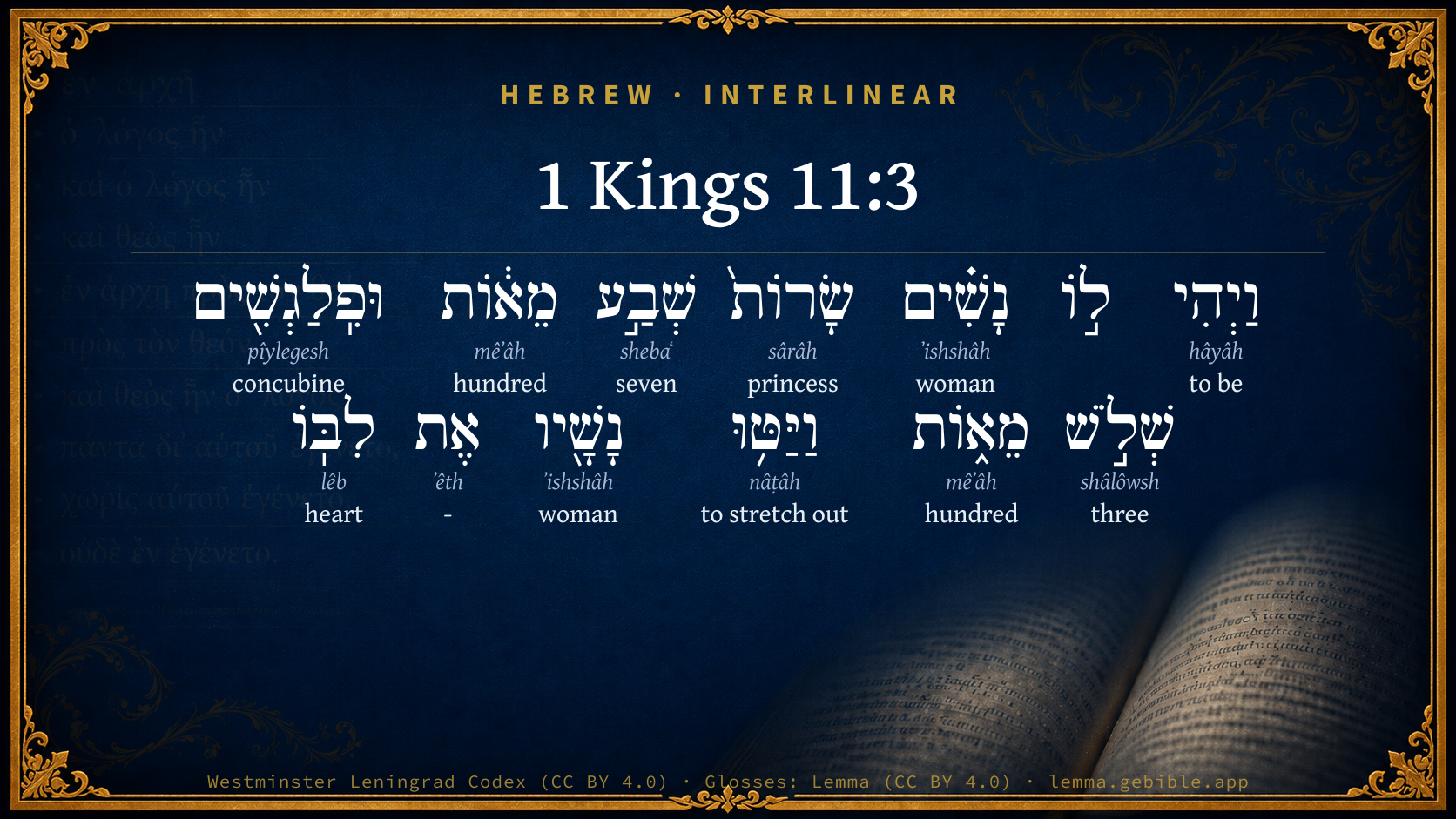
Hebrew (Westminster Leningrad Codex) 1 Kings 11:3 appears in the Hebrew Old Testament. The text above is from the Westminster Leningrad Codex. Each word links to its Strong’s number, a concise gloss, and parsing drawn from the Open Scriptures Hebrew Bible morphology. Click any word for its full Brown-Driver-Briggs (BDB) entry.
Download image
Cite this verse

1 Kings 11:3 (World English Bible). Public Domain. Lemma interlinear Bible study tool, https://lemma.gebible.app/v/1-kings/11/3.

Show BibTeX & RIS
BibTeX
RIS
English Translation
He had seven hundred wives, princesses, and three hundred concubines; and his wives turned away his heart.
World English Bible · Public Domain
Download a study sheet

One document with this verse’s original text, its word-by-word gloss line, the meaning frame, cross-references with their text, attributed commentary, and full source and license credits — printable, and it pastes into notes with its structure intact.

This verse Autodidact and up

Study sheet (.html) Plain text (.txt)

A passage Seminary Student

Up to 50 verses in one chapter. A passage sheet keeps up to 6 commentary sources and 12 cross-references per verse, in the order this page ranks them, and says so on the sheet whenever that leaves anything out. Ask for a single verse and you get the Autodidact verse sheet above.

Everything on this page stays free to read, with no account — the sheet is a download of what is already on screen, not access to it.

Want to remove ads? Support Godless Engineer
Compare translations 3

The same verse in 3 English versions, stacked beneath the original-language interlinear above. Click any original word for its lexicon entry.

Each is an independent rendering of the whole verse — the interlinear is not word-aligned to these translations.

Highlighted words mark where these versions differ — a whole-verse word diff, not a word-by-word alignment.

  • World English Bible Public Domain
    He had seven hundred wives, princesses, and three hundred concubines; and his wives turned away his heart.
  • King James Version Public Domain
    And he had seven hundred wives, princesses, and three hundred concubines: and his wives turned away his heart.
  • unfoldingWord Literal Text CC BY-SA 4.0
    And to him were 700 wives, princesses, and 300 concubines. And his wives stretched out his heart.

unfoldingWord Literal Text — © unfoldingWord, licensed CC BY-SA 4.0. Word-aligned USFM3 via Door43 (git.door43.org/unfoldingWord/en_ult).

Versions to compare (up to 4)

3 of 4 selected

Show all 18 translations

Every available English version of this verse, each an independent rendering of the whole verse.

  • World English Bible Public Domain
    He had seven hundred wives, princesses, and three hundred concubines; and his wives turned away his heart.
  • Berean Standard Bible Public Domain
    He had seven hundred wives of royal birth and three hundred concubines—and his wives turned his heart away.
  • Majority Standard Bible Public Domain
    He had seven hundred wives of royal birth and three hundred concubines—and his wives turned his heart away.
  • King James Version Public Domain
    And he had seven hundred wives, princesses, and three hundred concubines: and his wives turned away his heart.
  • American Standard Version (1901) Public Domain
    And he had seven hundred wives, princesses, and three hundred concubines; and his wives turned away his heart.
  • Revised Version (1885) Public Domain
    And he had seven hundred wives, princesses, and three hundred concubines: and his wives turned away his heart.
  • Geneva Bible (1599) Public Domain
    And he had seuen hundreth wiues, that were princesses, and three hundreth concubines, and his wiues turned away his heart.
  • Douay-Rheims (1899) Public Domain
    And he had seven hundred wives as queens, and three hundred concubines: and the women turned away his heart.
  • Young's Literal Translation Public Domain
    And he hath women, princesses, seven hundred, and concubines three hundred; and his wives turn aside his heart.
  • Literal Standard Version CC BY-SA 4.0
    And he has seven hundred wives, princesses, and three hundred concubines; and his wives turn aside his heart.
  • Unlocked Literal Bible CC BY-SA 4.0
    Solomon had seven hundred royal wives and three hundred concubines. His wives turned his heart away.
  • unfoldingWord Literal Text CC BY-SA 4.0
    And to him were 700 wives, princesses, and 300 concubines. And his wives stretched out his heart.
  • Darby Bible Public Domain
    And he had seven hundred wives, princesses, and three hundred concubines; and his wives turned away his heart.
  • World Messianic Bible Public Domain
    He had seven hundred wives, princesses, and three hundred concubines. His wives turned his heart away.
  • Webster's Bible Public Domain
    And he had seven hundred wives, princesses, and three hundred concubines: and his wives turned away his heart.
  • Free Bible Version CC BY-SA 4.0
    He had seven hundred wives of noble birth and three hundred concubines. His wives did convince him to turn away from the Lord.
  • Bible in Basic English Public Domain
    He had seven hundred wives, daughters of kings, and three hundred other wives; and through his wives his heart was turned away.
  • JPS Tanakh (1917) Public Domain
    And he had seven hundred wives, princesses, and three hundred concubines; and his wives turned away his heart.

Literal Standard Version (2020), Covenant Press — licensed CC BY-SA 4.0. Text via the HelloAO Bible API (eBible.org). Unlocked Literal Bible (unfoldingWord) — licensed CC BY-SA 4.0. Text via the HelloAO Bible API (eBible.org). unfoldingWord Literal Text — © unfoldingWord, licensed CC BY-SA 4.0. Word-aligned USFM3 via Door43 (git.door43.org/unfoldingWord/en_ult). Free Bible Version, Dr. Jonathan Gallagher — licensed CC BY-SA 4.0. Text via the HelloAO Bible API (eBible.org).

Word by word

More ways to search: Search by grammar → Find every occurrence → Compare this word →

Practice this passage: Drill this verse → Learn its vocabulary →

שָׂרוֹת֙
sârâh
H8282
“princesses”
Noun, Common, Feminine, Plural, Absolute
Part of Speech
Noun
Type
Common
Gender
Feminine
Number
Plural
State
Absolute
Full BDB Definition

Origin: from H8269

TWOT: 2295b

princess, noblewoman, noble lady
  1. וַיְהִי hâyâh H1961 “and · to be” Conjunction + Verb, Qal, Sequential Imperfect, 3rd Person, Masculine, Singular
  2. נָשִׁ֗ים ʼishshâh H802 “women” Noun, Common, Feminine, Plural, Absolute
  3. שְׁבַ֣ע shebaʻ H7651 “seven” Adjective, Cardinal number, Feminine, Singular, Absolute
  4. מֵא֔וֹת mêʼâh H3967 “hundred” Adjective, Cardinal number, Both, Plural, Absolute
  5. וּפִֽלַגְשִׁ֖ים pîylegesh H6370 “and · concubines” Conjunction + Noun, Common, Feminine, Plural, Absolute
  6. שְׁלֹ֣שׁ shâlôwsh H7969 “three” Adjective, Cardinal number, Feminine, Singular, Absolute
  7. מֵא֑וֹת mêʼâh H3967 “hundred” Adjective, Cardinal number, Both, Plural, Absolute
  8. וַיַּטּ֥וּ nâṭâh H5186 “and · to stretch out” Conjunction + Verb, Hiphil, Sequential Imperfect, 3rd Person, Masculine, Plural
  9. נָשָׁ֖יו ʼishshâh H802 “women · his” Noun, Common, Feminine, Plural, Construct + Suffix, Personal, 3rd Person, Masculine, Singular
  10. אֶת ʼêth H853 “-” Particle, Direct Object
  11. לִבּֽוֹ lêb H3820 “heart · his” Noun, Common, Masculine, Singular, Construct + Suffix, Personal, 3rd Person, Masculine, Singular

About this verse

These counts appear in no published source. They are computed here, from the morphology-tagged text and Lemma’s own curated glosses. What Lemma adds →

13
words
10
distinct lemmas
Historical
section

Notable vocabulary

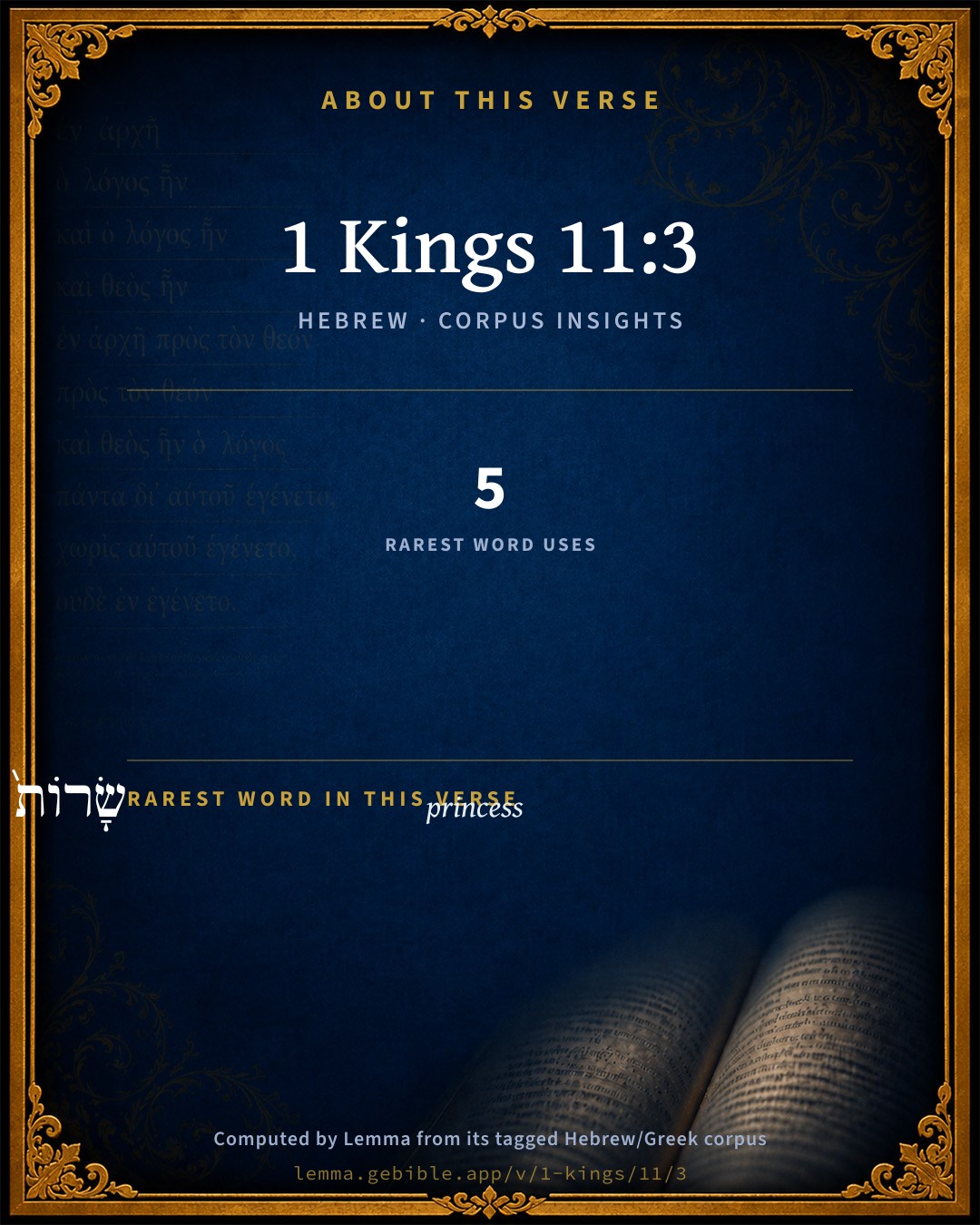
The rarest word here is שָׂרוֹת֙ princess H8282 — appearing just 5 times in the whole Hebrew Bible.

Shared distinctive vocabulary

שָׂרוֹת֙ princess H8282 occurs in 5 verses of the Hebrew Bible. Also found in:

Grammatical profile

  • 2 verbs
  • 5 nouns
  • 4 adjectives
  • 1 preposition
  • 1 particle

Verb forms

  • וַיְהִי Qal · Sequential Imperfect
  • וַיַּטּ֥וּ Hiphil · Sequential Imperfect

Repetition

Words recur within this verse — often emphatic in Hebrew:

  • נָשִׁ֗ים woman H802 ×2
  • מֵא֔וֹת hundred H3967 ×2

Cross-references

6

Topical passages linked to 1 Kings 11:3 in the Treasury of Scripture Knowledge — connected by theme and wording, ordered by reader-vote popularity; previews shown in the World English Bible.

  • 2 Samuel 5:13–16 David took him more concubines and wives out of Jerusalem, after he was come from Hebron; and there were yet sons and daughters born to David.
  • Ecclesiastes 7:28 which my soul still seeks; but I have not found: one man among a thousand have I found; but a woman among all those have I not found.
  • Judges 8:30–31 Gideon had seventy sons conceived from his body; for he had many wives.
  • Judges 9:5 He went to his father's house at Ophrah, and killed his brothers the sons of Jerubbaal, being seventy persons, on one stone: but Jotham the youngest son of Jerubbaal was left; for he hid himself.
  • 2 Samuel 3:2–5 To David were sons born in Hebron: and his firstborn was Amnon, of Ahinoam the Jezreelitess;
  • 2 Chronicles 11:21 Rehoboam loved Maacah the daughter of Absalom above all his wives and his concubines: (for he took eighteen wives, and sixty concubines, and became the father of twenty-eight sons and sixty daughters.)

Cross-references courtesy of OpenBible.info (CC BY 4.0).

Hebrew and Greek witnesses Masoretic Hebrew ↔ Greek Septuagint

The same verse in the two great witnesses to the Old Testament, shown verse-for-verse.

These are two independent witnesses, not word-aligned to each other, and the Septuagint is shown in lemma (dictionary) form.

Hebrew 1 Kings 11:3 Masoretic · Westminster Leningrad Codex

וַיְהִי ל֣וֹ נָשִׁ֗ים שָׂרוֹת֙ שְׁבַ֣ע מֵא֔וֹת וּפִֽלַגְשִׁ֖ים שְׁלֹ֣שׁ מֵא֑וֹת וַיַּטּ֥וּ נָשָׁ֖יו אֶת לִבּֽוֹ

He had seven hundred wives, princesses, and three hundred concubines; and his wives turned away his heart.

World English Bible · Public Domain

On this verse, Ellicott's Commentary for English Readers discusses the Septuagint’s reading. Read the note in Commentary ↓

Hebrew: Westminster Leningrad Codex (CC BY 4.0). Greek: Septuagint (public domain); English from a public-domain English Septuagint. How the Septuagint differs from the Hebrew →

Targum (Aramaic paraphrase)

1

The Targum is the ancient Jewish Aramaic paraphrase of the Hebrew Scriptures — an interpretive translation, not the Hebrew text itself. Onkelos (literal) and Pseudo-Jonathan (expansive) render the Torah, and Jonathan the Prophets. Coverage is partial: where no permissively-licensed English translation exists for a verse, only the Aramaic is shown. This is verse-level text, not a word-by-word alignment to the Hebrew.

  1. Targum Jonathan Prophets (Joshua–Malachi)
    וַהֲוָאָה לֵיהּ נְשִׁין מַלְכָּן שְׁבַע מְאָה וּלְחֵינָן תְּלַת מְאָה וְאַטְעִיאָה נְשׁוֹהִי יַת לִבֵּיהּ:

    (no public-domain English translation for this verse)

    Targum Jonathan — Aramaic: “Mikraot Gedolot” (public domain). English: “Sefaria Community Translation” (CC0 1.0 (public-domain dedication)); “London "Chaldee Paraphrase," 1871” (public domain). Text via Sefaria.

Commentary

Notes on 1 Kings 11:3 from classic Christian and Jewish commentators (each source and its license shown beneath its notes). The classic Christian expositions comment on the surrounding passage and are grouped to its opening verse, so a note may address several verses; the Jewish commentaries on the Tanakh (Rashi and others) are per-verse, so they appear only where the commentator wrote on this verse.

Lemma curates 59 commentaries, every one of them public domain or Creative Commons licensed, each selected and text-cleaned for this edition rather than reprinted as found. About our sources →

Trapp's Complete Commentary

John Trapp

1Ki 11:3 And he had seven hundred wives, princesses, and three hundred concubines: and his wives turned away his heart.

Ver. 3. And he had seven hundred wives.] Numerum effraenem. Fewer they were by far at first, as some do gather from Son 6:8, threescore queens, and fourscore concubines - wives of an inferior rank - and virgins without number: these likely were kept for store, as at this day sundry are in the great Turk’s harem, and turned off at pleasure, as Est 2:14, "they came in to the king no more, except he delighted in them." Miserabilis fuit hic lapsus, saith one. {a} This was a miserable fall indeed of so wise and holy a man into so foul evils: to teach us the truth of that old rhyming couplet,

“ Vestis pulchra, iocus, potus, cibus, otia, somnus,

Enervant mentem, luxuriamque fovent. ”

And his wives turned away his heart.] O wives! the most sweet poison - saith one of our historians, {b} speaking of the Duke of Somerset’s lady, in King Edward VI’s time - the most desired evil in the world, &c. Woman was first given to man for a comforter, and not for a counsellor, much less for a controller and director: and therefore in the first sentence against man, this cause is expressed, "Because thou obeyedst the voice of thy wife."

{a} A Lapide.

{b} Sir John Heywood.

John Trapp, A Commentary or Exposition upon All the Books of the Old and New Testament (1647–1656) — public domain. Text from a community e-Sword module.

Joseph Benson's Commentary

1Ki 11:3. He had seven hundred wives, princesses, and three hundred concubines — This was multiplying them prodigiously indeed, and pouring contempt on the divine prohibition in the most notorious manner. David had multiplied wives too, although to no such extent as this; but probably the bad example which he had set in this particular, had encouraged Solomon to think it, if not lawful, yet a lesser evil than it really was. One ill act of a good man may do more mischief than twenty of a wicked man. “Without knowing the customs of the princes of the East,” says Dr. Dodd, “their pomp and sumptuousness of living, one might be tempted to wonder of what possible use was this milliad of wives and concubines. But as Solomon was between forty and fifty years old before he ran into this excess, we cannot but think that he kept this multitude of women more for state than otherwise. Darius Codomanus was wont to carry along with him in his camp no less than three hundred and fifty concubines in time of war; nor was his queen offended at it, for the women used to reverence and adore her, as if she had been a goddess. Father Le Compte, in his history of China, tells us that the emperor has a vast number of wives, chosen out of the prime beauties of the country, many of which he never so much as saw in his whole life: and, therefore, it is not improbable that Solomon, as he found his riches increase, might enlarge his expenses, and endeavour to surpass all the princes of his time in this, as well as in all other kinds of pomp and magnificence.” He was guilty, however, of a flagrant violation of the divine law.

Joseph Benson's Commentary on the Old and New Testaments (1811–1818) — public domain. Text from a community e-Sword module.

Geneva Bible (1599)

Geneva Bible translators

To whom appertained no dowry.

Or, Queens.

Geneva Bible (1599) marginal notes — public domain. Text via Bolls.life.

Jamieson, Fausset & Brown

Robert Jamieson, A. R. Fausset & David Brown

he had seven hundred wives, princesses--They were, probably, according to an existing custom, the daughters of tributary chiefs, given as hostages for good conduct of their fathers.

concubines--were legitimate, but lower or secondary wives. These the chief or first wife regards without the smallest jealousy or regret, as they look up to her with feelings of respectful submission. Solomon's wives became numerous, not all at once, but gradually. Even at an early period his taste for Oriental show seems to have led to the establishment of a considerable harem (Sol 6:8).

Jamieson, Fausset & Brown — Commentary Critical and Explanatory on the Whole Bible (1871) — public domain (CC PDM 1.0). Text via the HelloAO Bible API.

Adam Clarke's Commentary

Verse 3. He had seven hundred wives, princesses] How he could get so many of the blood royal from the different surrounding nations, is astonishing; but probably the daughters of noblemen, generals, c., may be included.

And three hundred concubines] These were wives of the second rank, who were taken according to the usages of those times but their offspring could not inherit. Sarah was to Abraham what these seven hundred princesses were to Solomon; and the three hundred concubines stood in the same relation to the Israelitish king as Hagar and Keturah did to the patriarch.

Here then are one thousand wives to form this great bad man's harem! Was it possible that such a person could have any piety to God, who was absorbed by such a number of women? We scarcely allow a man to have the fear of God who has a second wife or mistress; in what state then must the man be who has one thousand of them? We may endeavour to excuse all this by saying, "It was a custom in the East to have a multitude of women, and that there were many of those whom Solomon probably never saw," c., c. But was there any of them whom he might not have seen? Was it for reasons of state, or merely court splendour, that he had so many? How then is it said that he loved many strange women? - that he clave to them in love? And did he not give them the utmost proofs of his attachment when he not only tolerated their iniquitous worship in the land, but built temples to their idols, and more, burnt incense to them himself? As we should not condemn what God justifies, so we should not justify what God condemns. He went after Ashtaroth, the impure Venus of the Sidonians after Milcom, the abomination of the Ammonites after Chemosh, the abomination of the Moabites; and after the murderous Molech, the abomination of the children of Ammon. He seems to have gone as far in iniquity as it was possible.

Adam Clarke's Commentary on the Bible (1810–1826) — public domain. Text from a community e-Sword/MySword module.

Ellicott's Commentary for English Readers

(3) Seven hundred wives and three hundred concubines.—The harem of an Eastern king is simply an adjunct of his magnificence, and the relation of the wives to him little more than nominal. (Comp. Est_2:14.) Nor does the statement here made necessarily imply that at any one time the whole number existed. Still, the numbers here given, though found also in the LXX. and in Josephus, are not only extraordinarily large, but excessive in comparison with the “three- score queens and fourscore concubines” of Son_6:8, and disproportionate in the relative number of the superior and inferior wives. It is possible that, in relation to the former, at any rate, the text may be corrupt, though the corruption must be of ancient date.

A Bible Commentary for English Readers, edited by Charles John Ellicott (1878–1897) — public domain. Text from a community e-Sword module.

The Cambridge Bible for Schools and Colleges

gen. ed. J. J. S. Perowne

3. seven hundred wives, princesses] The numbers in this verse are far in excess of those in the Song of Solomon, which makes mention (1Ki_6:8) of threescore queens. But from the instances known of other monarchs there is little reason to question what is stated in this verse. Philippson (die Israelitische Bibel) tells of the wives of the great Mogul as 1000 in number, and in ancient history there are similar examples. Many of these were probably never seen by the monarch in his life, but counted among his household, as an item of magnificence. It was only by the few who were his more constant companions that Solomon’s heart was turned away.

The Cambridge Bible for Schools and Colleges (gen. ed. J. J. S. Perowne; Cambridge University Press, 1878–1918) — public domain. Text from a community e-Sword module.

John Gill's Exposition

And he had seven hundred wives, princesses, and three hundred concubines,.... In all 1000, a prodigious number; though these might not be all for use, but for state after the manner of the eastern monarchs; these were a far greater number than are alluded to in Sol 6:8, unless the virgins without number there, were such of these as were not defiled by him; but the number here seems plainly referred to in Ecc 7:28,

and his wives turned away his heart; both from his duty to his God, and from attendance to his business as a king, especially the former, as follows.

John Gill's Exposition of the Whole Bible (1746–1763) — public domain (CC PDM 1.0). Text via the HelloAO Bible API.

Albert Barnes' Notes on the Bible

These numbers seem excessive to many critics, and it must be admitted that history furnishes no parallel to them. In Son 6:8 the number of Solomon’s legitimate wives is said to be sixty, and that of his concubines eighty. It is, perhaps probable, that the text has in this place suffered corruption. For “700” we should perhaps read “70.”

Albert Barnes' Notes on the Bible (1834–1885) — public domain. Text from a community e-Sword/MySword module.

Haydock's Catholic Bible Commentary

Concubines, or secondary wives. (Haydock) --- Those who have any sense of modesty, can hardly read this without blushing. (Salien) --- Solomon was guilty not only of intemperance, but also of a transgression of the precept. (Menochius) (Deuteronomy xvii. 17.) --- He shall not have many wives: though as that command is indefinite, and David had eighteen, without blame, (2 Kings iii. 3.) it is difficult to say how many a person might have, at that time, without exceeding the bounds of moderation. (Haydock) --- But a thousand wives for one man, is certainly too great a number. When Solomon wrote the Canticles, he had only sixty queens and eighty concubines, Canticle of Canticles vi. 8. The Rabbins allow the king eighteen wives. But it is probable that most of the kings indulged themselves in a greater latitude. Darius, of Persia, took along with him to the wars 350 concubines, when he was overcome by Alexander. (Atheneus xiii. 1.) Priam had also many wives, besides Hecuba, the queen. The inferior wives looked upon those who had this title with a degree of respect, bordering on adoration. (Calmet)

George Leo Haydock (1774–1849), Haydock's Catholic Family Bible and Commentary, 1859 edition — public domain. Excludes Psalms (Douay-Rheims chapter numbering differs from Protestant) and Deuterocanonical books (Catholic canon only).

Matthew Poole's English Annotations

Seven hundred wives, and three hundred concubines; partly for his lust, which being indulged, becomes infinite and unsatiable; and partly from his pride, accounting this a point of honour and magnificence.

Matthew Poole's English Annotations on the Holy Bible (1683–1685) — public domain. Text from a community e-Sword/MySword module.

Whedon's Commentary on the Bible

Daniel D. Whedon

3. Seven hundred wives — Some have thought by a supposed corruption in the text to reduce the seven hundred to seventy, and the three hundred concubines to eighty, and have referred to Son_6:8, as giving support to this conjecture. But all this proceeds from the false idea that an Oriental sovereign has intercourse with all his wives and concubines. The harem of an Eastern monarch is even at the present day looked upon as a sort of state necessity, and the king’s rank and greatness is estimated according to its extent. He multiplies his wives according to his wealth and power, though many of them he never sees at all. Darius Codomannus is said to have taken three hundred and sixty concubines in his camp when he marched against Alexander. So Solomon, wishing to surpass all other kings in the fame of greatness, filled his harem with a thousand women. Among these he had his favourites, who at length turned his heart from God; but the large majority of the thousand he probably never knew personally at all.

Daniel D. Whedon (gen. ed.), Commentary on the Old and New Testaments (1874–1909) — public domain. Text from a community e-Sword module.

The Pulpit Commentary

And he had seven hundred wives, princesses These may have been members of royal or princely houses of neighbouring nations. Evidently they enjoyed a distinguished rank, and three hundred concubines Though not committed to a defence of the accuracy of the figures 700 and 300 (which are clearly round numbers), it must be said that the reasons alleged for reducing them (as from 700 to 70) are not of much weight. It is hardly correct, e.g., to say (as Rawlinson) that the numbers are given in Song of Son_6:8 as "threescore queens and fourscore concubines," for it is obvious that too much importance must not be attached to an obiter statement ("there are threescore," etc.) in a poetical book, too, and one descriptive of Solomon"s youth. The view of Ewald and Keil, again, that these numbers represent the sum total of the inmates of the harem at different periods of Solomon"s long reign, rather than the number present at any one time they would see in the numbers of Song of Solomon l.c. a statement of the average strength of the seraglio though not to be described as evasive, is certainly not the natural interpretation of the words. And these numbers, when we compare them with the establishments of other Eastern potentates, are not found to be at all incredible. The commentators all remind us that Dareius Codomannus, e.g., took with him on his expedition against Alexander 360 pellices . Or if ancient history, as Rawlinson affirms, furnishes no strict parallel to these figures, the harems of modern Persia and Turkey at any rate have quite equalled that of Solomon. (See Bahr in loc.) It is true that Rehoboam had only 18 wives and 60 concubines, (2Ch_11:21) but then Rehoboam was not Solomon. If his harem was but a tithe of his father"s, so also were his wealth and his power: and his wives turned away his heart. "Satan hath found this bait to take so well that he never changed since he crept into Paradise" (Bp. Hall).

The Pulpit Commentary (1880–1919), ed. H.D.M. Spence-Jones & Joseph S. Exell — public domain. Text from a community e-Sword module.

John Wesley's Explanatory Notes

Seven hundred wives, &c. - God had particularly forbidden the kings to multiply either horses or wives, Deut. xvii, 16, 17, we saw chap.

chap. x, 29, how he broke the former law, multiplying horses: and here we see, how he broke the latter, multiplying wives. David set the example. One ill act of a good man may do more mischief than twenty of a wicked man. Besides, they were strange women, of the nations which God had expressly forbidden them to marry with. And to compleat the mischief, he clave unto these in love; was extravagantly fond of them, Solomon had much knowledge. But to what purpose, when he knew not how to govern his appetites?

John Wesley, Explanatory Notes Upon the Whole Bible (1754–1765) — public domain. Text via the GEBible commentary corpus.

unfoldingWord translationNotes

Door43 World Missions Community

seven hundred royal wives and three hundred concubines

"700 royal wives and 300 concubines" (See: Numbers)

turned his heart away

To "turn someone's heart" is to convince that person to change his affection. See how you translated a similar phrase in 1 Kings 11:01. AT: "turned his heart away from Yahweh" or "persuaded him to stop worshiping Yahweh" (See: Assumed Knowledge and Implicit Information and Metonymy)

his heart was not fully surrendered ... as was the heart of David

To "surrender" your heart refers to giving total allegiance and affection. AT: "he was not fully devoted ... as was David" (See: Metonymy)

translationWords

royal

concubine

God

David

ancestor

unfoldingWord translationNotes — © Distant Shores Media and the Door43 World Missions Community, licensed CC BY-SA 4.0. Source: git.door43.org/Door43/en_tn.

Lesson kit

Teaching starters — assembled from the data on this page, not authored interpretation. Every prompt links to the verse data it draws on. Edit before teaching.

1 Kings, in the Historical, opens this verse with 13 words (10 distinct Hebrew lemmas). Its most distinctive word is sârâh (“princess”). A historical commentator’s framing appears above. Read the whole chapter for the surrounding context.

Discussion questions

  1. How does “princess” (sârâh) shape what this verse is saying?
  2. Judges 5:29 shares the word «princess» with this verse. How do the two illuminate each other?
  3. “woman” occurs 2× in this one verse. What is the effect of the repetition?
  4. These translations render this verse differently. What is at stake in choosing one wording over another?
  5. The verb «וַיְהִי» is Qal Sequential Imperfect. How does its form color the action?
  6. Reading how Trapp's Complete Commentary and Joseph Benson's Commentary read this verse, where do the two commentators agree and where do they part?

Things to notice

Reading settings

Reading text

Shown beneath each verse's original-language words.

Old Testament
Old Testament edition

Read the OT as the Masoretic Hebrew (MT) or the Greek Septuagint (LXX).

English shown for the Greek Septuagint (in the Hebrew ↔ Greek comparison).

Comparing translations? Open the Compare panel on any verse page to stack up to four side by side.