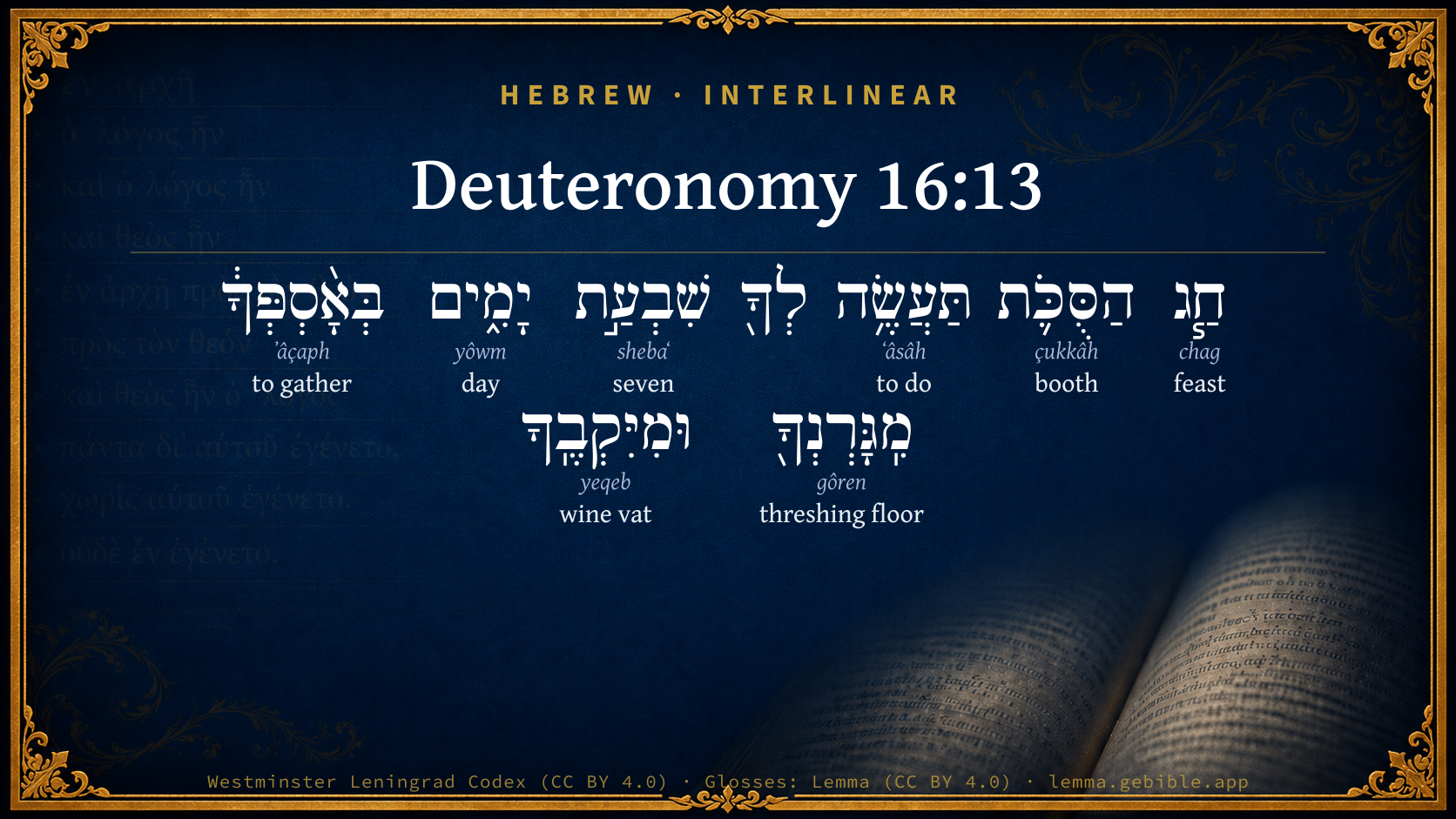
Deuteronomy 16:13

Hebrew (Westminster Leningrad Codex) Deuteronomy 16:13 appears in the Hebrew Old Testament. The text above is from the Westminster Leningrad Codex. Each word links to its Strong’s number, a concise gloss, and parsing drawn from the Open Scriptures Hebrew Bible morphology. Click any word for its full Brown-Driver-Briggs (BDB) entry.
Download image
Cite this verse

Deuteronomy 16:13 (World English Bible). Public Domain. Lemma interlinear Bible study tool, https://lemma.gebible.app/v/deuteronomy/16/13.

Show BibTeX & RIS
BibTeX
RIS
English Translation
You shall keep the feast of tents seven days, after that you have gathered in from your threshing floor and from your winepress:
World English Bible · Public Domain
Download a study sheet

One document with this verse’s original text, its word-by-word gloss line, the meaning frame, cross-references with their text, attributed commentary, and full source and license credits — printable, and it pastes into notes with its structure intact.

This verse Autodidact and up

Study sheet (.html) Plain text (.txt)

A passage Seminary Student

Up to 50 verses in one chapter. A passage sheet keeps up to 6 commentary sources and 12 cross-references per verse, in the order this page ranks them, and says so on the sheet whenever that leaves anything out. Ask for a single verse and you get the Autodidact verse sheet above.

Everything on this page stays free to read, with no account — the sheet is a download of what is already on screen, not access to it.

Want to remove ads? Support Godless Engineer
Compare translations 3

The same verse in 3 English versions, stacked beneath the original-language interlinear above. Click any original word for its lexicon entry.

Each is an independent rendering of the whole verse — the interlinear is not word-aligned to these translations.

Highlighted words mark where these versions differ — a whole-verse word diff, not a word-by-word alignment.

  • World English Bible Public Domain
    You shall keep the feast of tents seven days, after that you have gathered in from your threshing floor and from your winepress:
  • King James Version Public Domain
    Thou shalt observe the feast of tabernacles seven days, after that thou hast gathered in thy corn and thy wine:
  • unfoldingWord Literal Text CC BY-SA 4.0
    You must make the Festival of Huts for yourselves seven days into your gathering from your threshing floor and from your winepress.

unfoldingWord Literal Text — © unfoldingWord, licensed CC BY-SA 4.0. Word-aligned USFM3 via Door43 (git.door43.org/unfoldingWord/en_ult).

Versions to compare (up to 4)

3 of 4 selected

Show all 18 translations

Every available English version of this verse, each an independent rendering of the whole verse.

  • World English Bible Public Domain
    You shall keep the feast of tents seven days, after that you have gathered in from your threshing floor and from your winepress:
  • Berean Standard Bible Public Domain
    You are to celebrate the Feast of Tabernacles for seven days after you have gathered the produce of your threshing floor and your winepress.
  • Majority Standard Bible Public Domain
    You are to celebrate the Feast of Tabernacles for seven days after you have gathered the produce of your threshing floor and your winepress.
  • King James Version Public Domain
    Thou shalt observe the feast of tabernacles seven days, after that thou hast gathered in thy corn and thy wine:
  • American Standard Version (1901) Public Domain
    Thou shalt keep the feast of tabernacles seven days, after that thou hast gathered in from thy threshing-floor and from thy winepress:
  • Revised Version (1885) Public Domain
    Thou shalt keep the feast of tabernacles seven days, after that thou hast gathered in from thy threshing-floor and from thy winepress:
  • Geneva Bible (1599) Public Domain
    Thou shalt obserue the feast of the Tabernacles seuen daies, when thou hast gathered in thy corne, and thy wine.
  • Douay-Rheims (1899) Public Domain
    Thou shalt celebrate the solemnity also of tabernacles seven days, when thou hast gathered in thy fruit of the barnfloor and of the winepress.
  • Young's Literal Translation Public Domain
    `The feast of booths thou dost make for thee seven days, in thine in-gathering of thy threshing-floor, and of thy wine-vat;
  • Literal Standard Version CC BY-SA 4.0
    You observe the Celebration of Shelters for yourself [for] seven days, in your ingathering of your threshing-floor and of your wine-vat;
  • Unlocked Literal Bible CC BY-SA 4.0
    You must keep the Festival of Shelters for seven days after you have gathered in the harvest from your threshing floor and from your winepress.
  • unfoldingWord Literal Text CC BY-SA 4.0
    You must make the Festival of Huts for yourselves seven days into your gathering from your threshing floor and from your winepress.
  • Darby Bible Public Domain
    The feast of tabernacles shalt thou hold seven days, when thou hast gathered in [the produce] of thy floor and of thy winepress.
  • World Messianic Bible Public Domain
    You shall keep the feast of booths seven days, after you have gathered in from your threshing floor and from your wine press.
  • Webster's Bible Public Domain
    Thou shalt observe the feast of tabernacles seven days, after that thou hast gathered in thy corn, and thy wine.
  • Free Bible Version CC BY-SA 4.0
    Celebrate the Festival of Shelters for seven days once you have finished threshing your grain and pressing your grapes.
  • Bible in Basic English Public Domain
    You are to keep the feast of tents for seven days after you have got in all your grain and made your wine:
  • JPS Tanakh (1917) Public Domain
    Thou shalt keep the feast of tabernacles seven days, after that thou hast gathered in from thy threshing-floor and from thy winepress.

Literal Standard Version (2020), Covenant Press — licensed CC BY-SA 4.0. Text via the HelloAO Bible API (eBible.org). Unlocked Literal Bible (unfoldingWord) — licensed CC BY-SA 4.0. Text via the HelloAO Bible API (eBible.org). unfoldingWord Literal Text — © unfoldingWord, licensed CC BY-SA 4.0. Word-aligned USFM3 via Door43 (git.door43.org/unfoldingWord/en_ult). Free Bible Version, Dr. Jonathan Gallagher — licensed CC BY-SA 4.0. Text via the HelloAO Bible API (eBible.org).

Word by word

More ways to search: Search by grammar → Find every occurrence → Compare this word →

Practice this passage: Drill this verse → Learn its vocabulary →

וּמִיִּקְבֶֽךָ
yeqeb
H3342
“and · from · wine vat · your”
Conjunction + Preposition + Noun, Common, Masculine, Singular, Construct + Suffix, Personal, 2nd Person, Masculine, Singular
Part of Speech
Conjunction + Preposition + Noun
Type
Common
Gender
Masculine
Number
Singular
State
Construct
Full BDB Definition

Origin: from an unused root meaning to excavate

TWOT: 900a

wine vat, wine-press
  1. חַ֧ג chag H2282 “feast of” Noun, Common, Masculine, Singular, Construct
  2. הַסֻּכֹּ֛ת çukkâh H5521 “the · booths” Particle, Definite Article + Noun, Common, Feminine, Plural, Absolute
  3. תַּעֲשֶׂ֥ה ʻâsâh H6213 “to do” Verb, Qal, Imperfect, 2nd Person, Masculine, Singular
  4. שִׁבְעַ֣ת shebaʻ H7651 “seven” Adjective, Cardinal number, Masculine, Singular, Construct
  5. יָמִ֑ים yôwm H3117 “days” Noun, Common, Masculine, Plural, Absolute
  6. בְּאָ֨סְפְּךָ֔ ʼâçaph H622 “in/at · to gather · you” Preposition + Verb, Qal, Infinitive Construct + Suffix, Personal, 2nd Person, Masculine, Singular
  7. מִֽגָּרְנְךָ֖ gôren H1637 “from · threshing floor · your” Preposition + Noun, Common, Both, Singular, Construct + Suffix, Personal, 2nd Person, Masculine, Singular

About this verse

These counts appear in no published source. They are computed here, from the morphology-tagged text and Lemma’s own curated glosses. What Lemma adds →

9
words
8
distinct lemmas
Pentateuch
section

Notable vocabulary

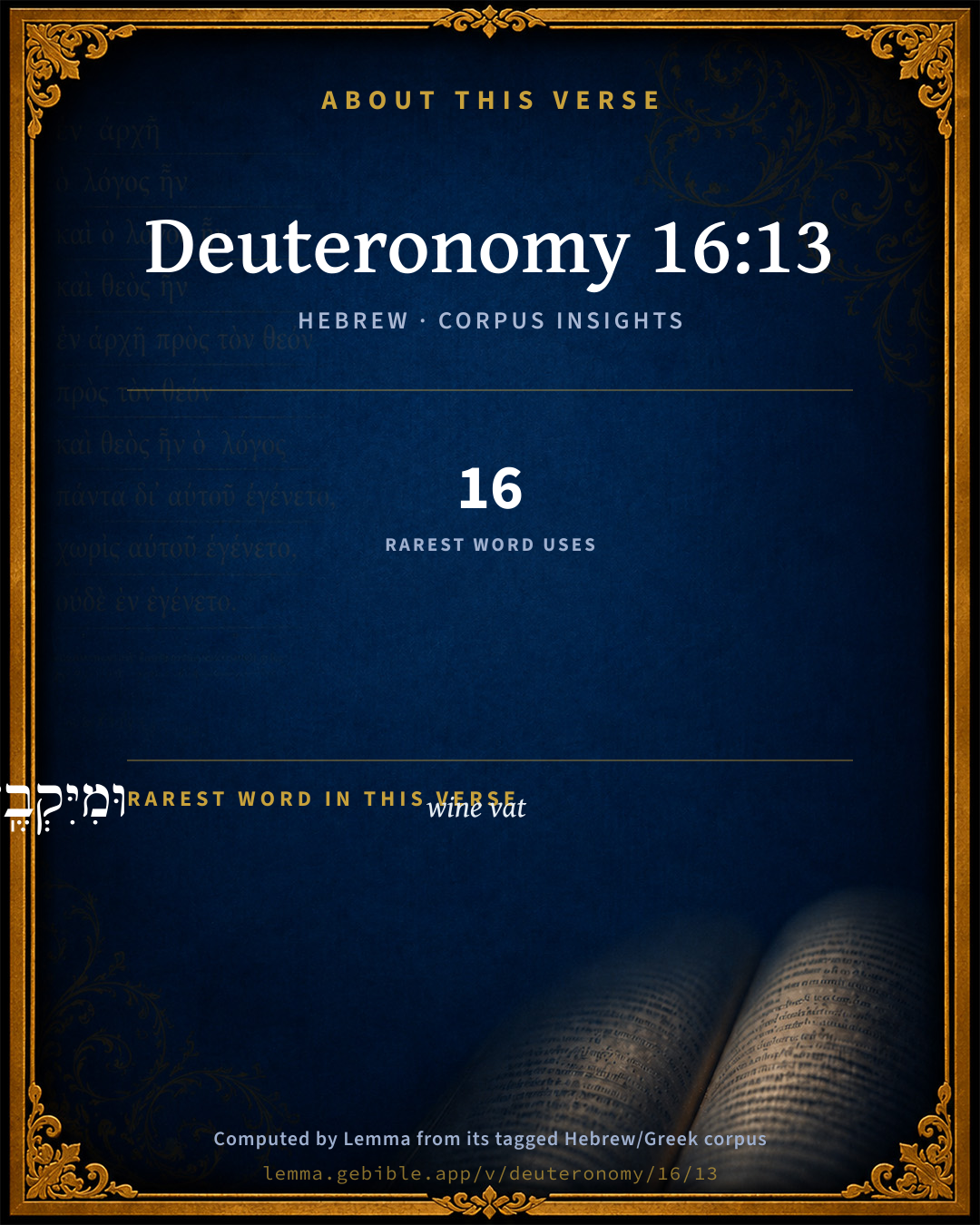
The rarest word here is וּמִיִּקְבֶֽךָ wine vat H3342 — appearing just 16 times in the whole Hebrew Bible.

Shared distinctive vocabulary

וּמִיִּקְבֶֽךָ wine vat H3342 occurs in 16 verses of the Hebrew Bible. Also found in:

Grammatical profile

  • 2 verbs
  • 5 nouns
  • 1 adjective
  • 1 preposition

Verb forms

  • תַּעֲשֶׂ֥ה Qal · Imperfect
  • בְּאָ֨סְפְּךָ֔ Qal · Infinitive Construct

Hebrew & Septuagint length

In English translation the verse runs 23 words from the Hebrew and 23 from the Septuagint (LXX English) — the same length.

A rough comparison of the two English renderings, which tokenize alike — not a word-level alignment.

Word counts can differ between the Hebrew and the Greek without any difference in meaning — e.g. the Hebrew direct-object marker אֵת has no separate Greek word, and Greek often adds the article ὁ.

Cross-references

12

Topical passages linked to Deuteronomy 16:13 in the Treasury of Scripture Knowledge — connected by theme and wording, ordered by reader-vote popularity; previews shown in the World English Bible.

  • Exodus 23:16 And the feast of harvest, the first fruits of your labors, which you sow in the field: and the feast of harvest, at the end of the year, when you gather in your labors out of the field.
  • John 7:2 Now the feast of the Jews, the Feast of Booths, was at hand.
  • Leviticus 23:34–36 "Speak to the children of Israel, and say, 'On the fifteenth day of this seventh month is the feast of tents for seven days to Yahweh.
  • 2 Chronicles 5:3 And all the men of Israel assembled themselves to the king at the feast, which was [in] the seventh month.
  • Exodus 34:22 You shall observe the feast of weeks with the first fruits of wheat harvest, and the feast of harvest at the year's end.
  • Numbers 29:12–40 On the fifteenth day of the seventh month you shall have a holy convocation; you shall do no servile work, and you shall keep a feast to Yahweh seven days:
  • Zechariah 14:16–18 It will happen that everyone who is left of all the nations that came against Jerusalem will go up from year to year to worship the King, Yahweh of Hosts, and to keep the feast of tents.
  • Deuteronomy 31:10 Moses commanded them, saying, At the end of [every] seven years, in the set time of the year of release, in the feast of tents,
  • 2 Chronicles 7:8–10 So Solomon held the feast at that time seven days, and all Israel with him, a very great assembly, from the entrance of Hamath to the brook of Egypt.
  • 2 Chronicles 8:13 even as the duty of every day required, offering according to the commandment of Moses, on the Sabbaths, and on the new moons, and on the set feasts, three times in the year, [even] in the feast of unleavened bread, and in the feast of weeks, and in the feast of tents.
  • Ezra 3:4 They kept the feast of tents, as it is written, and [offered] the daily burnt offerings by number, according to the ordinance, as the duty of every day required;
  • Nehemiah 8:14–18 They found written in the law, how that Yahweh had commanded by Moses, that the children of Israel should dwell in booths in the feast of the seventh month;

Cross-references courtesy of OpenBible.info (CC BY 4.0).

Hebrew and Greek witnesses Masoretic Hebrew ↔ Greek Septuagint

The same verse in the two great witnesses to the Old Testament, shown verse-for-verse.

These are two independent witnesses, not word-aligned to each other, and the Septuagint is shown in lemma (dictionary) form.

Hebrew Deuteronomy 16:13 Masoretic · Westminster Leningrad Codex

חַ֧ג הַסֻּכֹּ֛ת תַּעֲשֶׂ֥ה לְךָ֖ שִׁבְעַ֣ת יָמִ֑ים בְּאָ֨סְפְּךָ֔ מִֽגָּרְנְךָ֖ וּמִיִּקְבֶֽךָ

You shall keep the feast of tents seven days, after that you have gathered in from your threshing floor and from your winepress:

World English Bible · Public Domain

Greek LXX Deuteronomy 16:13 Septuagint · lemma form

ἑορτή σκηνή ποιέω σεαυτοῦ ἑπτά ἡμέρα ἐν ὁ συνἄγω σύ ἐκ ὁ ἅλων σύ καί ἀπό ὁ ληνός σύ

You shall keep for yourself the feast of tabernacles seven days, when you gather in your produce from your corn-floor and your wine-press.

LXX2012 (modern English Septuagint) · Public Domain

Hebrew: Westminster Leningrad Codex (CC BY 4.0). Greek: Septuagint (public domain); English from LXX2012 (modern English Septuagint) (Public Domain). How the Septuagint differs from the Hebrew →

Targum (Aramaic paraphrase)

2

The Targum is the ancient Jewish Aramaic paraphrase of the Hebrew Scriptures — an interpretive translation, not the Hebrew text itself. Onkelos (literal) and Pseudo-Jonathan (expansive) render the Torah, and Jonathan the Prophets. Coverage is partial: where no permissively-licensed English translation exists for a verse, only the Aramaic is shown. This is verse-level text, not a word-by-word alignment to the Hebrew.

  1. Targum Onkelos Torah (Genesis–Deuteronomy)
    חַגָא דִמְטָלַיָא תַּעְבֵּד לָךְ שִׁבְעָא יוֹמִין בְּמִכְנְשָׁךְ מֵאִדְרָךְ וּמִמַעְצַרְתָּךְ

    (no public-domain English translation for this verse)

    Targum Onkelos — Aramaic: “Onkelos Genesis” (public domain); “Onkelos Exodus” (public domain); “Onkelos Leviticus” (public domain); “Onkelos Numbers” (public domain); “Onkelos Deuteronomy” (public domain). English: “Sefaria Community Translation” (CC0 1.0 (public-domain dedication)); “J.W. Etheridge. The Targums of Onkelos and Jonathan Ben Uzziel on the Pentateuch. London: Longmans, Green, 1862” (public domain). Text via Sefaria.

  2. Targum Pseudo-Jonathan Torah (Genesis–Deuteronomy)
    חַגָא דִמְטָלַיָא תַעַבְּדוּן לְכוֹן שׁוּבְעָא יוֹמִין בְּמִשְׁלַמְכוֹן לְמִכְנוֹשׁ עֲלַלְתָּא מֵאִידִירֵכוֹן וְחַמְרָא מִן מַעֲצַרְתֵּיכוֹן

    The Feast of Tabernacles you shall make to you seven days, when you will have completed to gather in the corn from your threshing floors, and the wine from your presses.

    Targum Pseudo-Jonathan — Aramaic: “Targum Jonathan on Genesis” (public domain); “Targum Jonathan on Exodus” (public domain); “Targum Jonathan on Leviticus” (public domain); “Targum Jonathan on Numbers” (public domain); “Targum Jonathan on Deuteronomy” (public domain). English: “The Targum of Jonathan ben Uzziel, trans. J. W. Etheridge, London, 1862” (public domain). Text via Sefaria.

Commentary

Notes on Deuteronomy 16:13 from classic Christian and Jewish commentators (each source and its license shown beneath its notes). The classic Christian expositions comment on the surrounding passage and are grouped to its opening verse, so a note may address several verses; the Jewish commentaries on the Tanakh (Rashi and others) are per-verse, so they appear only where the commentator wrote on this verse.

Lemma curates 59 commentaries, every one of them public domain or Creative Commons licensed, each selected and text-cleaned for this edition rather than reprinted as found. About our sources →

Ellicott's Commentary for English Readers

Deu_16:13-15. THE FEAST OF TABERNACLES.

(13) Thou shalt observe the feast of tabernacles seven days.—For details of the observance see the passages already referred to in Exodus, Leviticus and Numbers, but more especially Lev_23:33-43.

(14) Thou, and thy son . . .—The rejoicing of the Feast of Tabernacles was proverbial among the Jews. On the persons who are to share the joy, Rashi has an interesting note. “The Levite, the stranger, and the fatherless, and the widow,—My four (Jehovah’s), over against thy four—thy son, thy daughter, thy manservant, thy maidservant. If thou wilt make My four to rejoice, I will rejoice thy four.”

(15) Seven days.—An eighth day is mentioned both in Lev_23:36 and Num_29:35. But the seven days of this feast are also spoken of in both those passages (Lev_23:36 and Num_29:12). There is, therefore, no contradiction between the two passages. The eighth day is treated apart from the first seven days of the Feast of Tabernacles, somewhat in the same way as the Passover is always distinguished in the Pentateuch from the six days which followed it, and which are called the Feast of Unleavened bread. The reason for the distinction in that case becomes clear in the fulfilment of the feast by our Lord. The Passover is His sacrifice and death. We keep the feast of unleavened bread by serving Him in “sincerity and truth.” The Feast of Tabernacles has not yet been fulfilled by our Lord like the two other great feasts of the Jewish calendar. Unfulfilled prophecies regarding it may be pointed out, as in Zechariah 14. Our Lord refused to signalise that feast by any public manifestation (Joh_7:2-10). There may, therefore, be some reason for separating the eighth and last day of the Feast of Tabernacles from the former seven, which will appear in its fulfilment in the kingdom of God. It is remarkable that the dedication of Solomon’s temple, the commencement of the second temple and the dedication of the wall of Jerusalem, all occurred about the time of the Feast of Tabernacles.

Thou shalt surely rejoice.—In the Hebrew this is a somewhat unusual form of expression. Literally, thou wilt be only rejoicing. Rashi says it is not a command, but a promise.

A Bible Commentary for English Readers, edited by Charles John Ellicott (1878–1897) — public domain. Text from a community e-Sword module.

Trapp's Complete Commentary

John Trapp

Deu 16:13 Thou shalt observe the feast of tabernacles seven days, after that thou hast gathered in thy corn and thy wine:

Ver. 13. Thou shalt observe.] {See Trapp on "Exo 23:16"}

John Trapp, A Commentary or Exposition upon All the Books of the Old and New Testament (1647–1656) — public domain. Text from a community e-Sword module.

The Biblical Illustrator

Joseph S. Exell

Deu_16:13-15

Thou shalt observe the feast of tabernacles seven days, after that thou hast gathered in thy corn and thy wine.

Harvest home

The Feast of Tabernacles was the harvest home of Israel. Where is the antitype of the festival of Tabernacles? The vision of the great multitude which no man could number is a vision throughout of a heavenly Feast of Tabernacles; the harvest home of the Church triumphant.

I. These festivals are occasions of hospitality and of reunion. A selfish life is an unchristian life. A man might possibly remember God in solitude, a monastery has ere now fostered devotion: but there is one virtue which cannot be practised in seclusion--charity; the Gospel virtue--without which we are nothing. The very exertion which it costs some men to come out is salutary. If some are made frivolous by the love of society, some are made selfish by isolation from their kind.

II. Two things were especially required of the Israelites when they assembled for their three annual feasts: first, that they should not appear before the lord empty; secondly, that children and servants, the Levite and the stranger, the fatherless and widow, should be allowed to rejoice with them. The feast only becomes a blessing when it remembers God, and remembers man.

III. The law of God was read over, once in seven years, to the assembled Israelites at their Feast of Tabernacles. If there be a time when we remember duty, surely it should be when our hands are full of gifts. A time of feasting, nay, a time of prosperity, nay, a time of unmarked, of average sufficiency, brings its own peculiar risk of practical ungodliness.

IV. Yet we recognise in this festival the comforting side of true religion. Gods voice never comes to make us miserable. If it condemns, it is that we may rise out of condemnation into a state altogether joyous. A harvest home is a glimpse of the love and of the peace and of the joy of the Gospel.

V. It is also a memento of the place of thankfulness in the Gospel. Is there any test so condemning as that which touches us on the point of gratitude? Who really gives God thanks for life, for health, for motion, for speech, for reason? Well may we have one day in the year set apart for the work of simple praise.

VI. Recognise in this celebration the identification of the God of nature and providence with the God of revelation and of the Gospel. The things that are seen become a very sign and sacrament of the things that are not seen. The harvest of the natural world indicates to us, by its marvellous yet now familiar phenomena, the working of the same power which alone can melt the heart of stone, and impress upon a trifling soul the realities of a life and a home in heaven. VII. Finally, let the service which gives thanks for an earthly harvest carry your thoughts to that great reaping after sowing, which is before every one of us, in the resurrection of the body and in the eternity which is yet beyond (Mat_13:39; Gal_6:7-8). God grant us all a place in that ingathering, the close of a worlds labour, the inauguration of a heavenly rest! (Dean Vaughan.)

The Biblical Illustrator, edited by Joseph S. Exell (c. 1880s–1900s) — public domain. Text from a community e-Sword module.

Tyndale Open Study Notes

Tyndale Open Resources

16:13-17 The Festival of Shelters is called this because the people of Israel were instructed to camp out for a week in crude huts made of tree limbs as a memorial to their years of wilderness wandering (Lev 23:33-43). It was also a celebration of the fall harvests.

Tyndale Open Study Notes — © Tyndale Open Resources, licensed CC BY-SA 4.0. Text via the HelloAO Bible API.

Geneva Bible (1599)

Geneva Bible translators

That is, the 15th day of the seventh month, Lev. 23:34.

Geneva Bible (1599) marginal notes — public domain. Text via Bolls.life.

Jamieson, Fausset & Brown

Robert Jamieson, A. R. Fausset & David Brown

Thou shalt observe the feast of tabernacles seven days--(See on Exo 23:14; Lev 23:34; Num 29:12). Various conjectures have been formed to account for the appointment of this feast at the conclusion of the whole harvest. Some imagine that it was designed to remind the Israelites of the time when they had no cornfields to reap but were daily supplied with manna; others think that it suited the convenience of the people better than any other period of the year for dwelling in booths; others that it was the time of Moses' second descent from the mount; while a fourth class are of opinion that this feast was fixed to the time of the year when the Word was made flesh and dwelt--literally, "tabernacled"--among us (Joh 1:14), Christ being actually born at that season.

Jamieson, Fausset & Brown — Commentary Critical and Explanatory on the Whole Bible (1871) — public domain (CC PDM 1.0). Text via the HelloAO Bible API.

The Cambridge Bible for Schools and Colleges

gen. ed. J. J. S. Perowne

13. Thou shalt keep] Heb. perform for thyself, see on Deu_16:1.

the feast of booths] feast, ḥag, as in Deu_16:10. Booths, suḳḳôth, lit. plaitings or interlacings, whether natural thickets (Job_38:40, etc.) or artificial shelters of branches or planks, especially for the guardians of vineyards (Isa_1:8); applied first by D, and explained by H, Lev_23:39-43, which prescribes that the people shall dwell throughout the feast in booths of palm-fronds, boughs of thick trees and poplars (Neh_8:15, olive, myrtle, palm and thick tree branches). H’s reason for this custom is that Israel dwelt in booths at the Exodus; but the general resort of the cultivators to booths in their vineyards at the time of the ripening of the grapes and the vintage, which still continues in Palestine (Robinson, Bib. Res. ii. 81), was no doubt very ancient and the real origin of the name of the Feast. After the centralisation of the cultus, the booths were erected in the courts and on the flat roofs of the city, Neh_8:14-17, which implies that before the restoration of Israel’s worship under Nehemiah the custom had been in abeyance. The term tabernacles is used in the EVV. in the sense given by Johnson of ‘casual dwellings’ (Lat. taberna a hut, tabernaculum a tent).

seven days] So H, Lev_23:39, to which P, Num_29:35, adds an eighth, with a convocation. Passover and Weeks are one day each.

threshing-floor and winepress] Deu_15:14.

13–15. The Feast of Booths

To be observed for seven days after the harvest of corn and wine by each family and their dependents, at the One Altar; and that altogether joyfully because of God’s blessing.—For the parallels and the other name of the Feast see introd. to Deu_16:1-17. This feast is also called the feast par excellence (1Ki_8:2; 1Ki_8:65, etc., cp. Jdg_21:19 ff.) not so much for its length, as because it crowned the year. See further Deu_31:10.

The Cambridge Bible for Schools and Colleges (gen. ed. J. J. S. Perowne; Cambridge University Press, 1878–1918) — public domain. Text from a community e-Sword module.

John Gill's Exposition

Thou shalt observe the feast of tabernacles seven days,.... Which began on the fifteenth day of Tisri, or September; see Lev 23:34, &c.

after that thou hast gathered in thy corn and thy wine; and therefore sometimes called the feast of ingathering, Exo 23:16, barley harvest began at the passover, and wheat harvest at Pentecost; and before the feast of tabernacles began, the vintage and the gathering of the olives were over, as well as all other summer fruits were got in.

John Gill's Exposition of the Whole Bible (1746–1763) — public domain (CC PDM 1.0). Text via the HelloAO Bible API.

Matthew Poole's English Annotations

Of the feast of tabernacles, see on Exo 23:16; Lev 23:34; Num 29:12.

Matthew Poole's English Annotations on the Holy Bible (1683–1685) — public domain. Text from a community e-Sword/MySword module.

Whedon's Commentary on the Bible

Daniel D. Whedon

13. Gathered in thy corn and thy wine — Better thus, in thy gathering from thy threshing floor and thy wine-press. At the present time very little wine is made in Palestine. “No wine is made from the very extensive vineyards of Hebron except a little by the Jews.” — ROBINSON’S Biblical Researches, vol. ii, p. 442. “Wine is not the most important, but rather the least so, of all the objects for which the vine is cultivated.” — Bibliotheca Sacra, Nov., 1846.

Daniel D. Whedon (gen. ed.), Commentary on the Old and New Testaments (1874–1909) — public domain. Text from a community e-Sword module.

The Pulpit Commentary

Vers. 13-15. The Feast of Tabernacles, properly, Booths. (cf. Lev_23:33-44; Num_29:12-38) This feast was to be observed at the end of harvest, after the corn had been gathered into granaries, and the produce of the vineyard had been put through the press. Nothing is added here to the instructions already given respecting this festival; only the observance of it at the appointed sanctuary is enforced, and stress is laid on their making not only their sons and daughters and domestics, but also the Levite, the fatherless, the widow, and the stranger participators in their rejoicings. Thou shalt surely rejoice; rather, thou shalt be wholly joyous; literally, rejoicing only; Rosenm., adnodum laetus.

Vers. 13-17. The Feast of Tabernacles, or of Ingathering.

festival of tabernacles, as originally instituted, presents but little symbolism. Its primary design was to give expression to joy and gratitude in view of the products of the earth, every kind of which had now been gathered; and it was therefore also called the Festival of Ingathering." As the Passover commemorated the first deliverance, so the Feast of Booths would recall the wilderness life. And "nothing was more natural than to associate in thought the richness of their inheritance with the probationary trials by means of which the nation had been prepared to possess it" (Atwater"s "History and Significance of the Sacred Tabernacle of the Hebrews," Dodd and Co., New York, 1877). It is scarcely necessary here to do more than suggest the underlying principles which are presented here. They must needs have some similarity with those in the preceding Homily. Israel is taught the following truths:

1. After the corn and wine have been gathered in, and the anxieties of the year are so far over, they are then expected to look up gratefully to God as the Author of all.

2. God"s mercies are to be enjoyed, in grateful and delightful repose.

3. With the gladsome rest there is to be associated a thankful memory of past guidance and help in the wilderness life.

4. In this rejoicing and thankfulness, master and servant are alike to share, as both equal in the sight of God.

5. By Israel"s gladness, the sorrows of the poor, the sad, the lonely, are to be relieved, and the solitary ones are to be made conscious of a kindly care encompassing them.

6. The recognition of a reception of mercy is to be accompanied with a loving offering to God in return (vers. 16, 17). According to the blessing, so is to be the tribute.

7. Thus Israel"s nationality is to be thrice sealed every year, as a specifically religious one, in holy and joyful covenant with the Lord their God. Manifestly on each of these points, Israel"s temporary and local forms illustrated permanent and worldwide principles, in the exposition of which the Christian teacher may well delight.

Vers. 13-16. The Feast of Tabernacle.

I A FEAST OF THE INGATHERING. (Ver. 13.) Held in the seventh month, when all the fruits of the earth had been gathered in. Thus:

1. Every stage of labor was sanctified by the recognition of God. At the Passover, when the sickle was thrust into the virgin grain; at Pentecost, when the cereal crops were harvested; and now, at the close of the agricultural year, when the season"s labors had yielded to the husbandman their full results.

2. The fruits of labor were sanctified by dedication to God. The usual feasts were held, and shared with the needy (ver. 14), and free-will offerings (vers. 16, 17) were presented to God. Bountiful giving is the appropriate return for bountiful receiving.

II A MEMORIAL OF PAST WANDERINGS. (Lev_23:43) During the seven days of the festival, the Israelites were to live in booths. This symbolized, and served to remind them of, the wandering, unsettled life of the desert. Booths were erections of simpler construction, and more in keeping with an agricultural festival, especially after the settlement in Canaan, than tents would have been. But there may have been an allusion also to actual circumstances of the journeyings, e.g. the first halt at Succoth, i.e. booths. (Exo_12:3; see Stanley) This memorial was instituted:

1. That in the midst of their prosperity they might not forget the days of their adversity. (Deu_8:12-18)

2. That they might be reminded of God"s gracious care of them. Booths or huts may, as Keil thinks, have been used instead of tents with reference to this idea. The booth was a shelter, a protection. So God promises to be to his Church, as he had been in the past, "a booth for a shadow in the daytime from the heat, and for a place of refuge, and for a covert from the storm and rain". (Isa_4:6)

3. That their enjoyment of the goodness of the land might be enhanced by feelings of warm gratitude, awakened by the sense of contrast.

III AN IMAGE OF PRESENT PILGRIMAGE. Though settled in Canaan, the Israelites were not to regard themselves as in possession of the final rest. (Heb_4:7, Heb_4:8) The pilgrim state continued. (Psa_39:12) It does so still. We still inhabit tabernacles. (2Co_5:1) Spiritual rest, the inward side of the Canaan type, is attained in Christ; but the full realization of the rest of God lies in eternity. Till heaven is reached, our state is that of pilgrims wilderness wanderers. "The admission of this festival into Zechariah"s prophecy of Messianic times (Zec_14:18) is undoubtedly founded on the thought that the keeping of the Feast of Tabernacles is an expression on the part of the nations of their thankfulness for the termination of their wanderings by their reception into the peaceful kingdom of Messiah" (Oehler). J.O.

Vers. 13-17. The Feast of Tabernacles life a tented state.

This was the third great festival, and it was after all the harvest and vintage had been gathered home. It was celebrated in the seventh month, from the fifteenth day to the twenty-second. It is also noticeable that it began five days after the great Day of Atonement, which was on the tenth day of this same seventh month. Sin pardoned, and the harvest saved, these were surely twin blessings at which poor sinners might well rejoice.

I THE FESTIVAL WAS TO REMIND THE ISRAELITES OF THE PILGRIMAGE IN THE WILDERNESS. Their settling in Canaan was not to blot out the memory of their previous pilgrimage, and how they dwelt with God in tents. The same danger threatens God"s children still. This world gets so settled and home-like that we forget the pilgrimage which life is meant by God to be. We need the exhortation of Peter, "Dearly beloved, I beseech you as strangers and pilgrims, abstain from fleshly lusts, which war against the soul". (1Pe_2:11)

II THE FESTIVAL WAS TO BE A JOYOUS ONE. It would be joyous on three accounts:

(1) because of the ingathered harvest;

(2) because of the complete atonement so recently past;

(3) because of the time of year, the glorious October of Palestine.

Hence the festival would be virtually a tenting out in the pleasantest time of the year, with minds delivered from all anxiety and fear.

And this is to indicate the high-water mark of Christian experience. We are living below our privileges if we are not rejoicing in God"s providential goodness, and in his atoning grace, and in his beautiful world. "Rejoice in the Lord always: and again I say, Rejoice". (Php_4:4)

III THE FESTIVAL FOSTERED HOPE. For if life as it now is should be regarded as a pilgrimage, an unsettled state, then each time we are reminded of this we learn to look for a better condition and more permanent abode. If I am reminded that I dwell in a tent of flesh, easily taken down, I learn to hope for the building of God, the "house not made with hands, eternal in the heavens". (2Co_5:1)

A while on earth we roam In these frail houses which are not our home, Journeying towards a refuge that is sure, A rest secure.

For in our Father"s house A mansion fair he has prepared for us; And only till his voice shall call us hence We dwell in tents.

IV THE FESTIVAL FOSTERED FORETHOUGHT AND THRIFT. It had all the wholesome effect on them which an annual picnic has upon working people. They look forward to it and make preparation for it. Now, these festivals at the center of the national worship were to be joyful and liberal times. They were not to appear empty-handed before the Lord. They were to be able to give at his altar and be hospitable as they had opportunity. Hence the festival cultivated thrifty habits in order to be openhanded when the glad day came. So should religion make us all! R.M.E.

The Pulpit Commentary (1880–1919), ed. H.D.M. Spence-Jones & Joseph S. Exell — public domain. Text from a community e-Sword module.

Kretzmann's Popular Commentary

Paul E. Kretzmann

Of the Feast of Tabernacle

v. 13. Thou shalt observe the Feast of Tabernacles seven days, Exo 23:16; Lev 23:34; Num 29:12, after that thou hast gathered in thy corn and thy wine, all the products of the threshing-floor and of the wine-press;

v. 14. and thou shalt rejoice in thy feast, thou, and thy son, and thy daughter, and thy man-servant, and thy maid-servant, and the Levite, the stranger, and the fatherless, and the widow that are within thy gates, all of whom should be remembered upon such a happy occasion.

v. 15. Seven days shalt thou keep a solemn feast unto the Lord, thy God, Lev 23:39, in the place which the Lord shall choose; because the Lord, thy God, shall bless thee in all thine increase and in all the works of thine hands, therefore thou shalt surely rejoice.

v. 16. Three times in a year shall all thy males appear before the Lord, thy God, in the place which He shall choose, Exo 23:17; Exo 34:23, but this precept did not exclude the women, 1Sa 1:3-5; Luk 2:41: in the Feast of Unleavened Bread and in the Feast of Weeks and in the Feast of Tabernacles. And they shall not appear before the Lord empty;

v. 17. every man shall give as he is able, as much as he finds that he can possibly afford to give, according to the blessing of the Lord, thy God, which He hath given thee, in the form of voluntary offerings. Three points deserve to be noted here, namely, that all men appeared at these great festivals, and that they did not leave their families at home if they could arrange to bring them along, that the rejoicing was over the wonderful deeds of the Lord, and that they brought voluntary gifts, as the Lord had prospered them. These three points deserve to be kept in mind by all Christians.

Paul E. Kretzmann, Popular Commentary of the Bible (1921–1924) — public domain. Text from a community e-Sword module.

unfoldingWord translationNotes

Door43 World Missions Community

Festival of Shelters

Other names for this festival are "Feast of Tabernacles," "Festival of Booths," and "Feast of the Ingathering." During harvest time, farmers would set up temporary shelters in the field. This festival took place after the last harvest of the year.

seven days

"7 days" (See: Numbers)

within your gates

Here the word "gates" represents cities or towns. AT: "within your towns" (See: Synecdoche)

translationWords

festival

day

harvest

thresh

winepress

joy

unfoldingWord translationNotes — © Distant Shores Media and the Door43 World Missions Community, licensed CC BY-SA 4.0. Source: git.door43.org/Door43/en_tn.

Rashi

Rabbi Shlomo Yitzchaki (Rashi)

באספך [THOU SHALT KEEP THE FESTIVAL OF TABERNACLES …] AFTER THAT THOU HAST GATHERED IN THE PRODUCE — i.e. at the usual harvest time, when thou bringest into the house the summer fruits. Another explanation is: באספך מגרנך ומיקבך teaches that one should cover the Succah only with the פסולת (lit., the chips, — that which falls off) of the barn and the wine-press [i.e. with vegetable matter] (Rosh Hashanah 13a; Sukkah 12a).

Rashi on the Tanakh — English translations: “The Judaica Press complete Tanach with Rashi, translated by A. J. Rosenberg” (CC BY 4.0); “Pentateuch with Rashi's commentary by M. Rosenbaum and A.M. Silbermann, 1929-1934” (public domain); “The Metsudah Tanach series, Lakewood, N.J” (CC BY 4.0); and “The Book of Joshua, Metsudah Publications, 1997” (CC BY 4.0). Text via Sefaria.

Lesson kit

Teaching starters — assembled from the data on this page, not authored interpretation. Every prompt links to the verse data it draws on. Edit before teaching.

Deuteronomy, in the Pentateuch, opens this verse with 9 words (8 distinct Hebrew lemmas). Its most distinctive word is yeqeb (“wine vat”). A historical commentator’s framing appears above. Read the whole chapter for the surrounding context.

Discussion questions

  1. The word yeqeb carries the sense “wine vat.” How does it shape the verse?
  2. Numbers 18:27 shares the word «wine vat» with this verse. How do the two illuminate each other?
  3. The translations on this page render this verse differently — a whole-verse word diff, not a word-by-word alignment. What might account for the different wordings?
  4. The verb «תַּעֲשֶׂ֥ה» is Qal Imperfect. How does its form color the action?
  5. Reading how Ellicott's Commentary for English Readers and Trapp's Complete Commentary read this verse, where do the two commentators agree and where do they part?

Things to notice

Reading settings

Reading text

Shown beneath each verse's original-language words.

Old Testament
Old Testament edition

Read the OT as the Masoretic Hebrew (MT) or the Greek Septuagint (LXX).

English shown for the Greek Septuagint (in the Hebrew ↔ Greek comparison).

Comparing translations? Open the Compare panel on any verse page to stack up to four side by side.