Genesis 7:3

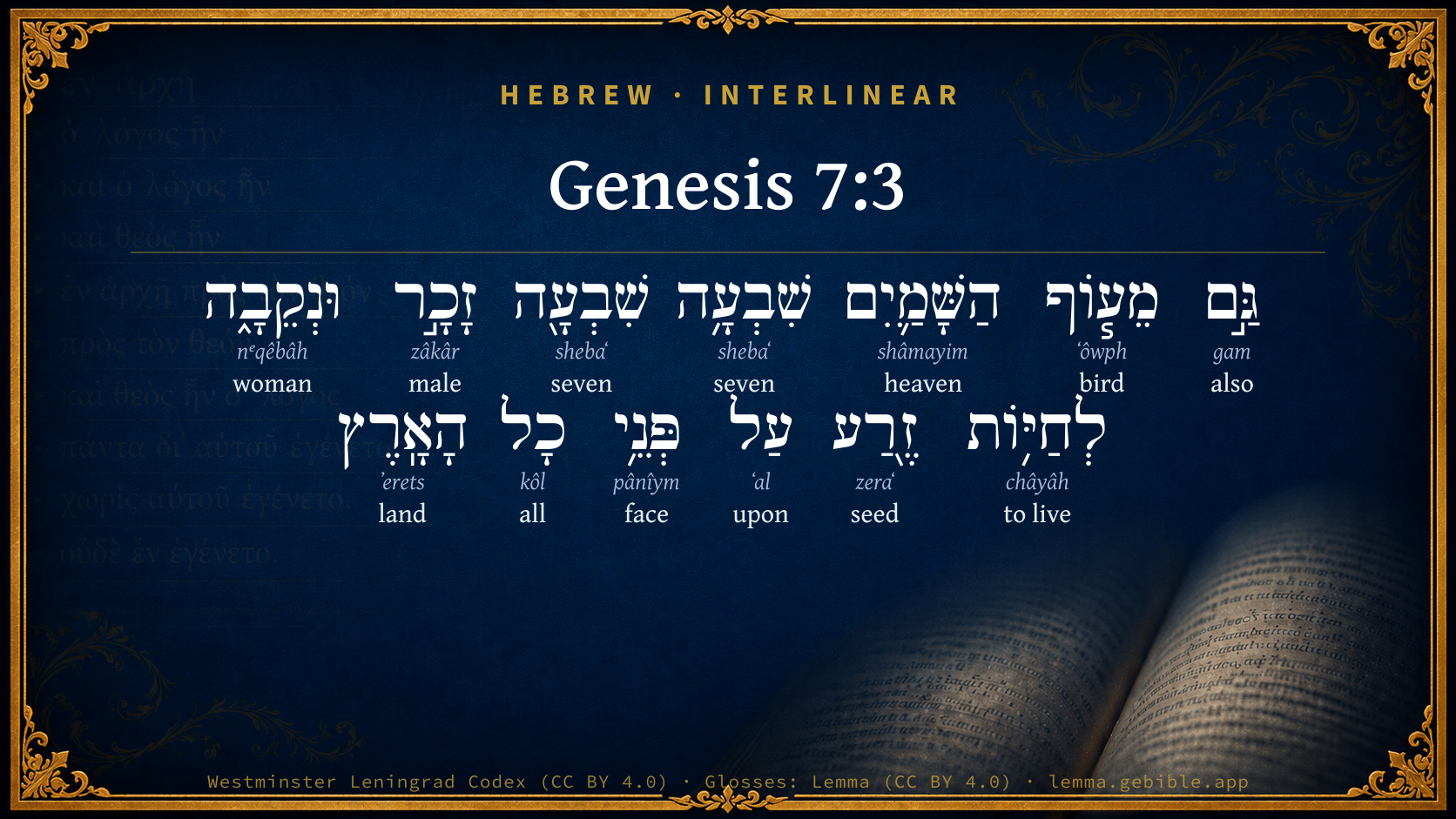
Hebrew (Westminster Leningrad Codex) Genesis 7:3 appears in the Hebrew Old Testament. The text above is from the Westminster Leningrad Codex. Each word links to its Strong’s number, a concise gloss, and parsing drawn from the Open Scriptures Hebrew Bible morphology. Click any word for its full Brown-Driver-Briggs (BDB) entry.
Download image
Cite this verse

Genesis 7:3 (World English Bible). Public Domain. Lemma interlinear Bible study tool, https://lemma.gebible.app/v/genesis/7/3.

Show BibTeX & RIS
BibTeX
RIS
English Translation
Also of the birds of the sky, seven and seven, male and female, to keep seed alive on the surface of all the earth.
World English Bible · Public Domain
Download a study sheet

One document with this verse’s original text, its word-by-word gloss line, the meaning frame, cross-references with their text, attributed commentary, and full source and license credits — printable, and it pastes into notes with its structure intact.

This verse Autodidact and up

Study sheet (.html) Plain text (.txt)

A passage Seminary Student

Up to 50 verses in one chapter. A passage sheet keeps up to 6 commentary sources and 12 cross-references per verse, in the order this page ranks them, and says so on the sheet whenever that leaves anything out. Ask for a single verse and you get the Autodidact verse sheet above.

Everything on this page stays free to read, with no account — the sheet is a download of what is already on screen, not access to it.

Want to remove ads? Support Godless Engineer
Compare translations 3

The same verse in 3 English versions, stacked beneath the original-language interlinear above. Click any original word for its lexicon entry.

Each is an independent rendering of the whole verse — the interlinear is not word-aligned to these translations.

Highlighted words mark where these versions differ — a whole-verse word diff, not a word-by-word alignment.

  • World English Bible Public Domain
    Also of the birds of the sky, seven and seven, male and female, to keep seed alive on the surface of all the earth.
  • King James Version Public Domain
    Of fowls also of the air by sevens, the male and the female; to keep seed alive upon the face of all the earth.
  • unfoldingWord Literal Text CC BY-SA 4.0
    also from bird of the sky seven pairs, male and female, to keep offspring alive on the surface of the whole earth,

unfoldingWord Literal Text — © unfoldingWord, licensed CC BY-SA 4.0. Word-aligned USFM3 via Door43 (git.door43.org/unfoldingWord/en_ult).

Versions to compare (up to 4)

3 of 4 selected

Show all 18 translations

Every available English version of this verse, each an independent rendering of the whole verse.

  • World English Bible Public Domain
    Also of the birds of the sky, seven and seven, male and female, to keep seed alive on the surface of all the earth.
  • Berean Standard Bible Public Domain
    and seven pairs of every kind of bird of the air, male and female, to preserve their offspring on the face of all the earth.
  • Majority Standard Bible Public Domain
    and seven pairs of every kind of bird of the air, male and female, to preserve their offspring on the face of all the earth.
  • King James Version Public Domain
    Of fowls also of the air by sevens, the male and the female; to keep seed alive upon the face of all the earth.
  • American Standard Version (1901) Public Domain
    of the birds also of the heavens, seven and seven, male and female, to keep seed alive upon the face of all the earth.
  • Revised Version (1885) Public Domain
    of the fowl also of the air, seven and seven, male and female: to keep seed alive upon the face of all the earth.
  • Geneva Bible (1599) Public Domain
    Of the foules also of the heauen by seuens, male and female, to keepe seede aliue vpon the whole earth.
  • Douay-Rheims (1899) Public Domain
    But of the beasts that are unclean two and two, the male and female. Of the fowls also of the air seven and seven,the male and the female: that seed may be saved upon the face of the whole earth.
  • Young's Literal Translation Public Domain
    also, of fowl of the heavens seven pairs, a male and a female, to keep alive seed on the face of all the earth;
  • Literal Standard Version CC BY-SA 4.0
    also, seven pairs from [each] bird of the heavens, a male and a female, to keep alive seed on the face of all the earth;
  • Unlocked Literal Bible CC BY-SA 4.0
    Also of the birds of the sky, bring seven males and seven females, to preserve their offspring upon the surface of all the earth.
  • unfoldingWord Literal Text CC BY-SA 4.0
    also from bird of the sky seven pairs, male and female, to keep offspring alive on the surface of the whole earth,
  • Darby Bible Public Domain
    Also of the fowl of the heavens by sevens, male and female; to keep seed alive on the face of all the earth.
  • World Messianic Bible Public Domain
    Also of the birds of the sky, seven and seven, male and female, to keep seed alive on the surface of all the earth.
  • Webster's Bible Public Domain
    Of fowls of the air also by sevens, the male and the female; to keep seed alive on the face of all the earth.
  • Free Bible Version CC BY-SA 4.0
    In addition take seven pairs, male and female, of all the birds, so their different kinds will survive throughout the earth.
  • Bible in Basic English Public Domain
    And of the birds of the air, seven males and seven females, so that their seed may still be living on the face of the earth.
  • JPS Tanakh (1917) Public Domain
    of the fowl also of the air, seven and seven, male and female; to keep seed alive upon the face of all the earth.

Literal Standard Version (2020), Covenant Press — licensed CC BY-SA 4.0. Text via the HelloAO Bible API (eBible.org). Unlocked Literal Bible (unfoldingWord) — licensed CC BY-SA 4.0. Text via the HelloAO Bible API (eBible.org). unfoldingWord Literal Text — © unfoldingWord, licensed CC BY-SA 4.0. Word-aligned USFM3 via Door43 (git.door43.org/unfoldingWord/en_ult). Free Bible Version, Dr. Jonathan Gallagher — licensed CC BY-SA 4.0. Text via the HelloAO Bible API (eBible.org).

Word by word

More ways to search: Search by grammar → Find every occurrence → Compare this word →

Practice this passage: Drill this verse → Learn its vocabulary →

וּנְקֵבָ֑ה
nᵉqêbâh
H5347
“and · woman”
Conjunction + Noun, Common, Feminine, Singular, Absolute
Part of Speech
Conjunction + Noun
Type
Common
Gender
Feminine
Number
Singular
State
Absolute
Full BDB Definition

Origin: from H5344

TWOT: 1409b

female - woman, female child - female animal
  1. גַּ֣ם gam H1571 “also” Particle, Accusative
  2. מֵע֧וֹף ʻôwph H5775 “from · bird of” Preposition + Noun, Common, Masculine, Singular, Construct
  3. הַשָּׁמַ֛יִם shâmayim H8064 “the · heaven(s)” Particle, Definite Article + Noun, Common, Masculine, Plural, Absolute
  4. שִׁבְעָ֥ה shebaʻ H7651 “seven” Adjective, Cardinal number, Masculine, Singular, Absolute
  5. שִׁבְעָ֖ה shebaʻ H7651 “seven” Adjective, Cardinal number, Masculine, Singular, Absolute
  6. זָכָ֣ר zâkâr H2145 “male” Adjective, Adjective, Masculine, Singular, Absolute
  7. לְחַיּ֥וֹת châyâh H2421 “to live” Preposition + Verb, Piel, Infinitive Construct
  8. זֶ֖רַע zeraʻ H2233 “seed” Noun, Common, Masculine, Singular, Absolute
  9. עַל ʻal H5921 “upon” Preposition
  10. פְּנֵ֥י pânîym H6440 “face(s) of” Noun, Common, Both, Plural, Construct
  11. כָל kôl H3605 “all of” Noun, Common, Masculine, Singular, Construct
  12. הָאָֽרֶץ ʼerets H776 “the · land” Particle, Definite Article + Noun, Common, Both, Singular, Absolute

About this verse

These counts appear in no published source. They are computed here, from the morphology-tagged text and Lemma’s own curated glosses. What Lemma adds →

13
words
12
distinct lemmas
Pentateuch
section

Notable vocabulary

The rarest word here is וּנְקֵבָ֑ה woman H5347 — appearing just 22 times in the whole Hebrew Bible.

Shared distinctive vocabulary

וּנְקֵבָ֑ה woman H5347 occurs in 22 verses of the Hebrew Bible. Also found in:

Grammatical profile

  • 1 verb
  • 7 nouns
  • 3 adjectives
  • 1 preposition
  • 1 particle

Verb forms

  • לְחַיּ֥וֹת Piel · Infinitive Construct

Repetition

A word recurs within this verse — often emphatic in Hebrew:

  • שִׁבְעָ֥ה seven H7651 ×2

Hebrew & Septuagint length

In English translation the verse runs 24 words from the Hebrew and 29 from the Septuagint (LXX English) — closely comparable.

A rough comparison of the two English renderings, which tokenize alike — not a word-level alignment.

Word counts can differ between the Hebrew and the Greek without any difference in meaning — e.g. the Hebrew direct-object marker אֵת has no separate Greek word, and Greek often adds the article ὁ.

Hebrew and Greek witnesses Masoretic Hebrew ↔ Greek Septuagint

The same verse in the two great witnesses to the Old Testament, shown verse-for-verse.

These are two independent witnesses, not word-aligned to each other, and the Septuagint is shown in lemma (dictionary) form.

Hebrew Genesis 7:3 Masoretic · Westminster Leningrad Codex

גַּ֣ם מֵע֧וֹף הַשָּׁמַ֛יִם שִׁבְעָ֥ה שִׁבְעָ֖ה זָכָ֣ר וּנְקֵבָ֑ה לְחַיּ֥וֹת זֶ֖רַע עַל פְּנֵ֥י כָל הָאָֽרֶץ

Also of the birds of the sky, seven and seven, male and female, to keep seed alive on the surface of all the earth.

World English Bible · Public Domain

Greek LXX Genesis 7:3 Septuagint · lemma form

καί ἀπό ὁ πετεινόν ὁ οὐρανός ὁ καθαρός ἑπτά ἑπτά ἄρσην καί θῆλυς καί ἀπό ὁ πετεινόν ὁ μή καθαρός δύο δύο ἄρσην καί θῆλυς διατρέφω σπέρμα ἐπί πᾶς ὁ γῆ

And of clean flying creatures of the sky sevens, male and female, and of all unclean flying creatures pairs, male and female, to maintain seed on all the earth.

LXX2012 (modern English Septuagint) · Public Domain

On this verse, The Cambridge Bible for Schools and Colleges discusses the Septuagint’s reading. Read the note in Commentary ↓

Hebrew: Westminster Leningrad Codex (CC BY 4.0). Greek: Septuagint (public domain); English from LXX2012 (modern English Septuagint) (Public Domain). How the Septuagint differs from the Hebrew →

Targum (Aramaic paraphrase)

2

The Targum is the ancient Jewish Aramaic paraphrase of the Hebrew Scriptures — an interpretive translation, not the Hebrew text itself. Onkelos (literal) and Pseudo-Jonathan (expansive) render the Torah, and Jonathan the Prophets. Coverage is partial: where no permissively-licensed English translation exists for a verse, only the Aramaic is shown. This is verse-level text, not a word-by-word alignment to the Hebrew.

  1. Targum Onkelos Torah (Genesis–Deuteronomy)
    אַף מֵעוֹפָא דִשְׁמַיָּא שַׁבְעָא שַׁבְעָא דְּכַר וְנוּקְבָא לְקַיָּמָא זַרְעָא עַל אַפֵּי כָל אַרְעָא

    Also of the fowls of heaven, seven and seven, male and female, to continue the seed upon the face of all the earth.

    Targum Onkelos — Aramaic: “Onkelos Genesis” (public domain); “Onkelos Exodus” (public domain); “Onkelos Leviticus” (public domain); “Onkelos Numbers” (public domain); “Onkelos Deuteronomy” (public domain). English: “Sefaria Community Translation” (CC0 1.0 (public-domain dedication)); “J.W. Etheridge. The Targums of Onkelos and Jonathan Ben Uzziel on the Pentateuch. London: Longmans, Green, 1862” (public domain). Text via Sefaria.

  2. Targum Pseudo-Jonathan Torah (Genesis–Deuteronomy)
    בְּרַם מִן צִפְּרֵי שְׁמַיָא שׁוּבְעָא שׁוּבְעָא דְכַר וְנֻקְבָא לְקַיָימָא מִנְהוֹן זַרְעָא עַל אַרְעָא

    But of birds of the heaven, seven by seven, male and female, to preserve from them seed upon the earth.

    Targum Pseudo-Jonathan — Aramaic: “Targum Jonathan on Genesis” (public domain); “Targum Jonathan on Exodus” (public domain); “Targum Jonathan on Leviticus” (public domain); “Targum Jonathan on Numbers” (public domain); “Targum Jonathan on Deuteronomy” (public domain). English: “The Targum of Jonathan ben Uzziel, trans. J. W. Etheridge, London, 1862” (public domain). Text via Sefaria.

Commentary

Notes on Genesis 7:3 from classic Christian and Jewish commentators (each source and its license shown beneath its notes). The classic Christian expositions comment on the surrounding passage and are grouped to its opening verse, so a note may address several verses; the Jewish commentaries on the Tanakh (Rashi and others) are per-verse, so they appear only where the commentator wrote on this verse.

Lemma curates 59 commentaries, every one of them public domain or Creative Commons licensed, each selected and text-cleaned for this edition rather than reprinted as found. About our sources →

Trapp's Complete Commentary

John Trapp

Gen 7:3 Of fowls also of the air by sevens, the male and the female; to keep seed alive upon the face of all the earth.

Ver. 3. Of fowls also.] Such as are of clean kinds, as R. Solomon senseth it. The eagle and the lion were not for sacrifice; like as were the lamb and the dove. "Not many mighty," &c. {1Co 1:26}

John Trapp, A Commentary or Exposition upon All the Books of the Old and New Testament (1647–1656) — public domain. Text from a community e-Sword module.

John Calvin's Commentaries

3. To keep seed alive upon the face of all the earth. That is, that hence offspring might be born. But this is referred to Noah; for although, properly speaking, God alone gives life, yet God here refers to those duties which he had enjoined upon his servant: and it is with respect to his appointed office, that God commands him to collect animals that he may keep seed alive. Nor is this extraordinary, seeing that the ministers of the gospel are said, in a sense, to confer spiritual life. In the clause which next follows, upon the face of all the earth, there is a twofold consolation: that the waters, after they had covered the earth for a time, would again cease, so that the dry surface of the earth should appear; and then, that not only should Noah himself survive, but, by the blessing of God, the number of animals should be so increased, as to spread far and wide through the whole world. Thus, in the midst of ruin, future restoration is promised to him. Moses is very earnest in showing that God took care, by every means, to retain Noah in obedience to his word, and that the holy man entirely acquiesced. This doctrine is very useful, especially when God either promises or threatens anything incredible, since men do not willingly receive what seems to them improbable. For nothing was less accordant with the judgment of the flesh, than that the world should be destroyed by its Creator; because this was to subvert the whole order of nature which he had established. Wherefore, unless Noah had been well admonished of this terrible judgment of God, he never would have ventured to believe it; lest he should conceive of God as acting in contradiction to himself. The word היקום (hayekom,) which Moses here uses has its origin from a word signifying to stand; but it properly means whatever lives and flourishes.

John Calvin's Commentaries (1540-1563) — public domain. Text from the Calvin Translation Society English edition (1840s-50s) via the Christian Classics Ethereal Library (ccel.org). Calvin's coverage is partial (roughly two-thirds of the Bible); uncommented books and verses are honest gaps, never fabricated. The 19th-century editor's footnotes and remarks are omitted so the notes are faithfully Calvin's own voice.

The Cambridge Bible for Schools and Colleges

gen. ed. J. J. S. Perowne

3. the fowl] Apparently, according to the Hebrew text, all the birds were regarded as clean. Possibly, however, the omission of the distinction between clean and unclean birds is due to the condensed form of the narrative. LXX reads “of fowl also of the air that are clean, seven and seven, male and female,” and of “fowl that are not clean, two and two, male and female.”

And it is very possible that this last clause has been dropped, through the common error of homoeoteleuton on the part of a scribe.

to keep seed alive] viz. “to maintain life,” and “to propagate the species,” literally, “to make seed to live.” The ideas are combined of continuance by breeding and of preservation from destruction: LXX διαθρέψαι σπέρμα gives the one; the Lat. ut salvetur semen, the other.

The Cambridge Bible for Schools and Colleges (gen. ed. J. J. S. Perowne; Cambridge University Press, 1878–1918) — public domain. Text from a community e-Sword module.

John Gill's Exposition

Of fowls also of the air by sevens, the male and his female,.... That is, of such as were clean; seven couple of these were to be brought into the ark, for the like use as of the clean beasts, and those under the law; and so at this time, and here meant were turtledoves, and young pigeons that were for sacrifice; and the rest were for food: and the design of bringing both into the ark was:

to keep seed alive upon the face of all the earth; that the species of creatures might be continued, both of beasts and birds, clean and unclean.

John Gill's Exposition of the Whole Bible (1746–1763) — public domain (CC PDM 1.0). Text via the HelloAO Bible API.

Matthew Poole's English Annotations

Of clean fowls, which he leaves to be understood out of the foregoing verse,

by sevens; and of the unclean, by two; as before of the beasts,

to keep seed alive, i.e. the issue or breed of them.

Matthew Poole's English Annotations on the Holy Bible (1683–1685) — public domain. Text from a community e-Sword/MySword module.

The Pulpit Commentary

Of fowls also of the air by sevens, the male and the female. Ie. of clean fowls, "which he leaves to be understood out of the foregoing verse" (Peele). The Samaritan, Syriac, and LXX (not so Vulgate, Onkelos, Arabic) insert the word "clean unnecessarily, and also add," kai ajpontwn twn peteinwn twnn mho duo arsen kai qhlu," manifestly to make the verse resemble the preceding. To keep seed alive upon the face of all the earth.

The Pulpit Commentary (1880–1919), ed. H.D.M. Spence-Jones & Joseph S. Exell — public domain. Text from a community e-Sword module.

Rashi

Rabbi Shlomo Yitzchaki (Rashi)

‘גס מעוף השמים וגו OF FOWLS ALSO OF THE AIR — Scripture here means “clean” birds just as the animals in verse 2 are stated to be clean, for what is not explicitly stated may be learned by analogy from what is explicitly stated.

Rashi on the Tanakh — English translations: “The Judaica Press complete Tanach with Rashi, translated by A. J. Rosenberg” (CC BY 4.0); “Pentateuch with Rashi's commentary by M. Rosenbaum and A.M. Silbermann, 1929-1934” (public domain); “The Metsudah Tanach series, Lakewood, N.J” (CC BY 4.0); and “The Book of Joshua, Metsudah Publications, 1997” (CC BY 4.0). Text via Sefaria.

Radak

Rabbi David Kimhi (Radak)

גם מעוף השמים, we have explained this already on the previous verse. The meaning of the words: על פני כל הארץ, is similar to what we explained in connection with this expression in Genesis 1,25, where it meant that the animals concerned were distributed across all different parts of the globe.

Radak on the Tanakh — English translations: “Sefaria Community Translation” (CC0 1.0 (public-domain dedication)); “Eliyahu Munk, HaChut Hameshulash” (CC BY 4.0); “Rabbi Mike Feuer, Jerusalem Anthology” (CC BY 4.0); and “R. David Kimhi on the first book of Psalms, Translated by R.G. Finch, London, 1919” (public domain). Text via Sefaria.

Lesson kit

Teaching starters — assembled from the data on this page, not authored interpretation. Every prompt links to the verse data it draws on. Edit before teaching.

Genesis, in the Pentateuch, opens this verse with 13 words (12 distinct Hebrew lemmas). Its most distinctive word is nᵉqêbâh (“woman”). A historical commentator’s framing appears above. Read the whole chapter for the surrounding context.

Discussion questions

  1. What does “woman” (nᵉqêbâh) contribute to the verse as a whole?
  2. Genesis 1:27 shares the word «woman» with this verse. How do the two illuminate each other?
  3. “seven” occurs 2× in this one verse. What is the effect of the repetition?
  4. The translations on this page render this verse differently — a whole-verse word diff, not a word-by-word alignment. What might account for the different wordings?
  5. The verb «לְחַיּ֥וֹת» is Piel Infinitive Construct. How does its form color the action?
  6. Reading how Trapp's Complete Commentary and John Calvin's Commentaries read this verse, where do the two commentators agree and where do they part?

Things to notice

Reading settings

Reading text

Shown beneath each verse's original-language words.

Old Testament
Old Testament edition

Read the OT as the Masoretic Hebrew (MT) or the Greek Septuagint (LXX).

English shown for the Greek Septuagint (in the Hebrew ↔ Greek comparison).

Comparing translations? Open the Compare panel on any verse page to stack up to four side by side.