Judges 20:16

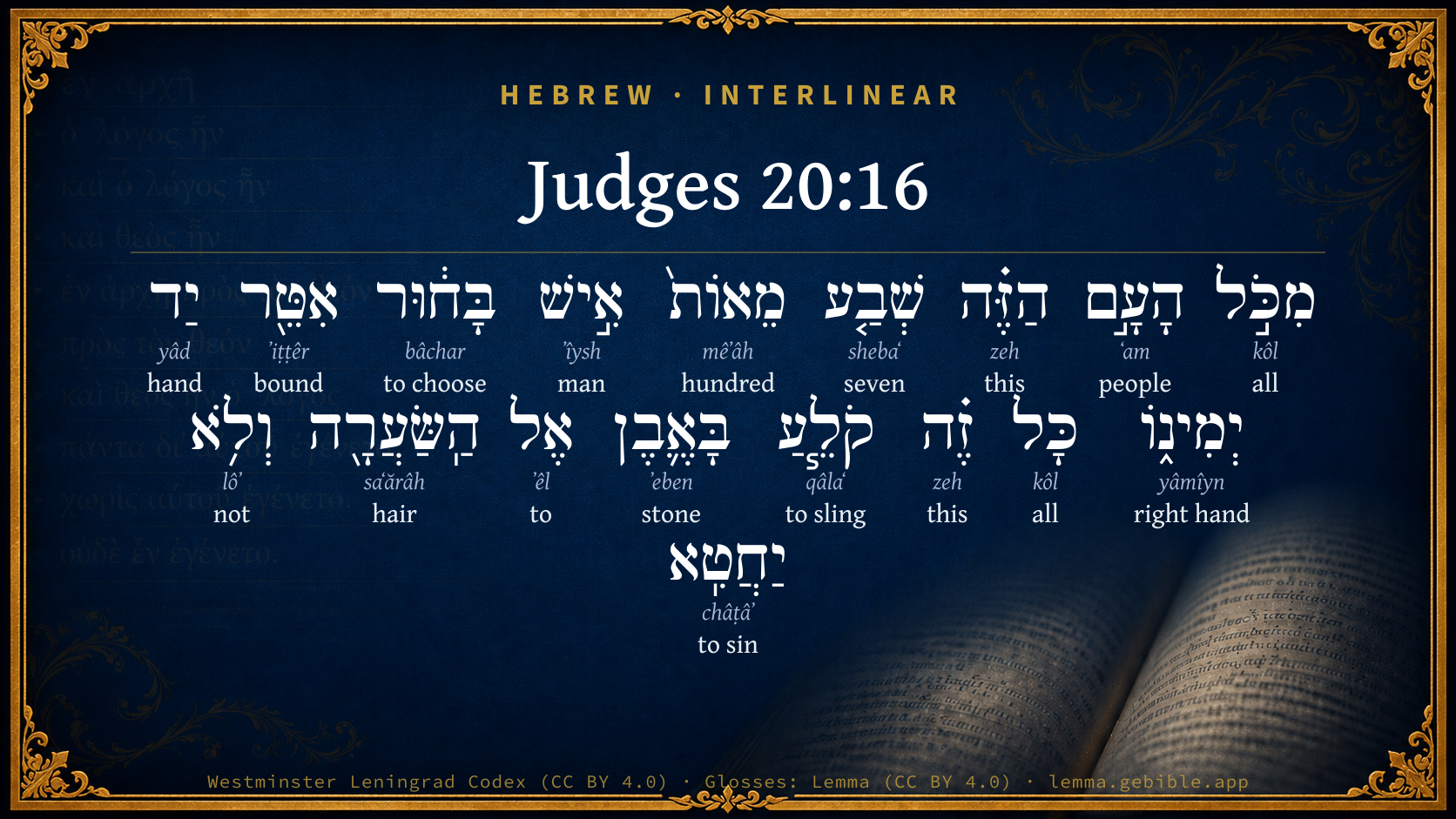
Hebrew (Westminster Leningrad Codex) Judges 20:16 appears in the Hebrew Old Testament. The text above is from the Westminster Leningrad Codex. Each word links to its Strong’s number, a concise gloss, and parsing drawn from the Open Scriptures Hebrew Bible morphology. Click any word for its full Brown-Driver-Briggs (BDB) entry.
Download image
Cite this verse

Judges 20:16 (World English Bible). Public Domain. Lemma interlinear Bible study tool, https://lemma.gebible.app/v/judges/20/16.

Show BibTeX & RIS
BibTeX
RIS
English Translation
Among all this people there were seven hundred chosen men left-handed; everyone could sling stones at a hair-breadth, and not miss.
World English Bible · Public Domain
Highlights Full analysis ↓
Download a study sheet

One document with this verse’s original text, its word-by-word gloss line, the meaning frame, cross-references with their text, attributed commentary, and full source and license credits — printable, and it pastes into notes with its structure intact.

This verse Autodidact and up

Study sheet (.html) Plain text (.txt)

A passage Seminary Student

Up to 50 verses in one chapter. A passage sheet keeps up to 6 commentary sources and 12 cross-references per verse, in the order this page ranks them, and says so on the sheet whenever that leaves anything out. Ask for a single verse and you get the Autodidact verse sheet above.

Everything on this page stays free to read, with no account — the sheet is a download of what is already on screen, not access to it.

Want to remove ads? Support Godless Engineer
Compare translations 3

The same verse in 3 English versions, stacked beneath the original-language interlinear above. Click any original word for its lexicon entry.

Each is an independent rendering of the whole verse — the interlinear is not word-aligned to these translations.

Highlighted words mark where these versions differ — a whole-verse word diff, not a word-by-word alignment.

  • World English Bible Public Domain
    Among all this people there were seven hundred chosen men left-handed; everyone could sling stones at a hair-breadth, and not miss.
  • King James Version Public Domain
    Among all this people there were seven hundred chosen men lefthanded; every one could sling stones at an hair breadth, and not miss.
  • unfoldingWord Literal Text CC BY-SA 4.0
    Among all of this people 700, a chosen man, impeded in his right hand, each of them slinging with a stone at a hair and he would not miss.

unfoldingWord Literal Text — © unfoldingWord, licensed CC BY-SA 4.0. Word-aligned USFM3 via Door43 (git.door43.org/unfoldingWord/en_ult).

Versions to compare (up to 4)

3 of 4 selected

Show all 18 translations

Every available English version of this verse, each an independent rendering of the whole verse.

  • World English Bible Public Domain
    Among all this people there were seven hundred chosen men left-handed; everyone could sling stones at a hair-breadth, and not miss.
  • Berean Standard Bible Public Domain
    Among all these soldiers there were 700 select left-handers, each of whom could sling a stone at a hair without missing.
  • Majority Standard Bible Public Domain
    Among all these soldiers there were 700 select left-handers, each of whom could sling a stone at a hair without missing.
  • King James Version Public Domain
    Among all this people there were seven hundred chosen men lefthanded; every one could sling stones at an hair breadth, and not miss.
  • American Standard Version (1901) Public Domain
    Among all this people there were seven hundred chosen men lefthanded; every one could sling stones at a hair-breadth, and not miss.
  • Revised Version (1885) Public Domain
    Among all this people there were seven hundred chosen men lefthanded; every one could sling stones at an hair-breadth, and not miss.
  • Geneva Bible (1599) Public Domain
    Of all this people were seuen hundreth chosen men, being left handed: all these could sling stones at an heare breadth, and not faile.
  • Douay-Rheims (1899) Public Domain
    Who were seven hundred most valiant men, fighting with the left hand as well as with the right: and slinging stones so sure that they could hit even a hair, and not miss by the stone's going on either side.
  • Young's Literal Translation Public Domain
    among all this people `are' seven hundred chosen men, bound of their right hand, each of these slinging with a stone at the hair, and he doth not err.
  • Literal Standard Version CC BY-SA 4.0
    among all this people [are] seven hundred chosen men, their right hand bound, each of these slinging with a stone at the hair, and he does not err.
  • Unlocked Literal Bible CC BY-SA 4.0
    Among all these soldiers were seven hundred chosen men who were left-handed. Each of them could sling a stone at a hair and not miss.
  • unfoldingWord Literal Text CC BY-SA 4.0
    Among all of this people 700, a chosen man, impeded in his right hand, each of them slinging with a stone at a hair and he would not miss.
  • Darby Bible Public Domain
    Among all these were seven hundred picked men who were left-handed; every one could sling a stone at a hair, and not miss.
  • World Messianic Bible Public Domain
    Among all these soldiers there were seven hundred chosen men who were left-handed. Every one of them could sling a stone at a hair and not miss.
  • Webster's Bible Public Domain
    Among all this people there were seven hundred chosen men left-handed; every one could sling stones to a hair-breadth, and not miss.
  • Free Bible Version CC BY-SA 4.0
    Making up part of this army were seven hundred experienced soldiers who used their left hands. All of them could fire a slingshot and not miss by even a hair's breadth.
  • Bible in Basic English Public Domain
    Who were left-handed, able to send a stone at a hair without error.
  • JPS Tanakh (1917) Public Domain
    All this people, even seven hundred chosen men, were left-handed; every one could sling stones at a hair-breadth, and not miss.

Literal Standard Version (2020), Covenant Press — licensed CC BY-SA 4.0. Text via the HelloAO Bible API (eBible.org). Unlocked Literal Bible (unfoldingWord) — licensed CC BY-SA 4.0. Text via the HelloAO Bible API (eBible.org). unfoldingWord Literal Text — © unfoldingWord, licensed CC BY-SA 4.0. Word-aligned USFM3 via Door43 (git.door43.org/unfoldingWord/en_ult). Free Bible Version, Dr. Jonathan Gallagher — licensed CC BY-SA 4.0. Text via the HelloAO Bible API (eBible.org).

Word by word

More ways to search: Search by grammar → Find every occurrence → Compare this word →

Practice this passage: Drill this verse → Learn its vocabulary →

אִטֵּ֖ר
ʼiṭṭêr
H334
“bound of”
Adjective, Adjective, Masculine, Singular, Construct
Part of Speech
Adjective
Type
Adjective
Gender
Masculine
Number
Singular
State
Construct
Full BDB Definition

Origin: from H332

TWOT: 74a

bound, impeded (on the right, i.e., left-handed), shut, shut up
  1. מִכֹּ֣ל kôl H3605 “from · all of” Preposition + Noun, Common, Masculine, Singular, Construct
  2. הָעָ֣ם ʻam H5971 “the · people” Particle, Definite Article + Noun, Common, Masculine, Singular, Absolute
  3. הַזֶּ֗ה zeh H2088 “the · this” Particle, Definite Article + Pronoun, Demonstrative, Masculine, Singular
  4. שְׁבַ֤ע shebaʻ H7651 “seven” Adjective, Cardinal number, Feminine, Singular, Absolute
  5. מֵאוֹת֙ mêʼâh H3967 “hundred” Adjective, Cardinal number, Both, Plural, Absolute
  6. אִ֣ישׁ ʼîysh H376 “man” Noun, Common, Masculine, Singular, Absolute
  7. בָּח֔וּר bâchar H977 “chosen” Verb, Qal, Participle Passive, Masculine, Singular, Absolute
  8. יַד yâd H3027 “hand of” Noun, Common, Both, Singular, Construct
  9. יְמִינ֑וֹ yâmîyn H3225 “right hand · his” Noun, Common, Feminine, Singular, Construct + Suffix, Personal, 3rd Person, Masculine, Singular
  10. כָּל kôl H3605 “all of” Noun, Common, Masculine, Singular, Construct
  11. זֶ֗ה zeh H2088 “this” Pronoun, Demonstrative, Masculine, Singular
  12. קֹלֵ֧עַ qâlaʻ H7049 “slinging” Verb, Qal, Participle Active, Masculine, Singular, Absolute
  13. בָּאֶ֛בֶן ʼeben H68 “in/at the · stone” Preposition, Determined + Noun, Common, Feminine, Singular, Absolute
  14. אֶל ʼêl H413 “to” Preposition
  15. הַֽשַּׂעֲרָ֖ה saʻărâh H8185 “the · hair” Particle, Definite Article + Noun, Common, Feminine, Singular, Absolute
  16. וְלֹ֥א lôʼ H3808 “and · not” Conjunction + Particle, Negative
  17. יַחֲטִֽא châṭâʼ H2398 “to sin” Verb, Hiphil, Imperfect, 3rd Person, Masculine, Singular

About this verse

These counts appear in no published source. They are computed here, from the morphology-tagged text and Lemma’s own curated glosses. What Lemma adds →

18
words
16
distinct lemmas
Historical
section

Notable vocabulary

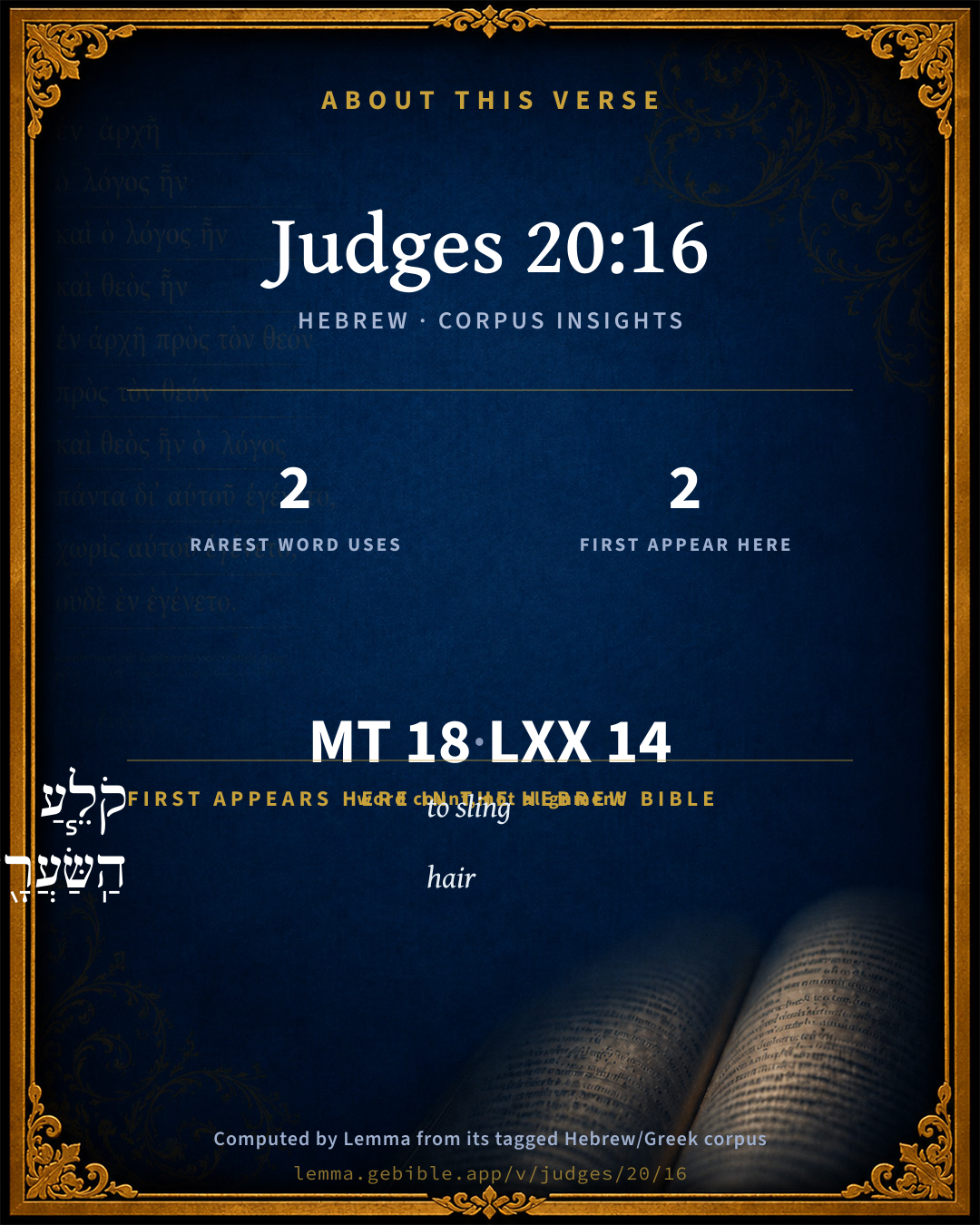
The rarest word here is אִטֵּ֖ר bound H334 — appearing just 2 times in the whole Hebrew Bible.

First appearance in Scripture

These words make their first canonical appearance in the Hebrew Bible here:

  • קֹלֵ֧עַ to sling H7049
  • הַֽשַּׂעֲרָ֖ה hair H8185

Shared distinctive vocabulary

אִטֵּ֖ר bound H334 occurs in 2 verses of the Hebrew Bible. Also found in:

Grammatical profile

  • 3 verbs
  • 8 nouns
  • 3 adjectives
  • 2 pronouns
  • 1 preposition
  • 1 particle

Verb forms

  • בָּח֔וּר Qal · Participle Passive
  • קֹלֵ֧עַ Qal · Participle Active
  • יַחֲטִֽא Hiphil · Imperfect

Repetition

Words recur within this verse — often emphatic in Hebrew:

  • מִכֹּ֣ל all H3605 ×2
  • הַזֶּ֗ה this H2088 ×2

Hebrew & Septuagint length

In English translation the verse runs 21 words from the Hebrew and 12 from the Septuagint (LXX English) — the Septuagint runs noticeably shorter here. See the side-by-side →

A rough comparison of the two English renderings, which tokenize alike — not a word-level alignment.

Word counts can differ between the Hebrew and the Greek without any difference in meaning — e.g. the Hebrew direct-object marker אֵת has no separate Greek word, and Greek often adds the article ὁ.

In the original languages it is 18 Hebrew tokens and 14 Greek tokens — but the two are counted differently (Hebrew bundles its prefixes and suffixes into one token; the Greek is in lemma form), so that isn’t a like-for-like length.

Cross-references

6

Topical passages linked to Judges 20:16 in the Treasury of Scripture Knowledge — connected by theme and wording, ordered by reader-vote popularity; previews shown in the World English Bible.

  • Judges 3:15 But when the children of Israel cried to Yahweh, Yahweh raised them up a savior, Ehud the son of Gera, the Benjamite, a man left-handed. The children of Israel sent tribute by him to Eglon the king of Moab.
  • 1 Chronicles 12:2 They were armed with bows, and could use both the right hand and the left in slinging stones and in shooting arrows from the bow: they were of Saul's brothers of Benjamin.
  • 1 Samuel 17:40 He took his staff in his hand, and chose him five smooth stones out of the brook, and put them in the shepherd's bag which he had, even in his wallet; and his sling was in his hand: and he drew near to the Philistine.
  • 1 Samuel 17:49–50 David put his hand in his bag, and took there a stone, and slang it, and struck the Philistine in his forehead; and the stone sank into his forehead, and he fell on his face to the earth.
  • 1 Samuel 25:29 Though men be risen up to pursue you, and to seek your soul, yet the soul of my lord shall be bound in the bundle of life with Yahweh your God; and the souls of your enemies, them shall he sling out, as from the hollow of a sling.
  • 2 Chronicles 26:14 Uzziah prepared for them, even for all the host, shields, and spears, and helmets, and coats of mail, and bows, and stones for slinging.

Cross-references courtesy of OpenBible.info (CC BY 4.0).

Hebrew and Greek witnesses Masoretic Hebrew ↔ Greek Septuagint

The same verse in the two great witnesses to the Old Testament, shown verse-for-verse.

Here the Septuagint runs noticeably shorter than the Hebrew — LXX2012 (modern English Septuagint) 12 words vs World English Bible 21. A rough length comparison of the two English translations, not a word-level alignment — read both below.

These are two independent witnesses, not word-aligned to each other, and the Septuagint is shown in lemma (dictionary) form.

Hebrew Judges 20:16 Masoretic · Westminster Leningrad Codex

מִכֹּ֣ל הָעָ֣ם הַזֶּ֗ה שְׁבַ֤ע מֵאוֹת֙ אִ֣ישׁ בָּח֔וּר אִטֵּ֖ר יַד יְמִינ֑וֹ כָּל זֶ֗ה קֹלֵ֧עַ בָּאֶ֛בֶן אֶל הַֽשַּׂעֲרָ֖ה וְלֹ֥א יַחֲטִֽא

Among all this people there were seven hundred chosen men left-handed; everyone could sling stones at a hair-breadth, and not miss.

World English Bible · Public Domain

Greek LXX Judges 20:16 Septuagint · lemma form

ἐκ πᾶς λαός ἀμφοτεροδέξιος πᾶς οὗτος σφενδονήτης ἐν λίθος πρός θρίξ καί οὐ ἐκἁμαρτάνω

All these could sling with stones at a hair, and not miss.

LXX2012 (modern English Septuagint) · Public Domain

On this verse, Ellicott's Commentary for English Readers discusses the Septuagint’s reading. Read the note in Commentary ↓

Hebrew: Westminster Leningrad Codex (CC BY 4.0). Greek: Septuagint (public domain); English from LXX2012 (modern English Septuagint) (Public Domain). How the Septuagint differs from the Hebrew →

Targum (Aramaic paraphrase)

1

The Targum is the ancient Jewish Aramaic paraphrase of the Hebrew Scriptures — an interpretive translation, not the Hebrew text itself. Onkelos (literal) and Pseudo-Jonathan (expansive) render the Torah, and Jonathan the Prophets. Coverage is partial: where no permissively-licensed English translation exists for a verse, only the Aramaic is shown. This is verse-level text, not a word-by-word alignment to the Hebrew.

  1. Targum Jonathan Prophets (Joshua–Malachi)
    מִכָּל עַמָא הָדֵין שְׁבַע מְאָה גְבַר עוּלֵים גַבְרָא גְמִיד בִּידֵיהּ דְיַמִינָא כָּל אִלֵין דְשָׁדָן אַבְנָא בְקִלְעָא וּמַרְמָן בְּבִינַת שַׂעֲרָא וְלָא מְשַׁנָן:

    (no public-domain English translation for this verse)

    Targum Jonathan — Aramaic: “Mikraot Gedolot” (public domain). English: “Sefaria Community Translation” (CC0 1.0 (public-domain dedication)); “London "Chaldee Paraphrase," 1871” (public domain). Text via Sefaria.

Commentary

Notes on Judges 20:16 from classic Christian and Jewish commentators (each source and its license shown beneath its notes). The classic Christian expositions comment on the surrounding passage and are grouped to its opening verse, so a note may address several verses; the Jewish commentaries on the Tanakh (Rashi and others) are per-verse, so they appear only where the commentator wrote on this verse.

Lemma curates 59 commentaries, every one of them public domain or Creative Commons licensed, each selected and text-cleaned for this edition rather than reprinted as found. About our sources →

Trapp's Complete Commentary

John Trapp

Jdg 20:16 Among all this people [there were] seven hundred chosen men lefthanded; every one could sling stones at an hair [breadth], and not miss.

Ver. 16. Lefthanded; every one could sling stones, &c.] See Jdg 3:15. David had an excellency in slinging: so had Domitian and Commodus the Emperors. The Indians are much commended for their faculty herein by Philostratus and Plutarch. The Boeotians and the Baleares in Spain were bred up to it of children, their mothers allowing them no more meat than they could hit with a sling stone. We have musketeers amongst us that are notable marksmen, as they call them.

John Trapp, A Commentary or Exposition upon All the Books of the Old and New Testament (1647–1656) — public domain. Text from a community e-Sword module.

Joseph Benson's Commentary

Jdg 20:16. Could sling stones at a hair’s breadth, and not miss — A hyperbolical expression, signifying that they could do this with great exactness. This extraordinary skill in their arms (for it is likely they handled other weapons with the like dexterity) and their natural courage, imboldened the Benjamites with such a small number to undertake a war against such a vast multitude of their brethren, the other Israelites; which warlike disposition of theirs was foretold by Jacob, for he said of them, when he spake of the character and fortune of each tribe, (Gen 49:27,) Benjamin shall raven as a wolf, which is an undaunted, fearless creature.

Joseph Benson's Commentary on the Old and New Testaments (1811–1818) — public domain. Text from a community e-Sword module.

Jamieson, Fausset & Brown

Robert Jamieson, A. R. Fausset & David Brown

left-handed; every one could sling stones at an hair-breadth, and not miss--The sling was one of the earliest weapons used in war. The Hebrew sling was probably similar to that of the Egyptian, consisting of a leather thong, broad in the middle, with a loop at one end, by which it was firmly held with the hand; the other end terminated in a lash, which was let slip when the stone was thrown. Those skilled in the use of it, as the Benjamites were, could hit the mark with unerring certainty. A good sling could carry its full force to the distance of two hundred yards.

Jamieson, Fausset & Brown — Commentary Critical and Explanatory on the Whole Bible (1871) — public domain (CC PDM 1.0). Text via the HelloAO Bible API.

Adam Clarke's Commentary

Verse 16. Left-handed] They were ambidexters - could use the right hand and the left with equal ease and effect. See Clarke on Jud 3:15.

Could sling stones at a hair - and not miss] ולא יחטא velo yachati, and not sin: και ουκ εξαμαρτανοντες; Sept. Here we have the true import of the term sin; it signifies simply to miss the mark, and is well translated in the New Testament by αμαρτανω, from α, negative, and μαρπτω, to hit the mark. Men miss the mark of true happiness in aiming at sensual gratifications; which happiness is to be found only in the possession and enjoyment of the favour of God, from whom their passions continually lead them. He alone hits the mark, and ceases from sin, who attains to God through Christ Jesus.

It is worthy of remark that the Persian [Persian] khuta kerden, which literally signifies to sin or mistake, is used by the Mohammedans to express to miss the mark.

The sling was a very ancient warlike instrument, and, in the hands of those who were skilled in the use of it, it produced astonishing effects. The inhabitants of the isles called Baleares, now Majorca and Minorca, were the most celebrated slingers of antiquity. They did not permit their children to break their fast till they had struck down the bread they were to eat from the top of a pole, or some distant eminence. They had their name Baleares from the Greek word βαλλειν to dart, cast, or throw.

Concerning the velocity of the ball out of the sling, there are strange and almost incredible things told by the ancients. The leaden ball, when thus projected, is said to have melted in its course. So OVID, Met. lib. ii.. ver. 726.

Obstupuit forma Jove natus: et aethere pendens

Non secus exarsit, quam cum balearica plumbum

Funda jacit; volat illud, et incandescit eundo;

Et, quos non habuit, sub nubibus invenit ignes.

Hermes was fired as in the clouds he hung;

So the cold bullet that, with fury slung

From Balearic engines, mounts on high,

Glows in the whirl, and burns along the sky.

DRYDEN.

This is not a poetic fiction; SENECA, the philosopher, in lib. iii. Quaest. Natural., c. 57, says the same thing: Sic liquescit excussa glans funda, et adtritu aeris velut igne distillat; "Thus the ball projected from the sling melts, and is liquefied by the friction of the air, as if it were exposed to the action of fire." I have often, by the sudden and violent compression of the air, produced fire; and by this alone inflamed tinder, and lighted a match.

Vegetius de Re Militari, lib. ii., cap. 23, tells us that slingers could in general hit the mark at six hundred feet distance. Funditores scopas-pro signo ponebant; ita ut SEXCENTOS PEDES removerentur a signo-signum saepius tangerent. These things render credible what is spoken here of the Benjamite slingers.

Adam Clarke's Commentary on the Bible (1810–1826) — public domain. Text from a community e-Sword/MySword module.

Ellicott's Commentary for English Readers

(16) Seven hundred chosen men.—These words are omitted in the LXX. and Vulg.

Left handed.—The same phrase as that employed in Jdg_3:15.

Could sling stones at an hair breadth, and not miss.—The expression is perfectly simple, and merely implies extreme accuracy of aim. Bochart’s attempt (Hieroz. Ii. 162) to explain it by a passage in Quintus Smyrnœus, which says that archers used to contend which should be able to shoot off the horsehair crest of a helmet, is a mere specimen of learning fantastically misapplied. Skill with the sling was not confined to the Benjamites, as we see from the case of David (1Sa_17:49). The sling is the natural weapon of a people which is poor and imperfectly armed. Cyrus valued his force of 400 slingers (Xen. Anab. iii. 3-6). The inhabitants of the Balearic Isles were as skilful as the Benjamites, and children were trained to sling their breakfasts down from the top of high poles. They once prevented the Carthaginian fleet from coming to anchor by showers of stones (liv. xxviii. 37, solo eo telo utebantur). Practice made them so expert that the stones they slung came with as much force as though hurled by a catapult, and pierced shields and helmets (Diod. Sic. Bibl. v. 18). Exactly similar tales are told of the trained skill of our English archers. The advantage of slinging with the left hand was very obvious, for it enabled the slinger to strike his enemy on the right, i.e., the undefended side.

A Bible Commentary for English Readers, edited by Charles John Ellicott (1878–1897) — public domain. Text from a community e-Sword module.

The Cambridge Bible for Schools and Colleges

gen. ed. J. J. S. Perowne

16. Then, keeping the text of this v. as it stands, we are told that the Benjamite host included a company of 700 left-handed and exceptionally skilful warriors, just as David’s army was strengthened by a similar band, 1Ch_12:2. Josephus understood the narrative in this way, Ant. Jdg_20:2; Jdg_20:10. The alternative is to omit the first half of this verse, and make the 700 chosen men refer to the inhabitants of Gibeah, and every one (rather, all this army) could sling … and not miss refer to the entire host. But this does not seem natural, and to cut out left-handed as merely borrowed from Jdg_3:15 is to remove a feature which has the appearance of originality.

The Cambridge Bible for Schools and Colleges (gen. ed. J. J. S. Perowne; Cambridge University Press, 1878–1918) — public domain. Text from a community e-Sword module.

John Gill's Exposition

Among all this people there were seven hundred chosen men lefthanded,.... According to Ben Gersom, these were the seven hundred men of Gibeah; but this does not appear from the text, but, on the contrary, that these were among all the people; or there were so many to be selected out of them all, who were lefthanded men; nor is it likely that all the inhabitants of one place should be such. Benjamin signifies a son of the right hand, yet this tribe had a great number of lefthanded men in it, see Jdg 3:15. Josephus (h) wrongly reduces the number to five hundred:

everyone could sling stones at an hair's breadth, and not miss: the mark they slung the stone at, so very expert were they at it; and perhaps their having such a number of skilful men in this art made them more confident of success, and emboldened them in this daring undertaking, to point to which this circumstance seems to be mentioned. There were a people that inhabited the islands, now called Majorca and Minorca, anciently Baleares, from their skilfulness in slinging stones, to which they brought up from their childhood, as it is related various writers, Strabo (i), Diodorus Siculus (k), Floras (l) and others (m); that their mothers used to set their breakfast on a beam or post, or some such thing, at a distance, which they were not to have, unless they could strike it off; and the first of these writers says, that they exercised this art from the time that the Phoenicians held these islands; and, according to Pliny (n), the Phoenicians, the old inhabitants of Canaan, were the first inventors of slings, and from these the Benjaminites might learn it. The Indians are said (o) to be very expert in slinging stones to an hair's breadth.

(h) Antiqu. l. 5. c. 2. sect. 10. (i) Geograph l. 3. p. 116. (k) Bibliothec. l. 5. p. 298. (l) Roman Cost. l. 3. c. 8. (m) Vid. Barthii Ammadv. ad Claudian. in 3 Consul. Honor. ver. 50. (n) Nat. Hist. l. 7. c. 56. (o) Philoetrat. Vit. Apollon. l. 2. c. 12.

John Gill's Exposition of the Whole Bible (1746–1763) — public domain (CC PDM 1.0). Text via the HelloAO Bible API.

Haydock's Catholic Bible Commentary

Right. Septuagint, "ambidextrous." Moderns generally translate the Hebrew, "left-handed." But we have seen that such a meaning is improbable, chap. iii. 15. --- Side. The inhabitants of Palestine formerly applied themselves very much to this exercise, and by them it was propagated over other parts of the world. (Pliny, [Natural History?] vii. 56.) Strabo (iii.) observes that eh people of the Balearic islands became famous for slinging, only after the Phœnicians had taken possession of their country, which is the present Majorca and Minorca. They could hit the mark without failing, and penetrate every sort of armour. (Florus iii.) Their bullets of lead were sent with such violence, as sometimes to melt in the air, according to Ovid and Seneca, q. 2. 56. The slingers commonly stood 600 paces from the mark of white, which they seldom missed. (Veget. ii. 23.) The stones which they used weighted a pound among the Romans. The sling would frequently carry farther than a bow. (Xenophon, Anab. v.) Yet the exploits of bowmen are not less extraordinary than what is here recorded. Philostorgius (ii. 12,) assures us that the Indians, after they have been drinking, will shoot at a child, and only touch the ends of his hair. Domitian would shoot from a great distance, and make the arrow pass between the extended fingers of a child, and at other times would divest himself with piercing an animal with two arrows, so that they would stick out like horns. (Suetonius) Soranus could send an arrow into the air, and pierce it with another as it fell. The emperor Hadrian writes of him, "Emissumque arcu dum pendet in aere telum,

Ac redit ex alto, fixi fregique sagitta." (Calmet)

George Leo Haydock (1774–1849), Haydock's Catholic Family Bible and Commentary, 1859 edition — public domain. Excludes Psalms (Douay-Rheims chapter numbering differs from Protestant) and Deuterocanonical books (Catholic canon only).

Matthew Poole's English Annotations

Left-handed, Heb. shut up on their right hand, i.e. using their left hand instead of their right.

Every one could sling stones at an hair breadth, and not miss; an hyperbolical expression, signifying that they could do this with great exactness. There are many parallel instances in historians of persons that could throw stones or shoot arrows with great certainty, so as seldom or never to miss; of which see my Latin Synopsis. And this was very considerable, and one ground of the Benjamites’ confidence, because in those times they had no guns.

Matthew Poole's English Annotations on the Holy Bible (1683–1685) — public domain. Text from a community e-Sword/MySword module.

Whedon's Commentary on the Bible

Daniel D. Whedon

16. Lefthanded — See on Jdg_3:15.

Sling stones at a hair breadth — Literally, to the hair. Seven hundred men thus disciplined argues that this lefthanded skill of Benjamin was acquired. “This is a region where such a mode of warfare would be cultivated in ancient times, and be very effective. The stones for the sling are everywhere at hand, and the country is cut up by deep gorges with impracticable banks; and before the invention of guns there was no other weapon that would carry across these profound depths, and reach the ranks of the enemy. David, while following his flocks over these rough mountains, practised other arts besides that of playing on the shepherd’s pipe, for he became as expert in the use of the sling as any of the chosen men of Benjamin.” — Thomson. This writer also states that he had seen boys fighting battles with slings among the gorges of Mount Hermon, and at times almost darkening the air with their whizzing pebbles. By similar practices, perhaps, the ancient youth of Benjamin and other tribes were disciplined for warfare.

Daniel D. Whedon (gen. ed.), Commentary on the Old and New Testaments (1874–1909) — public domain. Text from a community e-Sword module.

The Pulpit Commentary

Seven hundred... men left-handed. It is curious that the tribe of Benjamin, which means son of the right hand, should have this peculiar institution of a corps of left-handed men. Ehud the Benjamite was a man left-handed . (Jud_1:3:15; see also 1Ch_12:2) The Roman name Scaexola means left-handed. For the use of the sling see 1Sa_17:40, 1Sa_17:49. Diodorus Siculus (quoted by Rosenmuller) mentions the remarkable skill of the inhabitants of the Balearic Islands in the use of the sling, adding, in terms very similar to those of the text, that they seldom miss their aim.

The Pulpit Commentary (1880–1919), ed. H.D.M. Spence-Jones & Joseph S. Exell — public domain. Text from a community e-Sword module.

John Wesley's Explanatory Notes

Not miss - An hyperbolical expression, signifying, that they could do this with great exactness. And this was very considerable and one ground of the Benjamites confidence.

John Wesley, Explanatory Notes Upon the Whole Bible (1754–1765) — public domain. Text via the GEBible commentary corpus.

Rashi

Rabbi Shlomo Yitzchaki (Rashi)

With shriveled right arms. Their right arms were shrunken. They could not utilize them, as if they were closed, as in "Let not the well close its mouth over me."

Each of them These seven hundred men.

At a hair. A strand of hair.

And not miss. And not err.

Rashi on the Tanakh — English translations: “The Judaica Press complete Tanach with Rashi, translated by A. J. Rosenberg” (CC BY 4.0); “Pentateuch with Rashi's commentary by M. Rosenbaum and A.M. Silbermann, 1929-1934” (public domain); “The Metsudah Tanach series, Lakewood, N.J” (CC BY 4.0); and “The Book of Joshua, Metsudah Publications, 1997” (CC BY 4.0). Text via Sefaria.

Lesson kit

Teaching starters — assembled from the data on this page, not authored interpretation. Every prompt links to the verse data it draws on. Edit before teaching.

Judges, in the Historical, opens this verse with 18 words (16 distinct Hebrew lemmas). Its most distinctive word is ʼiṭṭêr (“bound”). The Greek Septuagint runs shorter here. A historical commentator’s framing appears above. Read the whole chapter for the surrounding context.

Discussion questions

  1. What does “bound” (ʼiṭṭêr) contribute to the verse as a whole?
  2. 2 words make their first appearance in Scripture here. What does this debut establish?
  3. How does Judges 3:15, which shares the word «bound», read alongside this verse?
  4. What does the repetition of “all” (2× in this one verse) do in this verse?
  5. The Septuagint runs shorter here than the Hebrew. What might account for the difference?
  6. These translations render this verse differently; the difference is in the English rendering, not the original. What questions does that raise?
  7. «בָּח֔וּר» is a Qal Participle Passive verb. How does that grammatical form shape the action described?
  8. Compare how Trapp's Complete Commentary and Joseph Benson's Commentary read this verse. Where do they agree or differ?

Things to notice

Reading settings

Reading text

Shown beneath each verse's original-language words.

Old Testament
Old Testament edition

Read the OT as the Masoretic Hebrew (MT) or the Greek Septuagint (LXX).

English shown for the Greek Septuagint (in the Hebrew ↔ Greek comparison).

Comparing translations? Open the Compare panel on any verse page to stack up to four side by side.