Genesis 8:12

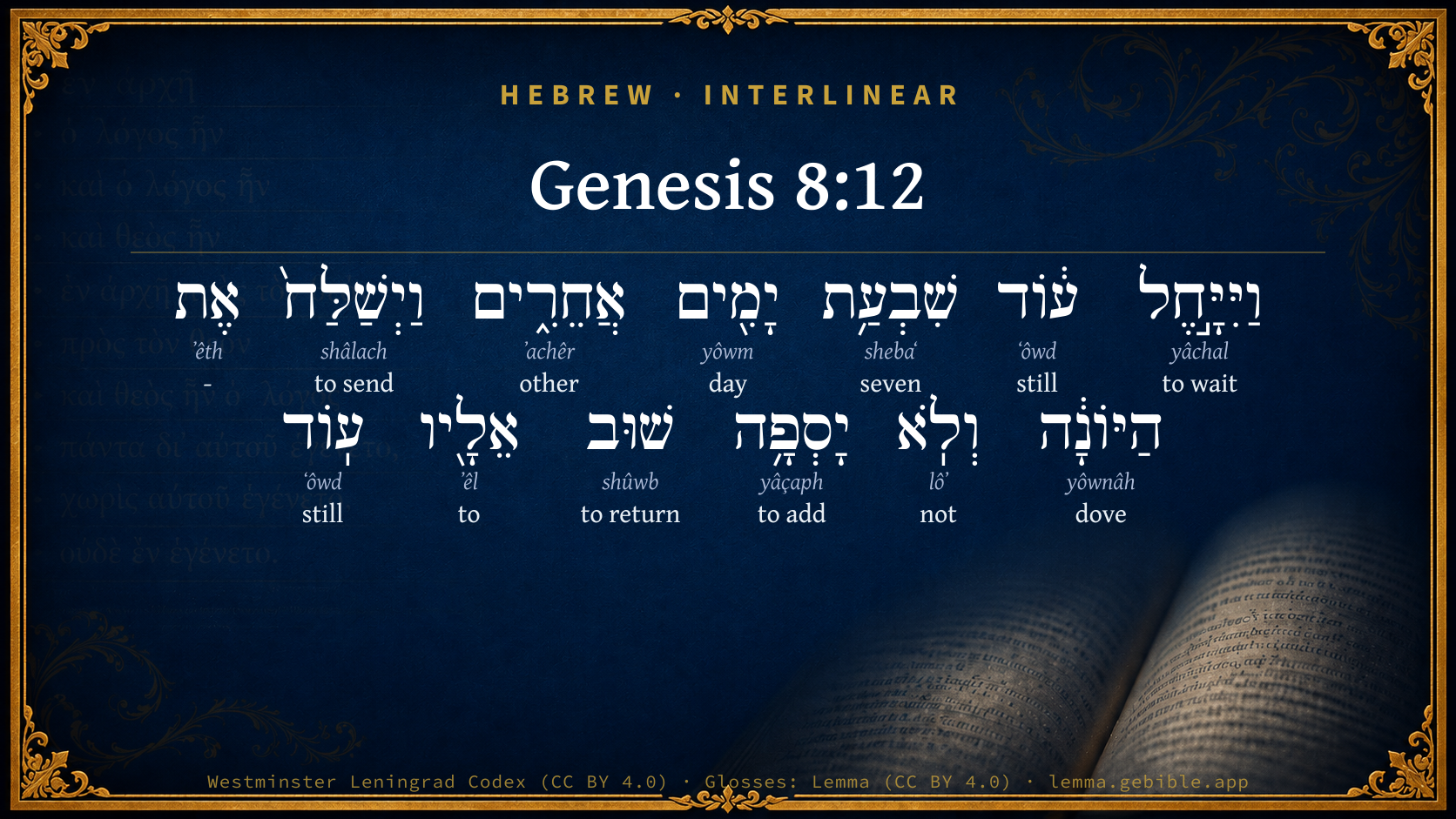
Hebrew (Westminster Leningrad Codex) Genesis 8:12 appears in the Hebrew Old Testament. The text above is from the Westminster Leningrad Codex. Each word links to its Strong’s number, a concise gloss, and parsing drawn from the Open Scriptures Hebrew Bible morphology. Click any word for its full Brown-Driver-Briggs (BDB) entry.
Download image
Cite this verse

Genesis 8:12 (World English Bible). Public Domain. Lemma interlinear Bible study tool, https://lemma.gebible.app/v/genesis/8/12.

Show BibTeX & RIS
BibTeX
RIS
English Translation
He stayed yet another seven days, and sent forth the dove; and she didn't return to him any more.
World English Bible · Public Domain
Highlights
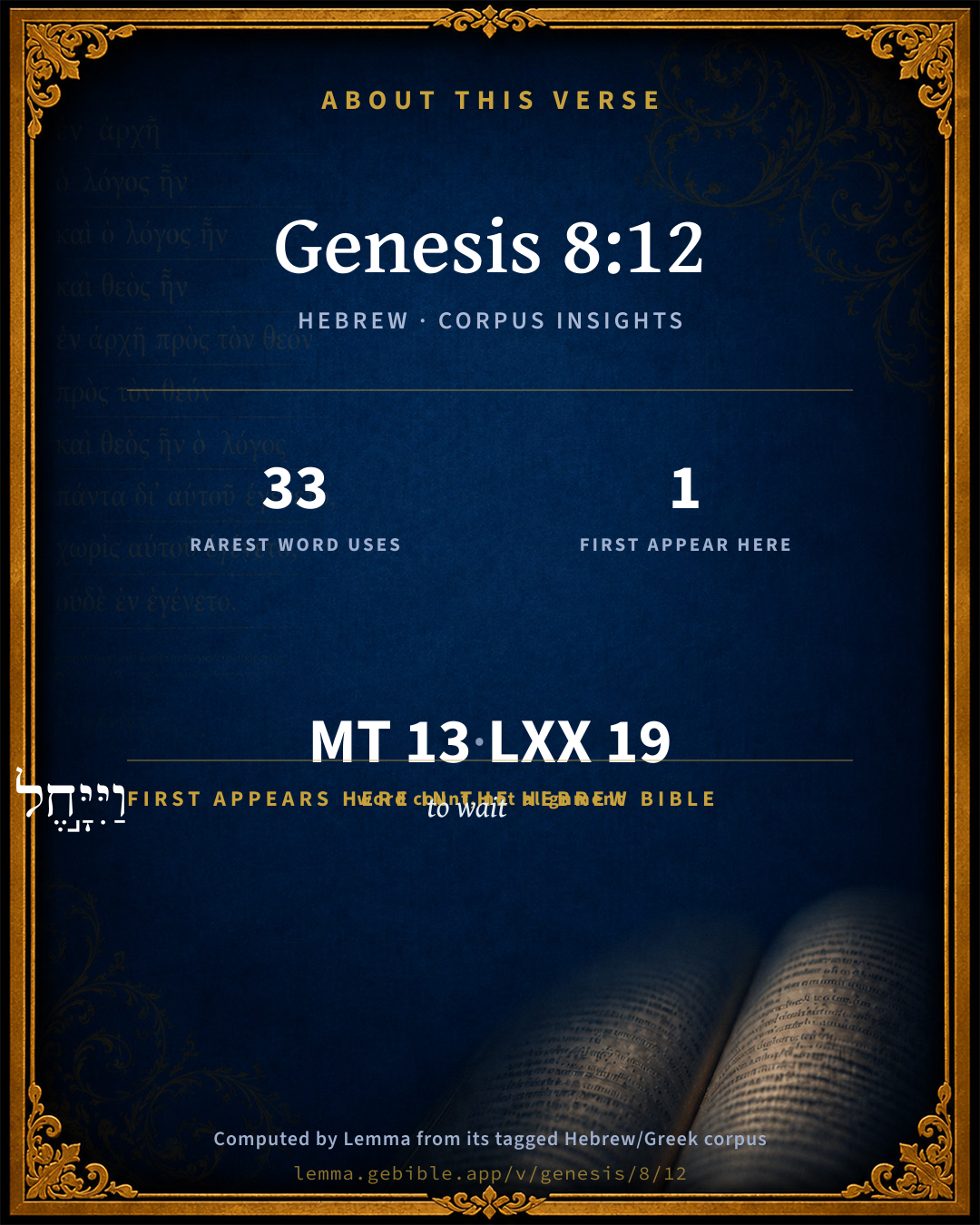
  • 1 first appearance in the Hebrew Bible
Full analysis ↓
Download a study sheet

One document with this verse’s original text, its word-by-word gloss line, the meaning frame, cross-references with their text, attributed commentary, and full source and license credits — printable, and it pastes into notes with its structure intact.

This verse Autodidact and up

Study sheet (.html) Plain text (.txt)

A passage Seminary Student

Up to 50 verses in one chapter. A passage sheet keeps up to 6 commentary sources and 12 cross-references per verse, in the order this page ranks them, and says so on the sheet whenever that leaves anything out. Ask for a single verse and you get the Autodidact verse sheet above.

Everything on this page stays free to read, with no account — the sheet is a download of what is already on screen, not access to it.

Want to remove ads? Support Godless Engineer
Compare translations 3

The same verse in 3 English versions, stacked beneath the original-language interlinear above. Click any original word for its lexicon entry.

Each is an independent rendering of the whole verse — the interlinear is not word-aligned to these translations.

Highlighted words mark where these versions differ — a whole-verse word diff, not a word-by-word alignment.

  • World English Bible Public Domain
    He stayed yet another seven days, and sent forth the dove; and she didn't return to him any more.
  • King James Version Public Domain
    And he stayed yet other seven days; and sent forth the dove; which returned not again unto him any more.
  • unfoldingWord Literal Text CC BY-SA 4.0
    Then he waited another seven days, and he sent out the dove, but it did not return to him again.

unfoldingWord Literal Text — © unfoldingWord, licensed CC BY-SA 4.0. Word-aligned USFM3 via Door43 (git.door43.org/unfoldingWord/en_ult).

Versions to compare (up to 4)

3 of 4 selected

Show all 18 translations

Every available English version of this verse, each an independent rendering of the whole verse.

  • World English Bible Public Domain
    He stayed yet another seven days, and sent forth the dove; and she didn't return to him any more.
  • Berean Standard Bible Public Domain
    And Noah waited seven more days and sent out the dove again, but this time she did not return to him.
  • Majority Standard Bible Public Domain
    And Noah waited seven more days and sent out the dove again, but this time she did not return to him.
  • King James Version Public Domain
    And he stayed yet other seven days; and sent forth the dove; which returned not again unto him any more.
  • American Standard Version (1901) Public Domain
    And he stayed yet other seven days, and sent forth the dove; and she returned not again unto him any more.
  • Revised Version (1885) Public Domain
    And he stayed yet other seven days; and sent forth the dove; and she returned not again unto him any more.
  • Geneva Bible (1599) Public Domain
    Notwithstanding he wayted yet other seuen dayes, and sent forth the doue, which returned not againe vnto him any more.
  • Douay-Rheims (1899) Public Domain
    And he stayed yet other seven days: and he sent forth the dove, which returned not any more unto him.
  • Young's Literal Translation Public Domain
    And he stayeth yet other seven days, and sendeth forth the dove, and it added not to turn back unto him any more.
  • Literal Standard Version CC BY-SA 4.0
    And he stays yet seven more days, and sends forth the dove, and it did not add to return to him anymore.
  • Unlocked Literal Bible CC BY-SA 4.0
    He waited another seven days, and sent out the dove again. She did not return again to him.
  • unfoldingWord Literal Text CC BY-SA 4.0
    Then he waited another seven days, and he sent out the dove, but it did not return to him again.
  • Darby Bible Public Domain
    And he waited yet other seven days, and sent forth the dove; but she returned no more to him.
  • World Messianic Bible Public Domain
    He waited yet another seven days, and sent out the dove; and she didn’t return to him any more.
  • Webster's Bible Public Domain
    And he stayed yet other seven days, and sent forth the dove; which returned not again to him any more.
  • Free Bible Version CC BY-SA 4.0
    Again he waited another seven days and sent the dove out again, but this time it didn't return to him.
  • Bible in Basic English Public Domain
    And after seven days more, he sent the dove out again, but she did not come back to him.
  • JPS Tanakh (1917) Public Domain
    And he stayed yet other seven days; and sent forth the dove; and she returned not again unto him any more.

Literal Standard Version (2020), Covenant Press — licensed CC BY-SA 4.0. Text via the HelloAO Bible API (eBible.org). Unlocked Literal Bible (unfoldingWord) — licensed CC BY-SA 4.0. Text via the HelloAO Bible API (eBible.org). unfoldingWord Literal Text — © unfoldingWord, licensed CC BY-SA 4.0. Word-aligned USFM3 via Door43 (git.door43.org/unfoldingWord/en_ult). Free Bible Version, Dr. Jonathan Gallagher — licensed CC BY-SA 4.0. Text via the HelloAO Bible API (eBible.org).

Word by word

More ways to search: Search by grammar → Find every occurrence → Compare this word →

Practice this passage: Drill this verse → Learn its vocabulary →

הַיּוֹנָ֔ה
yôwnâh
H3123
“the · dove”
Particle, Definite Article + Noun, Common, Feminine, Singular, Absolute
Part of Speech
Particle + Noun
Type
Common
Gender
Feminine
Number
Singular
State
Absolute
Full BDB Definition

Origin: probably from the same as H3196

TWOT: 854a

dove, pigeon
  1. וַיִּיָּ֣חֶל yâchal H3176 “and · to wait” Conjunction + Verb, Niphal, Sequential Imperfect, 3rd Person, Masculine, Singular
  2. ע֔וֹד ʻôwd H5750 “still” Adverb
  3. שִׁבְעַ֥ת shebaʻ H7651 “seven” Adjective, Cardinal number, Masculine, Singular, Construct
  4. יָמִ֖ים yôwm H3117 “days” Noun, Common, Masculine, Plural, Absolute
  5. אֲחֵרִ֑ים ʼachêr H312 “other” Adjective, Adjective, Masculine, Plural, Absolute
  6. וַיְשַׁלַּח֙ shâlach H7971 “and · to send” Conjunction + Verb, Piel, Sequential Imperfect, 3rd Person, Masculine, Singular
  7. אֶת ʼêth H853 “-” Particle, Direct Object
  8. וְלֹֽא lôʼ H3808 “and · not” Conjunction + Particle, Negative
  9. יָסְפָ֥ה yâçaph H3254 “to add” Verb, Qal, Perfect, 3rd Person, Feminine, Singular
  10. שׁוּב shûwb H7725 “to return” Verb, Qal, Infinitive Construct
  11. אֵלָ֖יו ʼêl H413 “to · him” Preposition + Suffix, Personal, 3rd Person, Masculine, Singular
  12. עֽוֹד ʻôwd H5750 “still” Adverb

About this verse

These counts appear in no published source. They are computed here, from the morphology-tagged text and Lemma’s own curated glosses. What Lemma adds →

13
words
12
distinct lemmas
Pentateuch
section

First appearance in Scripture

This word makes its first canonical appearance in the Hebrew Bible here:

  • וַיִּיָּ֣חֶל to wait H3176

Shared distinctive vocabulary

הַיּוֹנָ֔ה dove H3123 occurs in 33 verses of the Hebrew Bible. Also found in:

Grammatical profile

  • 4 verbs
  • 2 nouns
  • 2 adjectives
  • 1 preposition
  • 2 adverbs
  • 2 particles

Verb forms

  • וַיִּיָּ֣חֶל Niphal · Sequential Imperfect
  • וַיְשַׁלַּח֙ Piel · Sequential Imperfect
  • יָסְפָ֥ה Qal · Perfect
  • שׁוּב Qal · Infinitive Construct

Repetition

A word recurs within this verse — often emphatic in Hebrew:

  • ע֔וֹד still H5750 ×2

Hebrew & Septuagint length

In English translation the verse runs 19 words from the Hebrew and 23 from the Septuagint (LXX English) — closely comparable.

A rough comparison of the two English renderings, which tokenize alike — not a word-level alignment.

Word counts can differ between the Hebrew and the Greek without any difference in meaning — e.g. the Hebrew direct-object marker אֵת has no separate Greek word, and Greek often adds the article ὁ.

In the original languages it is 13 Hebrew tokens and 19 Greek tokens — but the two are counted differently (Hebrew bundles its prefixes and suffixes into one token; the Greek is in lemma form), so that isn’t a like-for-like length.

Cross-references

10

Topical passages linked to Genesis 8:12 in the Treasury of Scripture Knowledge — connected by theme and wording, ordered by reader-vote popularity; previews shown in the World English Bible.

  • Genesis 8:10 He stayed yet another seven days; and again he sent forth the dove out of the ark.
  • Isaiah 25:9 It shall be said in that day, Behold, this is our God; we have waited for him, and he will save us: this is Yahweh; we have waited for him, we will be glad and rejoice in his salvation.
  • Isaiah 26:8 Yes, in the way of your judgments, Yahweh, have we waited for you; to your name, even to your memorial [name], is the desire of our soul.
  • Isaiah 30:18 Therefore will Yahweh wait, that he may be gracious to you; and therefore will he be exalted, that he may have mercy on you: for Yahweh is a God of justice; blessed are all those who wait for him.
  • Genesis 2:2–3 On the seventh day God finished his work which he had made; and he rested on the seventh day from all his work which he had made.
  • Psalms 27:14 Wait for Yahweh. Be strong, and let your heart take courage. Yes, wait for Yahweh.
  • Psalms 130:5–6 I wait for Yahweh. My soul waits. I hope in his word.
  • Isaiah 8:17 I will wait for Yahweh, who hides his face from the house of Jacob, and I will look for him.
  • James 5:7–8 Be patient therefore, brothers, until the coming of the Lord. Behold, the farmer waits for the precious fruit of the earth, being patient over it, until it receives the early and late rain.
  • Habakkuk 2:3 For the vision is yet for the appointed time, and it hurries toward the end, and won't prove false. Though it takes time, wait for it; because it will surely come. It won't delay.

Cross-references courtesy of OpenBible.info (CC BY 4.0).

Hebrew and Greek witnesses Masoretic Hebrew ↔ Greek Septuagint

The same verse in the two great witnesses to the Old Testament, shown verse-for-verse.

These are two independent witnesses, not word-aligned to each other, and the Septuagint is shown in lemma (dictionary) form.

Hebrew Genesis 8:12 Masoretic · Westminster Leningrad Codex

וַיִּיָּ֣חֶל ע֔וֹד שִׁבְעַ֥ת יָמִ֖ים אֲחֵרִ֑ים וַיְשַׁלַּח֙ אֶת הַיּוֹנָ֔ה וְלֹֽא יָסְפָ֥ה שׁוּב אֵלָ֖יו עֽוֹד

He stayed yet another seven days, and sent forth the dove; and she didn't return to him any more.

World English Bible · Public Domain

Greek LXX Genesis 8:12 Septuagint · lemma form

καί ἐπιἔχω ἔτι ἡμέρα ἑπτά ἕτερος πάλιν ἐκ ἀποστέλλω ὁ περιστερά καί οὐ προςτίθημι ὁ ἐπιστρέφω πρός αὐτός ἔτι

And having waited yet seven other days, he again sent forth the dove, and she did not return to him again any more.

LXX2012 (modern English Septuagint) · Public Domain

Hebrew: Westminster Leningrad Codex (CC BY 4.0). Greek: Septuagint (public domain); English from LXX2012 (modern English Septuagint) (Public Domain). How the Septuagint differs from the Hebrew →

Targum (Aramaic paraphrase)

2

The Targum is the ancient Jewish Aramaic paraphrase of the Hebrew Scriptures — an interpretive translation, not the Hebrew text itself. Onkelos (literal) and Pseudo-Jonathan (expansive) render the Torah, and Jonathan the Prophets. Coverage is partial: where no permissively-licensed English translation exists for a verse, only the Aramaic is shown. This is verse-level text, not a word-by-word alignment to the Hebrew.

  1. Targum Onkelos Torah (Genesis–Deuteronomy)
    וְאוֹרִיךְ עוֹד שַׁבְעָא יוֹמִין אָחֳרָנִין וְשַׁלַּח יָת יוֹנָה וְלָא אוֹסֵיפַת לְמִתּוּב לְוָתֵהּ עוֹד

    And he prolonged yet other seven days, and sent forth the dove, and she added not to return to be with him again.

    Targum Onkelos — Aramaic: “Onkelos Genesis” (public domain); “Onkelos Exodus” (public domain); “Onkelos Leviticus” (public domain); “Onkelos Numbers” (public domain); “Onkelos Deuteronomy” (public domain). English: “Sefaria Community Translation” (CC0 1.0 (public-domain dedication)); “J.W. Etheridge. The Targums of Onkelos and Jonathan Ben Uzziel on the Pentateuch. London: Longmans, Green, 1862” (public domain). Text via Sefaria.

  2. Targum Pseudo-Jonathan Torah (Genesis–Deuteronomy)
    וְאוֹרִיךְ תּוּב שׁוּבְעָא יוֹמִין וְאוֹסִיף לְשַׁדְרָא יַת יוֹנָתָא וְלָא אוֹסִיפַת לְמֵיתַב לְוָתֵיהּ תּוּב

    And he prolonged yet seven days, and added to send forth the dove; but she added not to return to him again.

    Targum Pseudo-Jonathan — Aramaic: “Targum Jonathan on Genesis” (public domain); “Targum Jonathan on Exodus” (public domain); “Targum Jonathan on Leviticus” (public domain); “Targum Jonathan on Numbers” (public domain); “Targum Jonathan on Deuteronomy” (public domain). English: “The Targum of Jonathan ben Uzziel, trans. J. W. Etheridge, London, 1862” (public domain). Text via Sefaria.

Commentary

Notes on Genesis 8:12 from classic Christian and Jewish commentators (each source and its license shown beneath its notes). The classic Christian expositions comment on the surrounding passage and are grouped to its opening verse, so a note may address several verses; the Jewish commentaries on the Tanakh (Rashi and others) are per-verse, so they appear only where the commentator wrote on this verse.

Lemma curates 59 commentaries, every one of them public domain or Creative Commons licensed, each selected and text-cleaned for this edition rather than reprinted as found. About our sources →

Trapp's Complete Commentary

John Trapp

Gen 8:12 And he stayed yet other seven days; and sent forth the dove; which returned not again unto him any more.

Ver. 12. Which returned not unto him any more.] But, out of love of liberty, forgat both her mate and her master; who yet was hereby certified, to his comfort, that now she had, abroad, met with both footing and feeding.

John Trapp, A Commentary or Exposition upon All the Books of the Old and New Testament (1647–1656) — public domain. Text from a community e-Sword module.

Jamieson, Fausset & Brown

Robert Jamieson, A. R. Fausset & David Brown

he . . . sent forth the dove: which returned not . . . any more--In these results, we perceive a wisdom and prudence far superior to the inspiration of instinct--we discern the agency of God guiding all the movements of this bird for the instruction of Noah, and reviving the hopes of his household.

other seven days--a strong presumptive proof that Noah observed the Sabbath during his residence in the ark.

Jamieson, Fausset & Brown — Commentary Critical and Explanatory on the Whole Bible (1871) — public domain (CC PDM 1.0). Text via the HelloAO Bible API.

John Gill's Exposition

And he stayed yet other seven days,.... After the dove had returned:

and sent forth the dove; the same dove again:

which returned not again unto him any more: the earth being dry, it found rest for the sole of its feet, sufficient food to eat, and a proper place for its habitation; and liking to be at liberty, and in the open air, chose not to return to the ark, even though its mate was there: of those birds sent out, the Heathen writers make mention: Abydenus says (s), that Sisithrus, the same with Noah, sent out birds making an experiment to see whether the earth was emersed out of the water, which returned again to him; and after them he sent out others; and having done so three times, obtained what he wished for, since the birds returned with their wings full of clay or mud; and so Josephus (t) says, the dove which brought the olive leaf was all over with clay or mud: and Plutarch (u) makes particular mention of the dove, and says that, according to the mythologists, a dove was let out of the ark; and that her going out was to Deucalion, (the same with Noah) a sign of fair weather, and her return of foul: and the story that Lucian (w) tells of a golden dove upon the head of a statue in the temple of Hierapolis, supposed to be Deucalion's, seems plainly to refer to this dove of Noah; for the report, he says, was, that this golden dove flew away twice in a year, at the commemoration there made of the flood, by pouring out abundance of water into a chasm or cleft of the earth, then not very large; and which, it was told him, was formerly a very great one, and swallowed up all the flood that drowned the world.

(s) Apud Euseb. Praepar. Evangel. l. 9. c. 12. p. 414, 415. (t) Antiqu. l. 1. c. 3. p. 5. (u) De Solert. Animal. (w) De Dea Syria.

John Gill's Exposition of the Whole Bible (1746–1763) — public domain (CC PDM 1.0). Text via the HelloAO Bible API.

Matthew Poole's English Annotations

Finding convenient food and resting place upon the earth, and preferring her freedom before her mate: possibly she might lose the sight of the ark, and forget or mistake the way to it.

Matthew Poole's English Annotations on the Holy Bible (1683–1685) — public domain. Text from a community e-Sword/MySword module.

The Pulpit Commentary

And he stayed. ljYYiw Niph. fut. of ljy (Gesenius); cf. ljYw (ver. 10), Hiph. fut. of lWj (Furst, Delitzsch). Tayler Lewis, following Jewish authorities, would derive both from ljy with Aben Ezra making the first a regular Niphal, and with Rashi the second a contracted Piel (vide Lunge, p. 308; Clark"s "For. Theol. Lib."). Yet other seven days. The frequent repetition of the number seven clearly points to the hebdomadal division of the week, and the institution of Sabbatic rest (vide. Gen_2:1-3, Expos.) And sent forth the dove. "The more we examine these acts of Noah, the more it will strike us that they must have been of a religious nature. He did not take such observations, and so send out the birds, as mere arbitrary acts, prompted simply by his curiosity or his impatience; but as a man of faith and prayer he inquired of the Lord. What more likely then that such inquiry should have its basis in solemn religious exercises, not arbitrarily entered into, but on days held sacred for prayer and religious rest?" (T. Lewis). Which returned not again (literally, and it added not to return) unto him any more.

The Pulpit Commentary (1880–1919), ed. H.D.M. Spence-Jones & Joseph S. Exell — public domain. Text from a community e-Sword module.

Rashi

Rabbi Shlomo Yitzchaki (Rashi)

וייחל AND HE STAYED — This has the same meaning as ויחל (Genesis 8:10), only that the latter is the Kal, whereas the word here is the Hithpael: ויחל means “he waited” וייחל “he had patience”.

Rashi on the Tanakh — English translations: “The Judaica Press complete Tanach with Rashi, translated by A. J. Rosenberg” (CC BY 4.0); “Pentateuch with Rashi's commentary by M. Rosenbaum and A.M. Silbermann, 1929-1934” (public domain); “The Metsudah Tanach series, Lakewood, N.J” (CC BY 4.0); and “The Book of Joshua, Metsudah Publications, 1997” (CC BY 4.0). Text via Sefaria.

Radak

Rabbi David Kimhi (Radak)

וייחל עוד, the word is in a passive mode, the root being יחל. If it had been in a hitpael mode, the letter י should have the vowel patach underneath it, but the fact is that it has the vowel kametz.

ולא יספה שוב אליו עוד, this is when Noach realised that the surface of the earth had dried sufficiently and that the pigeon had found a resting place on earth as well as on many trees so that it did not bother to come back to him. This happened in the 601st year of Noach’s life, seeing that the Torah mentions that it was on the first of the first month of that year. (verse 13) Noach’s 600th year had been completed on the 30th of Ellul, and he had entered the 601st year of his life on the first of Tishrey, which is the first month of the year. On the 17th day of the second month he had completed a full year’s stay in the ark. Even though the surface of the earth was “dry” in the sense that it was no longer covered by water, it was still too muddy, and the surface was misleading, seeing that beneath the immediate surface it was soft, spongy. It was not yet ready for walking on without risking that one would break through a very thin veneer of dry earth. This is why G’d had not yet commanded him to leave the ark (until the 27th of that month) At that time, as testified by the word יבשה, the earth had dried sufficiently to make using it as one’s habitat a safe endeavour. Noach did not want to leave the ark until he had been commanded to do so by G’d. He knew that G’d would issue such a command, just as He had at the time commanded him to enter the ark.

Radak on the Tanakh — English translations: “Sefaria Community Translation” (CC0 1.0 (public-domain dedication)); “Eliyahu Munk, HaChut Hameshulash” (CC BY 4.0); “Rabbi Mike Feuer, Jerusalem Anthology” (CC BY 4.0); and “R. David Kimhi on the first book of Psalms, Translated by R.G. Finch, London, 1919” (public domain). Text via Sefaria.

Lesson kit

Teaching starters — assembled from the data on this page, not authored interpretation. Every prompt links to the verse data it draws on. Edit before teaching.

Genesis, in the Pentateuch, opens this verse with 13 words (12 distinct Hebrew lemmas). Its most distinctive word is yôwnâh (“dove”). A historical commentator’s framing appears above. Read the whole chapter for the surrounding context.

Discussion questions

  1. What does “dove” (yôwnâh) contribute to the verse as a whole?
  2. This is the first place “to wait” appears in Scripture (first appears here). What does its debut here establish?
  3. How does Genesis 8:8, which shares the word «dove», read alongside this verse?
  4. What does the repetition of “still” (2× in this one verse) do in this verse?
  5. These translations render this verse differently. What is at stake in choosing one wording over another?
  6. «וַיִּיָּ֣חֶל» is a Niphal Sequential Imperfect verb. How does that grammatical form shape the action described?
  7. Compare how Trapp's Complete Commentary and Jamieson, Fausset & Brown read this verse. Where do they agree or differ?

Things to notice

Reading settings

Reading text

Shown beneath each verse's original-language words.

Old Testament
Old Testament edition

Read the OT as the Masoretic Hebrew (MT) or the Greek Septuagint (LXX).

English shown for the Greek Septuagint (in the Hebrew ↔ Greek comparison).

Comparing translations? Open the Compare panel on any verse page to stack up to four side by side.