
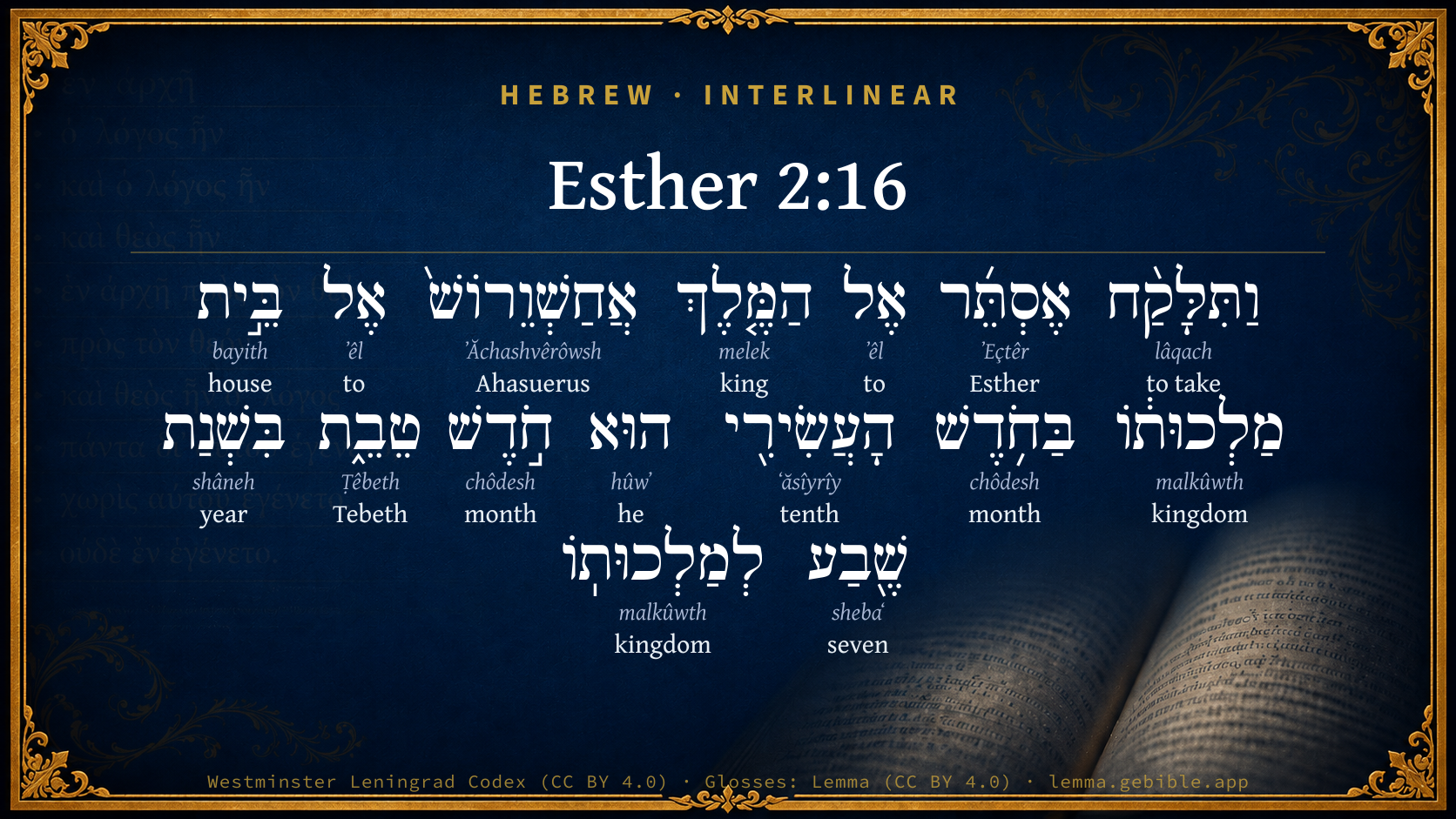
Esther 2:16

Hebrew (Westminster Leningrad Codex) Esther 2:16 appears in the Hebrew Old Testament. The text above is from the Westminster Leningrad Codex. Each word links to its Strong’s number, a concise gloss, and parsing drawn from the Open Scriptures Hebrew Bible morphology. Click any word for its full Brown-Driver-Briggs (BDB) entry.
Download image
Cite this verse

Esther 2:16 (World English Bible). Public Domain. Lemma interlinear Bible study tool, https://lemma.gebible.app/v/esther/2/16.

Show BibTeX & RIS
BibTeX
RIS
English Translation
So Esther was taken to king Ahasuerus into his house royal in the tenth month, which is the month Tebeth, in the seventh year of his reign.
World English Bible · Public Domain
Highlights
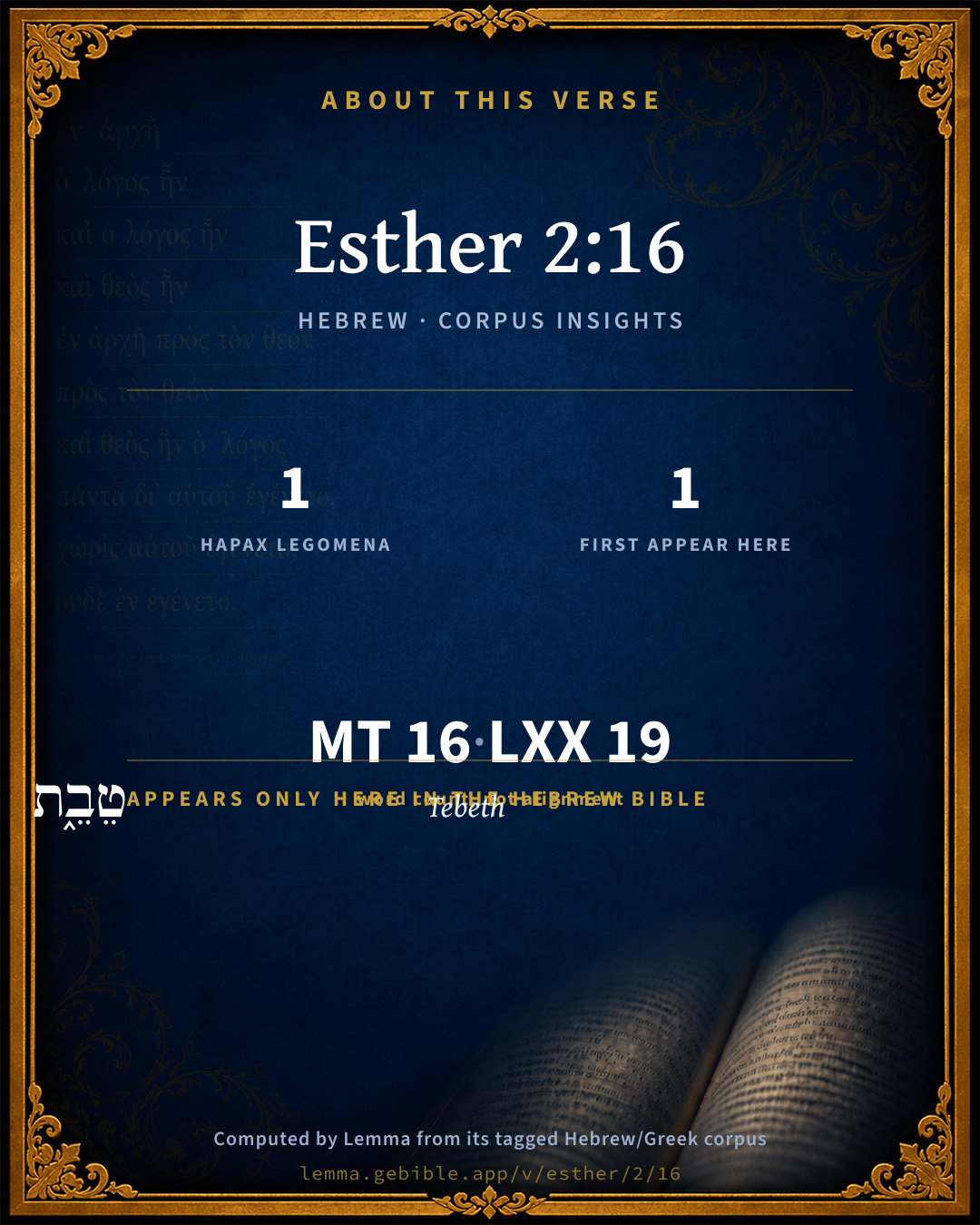
  • 1 hapax legomenon — only here in the Hebrew Bible
  • 1 first appearance in the Hebrew Bible
Full analysis ↓
Download a study sheet

One document with this verse’s original text, its word-by-word gloss line, the meaning frame, cross-references with their text, attributed commentary, and full source and license credits — printable, and it pastes into notes with its structure intact.

This verse Autodidact and up

Study sheet (.html) Plain text (.txt)

A passage Seminary Student

Up to 50 verses in one chapter. A passage sheet keeps up to 6 commentary sources and 12 cross-references per verse, in the order this page ranks them, and says so on the sheet whenever that leaves anything out. Ask for a single verse and you get the Autodidact verse sheet above.

Everything on this page stays free to read, with no account — the sheet is a download of what is already on screen, not access to it.

Want to remove ads? Support Godless Engineer
Compare translations 3

The same verse in 3 English versions, stacked beneath the original-language interlinear above. Click any original word for its lexicon entry.

Each is an independent rendering of the whole verse — the interlinear is not word-aligned to these translations.

Highlighted words mark where these versions differ — a whole-verse word diff, not a word-by-word alignment.

  • World English Bible Public Domain
    So Esther was taken to king Ahasuerus into his house royal in the tenth month, which is the month Tebeth, in the seventh year of his reign.
  • King James Version Public Domain
    So Esther was taken unto king Ahasuerus into his house royal in the tenth month, which is the month Tebeth, in the seventh year of his reign.
  • unfoldingWord Literal Text CC BY-SA 4.0
    And Esther was taken to the king Ahasuerus, to the palace of his royalty, in the tenth month (which is the month of Tebeth), in year seven of his reign.

unfoldingWord Literal Text — © unfoldingWord, licensed CC BY-SA 4.0. Word-aligned USFM3 via Door43 (git.door43.org/unfoldingWord/en_ult).

Versions to compare (up to 4)

3 of 4 selected

Show all 18 translations

Every available English version of this verse, each an independent rendering of the whole verse.

  • World English Bible Public Domain
    So Esther was taken to king Ahasuerus into his house royal in the tenth month, which is the month Tebeth, in the seventh year of his reign.
  • Berean Standard Bible Public Domain
    She was taken to King Xerxes in the royal palace in the tenth month, the month of Tebeth, in the seventh year of his reign.
  • Majority Standard Bible Public Domain
    She was taken to King Xerxes in the royal palace in the tenth month, the month of Tebeth, in the seventh year of his reign.
  • King James Version Public Domain
    So Esther was taken unto king Ahasuerus into his house royal in the tenth month, which is the month Tebeth, in the seventh year of his reign.
  • American Standard Version (1901) Public Domain
    So Esther was taken unto king Ahasuerus into his house royal in the tenth month, which is the month Tebeth, in the seventh year of his reign.
  • Revised Version (1885) Public Domain
    So Esther was taken unto king Ahasuerus into his house royal in the tenth month, which is the month Tebeth, in the seventh year of his reign.
  • Geneva Bible (1599) Public Domain
    So Ester was taken vnto King Ahashuerosh into his house royall in the tenth moneth, which is the moneth Tebeth, in the seuenth yeere of his reigne.
  • Douay-Rheims (1899) Public Domain
    So she was brought to the chamber of king Assuerus the tenth month, which is called Tebeth, in the seventh year of his reign.
  • Young's Literal Translation Public Domain
    And Esther is taken unto the king Ahasuerus, unto his royal house, in the tenth month -- it `is' the month of Tebeth -- in the seventh year of his reign,
  • Literal Standard Version CC BY-SA 4.0
    And Esther is taken to King Ahasuerus, to his royal house, in the tenth month—it [is] the month of Tebeth—in the seventh year of his reign,
  • Unlocked Literal Bible CC BY-SA 4.0
    Esther was taken to King Ahasuerus into the royal residence on the tenth month, which is the month of Tebeth, in the seventh year of his reign.
  • unfoldingWord Literal Text CC BY-SA 4.0
    And Esther was taken to the king Ahasuerus, to the palace of his royalty, in the tenth month (which is the month of Tebeth), in year seven of his reign.
  • Darby Bible Public Domain
    So Esther was taken to king Ahasuerus, into his royal house, in the tenth month, that is, the month Tebeth, in the seventh year of his reign.
  • World Messianic Bible Public Domain
    So Esther was taken to King Ahasuerus into his royal house in the tenth month, which is the month Tebeth, in the seventh year of his reign.
  • Webster's Bible Public Domain
    So Esther was taken to king Ahasuerus into his house royal in the tenth month, which is the month Tebeth, in the seventh year of his reign.
  • Free Bible Version CC BY-SA 4.0
    Esther was taken to King Xerxes into his royal palace, in the tenth month, the month of Tebeth, in the seventh year of his reign.
  • Bible in Basic English Public Domain
    So Esther was taken in to King Ahasuerus in his house in the tenth month, which is the month Tebeth, in the seventh year of his rule.
  • JPS Tanakh (1917) Public Domain
    So Esther was taken unto king Ahasuerus into his house royal in the tenth month, which is the month Tebeth, in the seventh year of his reign.

Literal Standard Version (2020), Covenant Press — licensed CC BY-SA 4.0. Text via the HelloAO Bible API (eBible.org). Unlocked Literal Bible (unfoldingWord) — licensed CC BY-SA 4.0. Text via the HelloAO Bible API (eBible.org). unfoldingWord Literal Text — © unfoldingWord, licensed CC BY-SA 4.0. Word-aligned USFM3 via Door43 (git.door43.org/unfoldingWord/en_ult). Free Bible Version, Dr. Jonathan Gallagher — licensed CC BY-SA 4.0. Text via the HelloAO Bible API (eBible.org).

Word by word

More ways to search: Search by grammar → Find every occurrence → Compare this word →

Practice this passage: Drill this verse → Learn its vocabulary →

טֵבֵ֑ת
Ṭêbeth
H2887
“Tebeth”
Noun, Proper
Part of Speech
Noun
Type
Proper
Full BDB Definition

Origin: probably of foreign derivation

TWOT: None

Tebeth = "goodness" - the 10th month of the Jewish calendar corresponding to modern Dec-Jan
  1. וַתִּלָּקַ֨ח lâqach H3947 “and · to take” Conjunction + Verb, Niphal, Sequential Imperfect, 3rd Person, Feminine, Singular
  2. אֶסְתֵּ֜ר ʼEçtêr H635 “Esther” Noun, Proper
  3. אֶל ʼêl H413 “to” Preposition
  4. הַמֶּ֤לֶךְ melek H4428 “the · king” Particle, Definite Article + Noun, Common, Masculine, Singular, Absolute
  5. אֲחַשְׁוֵרוֹשׁ֙ ʼĂchashvêrôwsh H325 “Ahasuerus” Noun, Proper
  6. אֶל ʼêl H413 “to” Preposition
  7. בֵּ֣ית bayith H1004 “house of” Noun, Common, Masculine, Singular, Construct
  8. מַלְכוּת֔וֹ malkûwth H4438 “kingdom · his” Noun, Common, Feminine, Singular, Construct + Suffix, Personal, 3rd Person, Masculine, Singular
  9. בַּחֹ֥דֶשׁ chôdesh H2320 “in/at the · month” Preposition, Determined + Noun, Common, Masculine, Singular, Absolute
  10. הָעֲשִׂירִ֖י ʻăsîyrîy H6224 “the · tenth” Particle, Definite Article + Adjective, Ordinal number, Masculine, Singular, Absolute
  11. הוּא hûwʼ H1931 “he” Pronoun, Personal, 3rd Person, Masculine, Singular
  12. חֹ֣דֶשׁ chôdesh H2320 “month of” Noun, Common, Masculine, Singular, Construct
  13. בִּשְׁנַת shâneh H8141 “in/at · year of” Preposition + Noun, Common, Feminine, Singular, Construct
  14. שֶׁ֖בַע shebaʻ H7651 “seven” Adjective, Cardinal number, Feminine, Singular, Absolute
  15. לְמַלְכוּתֽוֹ malkûwth H4438 “to/for · kingdom · his” Preposition + Noun, Common, Feminine, Singular, Construct + Suffix, Personal, 3rd Person, Masculine, Singular

About this verse

These counts appear in no published source. They are computed here, from the morphology-tagged text and Lemma’s own curated glosses. What Lemma adds →

16
words
13
distinct lemmas
Historical
section

Notable vocabulary

1 hapax legomenon — a word that appears only here in the entire Hebrew Bible:

  • טֵבֵ֑ת Tebeth H2887

First appearance in Scripture

This word makes its first canonical appearance in the Hebrew Bible here:

  • טֵבֵ֑ת Tebeth H2887

Shared distinctive vocabulary

הָעֲשִׂירִ֖י tenth H6224 occurs in 26 verses of the Hebrew Bible. Also found in:

Grammatical profile

  • 1 verb
  • 10 nouns
  • 2 adjectives
  • 1 pronoun
  • 2 prepositions

Verb forms

  • וַתִּלָּקַ֨ח Niphal · Sequential Imperfect

Repetition

Words recur within this verse — often emphatic in Hebrew:

  • מַלְכוּת֔וֹ kingdom H4438 ×2
  • בַּחֹ֥דֶשׁ month H2320 ×2
  • אֶל to H413 ×2

Hebrew & Septuagint length

In English translation the verse runs 27 words from the Hebrew and 21 from the Septuagint (LXX English) — closely comparable.

A rough comparison of the two English renderings, which tokenize alike — not a word-level alignment.

Word counts can differ between the Hebrew and the Greek without any difference in meaning — e.g. the Hebrew direct-object marker אֵת has no separate Greek word, and Greek often adds the article ὁ.

In the original languages it is 16 Hebrew tokens and 19 Greek tokens — but the two are counted differently (Hebrew bundles its prefixes and suffixes into one token; the Greek is in lemma form), so that isn’t a like-for-like length.

Cross-references

4

Topical passages linked to Esther 2:16 in the Treasury of Scripture Knowledge — connected by theme and wording, ordered by reader-vote popularity; previews shown in the World English Bible.

  • Esther 8:9 Then were the king's scribes called at that time, in the third month Sivan, on the three and twentieth [day] of it; and it was written according to all that Mordecai commanded to the Jews, and to the satraps, and the governors and princes of the provinces which are from India to Ethiopia, one hundred twenty-seven provinces, to every province according to the writing of it, and to every people after their language, and to the Jews according to their writing, and according to their language.
  • Ezra 7:8 He came to Jerusalem in the fifth month, which was in the seventh year of the king.
  • Esther 2:1 After these things, when the wrath of king Ahasuerus was pacified, he remembered Vashti, and what she had done, and what was decreed against her.
  • Esther 2:3 and let the king appoint officers in all the provinces of his kingdom, that they may gather together all the beautiful young virgins to Shushan the palace, to the house of the women, to the custody of Hegai the king's chamberlain, keeper of the women; and let their things for purification be given them;

Cross-references courtesy of OpenBible.info (CC BY 4.0).

Hebrew and Greek witnesses Masoretic Hebrew ↔ Greek Septuagint

The same verse in the two great witnesses to the Old Testament, shown verse-for-verse.

These are two independent witnesses, not word-aligned to each other, and the Septuagint is shown in lemma (dictionary) form.

Hebrew Esther 2:16 Masoretic · Westminster Leningrad Codex

וַתִּלָּקַ֨ח אֶסְתֵּ֜ר אֶל הַמֶּ֤לֶךְ אֲחַשְׁוֵרוֹשׁ֙ אֶל בֵּ֣ית מַלְכוּת֔וֹ בַּחֹ֥דֶשׁ הָעֲשִׂירִ֖י הוּא חֹ֣דֶשׁ טֵבֵ֑ת בִּשְׁנַת שֶׁ֖בַע לְמַלְכוּתֽוֹ

So Esther was taken to king Ahasuerus into his house royal in the tenth month, which is the month Tebeth, in the seventh year of his reign.

World English Bible · Public Domain

Greek LXX Esther 2:16 Septuagint · lemma form

καί εἰςἔρχομαι εσθηρ πρός ἀρταξέρξης ὁ βασιλεύς ὁ δωδέκατος μήν ὅς εἰμί αδαρ ὁ ἕβδομος ἔτος ὁ βασιλεία αὐτός

So Esther went in to king Artaxerxes in the twelfth month, which is Adar, in the seventh year of his reign.

LXX2012 (modern English Septuagint) · Public Domain

On this verse, John Gill's Exposition discusses the Septuagint’s reading. Read the note in Commentary ↓

Hebrew: Westminster Leningrad Codex (CC BY 4.0). Greek: Septuagint (public domain); English from LXX2012 (modern English Septuagint) (Public Domain). How the Septuagint differs from the Hebrew →

Commentary

Notes on Esther 2:16 from classic Christian and Jewish commentators (each source and its license shown beneath its notes). The classic Christian expositions comment on the surrounding passage and are grouped to its opening verse, so a note may address several verses; the Jewish commentaries on the Tanakh (Rashi and others) are per-verse, so they appear only where the commentator wrote on this verse.

Lemma curates 59 commentaries, every one of them public domain or Creative Commons licensed, each selected and text-cleaned for this edition rather than reprinted as found. About our sources →

Trapp's Complete Commentary

John Trapp

Est 2:16 So Esther was taken unto king Ahasuerus into his house royal in the tenth month, which [is] the month Tebeth, in the seventh year of his reign.

Ver. 16. So Esther was taken unto king Ahasuerus] And so that sweet promise was fulfilled and exemplified in her: "Though ye have lien among the pots, yet shall ye be as the wings of a dove covered with silver, and her feathers with yellow gold," Psa 68:13. God raised up this poor orphan, this despicable exile out of the dust, and lifted this needy one out of the dunghill, that he may set her with princes, even with the princes of the people, Psa 113:7-8. Thus he raised Moses and Joseph, David and Daniel, &c.

Into his house royal] A place of rest and honour. Thus

Flebile principium melior fortuna secuta est.

In the tenth month] Not in the twelfth month, as Josephus hath it falsely; and yet the Papists tell us, that the common people may well want the historical part of the Bible, and for it read Josephus’s Jewish Antiquities (Barclai).

In the seventh year of his reign] Four or five years before Haman’s advancement. This was a sweet providence, that God should set up one to be a deliverer to his Church so long before the danger grew on. So Joseph was sent down to Egypt before; Moses was skilled in all the learning of the Egyptians, and afterwards sent to Midian, that he might be fitted to be king in Jeshurun, &c. Oh how unsearchable are God’s judgments, and his ways past finding out Oh the depth, &c.! Latimer’s three last petitions were granted.

John Trapp, A Commentary or Exposition upon All the Books of the Old and New Testament (1647–1656) — public domain. Text from a community e-Sword module.

Joseph Benson's Commentary

Est 2:16. So Esther was taken into his house-royal — She was not sent back unto the second house of the women, as the rest were, but the king kept her in his own house. In the seventh year of his reign — How it came to pass that it was so long before Esther was advanced to succeed Vashti, seems difficult to resolve. But we are to consider, that a great deal of time was spent in gathering the virgins together, and that it was a year after they were collected, before she was brought to the king; and besides, he took some time, it is likely, to try how he liked her wit, humour, and conversation.

Joseph Benson's Commentary on the Old and New Testaments (1811–1818) — public domain. Text from a community e-Sword module.

Geneva Bible (1599)

Geneva Bible translators

Which contained part of December and part of January.

Geneva Bible (1599) marginal notes — public domain. Text via Bolls.life.

Adam Clarke's Commentary

Verse 16. The tenth month - Tebeth] Answering to part of our December and January.

Adam Clarke's Commentary on the Bible (1810–1826) — public domain. Text from a community e-Sword/MySword module.

Ellicott's Commentary for English Readers

(16) The month Tebeth.—This extended from the new moon in January to that in February; the name occurs only here. The fifth Egyptian month, lasting from December 20 to January 20, was called Tybi. The time referred to in the verse will be the January or February of the year 478 B.C., and must have been very shortly after Xerxes’ return to Susa from the West. The long delay in replacing Vashti is simply to be explained by the long absence of Xerxes in Greece.

A Bible Commentary for English Readers, edited by Charles John Ellicott (1878–1897) — public domain. Text from a community e-Sword module.

The Cambridge Bible for Schools and Colleges

gen. ed. J. J. S. Perowne

16. the tenth month, which is the month Tebeth] In the time of the Babylonish exile the months ceased to be called by the old Canaanitish names which the Jews had previously given them, e.g. Abib (Exo_13:4), Ziv (1Ki_6:1), and were denoted by numbers only. After the exile the new Babylonish names, of which Tebeth is one, began to come into use. The name does not occur elsewhere in the Old Testament. It corresponded to the latter part of December and earlier part of January, and is derived from a Babylonian root tebu, which appears also in Hebrew, and means to sink or dip, referring to the rainfall by which it is characterised.

in the seventh year of his reign] probably in January, b.c. 479. Xerxes had at that time lately returned from his ill-starred expedition against Greece.

The Cambridge Bible for Schools and Colleges (gen. ed. J. J. S. Perowne; Cambridge University Press, 1878–1918) — public domain. Text from a community e-Sword module.

John Gill's Exposition

So Esther was taken unto King Ahasuerus, into his house royal,.... Did not return on the morrow to the house of the women, as those who only became the king's concubines did, Est 2:14, but she was taken to be his wife, and designed for his queen, and so was retained in his palace, and placed in an apartment suitable to the dignity she was about to be advanced unto:

and this was done in the tenth month, which is the month Tebeth; and answers to part of December and part of January; not the twelfth month Adar, as the Septuagint version, and so Josephus (q), contrary to the original text: either that law had not obtained among the Persians, or the king thought himself not bound by it, which forbid marriage at any other time than the beginning of the vernal equinox (r):

in the seventh year of his reign; and the divorce of Vashti being in the third year of his reign, it was four years before Esther was taken by him; who, if Xerxes, it may be accounted for by his preparation for, and engagement in, a war with Greece, which took him up all this time; and from whence he returned in the seventh year of his reign, at the beginning of it, and married Esther at the close of it, see Est 2:1 as may be suggested.

(q) Ut supra (Antiqu. l. 11. c.6. sect. 2.) (r) Strabo. Geograph. l. 1. p. 504.

John Gill's Exposition of the Whole Bible (1746–1763) — public domain (CC PDM 1.0). Text via the HelloAO Bible API.

Albert Barnes' Notes on the Bible

Tebeth (compare the corresponding Egyptian month, “Tobi” or “Tubi”), corresponded nearly to our January.

In the seventh year of his reign - In December, 479 B.C., or January, 478 B.C. Xerxes quitted Sardis for Susa in, or soon after, September, 479 B.C. It has been regarded as a “difficulty” that Vashti’s place, declared vacant in 483 B.C., was not supplied until the end of 479 B.C., four years afterward. But since two years out of the four had been occupied by the Grecian expedition, the objection cannot be considered very weighty.

Albert Barnes' Notes on the Bible (1834–1885) — public domain. Text from a community e-Sword/MySword module.

Haydock's Catholic Bible Commentary

Tenth. Septuagint and old Vulgate, "twelfth month, which is Adar." Tebeth corresponds with December and January. (Calmet) --- Notwithstanding all exertions, Esther had been near four years in preparing; (Tirinus; chap. i. 3.; Calmet) unless some years had elapsed before she was brought, ver. 12. (Haydock) --- She was guilty of no sin in becoming an inferior wife of the king. (Menochius) (Tirinus)

George Leo Haydock (1774–1849), Haydock's Catholic Family Bible and Commentary, 1859 edition — public domain. Excludes Psalms (Douay-Rheims chapter numbering differs from Protestant) and Deuterocanonical books (Catholic canon only).

Matthew Poole's English Annotations

Into his house royal; and into his bed, as is implied; to which it is not strange if she, though a virtuous person, did in those circumstances yield, considering the infirmity of human nature, and of that sex, and the state of those times, when plurality of wives was permitted, and concubines were owned as wives; and these virgins were by this action made his wives or concubines. Besides, it is not known to us whether Mordecai and Esther had not direction or a dispensation from God in this matter; it being certain that God can dispense with his own positive laws.

Matthew Poole's English Annotations on the Holy Bible (1683–1685) — public domain. Text from a community e-Sword/MySword module.

Whedon's Commentary on the Bible

Daniel D. Whedon

16. The tenth month… Tebeth — Corresponding nearly with our January.

The seventh year of his reign — Vashti was divorced in the third year of his reign, so that four years or more elapsed before another queen was crowned in her stead. Xerxes’ preparations for his Grecian war, and his absence from his capital during that campaign, well accounts for this long interval. Herodotus says (vii, 20) that he was four full years preparing for his Grecian war, but this may easily be a mistake, for the Greek historian’s figures are not always to be depended upon. It may have been a year or more after Vashti’s divorce before the king’s love for her returned, and then the order was given for collecting the fair young virgins at Shushan, but before it could be executed Xerxes was off for Greece. Meanwhile the order for assembling the virgins was carried out by the eunuchs, so that when the king returned again to Shushan he found his harem supplied with many virgins and soon after chose Esther as his queen.

Daniel D. Whedon (gen. ed.), Commentary on the Old and New Testaments (1874–1909) — public domain. Text from a community e-Sword module.

The Pulpit Commentary

The tenth month, which is the month Tebeth. This is the only mention of the month Tebeth in Scripture. It followed Chisleu, and corresponded to the end of December and the earlier part of January. The word seems to have come in from Egypt, where the corresponding month was called Tobi, or Tubi. In the seventh year of his reign. Four years after the disgrace of Vashti, probably in January, B.C. 479. Xerxes had recently returned from the Grecian expedition defeated and disgraced. He was glad to dismiss warlike matters from his thoughts, and to console himself for his failure by the pleasures of the seraglio.

The Pulpit Commentary (1880–1919), ed. H.D.M. Spence-Jones & Joseph S. Exell — public domain. Text from a community e-Sword module.

Scofield Reference Notes

C. I. Scofield

tenth month

i.e. January.

The Scofield Reference Bible (1917 edition), notes by C. I. Scofield — public domain. Text from a community e-Sword module.

Rashi

Rabbi Shlomo Yitzchaki (Rashi)

in the tenth month the cold season, when one body enjoys [the warmth of] another body. The Holy One, blessed be He, designated that cold season in order to endear her to him.

Rashi on the Tanakh — English translations: “The Judaica Press complete Tanach with Rashi, translated by A. J. Rosenberg” (CC BY 4.0); “Pentateuch with Rashi's commentary by M. Rosenbaum and A.M. Silbermann, 1929-1934” (public domain); “The Metsudah Tanach series, Lakewood, N.J” (CC BY 4.0); and “The Book of Joshua, Metsudah Publications, 1997” (CC BY 4.0). Text via Sefaria.

Lesson kit

Teaching starters — assembled from the data on this page, not authored interpretation. Every prompt links to the verse data it draws on. Edit before teaching.

Esther, in the Historical, opens this verse with 16 words (13 distinct Hebrew lemmas). Its most distinctive word is Ṭêbeth (“Tebeth”). A historical commentator’s framing appears above. Read the whole chapter for the surrounding context.

Discussion questions

  1. What does “Tebeth” (Ṭêbeth) contribute to the verse as a whole?
  2. This verse holds 1 word here found nowhere else in the Hebrew Bible. What might the rare word draw attention to?
  3. The word “Tebeth” first appears here in Scripture. What is being introduced at this debut?
  4. Genesis 8:5 shares the word «tenth» with this verse. How do the two illuminate each other?
  5. “kingdom” occurs 2× in this one verse. What is the effect of the repetition?
  6. The translations on this page render this verse differently — a whole-verse word diff, not a word-by-word alignment. What might account for the different wordings?
  7. The verb «וַתִּלָּקַ֨ח» is Niphal Sequential Imperfect. How does its form color the action?
  8. Reading how Trapp's Complete Commentary and Joseph Benson's Commentary read this verse, where do the two commentators agree and where do they part?

Things to notice

  • 1 word in this verse appears nowhere else in the Hebrew Bible.
  • 1 word makes its first canonical appearance in Scripture here.
  • This verse counts 16 Hebrew ↔ 19 Greek words.
  • These translations choose different wording for 7 words in this verse.
  • “kingdom” occurs 2× in this single verse.

Reading settings

Reading text

Shown beneath each verse's original-language words.

Old Testament
Old Testament edition

Read the OT as the Masoretic Hebrew (MT) or the Greek Septuagint (LXX).

English shown for the Greek Septuagint (in the Hebrew ↔ Greek comparison).

Comparing translations? Open the Compare panel on any verse page to stack up to four side by side.