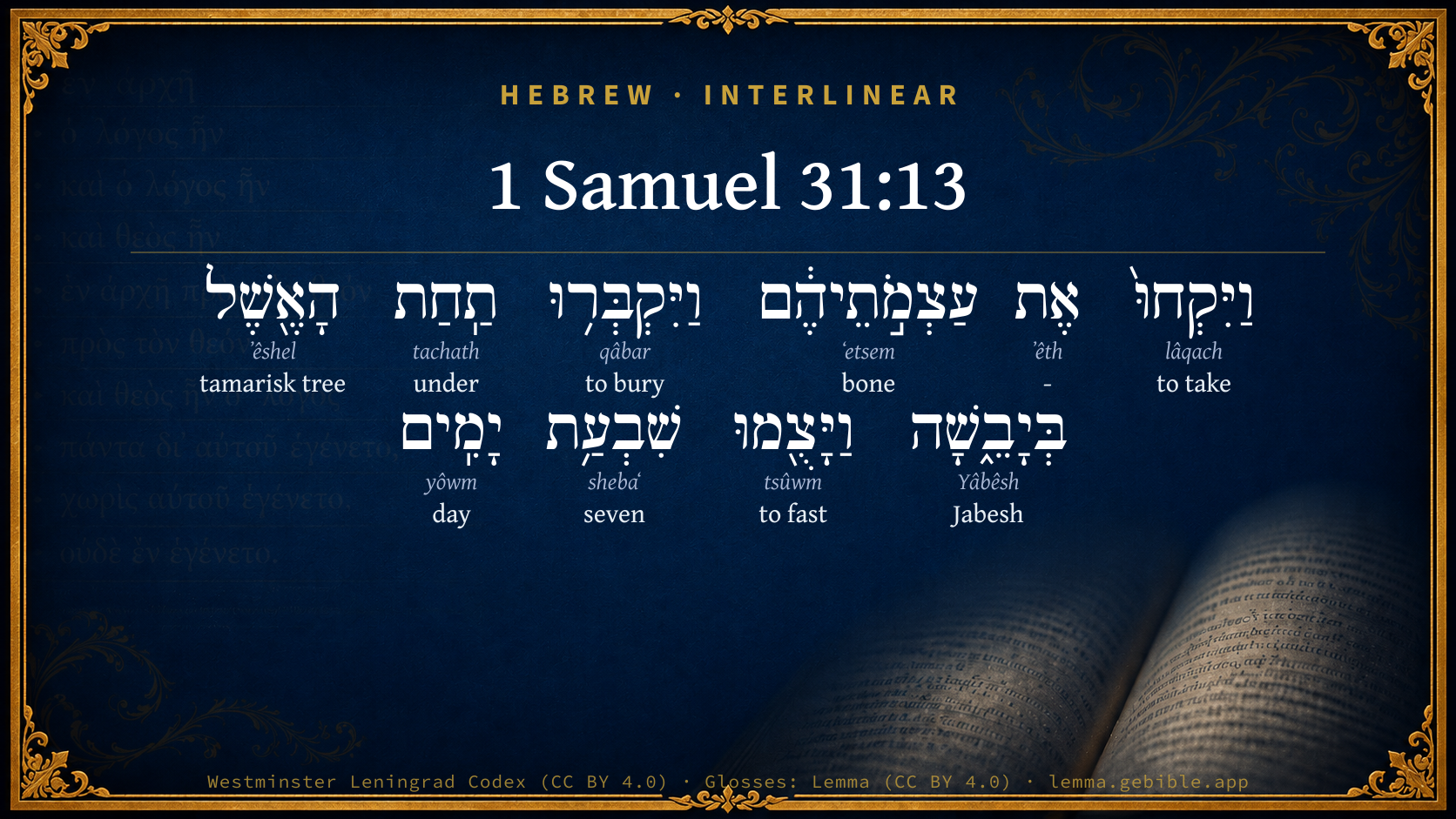
1 Samuel 31:13

Hebrew (Westminster Leningrad Codex) 1 Samuel 31:13 appears in the Hebrew Old Testament. The text above is from the Westminster Leningrad Codex. Each word links to its Strong’s number, a concise gloss, and parsing drawn from the Open Scriptures Hebrew Bible morphology. Click any word for its full Brown-Driver-Briggs (BDB) entry.
Download image
Cite this verse

1 Samuel 31:13 (World English Bible). Public Domain. Lemma interlinear Bible study tool, https://lemma.gebible.app/v/1-samuel/31/13.

Show BibTeX & RIS
BibTeX
RIS
English Translation
They took their bones, and buried them under the tamarisk tree in Jabesh, and fasted seven days.
World English Bible · Public Domain
Download a study sheet

One document with this verse’s original text, its word-by-word gloss line, the meaning frame, cross-references with their text, attributed commentary, and full source and license credits — printable, and it pastes into notes with its structure intact.

This verse Autodidact and up

Study sheet (.html) Plain text (.txt)

A passage Seminary Student

Up to 50 verses in one chapter. A passage sheet keeps up to 6 commentary sources and 12 cross-references per verse, in the order this page ranks them, and says so on the sheet whenever that leaves anything out. Ask for a single verse and you get the Autodidact verse sheet above.

Everything on this page stays free to read, with no account — the sheet is a download of what is already on screen, not access to it.

Want to remove ads? Support Godless Engineer
Compare translations 3

The same verse in 3 English versions, stacked beneath the original-language interlinear above. Click any original word for its lexicon entry.

Each is an independent rendering of the whole verse — the interlinear is not word-aligned to these translations.

Highlighted words mark where these versions differ — a whole-verse word diff, not a word-by-word alignment.

  • World English Bible Public Domain
    They took their bones, and buried them under the tamarisk tree in Jabesh, and fasted seven days.
  • King James Version Public Domain
    And they took their bones, and buried them under a tree at Jabesh, and fasted seven days.
  • unfoldingWord Literal Text CC BY-SA 4.0
    And they took their bones and buried under the tamarisk tree in Jabesh. And they fasted seven days.

unfoldingWord Literal Text — © unfoldingWord, licensed CC BY-SA 4.0. Word-aligned USFM3 via Door43 (git.door43.org/unfoldingWord/en_ult).

Versions to compare (up to 4)

3 of 4 selected

Show all 18 translations

Every available English version of this verse, each an independent rendering of the whole verse.

  • World English Bible Public Domain
    They took their bones, and buried them under the tamarisk tree in Jabesh, and fasted seven days.
  • Berean Standard Bible Public Domain
    Then they took their bones and buried them under the tamarisk tree in Jabesh, and they fasted seven days.
  • Majority Standard Bible Public Domain
    Then they took their bones and buried them under the tamarisk tree in Jabesh, and they fasted seven days.
  • King James Version Public Domain
    And they took their bones, and buried them under a tree at Jabesh, and fasted seven days.
  • American Standard Version (1901) Public Domain
    And they took their bones, and buried them under the tamarisk-tree in Jabesh, and fasted seven days.
  • Revised Version (1885) Public Domain
    And they took their bones, and buried them under the tamarisk tree in Jabesh, and fasted seven days.
  • Geneva Bible (1599) Public Domain
    And tooke their bones and buried them vnder a tree at Iabesh, and fasted seuen dayes.
  • Douay-Rheims (1899) Public Domain
    And they took their bones and buried them in the wood of Jabes: and fasted seven days.
  • Young's Literal Translation Public Domain
    and they take their bones, and bury `them' under the tamarisk in Jabesh, and fast seven days.
  • Literal Standard Version CC BY-SA 4.0
    and they take their bones, and bury [them] under the tamarisk in Jabesh, and fast seven days.
  • Unlocked Literal Bible CC BY-SA 4.0
    Then they took their bones and buried them under a tamarisk tree in Jabesh, and fasted for seven days.
  • unfoldingWord Literal Text CC BY-SA 4.0
    And they took their bones and buried under the tamarisk tree in Jabesh. And they fasted seven days.
  • Darby Bible Public Domain
    And they took their bones, and buried them under the tamarisk at Jabesh, and fasted seven days.
  • World Messianic Bible Public Domain
    They took their bones and buried them under the tamarisk tree in Jabesh, and fasted seven days.
  • Webster's Bible Public Domain
    And they took their bones, and buried them under a tree at Jabesh, and fasted seven days.
  • Free Bible Version CC BY-SA 4.0
    Then they took their bones and buried them under the tamarisk tree in Jabesh, and fasted for seven days.
  • Bible in Basic English Public Domain
    And their bones they put in the earth under a tree in Jabesh; and for seven days they took no food.
  • JPS Tanakh (1917) Public Domain
    And they took their bones, and buried them under the tamarisk-tree in Jabesh, and fasted seven days.

Literal Standard Version (2020), Covenant Press — licensed CC BY-SA 4.0. Text via the HelloAO Bible API (eBible.org). Unlocked Literal Bible (unfoldingWord) — licensed CC BY-SA 4.0. Text via the HelloAO Bible API (eBible.org). unfoldingWord Literal Text — © unfoldingWord, licensed CC BY-SA 4.0. Word-aligned USFM3 via Door43 (git.door43.org/unfoldingWord/en_ult). Free Bible Version, Dr. Jonathan Gallagher — licensed CC BY-SA 4.0. Text via the HelloAO Bible API (eBible.org).

Word by word

More ways to search: Search by grammar → Find every occurrence → Compare this word →

Practice this passage: Drill this verse → Learn its vocabulary →

הָאֶ֖שֶׁל
ʼêshel
H815
“the · tamarisk tree”
Particle, Definite Article + Noun, Common, Masculine, Singular, Absolute
Part of Speech
Particle + Noun
Type
Common
Gender
Masculine
Number
Singular
State
Absolute
Full BDB Definition

Origin: from a root of uncertain signification

TWOT: 179a

tamarisk tree
  1. וַיִּקְחוּ֙ lâqach H3947 “and · to take” Conjunction + Verb, Qal, Sequential Imperfect, 3rd Person, Masculine, Plural
  2. אֶת ʼêth H853 “-” Particle, Direct Object
  3. עַצְמֹ֣תֵיהֶ֔ם ʻetsem H6106 “bones · their” Noun, Common, Feminine, Plural, Construct + Suffix, Personal, 3rd Person, Masculine, Plural
  4. וַיִּקְבְּר֥וּ qâbar H6912 “and · to bury” Conjunction + Verb, Qal, Sequential Imperfect, 3rd Person, Masculine, Plural
  5. תַֽחַת tachath H8478 “under” Preposition
  6. בְּיָבֵ֑שָׁה Yâbêsh H3003 “in/at · Jabesh · toward” Preposition + Noun, Proper + Suffix, Demonstrative
  7. וַיָּצֻ֖מוּ tsûwm H6684 “and · to fast” Conjunction + Verb, Qal, Sequential Imperfect, 3rd Person, Masculine, Plural
  8. שִׁבְעַ֥ת shebaʻ H7651 “seven” Adjective, Cardinal number, Masculine, Singular, Construct
  9. יָמִֽים yôwm H3117 “days” Noun, Common, Masculine, Plural, Absolute

About this verse

These counts appear in no published source. They are computed here, from the morphology-tagged text and Lemma’s own curated glosses. What Lemma adds →

10
words
10
distinct lemmas
Historical
section

Notable vocabulary

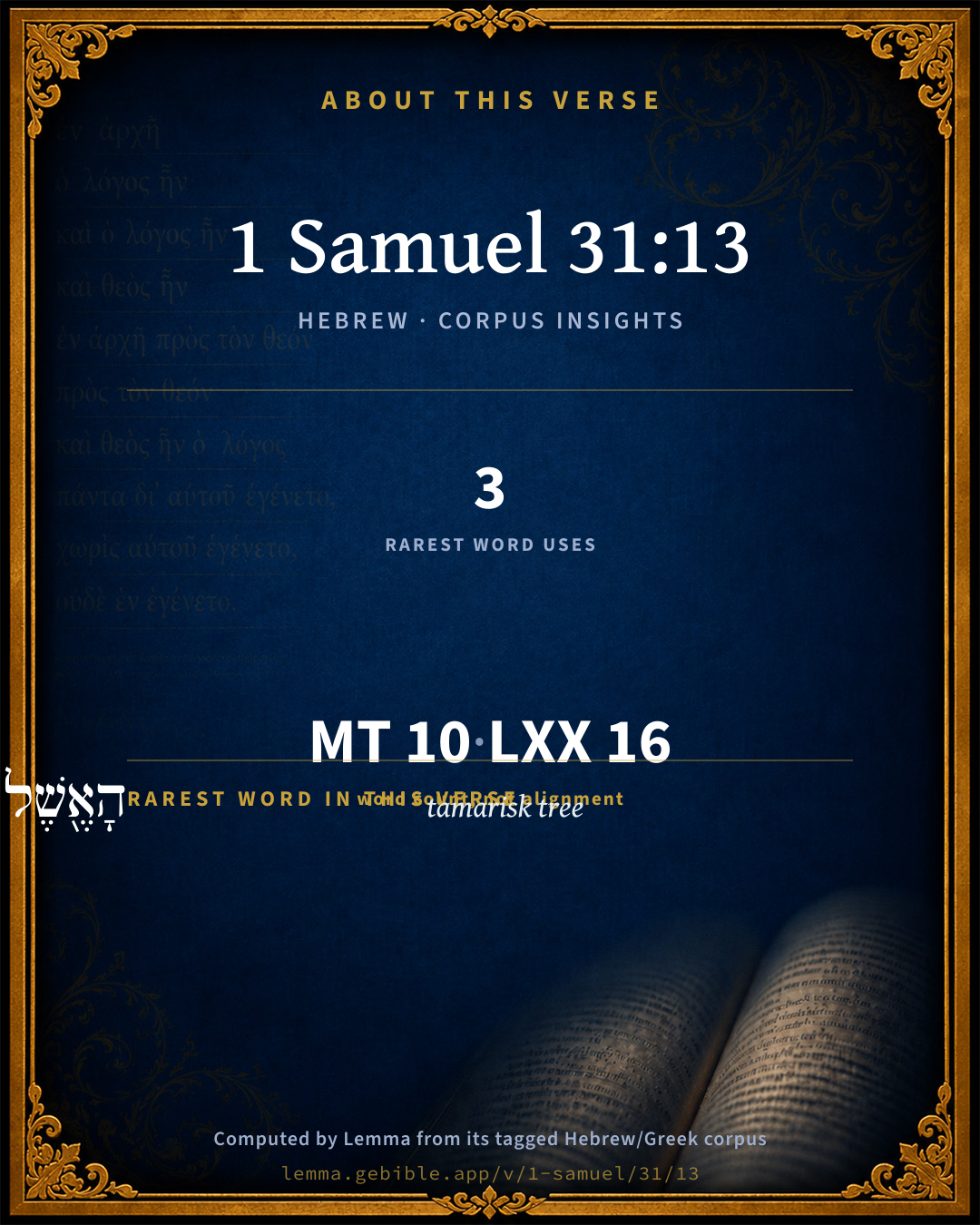
The rarest word here is הָאֶ֖שֶׁל tamarisk tree H815 — appearing just 3 times in the whole Hebrew Bible.

Shared distinctive vocabulary

הָאֶ֖שֶׁל tamarisk tree H815 occurs in 3 verses of the Hebrew Bible. Also found in:

Grammatical profile

  • 3 verbs
  • 4 nouns
  • 1 adjective
  • 1 preposition
  • 1 particle

Verb forms

  • וַיִּקְחוּ֙ Qal · Sequential Imperfect
  • וַיִּקְבְּר֥וּ Qal · Sequential Imperfect
  • וַיָּצֻ֖מוּ Qal · Sequential Imperfect

Hebrew & Septuagint length

In English translation the verse runs 17 words from the Hebrew and 19 from the Septuagint (LXX English) — closely comparable.

A rough comparison of the two English renderings, which tokenize alike — not a word-level alignment.

Word counts can differ between the Hebrew and the Greek without any difference in meaning — e.g. the Hebrew direct-object marker אֵת has no separate Greek word, and Greek often adds the article ὁ.

In the original languages it is 10 Hebrew tokens and 16 Greek tokens — but the two are counted differently (Hebrew bundles its prefixes and suffixes into one token; the Greek is in lemma form), so that isn’t a like-for-like length.

Cross-references

6

Topical passages linked to 1 Samuel 31:13 in the Treasury of Scripture Knowledge — connected by theme and wording, ordered by reader-vote popularity; previews shown in the World English Bible.

  • Genesis 50:10 They came to the threshing floor of Atad, which is beyond the Jordan, and there they lamented with a very great and sore lamentation. He mourned for his father seven days.
  • 2 Samuel 21:12–14 David went and took the bones of Saul and the bones of Jonathan his son from the men of Jabesh Gilead, who had stolen them from the street of Beth-shan, where the Philistines had hanged them, in the day that the Philistines killed Saul in Gilboa;
  • 1 Samuel 22:6 Saul heard that David was discovered, and the men who were with him: now Saul was sitting in Gibeah, under the tamarisk tree in Ramah, with his spear in his hand, and all his servants were standing about him.
  • Genesis 35:8 Deborah, Rebekah's nurse, died, and she was buried below Bethel under the oak; and the name of it was called Allon Bacuth.
  • 2 Samuel 1:12 and they mourned, and wept, and fasted until even, for Saul, and for Jonathan his son, and for the people of Yahweh, and for the house of Israel; because they were fallen by the sword.
  • 2 Samuel 2:4–5 The men of Judah came, and there they anointed David king over the house of Judah. They told David, saying, The men of Jabesh Gilead were those who buried Saul.

Cross-references courtesy of OpenBible.info (CC BY 4.0).

Hebrew and Greek witnesses Masoretic Hebrew ↔ Greek Septuagint

The same verse in the two great witnesses to the Old Testament, shown verse-for-verse.

These are two independent witnesses, not word-aligned to each other, and the Septuagint is shown in lemma (dictionary) form.

Hebrew 1 Samuel 31:13 Masoretic · Westminster Leningrad Codex

וַיִּקְחוּ֙ אֶת עַצְמֹ֣תֵיהֶ֔ם וַיִּקְבְּר֥וּ תַֽחַת הָאֶ֖שֶׁל בְּיָבֵ֑שָׁה וַיָּצֻ֖מוּ שִׁבְעַ֥ת יָמִֽים

They took their bones, and buried them under the tamarisk tree in Jabesh, and fasted seven days.

World English Bible · Public Domain

Greek LXX 1 Samuel 31:13 Septuagint · lemma form

καί λαμβάνω ὁ ὀστέον αὐτός καί θάπτω ὑπό ὁ ἄρουρα ὁ ιαβις καί νηστεύω ἑπτά ἡμέρα

And they took their bones, and buried them in the field that is in Jabis, and fasted seven days.

LXX2012 (modern English Septuagint) · Public Domain

Hebrew: Westminster Leningrad Codex (CC BY 4.0). Greek: Septuagint (public domain); English from LXX2012 (modern English Septuagint) (Public Domain). How the Septuagint differs from the Hebrew →

Targum (Aramaic paraphrase)

1

The Targum is the ancient Jewish Aramaic paraphrase of the Hebrew Scriptures — an interpretive translation, not the Hebrew text itself. Onkelos (literal) and Pseudo-Jonathan (expansive) render the Torah, and Jonathan the Prophets. Coverage is partial: where no permissively-licensed English translation exists for a verse, only the Aramaic is shown. This is verse-level text, not a word-by-word alignment to the Hebrew.

  1. Targum Jonathan Prophets (Joshua–Malachi)
    וּנְסִיבוּ יַת גַרְמֵיהוֹן וּקְבָרוּ תְּחוֹת אֲשֵׁלָא בְּיָבֵשׁ וְצָמוּ שַׁבְעָא יוֹמִין:

    (no public-domain English translation for this verse)

    Targum Jonathan — Aramaic: “Mikraot Gedolot” (public domain). English: “Sefaria Community Translation” (CC0 1.0 (public-domain dedication)); “London "Chaldee Paraphrase," 1871” (public domain). Text via Sefaria.

Commentary

Notes on 1 Samuel 31:13 from classic Christian and Jewish commentators (each source and its license shown beneath its notes). The classic Christian expositions comment on the surrounding passage and are grouped to its opening verse, so a note may address several verses; the Jewish commentaries on the Tanakh (Rashi and others) are per-verse, so they appear only where the commentator wrote on this verse.

Lemma curates 59 commentaries, every one of them public domain or Creative Commons licensed, each selected and text-cleaned for this edition rather than reprinted as found. About our sources →

Trapp's Complete Commentary

John Trapp

1Sa 31:13 And they took their bones, and buried [them] under a tree at Jabesh, and fasted seven days.

Ver. 13. And they took their bones.] Half calcinated.

And buried them under a tree.] Sub ulmo, some render it, under an elm: others, under a terebinth, as under a monument.

And fasted seven days.] To show their great grief, as Job 2:13, all which while they fasted, non a toto, sed a tanto et tali, as Dan 10:3, and prayed doubtless for the public wellfare.

Soli Deo Gloria

John Trapp, A Commentary or Exposition upon All the Books of the Old and New Testament (1647–1656) — public domain. Text from a community e-Sword module.

Joseph Benson's Commentary

1Sa 31:13. And fasted seven days — To testify their sorrow for the loss of Saul, and of the people of God; and to entreat God’s favour to prevent the utter extinction of his people. But we must not understand this word of fasting strictly, as if they ate nothing for seven whole days; but in a more large sense, as it is used both in sacred and profane writers; that they did eat but little, and that but mean food, and drank only water for that time. This book began with the birth of Samuel, and ends with the death of Saul. The comparing these together will teach us to prefer the honour that comes from God before all the honours of the world. The reader will do well to observe also that in this book we have two such examples of piety and virtue in Samuel and David as we cannot too frequently make the subject of our consideration. On the other hand, in the example of Saul we have a picture of the miserable state of that man who forgetteth God, and turneth aside from his commandments. May God, through Jesus Christ, send down his grace into our hearts, that, through our whole lives, we may be inclined to imitate the first, and may always dread to fall into the state of the latter, and, as the only way to escape it, make it our chief study and delight to please God, and do his will; for this is the whole of man: in which all his happiness, all his peace consists. For that there is no peace to the wicked, hath been pronounced by Him who knoweth the nature and frame of man; by the Lord himself, who cannot lie. “The wicked are like the troubled sea when it cannot rest. There is no peace, saith my God, to the wicked,” Isa 57:20-21.

Joseph Benson's Commentary on the Old and New Testaments (1811–1818) — public domain. Text from a community e-Sword module.

Tyndale Open Study Notes

Tyndale Open Resources

31:13 bones . . . Jabesh: This was not the final resting place of Saul’s remains (see 2 Sam 21:12-14). • The ending of 1 Samuel brings Israel’s history back to the situation at the end of Judges, when “Israel had no king.” Once again, the Philistines were in control. David had God’s anointing but no crown. He had wives but no sons. His affiliation with the hated Philistines might jeopardize his standing among his own people. David’s future path would be challenging, but God was clearly with him.

Tyndale Open Study Notes — © Tyndale Open Resources, licensed CC BY-SA 4.0. Text via the HelloAO Bible API.

Geneva Bible (1599)

Geneva Bible translators

According to the custom of mourners.

Geneva Bible (1599) marginal notes — public domain. Text via Bolls.life.

Adam Clarke's Commentary

Verse 13. And fasted seven days.] To testify their sincere regret for his unfortunate death, and the public calamity that had fallen upon the land.

THUS ends the troublesome, and I had almost said the useless, reign of Saul. A king was chosen in opposition to the will of the Most High; and the government of God in effect rejected, to make way for this king.

Saul was at first a very humble young man, and conducted himself with great propriety; but his elevation made him proud, and he soon became tyrannical in his private conduct and in his political measures. His natural temper was not good; he was peevish, fretful, and often outrageous; and these bad dispositions, unchecked by proper application to the grace of God, became every day more headstrong and dangerous. Through their violence he seems at times to have been wholly carried away and deranged; and this derangement appears to have been occasionally greatly exacerbated by diabolical influences. This led him to take his friends for his foes; so that in his paroxysms he strove to imbrue his hands in their blood, and more than once attempted to assassinate his own son; and most causelessly and inhumanly ordered the innocent priests of the Lord at Nob to be murdered. This was the worst act in his whole life.

Saul was but ill qualified for a proper discharge of the regal functions. The reader will remember that he was chosen rather as a general of the armies than as civil governor. The administration of the affairs of the state was left chiefly to Samuel, and Saul led forth the armies to battle.

As a general he gave proof of considerable capacity; he was courageous, prompt, decisive, and persevering; and, except in the last unfortunate battle in which he lost his life, generally led his troops to victory.

Saul was a weak man, and very capricious; this is amply proved by his unreasonable jealousy against David, and his continual suspicion that all were leagued against him. It is also evident, in his foolish adjuration relative to the matter of the honey (see 1Sa 14:24-30; 1Sa 14:38-44) in which, to save his rash and nonsensical oath, he would have sacrificed Jonathan his son!

The question, "Was Saul a good king?" has already in effect been answered. He was on the whole a good man, as far as we know, in private life; but he was a bad king; for he endeavoured to reign independently of the Jewish constitution; he in effect assumed the sacerdotal office and functions, and thus even changed what was essential to that constitution. He not only offered sacrifices which belonged to the priests alone; but in the most positive manner went opposite to the orders of that God whose vicegerent he was.

Of his conduct in visiting the woman at En-dor I have already given my opinion, and to this I must refer. His desperate circumstances imposed on the weakness of his mind; and he did in that instance an act which, in his jurisprudential capacity, he had disapproved by the edict which banished all witches, c., from Israel. Yet in this act he only wished to avail himself of the counsel and advice of his friend Samuel.

To the question, "Was not Saul a self-murderer?" I scruple not to answer, "No." He was to all appearance mortally wounded, when he begged his armour-bearer to extinguish the remaining spark of life and he was afraid that the Philistines might abuse his body, if they found him alive; and we can scarcely say how much of indignity is implied in this word; and his falling on his sword was a fit of desperation, which doubtless was the issue of a mind greatly agitated, and full of distraction. A few minutes longer, and his life would in all probability have ebbed out; but though this wound accelerated his death, yet it could not be properly the cause of it, as he was mortally wounded before, and did it on the conviction that he could not survive.

Taking Saul's state and circumstances together, I believe there is not a coroner's inquest in this nation that would not have brought in a verdict of derangement; while the pious and the humane would everywhere have consoled themselves with the hope that God had extended mercy to his soul.

MILLBROOK, June 11, 1818.

Ended this examination August 13, 1827. - A.C.

Adam Clarke's Commentary on the Bible (1810–1826) — public domain. Text from a community e-Sword/MySword module.

Ellicott's Commentary for English Readers

(13) A tree in Jabesh.—A tree, that is “the well-known” tamarisk (êshel). For Saul’s love for trees see as an instance 1Sa_22:6. The men of Jabesh-Gilead well remembered this peculiar fancy of their dead king, and under the waving branches of their own beautiful and famous tamarisk they tenderly laid the remains of their dead hero and his princely sons.

Evidently King David, at a subsequent period, fetched away these royal remains, and had them reverently interred in the family sepulchre of Kish, the father of Saul, in Zelah of Benjamin (2Sa_21:12; 2Sa_21:14).

And fasted seven days.—This was the period the sons of Israel mourned for Jacob at the threshing floor of Atad beyond Jordan (Gen_1:10). The grateful men of Jabesh-Gilead thus paid the last honours to the fallen Saul.

It is probable that the Talmudic rule which enjoins strict mourning for seven days (fasting was mourning of the strictest kind) was originally based on these two historic periods of mourning recorded in the case of the great ancestor of the tribes, Jacob, and of the first King Saul, although the curious tradition preserved in the Babylonian Talmud gives a special reason for the period—seven days. Rav. Chisda said: The soul of the deceased mourns over him the first seven days; for it is said, Job_14:22, “and his soul shall mourn over him.” Rav. Jehudah said: If there are no mourners to condole with, ten men sit down where the death took place. Such a case happened in the neighbourhood of Rav. Jehudah. After the seven days of mourning, the deceased appeared to Rav. Jehudah in a dream, and said “Mayest thou be comforted as thou hast comforted me.”—Treatise Shabbath, fol. 152, Colossians 2.

To this day among the Jews ten men are hired to perform the usual daily prayers during the seven days of mourning at the house of the deceased.

On the reason for the number seven being fixed for the period of mourning, we read again in the Seder Moed of the Babylonian Talmud, “How is it proved that mourning should be kept up seven days? “It is written, Amo_8:10 : “I will turn your feasts into mourning,” and these (usually) lasted seven days.—Treatise Moed Katon, fol. 20, Colossians 1.

“Again a long draught of my soul-wine! Look forth o’er the

years!

Thou hast done now with eyes for the actual; begin with the

seer’s!

Is Saul dead? In the depth of the vale make his tomb, bid

arise

A grey mountain of marble heaped four-square, till built to the

skies.

Let it mark where the great First King slumbers; whose fame

would ye know?

Up above see the rock’s naked face, where the record shall go,

In great characters cut by the scribe. Such was Saul, so ne

did;

With the sages directing the work, by the populace chid—

For not half, they’ll affirm, is comprised there! Which fault to

amend,

In the grove with his kind grows the cedar, whereon they shall

spend

(See, in tablets, it is level before them) their praise, and record,

With gold of the graver, Saul’s story—the statesman’s great

Word

Side by side with the poet’s sweet comment. The rivers

a-wave

With smooth paper-reeds grazing each other when prophet

winds rave:

So the pen gives unborn generations their due and their part

In thy being! Then, first of the mighty, thank God that thou

art !”

BROWNING’S Saul.

A Bible Commentary for English Readers, edited by Charles John Ellicott (1878–1897) — public domain. Text from a community e-Sword module.

The Cambridge Bible for Schools and Colleges

gen. ed. J. J. S. Perowne

13. under a tree] Under the tamarisk, some well-known tree at Jabesh. Chron. reads “under the terebinth,” (êlah). David removed the bones to the family sepulchre at Zelah (2Sa_21:12-14).

fasted seven days] A sign of general mourning. Cp. 2Sa_1:12; 2Sa_3:35, &c.

The Cambridge Bible for Schools and Colleges (gen. ed. J. J. S. Perowne; Cambridge University Press, 1878–1918) — public domain. Text from a community e-Sword module.

John Gill's Exposition

And they took their bones, and buried them under a tree at Jabesh,.... For though they burned the bodies, yet so as to preserve the bones; and these, together with the ashes of the parts burnt, they gathered up, and buried under a tree near this city; this tree is said to be an oak, Ch1 10:12; so Deborah, the nurse of Rebekah, was buried under an oak, Gen 35:8. The Jews generally interred their dead under some oak, as aforementioned writer observes (q); pleased perchance with the parallel, as he expresses it, that as these plants, seemingly dead in winter, have every spring an annual resurrection, so men's dry bones shall have new sap put into them at the day of judgment:

and fasted seven days; not that they ate and drank nothing all that time, but they fasted every day till evening, as the Jews used to do; so long it seems a man may live without eating, but not longer; See Gill on Exo 24:18 and see Gill on Kg1 19:8; this they did, as Kimchi thinks, in memory of the seven days Nahash the Ammonite gave them for their relief, in which time Saul came and saved them, Sa1 11:3.

(q) Pisgah-Sight of Palestine b. 2. ch. 2. p. 82.

Next: 2 Kings (2 Samuel) Introduction

John Gill's Exposition of the Whole Bible (1746–1763) — public domain (CC PDM 1.0). Text via the HelloAO Bible API.

Albert Barnes' Notes on the Bible

Under a tree - Rather, “Under the tamarisk,” a well-known tree at Jabesh which was standing when this narrative was written.

They fasted seven days - In imitation of the mourning for Jacob (marginal reference). They would give full honor to Saul though he was fallen.

Albert Barnes' Notes on the Bible (1834–1885) — public domain. Text from a community e-Sword/MySword module.

Haydock's Catholic Bible Commentary

Wood. 1 Paralipomenon x. 12., under the oak. --- Days, at their own option. David fasted one day, (Calmet) as he did for Abner. (Salien) --- There was no obligation of mourning for the kings, though it is probable that those near the royal city, would shew this mark of attention to the deceased monarch. See Jeremias xxxiv. 5., and 2 Paralipomenon xxxv. 25. The usual term of mourning was seven days, Ecclesiasticus xxii. 13. (Calmet) --- It is very difficult to ascertain the length of Saul’s reign. Sanctius and Tirinus allow him only 2 years; Petau 12; Calvisius 15; Salien 18; Bucholeer, and probably Josephus, 20, though most copies of the latter have 38; St. Augustine, Serarius, Usher, &c., 40, which is the term mentioned [in] Acts xiii. 20. But most chronologers suppose that the time of Samuel’s administration is there also included. (Haydock) --- Sulpitius thinks that Saul only "reigned a very short time," as "the ark was brought to Cariathiarim before the appeared on the throne, and was removed by David, after it had been there twenty years."

George Leo Haydock (1774–1849), Haydock's Catholic Family Bible and Commentary, 1859 edition — public domain. Excludes Psalms (Douay-Rheims chapter numbering differs from Protestant) and Deuterocanonical books (Catholic canon only).

Matthew Poole's English Annotations

To testify their sorrow for the public loss of Saul, and of the people of God; and to entreat God’s favour to prevent the utter extinction of his people. But you must not understand this word of fasting strictly, as if they eat nothing for seven whole days; but in a more large and general sense, as it is used both in sacred and profane writers; that they did eat but little, and that seldom, and that but mean food, and drunk only water for that time.

Matthew Poole's English Annotations on the Holy Bible (1683–1685) — public domain. Text from a community e-Sword/MySword module.

Whedon's Commentary on the Bible

Daniel D. Whedon

13. Took their bones — From which it appears that they were not burned to ashes.

Buried them… at Jabesh — Where they remained until David had them removed and placed in the sepulchre of Kish at Zelah. 2Sa_21:14.

Fasted seven days — Because of their deep humiliation and grief.

Here ends the history of Saul, and at its close we may well pause to record a few additional reflections on his life and reign. We are impressed from the beginning to the end of his career with the conviction, which deepens all the way along, that he was unequal to his times. He was the center of events and persons greater than himself, and was sadly deficient in those mental and religious qualities which mark the highest style of man. He possessed, indeed, some touching and tender traits of character. In his earlier years he was meek and little in his own eyes, (1Sa_15:17,) though in the eyes of all who knew him he was a choice and noble youth. 1Sa_9:2. His emotional soul quickly caught the ecstasy of the prophetic schools, and he prophesied among them; and even in the later days of his insane persecution of David there would come moments of deep humiliation and contrition of soul, when he would melt into tearful tenderness. 1Sa_24:16; 1Sa_26:21. But he was unequal to the weight of empire. Elevation to power spoiled and finally ruined him, for there was in him a sad mental and religious incapacity for meeting the exigencies of that most trying period of Israelitish history.

“If Samuel is the great example of an ancient saint growing up from childhood to old age without a sudden conversion, Saul is the first direct example of the mixed character often produced by such a conversion, a call coming in the midday of life to rouse the man to higher thoughts than the lost asses of his father’s household or than the tumults of war and victory. He became ‘another man,’ yet not entirely. He was, as is so often the case, half-converted, half-roused. His mind moved unequally and disproportionately in its new sphere. Backwards and forwards, in the names of his children, we see alternately the signs of the old heathenish superstition and of the new purified religion of Jehovah. He caught the prophetic inspiration not continuously, but only in fitful gusts. Then he would be again the slave of his common pursuits. His religion was never blended with his moral nature. It broke out in wild, ungovernable acts of zeal and superstition, and then left him more a prey than ever to his own savage disposition. With the prospects and the position of a David, he remained to the end a Jephthah or a Samson, with this difference, that, having outlived the age of Jephthah and of Samson, he could not be as they; and the struggle, therefore, between what he was and what he might have been, grew fiercer as years went on; and the knowledge of Samuel, and the companionship of David, became to him a curse instead of a blessing.” — Stanley.

The true theocratic view of Saul’s reign is appropriately given in Jehovah’s own words. Hos_13:11 : “I gave thee a king in mine anger, and took him away in my wrath.” We must not understand, then, that Saul was chosen because God saw in him the proper qualifications for a king, but quite the contrary. God wished to punish his people for their loss of the true theocratic spirit, and their blind adherence to the false principles and aims with which they thought to revolutionize their government, and the punishment came by the administration of an incompetent king. The leaders of Israel were in an almost passionate haste for change. The occasion and manner of their asking for a king was like throwing the blame of all their national misfortunes on Jehovah, and was accompanied by a suggestion that a king like one of the heathen monarchs would be better than any other kind of leader; so he gave them a king much after their fancy in order to punish them — a man of lofty stature, of splendid personal appearance, of strong heroic impulses, but sadly defective in those nobler virtues which make a man after God’s own heart.

We need not suppose that Saul was so exclusively chosen of God as that the people had no hand and voice in his election. Already, when he first appeared to Samuel, he was designated as the one above all others, “on whom was all the desire of Israel.” 1Sa_9:20. His noble presence and lofty stature, and the wealth and political influence of his family, had already led many in Israel, as they were talking up a king, to turn their eyes to Saul, the son of Kish. The sacred historian may have purposely passed over the merely human measures that were used to secure Saul’s election, and have given us, as is the design of sacred history, the working of God’s hand in the matter.

In the introduction to chapter 13, where the history of Saul’s reign properly begins, we have called attention to the fact that the first three chapters of that history (13, 14, and 15) are devoted to a detailed account of the three great errors of Saul’s life. From these three errors sprang all his after woes. They were the religious crises of his history, and at each point he failed.

But though Saul’s reign was a failure, his whole career is sketched with a plaintive tenderness. Not only did Samuel greatly mourn for Saul, (1Sa_15:11; 1Sa_15:35; 1Sa_16:1,) but the sacred historian, caught the sad, tender spirit of that saintly judge, and breathed it into his narrative. In the same spirit David pours forth his touching elegy over the fallen beauty and might of Israel. 2Sa_1:19-27. In the same spirit let us remember that “pride goeth before destruction, and a haughty spirit before a fall.”

Daniel D. Whedon (gen. ed.), Commentary on the Old and New Testaments (1874–1909) — public domain. Text from a community e-Sword module.

John Wesley's Explanatory Notes

Fasted - To testify their sorrow for the loss of Saul, and of the people of God; and to intreat God's favour to prevent the utter extinction of his people. But you must not understand this word of fasting strictly, as if they eat nothing for seven whole days; but in a more large sense, as it is used both in sacred and profane writers; that they did eat but little, and that but mean food, and drank only water for that time. This book began with the birth of Samuel, and ends with the death of Saul: The comparing these together will teach us to prefer the honour that comes from God, before all the honours of the world.

John Wesley, Explanatory Notes Upon the Whole Bible (1754–1765) — public domain. Text via the GEBible commentary corpus.

Lesson kit

Teaching starters — assembled from the data on this page, not authored interpretation. Every prompt links to the verse data it draws on. Edit before teaching.

1 Samuel, in the Historical, opens this verse with 10 words (10 distinct Hebrew lemmas). Its most distinctive word is ʼêshel (“tamarisk tree”). A historical commentator’s framing appears above. Read the whole chapter for the surrounding context.

Discussion questions

  1. What does “tamarisk tree” (ʼêshel) contribute to the verse as a whole?
  2. Genesis 21:33 shares the word «tamarisk tree» with this verse. How do the two illuminate each other?
  3. These translations render this verse differently; the difference is in the English rendering, not the original. What questions does that raise?
  4. The verb «וַיִּקְחוּ֙» is Qal Sequential Imperfect. How does its form color the action?
  5. Reading how Trapp's Complete Commentary and Joseph Benson's Commentary read this verse, where do the two commentators agree and where do they part?

Things to notice

Reading settings

Reading text

Shown beneath each verse's original-language words.

Old Testament
Old Testament edition

Read the OT as the Masoretic Hebrew (MT) or the Greek Septuagint (LXX).

English shown for the Greek Septuagint (in the Hebrew ↔ Greek comparison).

Comparing translations? Open the Compare panel on any verse page to stack up to four side by side.