
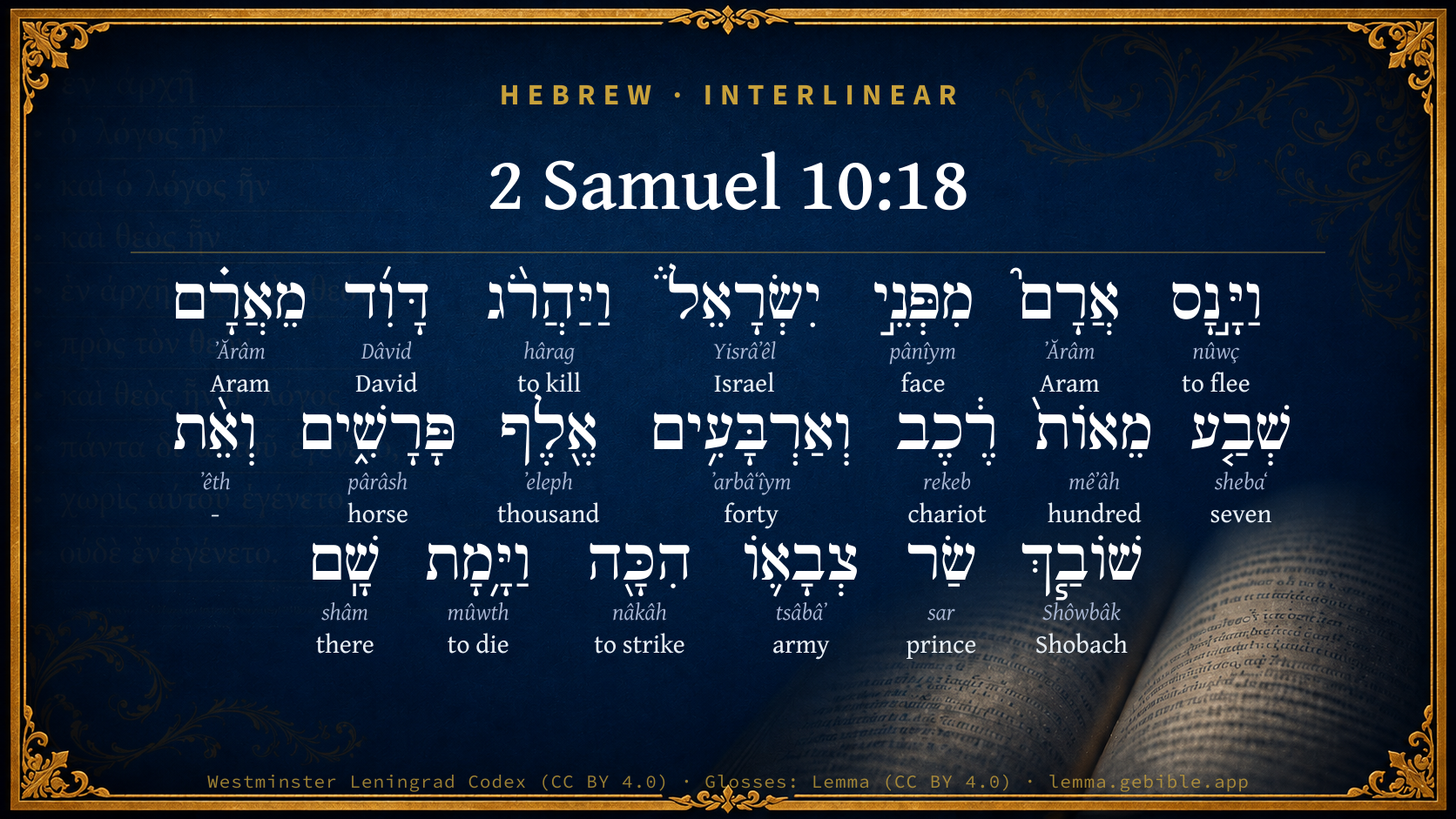
2 Samuel 10:18

Hebrew (Westminster Leningrad Codex) 2 Samuel 10:18 appears in the Hebrew Old Testament. The text above is from the Westminster Leningrad Codex. Each word links to its Strong’s number, a concise gloss, and parsing drawn from the Open Scriptures Hebrew Bible morphology. Click any word for its full Brown-Driver-Briggs (BDB) entry.
Download image
Cite this verse

2 Samuel 10:18 (World English Bible). Public Domain. Lemma interlinear Bible study tool, https://lemma.gebible.app/v/2-samuel/10/18.

Show BibTeX & RIS
BibTeX
RIS
English Translation
The Syrians fled before Israel; and David killed of the Syrians [the men of] seven hundred chariots, and forty thousand horsemen, and struck Shobach the captain of their host, so that he died there.
World English Bible · Public Domain
Download a study sheet

One document with this verse’s original text, its word-by-word gloss line, the meaning frame, cross-references with their text, attributed commentary, and full source and license credits — printable, and it pastes into notes with its structure intact.

This verse Autodidact and up

Study sheet (.html) Plain text (.txt)

A passage Seminary Student

Up to 50 verses in one chapter. A passage sheet keeps up to 6 commentary sources and 12 cross-references per verse, in the order this page ranks them, and says so on the sheet whenever that leaves anything out. Ask for a single verse and you get the Autodidact verse sheet above.

Everything on this page stays free to read, with no account — the sheet is a download of what is already on screen, not access to it.

Want to remove ads? Support Godless Engineer
Compare translations 3

The same verse in 3 English versions, stacked beneath the original-language interlinear above. Click any original word for its lexicon entry.

Each is an independent rendering of the whole verse — the interlinear is not word-aligned to these translations.

Highlighted words mark where these versions differ — a whole-verse word diff, not a word-by-word alignment.

  • World English Bible Public Domain
    The Syrians fled before Israel; and David killed of the Syrians [the men of] seven hundred chariots, and forty thousand horsemen, and struck Shobach the captain of their host, so that he died there.
  • King James Version Public Domain
    And the Syrians fled before Israel; and David slew the men of seven hundred chariots of the Syrians, and forty thousand horsemen, and smote Shobach the captain of their host, who died there.
  • unfoldingWord Literal Text CC BY-SA 4.0
    And Aram fled from the face of Israel, and David killed from Aram 700 charioteers and 40,000 horsemen. And he struck Shobach, the commander of his army, and he died there.

unfoldingWord Literal Text — © unfoldingWord, licensed CC BY-SA 4.0. Word-aligned USFM3 via Door43 (git.door43.org/unfoldingWord/en_ult).

Versions to compare (up to 4)

3 of 4 selected

Show all 18 translations

Every available English version of this verse, each an independent rendering of the whole verse.

  • World English Bible Public Domain
    The Syrians fled before Israel; and David killed of the Syrians [the men of] seven hundred chariots, and forty thousand horsemen, and struck Shobach the captain of their host, so that he died there.
  • Berean Standard Bible Public Domain
    But the Arameans fled before Israel, and David killed seven hundred charioteers and forty thousand foot soldiers. He also struck down Shobach the commander of their army, who died there.
  • Majority Standard Bible Public Domain
    But the Arameans fled before Israel, and David killed seven hundred charioteers and forty thousand foot soldiers. He also struck down Shobach the commander of their army, who died there.
  • King James Version Public Domain
    And the Syrians fled before Israel; and David slew the men of seven hundred chariots of the Syrians, and forty thousand horsemen, and smote Shobach the captain of their host, who died there.
  • American Standard Version (1901) Public Domain
    And the Syrians fled before Israel; and David slew of the Syrians `the men of' seven hundred chariots, and forty thousand horsemen, and smote Shobach the captain of their host, so that he died there.
  • Revised Version (1885) Public Domain
    And the Syrians fled before Israel; and David slew of the Syrians the men of seven hundred chariots, and forty thousand horsemen, and smote Shobach the captain of their host, that he died there.
  • Geneva Bible (1599) Public Domain
    And the Aramites fled before Israel: and Dauid destroyed seuen hundreth charets of the Aramites, and fourtie thousande horsemen, and smote Shobach the captaine of his hoste, who dyed there.
  • Douay-Rheims (1899) Public Domain
    And the Syrians fled before Israel, and David slew of the Syrians the men of seven hundred chariots, and forty thousand horsemen: and smote Sobach the captain of the army, who presently died.
  • Young's Literal Translation Public Domain
    and Aram fleeth from the presence of Israel, and David slayeth of Aram seven hundred charioteers, and forty thousand horsemen, and Shobach head of its host he hath smitten, and he dieth there.
  • Literal Standard Version CC BY-SA 4.0
    and Aram flees from the presence of Israel, and David slays seven hundred charioteers and forty thousand horsemen of Aram, and he has struck Shobach, [the] head of its host, and he dies there.
  • Unlocked Literal Bible CC BY-SA 4.0
    The Arameans fled from Israel, and David killed seven hundred of their men in chariots and forty thousand horsemen. Shobak the commander of their army was wounded and died there.
  • unfoldingWord Literal Text CC BY-SA 4.0
    And Aram fled from the face of Israel, and David killed from Aram 700 charioteers and 40,000 horsemen. And he struck Shobach, the commander of his army, and he died there.
  • Darby Bible Public Domain
    And the Syrians fled before Israel; and David slew of the Syrians seven hundred [in] chariots, and forty thousand horsemen, and smote Shobach the captain of their host, who died there.
  • World Messianic Bible Public Domain
    The Syrians fled before Israel; and David killed seven hundred charioteers of the Syrians and forty thousand horsemen, and struck Shobach the captain of their army, so that he died there.
  • Webster's Bible Public Domain
    And the Syrians fled before Israel; and David slew the men of seven hundred chariots of the Syrians, and forty thousand horsemen, and smote Shobach the captain of their host, who died there.
  • Free Bible Version CC BY-SA 4.0
    But the Aramean army ran away from the Israelites, and David killed 700 charioteers and 40,000 infantry. He also attacked Shobach, their army commander, and he died there.
  • Bible in Basic English Public Domain
    And the Aramaeans went in flight before Israel; and David put to the sword the men of seven hundred Aramaean war-carriages and forty thousand footmen, and Shobach, the captain of the army, was wounded, and came to his death there.
  • JPS Tanakh (1917) Public Domain
    And the Arameans fled before Israel; and David slew of the Arameans seven hundred drivers of chariots, and forty thousand horsemen, and smote Shobach the captain of their host, so that he died there.

Literal Standard Version (2020), Covenant Press — licensed CC BY-SA 4.0. Text via the HelloAO Bible API (eBible.org). Unlocked Literal Bible (unfoldingWord) — licensed CC BY-SA 4.0. Text via the HelloAO Bible API (eBible.org). unfoldingWord Literal Text — © unfoldingWord, licensed CC BY-SA 4.0. Word-aligned USFM3 via Door43 (git.door43.org/unfoldingWord/en_ult). Free Bible Version, Dr. Jonathan Gallagher — licensed CC BY-SA 4.0. Text via the HelloAO Bible API (eBible.org).

Word by word

More ways to search: Search by grammar → Find every occurrence → Compare this word →

Practice this passage: Drill this verse → Learn its vocabulary →

שׁוֹבַ֧ךְ
Shôwbâk
H7731
“Shobach”
Noun, Proper
Part of Speech
Noun
Type
Proper
Full BDB Definition

Origin: perhaps for H7730

TWOT: None

Shobach = "expansion" - general of king Hadarezer of the Syrians of Zoba in the time of David
  1. וַיָּ֣נָס nûwç H5127 “and · to flee” Conjunction + Verb, Qal, Sequential Imperfect, 3rd Person, Masculine, Singular
  2. אֲרָם֮ ʼĂrâm H758 “Aram” Noun, Proper
  3. מִפְּנֵ֣י pânîym H6440 “from · face(s) of” Preposition + Noun, Common, Both, Plural, Construct
  4. יִשְׂרָאֵל֒ Yisrâʼêl H3478 “Israel” Noun, Proper
  5. וַיַּהֲרֹ֨ג hârag H2026 “and · to kill” Conjunction + Verb, Qal, Sequential Imperfect, 3rd Person, Masculine, Singular
  6. דָּוִ֜ד Dâvid H1732 “David” Noun, Proper
  7. מֵאֲרָ֗ם ʼĂrâm H758 “from · Aram” Preposition + Noun, Proper
  8. שְׁבַ֤ע shebaʻ H7651 “seven” Adjective, Cardinal number, Feminine, Singular, Absolute
  9. מֵאוֹת֙ mêʼâh H3967 “hundred” Adjective, Cardinal number, Both, Plural, Absolute
  10. רֶ֔כֶב rekeb H7393 “chariot” Noun, Common, Masculine, Singular, Absolute
  11. וְאַרְבָּעִ֥ים ʼarbâʻîym H705 “and · forty” Conjunction + Adjective, Cardinal number, Both, Plural, Absolute
  12. אֶ֖לֶף ʼeleph H505 “thousand” Adjective, Cardinal number, Both, Singular, Absolute
  13. פָּרָשִׁ֑ים pârâsh H6571 “horses” Noun, Common, Masculine, Plural, Absolute
  14. וְאֵ֨ת ʼêth H853 “and · -” Conjunction + Particle, Direct Object
  15. שַׂר sar H8269 “prince of” Noun, Common, Masculine, Singular, Construct
  16. צְבָא֛וֹ tsâbâʼ H6635 “army · his” Noun, Common, Both, Singular, Construct + Suffix, Personal, 3rd Person, Masculine, Singular
  17. הִכָּ֖ה nâkâh H5221 “to strike” Verb, Hiphil, Perfect, 3rd Person, Masculine, Singular
  18. וַיָּ֥מָת mûwth H4191 “and · to die” Conjunction + Verb, Qal, Sequential Imperfect, 3rd Person, Masculine, Singular
  19. שָֽׁם shâm H8033 “there” Adverb

About this verse

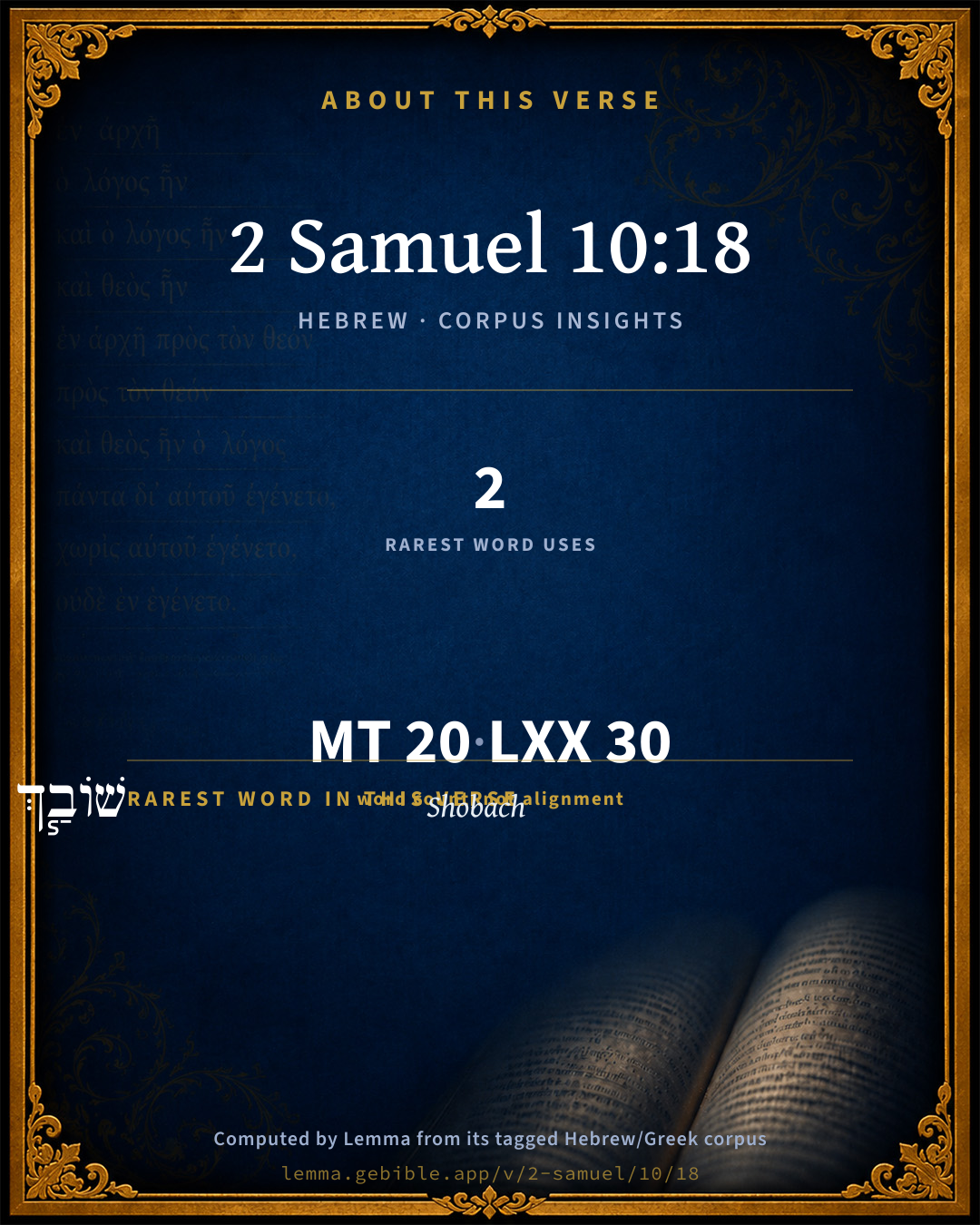
These counts appear in no published source. They are computed here, from the morphology-tagged text and Lemma’s own curated glosses. What Lemma adds →

20
words
19
distinct lemmas
Historical
section

Notable vocabulary

The rarest word here is שׁוֹבַ֧ךְ Shobach H7731 — appearing just 2 times in the whole Hebrew Bible.

Shared distinctive vocabulary

שׁוֹבַ֧ךְ Shobach H7731 occurs in 2 verses of the Hebrew Bible. Also found in:

Grammatical profile

  • 4 verbs
  • 10 nouns
  • 4 adjectives
  • 1 adverb
  • 1 particle

Verb forms

  • וַיָּ֣נָס Qal · Sequential Imperfect
  • וַיַּהֲרֹ֨ג Qal · Sequential Imperfect
  • הִכָּ֖ה Hiphil · Perfect
  • וַיָּ֥מָת Qal · Sequential Imperfect

Repetition

A word recurs within this verse — often emphatic in Hebrew:

  • אֲרָם֮ Aram H758 ×2

Hebrew & Septuagint length

In English translation the verse runs 34 words from the Hebrew and 31 from the Septuagint (LXX English) — closely comparable.

A rough comparison of the two English renderings, which tokenize alike — not a word-level alignment.

Word counts can differ between the Hebrew and the Greek without any difference in meaning — e.g. the Hebrew direct-object marker אֵת has no separate Greek word, and Greek often adds the article ὁ.

In the original languages it is 20 Hebrew tokens and 30 Greek tokens — but the two are counted differently (Hebrew bundles its prefixes and suffixes into one token; the Greek is in lemma form), so that isn’t a like-for-like length.

Cross-references

7

Topical passages linked to 2 Samuel 10:18 in the Treasury of Scripture Knowledge — connected by theme and wording, ordered by reader-vote popularity; previews shown in the World English Bible.

  • 1 Chronicles 19:18 The Syrians fled before Israel; and David killed of the Syrians [the men of] seven thousand chariots, and forty thousand footmen, and killed Shophach the captain of the host.
  • Judges 4:2 Yahweh sold them into the hand of Jabin king of Canaan, who reigned in Hazor; the captain of whose host was Sisera, who lived in Harosheth of the Gentiles.
  • Judges 4:22 Behold, as Barak pursued Sisera, Jael came out to meet him, and said to him, Come, and I will show you the man whom you seek. He came to her; and, behold, Sisera lay dead, and the tent-pin was in his temples.
  • Judges 5:26 She put her hand to the tent-pin, Her right hand to the workmen's hammer; With the hammer she struck Sisera, she struck through his head; Yes, she pierced and struck through his temples.
  • 2 Samuel 8:4 David took from him one thousand seven hundred horsemen, and twenty thousand footmen: and David hamstrung all the chariot horses, but reserved of them for one hundred chariots.
  • Psalms 18:38 I will strike them through, so that they will not be able to rise. They shall fall under my feet.
  • Psalms 46:11 Yahweh of Hosts is with us. The God of Jacob is our refuge. Selah.

Cross-references courtesy of OpenBible.info (CC BY 4.0).

Hebrew and Greek witnesses Masoretic Hebrew ↔ Greek Septuagint

The same verse in the two great witnesses to the Old Testament, shown verse-for-verse.

These are two independent witnesses, not word-aligned to each other, and the Septuagint is shown in lemma (dictionary) form.

Hebrew 2 Samuel 10:18 Masoretic · Westminster Leningrad Codex

וַיָּ֣נָס אֲרָם֮ מִפְּנֵ֣י יִשְׂרָאֵל֒ וַיַּהֲרֹ֨ג דָּוִ֜ד מֵאֲרָ֗ם שְׁבַ֤ע מֵאוֹת֙ רֶ֔כֶב וְאַרְבָּעִ֥ים אֶ֖לֶף פָּרָשִׁ֑ים וְאֵ֨ת שׁוֹבַ֧ךְ שַׂר צְבָא֛וֹ הִכָּ֖ה וַיָּ֥מָת שָֽׁם

The Syrians fled before Israel; and David killed of the Syrians [the men of] seven hundred chariots, and forty thousand horsemen, and struck Shobach the captain of their host, so that he died there.

World English Bible · Public Domain

Greek LXX 2 Samuel 10:18 Septuagint · lemma form

καί φεύγω συρία ἀπό πρόσωπον ἰσραήλ καί ἀνααἱρέω δαυίδ ἐκ ὁ συρία ἑπτακόσιοι ἅρμα καί τεσσαράκοντα χιλίας ἱππεύς καί ὁ σωβακ ὁ ἄρχων ὁ δύναμις αὐτός πατάσσω καί ἀποθνήσκω ἐκεῖ

And Syria fled from before Israel, and David destroyed of Syria seven hundred chariots, and forty thousand horsemen, and he struck Sobac the captain of his host, and he died there.

LXX2012 (modern English Septuagint) · Public Domain

Hebrew: Westminster Leningrad Codex (CC BY 4.0). Greek: Septuagint (public domain); English from LXX2012 (modern English Septuagint) (Public Domain). How the Septuagint differs from the Hebrew →

Targum (Aramaic paraphrase)

1

The Targum is the ancient Jewish Aramaic paraphrase of the Hebrew Scriptures — an interpretive translation, not the Hebrew text itself. Onkelos (literal) and Pseudo-Jonathan (expansive) render the Torah, and Jonathan the Prophets. Coverage is partial: where no permissively-licensed English translation exists for a verse, only the Aramaic is shown. This is verse-level text, not a word-by-word alignment to the Hebrew.

  1. Targum Jonathan Prophets (Joshua–Malachi)
    וְאַפָּכוּ אֱנַשׁ אֲרָם מִן קֳדָם יִשְׂרָאֵל וּקְטַל דָוִד מֵאֲרָם שְׁבַע מְאָה רְתִיכִין וְאַרְבְּעִין אַלְפִין פָּרָשִׁין וְיַת שׁוֹבָךְ רַב חֵילֵיהּ מְחוֹ וּמִית תַּמָן:

    (no public-domain English translation for this verse)

    Targum Jonathan — Aramaic: “Mikraot Gedolot” (public domain). English: “Sefaria Community Translation” (CC0 1.0 (public-domain dedication)); “London "Chaldee Paraphrase," 1871” (public domain). Text via Sefaria.

Commentary

Notes on 2 Samuel 10:18 from classic Christian and Jewish commentators (each source and its license shown beneath its notes). The classic Christian expositions comment on the surrounding passage and are grouped to its opening verse, so a note may address several verses; the Jewish commentaries on the Tanakh (Rashi and others) are per-verse, so they appear only where the commentator wrote on this verse.

Lemma curates 59 commentaries, every one of them public domain or Creative Commons licensed, each selected and text-cleaned for this edition rather than reprinted as found. About our sources →

Trapp's Complete Commentary

John Trapp

2Sa 10:18 And the Syrians fled before Israel; and David slew [the men of] seven hundred chariots of the Syrians, and forty thousand horsemen, and smote Shobach the captain of their host, who died there.

Ver. 18. And David slew the men of seven hundred chariots.] Heb., Slew seven hundred chariots; that is, seven thousand men that fought in chariots {a} {1Ch 19:18}

And forty thousand horsemen.] Which yet are said to be footmen. {1Ch 19:18} They might be dragoons, as we now call them; or there might be forty thousand of each sort. The Chronicles are therefore called Paralipomena, because they supply that which was wanting in the former books.

{a} Equites curules.

John Trapp, A Commentary or Exposition upon All the Books of the Old and New Testament (1647–1656) — public domain. Text from a community e-Sword module.

Geneva Bible (1599)

Geneva Bible translators

Which were the chiefest and most principal: for in all he destroyed 7000, as 1 Chron. 19:18, or the soldiers which were in 700 chariots.

Geneva Bible (1599) marginal notes — public domain. Text via Bolls.life.

Adam Clarke's Commentary

Verse 18. SEVEN HUNDRED chariots - and forty thousand HORSEMEN] In the parallel place, 1Ch 19:18, it is said, David slew of the Syrians SEVEN THOUSAND men, which fought in chariots. It is difficult to ascertain the right number in this and similar places. It is very probable that, in former times, the Jews expressed, as they often do now, their numbers, not by words at full length, but by numeral letters; and, as many of the letters bear a great similarity to each other, mistakes might easily creep in when the numeral letters came to be expressed by words at full length. This alone will account for the many mistakes which we find in the numbers in these books, and renders a mistake here very probable. The letter ז zain, with a dot above, stands for seven thousand, נ nun for seven hundred: the great similarity of these letters might easily cause the one to be mistaken for the other, and so produce an error in this place.

Adam Clarke's Commentary on the Bible (1810–1826) — public domain. Text from a community e-Sword/MySword module.

Ellicott's Commentary for English Readers

(18) Seven hundred chariots.—In this campaign David delivered a crushing blow upon his foes, from which they did not recover during the rest of his reign or that of his son. For the seven hundred here 1Ch_19:18 has seven thousand, which is almost an incredible number of chariots, and the number here is evidently the more correct; but the same place has forty thousand footmen, while here it is forty thousand horsemen. Probably both statements are meant to include both infantry and cavalry, though only one of them is especially mentioned in each case. Comp. Note on 2Sa_10:6.

A Bible Commentary for English Readers, edited by Charles John Ellicott (1878–1897) — public domain. Text from a community e-Sword module.

The Cambridge Bible for Schools and Colleges

gen. ed. J. J. S. Perowne

18. seven hundred chariots … forty thousand horsemen] The present text of Chronicles has seven thousand chariots … forty thousand footmen. It seems best to retain the reading seven hundred chariots, and follow Chronicles in reading footmen. But the omission of horsemen in the one and footmen in the other makes it likely that there is some further corruption.

The Cambridge Bible for Schools and Colleges (gen. ed. J. J. S. Perowne; Cambridge University Press, 1878–1918) — public domain. Text from a community e-Sword module.

John Gill's Exposition

And the Syrians fled before Israel,.... After an obstinate and bloody fight between them:

and David slew the men of seven hundred chariots of the Syrians; the word "men" is rightly supplied, for chariots could not be said to be slain, but the men in them; in Ch1 19:17, they are said to be seven thousand, here seven hundred; which may be reconciled by observing, that here the chariots that held the men are numbered, there the number of the men that were in the chariots given, and reckoning ten men in a chariot, seven hundred chariots held just seven thousand men; though Kimchi takes another way of reconciling the two places, by observing that here only the choicest chariots are mentioned, there all of them, but the former way seems best:

and forty thousand horsemen; in Ch1 19:17; it is forty thousand "footmen", and so Josephus (c); and the same may be called both horse and foot, be cause though they might come into the field of battle on horseback, yet might dismount and fight on foot; and so one historian calls them horsemen, and the other footmen; or the whole number of the slain, horse and foot mixed together, were forty thousand; Kimchi makes use of another way of removing this difficulty, and which perhaps is the best, that here only the horsemen are numbered that were slain, and there the footmen only, and both true; an equal number of each being slain, in all eighty thousand, besides the seven thousand in the chariots:

and smote Shobach the captain of their host, who died there; of his wounds upon the spot.

(c) Ut supra. (Antiqu. l. 7. c. 6. sect. 3.)

John Gill's Exposition of the Whole Bible (1746–1763) — public domain (CC PDM 1.0). Text via the HelloAO Bible API.

Albert Barnes' Notes on the Bible

Seven hundred chariots - More probable than the “seven thousand” of 1Ch 19:18. The frequent errors in numbers arise from the practice of expressing numerals by letters, with one or more dots or dashes to indicate hundreds, thousands, etc.

Albert Barnes' Notes on the Bible (1834–1885) — public domain. Text from a community e-Sword/MySword module.

Haydock's Catholic Bible Commentary

Hundred. Paralipomenon, thousand, allowing ten men for each chariot. (Du Hamel; Menochius) --- The men is omitted in both texts. See chap. viii. 4. (Haydock) --- Horsemen. Paralipomenon reads, footmen, supplying what is here omitted, (Salien) so that 87,000 Syrians perished, unless there be a mistake of the transcribers. (Calmet) --- Smote, though not perhaps with his own hand, as he slew so many thousands by means of his army. (Menochius)

George Leo Haydock (1774–1849), Haydock's Catholic Family Bible and Commentary, 1859 edition — public domain. Excludes Psalms (Douay-Rheims chapter numbering differs from Protestant) and Deuterocanonical books (Catholic canon only).

Matthew Poole's English Annotations

The men of seven hundred chariots; Heb. seven hundred chariots, i.e. the men belonging to them, that fought in or with them; as plainly appears,

1. Because the men only, and not the chariots, were capable of being killed, as these are said to have been.

2. Because it is thus explained in the Book of Chronicles, which was written after this book, for this end, to explain what was dark or doubtful, and to supply what was omitted here; where, instead of these words, are seven thousand men which fought in chariots, 1Ch 19:18. And this is a very common metonymy; of which see above, 2Sa 8:4, and the notes on 1Sa 13:5. Although there might be seven thousand chariots in all, whereof seven hundred where chosen ones; according to the distinction made Exo 14:7.

Forty thousand horsemen; for which in 1Ch 19:18, is forty thousand footmen; which may be reconciled divers ways.

1. Both these may be true, that he slew forty thousand horsemen, which being the most considerable part and strength of the army, it might seem sufficient to name them, and every one could easily understand that the footmen in that case were certainly cut off; and that he slew also forty thousand footmen, as is said in 1 Chronicles where he mentions them only, because they were omitted in 2 Samuel, and the horsemen being expressed here, it was needless to repeat them in 1Ch 2. The horsemen may be here called footmen, in opposition to those that fought in chariots; because they sometimes fought on horseback, and sometimes came down from their horses, and fought on foot, when the place of the battle was more commodious for footmen than for horsemen; which it is not improbable was their case here; for David being a soldier of great prudence and experience, and understanding the great numbers of the Syrian horsemen, whereas the Israelites had but very few, Deu 17:16, would doubtless endeavour to choose a place as inconvenient for their horsemen as he could.

3. Peradventure the Syrians designed to bring the war into David’s country, and therefore hastened their march, and for that end put their footmen on horseback, (as hath been frequently done in like cases,) who, when they came to the place of battle, carne down from their horses, and fought on foot. So there is no need of acknowledging an error of the scribe in the sacred text; which yet if it were granted in such historical passages of no moment to the doctrine of faith and good life, it would not shake the foundation of our faith in matters of great importance, which it might reasonably be presumed the providence of God would more watchfully preserve from all depravation or corruption.

Matthew Poole's English Annotations on the Holy Bible (1683–1685) — public domain. Text from a community e-Sword/MySword module.

Whedon's Commentary on the Bible

Daniel D. Whedon

18. Seven hundred chariots — In 1Ch_19:18, we have seven thousand. The discrepancy is doubtless the error of a copyist.

Forty thousand horsemen — In Chronicles forty thousand footmen, another discrepancy resulting either from the carelessness of some early copyist, or the fragmentary character of these accounts. A fully detailed history of this war would doubtless give us many facts and figures now unknown.

Daniel D. Whedon (gen. ed.), Commentary on the Old and New Testaments (1874–1909) — public domain. Text from a community e-Sword module.

The Pulpit Commentary

David slew, etc.. (see note on 2Sa_8:4) We have seen there that the word translated "chariots" means any vehicle or animal for riding. The numbers here are seven hundred chariots with their charioteers, and forty thousand horsemen; in 2Sa_8:4 we have seventeen hundred horsemen and twenty thousand footmen; finally, in 1Ch_19:18 we find seven thousand chariots and charioteers, and forty thousand footmen. It is impossible to reconcile these conflicting numbers, but as David had no cavalry, the numbers in 2Sa_8:4 are the more probable, namely, seventeen hundred cavalry and chariots, and twenty thousand infantry. The Syriac Version gives us here very reasonable numbers, namely, "seven hundred chariots, four thousand cavalry, and much people."

The Pulpit Commentary (1880–1919), ed. H.D.M. Spence-Jones & Joseph S. Exell — public domain. Text from a community e-Sword module.

Lesson kit

Teaching starters — assembled from the data on this page, not authored interpretation. Every prompt links to the verse data it draws on. Edit before teaching.

2 Samuel, in the Historical, opens this verse with 20 words (19 distinct Hebrew lemmas). Its most distinctive word is Shôwbâk (“Shobach”). A historical commentator’s framing appears above. Read the whole chapter for the surrounding context.

Discussion questions

  1. The word Shôwbâk carries the sense “Shobach.” How does it shape the verse?
  2. How does 2 Samuel 10:16, which shares the word «Shobach», read alongside this verse?
  3. What does the repetition of “Aram” (2× in this one verse) do in this verse?
  4. These translations render this verse differently. What is at stake in choosing one wording over another?
  5. «וַיָּ֣נָס» is a Qal Sequential Imperfect verb. How does that grammatical form shape the action described?
  6. Compare how Trapp's Complete Commentary and Geneva Bible (1599) read this verse. Where do they agree or differ?

Things to notice

Reading settings

Reading text

Shown beneath each verse's original-language words.

Old Testament
Old Testament edition

Read the OT as the Masoretic Hebrew (MT) or the Greek Septuagint (LXX).

English shown for the Greek Septuagint (in the Hebrew ↔ Greek comparison).

Comparing translations? Open the Compare panel on any verse page to stack up to four side by side.