Judges 16:7

Hebrew (Westminster Leningrad Codex) Judges 16:7 appears in the Hebrew Old Testament. The text above is from the Westminster Leningrad Codex. Each word links to its Strong’s number, a concise gloss, and parsing drawn from the Open Scriptures Hebrew Bible morphology. Click any word for its full Brown-Driver-Briggs (BDB) entry.
Download image
Cite this verse

Judges 16:7 (World English Bible). Public Domain. Lemma interlinear Bible study tool, https://lemma.gebible.app/v/judges/16/7.

Show BibTeX & RIS
BibTeX
RIS
English Translation
Samson said to her, If they bind me with seven green cords that were never dried, then shall I become weak, and be as another man.
World English Bible · Public Domain
Download a study sheet

One document with this verse’s original text, its word-by-word gloss line, the meaning frame, cross-references with their text, attributed commentary, and full source and license credits — printable, and it pastes into notes with its structure intact.

This verse Autodidact and up

Study sheet (.html) Plain text (.txt)

A passage Seminary Student

Up to 50 verses in one chapter. A passage sheet keeps up to 6 commentary sources and 12 cross-references per verse, in the order this page ranks them, and says so on the sheet whenever that leaves anything out. Ask for a single verse and you get the Autodidact verse sheet above.

Everything on this page stays free to read, with no account — the sheet is a download of what is already on screen, not access to it.

Want to remove ads? Support Godless Engineer
Compare translations 3

The same verse in 3 English versions, stacked beneath the original-language interlinear above. Click any original word for its lexicon entry.

Each is an independent rendering of the whole verse — the interlinear is not word-aligned to these translations.

Highlighted words mark where these versions differ — a whole-verse word diff, not a word-by-word alignment.

  • World English Bible Public Domain
    Samson said to her, If they bind me with seven green cords that were never dried, then shall I become weak, and be as another man.
  • King James Version Public Domain
    And Samson said unto her, If they bind me with seven green withes that were never dried, then shall I be weak, and be as another man.
  • unfoldingWord Literal Text CC BY-SA 4.0
    And Samson said to her, “If they bind me with seven fresh cords that have not been dried, then I will weaken and I will be like one of man.”

unfoldingWord Literal Text — © unfoldingWord, licensed CC BY-SA 4.0. Word-aligned USFM3 via Door43 (git.door43.org/unfoldingWord/en_ult).

Versions to compare (up to 4)

3 of 4 selected

Show all 18 translations

Every available English version of this verse, each an independent rendering of the whole verse.

  • World English Bible Public Domain
    Samson said to her, If they bind me with seven green cords that were never dried, then shall I become weak, and be as another man.
  • Berean Standard Bible Public Domain
    Samson told her, “If they tie me up with seven fresh bowstrings that have not been dried, I will become as weak as any other man.”
  • Majority Standard Bible Public Domain
    Samson told her, “If they tie me up with seven fresh bowstrings that have not been dried, I will become as weak as any other man.”
  • King James Version Public Domain
    And Samson said unto her, If they bind me with seven green withes that were never dried, then shall I be weak, and be as another man.
  • American Standard Version (1901) Public Domain
    And Samson said unto her, If they bind me with seven green withes that were never dried, then shall I become weak, and be as another man.
  • Revised Version (1885) Public Domain
    And Samson said unto her, If they bind me with seven green withes that were never dried, then shall I become weak, and be as another man.
  • Geneva Bible (1599) Public Domain
    Samson then answered vnto her, If they binde mee with seuen greene cordes, that were neuer dryed, then shall I bee weake, and be as an other man.
  • Douay-Rheims (1899) Public Domain
    And Samson answered her: If I shall be bound with seven cords made of sinews not yet dry, but still moist, I shall be weak like other men.
  • Young's Literal Translation Public Domain
    And Samson saith unto her, `If they bind me with seven green withs which have not been dried, then I have been weak, and have been as one of the human race.'
  • Literal Standard Version CC BY-SA 4.0
    And Samson says to her, “If they bind me with seven green cords which have not been dried, then I have been weak, and have been as one of mankind.”
  • Unlocked Literal Bible CC BY-SA 4.0
    Samson said to her, “If they tie me with seven fresh bowstrings that have not been dried, then I will become weak and be like any other man.”
  • unfoldingWord Literal Text CC BY-SA 4.0
    And Samson said to her, “If they bind me with seven fresh cords that have not been dried, then I will weaken and I will be like one of man.”
  • Darby Bible Public Domain
    And Samson said to her, "If they bind me with seven fresh bowstrings which have not been dried, then I shall become weak, and be like any other man."
  • World Messianic Bible Public Domain
    Samson said to her, “If they bind me with seven green cords that were never dried, then shall I become weak, and be as another man.”
  • Webster's Bible Public Domain
    And Samson said to her, If they bind me with seven green withs, that were never dried, then shall I be weak, and be as another man.
  • Free Bible Version CC BY-SA 4.0
    “If I'm tied up with seven supple bowstrings that haven't dried out, I'll become just as weak,” Samson told her.
  • Bible in Basic English Public Domain
    And Samson said to her, If seven new bow-cords which have never been made dry are knotted round me, I will become feeble and will be like any other man.
  • JPS Tanakh (1917) Public Domain
    And Samson said unto her: 'If they bind me with seven fresh bowstrings that were never dried, then shall I become weak, and be as any other man.'

Literal Standard Version (2020), Covenant Press — licensed CC BY-SA 4.0. Text via the HelloAO Bible API (eBible.org). Unlocked Literal Bible (unfoldingWord) — licensed CC BY-SA 4.0. Text via the HelloAO Bible API (eBible.org). unfoldingWord Literal Text — © unfoldingWord, licensed CC BY-SA 4.0. Word-aligned USFM3 via Door43 (git.door43.org/unfoldingWord/en_ult). Free Bible Version, Dr. Jonathan Gallagher — licensed CC BY-SA 4.0. Text via the HelloAO Bible API (eBible.org).

Word by word

More ways to search: Search by grammar → Find every occurrence → Compare this word →

Practice this passage: Drill this verse → Learn its vocabulary →

לַחִ֖ים
lach
H3892
“moist”
Adjective, Adjective, Masculine, Plural, Absolute
Part of Speech
Adjective
Type
Adjective
Gender
Masculine
Number
Plural
State
Absolute
Full BDB Definition

Origin: from an unused root meaning to be new

TWOT: 1102a

moist, fresh, new - moist, fresh (of plants) - new (of cords, sinews)
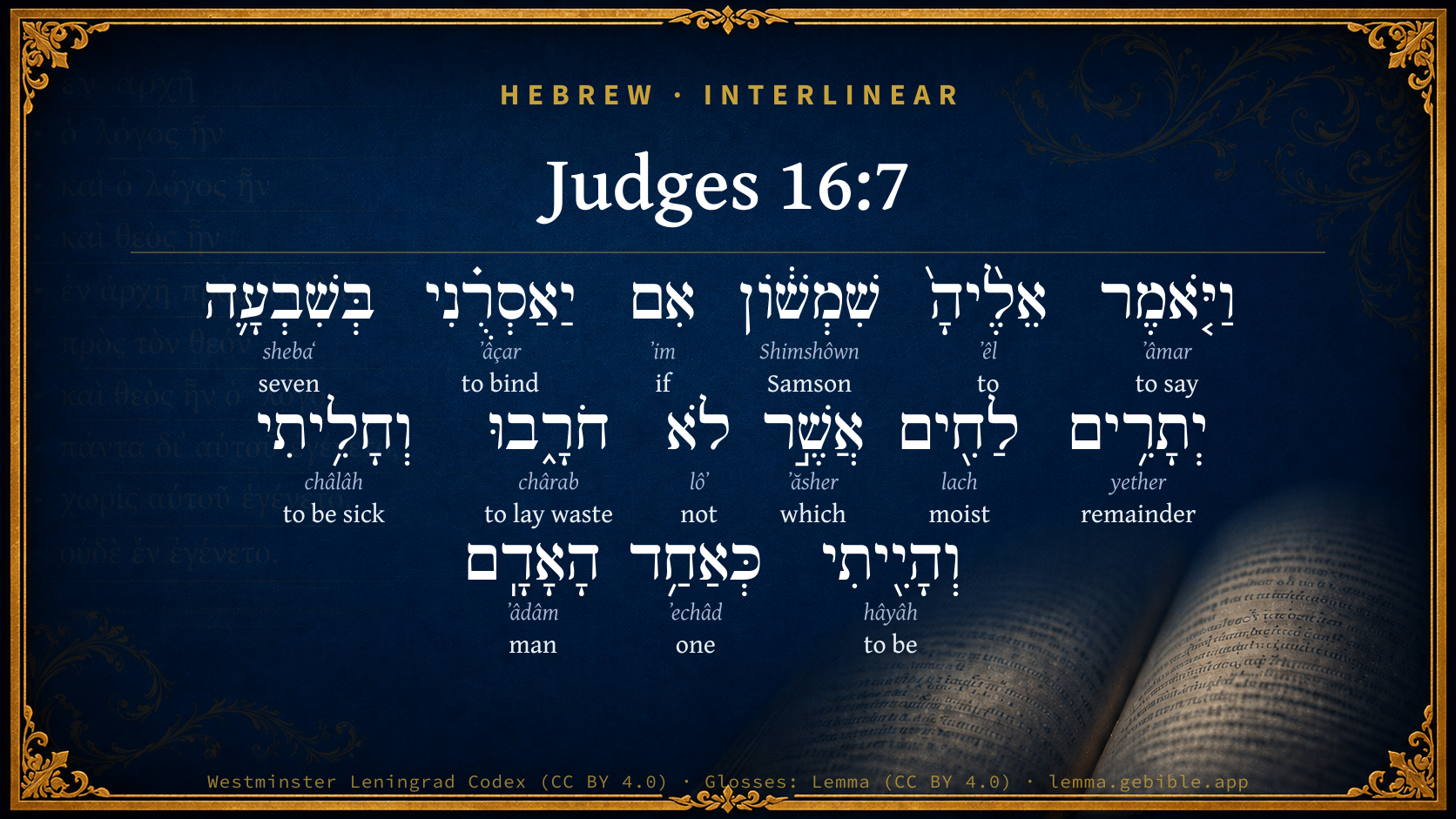
  1. וַיֹּ֤אמֶר ʼâmar H559 “and · to say” Conjunction + Verb, Qal, Sequential Imperfect, 3rd Person, Masculine, Singular
  2. אֵלֶ֨יהָ֙ ʼêl H413 “to · her” Preposition + Suffix, Personal, 3rd Person, Feminine, Singular
  3. שִׁמְשׁ֔וֹן Shimshôwn H8123 “Samson” Noun, Proper
  4. אִם ʼim H518 “if” Conjunction
  5. יַאַסְרֻ֗נִי ʼâçar H631 “to bind · me” Verb, Qal, Imperfect, 3rd Person, Masculine, Plural + Suffix, Personal, 1st Person, Common, Singular
  6. בְּשִׁבְעָ֛ה shebaʻ H7651 “in/at · seven” Preposition + Adjective, Cardinal number, Masculine, Singular, Absolute
  7. יְתָרִ֥ים yether H3499 “remainders” Noun, Common, Masculine, Plural, Absolute
  8. אֲשֶׁ֣ר ʼăsher H834 “which” Particle, Relative
  9. לֹא lôʼ H3808 “not” Particle, Negative
  10. חֹרָ֑בוּ chârab H2717 “to lay waste” Verb, Pual, Perfect, 3rd Person, Common, Plural
  11. וְחָלִ֥יתִי châlâh H2470 “and · to be sick” Conjunction + Verb, Qal, Perfect, 1st Person, Common, Singular
  12. וְהָיִ֖יתִי hâyâh H1961 “and · to be” Conjunction + Verb, Qal, Perfect, 1st Person, Common, Singular
  13. כְּאַחַ֥ד ʼechâd H259 “like/as · one” Preposition + Adjective, Cardinal number, Masculine, Singular, Construct
  14. הָאָדָֽם ʼâdâm H120 “the · man” Particle, Definite Article + Noun, Common, Masculine, Singular, Absolute

About this verse

These counts appear in no published source. They are computed here, from the morphology-tagged text and Lemma’s own curated glosses. What Lemma adds →

15
words
15
distinct lemmas
Historical
section

Notable vocabulary

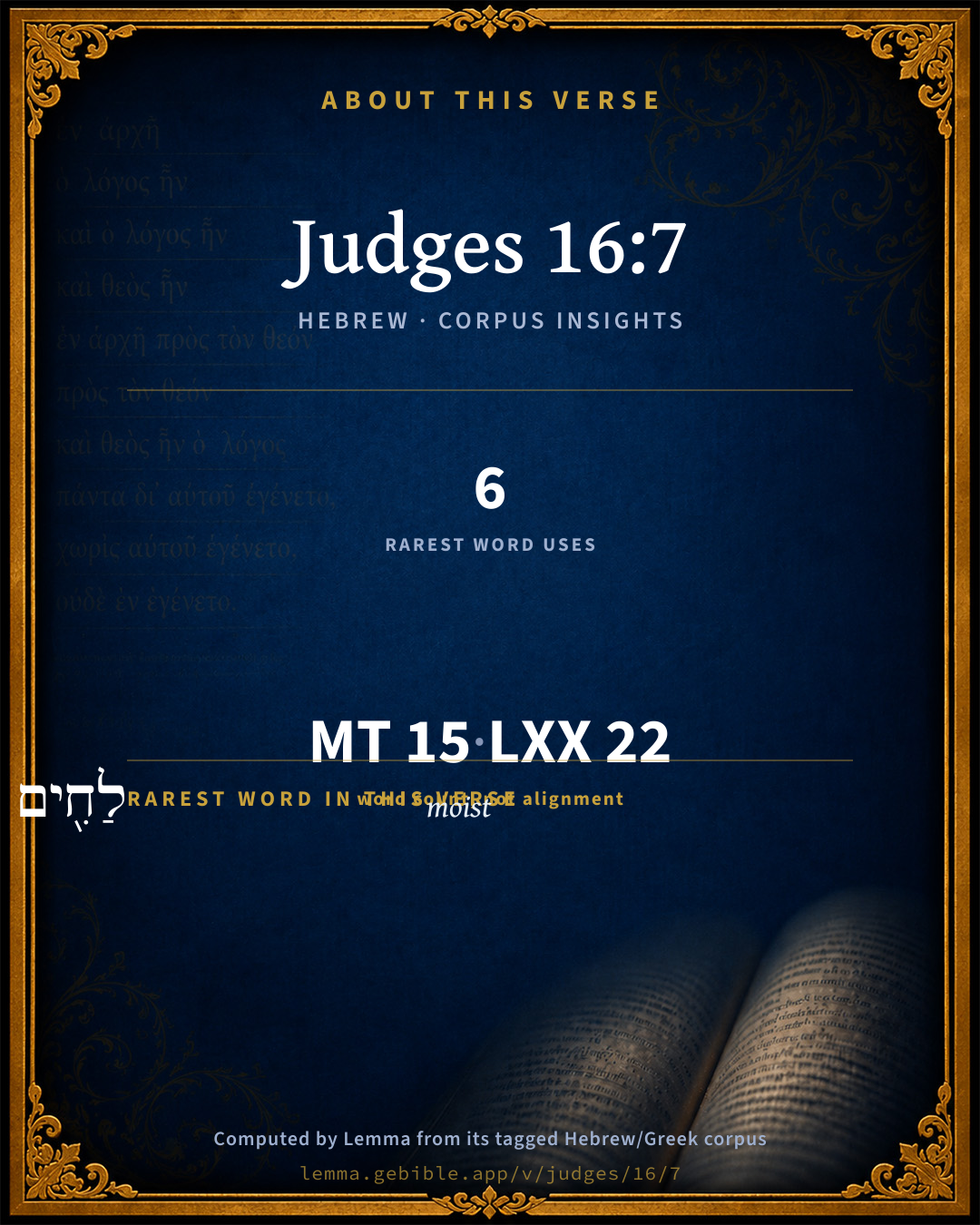
The rarest word here is לַחִ֖ים moist H3892 — appearing just 6 times in the whole Hebrew Bible.

Shared distinctive vocabulary

לַחִ֖ים moist H3892 occurs in 6 verses of the Hebrew Bible. Also found in:

Grammatical profile

  • 5 verbs
  • 3 nouns
  • 3 adjectives
  • 1 preposition
  • 1 conjunction
  • 2 particles

Verb forms

  • וַיֹּ֤אמֶר Qal · Sequential Imperfect
  • יַאַסְרֻ֗נִי Qal · Imperfect
  • חֹרָ֑בוּ Pual · Perfect
  • וְחָלִ֥יתִי Qal · Perfect
  • וְהָיִ֖יתִי Qal · Perfect

Hebrew & Septuagint length

In English translation the verse runs 26 words from the Hebrew and 30 from the Septuagint (LXX English) — closely comparable.

A rough comparison of the two English renderings, which tokenize alike — not a word-level alignment.

Word counts can differ between the Hebrew and the Greek without any difference in meaning — e.g. the Hebrew direct-object marker אֵת has no separate Greek word, and Greek often adds the article ὁ.

In the original languages it is 15 Hebrew tokens and 22 Greek tokens — but the two are counted differently (Hebrew bundles its prefixes and suffixes into one token; the Greek is in lemma form), so that isn’t a like-for-like length.

Cross-references

9

Topical passages linked to Judges 16:7 in the Treasury of Scripture Knowledge — connected by theme and wording, ordered by reader-vote popularity; previews shown in the World English Bible.

  • Proverbs 12:19 Truth's lips will be established forever, But a lying tongue is only momentary.
  • Galatians 6:7 Don't be deceived. God is not mocked, for whatever a man sows, that will he also reap.
  • Colossians 3:9 Don't lie to one another, seeing that you have put off the old man with his doings,
  • Judges 16:10 Delilah said to Samson, Behold, you have mocked me, and told me lies: now tell me, Please, with which you might be bound.
  • 1 Samuel 19:17 Saul said to Michal, Why have you deceived me thus, and let my enemy go, so that he is escaped? Michal answered Saul, He said to me, Let me go; why should I kill you?
  • 1 Samuel 21:2–3 David said to Ahimelech the priest, The king has commanded me a business, and has said to me, Let no man know anything of the business about which I send you, and what I have commanded you: and I have appointed the young men to such and such a place.
  • 1 Samuel 27:10 Achish said, Against whom have you made a raid today? David said, Against the South of Judah, and against the South of the Jerahmeelites, and against the South of the Kenites.
  • Proverbs 17:7 Arrogant speech isn't fitting for a fool, Much less do lying lips fit a prince.
  • Romans 3:8 Why not (as we are slanderously reported, and as some affirm that we say), "Let us do evil, that good may come?" Those who say so are justly condemned.

Cross-references courtesy of OpenBible.info (CC BY 4.0).

Hebrew and Greek witnesses Masoretic Hebrew ↔ Greek Septuagint

The same verse in the two great witnesses to the Old Testament, shown verse-for-verse.

These are two independent witnesses, not word-aligned to each other, and the Septuagint is shown in lemma (dictionary) form.

Hebrew Judges 16:7 Masoretic · Westminster Leningrad Codex

וַיֹּ֤אמֶר אֵלֶ֨יהָ֙ שִׁמְשׁ֔וֹן אִם יַאַסְרֻ֗נִי בְּשִׁבְעָ֛ה יְתָרִ֥ים לַחִ֖ים אֲשֶׁ֣ר לֹא חֹרָ֑בוּ וְחָלִ֥יתִי וְהָיִ֖יתִי כְּאַחַ֥ד הָאָדָֽם

Samson said to her, If they bind me with seven green cords that were never dried, then shall I become weak, and be as another man.

World English Bible · Public Domain

Greek LXX Judges 16:7 Septuagint · lemma form

καί εἶπον πρός αὐτός σαμψων ἐάν δέω ἐγώ ἐν ἑπτά νευρά ὑγρός μή διαφθείρω καί ἀσθενέω καί εἰμί ὡς εἷς ὁ ἄνθρωπος

And Sampson said to her, If they bind me with seven moist cords that have not been spoiled, then shall I be weak and be as one of ordinary men.

LXX2012 (modern English Septuagint) · Public Domain

On this verse, Adam Clarke's Commentary discusses the Septuagint’s reading. Read the note in Commentary ↓

Hebrew: Westminster Leningrad Codex (CC BY 4.0). Greek: Septuagint (public domain); English from LXX2012 (modern English Septuagint) (Public Domain). How the Septuagint differs from the Hebrew →

Targum (Aramaic paraphrase)

1

The Targum is the ancient Jewish Aramaic paraphrase of the Hebrew Scriptures — an interpretive translation, not the Hebrew text itself. Onkelos (literal) and Pseudo-Jonathan (expansive) render the Torah, and Jonathan the Prophets. Coverage is partial: where no permissively-licensed English translation exists for a verse, only the Aramaic is shown. This is verse-level text, not a word-by-word alignment to the Hebrew.

  1. Targum Jonathan Prophets (Joshua–Malachi)
    וַאֲמַר לָהּ שִׁמְשׁוֹן אִם יֵיסְרוּנַנִי בְּשַׁבְעָא יְתָרִין רְטִיבִין דְלָא יַבִּישׁוּ וְאֶחֱלוֹשׁ וְאֶהֱוֵי כְּחַד מִן בְּנֵי אֱנָשָׁא:

    (no public-domain English translation for this verse)

    Targum Jonathan — Aramaic: “Mikraot Gedolot” (public domain). English: “Sefaria Community Translation” (CC0 1.0 (public-domain dedication)); “London "Chaldee Paraphrase," 1871” (public domain). Text via Sefaria.

Commentary

Notes on Judges 16:7 from classic Christian and Jewish commentators (each source and its license shown beneath its notes). The classic Christian expositions comment on the surrounding passage and are grouped to its opening verse, so a note may address several verses; the Jewish commentaries on the Tanakh (Rashi and others) are per-verse, so they appear only where the commentator wrote on this verse.

Lemma curates 59 commentaries, every one of them public domain or Creative Commons licensed, each selected and text-cleaned for this edition rather than reprinted as found. About our sources →

Trapp's Complete Commentary

John Trapp

Jdg 16:7 And Samson said unto her, If they bind me with seven green withs that were never dried, then shall I be weak, and be as another man.

Ver. 7. And Samson said unto her, If they bind me with seven green withs.] This he said for a put off, or as intending to make himself sport with her. But he should have remembered that God’s children will not lie. {Isa 63:8}

John Trapp, A Commentary or Exposition upon All the Books of the Old and New Testament (1647–1656) — public domain. Text from a community e-Sword module.

Geneva Bible (1599)

Geneva Bible translators

Or, new withes.

Geneva Bible (1599) marginal notes — public domain. Text via Bolls.life.

Jamieson, Fausset & Brown

Robert Jamieson, A. R. Fausset & David Brown

Samson said . . ., If they bind me with seven green withs--Vine tendrils, pliant twigs, or twists made of crude vegetable stalks are used in many Eastern countries for ropes at the present day.

Jamieson, Fausset & Brown — Commentary Critical and Explanatory on the Whole Bible (1871) — public domain (CC PDM 1.0). Text via the HelloAO Bible API.

Adam Clarke's Commentary

Verse 7. Seven green withs] That is, any kind of pliant, tough wood, twisted in the form of a cord or rope. Such are used in many countries formed out of osiers, hazel, c. And in Ireland, very long and strong ropes are made of the fibres of bog-wood, or the larger roots of the fir, which is often dug up in the bogs or mosses of that country. But the Septuagint, by translating the Hebrew יתרים לחים yetharim lachim by νευραις ὑγραις, and the Vulgate by nerviceis funibus, understand these bonds to be cords made of the nerves of cattle, or perhaps rather out of raw hides, these also making an exceedingly strong cord. In some countries they take the skin of the horse, cut it lengthwise from the hide into thongs about two inches broad, and after having laid them in salt for some time, take them out for use. This practice is frequent in the country parts of Ireland and both customs, the wooden cord, and that made of the raw or green hide, are among the most ancient perhaps in the world. Among the Irish peasantry this latter species of cord is called the tug and is chiefly used for agricultural purposes, particularly for drawing the plough and the harrow, instead of the iron chains used in other countries.

Adam Clarke's Commentary on the Bible (1810–1826) — public domain. Text from a community e-Sword/MySword module.

Ellicott's Commentary for English Readers

(7) Green withs.—The meaning of the words is uncertain. Probably the LXX. and the Vulg. are right in taking them to mean moist, i.e., fresh sinews (Psa_11:2) (LAX., Neurais hugrais; Vulg., Nerviceis funibus necdum siccis et adhuc humentibus). Josephus says “vine shoots,” but fresh vine shoots would be ridiculously inadequate. The number seven is used as the sacred number implying perfectness; and it is one of the signs that even thus early Samson is playing about on the confines of his secret.

As another man.—Literally, as one man, i.e., as an ordinary man.

A Bible Commentary for English Readers, edited by Charles John Ellicott (1878–1897) — public domain. Text from a community e-Sword module.

The Cambridge Bible for Schools and Colleges

gen. ed. J. J. S. Perowne

7. seven green withes] Follow marg.; similarly LXX and Vulgate The cords (cf. Psa_11:2; Psa_21:12) were to be made of fresh or moist gut. Elsewhere the adjective is applied to trees or fruit, hence the rendering of EV; withes = flexible twigs, esp. of willow; Josephus thinks of vine stalks. There may have been a magic charm in the number seven here and in Jdg_16:13.

The Cambridge Bible for Schools and Colleges (gen. ed. J. J. S. Perowne; Cambridge University Press, 1878–1918) — public domain. Text from a community e-Sword module.

John Gill's Exposition

And Samson said unto her,.... In answer to her pressing solicitations:

if they bind me with seven green withs that were never dried; the word is sometimes used for nerves, and cords or ropes; but neither of these can be here meant, since these, if moistened or made wet, are the less fit to bind with, and the drier the better; but rods or branches of trees just cut off, such as faggots are bound up with, or green osiers, which are easily bent and twisted, and may bind with; Josephus (u) calls them vine branches:

then shall I be weak, and be as another man; which cannot well be excused from a lie; for Samson knew full well that being bound would not weaken his strength; but as he had fallen into one sin, it is no wonder he was drawn into another: unless this can be understood, as it is by some, as jesting with her; however, it shows that he was "compos mentis", as Josephus (w) observes, and was upon his guard with respect to the secret of his strength.

(u) Ut supra. (Antiqu. l. 5. c. 8. sect. 9.) (w) Ibid.

John Gill's Exposition of the Whole Bible (1746–1763) — public domain (CC PDM 1.0). Text via the HelloAO Bible API.

Haydock's Catholic Bible Commentary

Her, in jest. (Haydock) --- Sinews; such were frequently used for strength. (Vegetius iv. 9.; Psalm x. 2) Cato often speaks of loreos funes, (Calmet) or "leathern thongs." (Haydock) --- Moist. Hebrew, "seven bands, green and moist;" as if he were speaking of willow twigs, or bands made of the rind of trees, &c. But we need not abandon the Septuagint and Vulgate to follow the moderns in this place, as yetharim unquestionably means cords of sinews, and the epithet, green, is applied to the eyes of Moses, (Deuteronomy xxiv. 7.) to denote their shining vigour and strength; so here it may signify, that the sinews were to be fresh and in full perfection. (Calmet) --- Dalila might easily think that such bands would make Samson her prisoner. She had people to assist her, in case she proved successful. But Samson probably broke the bands before they made their appearance; otherwise he would have resented the woman’s infidelity, and not exposed himself again. He supposed she only made these exclamations to see what he would do, ver. 9., &c.

George Leo Haydock (1774–1849), Haydock's Catholic Family Bible and Commentary, 1859 edition — public domain. Excludes Psalms (Douay-Rheims chapter numbering differs from Protestant) and Deuterocanonical books (Catholic canon only).

Matthew Poole's English Annotations

Samson is guilty both of the sin of lying, though he dress up the lie in such circumstances as might make it most probable; and of great folly, in encouraging her inquiries, which he should at first have checked: but as he had forsaken God, so God had now forsaken him, and deprived him of common prudence; otherwise the frequent repetition and vehement urging of this question might easily have raised suspicion in him.

Matthew Poole's English Annotations on the Holy Bible (1683–1685) — public domain. Text from a community e-Sword/MySword module.

Whedon's Commentary on the Bible

Daniel D. Whedon

7. Seven green withs — Or, seven moist cords. The rendering withs comes from Josephus’s statement that these cords were twisted of a vine, and the well-known fact that strings were often made of tough and pliant wood twisted in the form of a rope. Samson was too shrewd not to see Delilah’s possible designs, and he thrice deceived her. The question of his veracity and morality need not be entertained, for if he was not too good to go in unto a harlot, he was not too good to practice deception on his wily mistress.

Daniel D. Whedon (gen. ed.), Commentary on the Old and New Testaments (1874–1909) — public domain. Text from a community e-Sword module.

The Pulpit Commentary

As another man literally, as one of men, i.e. of mankind, not different from other men. As regards the word rendered with, it is not certain whether strings of cat-gut are not meant In Psa_11:2 the same word is used of a bow-string. The word rendered green means fresh or new, and might be equally applied to catgut strings or withs.

The Pulpit Commentary (1880–1919), ed. H.D.M. Spence-Jones & Joseph S. Exell — public domain. Text from a community e-Sword module.

John Wesley's Explanatory Notes

Samson said - Samson is guilty both of the sin of lying, and of great folly in encouraging her enquiries, which he should at first have checked: but as he had forsaken God, so God had now forsaken him, otherwise the frequent repetition and vehement urging of this question might easily have raised suspicion in him.

John Wesley, Explanatory Notes Upon the Whole Bible (1754–1765) — public domain. Text via the GEBible commentary corpus.

Rashi

Rabbi Shlomo Yitzchaki (Rashi)

Cords. Thin strings.

Rashi on the Tanakh — English translations: “The Judaica Press complete Tanach with Rashi, translated by A. J. Rosenberg” (CC BY 4.0); “Pentateuch with Rashi's commentary by M. Rosenbaum and A.M. Silbermann, 1929-1934” (public domain); “The Metsudah Tanach series, Lakewood, N.J” (CC BY 4.0); and “The Book of Joshua, Metsudah Publications, 1997” (CC BY 4.0). Text via Sefaria.

Lesson kit

Teaching starters — assembled from the data on this page, not authored interpretation. Every prompt links to the verse data it draws on. Edit before teaching.

Judges, in the Historical, opens this verse with 15 words (15 distinct Hebrew lemmas). Its most distinctive word is lach (“moist”). A historical commentator’s framing appears above. Read the whole chapter for the surrounding context.

Discussion questions

  1. The word lach carries the sense “moist.” How does it shape the verse?
  2. Genesis 30:37 shares the word «moist» with this verse. How do the two illuminate each other?
  3. These translations render this verse differently. What is at stake in choosing one wording over another?
  4. The verb «וַיֹּ֤אמֶר» is Qal Sequential Imperfect. How does its form color the action?
  5. Reading how Trapp's Complete Commentary and Geneva Bible (1599) read this verse, where do the two commentators agree and where do they part?

Things to notice

Reading settings

Reading text

Shown beneath each verse's original-language words.

Old Testament
Old Testament edition

Read the OT as the Masoretic Hebrew (MT) or the Greek Septuagint (LXX).

English shown for the Greek Septuagint (in the Hebrew ↔ Greek comparison).

Comparing translations? Open the Compare panel on any verse page to stack up to four side by side.