
2 Chronicles 17:11

Hebrew (Westminster Leningrad Codex) 2 Chronicles 17:11 appears in the Hebrew Old Testament. The text above is from the Westminster Leningrad Codex. Each word links to its Strong’s number, a concise gloss, and parsing drawn from the Open Scriptures Hebrew Bible morphology. Click any word for its full Brown-Driver-Briggs (BDB) entry.
Download image
Cite this verse

2 Chronicles 17:11 (World English Bible). Public Domain. Lemma interlinear Bible study tool, https://lemma.gebible.app/v/2-chronicles/17/11.

Show BibTeX & RIS
BibTeX
RIS
English Translation
Some of the Philistines brought Jehoshaphat presents, and silver for tribute; the Arabians also brought him flocks, seven thousand and seven hundred rams, and seven thousand and seven hundred male goats.
World English Bible · Public Domain
Highlights
  • 1 first appearance in the Hebrew Bible
Full analysis ↓
Download a study sheet

One document with this verse’s original text, its word-by-word gloss line, the meaning frame, cross-references with their text, attributed commentary, and full source and license credits — printable, and it pastes into notes with its structure intact.

This verse Autodidact and up

Study sheet (.html) Plain text (.txt)

A passage Seminary Student

Up to 50 verses in one chapter. A passage sheet keeps up to 6 commentary sources and 12 cross-references per verse, in the order this page ranks them, and says so on the sheet whenever that leaves anything out. Ask for a single verse and you get the Autodidact verse sheet above.

Everything on this page stays free to read, with no account — the sheet is a download of what is already on screen, not access to it.

Want to remove ads? Support Godless Engineer
Compare translations 3

The same verse in 3 English versions, stacked beneath the original-language interlinear above. Click any original word for its lexicon entry.

Each is an independent rendering of the whole verse — the interlinear is not word-aligned to these translations.

Highlighted words mark where these versions differ — a whole-verse word diff, not a word-by-word alignment.

  • World English Bible Public Domain
    Some of the Philistines brought Jehoshaphat presents, and silver for tribute; the Arabians also brought him flocks, seven thousand and seven hundred rams, and seven thousand and seven hundred male goats.
  • King James Version Public Domain
    Also some of the Philistines brought Jehoshaphat presents, and tribute silver; and the Arabians brought him flocks, seven thousand and seven hundred rams, and seven thousand and seven hundred he goats.
  • unfoldingWord Literal Text CC BY-SA 4.0
    And some of the Philistines were bringing to Jehoshaphat tribute, and a silver load. Also, the Arabians were bringing to him flocks, 7,700 rams and 7,700 goats.

unfoldingWord Literal Text — © unfoldingWord, licensed CC BY-SA 4.0. Word-aligned USFM3 via Door43 (git.door43.org/unfoldingWord/en_ult).

Versions to compare (up to 4)

3 of 4 selected

Show all 18 translations

Every available English version of this verse, each an independent rendering of the whole verse.

  • World English Bible Public Domain
    Some of the Philistines brought Jehoshaphat presents, and silver for tribute; the Arabians also brought him flocks, seven thousand and seven hundred rams, and seven thousand and seven hundred male goats.
  • Berean Standard Bible Public Domain
    Some Philistines also brought gifts and silver as tribute to Jehoshaphat, and the Arabs brought him 7,700 rams and 7,700 goats from their flocks.
  • Majority Standard Bible Public Domain
    Some Philistines also brought gifts and silver as tribute to Jehoshaphat, and the Arabs brought him 7,700 rams and 7,700 goats from their flocks.
  • King James Version Public Domain
    Also some of the Philistines brought Jehoshaphat presents, and tribute silver; and the Arabians brought him flocks, seven thousand and seven hundred rams, and seven thousand and seven hundred he goats.
  • American Standard Version (1901) Public Domain
    And some of the Philistines brought Jehoshaphat presents, and silver for tribute; the Arabians also brought him flocks, seven thousand and seven hundred rams, and seven thousand and seven hundred he-goats.
  • Revised Version (1885) Public Domain
    And some of the Philistines brought Jehoshaphat presents, and silver for tribute; the Arabians also brought him flocks, seven thousand and seven hundred rams, and seven thousand and seven hundred he-goats.
  • Geneva Bible (1599) Public Domain
    Also some of the Philistims brought Iehoshaphat giftes and tribute siluer, and the Arabians brought him flockes, seuen thousande and seuen hundreth rammes, and seuen thousande and seuen hundreth hee goates.
  • Douay-Rheims (1899) Public Domain
    The Philistines also brought presents to Josaphat, and tribute in silver, and the Arabians brought him cattle, seven thousand seven hundred rams, and as many he goats.
  • Young's Literal Translation Public Domain
    and of the Philistines they are bringing in to Jehoshaphat a present, and tribute silver; also, the Arabians are bringing to him a flock, rams seven thousand an seven hundred, and he-goats seven thousand and seven hundred.
  • Literal Standard Version CC BY-SA 4.0
    and [some] from the Philistines are bringing a present to Jehoshaphat, and silver [as] tribute; also, the Arabians are bringing to him a flock of seven thousand and seven hundred rams, and seven thousand and seven hundred male goats.
  • Unlocked Literal Bible CC BY-SA 4.0
    Some of the Philistines brought Jehoshaphat presents, and silver as tribute. Arabians also brought him flocks, 7,700 rams, and 7,700 goats.
  • unfoldingWord Literal Text CC BY-SA 4.0
    And some of the Philistines were bringing to Jehoshaphat tribute, and a silver load. Also, the Arabians were bringing to him flocks, 7,700 rams and 7,700 goats.
  • Darby Bible Public Domain
    And some of the Philistines brought Jehoshaphat gifts and tribute-silver. The Arabians also brought him flocks, seven thousand seven hundred rams, and seven thousand seven hundred he-goats.
  • World Messianic Bible Public Domain
    Some of the Philistines brought Jehoshaphat presents and silver for tribute. The Arabians also brought him flocks: seven thousand seven hundred rams and seven thousand seven hundred male goats.
  • Webster's Bible Public Domain
    Also some of the Philistines brought Jehoshaphat presents, and tribute silver; and the Arabians brought him flocks, seven thousand and seven hundred rams, and seven thousand and seven hundred he-goats.
  • Free Bible Version CC BY-SA 4.0
    Some of the Philistines even brought him gifts and silver, while the Arabians brought him 7,700 rams and 7,700 goats.
  • Bible in Basic English Public Domain
    And some of the Philistines took offerings to Jehoshaphat, and made him payments of silver; and the Arabians gave him flocks, seven thousand, seven hundred sheep, and seven thousand, seven hundred he-goats.
  • JPS Tanakh (1917) Public Domain
    And some of the Philistines brought Jehoshaphat presents, and silver for tribute; the Arabians also brought him flocks, seven thousand and seven hundred rams, and seven thousand and seven hundred he-goats.

Literal Standard Version (2020), Covenant Press — licensed CC BY-SA 4.0. Text via the HelloAO Bible API (eBible.org). Unlocked Literal Bible (unfoldingWord) — licensed CC BY-SA 4.0. Text via the HelloAO Bible API (eBible.org). unfoldingWord Literal Text — © unfoldingWord, licensed CC BY-SA 4.0. Word-aligned USFM3 via Door43 (git.door43.org/unfoldingWord/en_ult). Free Bible Version, Dr. Jonathan Gallagher — licensed CC BY-SA 4.0. Text via the HelloAO Bible API (eBible.org).

Word by word

More ways to search: Search by grammar → Find every occurrence → Compare this word →

Practice this passage: Drill this verse → Learn its vocabulary →

וּתְיָשִׁ֕ים
tayish
H8495
“and · he-goats”
Conjunction + Noun, Common, Masculine, Plural, Absolute
Part of Speech
Conjunction + Noun
Type
Common
Gender
Masculine
Number
Plural
State
Absolute
Full BDB Definition

Origin: from an unused root meaning to butt

TWOT: 2506

he-goat
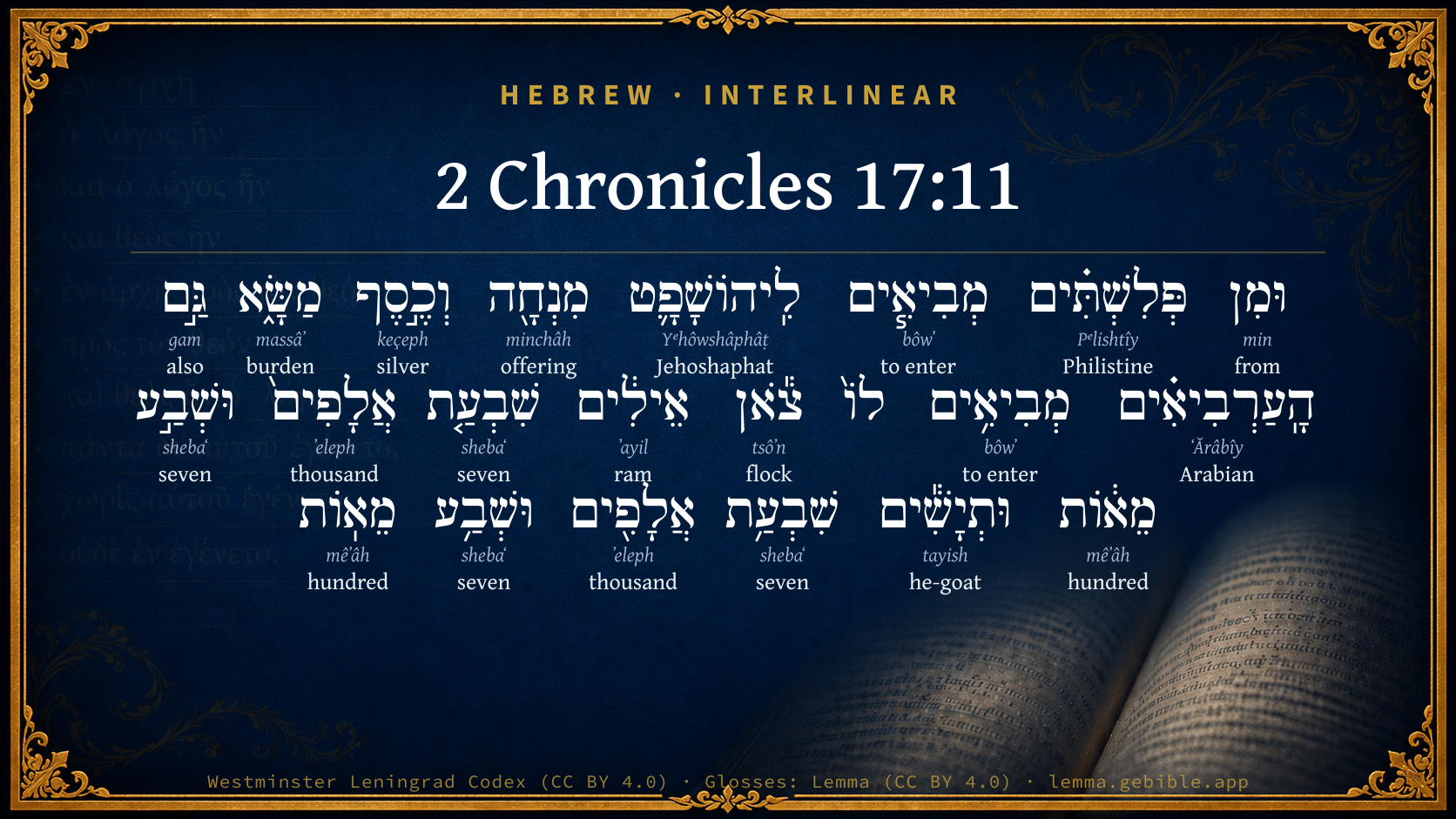
  1. וּמִן min H4480 “and · from” Conjunction + Preposition
  2. פְּלִשְׁתִּ֗ים Pᵉlishtîy H6430 “Philistines” Noun, Gentilic, Masculine, Plural, Absolute
  3. מְבִיאִ֧ים bôwʼ H935 “entering” Verb, Hiphil, Participle Active, Masculine, Plural, Absolute
  4. לִֽיהוֹשָׁפָ֛ט Yᵉhôwshâphâṭ H3092 “to/for · Jehoshaphat” Preposition + Noun, Proper
  5. מִנְחָ֖ה minchâh H4503 “offering” Noun, Common, Feminine, Singular, Absolute
  6. וְכֶ֣סֶף keçeph H3701 “and · silver” Conjunction + Noun, Common, Masculine, Singular, Absolute
  7. מַשָּׂ֑א massâʼ H4853 “burden” Noun, Common, Masculine, Singular, Absolute
  8. גַּ֣ם gam H1571 “also” Particle, Accusative
  9. הָֽעַרְבִיאִ֗ים ʻĂrâbîy H6163 “the · Arabians” Particle, Definite Article + Noun, Gentilic, Masculine, Plural, Absolute
  10. מְבִיאִ֥ים bôwʼ H935 “entering” Verb, Hiphil, Participle Active, Masculine, Plural, Absolute
  11. צֹ֕אן tsôʼn H6629 “flock” Noun, Common, Both, Singular, Absolute
  12. אֵילִ֔ים ʼayil H352 “rams” Noun, Common, Masculine, Plural, Absolute
  13. שִׁבְעַ֤ת shebaʻ H7651 “seven” Adjective, Cardinal number, Masculine, Singular, Construct
  14. אֲלָפִים֙ ʼeleph H505 “thousand” Adjective, Cardinal number, Both, Plural, Absolute
  15. וּשְׁבַ֣ע shebaʻ H7651 “and · seven” Conjunction + Adjective, Cardinal number, Feminine, Singular, Absolute
  16. מֵא֔וֹת mêʼâh H3967 “hundred” Adjective, Cardinal number, Both, Plural, Absolute
  17. שִׁבְעַ֥ת shebaʻ H7651 “seven” Adjective, Cardinal number, Masculine, Singular, Construct
  18. אֲלָפִ֖ים ʼeleph H505 “thousand” Adjective, Cardinal number, Both, Plural, Absolute
  19. וּשְׁבַ֥ע shebaʻ H7651 “and · seven” Conjunction + Adjective, Cardinal number, Feminine, Singular, Absolute
  20. מֵאֽוֹת mêʼâh H3967 “hundred” Adjective, Cardinal number, Both, Plural, Absolute

About this verse

These counts appear in no published source. They are computed here, from the morphology-tagged text and Lemma’s own curated glosses. What Lemma adds →

22
words
15
distinct lemmas
Historical
section

Notable vocabulary

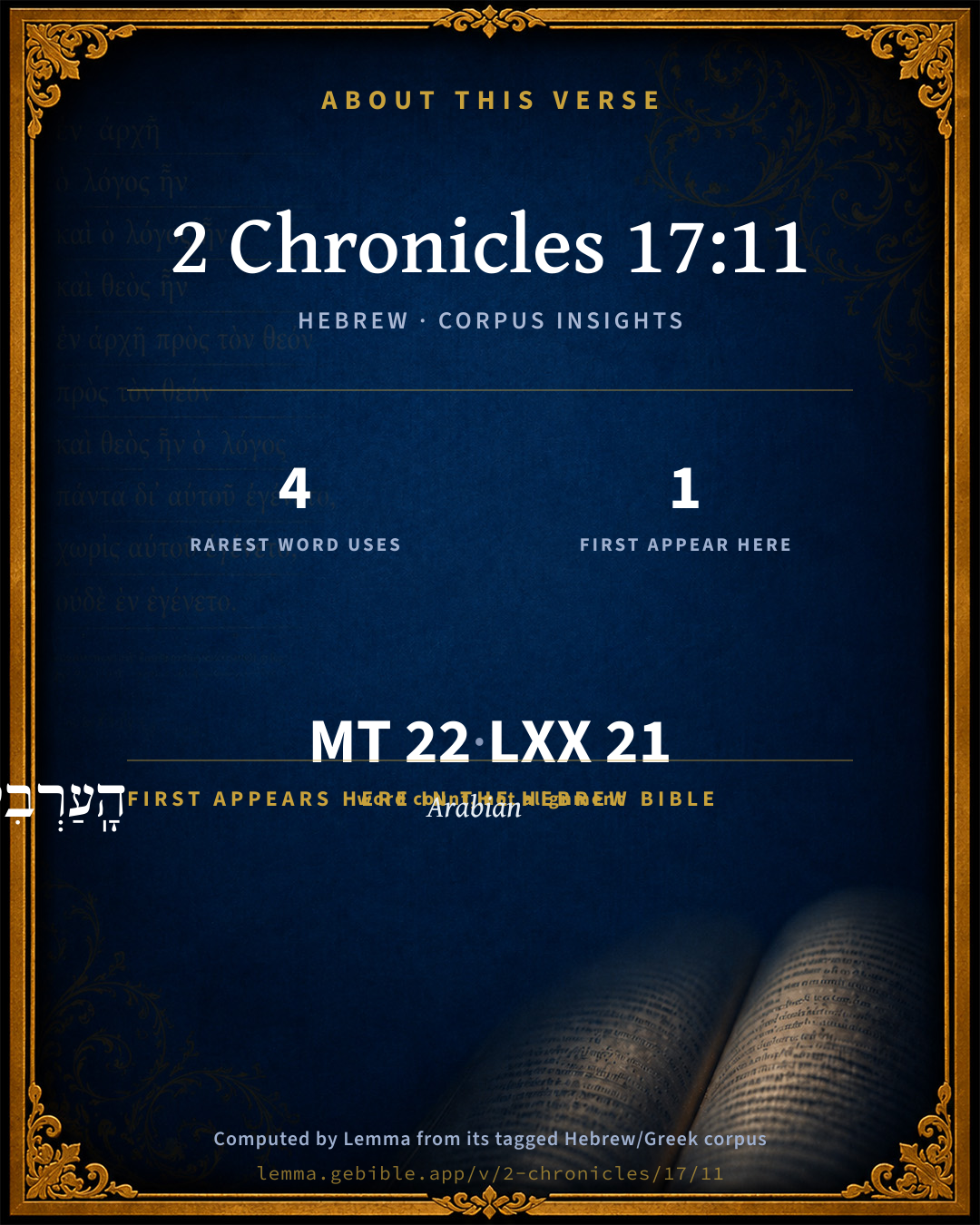
The rarest word here is וּתְיָשִׁ֕ים he-goat H8495 — appearing just 4 times in the whole Hebrew Bible.

First appearance in Scripture

This word makes its first canonical appearance in the Hebrew Bible here:

  • הָֽעַרְבִיאִ֗ים Arabian H6163

Shared distinctive vocabulary

וּתְיָשִׁ֕ים he-goat H8495 occurs in 4 verses of the Hebrew Bible. Also found in:

Grammatical profile

  • 2 verbs
  • 9 nouns
  • 8 adjectives
  • 2 prepositions
  • 1 particle

Verb forms

  • מְבִיאִ֧ים Hiphil · Participle Active
  • מְבִיאִ֥ים Hiphil · Participle Active

Repetition

Words recur within this verse — often emphatic in Hebrew:

  • שִׁבְעַ֤ת seven H7651 ×4
  • מְבִיאִ֧ים to enter H935 ×2
  • אֲלָפִים֙ thousand H505 ×2
  • מֵא֔וֹת hundred H3967 ×2

Hebrew & Septuagint length

In English translation the verse runs 31 words from the Hebrew and 23 from the Septuagint (LXX English) — closely comparable.

A rough comparison of the two English renderings, which tokenize alike — not a word-level alignment.

Word counts can differ between the Hebrew and the Greek without any difference in meaning — e.g. the Hebrew direct-object marker אֵת has no separate Greek word, and Greek often adds the article ὁ.

In the original languages it is 22 Hebrew tokens and 21 Greek tokens — but the two are counted differently (Hebrew bundles its prefixes and suffixes into one token; the Greek is in lemma form), so that isn’t a like-for-like length.

Cross-references

5

Topical passages linked to 2 Chronicles 17:11 in the Treasury of Scripture Knowledge — connected by theme and wording, ordered by reader-vote popularity; previews shown in the World English Bible.

  • 2 Chronicles 26:8 The Ammonites gave tribute to Uzziah: and his name spread abroad even to the entrance of Egypt; for he grew exceeding strong.
  • 2 Chronicles 9:14 besides that which the traders and merchants brought: and all the kings of Arabia and the governors of the country brought gold and silver to Solomon.
  • 2 Samuel 8:2 He struck Moab, and measured them with the line, making them to lie down on the ground; and he measured two lines to put to death, and one full line to keep alive. The Moabites became servants to David, and brought tribute.
  • 2 Kings 3:4 Now Mesha king of Moab was a sheep-master; and he rendered to the king of Israel the wool of one hundred thousand lambs, and of one hundred thousand rams.
  • 2 Chronicles 17:5 Therefore Yahweh established the kingdom in his hand; and all Judah brought to Jehoshaphat tribute; and he had riches and honor in abundance.

Cross-references courtesy of OpenBible.info (CC BY 4.0).

Hebrew and Greek witnesses Masoretic Hebrew ↔ Greek Septuagint

The same verse in the two great witnesses to the Old Testament, shown verse-for-verse.

These are two independent witnesses, not word-aligned to each other, and the Septuagint is shown in lemma (dictionary) form.

Hebrew 2 Chronicles 17:11 Masoretic · Westminster Leningrad Codex

וּמִן פְּלִשְׁתִּ֗ים מְבִיאִ֧ים לִֽיהוֹשָׁפָ֛ט מִנְחָ֖ה וְכֶ֣סֶף מַשָּׂ֑א גַּ֣ם הָֽעַרְבִיאִ֗ים מְבִיאִ֥ים לוֹ֙ צֹ֕אן אֵילִ֔ים שִׁבְעַ֤ת אֲלָפִים֙ וּשְׁבַ֣ע מֵא֔וֹת וּתְיָשִׁ֕ים שִׁבְעַ֥ת אֲלָפִ֖ים וּשְׁבַ֥ע מֵאֽוֹת

Some of the Philistines brought Jehoshaphat presents, and silver for tribute; the Arabians also brought him flocks, seven thousand and seven hundred rams, and seven thousand and seven hundred male goats.

World English Bible · Public Domain

Greek LXX 2 Chronicles 17:11 Septuagint · lemma form

καί ἀπό ὁ ἀλλόφυλος φέρω ὁ ιωσαφατ δῶρον καί ἀργύριον καί δόμα καί ὁ ἄραψ φέρω αὐτός κριός πρόβατον ἑπτακισχίλιοι ἑπτακόσιοι

And some of the Philistines brought to Josaphat gifts, and silver, and presents; and the Arabians brought him seven thousand seven hundred rams.

LXX2012 (modern English Septuagint) · Public Domain

Hebrew: Westminster Leningrad Codex (CC BY 4.0). Greek: Septuagint (public domain); English from LXX2012 (modern English Septuagint) (Public Domain). How the Septuagint differs from the Hebrew →

Commentary

Notes on 2 Chronicles 17:11 from classic Christian and Jewish commentators (each source and its license shown beneath its notes). The classic Christian expositions comment on the surrounding passage and are grouped to its opening verse, so a note may address several verses; the Jewish commentaries on the Tanakh (Rashi and others) are per-verse, so they appear only where the commentator wrote on this verse.

Lemma curates 59 commentaries, every one of them public domain or Creative Commons licensed, each selected and text-cleaned for this edition rather than reprinted as found. About our sources →

Trapp's Complete Commentary

John Trapp

2Ch 17:11 Also [some] of the Philistines brought Jehoshaphat presents, and tribute silver; and the Arabians brought him flocks, seven thousand and seven hundred rams, and seven thousand and seven hundred he goats.

Ver. 11. Also some of the Philistines.] These, having been subdued by David, had withheld their tribute for a time; but now, seeing Jehoshaphat’s growing greatness, they bring it in with the better, that no offence might be taken at their former neglect. The word here used signifieth honorary gifts, or oblations, pacifications.

“ Placatur donis Iupiter ipse datis ”

Think the same of the Arabians. See 2Ch 14:14-15.

John Trapp, A Commentary or Exposition upon All the Books of the Old and New Testament (1647–1656) — public domain. Text from a community e-Sword module.

Joseph Benson's Commentary

2Ch 17:11. Some of the Philistines brought presents — They had been subject to Judah ever since David’s time; but, it seems, had neglected this duty in the times of his predecessors, but were now moved by their own fears to perform it. And the Arabians brought him flocks — Either because he had upon some just occasion waged war against them, and subdued them; or because they voluntarily put themselves under his protection, in recompense whereof they sent him these presents; or only as a free acknowledgment of their respect for him.

Joseph Benson's Commentary on the Old and New Testaments (1811–1818) — public domain. Text from a community e-Sword module.

Jamieson, Fausset & Brown

Robert Jamieson, A. R. Fausset & David Brown

Also some of the Philistines brought Jehoshaphat presents, and tribute silver--either they had been his tributaries, or they were desirous of securing his valuable friendship, and now made a voluntary offer of tribute. Perhaps they were the Philistines who had submitted to the yoke of David (Sa2 8:1; Psa 60:8).

the Arabians--the nomad tribes on the south of the Dead Sea, who, seeking the protection of Jehoshaphat after his conquest of Edom, paid their tribute in the way most suitable to their pastoral habits--the present of so many head of cattle.

Jamieson, Fausset & Brown — Commentary Critical and Explanatory on the Whole Bible (1871) — public domain (CC PDM 1.0). Text via the HelloAO Bible API.

Adam Clarke's Commentary

Verse 11. The Philistines brought - presents] They and the Arabians purchased peace with the king of Judah by paying an annual tribute. The Philistines brought silver, and no doubt different kinds of merchandise, The Arabs, whose riches consisted in cattle, brought him flocks in great abundance, principally rams and he-goats.

Adam Clarke's Commentary on the Bible (1810–1826) — public domain. Text from a community e-Sword/MySword module.

Ellicott's Commentary for English Readers

(11) Brought—i.e., continually. Such is the force of the participle.

Presents.—An offering, i.e., tribute (minchah;. 2Ch_17:5).

And tribute silver.—Rather, and silver, a load, or burden, i.e., a great quantity (massâ’), 2Ch_20:25. As if, “silver as much as they could carry”—a natural hyperbole. Not all the five states of the Philistines were subject to Jehoshaphat. (Comp. 2Sa_8:1.)

The Arabians.—‘Arbî’im, here only equivalent to ‘Arbîyîm (2Ch_26:7), and ‘Arbim (2Ch_21:16). They are in each case grouped with the Philistines. The nomad Bedâwin conquered by Asa (2Ch_14:15) appear to be meant here; or else some tribes which recognised the overlordship of Jehoshaphat after his reduction of Edom (2Ch_20:22, sqq.).

Brought him flocks.—Comp. Mesha of Moab’s tribute to Ahab (2Ki_3:4).

A Bible Commentary for English Readers, edited by Charles John Ellicott (1878–1897) — public domain. Text from a community e-Sword module.

The Cambridge Bible for Schools and Colleges

gen. ed. J. J. S. Perowne

11. tribute silver] R.V. silver for tribute.

the Arabians] Cp. 2Ch_21:16.

flocks] Cp. 2Ki_3:4.

The Cambridge Bible for Schools and Colleges (gen. ed. J. J. S. Perowne; Cambridge University Press, 1878–1918) — public domain. Text from a community e-Sword module.

John Gill's Exposition

Also some of the Philistines brought Jehoshaphat presents and tribute silver,.... Perhaps those of Gerar, and the parts adjacent, Asa took and spoiled, and made tributary, Ch2 14:14,

and the Arabians brought him flocks, seven thousand and seven hundred rams, and seven thousand and seven hundred he goats; with which their country abounded; and these might be the Scenite Arabs, who fearing lest Jehoshaphat should fall upon them, and take away their flocks as his father had done, Ch2 14:15, brought these presents to him.

John Gill's Exposition of the Whole Bible (1746–1763) — public domain (CC PDM 1.0). Text via the HelloAO Bible API.

Albert Barnes' Notes on the Bible

Some of the Philistines brought Jehoshaphat presents - i. e. “some of the Philistines were among his tributaries.” Compare 2Sa 8:2; 1Ki 4:21.

Tribute silver - Or, “much silver” - literally “silver of burthen.”

The Arabians - The Arab tribes who bordered Judaea to the south and the southeast paid Jehoshaphat a fixed tribute in kind. Compare 2Ki 3:4 note.

Albert Barnes' Notes on the Bible (1834–1885) — public domain. Text from a community e-Sword/MySword module.

Haydock's Catholic Bible Commentary

Philistines. Though they had been reduced by David, they had sometimes proved remiss in the payment of tribute. --- Arabians, who lived near the Ethiopians, and the Dead Sea, C. xxi. 19. They had been subdued by Solomon, (3 K. x. 15.) and were rich in cattle, Ezechiel xxvii. 21. The name is not so comprehensive as we generally make it. C.

George Leo Haydock (1774–1849), Haydock's Catholic Family Bible and Commentary, 1859 edition — public domain. Excludes Psalms (Douay-Rheims chapter numbering differs from Protestant) and Deuterocanonical books (Catholic canon only).

Matthew Poole's English Annotations

Some of the Philistines; who had been subjects to this kingdom ever since David’s time, but, it seems, had neglected this duty in the times of his predecessors, but now were moved by their own fears to perform it.

The Arabians brought him flocks; either because he had upon some just occasion waged war against them, and subdued them, though the particulars of it be not described in Scripture; or because they voluntarily put themselves under his protection, in recompence whereof they sent him those presents; or only as a free acknowledgment of their respects to him.

Matthew Poole's English Annotations on the Holy Bible (1683–1685) — public domain. Text from a community e-Sword/MySword module.

The Pulpit Commentary

The presents were probably enough in the nature of tribute, the "fixed rate" of which is sometimes alluded to (1Ki_4:21 1Ki_10:25; 2Sa_8:2) but it is doubtful whether the word aC; m purports to say this. The word means "bearing" or "carrying," and then "a burden, load, or weight." The expression, (2Ch_20:25) "more than they could carry away," where this word is used, favours the idea that the meaning here is "silver of great weight." Probably the moral significance and historical interest, whether of this statement respecting the Philistines, or the following respecting the Arabians, lies in the fact that both of them brought, without more ado, their payments, and did not seek to slip out of their engagements with Judah and Judah"s king. Note, for confirmation of this view, 2Ki_3:4, 2Ki_3:5.

The Pulpit Commentary (1880–1919), ed. H.D.M. Spence-Jones & Joseph S. Exell — public domain. Text from a community e-Sword module.

Rashi

Rabbi Shlomo Yitzchaki (Rashi)

and loads of silver - Heb. וְכֶסֶף מַשָּׂא, loads of silver. An example (Isa. 46:1): “נְשֻׂאתֵיכֶם עֲמוּסוֹת מַשָּׂא: the things that you carried are made a load.”

Rashi on the Tanakh — English translations: “The Judaica Press complete Tanach with Rashi, translated by A. J. Rosenberg” (CC BY 4.0); “Pentateuch with Rashi's commentary by M. Rosenbaum and A.M. Silbermann, 1929-1934” (public domain); “The Metsudah Tanach series, Lakewood, N.J” (CC BY 4.0); and “The Book of Joshua, Metsudah Publications, 1997” (CC BY 4.0). Text via Sefaria.

Lesson kit

Teaching starters — assembled from the data on this page, not authored interpretation. Every prompt links to the verse data it draws on. Edit before teaching.

2 Chronicles, in the Historical, opens this verse with 22 words (15 distinct Hebrew lemmas). Its most distinctive word is tayish (“he-goat”). A historical commentator’s framing appears above. Read the whole chapter for the surrounding context.

Discussion questions

  1. How does “he-goat” (tayish) shape what this verse is saying?
  2. The word “Arabian” first appears here in Scripture. What is being introduced at this debut?
  3. Genesis 30:35 shares the word «he-goat» with this verse. How do the two illuminate each other?
  4. “seven” occurs 4× in this one verse. What is the effect of the repetition?
  5. These translations render this verse differently; the difference is in the English rendering, not the original. What questions does that raise?
  6. The verb «מְבִיאִ֧ים» is Hiphil Participle Active. How does its form color the action?
  7. Reading how Trapp's Complete Commentary and Joseph Benson's Commentary read this verse, where do the two commentators agree and where do they part?

Things to notice

Reading settings

Reading text

Shown beneath each verse's original-language words.

Old Testament
Old Testament edition

Read the OT as the Masoretic Hebrew (MT) or the Greek Septuagint (LXX).

English shown for the Greek Septuagint (in the Hebrew ↔ Greek comparison).

Comparing translations? Open the Compare panel on any verse page to stack up to four side by side.