
Exodus 34:18

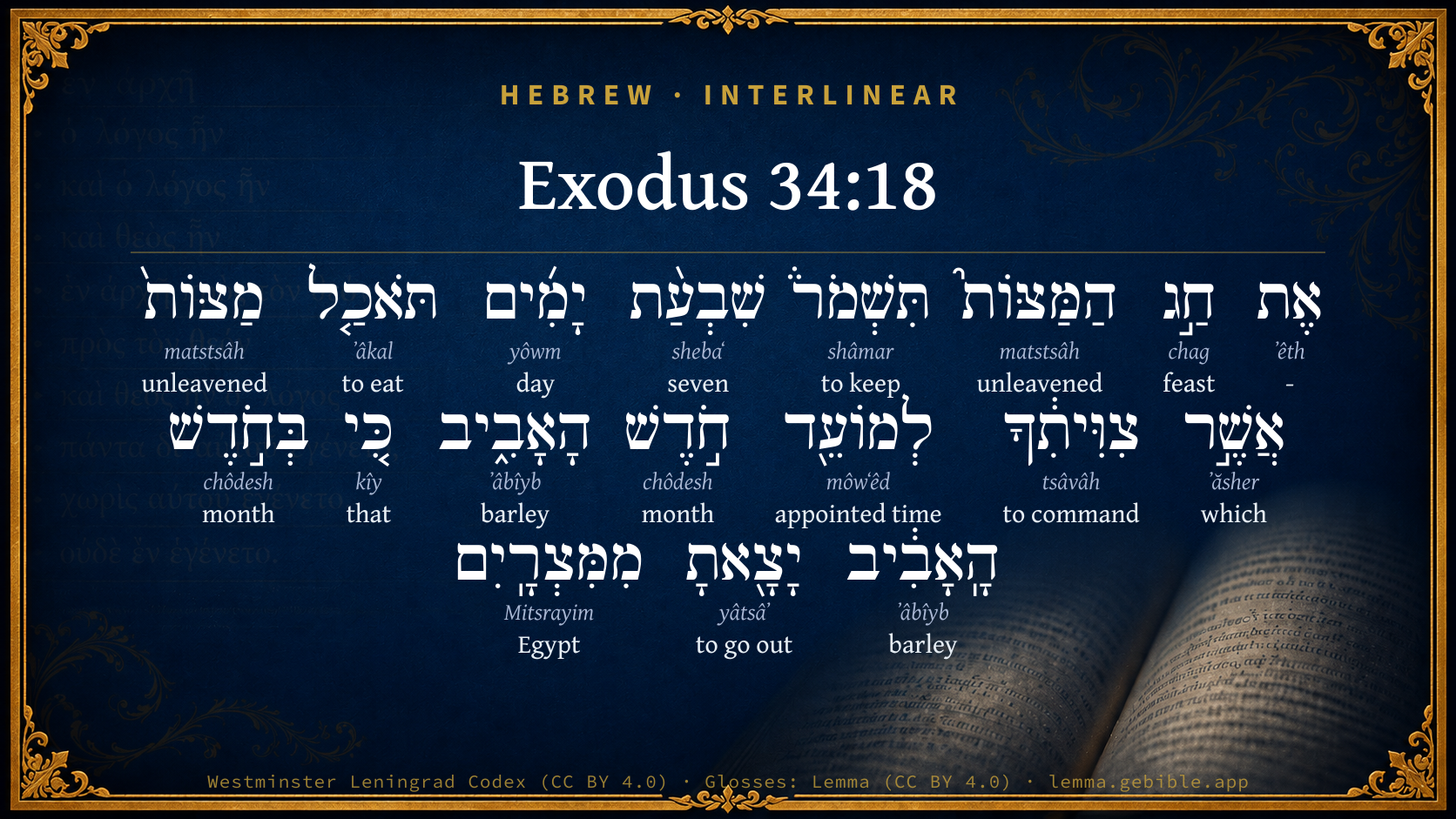
Hebrew (Westminster Leningrad Codex) Exodus 34:18 appears in the Hebrew Old Testament. The text above is from the Westminster Leningrad Codex. Each word links to its Strong’s number, a concise gloss, and parsing drawn from the Open Scriptures Hebrew Bible morphology. Click any word for its full Brown-Driver-Briggs (BDB) entry.
Download image
Cite this verse

Exodus 34:18 (World English Bible). Public Domain. Lemma interlinear Bible study tool, https://lemma.gebible.app/v/exodus/34/18.

Show BibTeX & RIS
BibTeX
RIS
English Translation
"You shall keep the feast of unleavened bread. Seven days you shall eat unleavened bread, as I commanded you, at the time appointed in the month Abib; for in the month Abib you came out from Egypt.
World English Bible · Public Domain
Download a study sheet

One document with this verse’s original text, its word-by-word gloss line, the meaning frame, cross-references with their text, attributed commentary, and full source and license credits — printable, and it pastes into notes with its structure intact.

This verse Autodidact and up

Study sheet (.html) Plain text (.txt)

A passage Seminary Student

Up to 50 verses in one chapter. A passage sheet keeps up to 6 commentary sources and 12 cross-references per verse, in the order this page ranks them, and says so on the sheet whenever that leaves anything out. Ask for a single verse and you get the Autodidact verse sheet above.

Everything on this page stays free to read, with no account — the sheet is a download of what is already on screen, not access to it.

Want to remove ads? Support Godless Engineer
Compare translations 3

The same verse in 3 English versions, stacked beneath the original-language interlinear above. Click any original word for its lexicon entry.

Each is an independent rendering of the whole verse — the interlinear is not word-aligned to these translations.

Highlighted words mark where these versions differ — a whole-verse word diff, not a word-by-word alignment.

  • World English Bible Public Domain
    "You shall keep the feast of unleavened bread. Seven days you shall eat unleavened bread, as I commanded you, at the time appointed in the month Abib; for in the month Abib you came out from Egypt.
  • King James Version Public Domain
    The feast of unleavened bread shalt thou keep. Seven days thou shalt eat unleavened bread, as I commanded thee, in the time of the month Abib: for in the month Abib thou camest out from Egypt.
  • unfoldingWord Literal Text CC BY-SA 4.0
    You shall keep the Festival of Unleavened Bread. You shall eat unleavened bread seven days, which I commanded you, at the appointed time, the month of Aviv, for in the month of Aviv you came out from Egypt.

unfoldingWord Literal Text — © unfoldingWord, licensed CC BY-SA 4.0. Word-aligned USFM3 via Door43 (git.door43.org/unfoldingWord/en_ult).

Versions to compare (up to 4)

3 of 4 selected

Show all 18 translations

Every available English version of this verse, each an independent rendering of the whole verse.

  • World English Bible Public Domain
    "You shall keep the feast of unleavened bread. Seven days you shall eat unleavened bread, as I commanded you, at the time appointed in the month Abib; for in the month Abib you came out from Egypt.
  • Berean Standard Bible Public Domain
    You are to keep the Feast of Unleavened Bread. For seven days at the appointed time in the month of Abib, you are to eat unleavened bread as I commanded you. For in the month of Abib you came out of Egypt.
  • Majority Standard Bible Public Domain
    You are to keep the Feast of Unleavened Bread. For seven days at the appointed time in the month of Abib, you are to eat unleavened bread as I commanded you. For in the month of Abib you came out of Egypt.
  • King James Version Public Domain
    The feast of unleavened bread shalt thou keep. Seven days thou shalt eat unleavened bread, as I commanded thee, in the time of the month Abib: for in the month Abib thou camest out from Egypt.
  • American Standard Version (1901) Public Domain
    The feast of unleavened bread shalt thou keep. Seven days thou shalt eat unleavened bread, as I commanded thee, at the time appointed in the month Abib; for in the month Abib thou camest out from Egypt.
  • Revised Version (1885) Public Domain
    The feast of unleavened bread shalt thou keep. Seven days thou shalt eat unleavened bread, as I commanded thee, at the time appointed in the month Abib: for in the month Abib thou camest out from Egypt.
  • Geneva Bible (1599) Public Domain
    The feast of vnleauened bread shalt thou keepe: seuen dayes shalt thou eate vnleauened bread, as I commanded thee, in ye time of the moneth of Abib: for in the moneth of Abib thou camest out of Egypt.
  • Douay-Rheims (1899) Public Domain
    Thou shalt keep the feast of the unleavened bread. Seven days shalt thou eat unleavened bread, as I commanded thee in the time of the month of the new corn: for in the month of the springtime thou camest out from Egypt.
  • Young's Literal Translation Public Domain
    `The feast of unleavened things thou dost keep; seven days thou dost eat unleavened things, as I have commanded thee, at an appointed time, the month of Abib: for in the month of Abib thou didst come out from Egypt.
  • Literal Standard Version CC BY-SA 4.0
    You keep the Celebration of Unleavened Things; [for] seven days you eat unleavened things, as I have commanded you, at an appointed time, [in] the month of Abib: for in the month of Abib you came out from Egypt.
  • Unlocked Literal Bible CC BY-SA 4.0
    You must keep the Festival of Unleavened Bread. As I commanded you, you must eat bread without yeast for seven days at the fixed time in the month of Aviv, for it was in the month of Aviv you came out from Egypt.
  • unfoldingWord Literal Text CC BY-SA 4.0
    You shall keep the Festival of Unleavened Bread. You shall eat unleavened bread seven days, which I commanded you, at the appointed time, the month of Aviv, for in the month of Aviv you came out from Egypt.
  • Darby Bible Public Domain
    -- The feast of the unleavened bread shalt thou keep: seven days shalt thou eat unleavened bread, as I have commanded thee, at the appointed time of the month Abib; for in the month Abib thou camest out from Egypt.
  • World Messianic Bible Public Domain
    “You shall keep the feast of unleavened bread. Seven days you shall eat unleavened bread, as I commanded you, at the time appointed in the month Abib; for in the month Abib you came out of Egypt.
  • Webster's Bible Public Domain
    The feast of unleavened bread shalt thou keep. Seven days shalt thou eat unleavened bread, as I commanded thee, in the time of the month Abib: for in the month Abib thou camest out of from Egypt.
  • Free Bible Version CC BY-SA 4.0
    Observe the Festival of Unleavened Bread. For seven days you are to eat bread made without yeast, as I ordered you to do. You are to do this at the specified time in the month of Abib, because that was the month when you left Egypt.
  • Bible in Basic English Public Domain
    Keep the feast of unleavened bread; for seven days your food is to be bread without leaven, as I gave you orders, at the regular time in the month Abib; for in that month you came out of Egypt.
  • JPS Tanakh (1917) Public Domain
    The feast of unleavened bread shalt thou keep. Seven days thou shalt eat unleavened bread, as I commanded thee, at the time appointed in the month Abib, for in the month Abib thou camest out from Egypt.

Literal Standard Version (2020), Covenant Press — licensed CC BY-SA 4.0. Text via the HelloAO Bible API (eBible.org). Unlocked Literal Bible (unfoldingWord) — licensed CC BY-SA 4.0. Text via the HelloAO Bible API (eBible.org). unfoldingWord Literal Text — © unfoldingWord, licensed CC BY-SA 4.0. Word-aligned USFM3 via Door43 (git.door43.org/unfoldingWord/en_ult). Free Bible Version, Dr. Jonathan Gallagher — licensed CC BY-SA 4.0. Text via the HelloAO Bible API (eBible.org).

Word by word

More ways to search: Search by grammar → Find every occurrence → Compare this word →

Practice this passage: Drill this verse → Learn its vocabulary →

הָאָבִ֑יב
ʼâbîyb
H24
“the · barley”
Particle, Definite Article + Noun, Common, Masculine, Singular, Absolute
Part of Speech
Particle + Noun
Type
Common
Gender
Masculine
Number
Singular
State
Absolute
Full BDB Definition

Origin: from an unused root (meaning to be tender)

TWOT: 1b

fresh, young barley ears, barley - month of ear-forming, of greening of crop, of growing green Abib, month of exodus and passover (March or April)
  1. אֶת ʼêth H853 “-” Particle, Direct Object
  2. חַ֣ג chag H2282 “feast of” Noun, Common, Masculine, Singular, Construct
  3. הַמַּצּוֹת֮ matstsâh H4682 “the · unleavened bread” Particle, Definite Article + Noun, Common, Feminine, Plural, Absolute
  4. תִּשְׁמֹר֒ shâmar H8104 “to keep” Verb, Qal, Imperfect, 2nd Person, Masculine, Singular
  5. שִׁבְעַ֨ת shebaʻ H7651 “seven” Adjective, Cardinal number, Masculine, Singular, Construct
  6. יָמִ֜ים yôwm H3117 “days” Noun, Common, Masculine, Plural, Absolute
  7. תֹּאכַ֤ל ʼâkal H398 “to eat” Verb, Qal, Imperfect, 2nd Person, Masculine, Singular
  8. מַצּוֹת֙ matstsâh H4682 “unleavened bread” Noun, Common, Feminine, Plural, Absolute
  9. אֲשֶׁ֣ר ʼăsher H834 “which” Particle, Relative
  10. צִוִּיתִ֔ךָ tsâvâh H6680 “to command · you” Verb, Piel, Perfect, 1st Person, Common, Singular + Suffix, Personal, 2nd Person, Masculine, Singular
  11. לְמוֹעֵ֖ד môwʻêd H4150 “to/for · appointed time of” Preposition + Noun, Common, Masculine, Singular, Construct
  12. חֹ֣דֶשׁ chôdesh H2320 “month of” Noun, Common, Masculine, Singular, Construct
  13. כִּ֚י kîy H3588 “that” Conjunction
  14. בְּחֹ֣דֶשׁ chôdesh H2320 “in/at · month of” Preposition + Noun, Common, Masculine, Singular, Construct
  15. הָֽאָבִ֔יב ʼâbîyb H24 “the · barley” Particle, Definite Article + Noun, Common, Masculine, Singular, Absolute
  16. יָצָ֖אתָ yâtsâʼ H3318 “to go out” Verb, Qal, Perfect, 2nd Person, Masculine, Singular
  17. מִמִּצְרָֽיִם Mitsrayim H4714 “from · Egypt” Preposition + Noun, Proper

About this verse

These counts appear in no published source. They are computed here, from the morphology-tagged text and Lemma’s own curated glosses. What Lemma adds →

18
words
15
distinct lemmas
Pentateuch
section

Notable vocabulary

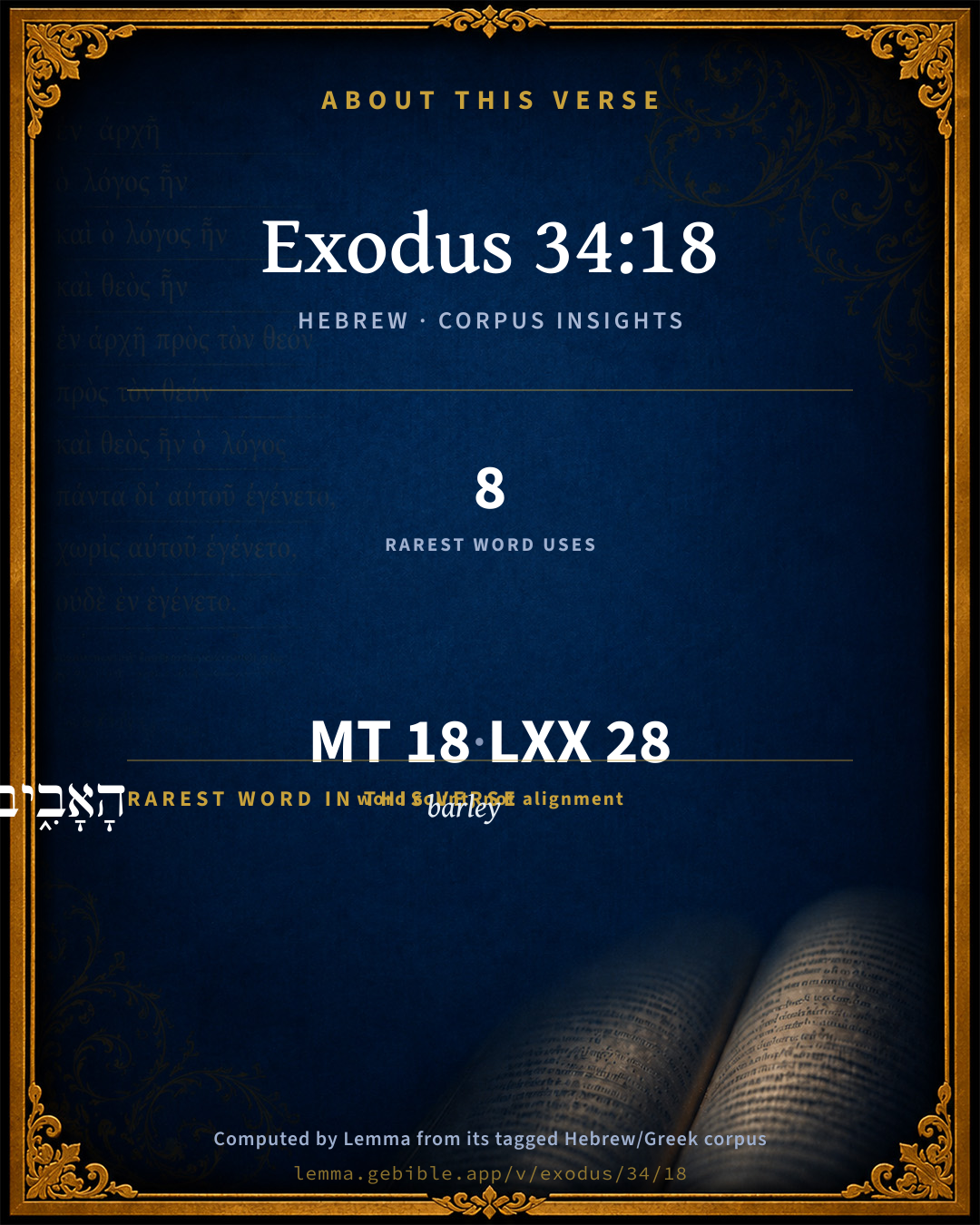
The rarest word here is הָאָבִ֑יב barley H24 — appearing just 8 times in the whole Hebrew Bible.

Shared distinctive vocabulary

הָאָבִ֑יב barley H24 occurs in 6 verses of the Hebrew Bible. Also found in:

Grammatical profile

  • 4 verbs
  • 10 nouns
  • 1 adjective
  • 1 conjunction
  • 2 particles

Verb forms

  • תִּשְׁמֹר֒ Qal · Imperfect
  • תֹּאכַ֤ל Qal · Imperfect
  • צִוִּיתִ֔ךָ Piel · Perfect
  • יָצָ֖אתָ Qal · Perfect

Repetition

Words recur within this verse — often emphatic in Hebrew:

  • הַמַּצּוֹת֮ unleavened H4682 ×2
  • חֹ֣דֶשׁ month H2320 ×2
  • הָאָבִ֑יב barley H24 ×2

Hebrew & Septuagint length

In English translation the verse runs 37 words from the Hebrew and 42 from the Septuagint (LXX English) — closely comparable.

A rough comparison of the two English renderings, which tokenize alike — not a word-level alignment.

Word counts can differ between the Hebrew and the Greek without any difference in meaning — e.g. the Hebrew direct-object marker אֵת has no separate Greek word, and Greek often adds the article ὁ.

In the original languages it is 18 Hebrew tokens and 28 Greek tokens — but the two are counted differently (Hebrew bundles its prefixes and suffixes into one token; the Greek is in lemma form), so that isn’t a like-for-like length.

Cross-references

10

Topical passages linked to Exodus 34:18 in the Treasury of Scripture Knowledge — connected by theme and wording, ordered by reader-vote popularity; previews shown in the World English Bible.

  • Exodus 13:4 This day you go forth in the month Abib.
  • Leviticus 23:6 On the fifteenth day of the same month is the feast of unleavened bread to Yahweh. Seven days you shall eat unleavened bread.
  • Exodus 13:6–7 Seven days you shall eat unleavened bread, and in the seventh day shall be a feast to Yahweh.
  • Deuteronomy 16:1–4 Observe the month of Abib, and keep the Passover to Yahweh your God; for in the month of Abib Yahweh your God brought you forth out of Egypt by night.
  • Exodus 12:2 "This month shall be to you the beginning of months. It shall be the first month of the year to you.
  • Exodus 12:15–20 Seven days shall you eat unleavened bread; even the first day you shall put away yeast out of your houses, for whoever eats leavened bread from the first day until the seventh day, that soul shall be cut off from Israel.
  • Exodus 23:15 You shall observe the feast of unleavened bread. Seven days you shall eat unleavened bread, as I commanded you, at the time appointed in the month Abib (for in it you came out from Egypt), and no one shall appear before me empty.
  • Mark 14:1 It was now two days before the feast of the Passover and the unleavened bread, and the chief priests and the scribes sought how they might sieze him by deception, and kill him.
  • Luke 22:1 Now the feast of unleavened bread, which is called the Passover, drew near.
  • Acts 12:3 When he saw that it pleased the Jews, he proceeded to seize Peter also. This was during the days of unleavened bread.

Cross-references courtesy of OpenBible.info (CC BY 4.0).

Hebrew and Greek witnesses Masoretic Hebrew ↔ Greek Septuagint

The same verse in the two great witnesses to the Old Testament, shown verse-for-verse.

These are two independent witnesses, not word-aligned to each other, and the Septuagint is shown in lemma (dictionary) form.

Hebrew Exodus 34:18 Masoretic · Westminster Leningrad Codex

אֶת חַ֣ג הַמַּצּוֹת֮ תִּשְׁמֹר֒ שִׁבְעַ֨ת יָמִ֜ים תֹּאכַ֤ל מַצּוֹת֙ אֲשֶׁ֣ר צִוִּיתִ֔ךָ לְמוֹעֵ֖ד חֹ֣דֶשׁ הָאָבִ֑יב כִּ֚י בְּחֹ֣דֶשׁ הָֽאָבִ֔יב יָצָ֖אתָ מִמִּצְרָֽיִם

"You shall keep the feast of unleavened bread. Seven days you shall eat unleavened bread, as I commanded you, at the time appointed in the month Abib; for in the month Abib you came out from Egypt.

World English Bible · Public Domain

Greek LXX Exodus 34:18 Septuagint · lemma form

καί ὁ ἑορτή ὁ ἄζυμος φυλάσσω ἑπτά ἡμέρα ἐσθίω ἄζυμος καθάπερ ἐντέλλομαι σύ εἰς ὁ καιρός ἐν μήν ὁ νέος ἐν γάρ μήν ὁ νέος ἐκἔρχομαι ἐκ αἴγυπτος

And you shall keep the feast of unleavened bread: seven days shall you eat unleavened bread, as I have charged you, at the season in the month of new corn; for in the month of new corn you came out from Egypt.

LXX2012 (modern English Septuagint) · Public Domain

Hebrew: Westminster Leningrad Codex (CC BY 4.0). Greek: Septuagint (public domain); English from LXX2012 (modern English Septuagint) (Public Domain). How the Septuagint differs from the Hebrew →

Targum (Aramaic paraphrase)

2

The Targum is the ancient Jewish Aramaic paraphrase of the Hebrew Scriptures — an interpretive translation, not the Hebrew text itself. Onkelos (literal) and Pseudo-Jonathan (expansive) render the Torah, and Jonathan the Prophets. Coverage is partial: where no permissively-licensed English translation exists for a verse, only the Aramaic is shown. This is verse-level text, not a word-by-word alignment to the Hebrew.

  1. Targum Onkelos Torah (Genesis–Deuteronomy)
    יָת חַגָא דְפַטִּירַיָא תִּטַר שַׁבְעָא יוֹמִין תֵּיכוֹל פַּטִירָא כְּמָא דִי פַקֵדִתָּךְ לִזְמַן יַרְחָא דְאַבִּיבָא אֲרֵי בְּיַרְחָא דְאַבִּיבָא נְפַקְתָּא מִמִצְרָיִם:

    (no public-domain English translation for this verse)

    Targum Onkelos — Aramaic: “Onkelos Genesis” (public domain); “Onkelos Exodus” (public domain); “Onkelos Leviticus” (public domain); “Onkelos Numbers” (public domain); “Onkelos Deuteronomy” (public domain). English: “Sefaria Community Translation” (CC0 1.0 (public-domain dedication)); “J.W. Etheridge. The Targums of Onkelos and Jonathan Ben Uzziel on the Pentateuch. London: Longmans, Green, 1862” (public domain). Text via Sefaria.

  2. Targum Pseudo-Jonathan Torah (Genesis–Deuteronomy)
    יַת חַגָא דְפַטִירַיָא תִנְטְרוּן שׁוּבְעָא יוֹמִין תֵּיכוֹל פַּטִּירֵי הֵיכְמָא דְפַקֵידְתָּךְ לִזְמַן יַרְחָא דְאַבִּיבָא אֲרוּם בְּיַרְחָא דְאַבִּיבָא נְפַקְתּוּן פְּרִיקִין מִמִּצְרָיִם

    You shall observe the feast of the unleavened. Seven days thou shalt eat unleavened (cakes), as I have commanded thee, in the time of the month Abiba; for in the month of Abiba you came out free from Mizraim.

    Targum Pseudo-Jonathan — Aramaic: “Targum Jonathan on Genesis” (public domain); “Targum Jonathan on Exodus” (public domain); “Targum Jonathan on Leviticus” (public domain); “Targum Jonathan on Numbers” (public domain); “Targum Jonathan on Deuteronomy” (public domain). English: “The Targum of Jonathan ben Uzziel, trans. J. W. Etheridge, London, 1862” (public domain). Text via Sefaria.

Commentary

Notes on Exodus 34:18 from classic Christian and Jewish commentators (each source and its license shown beneath its notes). The classic Christian expositions comment on the surrounding passage and are grouped to its opening verse, so a note may address several verses; the Jewish commentaries on the Tanakh (Rashi and others) are per-verse, so they appear only where the commentator wrote on this verse.

Lemma curates 59 commentaries, every one of them public domain or Creative Commons licensed, each selected and text-cleaned for this edition rather than reprinted as found. About our sources →

Matthew Henry's Commentary

Here is a repetition of several appointments made before, especially relating to their solemn feasts. When they had made the calf, they proclaimed a feast in honour of it; now, that they might never do so again, they are here charged with the observance of the feasts which God had instituted. Note, Men need not be drawn from their religion by the temptation of mirth, for we serve a Master that has abundantly provided for the joy of his servants: serious godliness is a continual feast, and joy in God always.

I. Once a week they must rest (Exo 34:21), even in earing time, and in harvest, the most busy times of the year. All worldly business must give way to that holy rest; harvest-work will prosper the better for the religious observance of the sabbath-day in harvest-time. Hereby we must show that we prefer our communion with God, and our duty to him, before either the business or the joy of harvest.

II. Thrice a year they must feast (Exo 34:23); they must then appear before the Lord, God, the God of Israel. In all our religious approaches to God, we must eye him as the Lord God, infinitely blessed, great, and glorious, that we may worship him with reverence and godly fear, as the God of Israel, a God in covenant with us, that we may be encouraged to trust in him, and to serve him cheerfully. We always are before God; but, in holy duties, we present ourselves before him, as servants to receive commands, as petitioners to sue for favours, and we have reason to do both with joy. But it might be suggested that, when all the males from every part of the country had gone up to worship in the place that God should choose, the country would be left exposed to the insults of their neighbours; and what would become of the poor women and children, and sick and aged, that were left at home? Trust God with them (Exo 34:24): Neither shall any man desire thy land; not only they shall not invade it, but they shall not so much as think of invading it. Note, 1. All hearts are in God's hands, and under his check; he can lay a restraint, not only upon men's actions, but upon their desires. Canaan was a desirable land, and the neighbouring nations were greedy enough; and yet God says, "They shall not desire it." Let us check all sinful desires in our own hearts against God and his glory, and then trust him to check all sinful desires in the hearts of others against us and our interest. 2. The way of duty is the way of safety. If we serve God, he will preserve us; and those that venture for him shall never lose by him. While we are employed in God's work, and are attending upon him, we are taken under special protection, as noblemen and members of parliament are privileged from arrests.

III. The three feasts are here mentioned, with their appendages. 1. The passover, and the feast of unleavened bread, in remembrance of their deliverance out of Egypt; and to this is annexed the law of the redemption of the first-born, Exo 34:18-20. This feast was instituted, Exo 12:13, and urged again, Exo 23:15. 2. The feast of weeks, that is, that of pentecost, seven weeks after the passover; and to this is annexed the law of the first-fruits. 3. The feast of in-gathering at the year's end, which was the feast of tabernacles (Exo 34:22): of these also he had spoken before, Exo 23:16. As to those laws repeated here (Exo 34:25, Exo 34:26), that against leaven relates to the passover, that of the first-fruits to the feast of pentecost, and therefore that against seething the kid in his mother's milk in all probability relates to the feast of in-gathering, at which God would not have them use that superstitious ceremony, which probably they had seen the Egyptians, or some other of the neighbouring nations, bless their harvests with.

IV. With these laws, here repeated, it is probable all that was said to him when he was before upon the mount was repeated likewise, and the model of the tabernacle shown him again, lest the ruffle and discomposure, which the golden calf had put him into should have bereaved him of the ideas he had in mind of what he had seen and heard; also in token of a complete reconciliation, and to show that not one jot or tittle of the law should pass away, but that all should be carefully preserved by the great Mediator, who came not to destroy, but to fulfil, Mat 5:17, Mat 5:18. And in the close, 1. Moses is ordered to write these words (Exo 34:27), that the people might be the better acquainted with them by a frequent perusal, and that they might be transmitted to the generations to come. We can never be enough thankful to God for the written word. 2. He is told that according to the tenour of these words God would make a covenant with Moses and Israel; not with Israel immediately, but with them in Moses a mediator. Thus the covenant of grace is made with believers through Christ, who is given for a covenant to the people, Isa 49:8. And, as here the covenant was made according to the tenour of the command, so it is still; for we are by baptism brought into covenant, that we may be taught to observe all things whatsoever Christ has commanded us, Mat 28:19, Mat 28:20.

Matthew Henry's Commentary on the Whole Bible (1708–1710) — public domain (CC PDM 1.0). Text via the HelloAO Bible API.

Trapp's Complete Commentary

John Trapp

Exo 34:18 The feast of unleavened bread shalt thou keep. Seven days thou shalt eat unleavened bread, as I commanded thee, in the time of the month Abib: for in the month Abib thou camest out from Egypt.

Ver. 18. In the month Abib.] So called from the new fruits, or ears of corn, then first appearing. See Exo 12:1; Exo 13:4. God here repeateth divers laws. It was a token of reconciliation to the people after their apostasy, in that he treats with them again, after their repentance, about his solemn worships. So, for a testimony of his reconciliation to Peter after his foul fall, he sets him to work in the ministry. {Joh 21:15} So he commendeth his spouse afresh, after her drowsy decays, every whir as amiable as she was before her fall. {Son 6:5; Son 5:10-16}

John Trapp, A Commentary or Exposition upon All the Books of the Old and New Testament (1647–1656) — public domain. Text from a community e-Sword module.

Ellicott's Commentary for English Readers

(18) The feast of unleavened bread shalt thou keep.—Comp. Exo_12:15-20; Exo_13:3-10; Exo_23:15.

The month Abib.—See Note on Exo_13:4.

A Bible Commentary for English Readers, edited by Charles John Ellicott (1878–1897) — public domain. Text from a community e-Sword module.

The Cambridge Bible for Schools and Colleges

gen. ed. J. J. S. Perowne

18. See on Exo_23:15 a.

19, 20a (to redeem). See on Exo_13:12-13.

The Cambridge Bible for Schools and Colleges (gen. ed. J. J. S. Perowne; Cambridge University Press, 1878–1918) — public domain. Text from a community e-Sword module.

John Gill's Exposition

All that openeth the matrix is mine,.... Or "the womb", and therefore to be sanctified, and set apart for his use: this also was declared, and the law concerning it given, at the time of their coming out of Egypt, and here repeated; see Gill on Exo 13:2, Exo 13:12.

.

Exodus 34:20

exo 34:20

exo 34:20

exo 34:20Every firstling of an ass thou shalt redeem,.... This goes along with the former; see Gill on Exo 13:13,

and none shall appear before me empty; at the grand festivals, the passover, pentecost, and tabernacles; see Gill on Exo 13:15.

John Gill's Exposition of the Whole Bible (1746–1763) — public domain (CC PDM 1.0). Text via the HelloAO Bible API.

Haydock's Catholic Bible Commentary

New corn. Hebrew, Abib; the name of the month Nisan, which corresponds with our March and April.

George Leo Haydock (1774–1849), Haydock's Catholic Family Bible and Commentary, 1859 edition — public domain. Excludes Psalms (Douay-Rheims chapter numbering differs from Protestant) and Deuterocanonical books (Catholic canon only).

The Pulpit Commentary

The feast of unleavened bread shalt thou keep. See Exo_23:15, and compare Exo_12:14-20, and Exo_13:3-10. The month Abib. See the comment on Exo_13:4.

The Pulpit Commentary (1880–1919), ed. H.D.M. Spence-Jones & Joseph S. Exell — public domain. Text from a community e-Sword module.

Scofield Reference Notes

C. I. Scofield

Abib

First month i.e. April.

The Scofield Reference Bible (1917 edition), notes by C. I. Scofield — public domain. Text from a community e-Sword module.

Kretzmann's Popular Commentary

Paul E. Kretzmann

The Second Festivals

v. 18. The Feast of Unleavened Bread shalt thou keep. Cf Exo 23:15. Seven days thou shalt eat unleavened bread, as I commanded thee, in the time of the month Abib; for in the month Abib thou camest out from Egypt. Because of the defection of the Israelites the Lord here repents the ordinances regarding the chief festival days and seasons.

v. 19. All that openeth the matrix is Mine, all the firstborn sons of the children of Israel; and every firstling among thy cattle, whether ox or sheep, that is male. This precept is here stated on account of its close connection with the Passover and its significance.

v. 20. But the firstling of an ass thou shalt redeem with a lamb, ransom by the payment of a lamb or a kid; and if thou redeem him not, then shalt thou break his neck. All the first-born of thy sons thou shalt redeem. And none shall appear before Me empty. Cf Exo 23:15.

v. 21. Six days thou shalt work, but on the seventh day thou shalt rest, Cf Exo 20:9; Exo 23:12; in earing time and in harvest thou shalt rest, these two seasons being mentioned since they were the busiest season for the farmer, when he would be inclined to use also the Sabbath for work.

v. 22. And thou shalt observe the Feast of Weeks, of the first-fruits of wheat harvest, namely, Pentecost, and the Feast of Ingathering at the year’s end, the Feast of Tabernacles at the end of the season.

v. 23. Thrice in the year shall all your men-children, all the males, the men, appear before the Lord God, the God of Israel. On these three great festivals the attendance of all Israelites was commanded; they were obliged to meet, first at the Sanctuary, and later in the Temple.

v. 24. For I will cast out the nations before thee, and enlarge thy borders, Cf Exo 23:31; neither shall any man desire thy land when thou shalt go up to appear before the Lord, thy God, thrice in the year; the Lord promised to keep away all enemies at these times, so that they would not take advantage of the men’s absence to invade the country.

v. 25. Thou shalt not offer the blood of My sacrifice, of the Passover lamb, with leaven; neither shall the sacrifice of the Feast of the Passover be left unto the morning; it should either be eaten to the last fragment, or the remainder burned with fire, Exo 12:10.

v. 26. The first of the first-fruits of thy land thou shalt bring unto the house of the Lord, thy God, this being the most prominent rite of the Feast of Unleavened Bread. Thou shalt not seethe a kid in his mother’s milk. Cf Exo 23:19.

v. 27. And the Lord said unto Moses, Write thou these words, the ordinances were to be preserved in writing; for after the tenor of these words I have made a covenant with thee and with Israel. The first covenant had hereby been renewed or reinstituted.

v. 28. And he (Moses) was there with the Lord forty days and forty nights, as he had been the first time, Exo 24:18; he did neither eat bread, nor drink water, being miraculously sustained by the Lord. And He (God) wrote upon the tables the words of the covenant, the Ten Commandments, the Decalog. The true hallowing of God’s name in the New Testament consists in this, that we gladly hear and learn the Word of God, and help to uphold the ministry in our midst and to spread the Gospel-news.

Paul E. Kretzmann, Popular Commentary of the Bible (1921–1924) — public domain. Text from a community e-Sword module.

unfoldingWord translationNotes

Door43 World Missions Community

General Information:

Yahweh continues to tell Moses what the people must do.

seven days

"7 days" (See: Numbers)

in the month of Aviv

This is the name of the first month of the Hebrew calendar. Aviv is during the last part of March and the first part of April on Western calendars. See how you translated "Aviv" in Exodus 13:4. (See: Hebrew Months and How to Translate Names)

translationWords

festival

unleavened bread

command

bread

yeast

Egypt

unfoldingWord translationNotes — © Distant Shores Media and the Door43 World Missions Community, licensed CC BY-SA 4.0. Source: git.door43.org/Door43/en_tn.

Rashi

Rabbi Shlomo Yitzchaki (Rashi)

חדש האביב THE MONTH OF ABIB — the month of early ripening — the month when the grain is in its first stage of ripening.

Rashi on the Tanakh — English translations: “The Judaica Press complete Tanach with Rashi, translated by A. J. Rosenberg” (CC BY 4.0); “Pentateuch with Rashi's commentary by M. Rosenbaum and A.M. Silbermann, 1929-1934” (public domain); “The Metsudah Tanach series, Lakewood, N.J” (CC BY 4.0); and “The Book of Joshua, Metsudah Publications, 1997” (CC BY 4.0). Text via Sefaria.

Lesson kit

Teaching starters — assembled from the data on this page, not authored interpretation. Every prompt links to the verse data it draws on. Edit before teaching.

Exodus, in the Pentateuch, opens this verse with 18 words (15 distinct Hebrew lemmas). Its most distinctive word is ʼâbîyb (“barley”). A historical commentator’s framing appears above. Read the whole chapter for the surrounding context.

Discussion questions

  1. How does “barley” (ʼâbîyb) shape what this verse is saying?
  2. Exodus 9:31 shares the word «barley» with this verse. How do the two illuminate each other?
  3. “unleavened” occurs 2× in this one verse. What is the effect of the repetition?
  4. These translations render this verse differently; the difference is in the English rendering, not the original. What questions does that raise?
  5. The verb «תִּשְׁמֹר֒» is Qal Imperfect. How does its form color the action?
  6. Reading how Matthew Henry's Commentary and Trapp's Complete Commentary read this verse, where do the two commentators agree and where do they part?

Things to notice

Reading settings

Reading text

Shown beneath each verse's original-language words.

Old Testament
Old Testament edition

Read the OT as the Masoretic Hebrew (MT) or the Greek Septuagint (LXX).

English shown for the Greek Septuagint (in the Hebrew ↔ Greek comparison).

Comparing translations? Open the Compare panel on any verse page to stack up to four side by side.