
Joshua 18:9

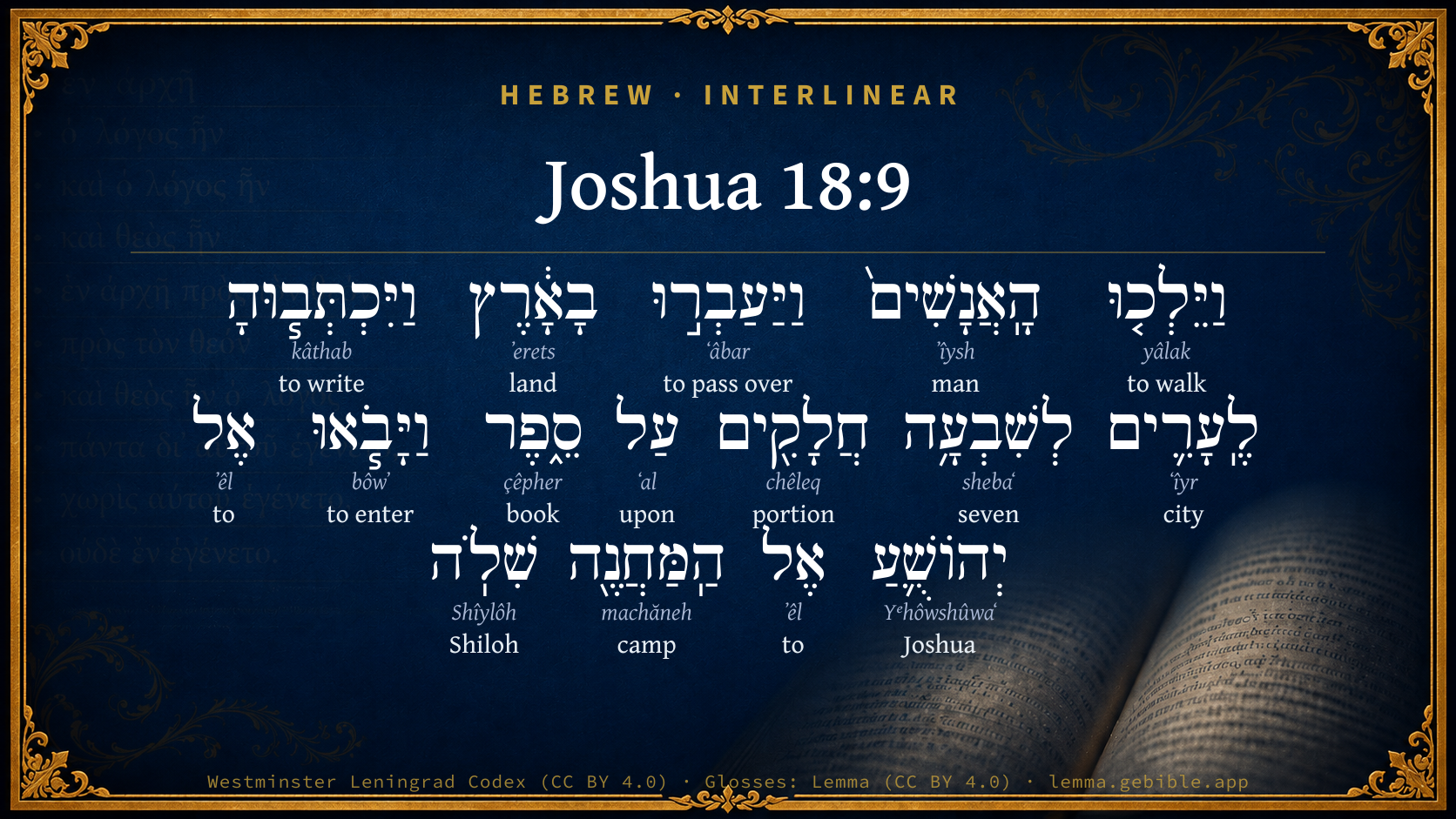
Hebrew (Westminster Leningrad Codex) Joshua 18:9 appears in the Hebrew Old Testament. The text above is from the Westminster Leningrad Codex. Each word links to its Strong’s number, a concise gloss, and parsing drawn from the Open Scriptures Hebrew Bible morphology. Click any word for its full Brown-Driver-Briggs (BDB) entry.
Download image
Cite this verse

Joshua 18:9 (World English Bible). Public Domain. Lemma interlinear Bible study tool, https://lemma.gebible.app/v/joshua/18/9.

Show BibTeX & RIS
BibTeX
RIS
English Translation
The men went and passed through the land, and described it by cities into seven portions in a book; and they came to Joshua to the camp at Shiloh.
World English Bible · Public Domain
Download a study sheet

One document with this verse’s original text, its word-by-word gloss line, the meaning frame, cross-references with their text, attributed commentary, and full source and license credits — printable, and it pastes into notes with its structure intact.

This verse Autodidact and up

Study sheet (.html) Plain text (.txt)

A passage Seminary Student

Up to 50 verses in one chapter. A passage sheet keeps up to 6 commentary sources and 12 cross-references per verse, in the order this page ranks them, and says so on the sheet whenever that leaves anything out. Ask for a single verse and you get the Autodidact verse sheet above.

Everything on this page stays free to read, with no account — the sheet is a download of what is already on screen, not access to it.

Want to remove ads? Support Godless Engineer
Compare translations 3

The same verse in 3 English versions, stacked beneath the original-language interlinear above. Click any original word for its lexicon entry.

Each is an independent rendering of the whole verse — the interlinear is not word-aligned to these translations.

Highlighted words mark where these versions differ — a whole-verse word diff, not a word-by-word alignment.

  • World English Bible Public Domain
    The men went and passed through the land, and described it by cities into seven portions in a book; and they came to Joshua to the camp at Shiloh.
  • King James Version Public Domain
    And the men went and passed through the land, and described it by cities into seven parts in a book, and came again to Joshua to the host at Shiloh.
  • unfoldingWord Literal Text CC BY-SA 4.0
    And the men went and passed over in the land, and they wrote it down upon a scroll according to the cities in seven divisions. And they came to Joshua, to the camp Shiloh.

unfoldingWord Literal Text — © unfoldingWord, licensed CC BY-SA 4.0. Word-aligned USFM3 via Door43 (git.door43.org/unfoldingWord/en_ult).

Versions to compare (up to 4)

3 of 4 selected

Show all 18 translations

Every available English version of this verse, each an independent rendering of the whole verse.

  • World English Bible Public Domain
    The men went and passed through the land, and described it by cities into seven portions in a book; and they came to Joshua to the camp at Shiloh.
  • Berean Standard Bible Public Domain
    So the men departed and went throughout the land, mapping it city by city into seven portions. Then they returned with the document to Joshua at the camp in Shiloh.
  • Majority Standard Bible Public Domain
    So the men departed and went throughout the land, mapping it city by city into seven portions. Then they returned with the document to Joshua at the camp in Shiloh.
  • King James Version Public Domain
    And the men went and passed through the land, and described it by cities into seven parts in a book, and came again to Joshua to the host at Shiloh.
  • American Standard Version (1901) Public Domain
    And the men went and passed through the land, and described it by cities into seven portions in a book; and they came to Joshua unto the camp at Shiloh.
  • Revised Version (1885) Public Domain
    And the men went and passed through the land, and described it by cities into seven portions in a book, and they came to Joshua unto the camp at Shiloh.
  • Geneva Bible (1599) Public Domain
    So the men departed, and passed through the lande, and described it by cities into seuen partes in a booke, and returned to Ioshua into the campe at Shiloh.
  • Douay-Rheims (1899) Public Domain
    And when the men were risen up, to go to mark out the land, Josue commanded them, saying: Go round the land and mark it out, and return to me: that I may cast lots for you before the Lord in Silo.
  • Young's Literal Translation Public Domain
    And the men go, and pass over through the land, and describe it by cities, in seven portions, on a book, and they come in unto Joshua, unto the camp, `at' Shiloh.
  • Literal Standard Version CC BY-SA 4.0
    And the men go, and pass over through the land, and describe it by cities, in seven portions, on a scroll, and they come to Joshua, to the camp [at] Shiloh.
  • Unlocked Literal Bible CC BY-SA 4.0
    The men left and walked up and down in the land and wrote a description of it in a scroll by its cities in seven sections, listing the cities in each section. Then they returned to Joshua in the camp at Shiloh.
  • unfoldingWord Literal Text CC BY-SA 4.0
    And the men went and passed over in the land, and they wrote it down upon a scroll according to the cities in seven divisions. And they came to Joshua, to the camp Shiloh.
  • Darby Bible Public Domain
    And the men went and passed through the land, and described it by cities into seven portions, in a book, and they came to Joshua, to the camp at Shiloh.
  • World Messianic Bible Public Domain
    The men went and passed through the land, and surveyed it by cities into seven portions in a book. They came to Joshua to the camp at Shiloh.
  • Webster's Bible Public Domain
    And the men went and passed through the land, and described it by cities in seven parts in a book, and came again, to Joshua to the host at Shiloh.
  • Free Bible Version CC BY-SA 4.0
    So the men went and explored the land and wrote down on a scroll a description of the seven parts, recording the towns in each part. Then they returned to Joshua at the camp in Shiloh
  • Bible in Basic English Public Domain
    So the men went, travelling through the land, and made a record of it by towns in seven parts in a book, and came back to Joshua to the tent-circle at Shiloh.
  • JPS Tanakh (1917) Public Domain
    And the men went and passed through the land, and described it by cities into seven portions in a book, and they came to Joshua unto the camp at Shiloh.

Literal Standard Version (2020), Covenant Press — licensed CC BY-SA 4.0. Text via the HelloAO Bible API (eBible.org). Unlocked Literal Bible (unfoldingWord) — licensed CC BY-SA 4.0. Text via the HelloAO Bible API (eBible.org). unfoldingWord Literal Text — © unfoldingWord, licensed CC BY-SA 4.0. Word-aligned USFM3 via Door43 (git.door43.org/unfoldingWord/en_ult). Free Bible Version, Dr. Jonathan Gallagher — licensed CC BY-SA 4.0. Text via the HelloAO Bible API (eBible.org).

Word by word

More ways to search: Search by grammar → Find every occurrence → Compare this word →

Practice this passage: Drill this verse → Learn its vocabulary →

שִׁלֹֽה
Shîylôh
H7887
“Shiloh”
Noun, Proper
Part of Speech
Noun
Type
Proper
Full BDB Definition

Origin: from the same as H7886

TWOT: 2376

Shiloh = "place of rest" - a city in Ephraim and temporary home of the Ark of the Covenant and the Tabernacle, the place where Samuel grew up
  1. וַיֵּלְכ֤וּ yâlak H3212 “and · to walk” Conjunction + Verb, Qal, Sequential Imperfect, 3rd Person, Masculine, Plural
  2. הָֽאֲנָשִׁים֙ ʼîysh H376 “the · men” Particle, Definite Article + Noun, Common, Masculine, Plural, Absolute
  3. וַיַּעַבְר֣וּ ʻâbar H5674 “and · to pass over” Conjunction + Verb, Qal, Sequential Imperfect, 3rd Person, Masculine, Plural
  4. בָאָ֔רֶץ ʼerets H776 “in/at the · land” Preposition, Determined + Noun, Common, Both, Singular, Absolute
  5. וַיִּכְתְּב֧וּהָ kâthab H3789 “and · to write · her” Conjunction + Verb, Qal, Sequential Imperfect, 3rd Person, Masculine, Plural + Suffix, Personal, 3rd Person, Feminine, Singular
  6. לֶֽעָרִ֛ים ʻîyr H5892 “to/for the · cities” Preposition, Determined + Noun, Common, Feminine, Plural, Absolute
  7. לְשִׁבְעָ֥ה shebaʻ H7651 “to/for · seven” Preposition + Adjective, Cardinal number, Masculine, Singular, Absolute
  8. חֲלָקִ֖ים chêleq H2506 “portions” Noun, Common, Masculine, Plural, Absolute
  9. עַל ʻal H5921 “upon” Preposition
  10. סֵ֑פֶר çêpher H5612 “book” Noun, Common, Masculine, Singular, Absolute
  11. וַיָּבֹ֧אוּ bôwʼ H935 “and · to enter” Conjunction + Verb, Qal, Sequential Imperfect, 3rd Person, Masculine, Plural
  12. אֶל ʼêl H413 “to” Preposition
  13. יְהוֹשֻׁ֛עַ Yᵉhôwshûwaʻ H3091 “Joshua” Noun, Proper
  14. אֶל ʼêl H413 “to” Preposition
  15. הַֽמַּחֲנֶ֖ה machăneh H4264 “the · camp” Particle, Definite Article + Noun, Common, Both, Singular, Absolute

About this verse

These counts appear in no published source. They are computed here, from the morphology-tagged text and Lemma’s own curated glosses. What Lemma adds →

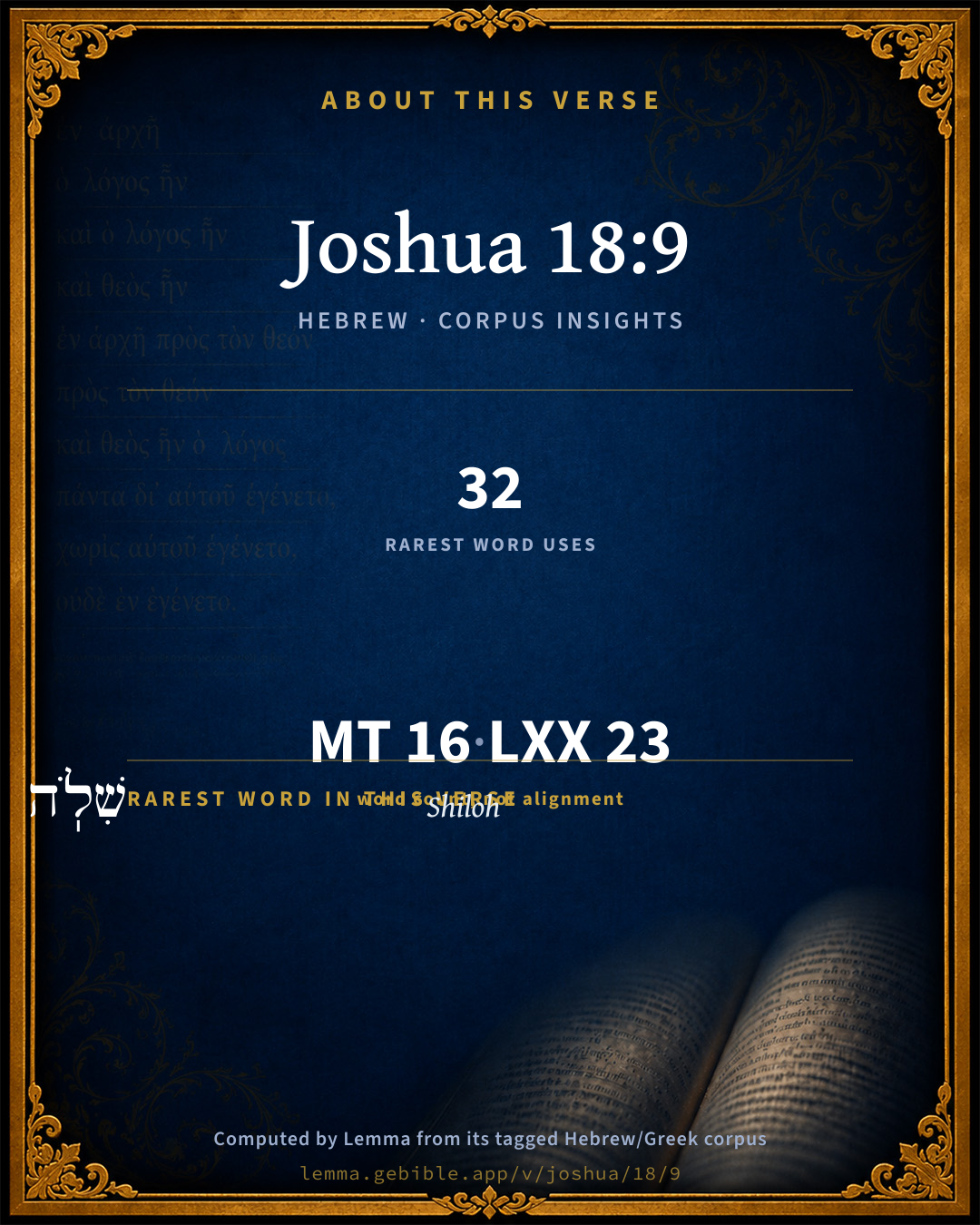
16
words
15
distinct lemmas
Historical
section

Shared distinctive vocabulary

שִׁלֹֽה Shiloh H7887 occurs in 30 verses of the Hebrew Bible. Also found in:

Grammatical profile

  • 4 verbs
  • 8 nouns
  • 1 adjective
  • 3 prepositions

Verb forms

  • וַיֵּלְכ֤וּ Qal · Sequential Imperfect
  • וַיַּעַבְר֣וּ Qal · Sequential Imperfect
  • וַיִּכְתְּב֧וּהָ Qal · Sequential Imperfect
  • וַיָּבֹ֧אוּ Qal · Sequential Imperfect

Repetition

A word recurs within this verse — often emphatic in Hebrew:

  • אֶל to H413 ×2

Hebrew & Septuagint length

In English translation the verse runs 29 words from the Hebrew and 29 from the Septuagint (LXX English) — the same length.

A rough comparison of the two English renderings, which tokenize alike — not a word-level alignment.

Word counts can differ between the Hebrew and the Greek without any difference in meaning — e.g. the Hebrew direct-object marker אֵת has no separate Greek word, and Greek often adds the article ὁ.

In the original languages it is 16 Hebrew tokens and 23 Greek tokens — but the two are counted differently (Hebrew bundles its prefixes and suffixes into one token; the Greek is in lemma form), so that isn’t a like-for-like length.

Cross-references

1

Topical passages linked to Joshua 18:9 in the Treasury of Scripture Knowledge — connected by theme and wording, ordered by reader-vote popularity; previews shown in the World English Bible.

  • Acts 13:19 When he had destroyed seven nations in the land of Canaan, he gave them their land for an inheritance, for about four hundred fifty years.

Cross-references courtesy of OpenBible.info (CC BY 4.0).

Hebrew and Greek witnesses Masoretic Hebrew ↔ Greek Septuagint

The same verse in the two great witnesses to the Old Testament, shown verse-for-verse.

These are two independent witnesses, not word-aligned to each other, and the Septuagint is shown in lemma (dictionary) form.

Hebrew Joshua 18:9 Masoretic · Westminster Leningrad Codex

וַיֵּלְכ֤וּ הָֽאֲנָשִׁים֙ וַיַּעַבְר֣וּ בָאָ֔רֶץ וַיִּכְתְּב֧וּהָ לֶֽעָרִ֛ים לְשִׁבְעָ֥ה חֲלָקִ֖ים עַל סֵ֑פֶר וַיָּבֹ֧אוּ אֶל יְהוֹשֻׁ֛עַ אֶל הַֽמַּחֲנֶ֖ה שִׁלֹֽה

The men went and passed through the land, and described it by cities into seven portions in a book; and they came to Joshua to the camp at Shiloh.

World English Bible · Public Domain

Greek LXX Joshua 18:9 Septuagint · lemma form

καί πορεύομαι καί χωροβατέω ὁ γῆ καί ὁράω αὐτός καί γράφω αὐτός κατά πόλις αὐτός ἑπτά μερίς εἰς βιβλίον καί φέρω πρός ἰησοῦς

And they went, and explored the land: and they viewed it, and described it according to the cities, seven parts in a book, and brought the book to Joshua.

LXX2012 (modern English Septuagint) · Public Domain

Hebrew: Westminster Leningrad Codex (CC BY 4.0). Greek: Septuagint (public domain); English from LXX2012 (modern English Septuagint) (Public Domain). How the Septuagint differs from the Hebrew →

Targum (Aramaic paraphrase)

1

The Targum is the ancient Jewish Aramaic paraphrase of the Hebrew Scriptures — an interpretive translation, not the Hebrew text itself. Onkelos (literal) and Pseudo-Jonathan (expansive) render the Torah, and Jonathan the Prophets. Coverage is partial: where no permissively-licensed English translation exists for a verse, only the Aramaic is shown. This is verse-level text, not a word-by-word alignment to the Hebrew.

  1. Targum Jonathan Prophets (Joshua–Malachi)
    וַאֲזַלוּ גִבָּרַיָא וַעֲבָרוּ בְּאַרְעָא וְכַתְבוּהָ לְקִרְוַיָא לְשַׁבְעָא חוּלְקִין עַל סִפְרָא וַאֲתוֹ לְוַת יְהוֹשֻׁעַ לְמַשְׁרִיתָא לְשִׁלֹה:

    (no public-domain English translation for this verse)

    Targum Jonathan — Aramaic: “Mikraot Gedolot” (public domain). English: “Sefaria Community Translation” (CC0 1.0 (public-domain dedication)); “London "Chaldee Paraphrase," 1871” (public domain). Text via Sefaria.

Commentary

Notes on Joshua 18:9 from classic Christian and Jewish commentators (each source and its license shown beneath its notes). The classic Christian expositions comment on the surrounding passage and are grouped to its opening verse, so a note may address several verses; the Jewish commentaries on the Tanakh (Rashi and others) are per-verse, so they appear only where the commentator wrote on this verse.

Lemma curates 59 commentaries, every one of them public domain or Creative Commons licensed, each selected and text-cleaned for this edition rather than reprinted as found. About our sources →

Trapp's Complete Commentary

John Trapp

Jos 18:9 And the men went and passed through the land, and described it by cities into seven parts in a book, and came [again] to Joshua to the host at Shiloh.

Ver. 9. And the men went and passed through the land.] The Lord securing them according as their trust was in him. Deo confisi nunquam confusi. A believer walketh through the world as a conqueror, being safe guarded by the peace of God within him, {Php 4:7} and the power of God without him. {1Pe 1:5} He committeth all his ways to God, depending upon him for direction and success, {Psa 37:5} resting on his might and mercy in time of dread, {Psa 69:3} yet ever careful to serve God’s providence by use of lawful means, and not to thrust himself into unnecessary dangers. {Pro 28:26}

And came again to Joshua.] After seven months, saith Josephus.

John Trapp, A Commentary or Exposition upon All the Books of the Old and New Testament (1647–1656) — public domain. Text from a community e-Sword module.

Joseph Benson's Commentary

Jos 18:9-10. The men went and passed through the land — Josephus tells us they were occupied seven months in taking this survey, and making the description here mentioned. And described it by cities — Or, according to the cities to which the several provisions or territories belonged. Joshua cast lots for them in Shiloh — That is, according to the divisions made by the surveyors, which were so just and equal that all consented the lot should determine what part should belong to them.

Joseph Benson's Commentary on the Old and New Testaments (1811–1818) — public domain. Text from a community e-Sword module.

Tyndale Open Study Notes

Tyndale Open Resources

18:9 The Canaanites of the hill country now feared Israel and allowed twenty-one men (18:4) to walk through these territories and return unharmed. • The written record was probably a scroll, which might have provided the original source for the descriptions of the tribal allotments in chs 18–19.

Tyndale Open Study Notes — © Tyndale Open Resources, licensed CC BY-SA 4.0. Text via the HelloAO Bible API.

Jamieson, Fausset & Brown

Robert Jamieson, A. R. Fausset & David Brown

The men went and passed through the land, and described it by cities into seven parts in a book--dividing the land according to its value, and the worth of the cities which it contained, into seven equal portions. This was no light task to undertake. It required learning and intelligence which they or their instructors had, in all probability, brought with them out of Egypt. Accordingly, JOSEPHUS says that the survey was performed by men expert in geometry. And, in fact, the circumstantial account which is given of the boundaries of each tribe and its situation, well proves it to have been the work of no mean or incompetent hands.

Jamieson, Fausset & Brown — Commentary Critical and Explanatory on the Whole Bible (1871) — public domain (CC PDM 1.0). Text via the HelloAO Bible API.

Adam Clarke's Commentary

Verse 9. And described it in a book] This as far as I can recollect, is the first act of surveying on record. These men and their work differed widely from those who had searched the land in the time of Moses; they went only to discover the nature of the country, and the state of its inhabitants; but these went to take an actual geographical survey of it, in order to divide it among the tribes which had not yet received their portions. We may suppose that the country was exactly described in a book, that is, a map, pointing out the face of the country, accompanied with descriptions of each part.

Adam Clarke's Commentary on the Bible (1810–1826) — public domain. Text from a community e-Sword/MySword module.

John Calvin's Commentaries

9. And the men went and passed, etc Here not only is praise bestowed on the ready obedience by which their virtue shone forth conspicuous, but the Lord gives a signal manifestation of his favor by deigning to bestow remarkable success on pious Joshua and the zeal of the people. Had they crept along by subterranean burrows, they could scarcely have escaped innumerable dangers, but now, when they are taking notes of the cities and their sites, of the fields, the varying features of the districts, and all the coasts, and without meeting with any adverse occurrence, return in safety to their countrymen, who can doubt that their life had been kept safe among a thousand deaths by a wonderful exertion of divine power? It is accordingly said emphatically, that they returned to celebrate the grace of God, which is just equivalent to saying that they were brought back by the hand of God. This made the people proceed more willingly to the casting of lots. For their minds would not yet have been well purged of fastidiousness had they not perceived in that journey a signal display of divine favor, promising them that the final issue would be according to their wish. Joshua is hence said to have divided according to the inheritance of each, as if he were sending them to enter on a quiet possession, though the effect depended on the divine presence, because it ought to have been enough for them that the whole business was carried on by the authority of God, who never deceives his people, even when he seems to sport with them. In what sense the ark of the covenant is called God, or the face of God, I have already explained in many passages.

John Calvin's Commentaries (1540-1563) — public domain. Text from the Calvin Translation Society English edition (1840s-50s) via the Christian Classics Ethereal Library (ccel.org). Calvin's coverage is partial (roughly two-thirds of the Bible); uncommented books and verses are honest gaps, never fabricated. The 19th-century editor's footnotes and remarks are omitted so the notes are faithfully Calvin's own voice.

The Cambridge Bible for Schools and Colleges

gen. ed. J. J. S. Perowne

9. and passed through the land] How long they were absent we are not told. Josephus tells us it was seven months, Ant. v. i. 21. The Rabbis tell us it was seven years. Both suppositions are equally devoid of foundation.

and described it] Although the survey was connected chiefly with a general estimate of the resources and characteristics of the several districts, yet it is to be remembered that the Israelites had acquired a knowledge of the art of mensuration in Egypt, where, on account of the annual overflowing of the Nile, it had been practised from the earliest times.

by cities into seven parts] i.e. they surveyed it so as to divide the cities and then the land itself into seven parts.

The Cambridge Bible for Schools and Colleges (gen. ed. J. J. S. Perowne; Cambridge University Press, 1878–1918) — public domain. Text from a community e-Sword module.

John Gill's Exposition

And the men went and passed through the land,.... Undisturbed by the inhabitants that remained; the fear of the Israelites being still upon them, and the providence of God restraining them, so that the men passed through the whole country, and took a survey of it without any molestation:

and described it by cities, into seven parts, in a book; or map, or rather made seven maps of it, and set down the several cities in each division, with the places adjacent, hills and vales, and marked out a plain and exact chorography of the whole, by which it appears they must be men well skilled in geometry. Josephus (b) says, that Joshua added to them some that understood geometry; but doubtless the persons each tribe chose and sent were such whom they knew were well versed in that art, and so fit for the business; and which they had, no doubt, learned in Egypt, this being one part of the wisdom and learning of the Egyptians; who boasted of it as an invention of theirs, as Diodorus Siculus (c) relates; and indeed they were obliged to study it, their country being divided into several homes, and these into lesser districts, and which also were subdivided, and according thereunto were the king's taxes levied upon them; and what with the confusion frequently made by the overflowings of the Nile, they were frequently obliged to measure their land over again; and hence they became expert in this science, which is commonly believed took its rise from them, and passed into Greece, as Herodotus (d), and Strabo (e), and other authors relate; however, it is certain from this instance in the time of Joshua, that geometry was not the invention of Anaximander, about five hundred years before Christ, as some have asserted (f):

and came again to Joshua to the host at Shiloh; where the camp, as well as the people in common, and the tabernacle, were; they returned, as Josephus (g) says, at the end of seven months; and to measure so much land, and make such divisions of it, and give the plans and maps of each division, must take up a considerable time.

(b) Antiqu. l. 5. c. 1. sect. 21. (c) Bibliothec. l. 1. p. 63. (d) Euterpe, sive, l. 2. c. 109. (e) Geograph. l. 17. p. 541, 542. Vid. Suidam in voce (f) Vid. Strabo. Geograph. l. 1. p. 5. Lar. l. 2. Vit. Anaximan I. (g) Ut supra. (Antiqu. l. 5. c. 1. sect. 21.)

John Gill's Exposition of the Whole Bible (1746–1763) — public domain (CC PDM 1.0). Text via the HelloAO Bible API.

Haydock's Catholic Bible Commentary

Book. Hebrew, "described it, according to the cities, into seven parts, in a volume," (Haydock) or table, resembling a map. The ancients commonly wrote on boards covered with wax, and engraved on stone, lead, &c.

George Leo Haydock (1774–1849), Haydock's Catholic Family Bible and Commentary, 1859 edition — public domain. Excludes Psalms (Douay-Rheims chapter numbering differs from Protestant) and Deuterocanonical books (Catholic canon only).

Matthew Poole's English Annotations

By cities, or, according to the cities, to which the several parts or territories belonged.

Matthew Poole's English Annotations on the Holy Bible (1683–1685) — public domain. Text from a community e-Sword/MySword module.

Whedon's Commentary on the Bible

Daniel D. Whedon

9. [Seven parts in a book — The cities and districts were divided into seven parts or groups, and described in a written document. Herodotus (II, 18:109) thought that land-surveying had its origin in Egypt, and thence passed over into Greece, and in Egypt the Hebrews may have acquired some knowledge of this art; but, as shown above, we need not understand this description of the Israelitish territory as a scientific survey.]

Came again to Joshua — We have no note of the time occupied by the survey. Josephus says seven months, while the Rabbins say seven years.

To the host — The Israelitish camp, which assembled at Shiloh to witness this allotment of the rest of the land.

Daniel D. Whedon (gen. ed.), Commentary on the Old and New Testaments (1874–1909) — public domain. Text from a community e-Sword module.

John Wesley's Explanatory Notes

By cities - Or, according to the cities, to which the several parties or territories belonged.

John Wesley, Explanatory Notes Upon the Whole Bible (1754–1765) — public domain. Text via the GEBible commentary corpus.

Lesson kit

Teaching starters — assembled from the data on this page, not authored interpretation. Every prompt links to the verse data it draws on. Edit before teaching.

Joshua, in the Historical, opens this verse with 16 words (15 distinct Hebrew lemmas). Its most distinctive word is Shîylôh (“Shiloh”). A historical commentator’s framing appears above. Read the whole chapter for the surrounding context.

Discussion questions

  1. The word Shîylôh carries the sense “Shiloh.” How does it shape the verse?
  2. Joshua 18:1 shares the word «Shiloh» with this verse. How do the two illuminate each other?
  3. “to” occurs 2× in this one verse. What is the effect of the repetition?
  4. The translations on this page render this verse differently — a whole-verse word diff, not a word-by-word alignment. What might account for the different wordings?
  5. The verb «וַיֵּלְכ֤וּ» is Qal Sequential Imperfect. How does its form color the action?
  6. Reading how Trapp's Complete Commentary and Joseph Benson's Commentary read this verse, where do the two commentators agree and where do they part?

Things to notice

Reading settings

Reading text

Shown beneath each verse's original-language words.

Old Testament
Old Testament edition

Read the OT as the Masoretic Hebrew (MT) or the Greek Septuagint (LXX).

English shown for the Greek Septuagint (in the Hebrew ↔ Greek comparison).

Comparing translations? Open the Compare panel on any verse page to stack up to four side by side.