
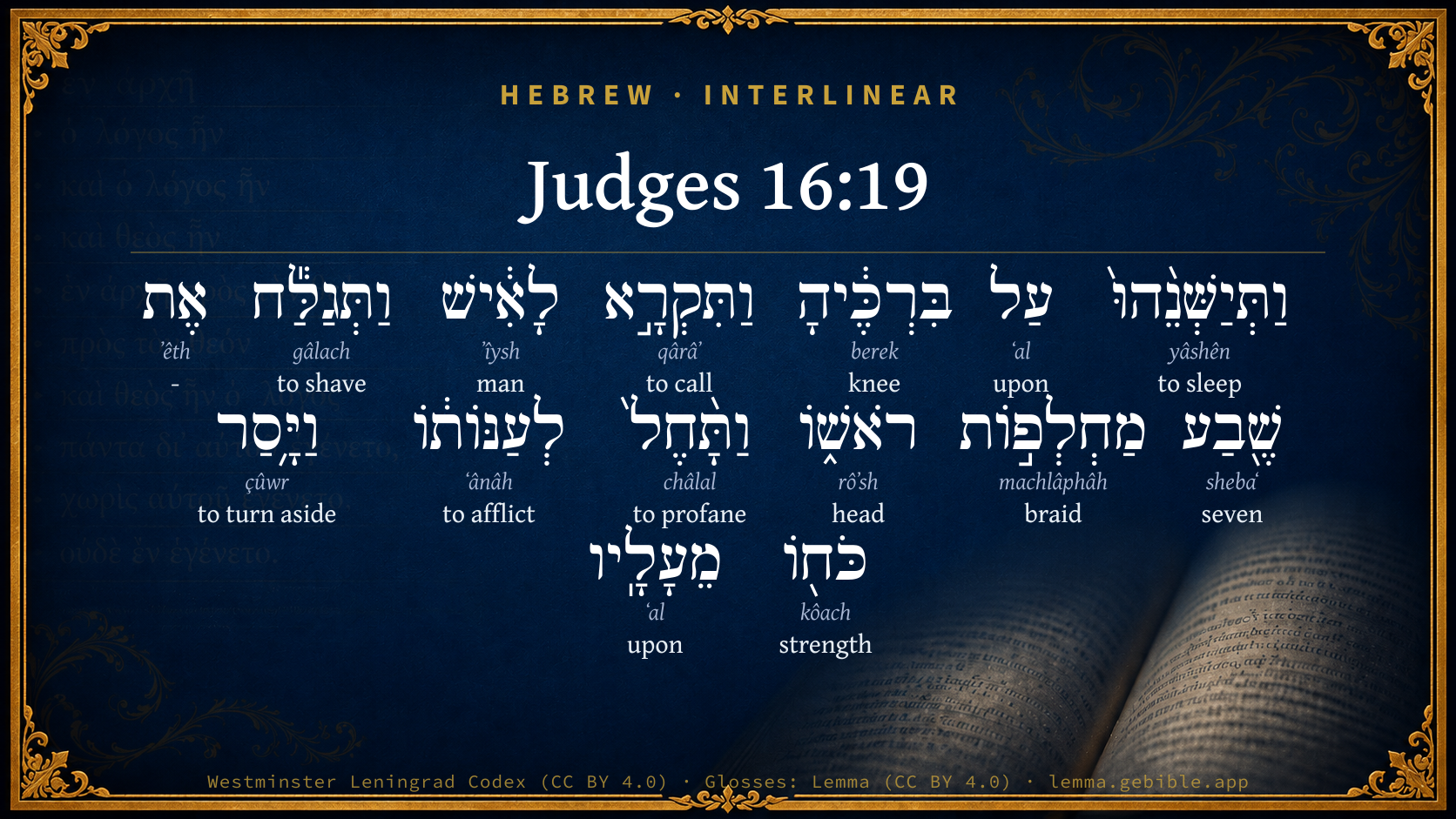
Judges 16:19

Hebrew (Westminster Leningrad Codex) Judges 16:19 appears in the Hebrew Old Testament. The text above is from the Westminster Leningrad Codex. Each word links to its Strong’s number, a concise gloss, and parsing drawn from the Open Scriptures Hebrew Bible morphology. Click any word for its full Brown-Driver-Briggs (BDB) entry.
Download image
Cite this verse

Judges 16:19 (World English Bible). Public Domain. Lemma interlinear Bible study tool, https://lemma.gebible.app/v/judges/16/19.

Show BibTeX & RIS
BibTeX
RIS
English Translation
She made him sleep on her knees; and she called for a man, and shaved off the seven locks of his head; and she began to afflict him, and his strength went from him.
World English Bible · Public Domain
Download a study sheet

One document with this verse’s original text, its word-by-word gloss line, the meaning frame, cross-references with their text, attributed commentary, and full source and license credits — printable, and it pastes into notes with its structure intact.

This verse Autodidact and up

Study sheet (.html) Plain text (.txt)

A passage Seminary Student

Up to 50 verses in one chapter. A passage sheet keeps up to 6 commentary sources and 12 cross-references per verse, in the order this page ranks them, and says so on the sheet whenever that leaves anything out. Ask for a single verse and you get the Autodidact verse sheet above.

Everything on this page stays free to read, with no account — the sheet is a download of what is already on screen, not access to it.

Want to remove ads? Support Godless Engineer
Compare translations 3

The same verse in 3 English versions, stacked beneath the original-language interlinear above. Click any original word for its lexicon entry.

Each is an independent rendering of the whole verse — the interlinear is not word-aligned to these translations.

Highlighted words mark where these versions differ — a whole-verse word diff, not a word-by-word alignment.

  • World English Bible Public Domain
    She made him sleep on her knees; and she called for a man, and shaved off the seven locks of his head; and she began to afflict him, and his strength went from him.
  • King James Version Public Domain
    And she made him sleep upon her knees; and she called for a man, and she caused him to shave off the seven locks of his head; and she began to afflict him, and his strength went from him.
  • unfoldingWord Literal Text CC BY-SA 4.0
    And she put him to sleep on her knees, and she called to a man, and she shaved the seven locks of his head, and she began to humble him, and his strength turned from upon him.

unfoldingWord Literal Text — © unfoldingWord, licensed CC BY-SA 4.0. Word-aligned USFM3 via Door43 (git.door43.org/unfoldingWord/en_ult).

Versions to compare (up to 4)

3 of 4 selected

Show all 18 translations

Every available English version of this verse, each an independent rendering of the whole verse.

  • World English Bible Public Domain
    She made him sleep on her knees; and she called for a man, and shaved off the seven locks of his head; and she began to afflict him, and his strength went from him.
  • Berean Standard Bible Public Domain
    And having lulled him to sleep on her lap, she called a man to shave off the seven braids of his head. In this way she began to subdue him, and his strength left him.
  • Majority Standard Bible Public Domain
    And having lulled him to sleep on her lap, she called a man to shave off the seven braids of his head. In this way she began to subdue him, and his strength left him.
  • King James Version Public Domain
    And she made him sleep upon her knees; and she called for a man, and she caused him to shave off the seven locks of his head; and she began to afflict him, and his strength went from him.
  • American Standard Version (1901) Public Domain
    And she made him sleep upon her knees; and she called for a man, and shaved off the seven locks of his head; and she began to afflict him, and his strength went from him.
  • Revised Version (1885) Public Domain
    And she made him sleep upon her knees; and she called for a man, and shaved off the seven locks of his head; and she began to afflict him, and his strength went from him.
  • Geneva Bible (1599) Public Domain
    And she made him sleepe vpon her knees, and she called a man, and made him to shaue off the seuen lockes of his head, and shee began to vexe him, and his strength was gone from him.
  • Douay-Rheims (1899) Public Domain
    But she made him sleep upon her knees, and lay his head in her bosom. And she called a barber, and shaved his seven locks, and began to drive him away, and thrust him from her: for immediately his strength departed from him.
  • Young's Literal Translation Public Domain
    and she maketh him sleep on her knees, and calleth for a man, and shaveth the seven locks of his head, and beginneth to afflict him, and his power turneth aside from off him;
  • Literal Standard Version CC BY-SA 4.0
    And she makes him sleep on her knees, and calls for a man, and shaves the seven locks of his head, and begins to afflict him, and his power turns aside from off him;
  • Unlocked Literal Bible CC BY-SA 4.0
    She had him fall asleep in her lap. She called for a man to shave off the seven locks of his head, and she began to subdue him, for his strength had left him.
  • unfoldingWord Literal Text CC BY-SA 4.0
    And she put him to sleep on her knees, and she called to a man, and she shaved the seven locks of his head, and she began to humble him, and his strength turned from upon him.
  • Darby Bible Public Domain
    She made him sleep upon her knees; and she called a man, and had him shave off the seven locks of his head. Then she began to torment him, and his strength left him.
  • World Messianic Bible Public Domain
    She made him sleep on her knees; and she called for a man and shaved off the seven locks of his head; and she began to afflict him, and his strength went from him.
  • Webster's Bible Public Domain
    And she made him sleep upon her knees; and she called for a man, and she caused him to shave off the seven locks of his head; and she began to afflict him, and his strength went from him.
  • Free Bible Version CC BY-SA 4.0
    Delilah soothed him to sleep on her lap, and then called in someone to shave off the seven braids of hair. She started to torment him but he couldn't do anything for his strength left him.
  • Bible in Basic English Public Domain
    And she made him go to sleep on her knees; and she sent for a man and had his seven twists of hair cut off; and while it was being done he became feeble and his strength went from him.
  • JPS Tanakh (1917) Public Domain
    And she made him sleep upon her knees; and she called for a man, and had the seven locks of his head shaven off; and she began to afflict him, and his strength went from him.

Literal Standard Version (2020), Covenant Press — licensed CC BY-SA 4.0. Text via the HelloAO Bible API (eBible.org). Unlocked Literal Bible (unfoldingWord) — licensed CC BY-SA 4.0. Text via the HelloAO Bible API (eBible.org). unfoldingWord Literal Text — © unfoldingWord, licensed CC BY-SA 4.0. Word-aligned USFM3 via Door43 (git.door43.org/unfoldingWord/en_ult). Free Bible Version, Dr. Jonathan Gallagher — licensed CC BY-SA 4.0. Text via the HelloAO Bible API (eBible.org).

Word by word

More ways to search: Search by grammar → Find every occurrence → Compare this word →

Practice this passage: Drill this verse → Learn its vocabulary →

מַחְלְפ֣וֹת
machlâphâh
H4253
“braids of”
Noun, Common, Feminine, Plural, Construct
Part of Speech
Noun
Type
Common
Gender
Feminine
Number
Plural
State
Construct
Full BDB Definition

Origin: from H2498

TWOT: 666e

braid, lock, plait - of hair
  1. וַתְּיַשְּׁנֵ֨הוּ֙ yâshên H3462 “and · to sleep · him” Conjunction + Verb, Piel, Sequential Imperfect, 3rd Person, Feminine, Singular + Suffix, Personal, 3rd Person, Masculine, Singular
  2. עַל ʻal H5921 “upon” Preposition
  3. בִּרְכֶּ֔יהָ berek H1290 “knees · her” Noun, Common, Feminine, Dual, Construct + Suffix, Personal, 3rd Person, Feminine, Singular
  4. וַתִּקְרָ֣א qârâʼ H7121 “and · to call” Conjunction + Verb, Qal, Sequential Imperfect, 3rd Person, Feminine, Singular
  5. לָאִ֔ישׁ ʼîysh H376 “to/for the · man” Preposition, Determined + Noun, Common, Masculine, Singular, Absolute
  6. וַתְּגַלַּ֕ח gâlach H1548 “and · to shave” Conjunction + Verb, Piel, Sequential Imperfect, 3rd Person, Feminine, Singular
  7. אֶת ʼêth H853 “-” Particle, Direct Object
  8. שֶׁ֖בַע shebaʻ H7651 “seven” Adjective, Cardinal number, Feminine, Singular, Absolute
  9. רֹאשׁ֑וֹ rôʼsh H7218 “head · his” Noun, Common, Masculine, Singular, Construct + Suffix, Personal, 3rd Person, Masculine, Singular
  10. וַתָּ֨חֶל֙ châlal H2490 “and · to profane” Conjunction + Verb, Hiphil, Sequential Imperfect, 3rd Person, Feminine, Singular
  11. לְעַנּוֹת֔וֹ ʻânâh H6031 “to afflict · him” Preposition + Verb, Piel, Infinitive Construct + Suffix, Personal, 3rd Person, Masculine, Singular
  12. וַיָּ֥סַר çûwr H5493 “and · to turn aside” Conjunction + Verb, Qal, Sequential Imperfect, 3rd Person, Masculine, Singular
  13. כֹּח֖וֹ kôach H3581 “strength · his” Noun, Common, Masculine, Singular, Construct + Suffix, Personal, 3rd Person, Masculine, Singular
  14. מֵעָלָֽיו ʻal H5921 “from · upon · him” Preposition + Preposition + Suffix, Personal, 3rd Person, Masculine, Singular

About this verse

These counts appear in no published source. They are computed here, from the morphology-tagged text and Lemma’s own curated glosses. What Lemma adds →

15
words
14
distinct lemmas
Historical
section

Notable vocabulary

The rarest word here is מַחְלְפ֣וֹת braid H4253 — appearing just 2 times in the whole Hebrew Bible.

Shared distinctive vocabulary

מַחְלְפ֣וֹת braid H4253 occurs in 2 verses of the Hebrew Bible. Also found in:

Grammatical profile

  • 6 verbs
  • 5 nouns
  • 1 adjective
  • 2 prepositions
  • 1 particle

Verb forms

  • וַתְּיַשְּׁנֵ֨הוּ֙ Piel · Sequential Imperfect
  • וַתִּקְרָ֣א Qal · Sequential Imperfect
  • וַתְּגַלַּ֕ח Piel · Sequential Imperfect
  • וַתָּ֨חֶל֙ Hiphil · Sequential Imperfect
  • לְעַנּוֹת֔וֹ Piel · Infinitive Construct
  • וַיָּ֥סַר Qal · Sequential Imperfect

Repetition

A word recurs within this verse — often emphatic in Hebrew:

Hebrew & Septuagint length

In English translation the verse runs 34 words from the Hebrew and 34 from the Septuagint (LXX English) — the same length.

A rough comparison of the two English renderings, which tokenize alike — not a word-level alignment.

Word counts can differ between the Hebrew and the Greek without any difference in meaning — e.g. the Hebrew direct-object marker אֵת has no separate Greek word, and Greek often adds the article ὁ.

Cross-references

4

Topical passages linked to Judges 16:19 in the Treasury of Scripture Knowledge — connected by theme and wording, ordered by reader-vote popularity; previews shown in the World English Bible.

  • Proverbs 7:26–27 For she has thrown down many wounded. Yes, all her slain are a mighty host.
  • Proverbs 7:21–23 With persuasive words, she led him astray. With the flattering of her lips, she seduced him.
  • Ecclesiastes 7:26 I find more bitter than death the woman whose heart is snares and traps, whose hands are chains. Whoever pleases God shall escape from her; but the sinner will be ensnared by her.
  • Proverbs 23:33–34 Your eyes will see strange things, And your mind will imagine confusing things.

Cross-references courtesy of OpenBible.info (CC BY 4.0).

Hebrew and Greek witnesses Masoretic Hebrew ↔ Greek Septuagint

The same verse in the two great witnesses to the Old Testament, shown verse-for-verse.

These are two independent witnesses, not word-aligned to each other, and the Septuagint is shown in lemma (dictionary) form.

Hebrew Judges 16:19 Masoretic · Westminster Leningrad Codex

וַתְּיַשְּׁנֵ֨הוּ֙ עַל בִּרְכֶּ֔יהָ וַתִּקְרָ֣א לָאִ֔ישׁ וַתְּגַלַּ֕ח אֶת שֶׁ֖בַע מַחְלְפ֣וֹת רֹאשׁ֑וֹ וַתָּ֨חֶל֙ לְעַנּוֹת֔וֹ וַיָּ֥סַר כֹּח֖וֹ מֵעָלָֽיו

She made him sleep on her knees; and she called for a man, and shaved off the seven locks of his head; and she began to afflict him, and his strength went from him.

World English Bible · Public Domain

Greek LXX Judges 16:19 Septuagint · lemma form

καί κοιμίζω δαλιδα ὁ σαμψων ἐπί ὁ γόνυ αὐτός καί καλέω ἀνήρ καί ξυράω ὁ ἑπτά σειρά ὁ κεφαλή αὐτός καί ἄρχω ταπεινόω αὐτός καί ἀποἵστημι ὁ ἰσχύς αὐτός ἀπό αὐτός

And Dalida made Sampson sleep upon her knees; and she called a man, and he shaved the seven locks of his head, and she began to humble him, and his strength departed from him.

LXX2012 (modern English Septuagint) · Public Domain

On this verse, The Cambridge Bible for Schools and Colleges discusses the Septuagint’s reading. Read the note in Commentary ↓

Hebrew: Westminster Leningrad Codex (CC BY 4.0). Greek: Septuagint (public domain); English from LXX2012 (modern English Septuagint) (Public Domain). How the Septuagint differs from the Hebrew →

Targum (Aramaic paraphrase)

1

The Targum is the ancient Jewish Aramaic paraphrase of the Hebrew Scriptures — an interpretive translation, not the Hebrew text itself. Onkelos (literal) and Pseudo-Jonathan (expansive) render the Torah, and Jonathan the Prophets. Coverage is partial: where no permissively-licensed English translation exists for a verse, only the Aramaic is shown. This is verse-level text, not a word-by-word alignment to the Hebrew.

  1. Targum Jonathan Prophets (Joshua–Malachi)
    וְאַשְׁכַּבְתֵּיהּ עַל בִּרְכָּהָא וּקְרַת לְגַבְרָא וּגְדַעַת יַת שְׁבַע גְדִילַת רֵישֵׁיהּ וּשְׁרִיאַת לְעַנָיוּתֵיהּ וַעֲדָא חֵילֵיהּ מִנֵיהּ:

    (no public-domain English translation for this verse)

    Targum Jonathan — Aramaic: “Mikraot Gedolot” (public domain). English: “Sefaria Community Translation” (CC0 1.0 (public-domain dedication)); “London "Chaldee Paraphrase," 1871” (public domain). Text via Sefaria.

Commentary

Notes on Judges 16:19 from classic Christian and Jewish commentators (each source and its license shown beneath its notes). The classic Christian expositions comment on the surrounding passage and are grouped to its opening verse, so a note may address several verses; the Jewish commentaries on the Tanakh (Rashi and others) are per-verse, so they appear only where the commentator wrote on this verse.

Lemma curates 59 commentaries, every one of them public domain or Creative Commons licensed, each selected and text-cleaned for this edition rather than reprinted as found. About our sources →

Trapp's Complete Commentary

John Trapp

Jdg 16:19 And she made him sleep upon her knees; and she called for a man, and she caused him to shave off the seven locks of his head; and she began to afflict him, and his strength went from him.

Ver. 19. And she made him sleep upon her knees.] He sleepeth, but his enemies are waking and working against him: so are the antichristian rout against the Church of Christ. Oh pray, pray, said an eminent Dutch divine, Pontifex enim Rom. et Concilium Tridentinum mira molluntur.

To shave off the seven locks of his head.] And here Samson, simul comam atque coronam amisit, saith Jerome; he lost his hair and his crown, that is, his stupendous strength, together. And with this history of Samson agreeth that which Ovid {a} writeth of Nisus, king of the Megarensians, with his purple hair stolen from him by his own daughter, to his utter undoing. The devil loveth to be God’s ape. Quid enim Satanas impie non imitetur? saith Junius here.

And she began to afflict him.] Trudere et trudendo excitare, ut sibi caveret fuga; to bind him, and then to rouse him by jogging and thrusting him.

{a} Metam. 8.

John Trapp, A Commentary or Exposition upon All the Books of the Old and New Testament (1647–1656) — public domain. Text from a community e-Sword module.

Joseph Benson's Commentary

Jdg 16:19-20. She made him sleep — By some sleepy potion; upon her knees — Resting his head upon her knees. She began to afflict him — To humble and bring him low, in which sense the original word is often used. For, it seems, as soon as the razor touched his head, his strength began to be diminished, which she perceived by some means or other. He awoke and said, within himself, I will go out as at other times — Samson probably did not find, immediately after he was awake, that his hair was shaven, which made him speak in this manner. He wist not that the Lord was departed — That he was not present with him as he had formerly been; that he no longer supplied him with that extraordinary and supernatural strength with which he had before endowed him. And justly, indeed, did God depart and withdraw his presents and gifts from a man who put it into the power of a harlot to rob him of that which he knew had been appointed the tenure whereby he was to hold them. For he hereby plainly showed that he regarded the caresses of a harlot more than the divine favour, and the preservation of such extraordinary endowments. Alas! how many have lost the favourable presence of God, and are not aware of it! They have provoked him to withdraw from them, but are not sensible of their loss!

Joseph Benson's Commentary on the Old and New Testaments (1811–1818) — public domain. Text from a community e-Sword module.

Geneva Bible (1599)

Geneva Bible translators

Not for the loss of his hair, but for the contempt of the ordinance of God, which was the cause that God departed from him.

Geneva Bible (1599) marginal notes — public domain. Text via Bolls.life.

Jamieson, Fausset & Brown

Robert Jamieson, A. R. Fausset & David Brown

she called for a man, and she caused him to shave off the seven locks of his head--It is uncertain, however, whether the ancient Hebrews cut off the hair to the same extent as Orientals now. The word employed is sometimes the same as that for shearing sheep, and therefore the instrument might be only scissors.

Jamieson, Fausset & Brown — Commentary Critical and Explanatory on the Whole Bible (1871) — public domain (CC PDM 1.0). Text via the HelloAO Bible API.

Adam Clarke's Commentary

Verse 19. She began to affect him] She had probably tied his hands slyly, while he was asleep, and after having cut off his hair, she began to insult him before she called the Philistines, to try whether he were really reduced to a state of weakness. Finding he could not disengage himself, she called the Philistines, and he, being alarmed, rose up, thinking he could exert himself as before, and shake himself, i.e., disengage himself from his bonds and his enemies: but he wist not that the Lord was departed from him; for as Delilah had cut off his locks while he was asleep, he had not yet perceived that they were gone.

Adam Clarke's Commentary on the Bible (1810–1826) — public domain. Text from a community e-Sword/MySword module.

Ellicott's Commentary for English Readers

(19) Made him sleep upon her knees.—As his locks could hardly be shaved off without awaking him from any ordinary sleep, the expression looks as if she had administered some “drowsy syrup,” like mandragora.

She called for a man.—Probably the concealed spy (Jdg_16:9). “Laying down his head amongst the strumpet flatteries . . . while he sleeps and thinks no harm, they, wickedly shaving off all those bright and weighty tresses . . . which were his ornament and his strength, deliver him over . . .” (Milton, Reason of Church Government). Whether the pagan legends of the lock of Nisus or Pterolaus were distant echoes of this incident we cannot say. But the hair of Samson was no magical amulet. It was only a sign of dedication to God. While he kept his vow the strength remained; it only departed when the vow was shamefully broken.

She began to afflict him.—Rather, to humble him (Jdg_19:24). We cannot tell the exact meaning of the clause, since it is only in the next verse that Samson is said to awake. (Comp. Pro_7:26.)

A Bible Commentary for English Readers, edited by Charles John Ellicott (1878–1897) — public domain. Text from a community e-Sword module.

The Cambridge Bible for Schools and Colleges

gen. ed. J. J. S. Perowne

19. she made him sleep] Cf. Jdg_16:14 LXX. cod. A. For a man the original has the man, i.e. who was waiting in readiness. For and shaved (subj. Delîlah) the context seems to require the reading and he shaved; the man was called in for this purpose.

she began to afflict him] Can this mean, by cutting off his hair? Moore suggests that D. bound him (cf. Jdg_16:5-6), as may be implied in the words I will shake myself in Jdg_16:20. The Greek reads he began to be afflicted or humbled; his strength began to ebb away as the hair fell. So many moderns.

The Cambridge Bible for Schools and Colleges (gen. ed. J. J. S. Perowne; Cambridge University Press, 1878–1918) — public domain. Text from a community e-Sword module.

John Gill's Exposition

And she made him sleep upon her knees,.... Giving him, as some think, a sleepy potion; or however encouraged him to take a nap upon her knees, and by her fondness lulled him to sleep:

and she called for a man; a barber; in former times to shave was the work of a servant (f) and sometimes of a woman; she gave orders for one to be sent for; for Jarchi calls him a messenger of the lords of the Philistines:

and she caused him to shave off the seven locks of his head; this shows that they were not wove into one another, and made but one lock, as some interpret what she was before directed to do:

and she began to afflict him; as his hair was shaving off; though he was asleep, yet he discovered some uneasiness, the effects of it began to appear: though the word "began" here may be redundant, as in Num 25:1 and then the meaning is, that she afflicted him, or again afflicted him; for she had afflicted him, or at least attempted it, three times before, and therefore did not begin now; this Hebraism is used in Mar 4:1 and frequently in Jewish writings (g):

and his strength went from him; sensibly and gradually; though some understand it of her shaking him in a violent manner to awake him, and shrieking and crying out terribly to frighten him, with her old cry of the Philistines being on him, and of her binding him, though not expressed; whereby she perceived his strength was gone, and he could not loose himself.

(f) Vid. Pignorium de servis, p. 89, 90, 91. & Popma de servis, p. 57, 58. (g) See Lightfoot. Hor. Heb. in Mark iv. 1. Vid. Sterringae Animadv. Philolog. Sacr. p. 248.

John Gill's Exposition of the Whole Bible (1746–1763) — public domain (CC PDM 1.0). Text via the HelloAO Bible API.

Haydock's Catholic Bible Commentary

Knees, by some soporiferous draught, as on the other occasions. (Menochius) --- Barber. He only produced the razor, or rather a pair of scissors, such as were used to shear sheep. Barbers were unknown at Rome for 454 years; and the ancient Greeks looked with indignation upon those who introduced the custom of shaving among them. (Pliny, [Natural History?] vii. 59.) The Hebrews did not cut all their beard, and generally let the hair of their head grow long. Samson wore his curled, which is still the fashion among some people. --- And began. Septuagint, "he began to be humbled, (Calmet) or rendered abject, and his strength," &c. Hebrew, "she began to render him contemptible" (Haydock)

"But what is strength without a double share

Of wisdom? vast, unwieldy, burdensome." --- Milton’s Samson.

George Leo Haydock (1774–1849), Haydock's Catholic Family Bible and Commentary, 1859 edition — public domain. Excludes Psalms (Douay-Rheims chapter numbering differs from Protestant) and Deuterocanonical books (Catholic canon only).

Matthew Poole's English Annotations

She made him sleep, by some sleepy potion, which it is like she gave him upon other pretences, agreeable enough to his present and vitiated inclination.

Upon her knees; resting his head upon her knees.

She caused him to shave off, with a gentle hand, as if she herself had been but sporting with him. She did this more securely, partly because she had cast him into a deep sleep, and partly because if he had discovered it before it was finished, she would have said it was only an innocent intention to try the sincerity of his affection to her, and the truth of this last relation, which she had so just reason to doubt of, from his frequent dissimulation and lies.

She began to afflict him, i.e. to disturb, and awaken, and affright him, as by other ways, so particularly by crying out in a terrible manner,

The Philistines are upon thee, as she had done before, and as it follows, Jdg 16:20.

His strength went from him; which, as is here implied, she perceived, because he could not now shake himself as he did before, i.e. with equal rigour and might, as is intimated in the next verse; or because she had bound him, though it be not here expressed, and found him unable to break his bands.

Matthew Poole's English Annotations on the Holy Bible (1683–1685) — public domain. Text from a community e-Sword/MySword module.

Whedon's Commentary on the Bible

Daniel D. Whedon

19. She called for a man — “Probably a barber. The business of eastern barbers lies in shaving the head rather than the beard, and they do it so skilfully and gently that, so far from a sleeping man being awaked, a waking man is lulled to sleep under the operation. Considering the great mass of hair of which Samson had to be deprived, he would probably have been roused by inexperienced hands, which may be the reason why Delilah herself did not operate upon the recumbent Nazarite, as painters falsely represent that she did.” — Kitto.

She began to afflict him — In what particular way is told in the next verse.

Daniel D. Whedon (gen. ed.), Commentary on the Old and New Testaments (1874–1909) — public domain. Text from a community e-Sword module.

The Pulpit Commentary

She called for a man. It is she called to the man the man whom she had secreted in the chamber before she put Samson to sleep, that he might cut off the locks. She caused him to shave. In the Hebrew it is she shaved, but it probably means that she did so by his instrumentality. She began to afflict, or humble, him. His strength began to wane immediately his locks began to be shorn, and it was all gone by the time his hair was all cut off.

The Pulpit Commentary (1880–1919), ed. H.D.M. Spence-Jones & Joseph S. Exell — public domain. Text from a community e-Sword module.

John Wesley's Explanatory Notes

Sleep - By some sleepy potion. Knees - Resting his head upon her knees. To weaken or hurt, tho' he felt it not.

John Wesley, Explanatory Notes Upon the Whole Bible (1754–1765) — public domain. Text via the GEBible commentary corpus.

Rashi

Rabbi Shlomo Yitzchaki (Rashi)

[She] summoned the man. The nobles' agent.

Rashi on the Tanakh — English translations: “The Judaica Press complete Tanach with Rashi, translated by A. J. Rosenberg” (CC BY 4.0); “Pentateuch with Rashi's commentary by M. Rosenbaum and A.M. Silbermann, 1929-1934” (public domain); “The Metsudah Tanach series, Lakewood, N.J” (CC BY 4.0); and “The Book of Joshua, Metsudah Publications, 1997” (CC BY 4.0). Text via Sefaria.

Lesson kit

Teaching starters — assembled from the data on this page, not authored interpretation. Every prompt links to the verse data it draws on. Edit before teaching.

Judges, in the Historical, opens this verse with 15 words (14 distinct Hebrew lemmas). Its most distinctive word is machlâphâh (“braid”). A historical commentator’s framing appears above. Read the whole chapter for the surrounding context.

Discussion questions

  1. How does “braid” (machlâphâh) shape what this verse is saying?
  2. How does Judges 16:13, which shares the word «braid», read alongside this verse?
  3. What does the repetition of “upon” (2× in this one verse) do in this verse?
  4. These translations render this verse differently. What is at stake in choosing one wording over another?
  5. «וַתְּיַשְּׁנֵ֨הוּ֙» is a Piel Sequential Imperfect verb. How does that grammatical form shape the action described?
  6. Compare how Trapp's Complete Commentary and Joseph Benson's Commentary read this verse. Where do they agree or differ?

Things to notice

Reading settings

Reading text

Shown beneath each verse's original-language words.

Old Testament
Old Testament edition

Read the OT as the Masoretic Hebrew (MT) or the Greek Septuagint (LXX).

English shown for the Greek Septuagint (in the Hebrew ↔ Greek comparison).

Comparing translations? Open the Compare panel on any verse page to stack up to four side by side.