
Joshua 6:4

Hebrew (Westminster Leningrad Codex) Joshua 6:4 appears in the Hebrew Old Testament. The text above is from the Westminster Leningrad Codex. Each word links to its Strong’s number, a concise gloss, and parsing drawn from the Open Scriptures Hebrew Bible morphology. Click any word for its full Brown-Driver-Briggs (BDB) entry.
Download image
Cite this verse

Joshua 6:4 (World English Bible). Public Domain. Lemma interlinear Bible study tool, https://lemma.gebible.app/v/joshua/6/4.

Show BibTeX & RIS
BibTeX
RIS
English Translation
Seven priests shall bear seven trumpets of rams' horns before the ark: and the seventh day you shall compass the city seven times, and the priests shall blow the trumpets.
World English Bible · Public Domain
Download a study sheet

One document with this verse’s original text, its word-by-word gloss line, the meaning frame, cross-references with their text, attributed commentary, and full source and license credits — printable, and it pastes into notes with its structure intact.

This verse Autodidact and up

Study sheet (.html) Plain text (.txt)

A passage Seminary Student

Up to 50 verses in one chapter. A passage sheet keeps up to 6 commentary sources and 12 cross-references per verse, in the order this page ranks them, and says so on the sheet whenever that leaves anything out. Ask for a single verse and you get the Autodidact verse sheet above.

Everything on this page stays free to read, with no account — the sheet is a download of what is already on screen, not access to it.

Want to remove ads? Support Godless Engineer
Compare translations 3

The same verse in 3 English versions, stacked beneath the original-language interlinear above. Click any original word for its lexicon entry.

Each is an independent rendering of the whole verse — the interlinear is not word-aligned to these translations.

Highlighted words mark where these versions differ — a whole-verse word diff, not a word-by-word alignment.

  • World English Bible Public Domain
    Seven priests shall bear seven trumpets of rams' horns before the ark: and the seventh day you shall compass the city seven times, and the priests shall blow the trumpets.
  • King James Version Public Domain
    And seven priests shall bear before the ark seven trumpets of rams' horns: and the seventh day ye shall compass the city seven times, and the priests shall blow with the trumpets.
  • unfoldingWord Literal Text CC BY-SA 4.0
    And seven priests shall carry seven shofars of rams to the face of the Box. And on the seventh day you shall circle the city seven times, and the priests shall blow on the shofars.

unfoldingWord Literal Text — © unfoldingWord, licensed CC BY-SA 4.0. Word-aligned USFM3 via Door43 (git.door43.org/unfoldingWord/en_ult).

Versions to compare (up to 4)

3 of 4 selected

Show all 18 translations

Every available English version of this verse, each an independent rendering of the whole verse.

  • World English Bible Public Domain
    Seven priests shall bear seven trumpets of rams' horns before the ark: and the seventh day you shall compass the city seven times, and the priests shall blow the trumpets.
  • Berean Standard Bible Public Domain
    Have seven priests carry seven rams’ horns in front of the ark. Then on the seventh day, march around the city seven times, while the priests blow the horns.
  • Majority Standard Bible Public Domain
    Have seven priests carry seven rams’ horns in front of the ark. Then on the seventh day, march around the city seven times, while the priests blow the horns.
  • King James Version Public Domain
    And seven priests shall bear before the ark seven trumpets of rams' horns: and the seventh day ye shall compass the city seven times, and the priests shall blow with the trumpets.
  • American Standard Version (1901) Public Domain
    And seven priests shall bear seven trumpets of rams' horns before the ark: and the seventh day ye shall compass the city seven times, and the priests shall blow the trumpets.
  • Revised Version (1885) Public Domain
    And seven priests shall bear seven trumpets of rams’ horns before the ark: and the seventh day ye shall compass the city seven times, and the priests shall blow with the trumpets.
  • Geneva Bible (1599) Public Domain
    And seuen Priests shall beare seuen trumpets of rams hornes before the Arke: and the seuenth day ye shall compasse the citie seuen times, and the Priests shall blow with the trumpets.
  • Douay-Rheims (1899) Public Domain
    And on the seventh day the priests shall take the seven trumpets, which are used in the jubilee, and shall go before the ark of the covenant: and you shall go about the city seven times, and the priests shall sound the trumpets.
  • Young's Literal Translation Public Domain
    and seven priests do bear seven trumpets of the jubilee before the ark, and on the seventh day ye compass the city seven times, and the priests blow with the trumpets,
  • Literal Standard Version CC BY-SA 4.0
    and seven priests carry seven horns of the rams before the Ark, and on the seventh day you go around the city seven times, and the priests blow with the horns,
  • Unlocked Literal Bible CC BY-SA 4.0
    Seven priests must carry seven trumpets of rams' horns before the ark. On the seventh day, you must march around the city seven times, and the priests must sound blasts on the trumpets.
  • unfoldingWord Literal Text CC BY-SA 4.0
    And seven priests shall carry seven shofars of rams to the face of the Box. And on the seventh day you shall circle the city seven times, and the priests shall blow on the shofars.
  • Darby Bible Public Domain
    And seven priests shall carry before the ark seven blast-trumpets; and on the seventh day ye shall go round the city seven times, and the priests shall blow with the trumpets.
  • World Messianic Bible Public Domain
    Seven priests shall bear seven shofars of rams’ horns before the ark. On the seventh day, you shall march around the city seven times, and the priests shall blow the shofars.
  • Webster's Bible Public Domain
    And seven priests shall bear before the ark seven trumpets of rams' horns: and the seventh day ye shall compass the city seven times, and the priests shall blow with the trumpets.
  • Free Bible Version CC BY-SA 4.0
    Seven priests are to go ahead of the Ark, each carrying a ram's horn. On the seventh day, march seven times around the city, with the priests blowing their rams' horns.
  • Bible in Basic English Public Domain
    And let seven priests go before the ark with seven loud-sounding horns in their hands: on the seventh day you are to go round the town seven times, the priests blowing their horns.
  • JPS Tanakh (1917) Public Domain
    And seven priests shall bear seven rams' horns before the ark; and the seventh day ye shall compass the city seven times, and the priests shall blow with the horns.

Literal Standard Version (2020), Covenant Press — licensed CC BY-SA 4.0. Text via the HelloAO Bible API (eBible.org). Unlocked Literal Bible (unfoldingWord) — licensed CC BY-SA 4.0. Text via the HelloAO Bible API (eBible.org). unfoldingWord Literal Text — © unfoldingWord, licensed CC BY-SA 4.0. Word-aligned USFM3 via Door43 (git.door43.org/unfoldingWord/en_ult). Free Bible Version, Dr. Jonathan Gallagher — licensed CC BY-SA 4.0. Text via the HelloAO Bible API (eBible.org).

Word by word

More ways to search: Search by grammar → Find every occurrence → Compare this word →

Practice this passage: Drill this verse → Learn its vocabulary →

הַיּֽוֹבְלִים֙
yôwbêl
H3104
“the · ram's horns”
Particle, Definite Article + Noun, Common, Masculine, Plural, Absolute
Part of Speech
Particle + Noun
Type
Common
Gender
Masculine
Number
Plural
State
Absolute
Full BDB Definition

Origin: apparently from H2986

TWOT: 835e

ram, ram's horn, trumpet, cornet - ram (only in combination) - ram's horn, trumpet - jubilee year (marked by the blowing of cornets) (metonymy)
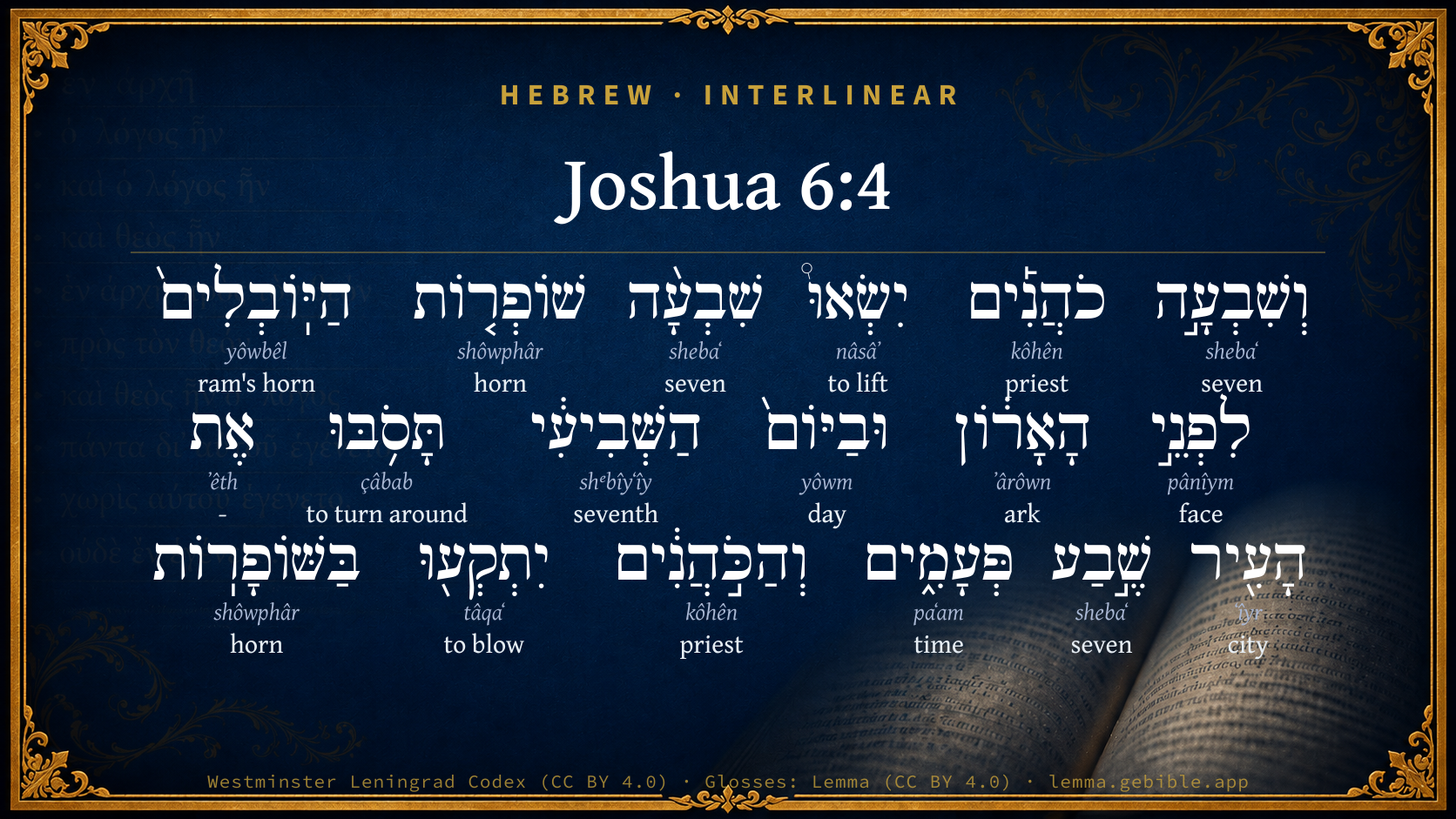
  1. וְשִׁבְעָ֣ה shebaʻ H7651 “and · seven” Conjunction + Adjective, Cardinal number, Masculine, Singular, Absolute
  2. כֹהֲנִ֡ים kôhên H3548 “priests” Noun, Common, Masculine, Plural, Absolute
  3. יִשְׂאוּ֩ nâsâʼ H5375 “to lift” Verb, Qal, Imperfect, 3rd Person, Masculine, Plural
  4. שִׁבְעָ֨ה shebaʻ H7651 “seven” Adjective, Cardinal number, Masculine, Singular, Absolute
  5. שׁוֹפְר֤וֹת shôwphâr H7782 “horns of” Noun, Common, Masculine, Plural, Construct
  6. לִפְנֵ֣י pânîym H6440 “to/for · face(s) of” Preposition + Noun, Common, Both, Plural, Construct
  7. הָאָר֔וֹן ʼârôwn H727 “the · ark” Particle, Definite Article + Noun, Common, Both, Singular, Absolute
  8. וּבַיּוֹם֙ yôwm H3117 “and · in/at the · day” Conjunction + Preposition, Determined + Noun, Common, Masculine, Singular, Absolute
  9. הַשְּׁבִיעִ֔י shᵉbîyʻîy H7637 “the · seventh” Particle, Definite Article + Adjective, Ordinal number, Masculine, Singular, Absolute
  10. תָּסֹ֥בּוּ çâbab H5437 “to turn around” Verb, Qal, Imperfect, 2nd Person, Masculine, Plural
  11. אֶת ʼêth H853 “-” Particle, Direct Object
  12. הָעִ֖יר ʻîyr H5892 “the · city” Particle, Definite Article + Noun, Common, Feminine, Singular, Absolute
  13. שֶׁ֣בַע shebaʻ H7651 “seven” Adjective, Cardinal number, Feminine, Singular, Absolute
  14. פְּעָמִ֑ים paʻam H6471 “times” Noun, Common, Feminine, Plural, Absolute
  15. וְהַכֹּ֣הֲנִ֔ים kôhên H3548 “and · the · priests” Conjunction + Particle, Definite Article + Noun, Common, Masculine, Plural, Absolute
  16. יִתְקְע֖וּ tâqaʻ H8628 “to blow” Verb, Qal, Imperfect, 3rd Person, Masculine, Plural
  17. בַּשּׁוֹפָרֽוֹת shôwphâr H7782 “in/at the · horns” Preposition, Determined + Noun, Common, Masculine, Plural, Absolute

About this verse

These counts appear in no published source. They are computed here, from the morphology-tagged text and Lemma’s own curated glosses. What Lemma adds →

18
words
14
distinct lemmas
Historical
section

Shared distinctive vocabulary

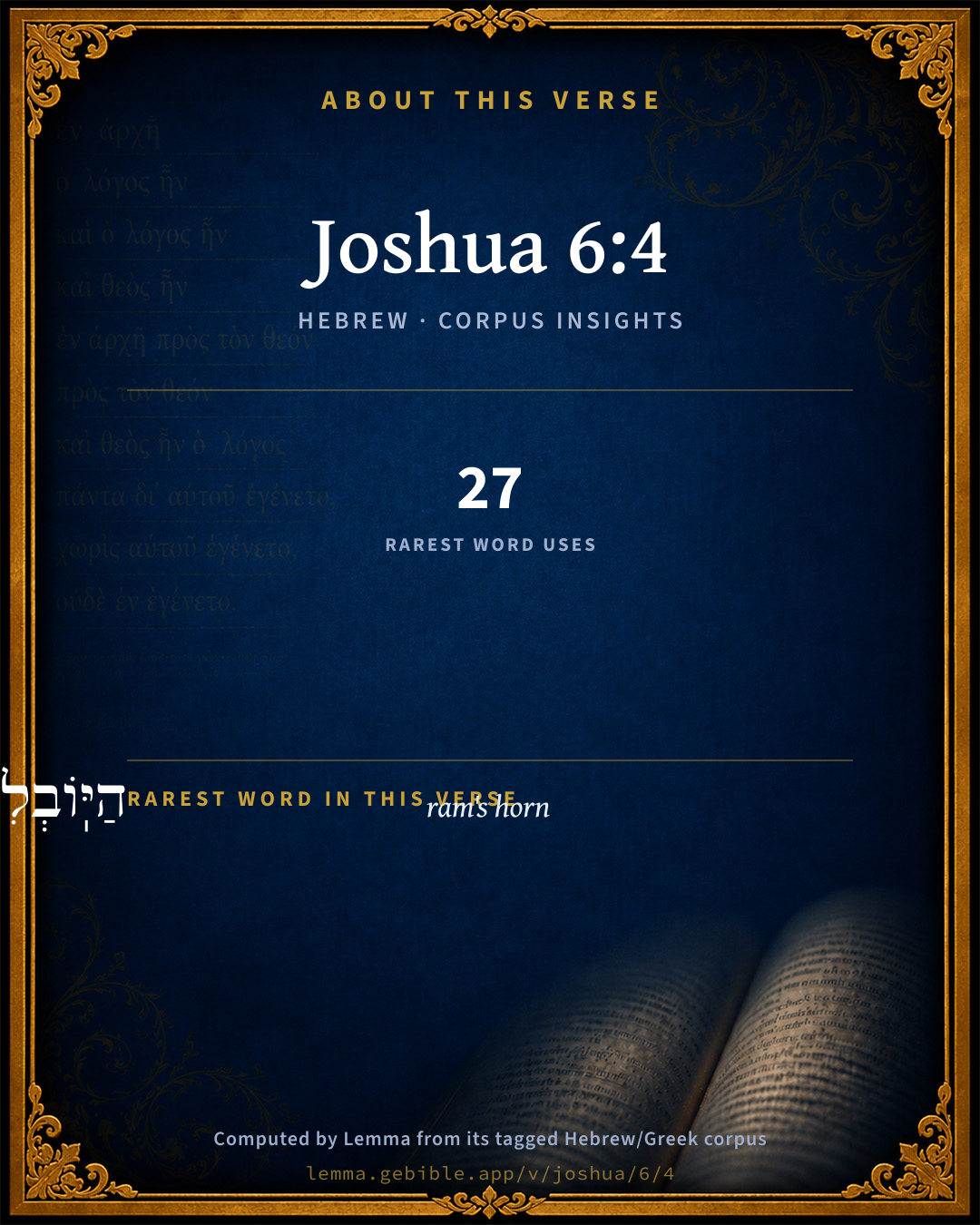
הַיּֽוֹבְלִים֙ ram's horn H3104 occurs in 25 verses of the Hebrew Bible. Also found in:

Grammatical profile

  • 3 verbs
  • 10 nouns
  • 4 adjectives
  • 1 particle

Verb forms

  • יִשְׂאוּ֩ Qal · Imperfect
  • תָּסֹ֥בּוּ Qal · Imperfect
  • יִתְקְע֖וּ Qal · Imperfect

Repetition

Words recur within this verse — often emphatic in Hebrew:

  • וְשִׁבְעָ֣ה seven H7651 ×3
  • כֹהֲנִ֡ים priest H3548 ×2
  • שׁוֹפְר֤וֹת horn H7782 ×2

Hebrew & Septuagint length

In English translation the verse runs 30 words from the Hebrew and 18 from the Septuagint (LXX English) — the Septuagint runs noticeably shorter here. See the side-by-side →

A rough comparison of the two English renderings, which tokenize alike — not a word-level alignment.

Word counts can differ between the Hebrew and the Greek without any difference in meaning — e.g. the Hebrew direct-object marker אֵת has no separate Greek word, and Greek often adds the article ὁ.

Cross-references

29

Topical passages linked to Joshua 6:4 in the Treasury of Scripture Knowledge — connected by theme and wording, ordered by reader-vote popularity; previews shown in the World English Bible.

  • 2 Chronicles 20:17 You shall not need to fight in this [battle]: set yourselves, stand you still, and see the salvation of Yahweh with you, O Judah and Jerusalem; don't be afraid, nor be dismayed: tomorrow go out against them: for Yahweh is with you.
  • Revelation 16:1 I heard a loud voice out of the temple, saying to the seven angels, "Go and pour out the seven bowls of the wrath of God on the earth!"
  • 1 Kings 18:43 He said to his servant, Go up now, look toward the sea. He went up, and looked, and said, There is nothing. He said, Go again seven times.
  • Revelation 8:2 I saw the seven angels who stand before God, and seven trumpets were given to them.
  • Leviticus 14:16 The priest shall dip his right finger in the oil that is in his left hand, and shall sprinkle some of the oil with his finger seven times before Yahweh.
  • Leviticus 25:8–9 "'You shall count off seven Sabbaths of years, seven times seven years; and there shall be to you the days of seven Sabbaths of years, even forty-nine years.
  • Numbers 23:1 Balaam said to Balak, Build me here seven altars, and prepare me here seven bulls and seven rams.
  • Judges 7:15–22 It was so, when Gideon heard the telling of the dream, and the interpretation of it, that he worshiped; and he returned into the camp of Israel, and said, Arise; for Yahweh has delivered into your hand the host of Midian.
  • 2 Kings 5:10 Elisha sent a messenger to him, saying, Go and wash in the Jordan seven times, and your flesh shall come again to you, and you shall be clean.
  • 2 Chronicles 20:21 When he had taken counsel with the people, he appointed those who should sing to Yahweh, and give praise in holy array, as they went out before the army, and say, Give thanks to Yahweh; for his loving kindness endures forever.
  • Revelation 1:4 John, to the seven assemblies that are in Asia: Grace to you and peace, from God, who is and who was and who is to come; and from the seven Spirits who are before his throne;
  • Revelation 1:20 the mystery of the seven stars which you saw in my right hand, and the seven golden lampstands. The seven stars are the angels of the seven assemblies. The seven lampstands are seven assemblies.
  • Revelation 5:1 I saw, in the right hand of him who sat on the throne, a book written inside and outside, sealed shut with seven seals.
  • Revelation 5:6 I saw in the midst of the throne and of the four living creatures, and in the midst of the elders, a Lamb standing, as though it had been slain, having seven horns, and seven eyes, which are the seven Spirits of God, sent out into all the earth.
  • Revelation 8:6 The seven angels who had the seven trumpets prepared themselves to sound.
  • Revelation 10:3 He cried with a loud voice, as a lion roars. When he cried, the seven thunders uttered their voices.
  • Revelation 15:1 I saw another great and marvelous sign in the sky: seven angels having the seven last plagues, for in them God's wrath is finished.
  • Genesis 7:2–3 You shall take seven pairs of every clean animal with you, the male and his female. Of the animals that are not clean, take two, the male and his female.
  • Job 42:8 Now therefore, take to yourselves seven bulls and seven rams, and go to my servant Job, and offer up for yourselves a burnt offering; and my servant Job shall pray for you, for I will accept him, that I not deal with you according to your folly. For you have not spoken of me the thing that is right, as my servant Job has."
  • Zechariah 4:6 Then he answered and spoke to me, saying, "This is the word of Yahweh to Zerubbabel, saying, 'Not by might, nor by power, but by my Spirit,' says Yahweh of Hosts.
  • Revelation 15:7 One of the four living creatures gave to the seven angels seven golden bowls full of the wrath of God, who lives forever and ever.
  • Genesis 2:3 God blessed the seventh day, and made it holy, because he rested in it from all his work which he had created and made.
  • Leviticus 4:6 The priest shall dip his finger in the blood, and sprinkle some of the blood seven times before Yahweh, before the veil of the sanctuary.
  • Numbers 10:1–10 Yahweh spoke to Moses, saying,
  • Judges 7:7–8 Yahweh said to Gideon, By the three hundred men who lapped will I save you, and deliver the Midianites into your hand; and let all the people go every man to his place.
  • 2 Chronicles 13:12 Behold, God is with us at our head, and his priests with the trumpets of alarm to sound an alarm against you. Children of Israel, don't you fight against Yahweh, the God of your fathers; for you shall not prosper.
  • 2 Chronicles 20:19 The Levites, of the children of the Kohathites and of the children of the Korahites, stood up to praise Yahweh, the God of Israel, with an exceeding loud voice.
  • Isaiah 27:13 It shall happen in that day, that a great trumpet shall be blown; and they shall come who were ready to perish in the land of Assyria, and those who were outcasts in the land of Egypt; and they shall worship Yahweh in the holy mountain at Jerusalem.
  • Zechariah 4:2 He said to me, "What do you see?" I said, "I have seen, and, behold, a lampstand all of gold, with its bowl on the top of it, and its seven lamps thereon; there are seven pipes to each of the lamps, which are on the top of it;

Cross-references courtesy of OpenBible.info (CC BY 4.0).

Hebrew and Greek witnesses Masoretic Hebrew ↔ Greek Septuagint

The same verse in the two great witnesses to the Old Testament, shown verse-for-verse.

Here the Septuagint runs noticeably shorter than the Hebrew — LXX2012 (modern English Septuagint) 18 words vs World English Bible 30. A rough length comparison of the two English translations, not a word-level alignment — read both below.

These are two independent witnesses, not word-aligned to each other, and the Septuagint is shown in lemma (dictionary) form.

Hebrew Joshua 6:4 Masoretic · Westminster Leningrad Codex

וְשִׁבְעָ֣ה כֹהֲנִ֡ים יִשְׂאוּ֩ שִׁבְעָ֨ה שׁוֹפְר֤וֹת הַיּֽוֹבְלִים֙ לִפְנֵ֣י הָאָר֔וֹן וּבַיּוֹם֙ הַשְּׁבִיעִ֔י תָּסֹ֥בּוּ אֶת הָעִ֖יר שֶׁ֣בַע פְּעָמִ֑ים וְהַכֹּ֣הֲנִ֔ים יִתְקְע֖וּ בַּשּׁוֹפָרֽוֹת

Seven priests shall bear seven trumpets of rams' horns before the ark: and the seventh day you shall compass the city seven times, and the priests shall blow the trumpets.

World English Bible · Public Domain

Greek LXX Joshua 6:4 Septuagint · lemma form
And it shall be that when you⌃ shall sound with the trumpet, all the people shall shout together.

LXX2012 (modern English Septuagint) · Public Domain

On this verse, The Pulpit Commentary discusses the Septuagint’s reading. Read the note in Commentary ↓

Hebrew: Westminster Leningrad Codex (CC BY 4.0). Greek: Septuagint (public domain); English from LXX2012 (modern English Septuagint) (Public Domain). How the Septuagint differs from the Hebrew →

Targum (Aramaic paraphrase)

1

The Targum is the ancient Jewish Aramaic paraphrase of the Hebrew Scriptures — an interpretive translation, not the Hebrew text itself. Onkelos (literal) and Pseudo-Jonathan (expansive) render the Torah, and Jonathan the Prophets. Coverage is partial: where no permissively-licensed English translation exists for a verse, only the Aramaic is shown. This is verse-level text, not a word-by-word alignment to the Hebrew.

  1. Targum Jonathan Prophets (Joshua–Malachi)
    וְשִׁבְעָא כַהֲנַיָא יִסְבוּן שִׁבְעָא שׁוֹפָרַיָא דְקֶרֶן דִכְרַיָא קֳדָם אֲרוֹנָא וּבְיוֹמָא שְׁבִיעָאָה תִּסְחֲרוּן יַת קַרְתָּא שְׁבַע זִמְנִין וְכַהֲנַיָא יִתְקְעוּן בְּשׁוֹפָרַיָא:

    (no public-domain English translation for this verse)

    Targum Jonathan — Aramaic: “Mikraot Gedolot” (public domain). English: “Sefaria Community Translation” (CC0 1.0 (public-domain dedication)); “London "Chaldee Paraphrase," 1871” (public domain). Text via Sefaria.

Commentary

Notes on Joshua 6:4 from classic Christian and Jewish commentators (each source and its license shown beneath its notes). The classic Christian expositions comment on the surrounding passage and are grouped to its opening verse, so a note may address several verses; the Jewish commentaries on the Tanakh (Rashi and others) are per-verse, so they appear only where the commentator wrote on this verse.

Lemma curates 59 commentaries, every one of them public domain or Creative Commons licensed, each selected and text-cleaned for this edition rather than reprinted as found. About our sources →

Trapp's Complete Commentary

John Trapp

Jos 6:4 And seven priests shall bear before the ark seven trumpets of rams’ horns: and the seventh day ye shall compass the city seven times, and the priests shall blow with the trumpets.

Ver. 4. Seven trumpets of rams’ horns.] God usually goeth a way by himself, and worketh his will by such means as the world judgeth absurd and ridiculous.

And the seventh day.] Which, probably, was the Sabbath day, wherein, "by the foolishness of preaching," God still overturneth the strongholds of Satan, {2Co 10:4} by the priests blowing with their trumpets.

John Trapp, A Commentary or Exposition upon All the Books of the Old and New Testament (1647–1656) — public domain. Text from a community e-Sword module.

Tyndale Open Study Notes

Tyndale Open Resources

6:4 Seven is a biblical number of perfection. • The seven priests were to precede the Ark, the emblem of God’s presence, at the head of Israel’s forces. This arrangement symbolized that God himself fought against the town. Israel had only to march and observe, then shout and observe, and finally mop up after God delivered the town into their hands. • The ram’s horn (Hebrew shofar) could sound several pitches to signal either battle or worship. In battle, the shofar alerted troops or townsfolk to an enemy’s approach or sounded the call to advance or retreat.

Tyndale Open Study Notes — © Tyndale Open Resources, licensed CC BY-SA 4.0. Text via the HelloAO Bible API.

Geneva Bible (1599)

Geneva Bible translators

That the conquest might not be assigned to man’s power, but to the mercy of God, which with most weak things can overcome that which seemeth most strong.

Geneva Bible (1599) marginal notes — public domain. Text via Bolls.life.

Adam Clarke's Commentary

Verse 4. Seven trumpets of rams' horns] The Hebrew word יובלים yobelim does not signify rams' horns; (See Clarke on Le 25:11); nor do any of the ancient versions, the Chaldee excepted, give it this meaning. The instruments used on this occasion were evidently of the same kind with those used on the jubilee, and were probably made of horn or of silver; and the text in this place may be translated, And seven priests shall bear before the ark the seven jubilee trumpets, for they appear to have been the same kind as those used on the jubilee.

Seven times] The time was thus lengthened out that the besiegers and the besieged might be the more deeply impressed with that supernatural power by which alone the walls fell.

Adam Clarke's Commentary on the Bible (1810–1826) — public domain. Text from a community e-Sword/MySword module.

Ellicott's Commentary for English Readers

(4) Seven trumpets of rams’ horns.—Literally, trumpets of jubilee—i.e., of loud or joyful sound.

A Bible Commentary for English Readers, edited by Charles John Ellicott (1878–1897) — public domain. Text from a community e-Sword module.

The Cambridge Bible for Schools and Colleges

gen. ed. J. J. S. Perowne

4. trumpets of rams’ horns] Rather, trumpets of soundings, or, of jubilee; “seuen trompes, vhose use is in the jubile.” Not the long straight trumpets generally used, but the same kind that were to be employed on the first day of the seventh month (Lev_23:24), and to announce the year of Jubilee (Lev_25:9). This instrument was curved, and would be more accurately rendered “cornet,” as in 1Ch_15:28; 2Ch_15:14; Psa_98:6; Hos_5:8; Dan_3:5.

seven] Observe the significance here of the number: seven priests; seven horns; seven days of compassing the walls; seven repetitions of it on the seventh day. The influence of the number “seven” was not restricted to the Hebrews. It prevailed among the Persians (Est_1:10; Est_1:14), among the ancient Indians, to a certain extent among the Greeks and Romans, and probably among all nations where the week of seven days was established, as in Egypt, Arabia, China. Amongst the Hebrews seven days were appointed as the length of the Feasts of Passover and Tabernacles; seven days for the ceremonies of the consecration of priests; seven victims were to be offered on any special occasion; and at the ratification of a treaty, the notion of seven was embodied in the very term signifying to swear, literally meaning to do seven times (Gen_21:28). The number seven was thus impressed with the seal of sanctity as the symbol of all connected with the Deity, with the subordinate notions of perfection or completeness. See Smith’s Bibl. Dict. Art. “Seven.”

The Cambridge Bible for Schools and Colleges (gen. ed. J. J. S. Perowne; Cambridge University Press, 1878–1918) — public domain. Text from a community e-Sword module.

John Gill's Exposition

And seven priests shall bear before the ark seven trumpets of rams' horns,.... The ark was to be taken up and carried by priests round the city. Ben Gersom observes, that this was to direct the Israelites to keep and do according to all that was written in it; that is, in the law, which was contained in it; but no doubt the design of it was to show, that the subduing of Jericho, and the miracle that would be wrought, were owing to the power and presence of God, of which the ark was a symbol: and before it were to go seven other priests, with trumpets in their hands; which, according to our version, were made of rams horns: in the original it is "jobelim", or "jubilee" trumpets. Some think it means only such as they were to use in the year of jubilee; so Abarbinel and others, as Masius and Noldius (x); that they had their name from Jubal, the first inventor of musical instruments, Gen 4:21; for rams' horns are objected to because they are solid, and not hollow; as if they could not be bored and made hollow, and fit for such a purpose. The Targum, Jarchi, and Kimchi, interpret the word by rams horns, as we do (y); and observe what R. Akiba said,"when (says he) I went into Arabia, I heard them call; a ram "jobel"; and the trumpet itself is called "jobel", because made of a ram's horn (z):"

and the seventh day ye shall compass the city seven times; in the same manner as on the other days:

and the priests shall blow with the trumpets; which they were to do; and did every day.

(x) P. 160. No. 1515. (y) So Joseph. Antiqu. l. 5. c. 6. sect. 5. (z) Kimchi, Sepher. Shorash. rad. R. Sol. Urbim. Ohel Moed, fol. 39. 2.

John Gill's Exposition of the Whole Bible (1746–1763) — public domain (CC PDM 1.0). Text via the HelloAO Bible API.

Haydock's Catholic Bible Commentary

Jubilee. (Numbers x. 2.) The number seven, is often used to express an indefinite number. But here a particular stress is laid upon it. See Masius. As, on the 7th year the Hebrews regained the possessions which they had sold: so now they assert their rights to the land of Chanaan. The sound of the trumpets announced joyful tidings to them. (Menochius)

George Leo Haydock (1774–1849), Haydock's Catholic Family Bible and Commentary, 1859 edition — public domain. Excludes Psalms (Douay-Rheims chapter numbering differs from Protestant) and Deuterocanonical books (Catholic canon only).

Matthew Poole's English Annotations

Of rams’ horns, or, of the jubilees, i.e. such trumpets wherewith they were to sound in the years of jubilee, Lev 25:9. Either this, or one of the other six, was certainly a sabbath day; and it is not material which was it, for the command of the Lord of the sabbath was sufficient to legitimate any action.

Matthew Poole's English Annotations on the Holy Bible (1683–1685) — public domain. Text from a community e-Sword/MySword module.

The Pulpit Commentary

And seven priests shall bear before the ark. The Vulgate puts "on the seventh day" in connection with this part of the sentence; Luther also translates thus. The LXX, which Calvin and our translators and the majority of commentators follow, regard this part of the sentence as stating what was to be done on the six days, and rightly so, as vers. 8-14 clearly show. That the historian, as has been before remarked, did not always give the full instructions Joshua received is evident from this passage. The priests are not said to have been instructed to sound the trumpet on the six days; yet we learn from Jos_5:13 that they did so. It is rather implied than expressed that the ark was also to be borne in procession; but that this was (lone is evident from ver. 8. Seven trumpets of rams" horns. There is no mention of rams" horns in the original, which is twOrpwOv trumpets of jubilee, i.e., of triumph (hardly as Gesenius, "alarm trumpets," though not necessarily, with Dr. Vaughan in his "Heroes of Faith," "the emblems of festival, not of warfare"). The word is derived from the same root as the Latin is in the phrase Io Triumphe (cf. Greek iw ), and according to Gesenius our word "yule" is also derived from this root. The rpwOv as the next verse shows, was a curved instrument, in shape like a ram"s horn, though not necessarily of that material; whereas the hrxxOj was a straight trumpet. Seven times. The importance of the number seven as indicative of completeness is here strongly indicated. Seven priests were to carry seven trumpets for seven days. The word for to swear, B literally to be sevened, means to have one"s vow consecrated and confirmed by seven sacrifices or seven witnesses. (see Gen_21:28, Gen_21:30) The number seven, says Bahr in his "Symbolik des Alten Testament," 1., 187, 188, is the sign of the relation, union, communion between God and the world, as represented by the number three and four respectively, just as twelve is in another relation. (see note on Jos_21:3) Its meaning, according to Bahr, among the heathen is somewhat different. There it means the harmony of the universe, and is signified by the seven stars, to which, and neither more nor less, was the power of influencing man"s destiny ascribed. And the priests shall blow with the trumpets. "Fac tibi tribas ductiles, si sacerdos es, immo, quia sacerdos es (gens enim regalis effectus es et sacerdotium sanctum, de te enim scripture est), fac tibi tribas ductiles ex Scripturis sanctis" (Orig., Hom. 7 on Joshua).

The Pulpit Commentary (1880–1919), ed. H.D.M. Spence-Jones & Joseph S. Exell — public domain. Text from a community e-Sword module.

Rashi

Rabbi Shlomo Yitzchaki (Rashi)

Rams’ horns the horns of rams.

Rashi on the Tanakh — English translations: “The Judaica Press complete Tanach with Rashi, translated by A. J. Rosenberg” (CC BY 4.0); “Pentateuch with Rashi's commentary by M. Rosenbaum and A.M. Silbermann, 1929-1934” (public domain); “The Metsudah Tanach series, Lakewood, N.J” (CC BY 4.0); and “The Book of Joshua, Metsudah Publications, 1997” (CC BY 4.0). Text via Sefaria.

Lesson kit

Teaching starters — assembled from the data on this page, not authored interpretation. Every prompt links to the verse data it draws on. Edit before teaching.

Joshua, in the Historical, opens this verse with 18 words (14 distinct Hebrew lemmas). Its most distinctive word is yôwbêl (“ram's horn”). The Greek Septuagint runs shorter here. A historical commentator’s framing appears above. Read the whole chapter for the surrounding context.

Discussion questions

  1. How does “ram's horn” (yôwbêl) shape what this verse is saying?
  2. Exodus 19:13 shares the word «ram's horn» with this verse. How do the two illuminate each other?
  3. “seven” occurs 3× in this one verse. What is the effect of the repetition?
  4. Compared with the Hebrew, the Septuagint runs shorter here. What questions does that raise?
  5. The translations on this page render this verse differently — a whole-verse word diff, not a word-by-word alignment. What might account for the different wordings?
  6. The verb «יִשְׂאוּ֩» is Qal Imperfect. How does its form color the action?
  7. Reading how Trapp's Complete Commentary and Tyndale Open Study Notes read this verse, where do the two commentators agree and where do they part?

Things to notice

Reading settings

Reading text

Shown beneath each verse's original-language words.

Old Testament
Old Testament edition

Read the OT as the Masoretic Hebrew (MT) or the Greek Septuagint (LXX).

English shown for the Greek Septuagint (in the Hebrew ↔ Greek comparison).

Comparing translations? Open the Compare panel on any verse page to stack up to four side by side.