
Exodus 7:25

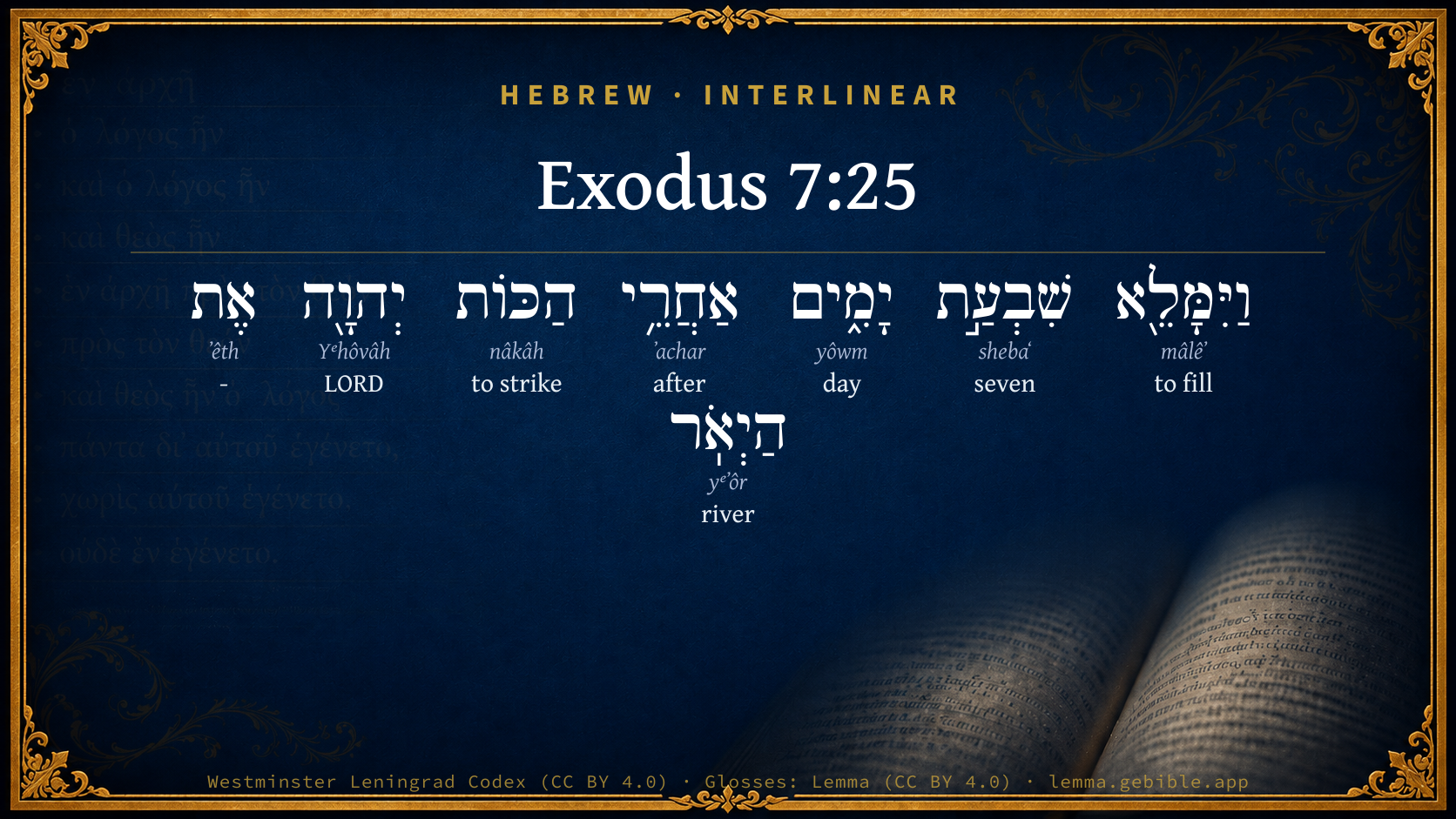
Hebrew (Westminster Leningrad Codex) Exodus 7:25 appears in the Hebrew Old Testament. The text above is from the Westminster Leningrad Codex. Each word links to its Strong’s number, a concise gloss, and parsing drawn from the Open Scriptures Hebrew Bible morphology. Click any word for its full Brown-Driver-Briggs (BDB) entry.
Download image
Cite this verse

Exodus 7:25 (World English Bible). Public Domain. Lemma interlinear Bible study tool, https://lemma.gebible.app/v/exodus/7/25.

Show BibTeX & RIS
BibTeX
RIS
English Translation
Seven days were fulfilled, after Yahweh had struck the river.
World English Bible · Public Domain
Download a study sheet

One document with this verse’s original text, its word-by-word gloss line, the meaning frame, cross-references with their text, attributed commentary, and full source and license credits — printable, and it pastes into notes with its structure intact.

This verse Autodidact and up

Study sheet (.html) Plain text (.txt)

A passage Seminary Student

Up to 50 verses in one chapter. A passage sheet keeps up to 6 commentary sources and 12 cross-references per verse, in the order this page ranks them, and says so on the sheet whenever that leaves anything out. Ask for a single verse and you get the Autodidact verse sheet above.

Everything on this page stays free to read, with no account — the sheet is a download of what is already on screen, not access to it.

Want to remove ads? Support Godless Engineer
Compare translations 3

The same verse in 3 English versions, stacked beneath the original-language interlinear above. Click any original word for its lexicon entry.

Each is an independent rendering of the whole verse — the interlinear is not word-aligned to these translations.

Highlighted words mark where these versions differ — a whole-verse word diff, not a word-by-word alignment.

  • World English Bible Public Domain
    Seven days were fulfilled, after Yahweh had struck the river.
  • King James Version Public Domain
    And seven days were fulfilled, after that the LORD had smitten the river.
  • unfoldingWord Literal Text CC BY-SA 4.0
    And seven days were filled after Yahweh struck the river.

unfoldingWord Literal Text — © unfoldingWord, licensed CC BY-SA 4.0. Word-aligned USFM3 via Door43 (git.door43.org/unfoldingWord/en_ult).

Versions to compare (up to 4)

3 of 4 selected

Show all 18 translations

Every available English version of this verse, each an independent rendering of the whole verse.

  • World English Bible Public Domain
    Seven days were fulfilled, after Yahweh had struck the river.
  • Berean Standard Bible Public Domain
    And seven full days passed after the LORD had struck the Nile.
  • Majority Standard Bible Public Domain
    And seven full days passed after the LORD had struck the Nile.
  • King James Version Public Domain
    And seven days were fulfilled, after that the LORD had smitten the river.
  • American Standard Version (1901) Public Domain
    And seven days were fulfilled, after that Jehovah had smitten the river.
  • Revised Version (1885) Public Domain
    And seven days were fulfilled, after that the LORD had smitten the river.
  • Geneva Bible (1599) Public Domain
    And this continued fully seuen dayes after the Lord had smitten the riuer.
  • Douay-Rheims (1899) Public Domain
    And seven days were fully ended, after that the Lord struck the river.
  • Young's Literal Translation Public Domain
    And seven days are completed after Jehovah's smiting the River,
  • Literal Standard Version CC BY-SA 4.0
    And seven days are completed after YHWH’s striking the River.
  • Unlocked Literal Bible CC BY-SA 4.0
    Seven days passed after Yahweh had attacked the river.
  • unfoldingWord Literal Text CC BY-SA 4.0
    And seven days were filled after Yahweh struck the river.
  • Darby Bible Public Domain
    And seven days were fulfilled, after Jehovah had smitten the river.
  • World Messianic Bible Public Domain
    Seven days were fulfilled, after the LORD had struck the river.
  • Webster's Bible Public Domain
    And seven days were fulfilled after that the LORD had smitten the river.
  • Free Bible Version CC BY-SA 4.0
    Seven days went by after the Lord hit the Nile.
  • Bible in Basic English Public Domain
    And seven days went past, after the Lord had put his hand on the Nile.
  • JPS Tanakh (1917) Public Domain
    And seven days were fulfilled, after that the LORD had smitten the river.

Literal Standard Version (2020), Covenant Press — licensed CC BY-SA 4.0. Text via the HelloAO Bible API (eBible.org). Unlocked Literal Bible (unfoldingWord) — licensed CC BY-SA 4.0. Text via the HelloAO Bible API (eBible.org). unfoldingWord Literal Text — © unfoldingWord, licensed CC BY-SA 4.0. Word-aligned USFM3 via Door43 (git.door43.org/unfoldingWord/en_ult). Free Bible Version, Dr. Jonathan Gallagher — licensed CC BY-SA 4.0. Text via the HelloAO Bible API (eBible.org).

Word by word

More ways to search: Search by grammar → Find every occurrence → Compare this word →

Practice this passage: Drill this verse → Learn its vocabulary →

About this verse

These counts appear in no published source. They are computed here, from the morphology-tagged text and Lemma’s own curated glosses. What Lemma adds →

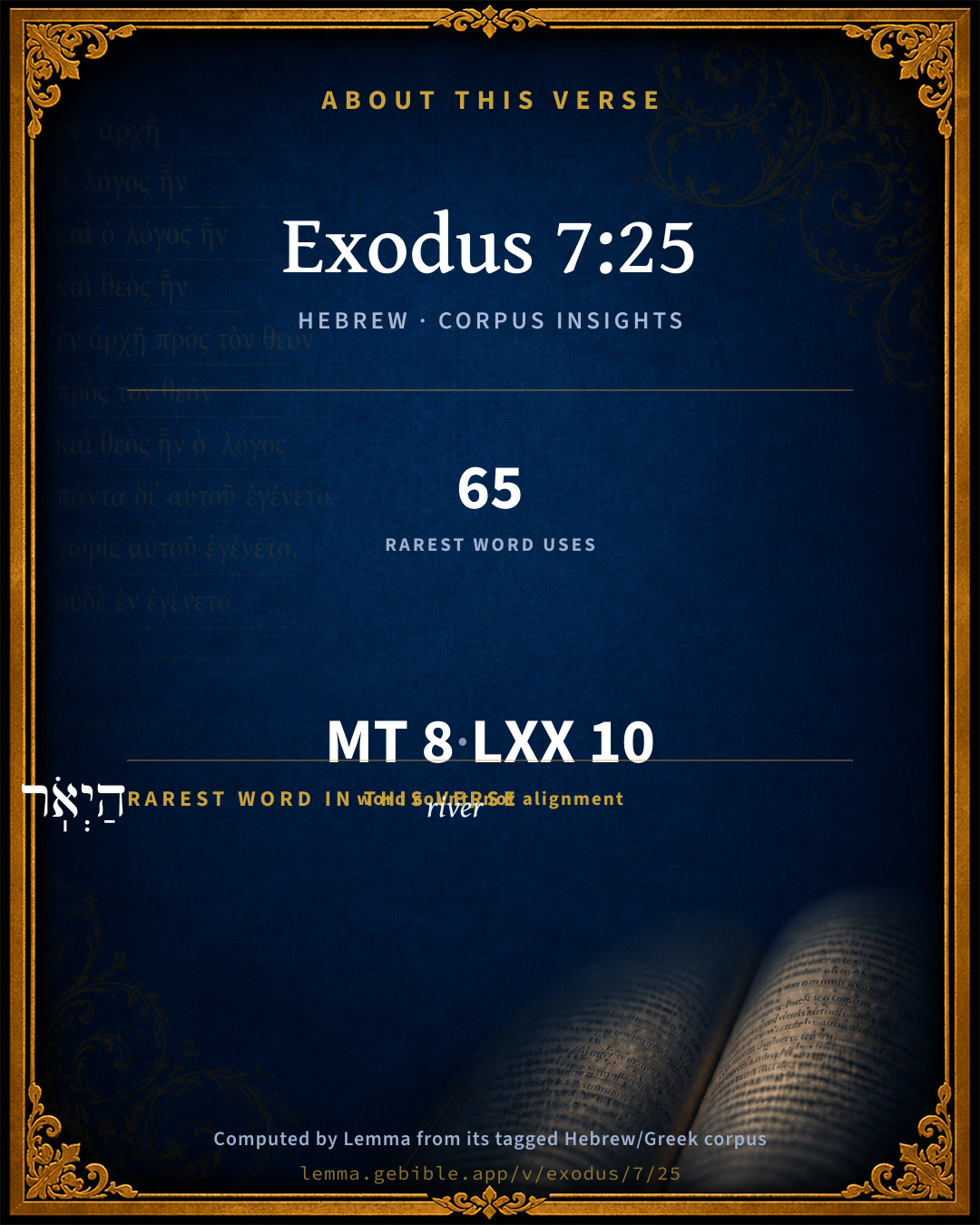
8
words
8
distinct lemmas
Pentateuch
section

Grammatical profile

  • 2 verbs
  • 3 nouns
  • 1 adjective
  • 1 preposition
  • 1 particle

Verb forms

  • וַיִּמָּלֵ֖א Niphal · Sequential Imperfect
  • הַכּוֹת Hiphil · Infinitive Construct

Hebrew & Septuagint length

In English translation the verse runs 10 words from the Hebrew and 12 from the Septuagint (LXX English) — closely comparable.

A rough comparison of the two English renderings, which tokenize alike — not a word-level alignment.

Word counts can differ between the Hebrew and the Greek without any difference in meaning — e.g. the Hebrew direct-object marker אֵת has no separate Greek word, and Greek often adds the article ὁ.

In the original languages it is 8 Hebrew tokens and 10 Greek tokens — but the two are counted differently (Hebrew bundles its prefixes and suffixes into one token; the Greek is in lemma form), so that isn’t a like-for-like length.

Cross-references

3

Topical passages linked to Exodus 7:25 in the Treasury of Scripture Knowledge — connected by theme and wording, ordered by reader-vote popularity; previews shown in the World English Bible.

  • Exodus 8:9–10 Moses said to Pharaoh, "I give you the honor of setting the time that I should pray for you, and for your servants, and for your people, that the frogs be destroyed from you and your houses, and remain in the river only."
  • Exodus 10:23 They didn't see one another, neither did anyone rise from his place for three days; but all the children of Israel had light in their dwellings.
  • 2 Samuel 24:13 So Gad came to David, and told him, and said to him, Shall seven years of famine come to you in your land? or will you flee three months before your foes while they pursue you? or shall there be three days' pestilence in your land? now advise you, and consider what answer I shall return to him who sent me.

Cross-references courtesy of OpenBible.info (CC BY 4.0).

Hebrew and Greek witnesses Masoretic Hebrew ↔ Greek Septuagint

The same verse in the two great witnesses to the Old Testament, shown verse-for-verse.

These are two independent witnesses, not word-aligned to each other, and the Septuagint is shown in lemma (dictionary) form.

Hebrew Exodus 7:25 Masoretic · Westminster Leningrad Codex

וַיִּמָּלֵ֖א שִׁבְעַ֣ת יָמִ֑ים אַחֲרֵ֥י הַכּוֹת יְהוָ֖ה אֶת הַיְאֹֽר

Seven days were fulfilled, after Yahweh had struck the river.

World English Bible · Public Domain

Greek LXX Exodus 7:25 Septuagint · lemma form

καί ἀναπληρόω ἑπτά ἡμέρα μετά ὁ πατάσσω κύριος ὁ ποταμός

and seven days were fulfilled after the Lord has struck the river.

LXX2012 (modern English Septuagint) · Public Domain

Hebrew: Westminster Leningrad Codex (CC BY 4.0). Greek: Septuagint (public domain); English from LXX2012 (modern English Septuagint) (Public Domain). How the Septuagint differs from the Hebrew →

Targum (Aramaic paraphrase)

2

The Targum is the ancient Jewish Aramaic paraphrase of the Hebrew Scriptures — an interpretive translation, not the Hebrew text itself. Onkelos (literal) and Pseudo-Jonathan (expansive) render the Torah, and Jonathan the Prophets. Coverage is partial: where no permissively-licensed English translation exists for a verse, only the Aramaic is shown. This is verse-level text, not a word-by-word alignment to the Hebrew.

  1. Targum Onkelos Torah (Genesis–Deuteronomy)
    וְאַשְׁלֵם שִׁבְעַת יוֹמִין בָּתַר דִמְחָא יְיָ יָת נַהֲרָא:

    (no public-domain English translation for this verse)

    Targum Onkelos — Aramaic: “Onkelos Genesis” (public domain); “Onkelos Exodus” (public domain); “Onkelos Leviticus” (public domain); “Onkelos Numbers” (public domain); “Onkelos Deuteronomy” (public domain). English: “Sefaria Community Translation” (CC0 1.0 (public-domain dedication)); “J.W. Etheridge. The Targums of Onkelos and Jonathan Ben Uzziel on the Pentateuch. London: Longmans, Green, 1862” (public domain). Text via Sefaria.

  2. Targum Pseudo-Jonathan Torah (Genesis–Deuteronomy)
    וּשְׁלִימוּ שׁוּבְעָא יוֹמִין מִן בָּתַר דִמְחָא יְיָ יַת נַהֲרָא וּמִבָּתַר כֵּן אָסֵי מֵימְרָא דַיְיָ יַת נַהֲרָא

    And seven days were completed after the Lord had smitten the river, and the Word of the Lord had afterward healed the river.

    Targum Pseudo-Jonathan — Aramaic: “Targum Jonathan on Genesis” (public domain); “Targum Jonathan on Exodus” (public domain); “Targum Jonathan on Leviticus” (public domain); “Targum Jonathan on Numbers” (public domain); “Targum Jonathan on Deuteronomy” (public domain). English: “The Targum of Jonathan ben Uzziel, trans. J. W. Etheridge, London, 1862” (public domain). Text via Sefaria.

Commentary

Notes on Exodus 7:25 from classic Christian and Jewish commentators (each source and its license shown beneath its notes). The classic Christian expositions comment on the surrounding passage and are grouped to its opening verse, so a note may address several verses; the Jewish commentaries on the Tanakh (Rashi and others) are per-verse, so they appear only where the commentator wrote on this verse.

Lemma curates 59 commentaries, every one of them public domain or Creative Commons licensed, each selected and text-cleaned for this edition rather than reprinted as found. About our sources →

Trapp's Complete Commentary

John Trapp

Exo 7:25 And seven days were fulfilled, after that the LORD had smitten the river.

Ver. 25. And seven days were fulfilled.] So long the plague continued; that they might be sensible of it; and not do as the dog, who getting out of the water, shakes his ears, and there is an end. Surely if these Egyptians had believed the prediction of this plague, they would have done as Pliny saith camels do - Implentur cameli, cum bibendi est occasio et in praeteritum et in futurum. They would have drunk for hereafter also. {a}

{a} Plin., lib. viii. cap. 18.

John Trapp, A Commentary or Exposition upon All the Books of the Old and New Testament (1647–1656) — public domain. Text from a community e-Sword module.

Joseph Benson's Commentary

Exo 7:25. Seven days were fulfilled — Before the plague was removed.

Joseph Benson's Commentary on the Old and New Testaments (1811–1818) — public domain. Text from a community e-Sword module.

Geneva Bible (1599)

Geneva Bible translators

Or seven days accomplished.

Geneva Bible (1599) marginal notes — public domain. Text via Bolls.life.

Adam Clarke's Commentary

Verse 25. And seven days were fulfilled] So we learn that this plague continued at least a whole week.

THE contention between Moses and Aaron and the magicians of Egypt has become famous throughout the world. Tradition in various countries has preserved not only the account, but also the names of the chief persons concerned in the opposition made by the Egyptians to these messengers of God. Though their names are not mentioned in the sacred text, yet tradition had preserved them in the Jewish records, from which St. Paul undoubtedly quotes 2Ti 3:8, where, speaking of the enemies of the Gospel, he compares them to Jannes and Jambres, who withstood Moses. That these names existed in the ancient Jewish records, their own writings show. In the Targum of Jonathan ben Uzziel on this place they are called יניס וימבריס Janis and Jambris; and in the Babylonian Talmud they are named Joanne and Mambre, and are represented as chiefs of the sorcerers of Egypt, and as having ridiculed Moses and Aaron for pretending to equal them in magical arts. And Rab. Tanchum, in his Commentary, names them Jonos and Jombrus. If we allow the readings of the ancient editions of Pliny to be correct, he refers, in Hist. Nat., l. xxx., c. 2, to the same persons, the names being a little changed: Est et alia magices factio, a Mose et Jamne et Jotape Judaeis pendens, sed multis millibus annorum post Zoroastrem; "There is also another faction of magicians which took its origin from the Jews, Moses, Jamnes, and Jotapes, many thousands of years after Zoroaster;" where he confounds Moses with the Egyptian magicians; for the heathens, having no just notion of the power of God, attributed all miracles to the influence of magic. Pliny also calls the Egyptian magicians Jews; but this is not the only mistake in his history; and as he adds, sed multis millibus annorum post Zoroastrem, he is supposed by some to refer to the Christians, and particularly the apostles, who wrought many miracles, and whom he considers to be a magical sect derived from Moses and the Jews, because they were Jews by nation, and quoted Moses and the prophets in proof of the truth of the doctrines of Christianity, and of the Divine mission of Christ.

Numenius, a Pythagorean philosopher, mentioned by Eusebius, names these magicians, Jamnes and Jambres, and mentions their opposition to Moses; and we have already seen that there was a tradition among the Asiatics that Pharaoh's daughter had Moses instructed by the wise men Jannes and Jambres; see Abul Faraje, edit. Pococ., p. 26. Here then is a very remarkable fact, the principal circumstances of which, and the chief actors in them, have been preserved by a sort of universal tradition. See Ainsworth.

When all the circumstances of the preceding case are considered, it seems strange that God should enter into any contest with such persons as the Egyptian magicians; but a little reflection will show the absolute necessity of this. Mr. Psalmanazar, who wrote the Account of the Jews in the first volume of the Universal History, gives the following judicious reasons for this: "If it be asked," says he, "why God did suffer the Egyptian magicians to borrow power from the devil to invalidate, if possible, those miracles which his servant wrought by his Divine power, the following reasons may be given for it:

1. It was necessary that these magicians should be suffered to exert the utmost of their power against Moses, in order to clear him from the imputation of magic or sorcery; for as the notion of such an extraordinary art was very rife, not only among the Egyptians, but all other nations, if they had not entered into this strenuous competition with him, and been at length overcome by him, both the Hebrews and the Egyptians would have been apter to have attributed all his miracles to his skill in magic, than to the Divine power.

"2. It was necessary, in order to confirm the faith of the wavering and desponding Israelites, by making them see the difference between Moses acting by the power of God, and the sorcerers by that of Satan.

"3. It was necessary, in order to preserve them afterwards from being seduced by any false miracles from the true worship of God."

To these a fourth reason may be added: God permitted this in mercy to the Egyptians, that they might see that the gods in whom they trusted were utterly incapable of saving them; that they could not undo or counteract one of the plagues sent on them by the power of Jehovah; the whole of their influence extending only to some superficial imitations of the genuine miracles wrought by Moses in the name of the true God. By these means it is natural to conclude that many of the Egyptians, and perhaps several of the servants of Pharaoh, were cured of their idolatry; though the king himself hardened his heart against the evidences which God brought before his eyes. Thus God is known by his judgments: for in every operation of his hand his design is to enlighten the minds of men, to bring them from false dependences to trust in himself alone; that, being saved from error and sin, they may become wise, holy, and happy. When his judgments are abroad in the earth, the inhabitants learn righteousness. (See Clarke on Ex 4:21,)

Adam Clarke's Commentary on the Bible (1810–1826) — public domain. Text from a community e-Sword/MySword module.

Ellicott's Commentary for English Readers

(25) And seven days were fulfilled.—These words seem to mark the duration of the first plague, which was the longer because Pharaoh made no submission at all in consequence of it. Obtaining sufficient water for his own purposes (see the comment on Exo_7:23), he thought little of its continuance.

A Bible Commentary for English Readers, edited by Charles John Ellicott (1878–1897) — public domain. Text from a community e-Sword module.

John Gill's Exposition

And seven days were fulfilled,.... Or there were full seven days, a whole week:

after that the Lord had smitten the river, and turned it into blood; here the miracle is ascribed to him; Moses and Aaron, and the rod they used, were only instruments, nothing short of almighty power could do such a miracle; it seems this lasted seven days at least. It began, as Bishop Usher (o) computes it, on the eighteen day of the sixth month, or Adar, part of February and part of March, and ended the twenty fifth of the same. It is not said that Pharaoh requested to have it removed, though Philo (p) says he did; his stubborn heart not being humbled enough as yet to ask such a favour, and therefore perhaps it was taken off without asking for it, to make way for another.

(o) Annal. Vet. Test. p. 20. (p) Ut supra. (De Vita. Mosis, l. 1. p. 617.)

Next: Exodus Chapter 8

John Gill's Exposition of the Whole Bible (1746–1763) — public domain (CC PDM 1.0). Text via the HelloAO Bible API.

Albert Barnes' Notes on the Bible

Seven days - This marks the duration of the plague. The natural discoloration of the Nile water lasts generally much longer, about 20 days.

Albert Barnes' Notes on the Bible (1834–1885) — public domain. Text from a community e-Sword/MySword module.

Matthew Poole's English Annotations

For seven days were fulfilled, ere all the waters of Egypt were perfectly free from this infection.

Quest. How could the Egyptians subsist so long without water?

Answ.

1. Philo tells us that many of them died of this plague.

2. As the plague might come on, so it might go off, by degrees; and so the water, though mixed with blood, might give them some relief.

3. The juices of herbs, and other liquors, which were untouched with this plague, might refresh them.

4. They might have some water, either from their pits, or by rain from heaven, as was said before; or from Goshen; for though it be said that the blood was in all their vessels, Exo 7:19, yet it is not said that all that should afterwards be put into them should be turned into blood.

Matthew Poole's English Annotations on the Holy Bible (1683–1685) — public domain. Text from a community e-Sword/MySword module.

Whedon's Commentary on the Bible

Daniel D. Whedon

25. Seven days — A week passed while the Nile rolled blood through Egypt, but Pharaoh obstinately shut himself in his house and made no sign of submission.

Daniel D. Whedon (gen. ed.), Commentary on the Old and New Testaments (1874–1909) — public domain. Text from a community e-Sword module.

The Pulpit Commentary

And seven days were fulfilled. This note of time has been regarded as merely fixing the interval between the first plague and the second. But it is more natural to regard it as marking the duration of the first plague. The intervals between one plague and another are nowhere estimated.

The Pulpit Commentary (1880–1919), ed. H.D.M. Spence-Jones & Joseph S. Exell — public domain. Text from a community e-Sword module.

John Wesley's Explanatory Notes

Seven days were fulfilled - Before this plague was removed.

John Wesley, Explanatory Notes Upon the Whole Bible (1754–1765) — public domain. Text via the GEBible commentary corpus.

Rashi

Rabbi Shlomo Yitzchaki (Rashi)

וימלא AND THERE WAS COMPLETED (the verb is singular) שבעת ימים the number of SEVEN DAYS during which the river did not return to its original condition. For each plague functioned a quarter of a month and for three quarters He warned and cautioned them (Midrash Tanchuma, Vaera 13; Exodus Rabbah 9:12).

Rashi on the Tanakh — English translations: “The Judaica Press complete Tanach with Rashi, translated by A. J. Rosenberg” (CC BY 4.0); “Pentateuch with Rashi's commentary by M. Rosenbaum and A.M. Silbermann, 1929-1934” (public domain); “The Metsudah Tanach series, Lakewood, N.J” (CC BY 4.0); and “The Book of Joshua, Metsudah Publications, 1997” (CC BY 4.0). Text via Sefaria.

Ramban (Nachmanides)

Rabbi Moshe ben Nachman (Ramban / Nachmanides)

And seven days were fulfilled after that the Eternal had smitten the river. This is connected with the verse above, and the purport thereof is as follows: And with this (And it was fulfilled) seven days, using a singular verb when the verb actually required is a plural: vayimal’u (and they were fulfilled). Rashi explained it by adding the word minyan (number) in the singular, explaining it thus: “and the number of seven days was fulfilled.” Ramban suggests that the verse is connected to the preceding one and is to be understood with the additional word of bazeh (with this), thus rendering the sense of the verse: “and with this activity — i.e., with the Egyptians’ digging, etc., as stated in the above Verse 24 — was filled (or completed) seven days.” — namely, the Egyptians’ digging round about the river for they could not drink of the water of the river, [as stated in Verse 24] — with this was filled the seven days after the river had been smitten.

Ramban (Nachmanides) on the Tanakh — English translation: “Commentary on the Torah by Ramban (Nachmanides). Translated and annotated by Charles B. Chavel. New York, Shilo Pub. House, 1971-1976” (CC BY 4.0). Text via Sefaria.

Lesson kit

Teaching starters — assembled from the data on this page, not authored interpretation. Every prompt links to the verse data it draws on. Edit before teaching.

Exodus, in the Pentateuch, opens this verse with 8 words (8 distinct Hebrew lemmas). Its most distinctive word is yᵉʼôr (“river”). A historical commentator’s framing appears above. Read the whole chapter for the surrounding context.

Discussion questions

  1. What does “river” (yᵉʼôr) contribute to the verse as a whole?
  2. Exodus 8:9–10 shares this passage’s theme. How do the two illuminate each other?
  3. The translations on this page render this verse differently — a whole-verse word diff, not a word-by-word alignment. What might account for the different wordings?
  4. The verb «וַיִּמָּלֵ֖א» is Niphal Sequential Imperfect. How does its form color the action?
  5. Reading how Trapp's Complete Commentary and Joseph Benson's Commentary read this verse, where do the two commentators agree and where do they part?

Things to notice

Reading settings

Reading text

Shown beneath each verse's original-language words.

Old Testament
Old Testament edition

Read the OT as the Masoretic Hebrew (MT) or the Greek Septuagint (LXX).

English shown for the Greek Septuagint (in the Hebrew ↔ Greek comparison).

Comparing translations? Open the Compare panel on any verse page to stack up to four side by side.