
Leviticus 13:5

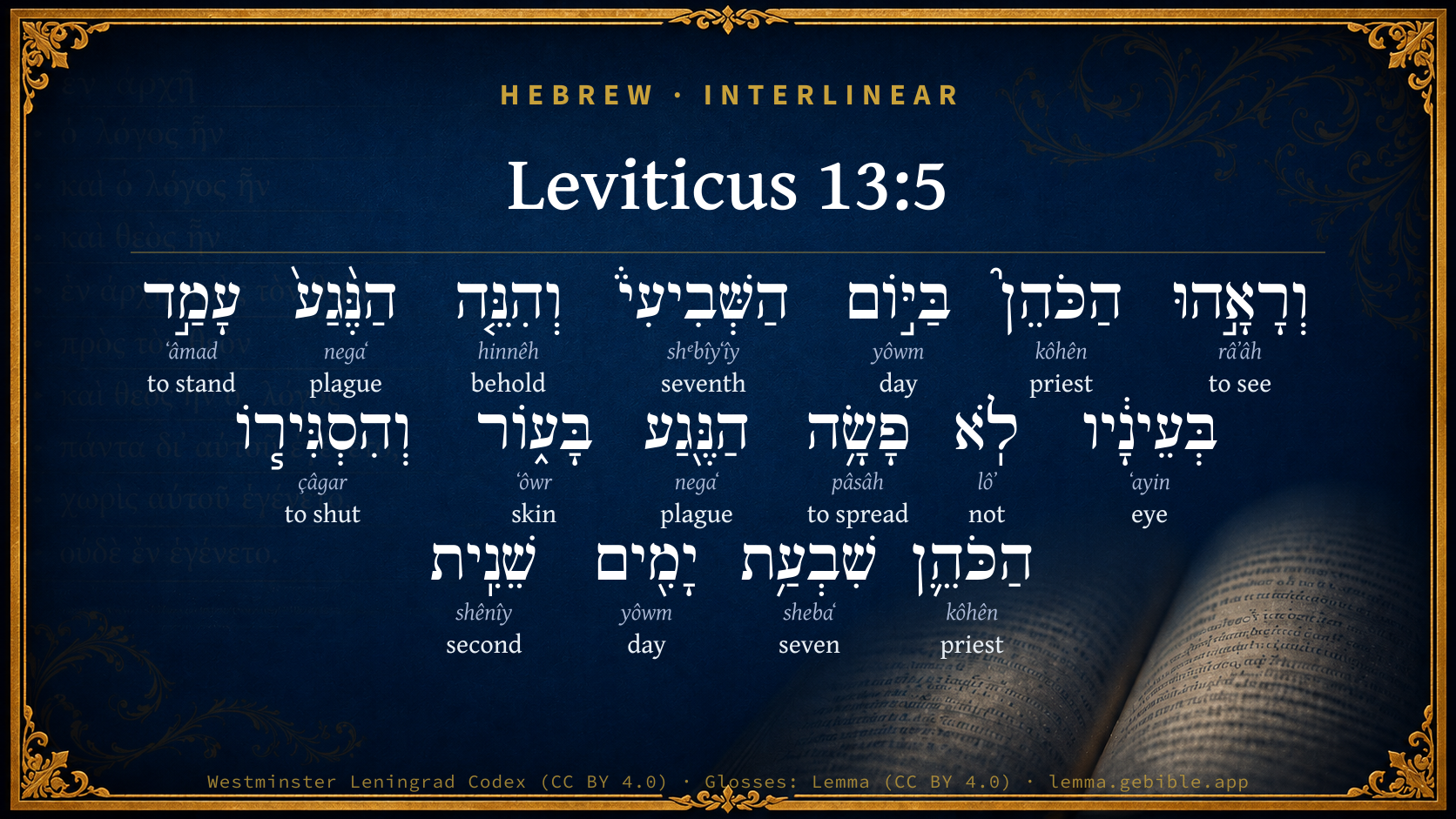
Hebrew (Westminster Leningrad Codex) Leviticus 13:5 appears in the Hebrew Old Testament. The text above is from the Westminster Leningrad Codex. Each word links to its Strong’s number, a concise gloss, and parsing drawn from the Open Scriptures Hebrew Bible morphology. Click any word for its full Brown-Driver-Briggs (BDB) entry.
Download image
Cite this verse

Leviticus 13:5 (World English Bible). Public Domain. Lemma interlinear Bible study tool, https://lemma.gebible.app/v/leviticus/13/5.

Show BibTeX & RIS
BibTeX
RIS
English Translation
The priest shall examine him on the seventh day, and, behold, if in his eyes the plague is arrested, and the plague hasn't spread in the skin, then the priest shall isolate him for seven more days.
World English Bible · Public Domain
Highlights
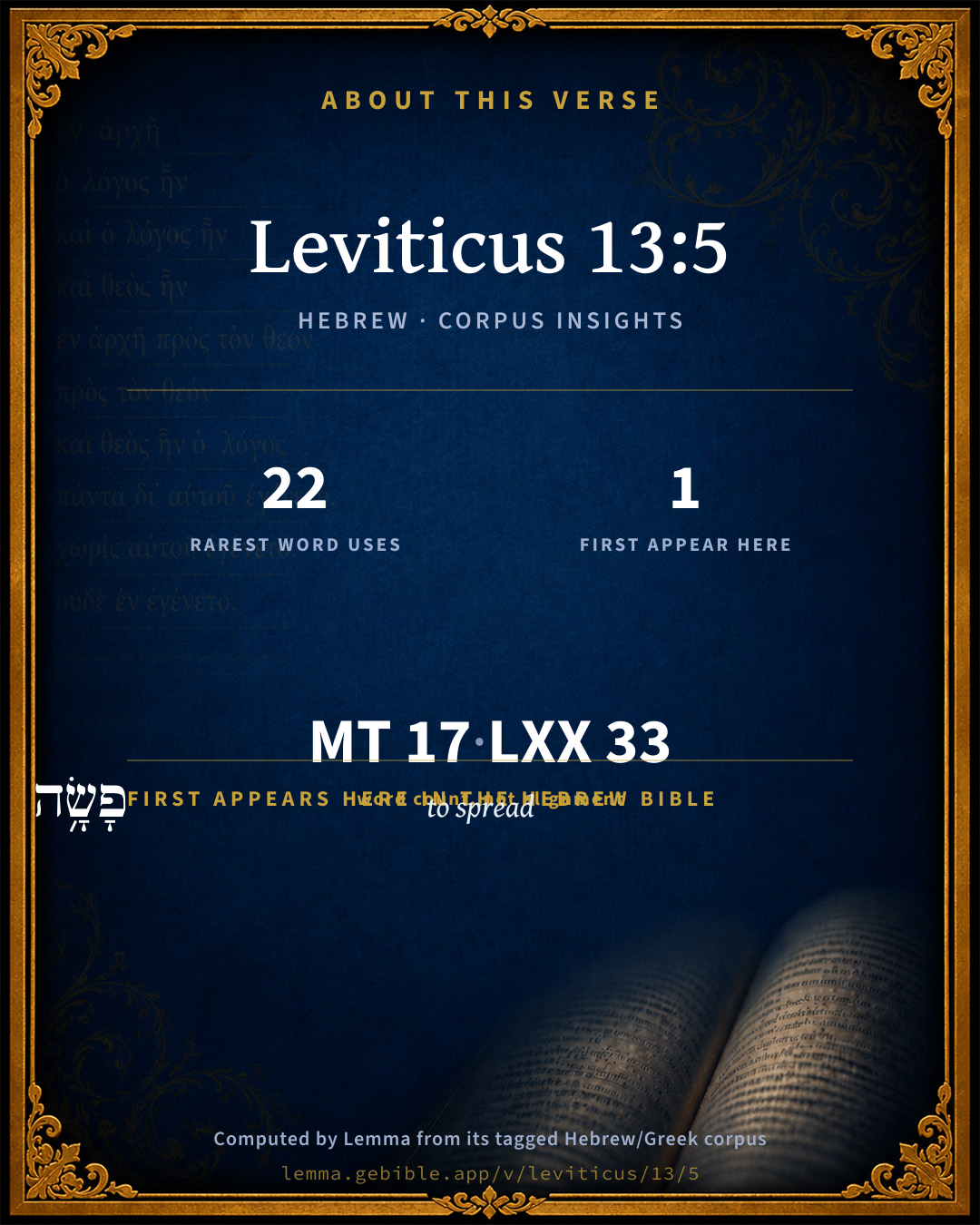
  • 1 first appearance in the Hebrew Bible
Full analysis ↓
Download a study sheet

One document with this verse’s original text, its word-by-word gloss line, the meaning frame, cross-references with their text, attributed commentary, and full source and license credits — printable, and it pastes into notes with its structure intact.

This verse Autodidact and up

Study sheet (.html) Plain text (.txt)

A passage Seminary Student

Up to 50 verses in one chapter. A passage sheet keeps up to 6 commentary sources and 12 cross-references per verse, in the order this page ranks them, and says so on the sheet whenever that leaves anything out. Ask for a single verse and you get the Autodidact verse sheet above.

Everything on this page stays free to read, with no account — the sheet is a download of what is already on screen, not access to it.

Want to remove ads? Support Godless Engineer
Compare translations 3

The same verse in 3 English versions, stacked beneath the original-language interlinear above. Click any original word for its lexicon entry.

Each is an independent rendering of the whole verse — the interlinear is not word-aligned to these translations.

Highlighted words mark where these versions differ — a whole-verse word diff, not a word-by-word alignment.

  • World English Bible Public Domain
    The priest shall examine him on the seventh day, and, behold, if in his eyes the plague is arrested, and the plague hasn't spread in the skin, then the priest shall isolate him for seven more days.
  • King James Version Public Domain
    And the priest shall look on him the seventh day: and, behold, if the plague in his sight be at a stay, and the plague spread not in the skin; then the priest shall shut him up seven days more:
  • unfoldingWord Literal Text CC BY-SA 4.0
    And the priest shall see it on the seventh day, and behold, the infection stands in his eyes; the infection has not spread on the skin. Then the priest shall separate him a second seven days.

unfoldingWord Literal Text — © unfoldingWord, licensed CC BY-SA 4.0. Word-aligned USFM3 via Door43 (git.door43.org/unfoldingWord/en_ult).

Versions to compare (up to 4)

3 of 4 selected

Show all 18 translations

Every available English version of this verse, each an independent rendering of the whole verse.

  • World English Bible Public Domain
    The priest shall examine him on the seventh day, and, behold, if in his eyes the plague is arrested, and the plague hasn't spread in the skin, then the priest shall isolate him for seven more days.
  • Berean Standard Bible Public Domain
    On the seventh day the priest is to reexamine him, and if he sees that the infection is unchanged and has not spread on the skin, the priest must isolate him for another seven days.
  • Majority Standard Bible Public Domain
    On the seventh day the priest is to reexamine him, and if he sees that the infection is unchanged and has not spread on the skin, the priest must isolate him for another seven days.
  • King James Version Public Domain
    And the priest shall look on him the seventh day: and, behold, if the plague in his sight be at a stay, and the plague spread not in the skin; then the priest shall shut him up seven days more:
  • American Standard Version (1901) Public Domain
    and the priest shall look on him the seventh day: and, behold, if in his eyes the plague be at a stay, and the plague be not spread in the skin, then the priest shall shut him up seven days more:
  • Revised Version (1885) Public Domain
    and the priest shall look on him the seventh day: and, behold, if in his eyes the plague be at a stay, and the plague be not spread in the skin, then the priest shall shut him up seven days more:
  • Geneva Bible (1599) Public Domain
    After, the Priest shall looke vpon him the seuenth day: and if the plague seeme to him to abide still, and the plague growe not in the skin, the Priest shall shut him vp yet seuen dayes more.
  • Douay-Rheims (1899) Public Domain
    And the seventh day he shall look on him: and if the leprosy be grown no farther, and hath not spread itself in the skin, he shall shut him up again other seven days.
  • Young's Literal Translation Public Domain
    `And the priest hath seen him on the seventh day, and lo, the plague hath stood in his eyes, the plague hath not spread in the skin, and the priest hath shut him up a second seven days.
  • Literal Standard Version CC BY-SA 4.0
    And the priest has seen him on the seventh day, and behold, the plague has stood in his eyes, the plague has not spread in the skin, and the priest has shut him up [for] a second seven days.
  • Unlocked Literal Bible CC BY-SA 4.0
    On the seventh day, the priest must examine him to see if in his opinion the disease is not any worse, and if it has not spread in the skin. If it has not, then the priest must isolate him seven days more.
  • unfoldingWord Literal Text CC BY-SA 4.0
    And the priest shall see it on the seventh day, and behold, the infection stands in his eyes; the infection has not spread on the skin. Then the priest shall separate him a second seven days.
  • Darby Bible Public Domain
    And the priest shall look on him the seventh day; and behold, in his sight, the sore remaineth as it was, the sore hath not spread in the skin, then the priest shall shut him up seven days a second time.
  • World Messianic Bible Public Domain
    The priest shall examine him on the seventh day. Behold, if in his eyes the plague is arrested and the plague hasn’t spread in the skin, then the priest shall isolate him for seven more days.
  • Webster's Bible Public Domain
    And the priest shall look on him the seventh day: and behold, if the plague in his sight is at a stay, and the plague spreadeth not in the skin; then the priest shall shut him up seven days more:
  • Free Bible Version CC BY-SA 4.0
    On the seventh day the priest will conduct another inspection, and if he discovers that the spot hasn't changed and hasn't spread on the skin, the priest must place the person in isolation for another seven days.
  • Bible in Basic English Public Domain
    And the priest is to see him on the seventh day; and if, in his opinion, the place on his skin has not become worse and is not increased in size, then the priest will keep him shut up for seven days more:
  • JPS Tanakh (1917) Public Domain
    And the priest shall look on him the seventh day; and, behold, if the plague stay in its appearance, and the plague be not spread in the skin, then the priest shall shut him up seven days more.

Literal Standard Version (2020), Covenant Press — licensed CC BY-SA 4.0. Text via the HelloAO Bible API (eBible.org). Unlocked Literal Bible (unfoldingWord) — licensed CC BY-SA 4.0. Text via the HelloAO Bible API (eBible.org). unfoldingWord Literal Text — © unfoldingWord, licensed CC BY-SA 4.0. Word-aligned USFM3 via Door43 (git.door43.org/unfoldingWord/en_ult). Free Bible Version, Dr. Jonathan Gallagher — licensed CC BY-SA 4.0. Text via the HelloAO Bible API (eBible.org).

Word by word

More ways to search: Search by grammar → Find every occurrence → Compare this word →

Practice this passage: Drill this verse → Learn its vocabulary →

פָשָׂ֥ה
pâsâh
H6581
“to spread”
Verb, Qal, Perfect, 3rd Person, Masculine, Singular
Part of Speech
Verb
Stem
Qal
Form
Perfect
Person
3rd Person
Gender
Masculine
Number
Singular
Full BDB Definition

Origin: a primitive root

TWOT: 1840

(Qal) to spread
  1. וְרָאָ֣הוּ râʼâh H7200 “and · to see · him” Conjunction + Verb, Qal, Sequential Perfect, 3rd Person, Masculine, Singular + Suffix, Personal, 3rd Person, Masculine, Singular
  2. הַכֹּהֵן֮ kôhên H3548 “the · priest” Particle, Definite Article + Noun, Common, Masculine, Singular, Absolute
  3. בַּיּ֣וֹם yôwm H3117 “in/at the · day” Preposition, Determined + Noun, Common, Masculine, Singular, Absolute
  4. הַשְּׁבִיעִי֒ shᵉbîyʻîy H7637 “the · seventh” Particle, Definite Article + Adjective, Ordinal number, Masculine, Singular, Absolute
  5. וְהִנֵּ֤ה hinnêh H2009 “and · behold” Conjunction + Particle, Demonstrative
  6. הַנֶּ֨גַע֙ negaʻ H5061 “the · plague” Particle, Definite Article + Noun, Common, Masculine, Singular, Absolute
  7. עָמַ֣ד ʻâmad H5975 “to stand” Verb, Qal, Perfect, 3rd Person, Masculine, Singular
  8. בְּעֵינָ֔יו ʻayin H5869 “in/at · eyes · his” Preposition + Noun, Common, Both, Dual, Construct + Suffix, Personal, 3rd Person, Masculine, Singular
  9. לֹֽא lôʼ H3808 “not” Particle, Negative
  10. הַנֶּ֖גַע negaʻ H5061 “the · plague” Particle, Definite Article + Noun, Common, Masculine, Singular, Absolute
  11. בָּע֑וֹר ʻôwr H5785 “in/at the · skin” Preposition, Determined + Noun, Common, Masculine, Singular, Absolute
  12. וְהִסְגִּיר֧וֹ çâgar H5462 “and · to shut · him” Conjunction + Verb, Hiphil, Sequential Perfect, 3rd Person, Masculine, Singular + Suffix, Personal, 3rd Person, Masculine, Singular
  13. הַכֹּהֵ֛ן kôhên H3548 “the · priest” Particle, Definite Article + Noun, Common, Masculine, Singular, Absolute
  14. שִׁבְעַ֥ת shebaʻ H7651 “seven” Adjective, Cardinal number, Masculine, Singular, Construct
  15. יָמִ֖ים yôwm H3117 “days” Noun, Common, Masculine, Plural, Absolute
  16. שֵׁנִֽית shênîy H8145 “second” Adjective, Ordinal number, Feminine, Singular, Absolute

About this verse

These counts appear in no published source. They are computed here, from the morphology-tagged text and Lemma’s own curated glosses. What Lemma adds →

17
words
14
distinct lemmas
Pentateuch
section

Notable vocabulary

The rarest word here is פָשָׂ֥ה to spread H6581 — appearing just 22 times in the whole Hebrew Bible.

First appearance in Scripture

This word makes its first canonical appearance in the Hebrew Bible here:

  • פָשָׂ֥ה to spread H6581

Shared distinctive vocabulary

פָשָׂ֥ה to spread H6581 occurs in 18 verses of the Hebrew Bible. Also found in:

Grammatical profile

  • 4 verbs
  • 8 nouns
  • 3 adjectives
  • 2 particles

Verb forms

  • וְרָאָ֣הוּ Qal · Sequential Perfect
  • עָמַ֣ד Qal · Perfect
  • פָשָׂ֥ה Qal · Perfect
  • וְהִסְגִּיר֧וֹ Hiphil · Sequential Perfect

Repetition

Words recur within this verse — often emphatic in Hebrew:

  • הַכֹּהֵן֮ priest H3548 ×2
  • בַּיּ֣וֹם day H3117 ×2
  • הַנֶּ֨גַע֙ plague H5061 ×2

Hebrew & Septuagint length

In English translation the verse runs 37 words from the Hebrew and 39 from the Septuagint (LXX English) — closely comparable.

A rough comparison of the two English renderings, which tokenize alike — not a word-level alignment.

Word counts can differ between the Hebrew and the Greek without any difference in meaning — e.g. the Hebrew direct-object marker אֵת has no separate Greek word, and Greek often adds the article ὁ.

In the original languages it is 17 Hebrew tokens and 33 Greek tokens — but the two are counted differently (Hebrew bundles its prefixes and suffixes into one token; the Greek is in lemma form), so that isn’t a like-for-like length.

Hebrew and Greek witnesses Masoretic Hebrew ↔ Greek Septuagint

The same verse in the two great witnesses to the Old Testament, shown verse-for-verse.

These are two independent witnesses, not word-aligned to each other, and the Septuagint is shown in lemma (dictionary) form.

Hebrew Leviticus 13:5 Masoretic · Westminster Leningrad Codex

וְרָאָ֣הוּ הַכֹּהֵן֮ בַּיּ֣וֹם הַשְּׁבִיעִי֒ וְהִנֵּ֤ה הַנֶּ֨גַע֙ עָמַ֣ד בְּעֵינָ֔יו לֹֽא פָשָׂ֥ה הַנֶּ֖גַע בָּע֑וֹר וְהִסְגִּיר֧וֹ הַכֹּהֵ֛ן שִׁבְעַ֥ת יָמִ֖ים שֵׁנִֽית

The priest shall examine him on the seventh day, and, behold, if in his eyes the plague is arrested, and the plague hasn't spread in the skin, then the priest shall isolate him for seven more days.

World English Bible · Public Domain

Greek LXX Leviticus 13:5 Septuagint · lemma form

καί ὁράω ὁ ἱερεύς ὁ ἁφή ὁ ἡμέρα ὁ ἕβδομος καί ἰδού ὁ ἁφή μένω ἐναντίον αὐτός οὐ μεταπίπτω ὁ ἁφή ἐν ὁ δέρμα καί ἀποὁρίζω αὐτός ὁ ἱερεύς ἑπτά ἡμέρα ὁ δεύτερος

and the priest shall look on the spot the seventh day; and, behold, if the spot remains before him, if the spot has not spread in the skin, then the priest shall separate him the second time seven days.

LXX2012 (modern English Septuagint) · Public Domain

Hebrew: Westminster Leningrad Codex (CC BY 4.0). Greek: Septuagint (public domain); English from LXX2012 (modern English Septuagint) (Public Domain). How the Septuagint differs from the Hebrew →

Targum (Aramaic paraphrase)

2

The Targum is the ancient Jewish Aramaic paraphrase of the Hebrew Scriptures — an interpretive translation, not the Hebrew text itself. Onkelos (literal) and Pseudo-Jonathan (expansive) render the Torah, and Jonathan the Prophets. Coverage is partial: where no permissively-licensed English translation exists for a verse, only the Aramaic is shown. This is verse-level text, not a word-by-word alignment to the Hebrew.

  1. Targum Onkelos Torah (Genesis–Deuteronomy)
    וְיֶחֱזִנֵהּ כַּהֲנָא בְּיוֹמָא שְׁבִיעָאָה וְהָא מַכְתָּשָׁא קָם כַּד הֲוָה לָא אוֹסֵף מַכְתָּשָׁא בְּמַשְׁכָּא וְיַסְגְרִנֵהּ כַּהֲנָא שִׁבְעָא יוֹמִין תִּנְיָנוּת

    (no public-domain English translation for this verse)

    Targum Onkelos — Aramaic: “Onkelos Genesis” (public domain); “Onkelos Exodus” (public domain); “Onkelos Leviticus” (public domain); “Onkelos Numbers” (public domain); “Onkelos Deuteronomy” (public domain). English: “Sefaria Community Translation” (CC0 1.0 (public-domain dedication)); “J.W. Etheridge. The Targums of Onkelos and Jonathan Ben Uzziel on the Pentateuch. London: Longmans, Green, 1862” (public domain). Text via Sefaria.

  2. Targum Pseudo-Jonathan Torah (Genesis–Deuteronomy)
    וְיֶחֱמִינֵיהּ כַּהֲנָא בְּיוֹמָא שְׁבִיעָאָה וְהָא מַכְתָּשָׁא קָם כַּד הֲוָה לָא הֲלִיךְ פִּיסְיוֹנָא דְמַכְתָּשָׁא בְּמַשְׁכָא וְיַסְגְרִינֵיהּ כַּהֲנָא שַׁבְעָא יוֹמִין תִּנְיָינוּת

    and the priest shall inspect him on the seventh day, and, behold, if the plague stand as it was, and have not gone on wider in the skin, the priest shall shut him up a second seven days.

    Targum Pseudo-Jonathan — Aramaic: “Targum Jonathan on Genesis” (public domain); “Targum Jonathan on Exodus” (public domain); “Targum Jonathan on Leviticus” (public domain); “Targum Jonathan on Numbers” (public domain); “Targum Jonathan on Deuteronomy” (public domain). English: “The Targum of Jonathan ben Uzziel, trans. J. W. Etheridge, London, 1862” (public domain). Text via Sefaria.

Commentary

Notes on Leviticus 13:5 from classic Christian and Jewish commentators (each source and its license shown beneath its notes). The classic Christian expositions comment on the surrounding passage and are grouped to its opening verse, so a note may address several verses; the Jewish commentaries on the Tanakh (Rashi and others) are per-verse, so they appear only where the commentator wrote on this verse.

Lemma curates 59 commentaries, every one of them public domain or Creative Commons licensed, each selected and text-cleaned for this edition rather than reprinted as found. About our sources →

Trapp's Complete Commentary

John Trapp

Lev 13:5 And the priest shall look on him the seventh day: and, behold, [if] the plague in his sight be at a stay, [and] the plague spread not in the skin; then the priest shall shut him up seven days more:

Ver. 5. Spread not in the skin.] So if men mend by admonition, and take up in time; if they refuse not to be reformed, hate not to be healed, as Babylon, {Jer 51:9} as Ephraim. {Hos 7:1} "When I would have healed Ephraim, then the iniquity of Ephraim was discovered," or brake out as a leprosy in his forehead. See Eze 24:13.

John Trapp, A Commentary or Exposition upon All the Books of the Old and New Testament (1647–1656) — public domain. Text from a community e-Sword module.

Geneva Bible (1599)

Geneva Bible translators

Hebrew, in his eyes.

Geneva Bible (1599) marginal notes — public domain. Text via Bolls.life.

Ellicott's Commentary for English Readers

(5) And the priest shall look on him.—If at the end of a week there is no alteration in the symptoms, the case must be adjourned for another seven days. The same priest who inspected it at the first must examine it again, as another one could not tell whether it has spread or not. If the priest died in the interim, or was taken ill, another priest could examine the patient, but could not pronounce him unclean. If the seventh day happened to be a Sabbath or feast day, the case had to be put off to the following day.

If the plague in his sight be at a stay.—Better, if the plagued spot remain the same in its colour, that is, if the suspicious spot which caused the individual to be shut up had not altered its complexion. The expression here translated “sight” is the same which is rightly rendered by “colour” in the Authorised Version in Lev_13:55 of this very chapter. (Comp. also Num_11:7.) It will thus be seen that though the affected spot had not spread, still it retained its unhealthy and suspicious complexion.

A Bible Commentary for English Readers, edited by Charles John Ellicott (1878–1897) — public domain. Text from a community e-Sword module.

The Cambridge Bible for Schools and Colleges

gen. ed. J. J. S. Perowne

5. If the plague (i.e. the rising described in Lev_13:2) has not spread (the Heb. verb occurs only in chs. 13, 14), he is to be shut up another seven days, and if the spot then appears dull (the Heb. word in this sense is confined to the two chs.; it is applied to the eye becoming dim through age, 1Sa_3:2), and there is no sign of its spreading, the priest shall pronounce him clean.

The Cambridge Bible for Schools and Colleges (gen. ed. J. J. S. Perowne; Cambridge University Press, 1878–1918) — public domain. Text from a community e-Sword module.

John Gill's Exposition

And the priest shall look on him the seventh day,.... In the day, and not in the night, as Maimonides, but not on the seventh day, if it happened to be on the sabbath (f), then it was put off till after it; and, according to the Jewish canons (g), they do not look upon plagues in the morning, nor in the evening, nor in the middle of a house, nor on a cloudy day, nor at noon, but at the fourth, fifth, eighth, and ninth hours:

and, behold, if the plague in his sight be at a stay; it appears to the priest, according to the strictest view he can take of it, that it is in the same state and condition it was, neither better nor worse:

and the plague spread not in the skin: is not greater or larger than it was, though not less:

then the priest shall shut him up seven days more; such abundant care was taken, lest after all it should prove a leprosy.

(f) Misn. Negaim, c. 1. sect. 4. (g) Misn. ib. c. 2. sect. 2.

John Gill's Exposition of the Whole Bible (1746–1763) — public domain (CC PDM 1.0). Text via the HelloAO Bible API.

Albert Barnes' Notes on the Bible

And the plague spread not - Rather, advance not, so as to show that the disease is under the cuticle and assuming the symptoms of Lev 13:3.

Albert Barnes' Notes on the Bible (1834–1885) — public domain. Text from a community e-Sword/MySword module.

Matthew Poole's English Annotations

If the plague be at a stay: this translation is justified by the following clause, which is added to explain it. Otherwise the words are and may be rendered thus, stand or abide in its own colour; the Hebrew word being used for colour as well as for sight.

Matthew Poole's English Annotations on the Holy Bible (1683–1685) — public domain. Text from a community e-Sword/MySword module.

Whedon's Commentary on the Bible

Daniel D. Whedon

5. Seven days more — It would seem that the suspected leper must necessarily be imprisoned two weeks. But if the symptoms had disappeared entirely at the end of the first week, the man was doubtless entitled to a discharge, otherwise there would be no use of any examination till the end of the second week. The priest who made the first examination must make the second also, as another could not tell whether the disease had spread.

Daniel D. Whedon (gen. ed.), Commentary on the Old and New Testaments (1874–1909) — public domain. Text from a community e-Sword module.

The Pulpit Commentary

The chosen type of sin its social aspect.

We have seen (vide previous Homily) how true a picture is leprosy of sin in its individual aspect; we now regard the subject in its more social aspect. What this terrible disease was to a man as a member of the Hebrew commonwealth, that is sin to a man as a member of society today.

I ITS LOATHSOMENESS. It is quite possible that the leprosy from which the Israelites suffered was a contagious disorder. It is also possible that the dread of contagion, though there was no actual danger (as in cholera), may have had its influence in the matter. But there is no convincing evidence that it was contagious. There are indications that it was not (action of the priests, etc.); and the exclusion of the leper from the camp is fully accounted for in another way. The loathsomeness of the disease is a sufficient explanation. Whoever has seen any one suffering acutely from a kindred malady will perfectly understand and appreciate this legislation on that ground alone. It is difficult, if not impossible, to recover altogether from the mental effect of so shocking and so repulsive a spectacle. The vision haunts the memory for years. In this aspect leprosy is a striking picture of sin; for that is a thing odious and abominable in the last degree loathsome to the Holy One of Israel, hateful to all holy souls. In its viler forms it is a thing which we even with our imperfect purity cannot "look upon"; (Heb_1:13) holy much more horrible and hateful must it be in his sight whose thoughts of holiness as well as of mercy are as much higher than ours as the heavens are higher than the earth! (Isa_55:9)

II ITS DIFFUSIVENESS. Though not, probably, contagious, leprosy was diffusive and communicable from parent to child. It was one of the crucial tests in the case that it spread over the skin (verses 7, 8), that it "spread much abroad" (verses 22, 27). As this typical disease spread from one part of the body to another, from one limb and organ to another, until it sometimes covered the entire frame, so sin, of which it was the divinely chosen type, is a thing that spreads. It is an emphatically diffusive, a communicable thing. It spreads:

1. From faculty to faculty of the same human spirit; one sin leads on to another, as theft to violence, or drunkenness to falsehood, or impurity to deception.

2. From parent to child.

3. From man to man, through the whole "body politic." It spreads much abroad through any and every body, civil or ecclesiastical, into which it enters.

III ITS SEPARATING EFFECT. "He shall dwell alone: without the camp shall his habitation be" (verse 46). Leprosy separated between husband and wife, parent and children, friend and friend; it sundered one human life from that of the commonwealth, and was a source of sad and, so far as the preciousness of life was concerned, a fatal loneliness. Sin is the separating power.

1. It comes between man and God. (Isa_59:2) It places him outside the gates of the spiritual kingdom; it deprives a man of all fellowship with the heavenly Father; it leads him out into a "far country" of alienation, of dread, of dissimilarity.

2. It comes between man and man. It is the endless and bitter source of estrangement, animosity, war; it makes lonely the life that should be full of sweet and elevating fellowship.

IV ITS PITIFULNESS. Who could see the poor leper, with rent clothes, with bare head, with covered lip, passing through the camp, crying, "Unclean, unclean!" on his way to a dreary and, it might be, life-long solitude and not be affected with a tender pity? He might be "unclean," but he was miserable, he was lost; the light of his life had gone out. Sin is not more condemnable than it is pitiable. Blame the erring, reproach the faulty, remonstrate with the foolish and the mischievous, (1Ti_5:20) but pity those whom sin is shutting out from all that is best below, and will exclude from all that is bright and blessed above. Remember the "great love (of pity) wherewith he loved us, even when we were dead in sins", (Eph_2:4, Eph_2:5) and pity with a profound compassion and help with an uplifting hand those who are still down in the mire of sin, still far from the kingdom of God. C.

The Pulpit Commentary (1880–1919), ed. H.D.M. Spence-Jones & Joseph S. Exell — public domain. Text from a community e-Sword module.

unfoldingWord translationNotes

Door43 World Missions Community

the priest must examine him

Here "him" refers to the person with the skin disease.

if it has not spread in the skin

This means if the skin disease has not increased in size or moved to other parts of the body.

seventh day

"day 7" (See: Ordinal Numbers)

seven days

"7 days" (See: Numbers)

the priest will pronounce him clean ... he is clean

The man whom other people may touch is spoken of as if he were physically clean. (See: Metaphor)

rash

This is an area of the skin that is irritated, but the rash will not spread to other people.

translationWords

priest

clean

unfoldingWord translationNotes — © Distant Shores Media and the Door43 World Missions Community, licensed CC BY-SA 4.0. Source: git.door43.org/Door43/en_tn.

Rashi

Rabbi Shlomo Yitzchaki (Rashi)

בעניו means in its original colour and size.

שנית … ‎והסגירו HE SHALL SHUT HIM UP … A SECOND TIME — Consequently if it has spread during the first week, he is decidedly unclean, and no further quarantine is required.

Rashi on the Tanakh — English translations: “The Judaica Press complete Tanach with Rashi, translated by A. J. Rosenberg” (CC BY 4.0); “Pentateuch with Rashi's commentary by M. Rosenbaum and A.M. Silbermann, 1929-1934” (public domain); “The Metsudah Tanach series, Lakewood, N.J” (CC BY 4.0); and “The Book of Joshua, Metsudah Publications, 1997” (CC BY 4.0). Text via Sefaria.

Ramban (Nachmanides)

Rabbi Moshe ben Nachman (Ramban / Nachmanides)

AND THE PRIEST SHALL LOOK AT HIM ON THE SEVENTH DAY, AND BEHOLD, IF THE PLAGUE STAY ‘B’EINAV.’ “This means in its original color and size.” is “in his eyes,” i.e., the eyes of the priest examining the plague. Ramban will further on stress this literal meaning of the word. This is Rashi’s language. Similarly, ‘v’eino’ (and the appearance thereof) was as the appearance of bdellium; and so also, ‘k’ein’ (like the color of) the crystal ice. as meaning “its appearance,” thus making the sense of the verse to be: and, behold, if the plague stay ‘in its appearance.’But in the Torath Kohanim we have been taught as follows: “[From the expression here] I know only that the plague so appeared [i.e., in its original size] in his own [i.e., the priest’s] eyes. Whence do I know that the same law applies if it so appeared in the eyes of his pupil? Scripture therefore says [in Verse 37]. But if the scall stay ‘b’einav.’” Now if so, the meaning of the verse here would be: “and if the plague is at a stay in the sight of the aforementioned priest,” namely that it has remained as it was, neither having changed its place nor having spread in the skin, wheresoever the priest looks [then he shall shut him up for another seven days]. The usage [of the term a’yin (eye)] is often found in the words of the Sages. (Sages) is evidently used by Ramban here not in the strict sense of the term, as referring to the Sages of the Talmud, as I have not found this expression in Talmudic literature. It must then be a reference to the later scholars in whose writings this expression abounds. Thus: “So it appears in my eyes.” So also you find [in Scripture]: O man of G-d, I pray thee, let my life be precious ‘b’einecha’ (in thy sight], meaning, in your opinion and thought. Thus the verse here alludes to the principle that the priest in examining whether the plague has extended in the skin need only judge it as he sees it, but it is not necessary that [he base his decision] upon measuring the plague.

Ramban (Nachmanides) on the Tanakh — English translation: “Commentary on the Torah by Ramban (Nachmanides). Translated and annotated by Charles B. Chavel. New York, Shilo Pub. House, 1971-1976” (CC BY 4.0). Text via Sefaria.

Lesson kit

Teaching starters — assembled from the data on this page, not authored interpretation. Every prompt links to the verse data it draws on. Edit before teaching.

Leviticus, in the Pentateuch, opens this verse with 17 words (14 distinct Hebrew lemmas). Its most distinctive word is pâsâh (“to spread”). A historical commentator’s framing appears above. Read the whole chapter for the surrounding context.

Discussion questions

  1. The word pâsâh carries the sense “to spread.” How does it shape the verse?
  2. This is the first place “to spread” appears in Scripture (first appears here). What does its debut here establish?
  3. How does Leviticus 13:6, which shares the word «to spread», read alongside this verse?
  4. What does the repetition of “priest” (2× in this one verse) do in this verse?
  5. The translations on this page render this verse differently — a whole-verse word diff, not a word-by-word alignment. What might account for the different wordings?
  6. «וְרָאָ֣הוּ» is a Qal Sequential Perfect verb. How does that grammatical form shape the action described?
  7. Compare how Trapp's Complete Commentary and Geneva Bible (1599) read this verse. Where do they agree or differ?

Things to notice

Reading settings

Reading text

Shown beneath each verse's original-language words.

Old Testament
Old Testament edition

Read the OT as the Masoretic Hebrew (MT) or the Greek Septuagint (LXX).

English shown for the Greek Septuagint (in the Hebrew ↔ Greek comparison).

Comparing translations? Open the Compare panel on any verse page to stack up to four side by side.