
Judges 14:17

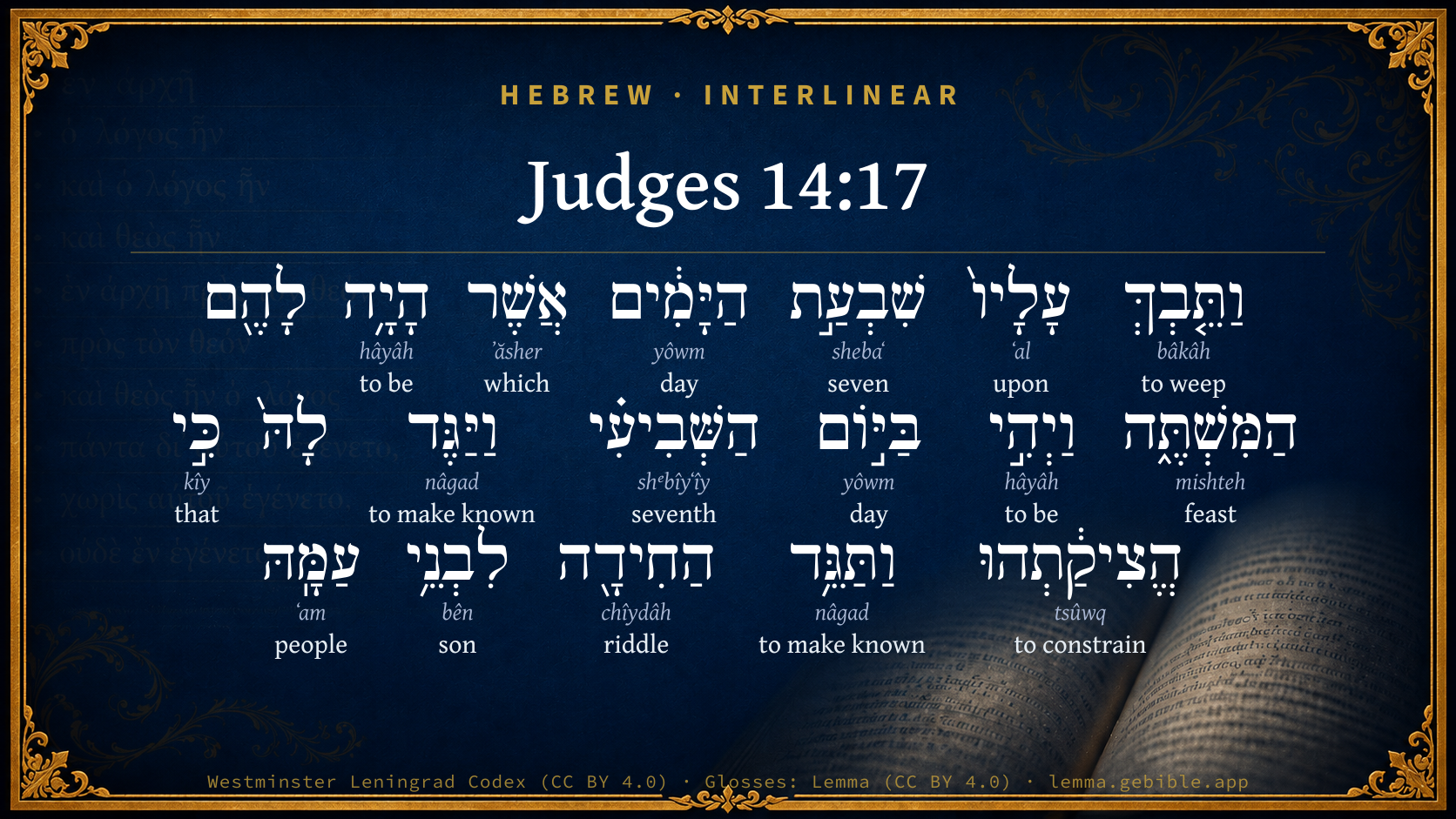
Hebrew (Westminster Leningrad Codex) Judges 14:17 appears in the Hebrew Old Testament. The text above is from the Westminster Leningrad Codex. Each word links to its Strong’s number, a concise gloss, and parsing drawn from the Open Scriptures Hebrew Bible morphology. Click any word for its full Brown-Driver-Briggs (BDB) entry.
Download image
Cite this verse

Judges 14:17 (World English Bible). Public Domain. Lemma interlinear Bible study tool, https://lemma.gebible.app/v/judges/14/17.

Show BibTeX & RIS
BibTeX
RIS
English Translation
She wept before him the seven days, while their feast lasted: and it happened on the seventh day, that he told her, because she pressed him sore; and she told the riddle to the children of her people.
World English Bible · Public Domain
Download a study sheet

One document with this verse’s original text, its word-by-word gloss line, the meaning frame, cross-references with their text, attributed commentary, and full source and license credits — printable, and it pastes into notes with its structure intact.

This verse Autodidact and up

Study sheet (.html) Plain text (.txt)

A passage Seminary Student

Up to 50 verses in one chapter. A passage sheet keeps up to 6 commentary sources and 12 cross-references per verse, in the order this page ranks them, and says so on the sheet whenever that leaves anything out. Ask for a single verse and you get the Autodidact verse sheet above.

Everything on this page stays free to read, with no account — the sheet is a download of what is already on screen, not access to it.

Want to remove ads? Support Godless Engineer
Compare translations 3

The same verse in 3 English versions, stacked beneath the original-language interlinear above. Click any original word for its lexicon entry.

Each is an independent rendering of the whole verse — the interlinear is not word-aligned to these translations.

Highlighted words mark where these versions differ — a whole-verse word diff, not a word-by-word alignment.

  • World English Bible Public Domain
    She wept before him the seven days, while their feast lasted: and it happened on the seventh day, that he told her, because she pressed him sore; and she told the riddle to the children of her people.
  • King James Version Public Domain
    And she wept before him the seven days, while their feast lasted: and it came to pass on the seventh day, that he told her, because she lay sore upon him: and she told the riddle to the children of her people.
  • unfoldingWord Literal Text CC BY-SA 4.0
    And she wept on him the seven days which the feast was to them. And it happened on the seventh day that he declared to her, for she had pressed him. And she declared the riddle to the sons of her people.

unfoldingWord Literal Text — © unfoldingWord, licensed CC BY-SA 4.0. Word-aligned USFM3 via Door43 (git.door43.org/unfoldingWord/en_ult).

Versions to compare (up to 4)

3 of 4 selected

Show all 18 translations

Every available English version of this verse, each an independent rendering of the whole verse.

  • World English Bible Public Domain
    She wept before him the seven days, while their feast lasted: and it happened on the seventh day, that he told her, because she pressed him sore; and she told the riddle to the children of her people.
  • Berean Standard Bible Public Domain
    She wept the whole seven days of the feast, and finally on the seventh day, because she had pressed him so much, he told her the answer. And in turn she explained the riddle to her people.
  • Majority Standard Bible Public Domain
    She wept the whole seven days of the feast, and finally on the seventh day, because she had pressed him so much, he told her the answer. And in turn she explained the riddle to her people.
  • King James Version Public Domain
    And she wept before him the seven days, while their feast lasted: and it came to pass on the seventh day, that he told her, because she lay sore upon him: and she told the riddle to the children of her people.
  • American Standard Version (1901) Public Domain
    And she wept before him the seven days, while their feast lasted: and it came to pass on the seventh day, that he told her, because she pressed him sore; and she told the riddle to the children of her people.
  • Revised Version (1885) Public Domain
    And she wept before him the seven days, while their feast lasted: and it came to pass on the seventh day, that he told her, because she pressed him sore: and she told the riddle to the children of her people.
  • Geneva Bible (1599) Public Domain
    Then Samsons wife wept before him seuen dayes, while their feast lasted: and when the seuenth day came he tolde her, because she was importunate vpon him: so she told the riddle to the children of her people.
  • Douay-Rheims (1899) Public Domain
    So she wept before him the seven days of the feast: and at length on the seventh day as she was troublesome to him, he expounded it. And she immediately told her countrymen.
  • Young's Literal Translation Public Domain
    And she weepeth for it the seven days `in' which their banquet hath been, and it cometh to pass on the seventh day that he declareth `it' to her, for she hath distressed him; and she declareth the riddle to the sons of her people.
  • Literal Standard Version CC BY-SA 4.0
    And she weeps for it the seven days [in] which their banquet has been, and it comes to pass on the seventh day that he declares [it] to her, for she has distressed him; and she declares the riddle to the sons of her people.
  • Unlocked Literal Bible CC BY-SA 4.0
    She cried during the seven days that their feast lasted. On the seventh day he told her the answer because she pressured him very much. She told the answer to the relatives of her people.
  • unfoldingWord Literal Text CC BY-SA 4.0
    And she wept on him the seven days which the feast was to them. And it happened on the seventh day that he declared to her, for she had pressed him. And she declared the riddle to the sons of her people.
  • Darby Bible Public Domain
    She wept before him the seven days that their feast lasted; and on the seventh day he told her, because she pressed him hard. Then she told the riddle to her countrymen.
  • World Messianic Bible Public Domain
    She wept before him the seven days, while their feast lasted; and on the seventh day, he told her, because she pressed him severely; and she told the riddle to the children of her people.
  • Webster's Bible Public Domain
    And she wept before him the seven days, while their feast lasted: and it came to pass on the seventh day, that he told her, because she urged him: and she told the riddle to the children of her people.
  • Free Bible Version CC BY-SA 4.0
    She cried in front of him for the whole time of the party, and eventually on the seventh day he explained it to her because she nagged him so much. Then she explained the meaning of the riddle to the Philistine young men.
  • Bible in Basic English Public Domain
    And all the seven days of the feast she went on weeping over him; and on the seventh day he gave her the answer, because she gave him no peace; and she sent word of it to the children of her people.
  • JPS Tanakh (1917) Public Domain
    And she wept before him the seven days, while their feast lasted; and it came to pass on the seventh day, that he told her, because she pressed him sore; and she told the riddle to the children of her people.

Literal Standard Version (2020), Covenant Press — licensed CC BY-SA 4.0. Text via the HelloAO Bible API (eBible.org). Unlocked Literal Bible (unfoldingWord) — licensed CC BY-SA 4.0. Text via the HelloAO Bible API (eBible.org). unfoldingWord Literal Text — © unfoldingWord, licensed CC BY-SA 4.0. Word-aligned USFM3 via Door43 (git.door43.org/unfoldingWord/en_ult). Free Bible Version, Dr. Jonathan Gallagher — licensed CC BY-SA 4.0. Text via the HelloAO Bible API (eBible.org).

Word by word

More ways to search: Search by grammar → Find every occurrence → Compare this word →

Practice this passage: Drill this verse → Learn its vocabulary →

הֱצִיקַ֔תְהוּ
tsûwq
H6693
“to constrain · him”
Verb, Hiphil, Perfect, 3rd Person, Feminine, Singular + Suffix, Personal, 3rd Person, Masculine, Singular
Part of Speech
Verb
Stem
Hiphil
Form
Perfect
Person
3rd Person
Gender
Feminine
Number
Singular
Full BDB Definition

Origin: a primitive root

TWOT: 1895

(Hiphil) to constrain, press, bring into straits, straiten, oppress
  1. וַתֵּ֤בְךְּ bâkâh H1058 “and · to weep” Conjunction + Verb, Qal, Sequential Imperfect, 3rd Person, Feminine, Singular
  2. עָלָיו֙ ʻal H5921 “upon · him” Preposition + Suffix, Personal, 3rd Person, Masculine, Singular
  3. שִׁבְעַ֣ת shebaʻ H7651 “seven” Adjective, Cardinal number, Masculine, Singular, Construct
  4. הַיָּמִ֔ים yôwm H3117 “the · days” Particle, Definite Article + Noun, Common, Masculine, Plural, Absolute
  5. אֲשֶׁר ʼăsher H834 “which” Particle, Relative
  6. הָיָ֥ה hâyâh H1961 “to be” Verb, Qal, Perfect, 3rd Person, Masculine, Singular
  7. הַמִּשְׁתֶּ֑ה mishteh H4960 “the · feast” Particle, Definite Article + Noun, Common, Masculine, Singular, Absolute
  8. וַיְהִ֣י hâyâh H1961 “and · to be” Conjunction + Verb, Qal, Sequential Imperfect, 3rd Person, Masculine, Singular
  9. בַּיּ֣וֹם yôwm H3117 “in/at the · day” Preposition, Determined + Noun, Common, Masculine, Singular, Absolute
  10. הַשְּׁבִיעִ֗י shᵉbîyʻîy H7637 “the · seventh” Particle, Definite Article + Adjective, Ordinal number, Masculine, Singular, Absolute
  11. וַיַּגֶּד nâgad H5046 “and · to make known” Conjunction + Verb, Hiphil, Sequential Imperfect, 3rd Person, Masculine, Singular
  12. כִּ֣י kîy H3588 “that” Conjunction
  13. וַתַּגֵּ֥ד nâgad H5046 “and · to make known” Conjunction + Verb, Hiphil, Sequential Imperfect, 3rd Person, Feminine, Singular
  14. הַחִידָ֖ה chîydâh H2420 “the · riddle” Particle, Definite Article + Noun, Common, Feminine, Singular, Absolute
  15. לִבְנֵ֥י bên H1121 “to/for · sons of” Preposition + Noun, Common, Masculine, Plural, Construct
  16. עַמָּֽהּ ʻam H5971 “people · her” Noun, Common, Masculine, Singular, Construct + Suffix, Personal, 3rd Person, Feminine, Singular

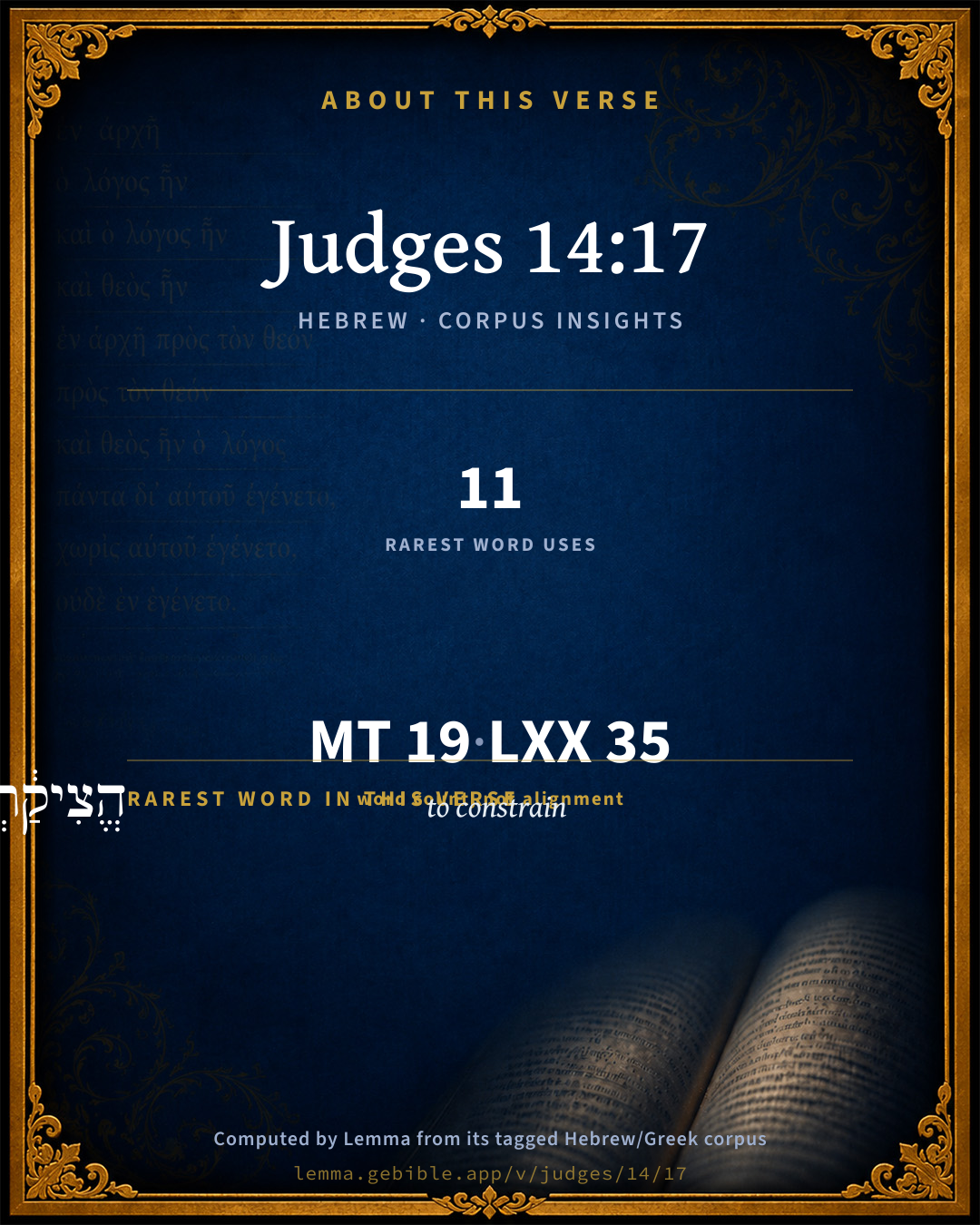
About this verse

These counts appear in no published source. They are computed here, from the morphology-tagged text and Lemma’s own curated glosses. What Lemma adds →

19
words
14
distinct lemmas
Historical
section

Notable vocabulary

The rarest word here is הֱצִיקַ֔תְהוּ to constrain H6693 — appearing just 11 times in the whole Hebrew Bible.

Shared distinctive vocabulary

הֱצִיקַ֔תְהוּ to constrain H6693 occurs in 10 verses of the Hebrew Bible. Also found in:

Grammatical profile

  • 6 verbs
  • 6 nouns
  • 2 adjectives
  • 3 prepositions
  • 1 conjunction
  • 1 particle

Verb forms

  • וַתֵּ֤בְךְּ Qal · Sequential Imperfect
  • הָיָ֥ה Qal · Perfect
  • וַיְהִ֣י Qal · Sequential Imperfect
  • וַיַּגֶּד Hiphil · Sequential Imperfect
  • הֱצִיקַ֔תְהוּ Hiphil · Perfect
  • וַתַּגֵּ֥ד Hiphil · Sequential Imperfect

Repetition

Words recur within this verse — often emphatic in Hebrew:

  • הַיָּמִ֔ים day H3117 ×2
  • הָיָ֥ה to be H1961 ×2
  • וַיַּגֶּד to make known H5046 ×2

Hebrew & Septuagint length

In English translation the verse runs 38 words from the Hebrew and 40 from the Septuagint (LXX English) — closely comparable.

A rough comparison of the two English renderings, which tokenize alike — not a word-level alignment.

Word counts can differ between the Hebrew and the Greek without any difference in meaning — e.g. the Hebrew direct-object marker אֵת has no separate Greek word, and Greek often adds the article ὁ.

In the original languages it is 19 Hebrew tokens and 35 Greek tokens — but the two are counted differently (Hebrew bundles its prefixes and suffixes into one token; the Greek is in lemma form), so that isn’t a like-for-like length.

Cross-references

9

Topical passages linked to Judges 14:17 in the Treasury of Scripture Knowledge — connected by theme and wording, ordered by reader-vote popularity; previews shown in the World English Bible.

  • Judges 16:16 It happened, when she pressed him daily with her words, and urged him, that his soul was vexed to death.
  • Luke 18:4–5 He wouldn't for a while, but afterward he said to himself, 'Though I neither fear God, nor respect man,
  • Genesis 3:6 When the woman saw that the tree was good for food, and that it was a delight to the eyes, and that the tree was to be desired to make one wise, she took of the fruit of it, and ate; and she gave some to her husband with her, and he ate.
  • Judges 16:6 Delilah said to Samson, Tell me, Please, in which your great strength lies, and with which you might be bound to afflict you.
  • Judges 16:13 Delilah said to Samson, Hitherto you have mocked me, and told me lies: tell me with which you might be bound. He said to her, If you weave the seven locks of my head with the web.
  • Job 2:9 Then his wife said to him, "Do you still maintain your integrity? Renounce God, and die."
  • Proverbs 2:16–17 To deliver you from the strange woman, Even from the foreigner who flatters with her words;
  • Proverbs 7:21 With persuasive words, she led him astray. With the flattering of her lips, she seduced him.
  • Luke 11:8 I tell you, although he will not rise and give it to him because he is his friend, yet because of his persistence, he will get up and give him as many as he needs.

Cross-references courtesy of OpenBible.info (CC BY 4.0).

Hebrew and Greek witnesses Masoretic Hebrew ↔ Greek Septuagint

The same verse in the two great witnesses to the Old Testament, shown verse-for-verse.

These are two independent witnesses, not word-aligned to each other, and the Septuagint is shown in lemma (dictionary) form.

Hebrew Judges 14:17 Masoretic · Westminster Leningrad Codex

וַתֵּ֤בְךְּ עָלָיו֙ שִׁבְעַ֣ת הַיָּמִ֔ים אֲשֶׁר הָיָ֥ה לָהֶ֖ם הַמִּשְׁתֶּ֑ה וַיְהִ֣י בַּיּ֣וֹם הַשְּׁבִיעִ֗י וַיַּגֶּד לָהּ֙ כִּ֣י הֱצִיקַ֔תְהוּ וַתַּגֵּ֥ד הַחִידָ֖ה לִבְנֵ֥י עַמָּֽהּ

She wept before him the seven days, while their feast lasted: and it happened on the seventh day, that he told her, because she pressed him sore; and she told the riddle to the children of her people.

World English Bible · Public Domain

Greek LXX Judges 14:17 Septuagint · lemma form

καί κλαίω πρός αὐτός ἐπί ὁ ἑπτά ἡμέρα ὅς εἰμί αὐτός ὁ πότος καί γίγνομαι ἐν ὁ ἡμέρα ὁ ἕβδομος καί ἀποἀγγέλλω αὐτός ὅτι παρα ἐνὀχλέω αὐτός καί αὐτός ἀποἀγγέλλω ὁ υἱός ὁ λαός αὐτός

And she wept before him the seven days, during which their banquet lasted: and it came to pass on the seventh day, that he told her, because she troubled him; and she told it to the children of her people.

LXX2012 (modern English Septuagint) · Public Domain

On this verse, Ellicott's Commentary for English Readers discusses the Septuagint’s reading. Read the note in Commentary ↓

Hebrew: Westminster Leningrad Codex (CC BY 4.0). Greek: Septuagint (public domain); English from LXX2012 (modern English Septuagint) (Public Domain). How the Septuagint differs from the Hebrew →

Targum (Aramaic paraphrase)

1

The Targum is the ancient Jewish Aramaic paraphrase of the Hebrew Scriptures — an interpretive translation, not the Hebrew text itself. Onkelos (literal) and Pseudo-Jonathan (expansive) render the Torah, and Jonathan the Prophets. Coverage is partial: where no permissively-licensed English translation exists for a verse, only the Aramaic is shown. This is verse-level text, not a word-by-word alignment to the Hebrew.

  1. Targum Jonathan Prophets (Joshua–Malachi)
    וּבְכַת עֲלוֹהִי שַׁבְעָא יוֹמַיָא דַהֲוָה לְהוֹן מִשְׁתַּיָא וַהֲוָה בְּיוֹמָא שְׁבִיעָאָה וְחַוִי לָהּ אֲרֵי דְחַקְתֵּיהּ וְחַוִיאַת חוּדִיתָא לִבְנֵי עַמָהּ:

    (no public-domain English translation for this verse)

    Targum Jonathan — Aramaic: “Mikraot Gedolot” (public domain). English: “Sefaria Community Translation” (CC0 1.0 (public-domain dedication)); “London "Chaldee Paraphrase," 1871” (public domain). Text via Sefaria.

Commentary

Notes on Judges 14:17 from classic Christian and Jewish commentators (each source and its license shown beneath its notes). The classic Christian expositions comment on the surrounding passage and are grouped to its opening verse, so a note may address several verses; the Jewish commentaries on the Tanakh (Rashi and others) are per-verse, so they appear only where the commentator wrote on this verse.

Lemma curates 59 commentaries, every one of them public domain or Creative Commons licensed, each selected and text-cleaned for this edition rather than reprinted as found. About our sources →

Trapp's Complete Commentary

John Trapp

Jdg 14:17 And she wept before him the seven days, while their feast lasted: and it came to pass on the seventh day, that he told her, because she lay sore upon him: and she told the riddle to the children of her people.

Ver. 17. And she wept before him the seven days.] Or, Unto the seventh day; this was no less unseasonable and absurd than music in mourning.

He told her, because she lay sore upon him.] Whom the lion could not conquer, the tears of a woman have conquered. Samson never bewrayed infirmity but in mulierosity {Excessive fondness for women} and uxoriousness. {doting or submissive fondness of one’s wife} Utinam tam prudens ad cavendam mulierem fuisset quam fortis ad strangulandum leonem, saith Paulinus. I would he had been as wise as valiant. But many military men are fleshly minded.

John Trapp, A Commentary or Exposition upon All the Books of the Old and New Testament (1647–1656) — public domain. Text from a community e-Sword module.

Joseph Benson's Commentary

Jdg 14:17. She wept before him, the seven days — Or rather, the rest of the seven days; that is, either after the third day, (Jdg 14:14,) or all the seventh day, from the time her countrymen came and threatened her till she persuaded Samson to tell her the riddle.

Joseph Benson's Commentary on the Old and New Testaments (1811–1818) — public domain. Text from a community e-Sword module.

Geneva Bible (1599)

Geneva Bible translators

Or, to the seventh day beginning at the fourth.

Geneva Bible (1599) marginal notes — public domain. Text via Bolls.life.

Adam Clarke's Commentary

Verse 17. And she wept before him] Not through any love to him, for it appears she had none, but to oblige her paramours; and of this he soon had ample proof.

Adam Clarke's Commentary on the Bible (1810–1826) — public domain. Text from a community e-Sword/MySword module.

Ellicott's Commentary for English Readers

(17) The seven days.—The margin suggests that it may mean the rest of the seven days. If not, it can only imply that mere feminine curiosity had induced Samson’s wife to weary her husband to tell her the secret from the first.

On the seventh day.—Perhaps he hoped that he might prevent her from finding an opportunity to betray his secret.

He told her.—“Keep the door of thy mouth from her that lieth in thy bosom” (Mic_7:5).

She lay sore upon him—i.e., she grievously troubled him (LXX., Vulg.).

She told the riddle.—Perhaps she might have done so in any case, but she now had the excuse of violent menaces.

A Bible Commentary for English Readers, edited by Charles John Ellicott (1878–1897) — public domain. Text from a community e-Sword module.

The Cambridge Bible for Schools and Colleges

gen. ed. J. J. S. Perowne

17. she pressed him sore] lit. reduced him to straits by her importunity; again in Jdg_16:16.

The Cambridge Bible for Schools and Colleges (gen. ed. J. J. S. Perowne; Cambridge University Press, 1878–1918) — public domain. Text from a community e-Sword module.

John Gill's Exposition

And she wept before him the seven days, while the feast lasted,.... Those that remained of the seven days, from the fourth to this time, as Kimchi seems rightly to interpret it; though some think she began to beseech him with tears, on the first day of the feast, to impart the secret to her for her own satisfaction; and then, after the men had urged her on the fourth day to persuade her husband to it, she continued pressing him more earnestly with tears unto the seventh day. Some, as Abarbinel observes, and to whom he seems to incline, think there were fourteen days, seven days before the festival began, on the last of which they importuned her to try to get the secret from him, Jdg 14:15, and that she continued pressing all the second seven days; but it seems quite clear that it was at the beginning of the seven days of the feast that the riddle was put, which was to be explained within that time, Jdg 14:12.

and it came to pass on the seven day, that he told her, because she lay sore upon him; pressed him most earnestly with her entreaties, cries, and tears:

and she told the riddle to the children of her people; though she knew it would be to her husband's detriment, and that he must be obliged to give them thirty sheets of linen, and as many suits of apparel, and though it is probable she had promised not to tell them.

John Gill's Exposition of the Whole Bible (1746–1763) — public domain (CC PDM 1.0). Text via the HelloAO Bible API.

Matthew Poole's English Annotations

The seven days, while their feast lasted, i.e. on the residue of the seven days, to wit, after the third day. It is a familiar synecdoche. Or, on the seventh of the days on which the feast was; and then the following clause, on the seventh day, is only the noun repeated for the pronoun, on that day; as is most frequent, as 1Ki 8:1, Solomon assembled—unto Solomon, i.e. unto himself.

Matthew Poole's English Annotations on the Holy Bible (1683–1685) — public domain. Text from a community e-Sword/MySword module.

Whedon's Commentary on the Bible

Daniel D. Whedon

17. She wept… the seven days — That is, the rest of the seven days after he put forth the riddle, and while their feast lasted. See notes on Jdg_14:14-15. “Samson’s wife was a weak and wicked woman, who had no real love for her husband, and this is certainly common enough at the present day. Wives are procured now as then by the intervention of parents, and without any of that personal attachment between the parties which we deem essential. They are also very often ready to enter into any treacherous conspiracy against their husbands by which they can gain some desired advantage for themselves or their friends. Indeed, there are very many husbands in this country who neither will nor dare trust their wives. And yet these distrusted but cunning wives have wonderful power over their husbands. “By their arts and their importunity they carry their points, often to the utter and obvious ruin of their husbands. It is not at all contrary to present experience, therefore, that Samson’s wife should conspire against him in the matter of the riddle, nor that she should succeed in teasing him out of the secret.” — Thomson.

Daniel D. Whedon (gen. ed.), Commentary on the Old and New Testaments (1874–1909) — public domain. Text from a community e-Sword module.

The Pulpit Commentary

She lay sore upon him. In Jud_1:16:16 the same word is rendered pressed him. It came to pass on the seventh day. This is the confluence of the two streams of narrative.

The Pulpit Commentary (1880–1919), ed. H.D.M. Spence-Jones & Joseph S. Exell — public domain. Text from a community e-Sword module.

John Wesley's Explanatory Notes

The seven days - That is, on the residue of the seven days; namely, after the third day.

John Wesley, Explanatory Notes Upon the Whole Bible (1754–1765) — public domain. Text via the GEBible commentary corpus.

Rashi

Rabbi Shlomo Yitzchaki (Rashi)

The seven days. What remained of the seven days, after the fourth day.

Rashi on the Tanakh — English translations: “The Judaica Press complete Tanach with Rashi, translated by A. J. Rosenberg” (CC BY 4.0); “Pentateuch with Rashi's commentary by M. Rosenbaum and A.M. Silbermann, 1929-1934” (public domain); “The Metsudah Tanach series, Lakewood, N.J” (CC BY 4.0); and “The Book of Joshua, Metsudah Publications, 1997” (CC BY 4.0). Text via Sefaria.

Lesson kit

Teaching starters — assembled from the data on this page, not authored interpretation. Every prompt links to the verse data it draws on. Edit before teaching.

Judges, in the Historical, opens this verse with 19 words (14 distinct Hebrew lemmas). Its most distinctive word is tsûwq (“to constrain”). A historical commentator’s framing appears above. Read the whole chapter for the surrounding context.

Discussion questions

  1. The word tsûwq carries the sense “to constrain.” How does it shape the verse?
  2. How does Deuteronomy 28:53, which shares the word «to constrain», read alongside this verse?
  3. What does the repetition of “day” (2× in this one verse) do in this verse?
  4. These translations render this verse differently; the difference is in the English rendering, not the original. What questions does that raise?
  5. «וַתֵּ֤בְךְּ» is a Qal Sequential Imperfect verb. How does that grammatical form shape the action described?
  6. Compare how Trapp's Complete Commentary and Joseph Benson's Commentary read this verse. Where do they agree or differ?

Things to notice

Reading settings

Reading text

Shown beneath each verse's original-language words.

Old Testament
Old Testament edition

Read the OT as the Masoretic Hebrew (MT) or the Greek Septuagint (LXX).

English shown for the Greek Septuagint (in the Hebrew ↔ Greek comparison).

Comparing translations? Open the Compare panel on any verse page to stack up to four side by side.