
Leviticus 23:36

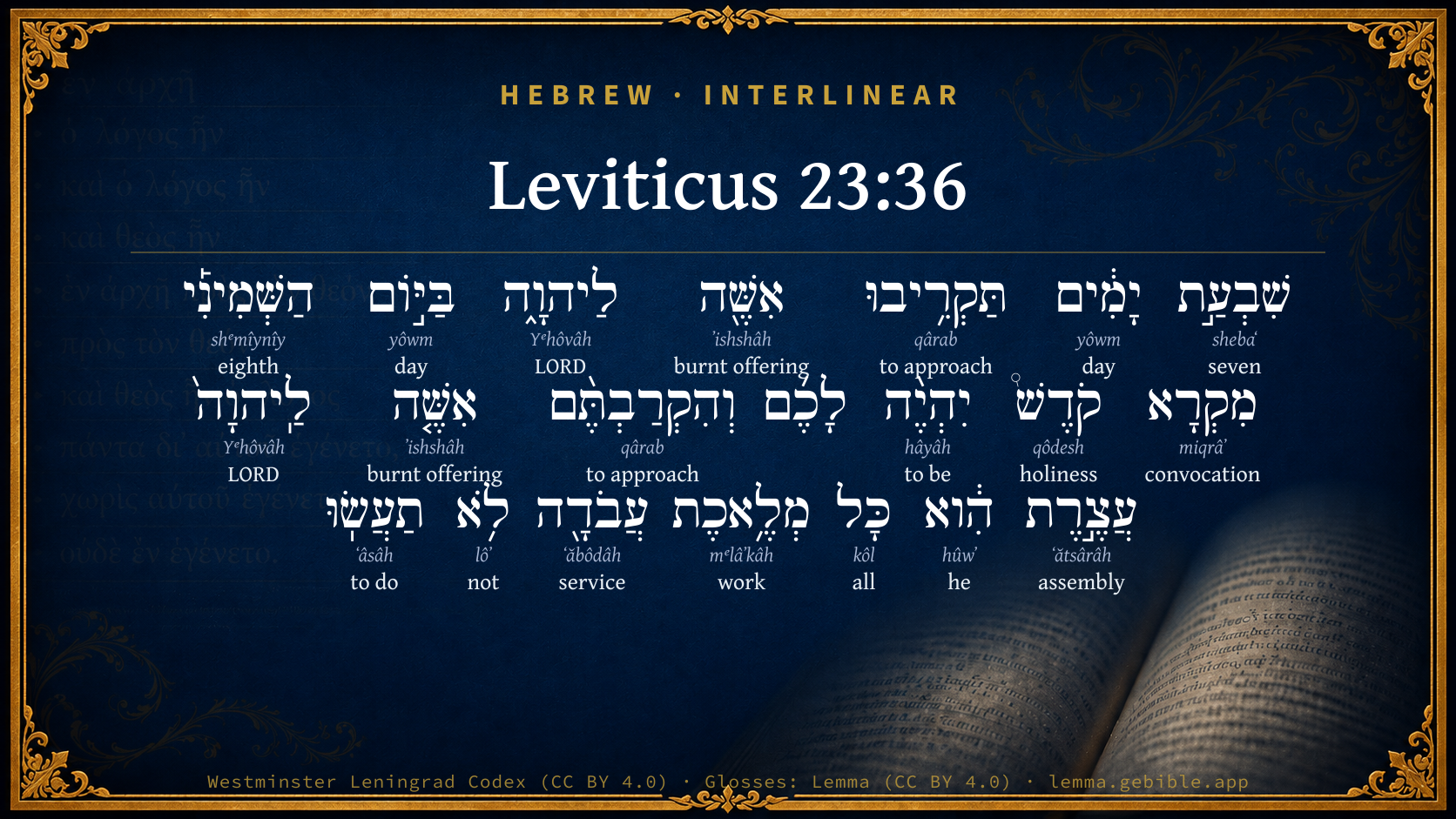
Hebrew (Westminster Leningrad Codex) Leviticus 23:36 appears in the Hebrew Old Testament. The text above is from the Westminster Leningrad Codex. Each word links to its Strong’s number, a concise gloss, and parsing drawn from the Open Scriptures Hebrew Bible morphology. Click any word for its full Brown-Driver-Briggs (BDB) entry.
Download image
Cite this verse

Leviticus 23:36 (World English Bible). Public Domain. Lemma interlinear Bible study tool, https://lemma.gebible.app/v/leviticus/23/36.

Show BibTeX & RIS
BibTeX
RIS
English Translation
Seven days you shall offer an offering made by fire to Yahweh. On the eighth day shall be a holy convocation to you; and you shall offer an offering made by fire to Yahweh. It is a solemn assembly; you shall do no regular work.
World English Bible · Public Domain
Highlights
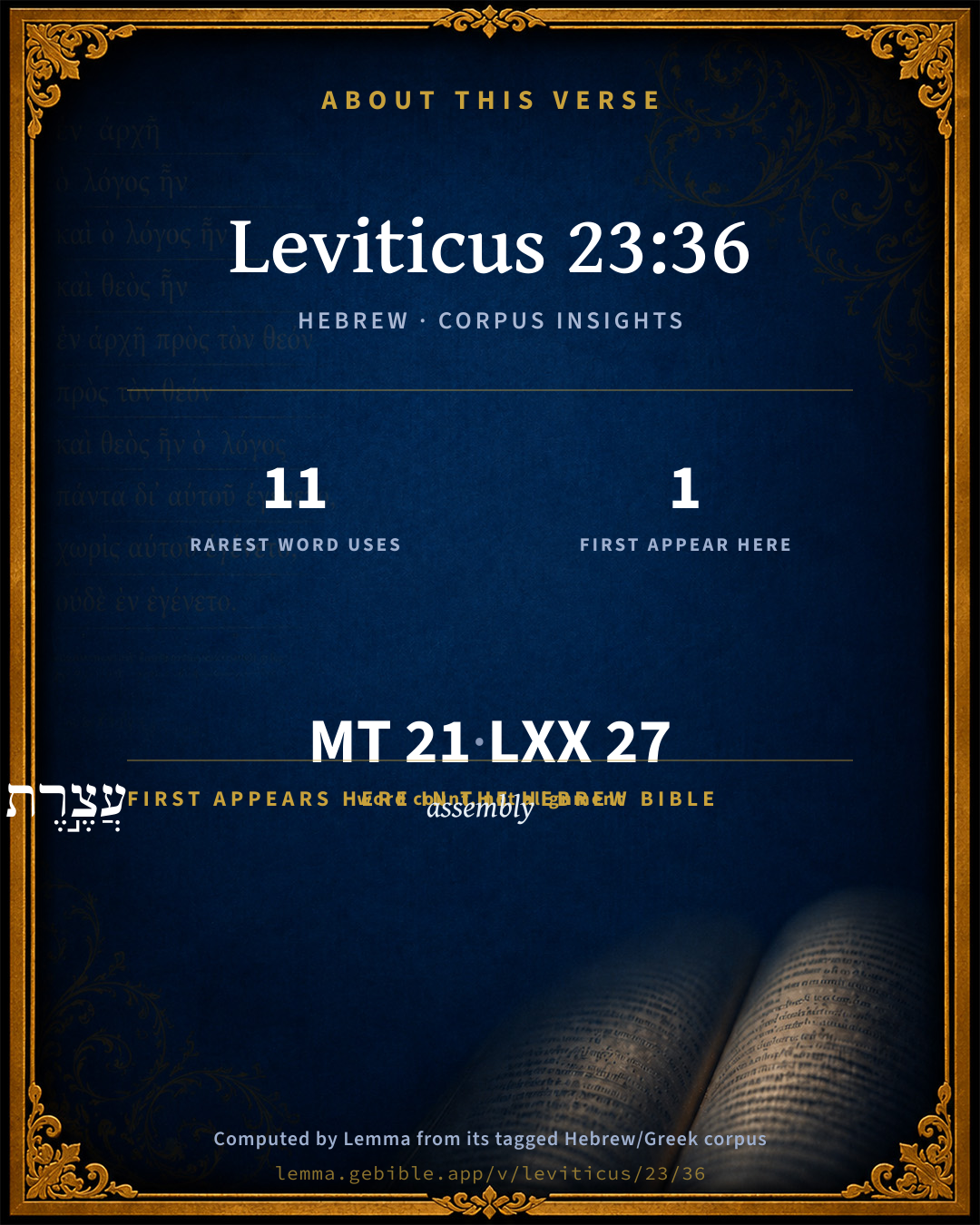
  • 1 first appearance in the Hebrew Bible
Full analysis ↓
Download a study sheet

One document with this verse’s original text, its word-by-word gloss line, the meaning frame, cross-references with their text, attributed commentary, and full source and license credits — printable, and it pastes into notes with its structure intact.

This verse Autodidact and up

Study sheet (.html) Plain text (.txt)

A passage Seminary Student

Up to 50 verses in one chapter. A passage sheet keeps up to 6 commentary sources and 12 cross-references per verse, in the order this page ranks them, and says so on the sheet whenever that leaves anything out. Ask for a single verse and you get the Autodidact verse sheet above.

Everything on this page stays free to read, with no account — the sheet is a download of what is already on screen, not access to it.

Want to remove ads? Support Godless Engineer
Compare translations 3

The same verse in 3 English versions, stacked beneath the original-language interlinear above. Click any original word for its lexicon entry.

Each is an independent rendering of the whole verse — the interlinear is not word-aligned to these translations.

Highlighted words mark where these versions differ — a whole-verse word diff, not a word-by-word alignment.

  • World English Bible Public Domain
    Seven days you shall offer an offering made by fire to Yahweh. On the eighth day shall be a holy convocation to you; and you shall offer an offering made by fire to Yahweh. It is a solemn assembly; you shall do no regular work.
  • King James Version Public Domain
    Seven days ye shall offer an offering made by fire unto the LORD: on the eighth day shall be an holy convocation unto you; and ye shall offer an offering made by fire unto the LORD: it is a solemn assembly; and ye shall do no servile work therein.
  • unfoldingWord Literal Text CC BY-SA 4.0
    seven days you shall present a gift to Yahweh. On the eighth day there shall be an assembly of holiness for you, and you shall present a gift to Yahweh. It is a holiday. You shall not do any work of labor.

unfoldingWord Literal Text — © unfoldingWord, licensed CC BY-SA 4.0. Word-aligned USFM3 via Door43 (git.door43.org/unfoldingWord/en_ult).

Versions to compare (up to 4)

3 of 4 selected

Show all 18 translations

Every available English version of this verse, each an independent rendering of the whole verse.

  • World English Bible Public Domain
    Seven days you shall offer an offering made by fire to Yahweh. On the eighth day shall be a holy convocation to you; and you shall offer an offering made by fire to Yahweh. It is a solemn assembly; you shall do no regular work.
  • Berean Standard Bible Public Domain
    For seven days you are to present an offering made by fire to the LORD. On the eighth day you are to hold a sacred assembly and present an offering made by fire to the LORD. It is a solemn assembly; you must not do any regular work.
  • Majority Standard Bible Public Domain
    For seven days you are to present a food offering to the LORD. On the eighth day you are to hold a sacred assembly and present a food offering to the LORD. It is a solemn assembly; you must not do any regular work.
  • King James Version Public Domain
    Seven days ye shall offer an offering made by fire unto the LORD: on the eighth day shall be an holy convocation unto you; and ye shall offer an offering made by fire unto the LORD: it is a solemn assembly; and ye shall do no servile work therein.
  • American Standard Version (1901) Public Domain
    Seven days ye shall offer an offering made by fire unto Jehovah: on the eighth day shall be a holy convocation unto you; and ye shall offer an offering made by fire unto Jehovah: it is a solemn assembly; ye shall do no servile work.
  • Revised Version (1885) Public Domain
    Seven days ye shall offer an offering made by fire unto the LORD: on the eighth day shall be an holy convocation unto you; and ye shall offer an offering made by fire unto the LORD: it is a solemn assembly; ye shall do no servile work.
  • Geneva Bible (1599) Public Domain
    Seuen daies ye shall offer sacrifice made by fire vnto the Lord, and in the eight day shalbe an holy conuocation vnto you, and ye shall offer sacrifices made by fire vnto the Lord: it is the solemne assemblie, yee shall doe no seruile worke therein.
  • Douay-Rheims (1899) Public Domain
    The eighth day also shall be most solemn and most holy, and you shall offer holocausts to the Lord: for it is the day of assembly and congregation: you shall do no servile work therein.
  • Young's Literal Translation Public Domain
    seven days ye bring near a fire-offering to Jehovah, on the eighth day ye have a holy convocation, and ye have brought near a fire-offering to Jehovah; it `is' a restraint, ye do no servile work.
  • Literal Standard Version CC BY-SA 4.0
    [for] seven days you bring a fire-offering near to YHWH, on the eighth day you have a holy convocation, and you have brought a fire-offering near to YHWH; it [is] a restraint, you do no servile work.
  • Unlocked Literal Bible CC BY-SA 4.0
    For seven days you must offer a sacrifice made by fire to Yahweh. On the eighth day there must be a holy assembly, and you must make a sacrifice offered with fire to Yahweh. This is a solemn assembly, and you must not do any ordinary work.
  • unfoldingWord Literal Text CC BY-SA 4.0
    seven days you shall present a gift to Yahweh. On the eighth day there shall be an assembly of holiness for you, and you shall present a gift to Yahweh. It is a holiday. You shall not do any work of labor.
  • Darby Bible Public Domain
    Seven days ye shall present an offering by fire to Jehovah; on the eighth day shall be a holy convocation unto you; and ye shall present an offering by fire to Jehovah: it is a solemn assembly; no manner of servile work shall ye do.
  • World Messianic Bible Public Domain
    Seven days you shall offer an offering made by fire to the LORD. On the eighth day shall be a holy convocation to you. You shall offer an offering made by fire to the LORD. It is a solemn assembly; you shall do no regular work.
  • Webster's Bible Public Domain
    Seven days ye shall offer an offering made by fire to the LORD: on the eighth day shall be a holy convocation to you, and ye shall offer an offering made by fire to the LORD: it is a solemn assembly; and ye shall do no servile work in it.
  • Free Bible Version CC BY-SA 4.0
    For seven days you shall present food offerings to the Lord. On the eighth day you are to have another holy meeting and present a food offering to the Lord. It is a meeting for worship. You must not do any of your usual work.
  • Bible in Basic English Public Domain
    Every day for seven days give an offering made by fire to the Lord; and on the eighth day there is to be a holy meeting, when you are to give an offering made by fire to the Lord; this is a special holy day: you may do no field-work on that day.
  • JPS Tanakh (1917) Public Domain
    Seven days ye shall bring an offering made by fire unto the LORD; on the eighth day shall be a holy convocation unto you; and ye shall bring an offering made by fire unto the LORD; it is a day of solemn assembly; ye shall do no manner of servile work.

Literal Standard Version (2020), Covenant Press — licensed CC BY-SA 4.0. Text via the HelloAO Bible API (eBible.org). Unlocked Literal Bible (unfoldingWord) — licensed CC BY-SA 4.0. Text via the HelloAO Bible API (eBible.org). unfoldingWord Literal Text — © unfoldingWord, licensed CC BY-SA 4.0. Word-aligned USFM3 via Door43 (git.door43.org/unfoldingWord/en_ult). Free Bible Version, Dr. Jonathan Gallagher — licensed CC BY-SA 4.0. Text via the HelloAO Bible API (eBible.org).

Word by word

More ways to search: Search by grammar → Find every occurrence → Compare this word →

Practice this passage: Drill this verse → Learn its vocabulary →

עֲצֶ֣רֶת
ʻătsârâh
H6116
“assembly”
Noun, Common, Feminine, Singular, Absolute
Part of Speech
Noun
Type
Common
Gender
Feminine
Number
Singular
State
Absolute
Full BDB Definition

Origin: from H6113

TWOT: 1675c

assembly, solemn assembly - assembly (sacred or festive meeting) - assemblage, company, group
  1. שִׁבְעַ֣ת shebaʻ H7651 “seven” Adjective, Cardinal number, Masculine, Singular, Construct
  2. יָמִ֔ים yôwm H3117 “days” Noun, Common, Masculine, Plural, Absolute
  3. תַּקְרִ֥יבוּ qârab H7126 “to approach” Verb, Hiphil, Imperfect, 2nd Person, Masculine, Plural
  4. אִשֶּׁ֖ה ʼishshâh H801 “burnt offering” Noun, Common, Masculine, Singular, Absolute
  5. לַיהוָ֑ה Yᵉhôvâh H3068 “to/for · LORD” Preposition + Noun, Proper
  6. בַּיּ֣וֹם yôwm H3117 “in/at the · day” Preposition, Determined + Noun, Common, Masculine, Singular, Absolute
  7. הַשְּׁמִינִ֡י shᵉmîynîy H8066 “the · eighth” Particle, Definite Article + Adjective, Ordinal number, Masculine, Singular, Absolute
  8. מִקְרָא miqrâʼ H4744 “convocation of” Noun, Common, Masculine, Singular, Construct
  9. קֹדֶשׁ֩ qôdesh H6944 “holiness” Noun, Common, Masculine, Singular, Absolute
  10. יִהְיֶ֨ה hâyâh H1961 “to be” Verb, Qal, Imperfect, 3rd Person, Masculine, Singular
  11. וְהִקְרַבְתֶּ֨ם qârab H7126 “and · to approach” Conjunction + Verb, Hiphil, Sequential Perfect, 2nd Person, Masculine, Plural
  12. אִשֶּׁ֤ה ʼishshâh H801 “burnt offering” Noun, Common, Masculine, Singular, Absolute
  13. לַֽיהוָה֙ Yᵉhôvâh H3068 “to/for · LORD” Preposition + Noun, Proper
  14. הִ֔וא hûwʼ H1931 “he” Pronoun, Personal, 3rd Person, Feminine, Singular
  15. כָּל kôl H3605 “all of” Noun, Common, Masculine, Singular, Construct
  16. מְלֶ֥אכֶת mᵉlâʼkâh H4399 “work of” Noun, Common, Feminine, Singular, Construct
  17. עֲבֹדָ֖ה ʻăbôdâh H5656 “service” Noun, Common, Feminine, Singular, Absolute
  18. לֹ֥א lôʼ H3808 “not” Particle, Negative
  19. תַעֲשֽׂוּ ʻâsâh H6213 “to do” Verb, Qal, Imperfect, 2nd Person, Masculine, Plural

About this verse

These counts appear in no published source. They are computed here, from the morphology-tagged text and Lemma’s own curated glosses. What Lemma adds →

21
words
16
distinct lemmas
Pentateuch
section

Notable vocabulary

The rarest word here is עֲצֶ֣רֶת assembly H6116 — appearing just 11 times in the whole Hebrew Bible.

First appearance in Scripture

This word makes its first canonical appearance in the Hebrew Bible here:

  • עֲצֶ֣רֶת assembly H6116

Shared distinctive vocabulary

עֲצֶ֣רֶת assembly H6116 occurs in 11 verses of the Hebrew Bible. Also found in:

Grammatical profile

  • 4 verbs
  • 12 nouns
  • 2 adjectives
  • 1 pronoun
  • 1 preposition
  • 1 particle

Verb forms

  • תַּקְרִ֥יבוּ Hiphil · Imperfect
  • יִהְיֶ֨ה Qal · Imperfect
  • וְהִקְרַבְתֶּ֨ם Hiphil · Sequential Perfect
  • תַעֲשֽׂוּ Qal · Imperfect

Repetition

Words recur within this verse — often emphatic in Hebrew:

  • יָמִ֔ים day H3117 ×2
  • תַּקְרִ֥יבוּ to approach H7126 ×2
  • אִשֶּׁ֖ה burnt offering H801 ×2
  • לַיהוָ֑ה LORD H3068 ×2

Hebrew & Septuagint length

In English translation the verse runs 45 words from the Hebrew and 43 from the Septuagint (LXX English) — closely comparable.

A rough comparison of the two English renderings, which tokenize alike — not a word-level alignment.

Word counts can differ between the Hebrew and the Greek without any difference in meaning — e.g. the Hebrew direct-object marker אֵת has no separate Greek word, and Greek often adds the article ὁ.

In the original languages it is 21 Hebrew tokens and 27 Greek tokens — but the two are counted differently (Hebrew bundles its prefixes and suffixes into one token; the Greek is in lemma form), so that isn’t a like-for-like length.

Cross-references

7

Topical passages linked to Leviticus 23:36 in the Treasury of Scripture Knowledge — connected by theme and wording, ordered by reader-vote popularity; previews shown in the World English Bible.

  • Nehemiah 8:18 Also day by day, from the first day to the last day, he read in the book of the law of God. They kept the feast seven days; and on the eighth day was a solemn assembly, according to the ordinance.
  • John 7:37 Now on the last and greatest day of the feast, Jesus stood and cried out, "If anyone is thirsty, let him come to me and drink!
  • Numbers 29:12–38 On the fifteenth day of the seventh month you shall have a holy convocation; you shall do no servile work, and you shall keep a feast to Yahweh seven days:
  • Deuteronomy 16:8 Six days you shall eat unleavened bread; and on the seventh day shall be a solemn assembly to Yahweh your God; you shall do no work [therein].
  • 2 Chronicles 7:8–11 So Solomon held the feast at that time seven days, and all Israel with him, a very great assembly, from the entrance of Hamath to the brook of Egypt.
  • Joel 1:14 Sanctify a fast. Call a solemn assembly. Gather the elders, And all the inhabitants of the land, to the house of Yahweh, your God, And cry to Yahweh.
  • Joel 2:15 Blow the trumpet in Zion! Sanctify a fast. Call a solemn assembly.

Cross-references courtesy of OpenBible.info (CC BY 4.0).

Hebrew and Greek witnesses Masoretic Hebrew ↔ Greek Septuagint

The same verse in the two great witnesses to the Old Testament, shown verse-for-verse.

These are two independent witnesses, not word-aligned to each other, and the Septuagint is shown in lemma (dictionary) form.

Hebrew Leviticus 23:36 Masoretic · Westminster Leningrad Codex

שִׁבְעַ֣ת יָמִ֔ים תַּקְרִ֥יבוּ אִשֶּׁ֖ה לַיהוָ֑ה בַּיּ֣וֹם הַשְּׁמִינִ֡י מִקְרָא קֹדֶשׁ֩ יִהְיֶ֨ה לָכֶ֜ם וְהִקְרַבְתֶּ֨ם אִשֶּׁ֤ה לַֽיהוָה֙ עֲצֶ֣רֶת הִ֔וא כָּל מְלֶ֥אכֶת עֲבֹדָ֖ה לֹ֥א תַעֲשֽׂוּ

Seven days you shall offer an offering made by fire to Yahweh. On the eighth day shall be a holy convocation to you; and you shall offer an offering made by fire to Yahweh. It is a solemn assembly; you shall do no regular work.

World English Bible · Public Domain

Greek LXX Leviticus 23:36 Septuagint · lemma form

ἑπτά ἡμέρα προςἄγω ὁλοκαύτωμα ὁ κύριος καί ὁ ἡμέρα ὁ ὄγδοος κλητός ἅγιος εἰμί σύ καί προςἄγω ὁλοκαύτωμα ὁ κύριος ἐξόδιος εἰμί πᾶς ἔργον λατρευτός οὐ ποιέω

Seven days shall you⌃ offer whole burnt offerings to the Lord, and the eighth-day shall be a holy convocation to you; and you⌃ shall offer whole burnt offerings to the Lord: it is a time of release, you⌃ shall do no servile work.

LXX2012 (modern English Septuagint) · Public Domain

On this verse, Haydock's Catholic Bible Commentary discusses the Septuagint’s reading. Read the note in Commentary ↓

Hebrew: Westminster Leningrad Codex (CC BY 4.0). Greek: Septuagint (public domain); English from LXX2012 (modern English Septuagint) (Public Domain). How the Septuagint differs from the Hebrew →

Targum (Aramaic paraphrase)

2

The Targum is the ancient Jewish Aramaic paraphrase of the Hebrew Scriptures — an interpretive translation, not the Hebrew text itself. Onkelos (literal) and Pseudo-Jonathan (expansive) render the Torah, and Jonathan the Prophets. Coverage is partial: where no permissively-licensed English translation exists for a verse, only the Aramaic is shown. This is verse-level text, not a word-by-word alignment to the Hebrew.

  1. Targum Onkelos Torah (Genesis–Deuteronomy)
    שִׁבְעָא יוֹמִין תְּקָרְבוּן קֻרְבָּנָא קֳדָם יְיָ בְּיוֹמָא תְמִינָאָה מְעָרַע קַדִישׁ יְהֵי לְכוֹן וּתְקָרְבוּן קֻרְבָּנָא קֳדָם יְיָ כְּנֵשׁ תְּהוֹן כָּל עִבִידַת פָּלְחַן לָא תַעֲבְּדוּן

    (no public-domain English translation for this verse)

    Targum Onkelos — Aramaic: “Onkelos Genesis” (public domain); “Onkelos Exodus” (public domain); “Onkelos Leviticus” (public domain); “Onkelos Numbers” (public domain); “Onkelos Deuteronomy” (public domain). English: “Sefaria Community Translation” (CC0 1.0 (public-domain dedication)); “J.W. Etheridge. The Targums of Onkelos and Jonathan Ben Uzziel on the Pentateuch. London: Longmans, Green, 1862” (public domain). Text via Sefaria.

  2. Targum Pseudo-Jonathan Torah (Genesis–Deuteronomy)
    שִׁבְעָתֵי יוֹמִין תְּקַרְבוּן קוּרְבָּנָא לִשְׁמָא דַיְיָ כְּנִישִׁין תֶּהֱווֹן לְצַלָאָה קֳדָם יְיָ עַל מִטְרָא כָּל עִיבִידַת פּוּלְחָנָא לָא תַעַבְדוּן בְּיוֹמָא תְמִינָאָה מְאַרְעֵי קַדִישׁ יְהֵי לְכוֹן וְתִקְרְבוּן קוּרְבָּנָא קֳדָם יְיָ

    Seven days you shall offer an oblation to the Name of the Lord, you shall gather together to pray before the Lord for rain; no work of labour may you do.

    Targum Pseudo-Jonathan — Aramaic: “Targum Jonathan on Genesis” (public domain); “Targum Jonathan on Exodus” (public domain); “Targum Jonathan on Leviticus” (public domain); “Targum Jonathan on Numbers” (public domain); “Targum Jonathan on Deuteronomy” (public domain). English: “The Targum of Jonathan ben Uzziel, trans. J. W. Etheridge, London, 1862” (public domain). Text via Sefaria.

Commentary

Notes on Leviticus 23:36 from classic Christian and Jewish commentators (each source and its license shown beneath its notes). The classic Christian expositions comment on the surrounding passage and are grouped to its opening verse, so a note may address several verses; the Jewish commentaries on the Tanakh (Rashi and others) are per-verse, so they appear only where the commentator wrote on this verse.

Lemma curates 59 commentaries, every one of them public domain or Creative Commons licensed, each selected and text-cleaned for this edition rather than reprinted as found. About our sources →

Joseph Benson's Commentary

Lev 23:36. Ye shall offer — A several offering each day. The eighth day — Which, though it was not one of the days of this feast, strictly taken, yet, in a larger sense, it belonged to this feast, and is called the great day of the feast, Joh 7:37. And so indeed it was, as for other reasons, so because, by their removal from the tabernacles into fixed habitations, it represented that happy time wherein their forty years’ tedious march in the wilderness was ended with their settlement in the land of Canaan, which it was most fit they should acknowledge with such a solemn day of thanksgiving as this was.

Joseph Benson's Commentary on the Old and New Testaments (1811–1818) — public domain. Text from a community e-Sword module.

Geneva Bible (1599)

Geneva Bible translators

Or, a day wherein the people are stayed from all work.

Geneva Bible (1599) marginal notes — public domain. Text via Bolls.life.

Ellicott's Commentary for English Readers

(36) Seven days ye shall offer.—The special sacrifices for this day consisted of a burnt offering of thirteen bullocks, two rams, and fourteen lambs, with an appropriate meat and drink offering, and a goat for a sin offering (Num_29:12-38). Whereupon were offered the peace offerings, the vows and the free-will offerings which constituted the repasts of the people. Whilst these sacrifices were being offered up the Levites chanted the festive Hallel, as on the feasts of Passover and Pentecost. This was repeated every day during the seven days of the festival, only that the number of animals offered as sacrifices diminished daily during the middle days of the festival, according to the prescription in Num_29:12-38. On the eve of the second day, or what is called the lesser festival, and on each of the five succeeding nights, was celebrated the “Rejoicing of the water-drawing” in the court of the Temple. Four huge golden candelabra were lighted in the centre of the court, and the light emanating from them was visible to the whole city. Around these lights pious men danced before the people with lighted flambeaux in their hands, singing hymns and songs of praise, whilst the Levites, who were stationed on the fifteen steps which led into the women’s court, and which corresponded to the fifteen psalms of degrees, i.e., steps (Psalms 120-134), accompanied the songs with instrumental music. It is supposed that on the last evening of the festival, when the splendid light of this grand illumination was to cease, Christ called attention to himself, “I am the light of the world” (Joh_8:12), which is to shine for ever, and illuminate not only the Temple and the holy city, but all the world.

On the eighth day shall be an holy convocation.—That is, like the first day, since no servile work is to be done on it. As it is not only the finishing of the feast of Tabernacles, but the conclusion of the whole cycle of festivals, the dwelling in tabernacles is to cease on it.

Ye shall offer.—For this reason the sacrifices offered on this day are to be distinct, and unlike the sacrifices of the preceding days. The burnt sacrifice is to consist of one bullock, one ram, and seven lambs, with the appropriate meat and drink offerings, and one goat for a sin offering. (Num_29:36-38.) Being, however, attached to the feast of Tabernacles, the two festivals are often joined together, and spoken of as one festival of eight days.

A Bible Commentary for English Readers, edited by Charles John Ellicott (1878–1897) — public domain. Text from a community e-Sword module.

The Cambridge Bible for Schools and Colleges

gen. ed. J. J. S. Perowne

36. a solemn assembly] R.V. mg. closing festival. The Heb. word (‘ãẓéreth) does not in itself involve the idea of solemnity. It is used of the closing day of the Feast of Unleavened Bread (Deu_16:8), and (as here) in Num_29:35 (P); Neh_8:18, of the extra day following the seven days of the Feast of Booths, which became ‘the great day of the feast’ (Joh_7:37). According to 2Ch_7:9 (though not recognised in the parallel, 1Ki_8:66), it formed a joyful celebration in thankfulness for the completion of the dedication of Solomon’s Temple.

The Cambridge Bible for Schools and Colleges (gen. ed. J. J. S. Perowne; Cambridge University Press, 1878–1918) — public domain. Text from a community e-Sword module.

John Gill's Exposition

Seven days ye shall offer an offering made, by fire unto the Lord,.... A burnt offering; what this was, and how many were offered on each day, see at large in Num 29:13,

on the eighth day shall be an holy convocation unto you; as on the first day; See Gill on Lev 23:35,

and ye shall offer an offering made by fire unto the Lord; which was different from that on all the other days, being one bullock only, &c. Num 29:35,

it is a solemn assembly; of all the people, when they were gathered together before the Lord. Some render the word used a "restraint" or "detention", and interpret it of restraining or detaining them from servile work, as in the next clause; so Aben Ezra and Gersom; but this sense seems to make that clause unnecessary and is never used elsewhere where that is:

ye shall do no servile work therein; as on the first day; See Gill on Lev 23:35.

John Gill's Exposition of the Whole Bible (1746–1763) — public domain (CC PDM 1.0). Text via the HelloAO Bible API.

Albert Barnes' Notes on the Bible

An offering made by fire - See Lev 23:8. The succession of sacrifices prescribed in Num. 29:12-38, which forms such a marked feature in the Feast of Tabernacles, tends to show the distinctness of the “solemn assembly” from the festal week.

Albert Barnes' Notes on the Bible (1834–1885) — public domain. Text from a community e-Sword/MySword module.

Haydock's Catholic Bible Commentary

Most holy. Hebrew, "an holy assembly." The great day of the festivity, John vii. 37. --- Congregation. Hebrew hatsereth, "retention." All were bound to wait till this day was over. In other festivals, it was sufficient if they were present one day. This was the concluding day of the feast of tabernacles. Septuagint exodion. Plutarch (Sym. iv. 5.) observes, that this festival greatly resembles that of Bacchus. Ovid (Fast. iii.) speaking of the feast of Anna Perenna, describes it thus: Sub Jove pars durat, pauci tentoria ponunt,

Sub quibus e ramis frondea facta casa est.

Casaubon (on Atheneus iv. 9. and v. 5.) mentions other feasts, on which the pagans dwelt under tents. The devil has caused his slaves to imitate most of the holy ceremonies of the true religion. (Calmet)

George Leo Haydock (1774–1849), Haydock's Catholic Family Bible and Commentary, 1859 edition — public domain. Excludes Psalms (Douay-Rheims chapter numbering differs from Protestant) and Deuterocanonical books (Catholic canon only).

Matthew Poole's English Annotations

Seven days ye shall offer an offering; a several offering each day, which is particularly described Num 29:13, &c.

On the eighth day; which though it was not one of the days of this feast strictly taken, nor is it here affirmed to be so, but on the contrary is expressly said to consist of seven days, Lev 23:31,39, nor did they dwell longer in tabernacles; yet in a larger sense it belonged to this feast, and is called the great day of the feast, Joh 7:37. And so indeed it was, as for other reasons, so because, by their removal from their tabernacles into more fixed and comfortable habitations, it represented that happy time wherein their forty years’ tedious march in the wilderness was ended, with their introduction into, and settlement in, the land of Canaan, which it was most fit and just they should acknowledge with such a solemn day of thanksgiving as this was.

A solemn assembly, Heb. a day of conclusion, because it was the end of the feast, Joh 7:37; or, of restraint, because they were restrained from servile work, and obliged to attendance upon God’s worship; or, of detention, because they were yet detained before the Lord, and kept together for his service, and not suffered to return to their tents till this was over.

Matthew Poole's English Annotations on the Holy Bible (1683–1685) — public domain. Text from a community e-Sword/MySword module.

Whedon's Commentary on the Bible

Daniel D. Whedon

36. The eighth day — Since this feast was to continue seven days, and since no mention is made of an eighth day in Deu_16:13-15, we conclude that it formed no part of the festival, but was a day of rest, as is declared in Lev_23:37.

Ye shall offer an offering — The number of public sacrifices offered on the first day exceeded those of any other day of the year, while private peace offerings were also more abundant. There is ground for the opinion that the number of sacrifices equalled the total number of victims offered at all the other festivals.

Daniel D. Whedon (gen. ed.), Commentary on the Old and New Testaments (1874–1909) — public domain. Text from a community e-Sword module.

John Wesley's Explanatory Notes

Ye shall offer - A several-offering each day. The eighth day - Which though it was not one of the days of this feast strictly taken. Yet in a larger sense it belonged to this feast, and is called the great day of the feast, John vii, 37. And so indeed it was, as for other reasons, so because, by their removal from the tabernacles into fixed habitations, it represented that happy time wherein their 40 years tedious march in the wilderness was ended with their settlement in the land of Canaan, which it was most fit they should acknowledge with such a solemn day of thanksgiving as this was.

John Wesley, Explanatory Notes Upon the Whole Bible (1754–1765) — public domain. Text via the GEBible commentary corpus.

Rashi

Rabbi Shlomo Yitzchaki (Rashi)

עצרת הוא — The word is derived from the root עצר “to hold back” and suggests: I keep you back with Me one day more. It is similar to the case of a king who invited his children to a banquet for a certain number of days. When the time arrived for them to take their departure he said, “Children, I beg of you, stay one day more with me; it is so hard for me to part with you!” (cf. Rashi on Numbers 29:36 and Sukkah 55b).

כל מלאכת עבדה ANY WORK THAT IS AN עבדה — i. e. even such work which rests as an obligation (עבודה) upon you because if it is left undone it involves monetary loss (cf. Rashi v. 8),

לא תעשו YE SHALL NOT DO: — One might think that it is forbidden to do such urgent work (מלאכת עבדה) also on the intermediate days of Passover and Tabernacles (which are Half-festivals)! Scripture, however, states: עצרת] הוא], “it (i. e. the eighth day) forms a restriction: [ye shall do no urgent work]” — but on the intermediate days such work is not forbidden (Sifra, Emor, Section 12 6).

Rashi on the Tanakh — English translations: “The Judaica Press complete Tanach with Rashi, translated by A. J. Rosenberg” (CC BY 4.0); “Pentateuch with Rashi's commentary by M. Rosenbaum and A.M. Silbermann, 1929-1934” (public domain); “The Metsudah Tanach series, Lakewood, N.J” (CC BY 4.0); and “The Book of Joshua, Metsudah Publications, 1997” (CC BY 4.0). Text via Sefaria.

Ramban (Nachmanides)

Rabbi Moshe ben Nachman (Ramban / Nachmanides)

IT IS ‘ATZERETH.’ is of the root atzor (to hold back, restrain). Rashi will accordingly explain that the eighth day of Tabernacles is the day G-d requested Israel “to hold back” yet another day before leaving for their homes. Ramban will explain atzereth in the sense of “binding,” or “holding in,” because this day represents the assembly of all emanations alluded to by all festivals, as mentioned in the text. “I keep you back before Me. It is similar to the case of a prince who invited his children to a banquet for a certain number of days. When the time came for them to leave, he said, ‘I beg of you stay with me for yet one more day, for your departure is so hard for me!’” This is Rashi’s language. And these are words of Agadah (homily) in Vayikra Rabbah. By way of the Truth, [the mystic teachings of the Cabala], for in six days the Eternal made the heaven and the earth, and the seventh day is the Sabbath which has no partner, and the congregation of Israel is its partner, as it is said, and the earth, this being the eighth day. It is ‘Atzereth,’ for there everything is assembled. Now with respect to the Festival of Unleavened Bread He commanded that it be observed for seven days, with the first and seventh [days] being holy, though they are all holy and the Eternal is among them. From then on [i.e., beginning with the second day of Passover] we are to count forty-nine days[of the omer], which are seven weeks comparable to the [seven] “days” of the world, are comparable to “the days” of the world, and Shevuoth is thus like the “eighth day” in the Festival of Tabernacles; and the forty-nine days between the first day and “the eighth day” are thus like the intermediate days of the Festival of Tabernacles (Abusaula). and then to sanctify the “eighth day” [i.e., the Festival of Weeks] just as the eighth day of Tabernacles [is holy]; and [the forty-nine days] counted between them are in the “intermediate days” of the festival, in the interval separating the first day and “eighth day” of the festival, this being the day of the Giving of the Torah when He made them to see His great fire and His words they heard out of the midst of the fire. Therefore our Rabbis, of blessed memory, always called the Festival of Weeks by the name of Atzereth [a name here used in the verse for the eighth day of the Festival of Tabernacles], for it is on “the eighth” day of the festival, which Scripture here so called by that name. And this is the [intention of the] saying of the Rabbis: “The eighth day is a festival for itself” with respect to ‘p’zar k’shab,’ (lots), z’man (time), regel (festival), korban (offering), shir (song), brachah (blessing). These are all references to various laws indicating that the eighth day of Tabernacles is not considered as just another day of that festival, but is rather an independent festival by itself. Such acrostics were used in order to assist memory. but yet it complements the first [seven] days connected with the first seven days. since it is an emanation of the first days but is not like their unity. Therefore in the section of All the firstlings He mentions in speaking of the three festivals — the Festival of Unleavened Bread, the Festival of Weeks, and the Festival of Tabernacles — [that the Festival of Tabernacles] is seven days, 16:15. and He did not mention the eighth day, for there He said, all thy males appear etc., Verse 16. See my Hebrew commentary p. 197. This is thus clear.

Ramban (Nachmanides) on the Tanakh — English translation: “Commentary on the Torah by Ramban (Nachmanides). Translated and annotated by Charles B. Chavel. New York, Shilo Pub. House, 1971-1976” (CC BY 4.0). Text via Sefaria.

Lesson kit

Teaching starters — assembled from the data on this page, not authored interpretation. Every prompt links to the verse data it draws on. Edit before teaching.

Leviticus, in the Pentateuch, opens this verse with 21 words (16 distinct Hebrew lemmas). Its most distinctive word is ʻătsârâh (“assembly”). A historical commentator’s framing appears above. Read the whole chapter for the surrounding context.

Discussion questions

  1. How does “assembly” (ʻătsârâh) shape what this verse is saying?
  2. The word “assembly” first appears here in Scripture. What is being introduced at this debut?
  3. Numbers 29:35 shares the word «assembly» with this verse. How do the two illuminate each other?
  4. “day” occurs 2× in this one verse. What is the effect of the repetition?
  5. These translations render this verse differently; the difference is in the English rendering, not the original. What questions does that raise?
  6. The verb «תַּקְרִ֥יבוּ» is Hiphil Imperfect. How does its form color the action?
  7. Reading how Joseph Benson's Commentary and Geneva Bible (1599) read this verse, where do the two commentators agree and where do they part?

Things to notice

Reading settings

Reading text

Shown beneath each verse's original-language words.

Old Testament
Old Testament edition

Read the OT as the Masoretic Hebrew (MT) or the Greek Septuagint (LXX).

English shown for the Greek Septuagint (in the Hebrew ↔ Greek comparison).

Comparing translations? Open the Compare panel on any verse page to stack up to four side by side.