
1 Kings 16:15

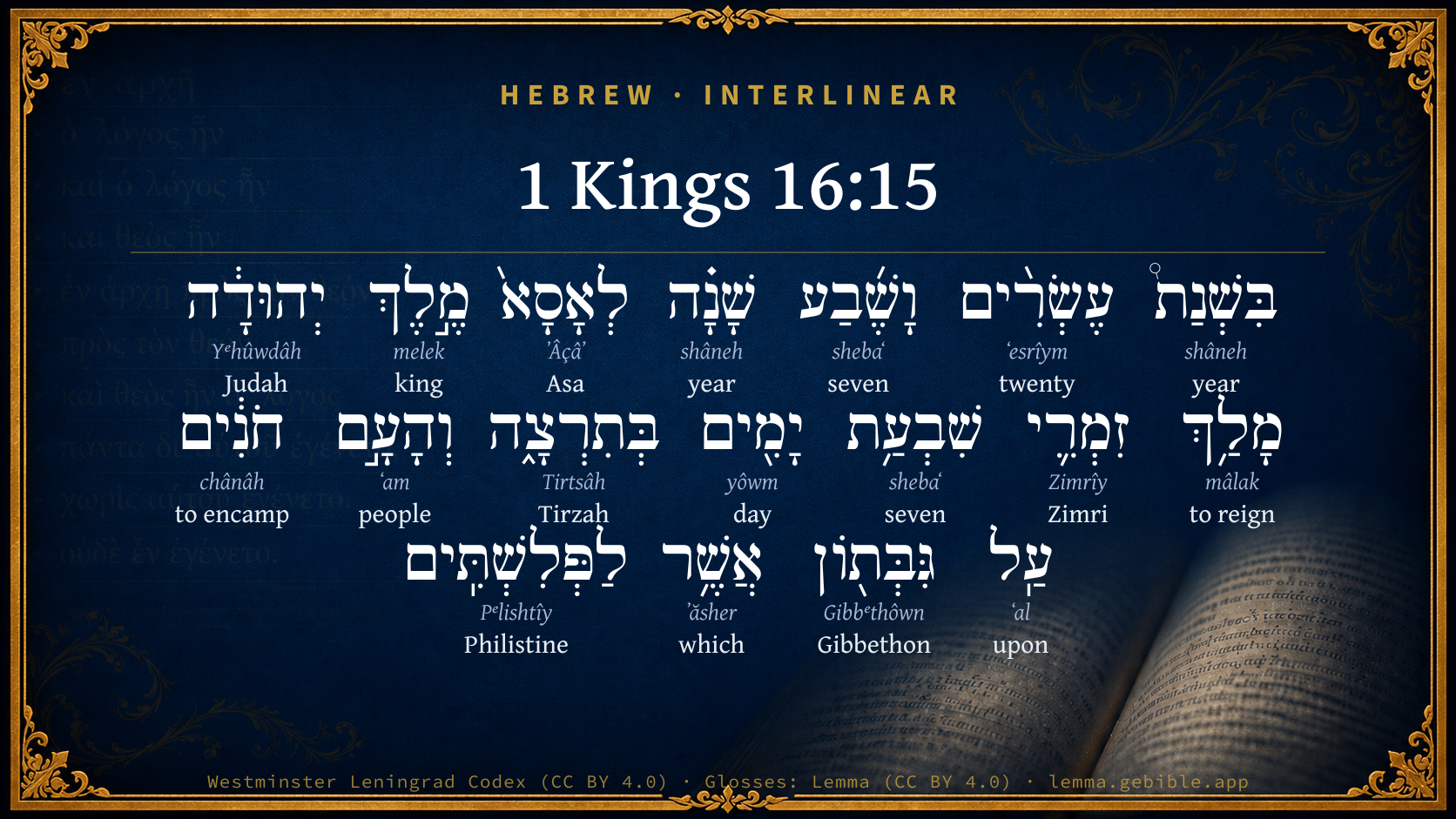
Hebrew (Westminster Leningrad Codex) 1 Kings 16:15 appears in the Hebrew Old Testament. The text above is from the Westminster Leningrad Codex. Each word links to its Strong’s number, a concise gloss, and parsing drawn from the Open Scriptures Hebrew Bible morphology. Click any word for its full Brown-Driver-Briggs (BDB) entry.
Download image
Cite this verse

1 Kings 16:15 (World English Bible). Public Domain. Lemma interlinear Bible study tool, https://lemma.gebible.app/v/1-kings/16/15.

Show BibTeX & RIS
BibTeX
RIS
English Translation
In the twenty-seventh year of Asa king of Judah did Zimri reign seven days in Tirzah. Now the people were encamped against Gibbethon, which belonged to the Philistines.
World English Bible · Public Domain
Download a study sheet

One document with this verse’s original text, its word-by-word gloss line, the meaning frame, cross-references with their text, attributed commentary, and full source and license credits — printable, and it pastes into notes with its structure intact.

This verse Autodidact and up

Study sheet (.html) Plain text (.txt)

A passage Seminary Student

Up to 50 verses in one chapter. A passage sheet keeps up to 6 commentary sources and 12 cross-references per verse, in the order this page ranks them, and says so on the sheet whenever that leaves anything out. Ask for a single verse and you get the Autodidact verse sheet above.

Everything on this page stays free to read, with no account — the sheet is a download of what is already on screen, not access to it.

Want to remove ads? Support Godless Engineer
Compare translations 3

The same verse in 3 English versions, stacked beneath the original-language interlinear above. Click any original word for its lexicon entry.

Each is an independent rendering of the whole verse — the interlinear is not word-aligned to these translations.

Highlighted words mark where these versions differ — a whole-verse word diff, not a word-by-word alignment.

  • World English Bible Public Domain
    In the twenty-seventh year of Asa king of Judah did Zimri reign seven days in Tirzah. Now the people were encamped against Gibbethon, which belonged to the Philistines.
  • King James Version Public Domain
    In the twenty and seventh year of Asa king of Judah did Zimri reign seven days in Tirzah. And the people were encamped against Gibbethon, which belonged to the Philistines.
  • unfoldingWord Literal Text CC BY-SA 4.0
    In the year of 27, the year to Asa, the king of Judah, Zimri reigned seven days in Tirzah. Now the people camping against Gibbethon, which to the Philistines.

unfoldingWord Literal Text — © unfoldingWord, licensed CC BY-SA 4.0. Word-aligned USFM3 via Door43 (git.door43.org/unfoldingWord/en_ult).

Versions to compare (up to 4)

3 of 4 selected

Show all 18 translations

Every available English version of this verse, each an independent rendering of the whole verse.

  • World English Bible Public Domain
    In the twenty-seventh year of Asa king of Judah did Zimri reign seven days in Tirzah. Now the people were encamped against Gibbethon, which belonged to the Philistines.
  • Berean Standard Bible Public Domain
    In the twenty-seventh year of Asa’s reign over Judah, Zimri reigned in Tirzah for seven days. Now the troops were encamped against Gibbethon of the Philistines,
  • Majority Standard Bible Public Domain
    In the twenty-seventh year of Asa’s reign over Judah, Zimri reigned in Tirzah for seven days. Now the troops were encamped against Gibbethon of the Philistines,
  • King James Version Public Domain
    In the twenty and seventh year of Asa king of Judah did Zimri reign seven days in Tirzah. And the people were encamped against Gibbethon, which belonged to the Philistines.
  • American Standard Version (1901) Public Domain
    In the twenty and seventh year of Asa king of Judah did Zimri reign seven days in Tirzah. Now the people were encamped against Gibbethon, which belonged to the Philistines.
  • Revised Version (1885) Public Domain
    In the twenty and seventh year of Asa king of Judah did Zimri reign seven days in Tirzah. Now the people were encamped against Gibbethon, which belonged to the Philistines.
  • Geneva Bible (1599) Public Domain
    In the seuen and twentie yeere of Asa King of Iudah did Zimri reigne seuen dayes in Tirzah, and the people was then in campe against Gibbethon, which belonged to the Philistims.
  • Douay-Rheims (1899) Public Domain
    In the seven and twentieth year of Asa king of Juda, Zambri reigned seven days in Thersa: now the army was besieging Gebbethon a city of the Philistines.
  • Young's Literal Translation Public Domain
    In the twenty and seventh year of Asa king of Judah, reigned hath Zimri seven days in Tirzah; and the people are encamping against Gibbethon, which `is' to the Philistines;
  • Literal Standard Version CC BY-SA 4.0
    In the twenty-seventh year of Asa king of Judah, Zimri has reigned seven days in Tirzah; and the people are encamping against Gibbethon, which [belonged] to the Philistines;
  • Unlocked Literal Bible CC BY-SA 4.0
    In the twenty-seventh year of Asa king of Judah, Zimri reigned only for seven days in Tirzah. Now the army was camped by Gibbethon, which belonged to the Philistines.
  • unfoldingWord Literal Text CC BY-SA 4.0
    In the year of 27, the year to Asa, the king of Judah, Zimri reigned seven days in Tirzah. Now the people camping against Gibbethon, which to the Philistines.
  • Darby Bible Public Domain
    In the twenty-seventh year of Asa king of Judah, Zimri reigned seven days in Tirzah. Now the people were encamped against Gibbethon, which [belonged] to the Philistines.
  • World Messianic Bible Public Domain
    In the twenty-seventh year of Asa king of Judah, Zimri reigned seven days in Tirzah. Now the people were encamped against Gibbethon, which belonged to the Philistines.
  • Webster's Bible Public Domain
    In the twenty and seventh year of Asa king of Judah did Zimri reign seven days in Tirzah. And the people were encamped against Gibbethon, which belonged to the Philistines.
  • Free Bible Version CC BY-SA 4.0
    Zimri became king of Israel in the twenty-seventh year of the reign of King Asa of Judah. He reigned in Tirzah seven days. At that time the Israelite army was attacking the Philistine town of Gibbethon.
  • Bible in Basic English Public Domain
    In the twenty-seventh year of Asa, king of Judah, Zimri was king for seven days in Tirzah. Now the people were attacking Gibbethon in the land of the Philistines.
  • JPS Tanakh (1917) Public Domain
    In the twenty and seventh year of Asa king of Judah did Zimri reign seven days in Tirzah. Now the people were encamped against Gibbethon, which belonged to the Philistines.

Literal Standard Version (2020), Covenant Press — licensed CC BY-SA 4.0. Text via the HelloAO Bible API (eBible.org). Unlocked Literal Bible (unfoldingWord) — licensed CC BY-SA 4.0. Text via the HelloAO Bible API (eBible.org). unfoldingWord Literal Text — © unfoldingWord, licensed CC BY-SA 4.0. Word-aligned USFM3 via Door43 (git.door43.org/unfoldingWord/en_ult). Free Bible Version, Dr. Jonathan Gallagher — licensed CC BY-SA 4.0. Text via the HelloAO Bible API (eBible.org).

Word by word

More ways to search: Search by grammar → Find every occurrence → Compare this word →

Practice this passage: Drill this verse → Learn its vocabulary →

גִּבְּת֖וֹן
Gibbᵉthôwn
H1405
“Gibbethon”
Noun, Proper
Part of Speech
Noun
Type
Proper
Full BDB Definition

Origin: intensive from H1389

TWOT: None

Gibbethon = "mound" - a Philistine town in Dan allocated to the Kohathite Levites
  1. בִּשְׁנַת֩ shâneh H8141 “in/at · year of” Preposition + Noun, Common, Feminine, Singular, Construct
  2. עֶשְׂרִ֨ים ʻesrîym H6242 “twenty” Adjective, Cardinal number, Both, Plural, Absolute
  3. וָשֶׁ֜בַע shebaʻ H7651 “and · seven” Conjunction + Adjective, Cardinal number, Feminine, Singular, Absolute
  4. שָׁנָ֗ה shâneh H8141 “year” Noun, Common, Feminine, Singular, Absolute
  5. לְאָסָא֙ ʼÂçâʼ H609 “to/for · Asa” Preposition + Noun, Proper
  6. מֶ֣לֶךְ melek H4428 “king of” Noun, Common, Masculine, Singular, Construct
  7. יְהוּדָ֔ה Yᵉhûwdâh H3063 “Judah” Noun, Proper
  8. מָלַ֥ךְ mâlak H4427 “to reign” Verb, Qal, Perfect, 3rd Person, Masculine, Singular
  9. זִמְרִ֛י Zimrîy H2174 “Zimri” Noun, Proper
  10. שִׁבְעַ֥ת shebaʻ H7651 “seven” Adjective, Cardinal number, Masculine, Singular, Construct
  11. יָמִ֖ים yôwm H3117 “days” Noun, Common, Masculine, Plural, Absolute
  12. בְּתִרְצָ֑ה Tirtsâh H8656 “in/at · Tirzah” Preposition + Noun, Proper
  13. וְהָעָ֣ם ʻam H5971 “and · the · people” Conjunction + Particle, Definite Article + Noun, Common, Masculine, Singular, Absolute
  14. חֹנִ֔ים chânâh H2583 “encamping” Verb, Qal, Participle Active, Masculine, Plural, Absolute
  15. עַֽל ʻal H5921 “upon” Preposition
  16. אֲשֶׁ֥ר ʼăsher H834 “which” Particle, Relative
  17. לַפְּלִשְׁתִּֽים Pᵉlishtîy H6430 “to/for the · Philistines” Preposition, Determined + Noun, Gentilic, Masculine, Plural, Absolute

About this verse

These counts appear in no published source. They are computed here, from the morphology-tagged text and Lemma’s own curated glosses. What Lemma adds →

18
words
16
distinct lemmas
Historical
section

Notable vocabulary

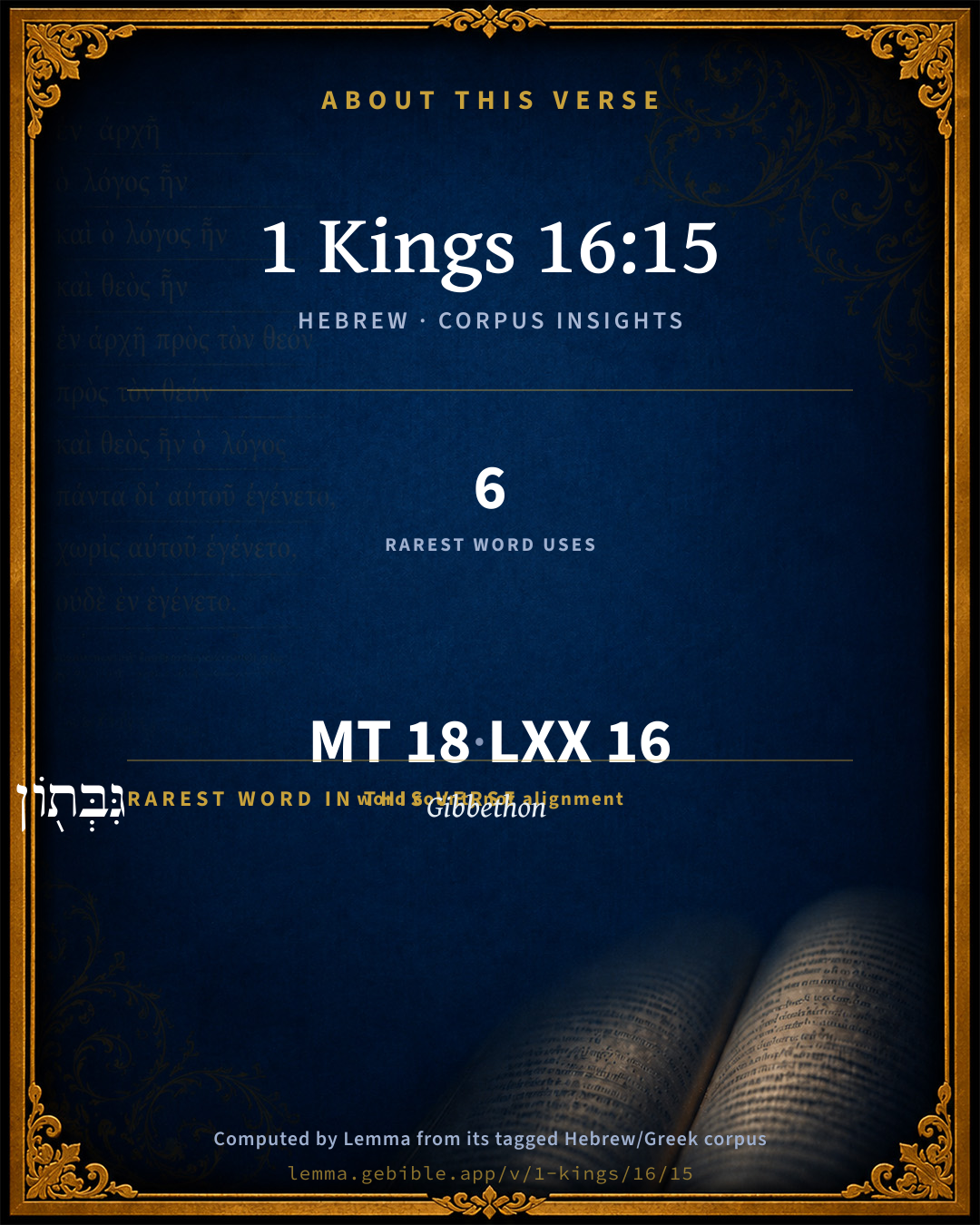
The rarest word here is גִּבְּת֖וֹן Gibbethon H1405 — appearing just 6 times in the whole Hebrew Bible.

Shared distinctive vocabulary

גִּבְּת֖וֹן Gibbethon H1405 occurs in 5 verses of the Hebrew Bible. Also found in:

Grammatical profile

  • 2 verbs
  • 11 nouns
  • 3 adjectives
  • 1 preposition
  • 1 particle

Verb forms

  • מָלַ֥ךְ Qal · Perfect
  • חֹנִ֔ים Qal · Participle Active

Repetition

Words recur within this verse — often emphatic in Hebrew:

  • בִּשְׁנַת֩ year H8141 ×2
  • וָשֶׁ֜בַע seven H7651 ×2

Hebrew & Septuagint length

In English translation the verse runs 28 words from the Hebrew and 19 from the Septuagint (LXX English) — the Septuagint runs noticeably shorter here. See the side-by-side →

A rough comparison of the two English renderings, which tokenize alike — not a word-level alignment.

Word counts can differ between the Hebrew and the Greek without any difference in meaning — e.g. the Hebrew direct-object marker אֵת has no separate Greek word, and Greek often adds the article ὁ.

In the original languages it is 18 Hebrew tokens and 16 Greek tokens — but the two are counted differently (Hebrew bundles its prefixes and suffixes into one token; the Greek is in lemma form), so that isn’t a like-for-like length.

Cross-references

7

Topical passages linked to 1 Kings 16:15 in the Treasury of Scripture Knowledge — connected by theme and wording, ordered by reader-vote popularity; previews shown in the World English Bible.

  • 1 Kings 15:27 Baasha the son of Ahijah, of the house of Issachar, conspired against him; and Baasha struck him at Gibbethon, which belonged to the Philistines; for Nadab and all Israel were laying siege to Gibbethon.
  • Joshua 19:44 and Eltekeh, and Gibbethon, and Baalath,
  • Joshua 21:23 Out of the tribe of Dan, Elteke with its suburbs, Gibbethon with its suburbs,
  • 1 Kings 16:8 In the twenty-sixth year of Asa king of Judah began Elah the son of Baasha to reign over Israel in Tirzah, [and reigned] two years.
  • 2 Kings 9:31 As Jehu entered in at the gate, she said, Is it peace, you Zimri, your master's murderer?
  • Job 20:5 That the triumphing of the wicked is short, The joy of the godless but for a moment?
  • Psalms 37:35 I have seen the wicked in great power, Spreading himself like a green tree in its native soil.

Cross-references courtesy of OpenBible.info (CC BY 4.0).

Hebrew and Greek witnesses Masoretic Hebrew ↔ Greek Septuagint

The same verse in the two great witnesses to the Old Testament, shown verse-for-verse.

Here the Septuagint runs noticeably shorter than the Hebrew — LXX2012 (modern English Septuagint) 19 words vs World English Bible 28. A rough length comparison of the two English translations, not a word-level alignment — read both below.

These are two independent witnesses, not word-aligned to each other, and the Septuagint is shown in lemma (dictionary) form.

Hebrew 1 Kings 16:15 Masoretic · Westminster Leningrad Codex

בִּשְׁנַת֩ עֶשְׂרִ֨ים וָשֶׁ֜בַע שָׁנָ֗ה לְאָסָא֙ מֶ֣לֶךְ יְהוּדָ֔ה מָלַ֥ךְ זִמְרִ֛י שִׁבְעַ֥ת יָמִ֖ים בְּתִרְצָ֑ה וְהָעָ֣ם חֹנִ֔ים עַֽל גִּבְּת֖וֹן אֲשֶׁ֥ר לַפְּלִשְׁתִּֽים

In the twenty-seventh year of Asa king of Judah did Zimri reign seven days in Tirzah. Now the people were encamped against Gibbethon, which belonged to the Philistines.

World English Bible · Public Domain

Greek LXX 1 Kings 16:15 Septuagint · lemma form

καί ζαμβρι βασιλεύω ἑπτά ἡμέρα ἐν θερσα καί ὁ παρεμβολή ἰσραήλ ἐπί γαβαθων ὁ ὁ ἀλλόφυλος

And Zambri reigned in Thersa seven days: and the army of Israel was encamped against Gabathon of the Philistines.

LXX2012 (modern English Septuagint) · Public Domain

On this verse, The Cambridge Bible for Schools and Colleges discusses the Septuagint’s reading. Read the note in Commentary ↓

Hebrew: Westminster Leningrad Codex (CC BY 4.0). Greek: Septuagint (public domain); English from LXX2012 (modern English Septuagint) (Public Domain). How the Septuagint differs from the Hebrew →

Targum (Aramaic paraphrase)

1

The Targum is the ancient Jewish Aramaic paraphrase of the Hebrew Scriptures — an interpretive translation, not the Hebrew text itself. Onkelos (literal) and Pseudo-Jonathan (expansive) render the Torah, and Jonathan the Prophets. Coverage is partial: where no permissively-licensed English translation exists for a verse, only the Aramaic is shown. This is verse-level text, not a word-by-word alignment to the Hebrew.

  1. Targum Jonathan Prophets (Joshua–Malachi)
    בִּשְׁנַת עַסְרִין וּשְׁבַע שְׁנִין לְאָסָא מֶלֶךְ שִׁבְטָא דְבֵית יְהוּדָה מְלַךְ זִמְרִי שַׁבְעָא יוֹמִין בְּתִרְצָה וְעַמָא שָׁרָן בְּגִבְּתוֹן דִי לִפְלִשְׁתָּאֵי:

    (no public-domain English translation for this verse)

    Targum Jonathan — Aramaic: “Mikraot Gedolot” (public domain). English: “Sefaria Community Translation” (CC0 1.0 (public-domain dedication)); “London "Chaldee Paraphrase," 1871” (public domain). Text via Sefaria.

Commentary

Notes on 1 Kings 16:15 from classic Christian and Jewish commentators (each source and its license shown beneath its notes). The classic Christian expositions comment on the surrounding passage and are grouped to its opening verse, so a note may address several verses; the Jewish commentaries on the Tanakh (Rashi and others) are per-verse, so they appear only where the commentator wrote on this verse.

Lemma curates 59 commentaries, every one of them public domain or Creative Commons licensed, each selected and text-cleaned for this edition rather than reprinted as found. About our sources →

Matthew Henry's Commentary

Solomon observes (Pro 28:2) that for the transgression of a land many were the princes thereof (so it was here in Israel), but by a man of understanding the state thereof shall be prolonged - so it was with Judah at the same time under Asa. When men forsake God they are out of the way of rest and establishment. Zimri, and Tibni, and Omri, are here striving for the crown. Proud aspiring men ruin one another, and involve others in the ruin. These confusions end in the settlement of Omri; we must therefore take him along with us through this part of the story.

I. How he was chosen, as the Roman emperors often were, by the army in the field, now encamped before Gibbethon. Notice was soon brought thither that Zimri had slain their king (Kg1 16:16) and set up himself in Tirzah, the royal city, whereupon they chose Omri king in the camp, that they might without delay avenge the death of Elah upon Zimri. Though he was idle and intemperate, yet he was their king, and they would not tamely submit to his murderer, nor let the treason go unpunished. They did not attempt to avenge the death of Nadab upon Baasha, perhaps because the house of Baasha had ruled with more gentleness than the house of Jeroboam; but Zimri shall feel the resentments of the provoked army. The siege of Gibbethon is quitted (Philistines are sure to gain when Israelites quarrel) and Zimri is prosecuted.

II. How he conquered Zimri, who is said to have reigned seven days (Kg1 16:15), so long before Omri was proclaimed king and himself proclaimed traitor; but we may suppose it was a longer time before he died, for he continued long enough to show his inclination to the way of Jeroboam, and to make himself obnoxious to the justice of God by supporting his idolatry, Kg1 16:19. Tirzah was a beautiful city, but not fortified, so that Omri soon made himself master of it (Kg1 16:17), forced Zimri into the palace, which being unable to defend, and yet unwilling to surrender, he burnt, and himself in it, Kg1 16:18. Unwilling that his rival should ever enjoy that sumptuous palace, he burnt it; and fearing that if he fell into the hands of the army, either alive or dead, he should be ignominiously treated, he burnt himself in it. See what desperate practices men's wickedness sometimes brings them to, and how it hurries them into their own ruin; see the disposition of incendiaries, who set palaces and kingdoms on fire, though they are themselves in danger of perishing in the flame.

III. How he struggled with Tibni, and at length got clear of him: Half of the people followed this Tibni (Kg1 16:21), probably those who were in Zimri's interest, with whom others joined, who would not have a king chosen in the camp (lest he should rule by the sword and a standing army), but in a convention of the states. The contest between these two lasted some years, and, it is likely, cost a great deal of blood on both sides, for it was in the twenty-seventh year of Asa that Omri was first elected (Kg1 16:15) and thence the twelve years of his reign are to be dated; but it was not till the thirty-first year of Asa that he began to reign without a rival; then Tibni died, it is likely in battle, and Omri reigned, Kg1 16:22. Sir Walter Raleigh, in his History of the World (2.19.6), enquires here why it was that in all these confusions and revolutions of the kingdom of Israel they never thought of returning to the house of David, and uniting themselves again to Judah, for then it was better with them than now; and he thinks the reason was because the kings of Judah assumed a more absolute, arbitrary, and despotic power than the kings of Israel. It was the heaviness of the yoke that they complained of when they first revolted from the house of David, and the dread of that made them ever after averse to it, and attached to kings of their own, who ruled more by law and the rules of a limited monarchy.

IV. How he reigned when he was at length settled on the throne. 1. He made himself famous by building Samaria, which, ever after, was the royal city of the kings of Israel (the palace at Tirzah being burnt), and in process of time grew so considerable that it gave name to the middle part of Canaan (which lay between Galilee on the north and Judea on the south) and to the inhabitants of that country, who were called Samaritans. He bought the ground for two talents of silver, somewhat more than 700l. of our money, for a talent was 353l. 11s. 10 1/2d. Perhaps Shemer, who sold him the ground, let him have it considerably the cheaper upon condition that the city should be called after his name, for otherwise it would have borne the name of the purchaser; it was called Samaria, or Shemeren (as it is in the Hebrew), from Shemer, the former owner, Kg1 16:24. The kings of Israel changed their royal seats, Shechem first, then Tirzah, now Samaria; but the kings of Judah were constant to Jerusalem, the city of God. Those that cleave to the Lord fix, but those that leave him ever wander. 2. He made himself infamous by his wickedness; for he did worse than all that were before him, Kg1 16:25. Though he was brought to the throne with much difficulty, and Providence had remarkably favoured him in his advancement, yet he was more profane, or more superstitious, and a greater persecutor, than either of the houses of Jeroboam or Baasha. He went further than they had done in establishing iniquity by a law, and forcing his subjects to comply with him in it; for we read of the statutes of Omri, the keeping of which made Israel a desolation, Mic 6:16. Jeroboam caused Israel to sin by temptation, example, and allurement; but Omri did it by compulsion.

V. How he ended his reign, Kg1 16:27, Kg1 16:28. He was in some repute for the might which he showed. Many a bad man has been a stout man. He died in his bed, as did Jeroboam and Baasha themselves; but, like them, left it to his posterity to fill up the measure, and then pay off the scores, of his iniquity.

Matthew Henry's Commentary on the Whole Bible (1708–1710) — public domain (CC PDM 1.0). Text via the HelloAO Bible API.

Trapp's Complete Commentary

John Trapp

1Ki 16:15 In the twenty and seventh year of Asa king of Judah did Zimri reign seven days in Tirzah. And the people [were] encamped against Gibbethon, which [belonged] to the Philistines.

Ver. 15. Did Zimri reign seven days.] God quickly wore this rod of his wrath to the stumps, and then cast it into the fire.

John Trapp, A Commentary or Exposition upon All the Books of the Old and New Testament (1647–1656) — public domain. Text from a community e-Sword module.

Joseph Benson's Commentary

1Ki 16:15-17. The people were encamped against Gibbethon — Which had been besieged many years before, but, it seems, was then relieved or afterward recovered by the Philistines, while the Israelites were in a distracted condition through civil broils and contentions. It was, however, now again invested. The people heard say, Zimri has conspired, &c. — Notice was soon brought to the camp that Zimri had slain their king, and set up himself in Tirzah, the royal city; whereupon they chose Omri king in the camp, that they might, without delay, avenge the death of Elah upon Zimri. Thus proud aspiring men ruin one another, and involve others in ruin. Omri went up from Gibbethon — The siege of which was instantly quitted. And all Israel with him — All the army that were at the siege.

Joseph Benson's Commentary on the Old and New Testaments (1811–1818) — public domain. Text from a community e-Sword module.

Whedon's Commentary on the Bible

Daniel D. Whedon

ZIMRI’S REIGN, 1Ki_16:15-20.

15. Zimri… seven days — This is the shortest reign on record. Short lived are the glories bought by bloody hands. In this case divine vengeance followed so speedily that there needed no prophet to utter it in word.

The people… encamped against Gibbethon — This siege, begun by Nadab, was continued still. Compare 1Ki_15:27. Evidently the possession of that city was much desired by the kings of Israel.

Daniel D. Whedon (gen. ed.), Commentary on the Old and New Testaments (1874–1909) — public domain. Text from a community e-Sword module.

The Preacher's Complete Homiletical Commentary

Joseph S. Exell (gen. ed.)

CRITICAL AND EXPLANATORY NOTES.—

1Ki_16:15. Did Zimri reign seven days—A brief possession of a throne won by such criminal deeds! The Israelites repudiated the villainous usurper.

1Ki_16:18. Into the palace of the king’s house—אֲרְמוֹן means the highest place in the king’s house; “the fortress of the palace, the securest and inmost place; for the royal palace contained a great number of buildings” (Gesenius). Burnt the king’s house over him—The Syriac says, the besiegers fired the royal house over his head.

1Ki_16:19. For his sins … and in walking in the way of Jeroboam—As he only reigned “seven days,” this must refer to his previous career, although “the sins which he sinned” well describe his sanguinary deeds in seizing the throne.

1Ki_16:22. So Tibni died, and Omri reigned—According to Josephus (Antiq. viii. 12, 5), Tibni was slain; which seems the necessary termination of the struggle. The phrase, “So he died,” does not allow of the thought of a natural death, whereby Tibni conveniently left the position unchallenged to Omri; but a forced conclusion of the rivalry by the death of Tibni. However, וַיָּמָת does not definitely indicate a violent death.

1Ki_16:24. Bought the hill Samaria of Shemer—The “two talents of silver” purchase price equal less than £700. Thus this hill became the site of the royal residences of the kings of Israel, and Samaria the capital of the kingdom of Israel, until Israel was dispersed and the kingdom ceased. Stanley says of this site: In the centre of a wide amphitheatre of mountains, about six miles from Shechem, rises an oblong hill, with steep yet accessible sides, and a long flat top extending east and west, and rising 500 or 600 feet above the valley. Knobel says: It was a beautiful round mountain, covered with splendid trees, commanding a lorious prospect of the fruitful valley and the heights and villages surrounding it. Layard tells us a tablet was dug from the ruins of Nineveh relating to Samaria, thereon called Beth-Khumri, the house of Omri.

HOMILETICS OF 1Ki_16:15-28

SIN THE PROLIFIC SOURCE OF NATIONAL CALAMITIES

I. It degrades the throne and vitiates its authority (1Ki_16:15-20). It places the crown at the disposal of ambitious adventurers. At this period in the history of Israel there is a remarkable resemblance to the events which led to the accession of the Flavian dynasty at Rome; and the character and career of the Roman Galba, Otho, Vitellius, and Vespasian bear a curious similarity to the Israelitish Elah, Zimri, Tibni, and Omri. Whoever could best succeed in bribing the army was sure to gain the crown; and the monarch for the time being used his exalted position and power for purposes of personal indulgence and debauchery. “It is an abomination to kings to commit wickedness; for the throne is established by righteousness” (Pro_16:12).

He’s a king,

A true, right king, that dare do aught save wrong;

Fears nothing mortal but to be unjust:

Who is not blown up with flattering puffs

Of spongy sycophants; who stands unmoved

Despite the jostling of opinion.

But where sin is triumphant, and justice and righteousness are disregarded, no throne can be stable. The very army which has elevated the monarch may be the instrument of his fall and ruin. Sin tarnishes the crown, breaks the sceptre of authority, and weakens the whole nation. The usurper is often the dupe of his own wickedness. You smile when you see a child trying to grasp its own shadow; but how many have been grasping shadows all their lives, and will continue to reach out and grasp as long as breath and eyesight last!

II. It divides the people, and introduces all the horrors of civil war (1Ki_16:21-22). For four years the rival claimants of the crown carried on the fratricidal contest, and in all probability Tibni suffered a violent death. As soon as Zimri—Sardanapalus-like—came to such a suicidal end, it would appear that the authorities at Tirzah, disliking a military despotism, elected Tibni as king, and as the army had already elected Omri, the nation was plunged into all the miseries of civil war, which was terminated by Omri gaining the supremacy. Bitterly do the seceding tribes reap the fruits of evil sowing; for not only are they given up to idolatry, but are half swallowed up in anarchy. Both Tibni and Omri would have done well to refuse these proffered honours, considering what had befallen the kings that had gone before them. Macro, captain of the guard, and Laco, knight of the watch, Romans who had been active in ruining Sejanus, had great honours bestowed upon them by the Senate. But they refused them; and Dion attributed the reason of their refusal to the terrors of an example so fresh in their memories. “The nation from whose heart rectitude is gone, in whose soul vice runs riot, has its throne built on moral gunpowder.”

III. It encourages the ruling power to perpetrate acts of unexampled wickedness (1Ki_16:25-26). Omri “did worse than all that were before him.” Worse than Jeroboam, Nadab, Baasha, and Elah. He was an idolater in principle and in practice. He led the people to idolatry by precept and example; and he went beyond all his predecessors in legalising and enforcing idolatry upon his subjects by statutes, for we read in Mic_6:16, of “the statutes of Omri, the keeping of which made Israel a desolation.” Taking this in connection with the character which the historian ascribes to him, we cannot doubt, remarks Kitto, that these “statutes of Omri,” which were but too well maintained by his successors and observed by the subjects of his kingdom, were measures adopted for more completely isolating the people of Israel from the services of the House of the Lord at Jerusalem, and for perpetuating, perhaps increasing, their idolatrous practices. Jeroboam made Israel to sin by temptation, example, and allurement; but Omri did it by compulsion. Thus when a people forsake God, they go from worse to worse, till destruction comes upon them to the uttermost.

LESSONS:—

1. The frequent end of ambitious projectors is to perish in the flames they have themselves kindled.

2. Envy and revenge, even in death, forsake not the wicked.

3. Of all inflictions on a nation, none are more terrible than civil wars.

GERM NOTES ON THE VERSES

1Ki_16:15-20. The vanity of an ill-gotten success. I. An ill-gotten success is evanescent in its character (1Ki_16:15). II. Creates numerous enemies (1Ki_16:16). III. Has to contend with violent opposition (1Ki_16:17). IV. Drives to acts of desperation (1Ki_16:18). V. Brings its own inevitable punishment (1Ki_16:19). VI. Acquires an unenviable notoriety (1Ki_16:20).

1Ki_16:18. Despair. I. Often the result of baffled ambition. II. Is one of the sharpest stings of a guilty conscience. III. Is associated with the bitterest feelings of hatred and revenge. IV. Frequently ends in suicide.

—The doom of despair is the end of a life given over to sin, which has lost sight of the living God, and can never again find Him. Frequently what the world regards as heroism and contempt of death is simply cowardice and crime in the sight of God. The Lord has no pleasure, &c. (Eze_18:23). It requires more courage and bravery to bear the merited punishment of one’s sins than to escape from it by suicide.

—Zimri’s desperate act has been repeated more than once in the world’s history. That the last king of Assyria, the Sardanapalus of the Greeks, thus destroyed himself, is almost the only fact which we know concerning him. Herodotus gives a similar account of a contemporary of his, a certain Boges, a Persian general left by Xerxes to defend Eïon when he retired from Europe after Salamis. He also relates that the Xanthians, when pressed by Harpagus, burnt their wives, their children, and their slaves in the Acropolis, and then threw themselves on the Persian swords.

1Ki_16:21-22. Anarchy. I. The inevitable consequence of national irreligion. II. Is fomented and sustained by incompetent and unscrupulous rulers. III. Is not suppressed without much cruelty and suffering.

1Ki_16:23-28. The power of a wicked life. I. Is the more dangerous when associated with material prosperity (1Ki_16:24). II. Transforms a king into a tyrant (1Ki_16:25-26). III. Is the less excusable in a man of valour and capacity (1Ki_16:27). IV. Is transmitted to succeeding generations (1Ki_16:28).

1Ki_16:24-26. Omri built Samaria, making it the strong centre of the kingdom; but he walked in all the sins of Jeroboam, and did worse than all who went before him. It is not said in what respect he was worse, but it certainly implies that he maintained the anti-theocratic institutions of Jeroboam with great zeal and decision. It appears that he stood well as captain of the army, for it was in the camp that he was elected to the throne. Yet, however valiant he may have been as a warrior, in the chief thing—namely, in his relation to Jehovah and the theocratic fundamental law—he stood worse than any of his predecessors, and was furthest from being what was especially required of a theocratic king, that is, a servant of Jehovah. A man may be skilful and useful to himself and others in all material and worldly things, whilst in spiritual and divine things he works only mischief and destruction. What, without religion, is so-called civilization?—Lange.

The Preacher's Complete Homiletical Commentary (gen. ed. Joseph S. Exell; Funk & Wagnalls, c. 1892) — public domain (pre-1929). A full-Bible homiletical/sermon-outline anthology covering 65 of 66 books (2 John is absent from the source module). Text from a community e-Sword module.

Tyndale Open Study Notes

Tyndale Open Resources

16:15-17 Although Zimri commanded half of the royal chariots (16:9), he was in Tirzah rather than with the army . . . attacking . . . Gibbethon. He apparently did not have the respect of the armed forces; they saw his acts as treason and chose their commander Omri as the new king of Israel.

Tyndale Open Study Notes — © Tyndale Open Resources, licensed CC BY-SA 4.0. Text via the HelloAO Bible API.

Geneva Bible (1599)

Geneva Bible translators

The siege had continued from the time of Nadab Jeroboam’s son.

Geneva Bible (1599) marginal notes — public domain. Text via Bolls.life.

Jamieson, Fausset & Brown

Robert Jamieson, A. R. Fausset & David Brown

did Zimri reign seven days--The news of his conspiracy soon spread, and the army having proclaimed their general, Omri, king, that officer immediately raised the siege at Gibbethon and marched directly against the capital in which the usurper had established himself. Zimri soon saw that he was not in circumstances to hold out against all the forces of the kingdom; so, shutting himself up in the palace, he set it on fire, and, like Sardanapalus, chose to perish himself and reduce all to ruin, rather than that the palace and royal treasures should fall into the hands of his successful rival. The seven days' reign may refer either to the brief duration of his royal authority, or the period in which he enjoyed unmolested tranquillity in the palace.

Jamieson, Fausset & Brown — Commentary Critical and Explanatory on the Whole Bible (1871) — public domain (CC PDM 1.0). Text via the HelloAO Bible API.

Adam Clarke's Commentary

Verse 15. The people were encamped against Gibbethon] It appears that, at this time, the Israelites had war with the Philistines, and were now besieging Gibbethon, one of their cities. This army, hearing that Zimri had rebelled and killed Elah, made Omri, their general, king, who immediately raised the siege of Gibbethon, and went to attack Zimri in the royal city of Tirzah; who, finding his affairs desperate, chose rather to consume himself in his palace than to fall into the hands of his enemies.

Adam Clarke's Commentary on the Bible (1810–1826) — public domain. Text from a community e-Sword/MySword module.

The Cambridge Bible for Schools and Colleges

gen. ed. J. J. S. Perowne

15–20. Zimri king of Israel. Omri proclaimed king by the army (Not in Chronicles)

15. In the twenty and seventh year of Asa king of Judah] The chronological note is omitted by the LXX.

And [R.V. Now] the people were encamped against Gibbethon] The LXX. explains ‘the people’ by ἡ παρεμβολὴ = the camp. It was, of course, only the army and camp-followers who were away in the land of the Philistines. Apparently the attempt to wrest Gibbethon from the Philistines had continued from the time of Nadab. But the vicissitudes of the northern kingdom had been many, and such as to hinder the prosecution of any campaign.

The Cambridge Bible for Schools and Colleges (gen. ed. J. J. S. Perowne; Cambridge University Press, 1878–1918) — public domain. Text from a community e-Sword module.

John Gill's Exposition

For his sins which he sinned in doing evil in the sight of the Lord,.... In the former part of his life, as well as now:

in walking in the way of Jeroboam, and in his sin which he did to make Israel sin; worshipping the golden calves, which he might do while a captain of the chariots, and also since he usurped the crown, sacrificing to them by way of thanksgiving, for being in possession of the kingdom; and though his reign was so short, he might give plain and strong intimations that he should continue the worship of idols.

John Gill's Exposition of the Whole Bible (1746–1763) — public domain (CC PDM 1.0). Text via the HelloAO Bible API.

Matthew Poole's English Annotations

Which had been besieged before, 1Ki 15:27, but, it seems, was then relieved, or afterwards recovered by the Philistines, taking the advantage of the disorders and contentions which were among their enemies.

Matthew Poole's English Annotations on the Holy Bible (1683–1685) — public domain. Text from a community e-Sword/MySword module.

The Pulpit Commentary

In the twenty and seventh year of Asa king of Judah did Zimri reign The same word elsewhere translated in A.V began to reign. It is really an aorist = succeeded to the throne seven days in Tirzah. And the people were encamped Heb. encamping against Gibbethon, which belonged to the Phistines. It has at first sight a suspicious look that two kings of Israel, within an interval of about twenty-five years, should have been slain by conspirators during a siege of this place. But when the narrative is examined, its probability and consistency become at once apparent. Stanley assumes that the siege lasted over the whole of this period, but it is more likely that when Baasha found himself king, he discovered that he had domestic matters enough upon his hands, without a foreign war, and so he raised the siege. It is very probable that he feared opposition such as Zimri and Omri subsequently experienced. And his wars with Asa and with Syria may well have prevented his renewing the undertaking. On the accession of Elah, however, with the usual ambition and impetuosity of youth, it was decided to recommence the siege and to win this city back for Israel. But the fate of Nadab, and the consequent ill omen attaching to the place would not be forgotten, and this, as well as his voluptuous habits, may have deterred the faineant Elah from besieging it in person, while the conspiracy which marked the former siege may at the same time have suggested to Zimri and others the thought of conspiring against Elah.

HOMILIES NY J.A. MACDONALD

Vers. 15-22.

The Kingdom of Men.

Though "the Most High ruleth in the kingdom of men," yet is He not responsible for the principles by which such kingdoms are actuated. For these are in shaking contrast to those which shall obtain in the "kingdom of God." In the kingdom of men as represented in the specimen before us we encounter

I FOLLY.

1. True religion is pure wisdom.

(1) It is the "wisdom of God" revealed outwardly, in His wordinwardly, by being written by His Spirit in the heart.

(2) To encourage this is man"s highest wisdom. Godliness has promise of this life of that to come.

2. False religion is supreme folly.

(1) It is in some respects even worse than no religion. It is more than a negation in respect to truth; it is pertinacious antagonism to truth.

(2) It is folly in relation to the highest interests of man. It demoralizes in the proportion of its ascendancy. It forfeits the heaven it professes to seek. It aggravates the hell it professes to avoid.

(3) It expresses itself in vanity. What more vain than the idols of the heathen? The very forms of those idols evince the monstrosity of folly. Witness a monkey or an onion for a God; a fish with a man"s head; a satyr; a griffin! (see Deu_32:21; Isa_41:29)

3. Of such folly was the kingdom of Israel flagrantly guilty.

(1) The calves with which they so deeply sinned were introduced by the kingcraft of Jeroboam.

(2) They are maintained by the kingcraft of all his successors, of whatever dynasty. Even Zimri, who only reigned seven days, and in those days was occupied in exterminating the house of Baasha, yet found time to pronounce himself in their favour.

(3) What a substitute for the Lord God of Israel who brought them up out of the land of Egypt!

II RESTLESSNESS.

1. Witnessed in frequent dynastic changes.

(1) The house of Jeroboam lasted twenty-four years. This gave place to that of Baasha, which lasted twenty-six. Zimri wore the crown seven days. Then came a four years" struggle for it between Omri and Tibni. At length "Tibni died and Omri reigned.

2. These changes represented strong passions.

(1) There was the impatience of the rule of the house of David which resulted in the revolution in favour of Jeroboam. Yet so little did they benefit by the change, that when Baasha destroyed that house they accepted, without a murmur, the rule of the regicide.

(2) But when Zimri treated the house of Baasha as Baasha had treated that of Jeroboam, they did not accept the second regicide. They now evinced some sense of right and wrong; but it was a wayward sense. There was no inquiry after the will of God. The army set up Omri, their general; but the civilians, apparently, chose Tibni. Here was a confusion which lasted until the death of one competitor.

3. These commotions were sanguinary.

(1) The division of the nation into two kingdoms induced civil war.

(2) Civil war also attended the treason of Zimri. For the army was occupied with the siege of Gibbethon when the news of this treason reached them, which determined them to raise the siege and invest Tirzah instead. The capture of Tirzah was not unbloody. A desperate character like Zimri would not tamely yield, when, rather than fall into the hands of Omri, he burnt the palace over his head and perished in the flames.

(3) The competition for the crown between Omri and Tibni protracted the civil war four years. Omri is not said to have resigned until the "thirty-first year of Asa, whereas Zimri"s treason occurred in the twenty-seventh year of Asa," upon which Omri was chosen by the army. (Compare vers. 15 and 23.) The difference here is about four years.

III CRIME.

1. Foremost under this head is idolatry.

(1) We mentioned this under the head of "folly," but it is not thereby removed from the category of "crime." Idolatry is the grossest and most direct insult to the living God.

(2) Hence no crime is in Scripture more heavily denounced and more signally obnoxious to punishment.

2. Next comes the capital crime of murder.

(1) As idolatry is the highest affront to God, so is murder the greatest offence against man.

(2) The crown of Israel was deeply stained with the blood of murder with that of the house of Jeroboam; with that of the house of Baasha.

(3) Suicide also disgraced these violent times. And the note is significant that in his suicide Zimri perished "for his sins which he sinned in doing evil in the sight of the Lord, in walking in the way of Jeroboam, and in his sin which he did to make Israel to sin" (vers. 18, 19). Note: Men with their own hands may punish their sin.

What a contrast is the kingdom of God! Its principles are peace, righteousness, and joy. Of this those have the earnest who in heart accept Jesus as their Melchisedec. J.A.M.

The Pulpit Commentary (1880–1919), ed. H.D.M. Spence-Jones & Joseph S. Exell — public domain. Text from a community e-Sword module.

John Wesley's Explanatory Notes

Gibbethon - Which had been besieged before, but, it seems, was then relieved, or afterwards recovered by the Philistines; taking the advantage of the disorders and contentions which were among their enemies.

John Wesley, Explanatory Notes Upon the Whole Bible (1754–1765) — public domain. Text via the GEBible commentary corpus.

Keil & Delitzsch

C. F. Keil & F. Delitzsch

The Reign of Zimri lasted only seven days. As soon as the people of war (העם), who were besieging Gibbethon (see at Kg1 15:27), heard of his conspiracy, his usurpation of the throne, and his murderous deeds, they proclaimed Omri king in the camp of the military commanders, and he at once, with all Israel, i.e., all the army, raised the siege of Gibbethon, to lay siege to Thirza. Now when Zimri saw that the city was taken, he went into the castle of the royal palace and burned the king's house over his own head, as Sardanapalus did, according to Justin (Hist. i. 3). ארמון does not mean harem (Ewald), but the high castle (from ארם, to be high); here and in Kg2 15:25, the citadel of the royal palace, which consisted of several buildings.

Keil & Delitzsch — Biblical Commentary on the Old Testament (1861–1891) — public domain (CC PDM 1.0). Text via the HelloAO Bible API. (Old Testament only.)

Kretzmann's Popular Commentary

Paul E. Kretzmann

The Rule of Zimri in Israel

v. 15. In the twenty and seventh year of Asa, king of Judah, did Zimri reign seven days in Tirzah, so long he was in undisturbed possession of the throne. And the people, the army of Israel, were encamped against Gibbethon, which belonged to the Philistines, and which Nadab had already tried to recover from the hands of the enemy.

v. 16. And the people that were encamped heard say, the rumor or the report came to the army, Zimri hath conspired, and hath also slain the king; wherefore all Israel, as represented in the army, the military party, made Omri, the captain of the host, king over Israel that day in the camp, they proclaimed him ruler over the northern nation.

v. 17. And Omri went up from Gibbethon and all Israel with him, he went on a campaign against the usurper of the throne, and they besieged Tirzah.

v. 18. And it came to pass, when Zimri saw that the city was taken, it being impossible for him to hold out against the besieging force, that he went into the palace of the king’s house, the citadel, the highest and strongest of the buildings included in the royal palace, and burned the king’s house over him with fire and died, preferring this death to that at the hands of the victorious army,

v. 19. for his sins which he sinned in doing evil in the sight of the Lord, in walking in the way of Jeroboam, and in his sin which he did to make Israel to sin; for even in these few days he had shown that he had no intention of doing away with the calf-worship introduced by Jeroboam.

v. 20. Now, the rest of the acts of Zimri, and his treason that he wrought, the manner in which he planned the removal of Baasha, are they not written in the Book of the Chronicles of the Kings of Israel?

v. 21. Then were the people of Israel, the entire northern nation, divided into two parts, the faction represented by the army and the party of the people: half of the people, the nonmilitary party, followed Tibni, the son of Ginath, to make him king; and half, the military party, followed Omri.

v. 22. But the people that followed Omri prevailed, his party gained the ascendancy, against the people that followed Tibni, the son of Ginath. So Tibni died, either by assassination or in battle, and Omri reigned, the opposition having no other man to take his place. All men who are blinded by sin act like the kings of Israel here described. They have warning examples in great number before their eyes, but they obstinately continue on their way to their own destruction.

Paul E. Kretzmann, Popular Commentary of the Bible (1921–1924) — public domain. Text from a community e-Sword module.

unfoldingWord translationNotes

Door43 World Missions Community

Tirzah

This is the name of a city. See how you translated it in 1 Kings 14:17.

the army was camped by Gibbethon

The word "army" refers to the army of the kingdom of Israel.

Gibbethon

This is the name of a city. See how you translated it in 1 Kings 15:27.

The army camped there heard it said

This can be stated in active form. AT: "The soldiers who camped there heard someone say" (See: Active or Passive)

all Israel

Both times this phrase is used, it represents the army of Israel. Here the word "all" is a generalization meaning "most." AT: "all the army of Israel" or "most of the soldiers in the army of Israel" or "the army of Israel" (See: Synecdoche and Hyperbole and Generalization)

translationWords

Asa

king

kingdom of Judah

reign

Philistines

kingdom of Israel

commander

unfoldingWord translationNotes — © Distant Shores Media and the Door43 World Missions Community, licensed CC BY-SA 4.0. Source: git.door43.org/Door43/en_tn.

Lesson kit

Teaching starters — assembled from the data on this page, not authored interpretation. Every prompt links to the verse data it draws on. Edit before teaching.

1 Kings, in the Historical, opens this verse with 18 words (16 distinct Hebrew lemmas). Its most distinctive word is Gibbᵉthôwn (“Gibbethon”). The Greek Septuagint runs shorter here. A historical commentator’s framing appears above. Read the whole chapter for the surrounding context.

Discussion questions

  1. What does “Gibbethon” (Gibbᵉthôwn) contribute to the verse as a whole?
  2. Joshua 19:44 shares the word «Gibbethon» with this verse. How do the two illuminate each other?
  3. “year” occurs 2× in this one verse. What is the effect of the repetition?
  4. Compared with the Hebrew, the Septuagint runs shorter here. What questions does that raise?
  5. These translations render this verse differently; the difference is in the English rendering, not the original. What questions does that raise?
  6. The verb «מָלַ֥ךְ» is Qal Perfect. How does its form color the action?
  7. Reading how Matthew Henry's Commentary and Trapp's Complete Commentary read this verse, where do the two commentators agree and where do they part?

Things to notice

Reading settings

Reading text

Shown beneath each verse's original-language words.

Old Testament
Old Testament edition

Read the OT as the Masoretic Hebrew (MT) or the Greek Septuagint (LXX).

English shown for the Greek Septuagint (in the Hebrew ↔ Greek comparison).

Comparing translations? Open the Compare panel on any verse page to stack up to four side by side.