Exodus 29:35

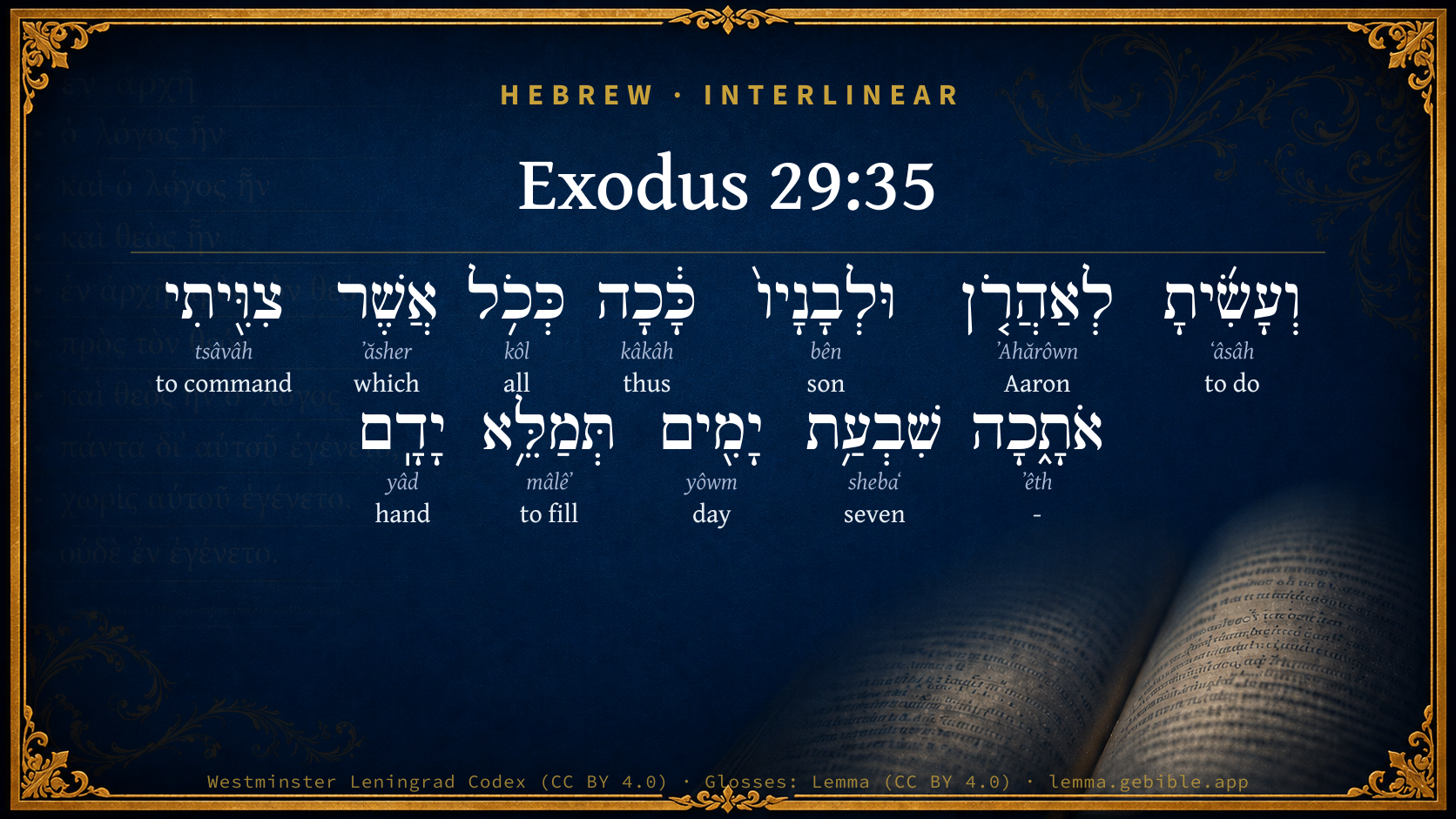
Hebrew (Westminster Leningrad Codex) Exodus 29:35 appears in the Hebrew Old Testament. The text above is from the Westminster Leningrad Codex. Each word links to its Strong’s number, a concise gloss, and parsing drawn from the Open Scriptures Hebrew Bible morphology. Click any word for its full Brown-Driver-Briggs (BDB) entry.
Download image
Cite this verse

Exodus 29:35 (World English Bible). Public Domain. Lemma interlinear Bible study tool, https://lemma.gebible.app/v/exodus/29/35.

Show BibTeX & RIS
BibTeX
RIS
English Translation
"Thus shall you do to Aaron, and to his sons, according to all that I have commanded you. Seven days shall you consecrate them.
World English Bible · Public Domain
Download a study sheet

One document with this verse’s original text, its word-by-word gloss line, the meaning frame, cross-references with their text, attributed commentary, and full source and license credits — printable, and it pastes into notes with its structure intact.

This verse Autodidact and up

Study sheet (.html) Plain text (.txt)

A passage Seminary Student

Up to 50 verses in one chapter. A passage sheet keeps up to 6 commentary sources and 12 cross-references per verse, in the order this page ranks them, and says so on the sheet whenever that leaves anything out. Ask for a single verse and you get the Autodidact verse sheet above.

Everything on this page stays free to read, with no account — the sheet is a download of what is already on screen, not access to it.

Want to remove ads? Support Godless Engineer
Compare translations 3

The same verse in 3 English versions, stacked beneath the original-language interlinear above. Click any original word for its lexicon entry.

Each is an independent rendering of the whole verse — the interlinear is not word-aligned to these translations.

Highlighted words mark where these versions differ — a whole-verse word diff, not a word-by-word alignment.

  • World English Bible Public Domain
    "Thus shall you do to Aaron, and to his sons, according to all that I have commanded you. Seven days shall you consecrate them.
  • King James Version Public Domain
    And thus shalt thou do unto Aaron, and to his sons, according to all things which I have commanded thee: seven days shalt thou consecrate them.
  • unfoldingWord Literal Text CC BY-SA 4.0
    And thus you shall do to Aaron and to his sons according to all that I have commanded you: you shall fill their hand seven days.

unfoldingWord Literal Text — © unfoldingWord, licensed CC BY-SA 4.0. Word-aligned USFM3 via Door43 (git.door43.org/unfoldingWord/en_ult).

Versions to compare (up to 4)

3 of 4 selected

Show all 18 translations

Every available English version of this verse, each an independent rendering of the whole verse.

  • World English Bible Public Domain
    "Thus shall you do to Aaron, and to his sons, according to all that I have commanded you. Seven days shall you consecrate them.
  • Berean Standard Bible Public Domain
    This is what you are to do for Aaron and his sons based on all that I have commanded you, taking seven days to ordain them.
  • Majority Standard Bible Public Domain
    This is what you are to do for Aaron and his sons based on all that I have commanded you, taking seven days to ordain them.
  • King James Version Public Domain
    And thus shalt thou do unto Aaron, and to his sons, according to all things which I have commanded thee: seven days shalt thou consecrate them.
  • American Standard Version (1901) Public Domain
    And thus shalt thou do unto Aaron, and to his sons, according to all that I have commanded thee: seven days shalt thou consecrate them.
  • Revised Version (1885) Public Domain
    And thus shalt thou do unto Aaron, and to his sons, according to all that I have commanded thee: seven days shalt thou consecrate them.
  • Geneva Bible (1599) Public Domain
    Therefore shalt thou doe thus vnto Aaron and vnto his sonnes, according to all things, which I haue commanded thee: seuen dayes shalt thou consecrate them,
  • Douay-Rheims (1899) Public Domain
    All that I have commanded thee, thou shalt do unto Aaron and his sons. Seven days shalt thou consecrate their hands:
  • Young's Literal Translation Public Domain
    `And thou hast done thus to Aaron and to his sons, according to all that I have commanded thee; seven days thou dost consecrate their hand;
  • Literal Standard Version CC BY-SA 4.0
    And you have done thus to Aaron and to his sons, according to all that I have commanded you; [for] seven days you consecrate their hand;
  • Unlocked Literal Bible CC BY-SA 4.0
    In this way, by following all that I have commanded you to do, you must treat Aaron and his sons. For seven days you must prepare them.
  • unfoldingWord Literal Text CC BY-SA 4.0
    And thus you shall do to Aaron and to his sons according to all that I have commanded you: you shall fill their hand seven days.
  • Darby Bible Public Domain
    And thus shalt thou do to Aaron, and to his sons, according to all that I have commanded thee: seven days shalt thou consecrate them.
  • World Messianic Bible Public Domain
    “You shall do so to Aaron and to his sons, according to all that I have commanded you. You shall consecrate them seven days.
  • Webster's Bible Public Domain
    And thus shalt thou do to Aaron, and to his sons, according to all things which I have commanded thee: seven days shalt thou consecrate them.
  • Free Bible Version CC BY-SA 4.0
    This is the process you are to follow for Aaron and his sons, observing all the instructions I have given you. It will take seven days to ordain them.
  • Bible in Basic English Public Domain
    All these things you are to do to Aaron and his sons as I have given you orders: for seven days the work of making them priests is to go on.
  • JPS Tanakh (1917) Public Domain
    And thus shalt thou do unto Aaron, and to his sons, according to all that I have commanded thee; seven days shalt thou consecrate them.

Literal Standard Version (2020), Covenant Press — licensed CC BY-SA 4.0. Text via the HelloAO Bible API (eBible.org). Unlocked Literal Bible (unfoldingWord) — licensed CC BY-SA 4.0. Text via the HelloAO Bible API (eBible.org). unfoldingWord Literal Text — © unfoldingWord, licensed CC BY-SA 4.0. Word-aligned USFM3 via Door43 (git.door43.org/unfoldingWord/en_ult). Free Bible Version, Dr. Jonathan Gallagher — licensed CC BY-SA 4.0. Text via the HelloAO Bible API (eBible.org).

Word by word

More ways to search: Search by grammar → Find every occurrence → Compare this word →

Practice this passage: Drill this verse → Learn its vocabulary →

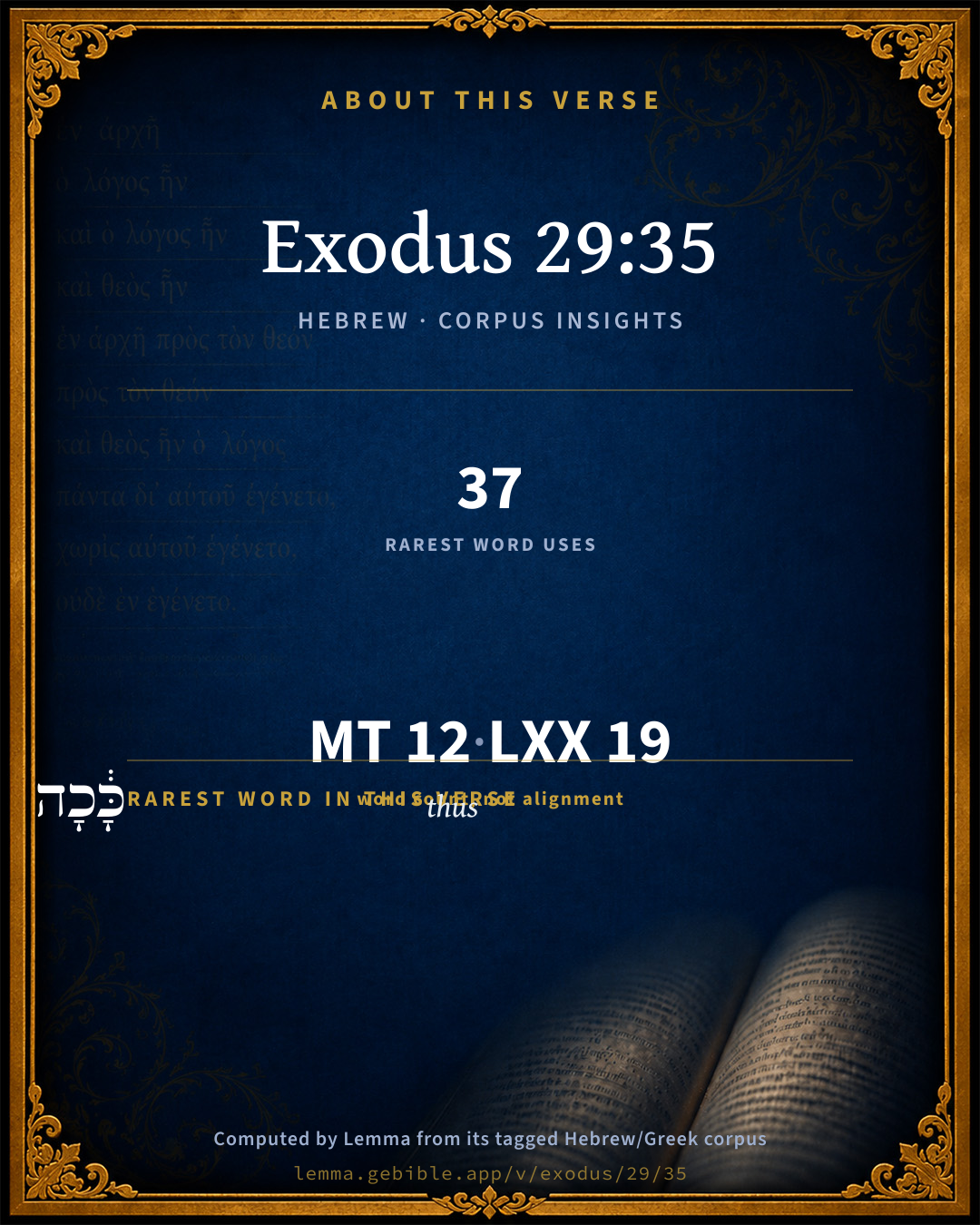
כָּ֔כָה
kâkâh
  1. וְעָשִׂ֜יתָ ʻâsâh H6213 “and · to do” Conjunction + Verb, Qal, Sequential Perfect, 2nd Person, Masculine, Singular
  2. לְאַהֲרֹ֤ן ʼAhărôwn H175 “to/for · Aaron” Preposition + Noun, Proper
  3. וּלְבָנָיו֙ bên H1121 “and · to/for · sons · his” Conjunction + Preposition + Noun, Common, Masculine, Plural, Construct + Suffix, Personal, 3rd Person, Masculine, Singular
  4. כְּכֹ֥ל kôl H3605 “like/as · all” Preposition + Noun, Common, Masculine, Singular, Absolute
  5. אֲשֶׁר ʼăsher H834 “which” Particle, Relative
  6. צִוִּ֖יתִי tsâvâh H6680 “to command” Verb, Piel, Perfect, 1st Person, Common, Singular
  7. אֹתָ֑כָה ʼêth H853 “- · you” Particle, Direct Object + Suffix, Personal, 2nd Person, Masculine, Singular
  8. שִׁבְעַ֥ת shebaʻ H7651 “seven” Adjective, Cardinal number, Masculine, Singular, Construct
  9. יָמִ֖ים yôwm H3117 “days” Noun, Common, Masculine, Plural, Absolute
  10. תְּמַלֵּ֥א mâlêʼ H4390 “to fill” Verb, Piel, Imperfect, 2nd Person, Masculine, Singular
  11. יָדָֽם yâd H3027 “hand · their” Noun, Common, Both, Singular, Construct + Suffix, Personal, 3rd Person, Masculine, Plural

About this verse

These counts appear in no published source. They are computed here, from the morphology-tagged text and Lemma’s own curated glosses. What Lemma adds →

12
words
12
distinct lemmas
Pentateuch
section

Shared distinctive vocabulary

כָּ֔כָה thus H3602 occurs in 35 verses of the Hebrew Bible. Also found in:

Grammatical profile

  • 3 verbs
  • 5 nouns
  • 1 adjective
  • 1 adverb
  • 2 particles

Verb forms

  • וְעָשִׂ֜יתָ Qal · Sequential Perfect
  • צִוִּ֖יתִי Piel · Perfect
  • תְּמַלֵּ֥א Piel · Imperfect

Hebrew & Septuagint length

In English translation the verse runs 24 words from the Hebrew and 27 from the Septuagint (LXX English) — closely comparable.

A rough comparison of the two English renderings, which tokenize alike — not a word-level alignment.

Word counts can differ between the Hebrew and the Greek without any difference in meaning — e.g. the Hebrew direct-object marker אֵת has no separate Greek word, and Greek often adds the article ὁ.

In the original languages it is 12 Hebrew tokens and 19 Greek tokens — but the two are counted differently (Hebrew bundles its prefixes and suffixes into one token; the Greek is in lemma form), so that isn’t a like-for-like length.

Cross-references

7

Topical passages linked to Exodus 29:35 in the Treasury of Scripture Knowledge — connected by theme and wording, ordered by reader-vote popularity; previews shown in the World English Bible.

  • Exodus 29:30 Seven days shall the son who is priest in his place put them on, when he comes into the tent of meeting to minister in the holy place.
  • Exodus 29:37 Seven days you shall make atonement for the altar, and sanctify it: and the altar shall be most holy; whatever touches the altar shall be holy.
  • Exodus 39:42–43 According to all that Yahweh commanded Moses, so the children of Israel did all the work.
  • Exodus 40:12–16 You shall bring Aaron and his sons to the door of the tent of meeting, and shall wash them with water.
  • Leviticus 8:4–36 Moses did as Yahweh commanded him; and the congregation was assembled at the door of the Tent of Meeting.
  • Leviticus 14:8–11 "He who is to be cleansed shall wash his clothes, and shave off all his hair, and bathe himself in water; and he shall be clean. After that he shall come into the camp, but shall dwell outside his tent seven days.
  • John 16:14 He will glorify me, for he will take from what is mine, and will declare it to you.

Cross-references courtesy of OpenBible.info (CC BY 4.0).

Hebrew and Greek witnesses Masoretic Hebrew ↔ Greek Septuagint

The same verse in the two great witnesses to the Old Testament, shown verse-for-verse.

These are two independent witnesses, not word-aligned to each other, and the Septuagint is shown in lemma (dictionary) form.

Hebrew Exodus 29:35 Masoretic · Westminster Leningrad Codex

וְעָשִׂ֜יתָ לְאַהֲרֹ֤ן וּלְבָנָיו֙ כָּ֔כָה כְּכֹ֥ל אֲשֶׁר צִוִּ֖יתִי אֹתָ֑כָה שִׁבְעַ֥ת יָמִ֖ים תְּמַלֵּ֥א יָדָֽם

"Thus shall you do to Aaron, and to his sons, according to all that I have commanded you. Seven days shall you consecrate them.

World English Bible · Public Domain

Greek LXX Exodus 29:35 Septuagint · lemma form

καί ποιέω ααρων καί ὁ υἱός αὐτός οὕτως κατά πᾶς ὅσος ἐντέλλομαι σύ ἑπτά ἡμέρα τελειόω αὐτός ὁ χείρ

And thus shall you do for Aaron and for his sons according to all things that I have commanded you; seven days shall you fill their hands.

LXX2012 (modern English Septuagint) · Public Domain

Hebrew: Westminster Leningrad Codex (CC BY 4.0). Greek: Septuagint (public domain); English from LXX2012 (modern English Septuagint) (Public Domain). How the Septuagint differs from the Hebrew →

Targum (Aramaic paraphrase)

2

The Targum is the ancient Jewish Aramaic paraphrase of the Hebrew Scriptures — an interpretive translation, not the Hebrew text itself. Onkelos (literal) and Pseudo-Jonathan (expansive) render the Torah, and Jonathan the Prophets. Coverage is partial: where no permissively-licensed English translation exists for a verse, only the Aramaic is shown. This is verse-level text, not a word-by-word alignment to the Hebrew.

  1. Targum Onkelos Torah (Genesis–Deuteronomy)
    וְתַעְבֵּד לְאַהֲרֹן וְלִבְנוֹהִי כְּדֵין כְּכֹל דִי פַקֵּדִית יָתָךְ שִׁבְעַת יוֹמִין תְּקָרֵב קֻרְבָּנְהוֹן:

    (no public-domain English translation for this verse)

    Targum Onkelos — Aramaic: “Onkelos Genesis” (public domain); “Onkelos Exodus” (public domain); “Onkelos Leviticus” (public domain); “Onkelos Numbers” (public domain); “Onkelos Deuteronomy” (public domain). English: “Sefaria Community Translation” (CC0 1.0 (public-domain dedication)); “J.W. Etheridge. The Targums of Onkelos and Jonathan Ben Uzziel on the Pentateuch. London: Longmans, Green, 1862” (public domain). Text via Sefaria.

  2. Targum Pseudo-Jonathan Torah (Genesis–Deuteronomy)
    וְתַעֲבֵיד לְאַהֲרן וְלִבְנוֹהִי הֵיכְדֵין כְּכָל דִּי פַקֵידִית יָתָךְ שׁוּבְעָא יוֹמִין תִּקְרַב קוּרְבַּנְהוֹן

    And thus thou shalt do to Aharon and to his sons according to all that I have prescribed to thee; seven days thou shalt offer their oblation.

    Targum Pseudo-Jonathan — Aramaic: “Targum Jonathan on Genesis” (public domain); “Targum Jonathan on Exodus” (public domain); “Targum Jonathan on Leviticus” (public domain); “Targum Jonathan on Numbers” (public domain); “Targum Jonathan on Deuteronomy” (public domain). English: “The Targum of Jonathan ben Uzziel, trans. J. W. Etheridge, London, 1862” (public domain). Text via Sefaria.

Commentary

Notes on Exodus 29:35 from classic Christian and Jewish commentators (each source and its license shown beneath its notes). The classic Christian expositions comment on the surrounding passage and are grouped to its opening verse, so a note may address several verses; the Jewish commentaries on the Tanakh (Rashi and others) are per-verse, so they appear only where the commentator wrote on this verse.

Lemma curates 59 commentaries, every one of them public domain or Creative Commons licensed, each selected and text-cleaned for this edition rather than reprinted as found. About our sources →

Trapp's Complete Commentary

John Trapp

Exo 29:35 And thus shalt thou do unto Aaron, and to his sons, according to all [things] which I have commanded thee: seven days shalt thou consecrate them.

Ver. 35. Seven days.] To teach the priests to consecrate their whole lives to God’s service.

John Trapp, A Commentary or Exposition upon All the Books of the Old and New Testament (1647–1656) — public domain. Text from a community e-Sword module.

Joseph Benson's Commentary

Exo 29:35. Seven days shalt thou consecrate them — Though all the ceremonies were performed on the first day, yet they were not to look upon their consecration as completed till the seven days’ end, which put a solemnity upon their admission, and a distance between this and their former state, and obliged them to enter upon their work with a pause, giving them time to consider the weight of it. This was to be observed in after ages: he that was to succeed Aaron in the high-priesthood, must put on the holy garments seven days together, in token of a deliberate advance into his office, and that one sabbath might pass over him in his consecration. Every day of the seven, in this first consecrations, a bullock was to be offered for a sin-offering, which was to intimate, 1st, That though atonement was made, yet they must still keep up a penitent sense of sin, and often repeat the confession of it. 2d, That those sacrifices which were thus offered day by day, could not make the comers thereunto perfect, for then they would have ceased to be offered, Heb 10:1-2. They must therefore expect the bringing in of a better hope. Now this consecration of the priests was a shadow of good things to come. 1st, Our Lord Jesus is the great High-Priest of our profession, called of God to be so consecrated for evermore, anointed with the Spirit above his fellows, clothed with the holy garments, even with glory and beauty, sanctified by his own blood, not that of bullocks and rams. 2d, All believers are spiritual priests, to offer spiritual sacrifices, (1Pe 2:5,) washed in the blood of Christ, and so made to our God priests, Rev 1:5-6. They also are clothed with the beauty of holiness, and have received the anointing, 1Jn 2:27. 3d, It is likewise here intimated that gospel ministers are to be solemnly set apart to the work of the ministry with great deliberation and seriousness, both in the ordainers and in the ordained, as those that are employed in a great work, and intrusted with a great charge.

Joseph Benson's Commentary on the Old and New Testaments (1811–1818) — public domain. Text from a community e-Sword module.

Geneva Bible (1599)

Geneva Bible translators

Hebrew, fill their hands.

Geneva Bible (1599) marginal notes — public domain. Text via Bolls.life.

Jamieson, Fausset & Brown

Robert Jamieson, A. R. Fausset & David Brown

seven days shalt thou consecrate them--The renewal of these ceremonies on the return of every day in the seven, with the intervention of a Sabbath, was a wise preparatory arrangement, in order to afford a sufficient interval for calm and devout reflection (Heb 9:1; Heb 10:1).

Jamieson, Fausset & Brown — Commentary Critical and Explanatory on the Whole Bible (1871) — public domain (CC PDM 1.0). Text via the HelloAO Bible API.

Ellicott's Commentary for English Readers

THE SEVENFOLD REPETITION OF THE CONSECRATION CEREMONIAL.

(35) Seven days shalt thou consecrate them.—The number seven possessed an ideal completeness, resting on the primeval facts of creation (Genesis 1, 2). It is the number almost exclusively used under the old covenant, when acts are to attain their result by repetition. (See Lev_4:6; Lev_4:17; Lev_8:11; Lev_14:7; Lev_16:14; Num_19:4; Jos_6:4; 1Ki_18:43; 2Ki_5:10; Psa_119:164; &c.) Here we are to understand a sevenfold repetition of the entire ceremonial of consecration. (See Lev_8:33-34.)

A Bible Commentary for English Readers, edited by Charles John Ellicott (1878–1897) — public domain. Text from a community e-Sword module.

The Cambridge Bible for Schools and Colleges

gen. ed. J. J. S. Perowne

35. To make it the more solemn and efficacious, the entire installation-ceremony is to be repeated every day for seven days (cf. Lev_8:33-35). In Lev. it is added that the priests are to remain during the whole of the seven days at the entrance of the Tent of Meeting.

consecrate] install.

The Cambridge Bible for Schools and Colleges (gen. ed. J. J. S. Perowne; Cambridge University Press, 1878–1918) — public domain. Text from a community e-Sword module.

John Gill's Exposition

And thus shall thou do unto Aaron, and to his sons,.... For their consecration, washing, clothing, anointing them, sprinkling blood upon them and their garments, and offering sacrifice for them:

according to all things which I have commanded thee; no one thing was to be omitted, and we find they were carefully and punctually observed, Lev 8:1.

seven days shalt thou consecrate them: so long the rites and ceremonies of the consecration were to be performing, that they might be thoroughly used to the putting on of their garments, and the offering of sacrifices as they saw performed by Moses; and in all respects be fitted for the discharge of their office: the Jewish writers generally say that seven days were appointed, that a sabbath might pass over them.

John Gill's Exposition of the Whole Bible (1746–1763) — public domain (CC PDM 1.0). Text via the HelloAO Bible API.

The Pulpit Commentary

Vers. 35-37. The repetition of the ceremonial, and the consecration of the altar.

Seven days shalt thou consecrate them. The repetition of the ceremony seven times on seven separate days seems to be intended. Thus was an ideal completeness given to it. Compare the seven days" compassing around of Jericho, (Jos_6:3, Jos_6:4) the seven washings in Jordan by Naaman, (2Ki_5:14) the seven ascents to the top of Carmel by the servant of Elijah, (1Ki_18:43, 1Ki_18:44) etc.

The Pulpit Commentary (1880–1919), ed. H.D.M. Spence-Jones & Joseph S. Exell — public domain. Text from a community e-Sword module.

John Wesley's Explanatory Notes

Seven days shalt thou consecrate them - Though all the ceremonies were performed on the first day, yet, they were not to look upon their consecration as compleated till the seven days end, which put a solemnity upon their admission, and a distance between this and their former state, and obliged them to enter upon their work with a pause, giving them time to consider the weight of it. This was to be observed in after ages: he that was to succeed Aaron in the high priesthood, must put on the holy garments seven days together, in token of a deliberate advance into his office, and that one sabbath might pass over him, in his consecration. Every day of the seven, in this first consecration, a bullock was to be offered for a sin-offering, which was to intimate, (1.) That though atonement was made, yet they must still keep up a penitent sense of sin, and often repeat the confession of it. (2.) That those sacrifices which were thus offered day by day, could not make the comers there unto perfect, for then they would have ceased to be offered; Heb. x, 1, 2. They must therefore expect the bringing in of a better hope. Now this consecration of the priests was a shadow of good things to come.

1. Our Lord Jesus is the great high priest of our profession, called of God to be so consecrated forevermore, anointed with the Spirit above his fellows, whence he is called Messiah, the Christ; clothed with the holy garments, even with glory and beauty; sanctified by his own blood, not that of bullocks and rams.

2. All believers are spiritual priests, to offer spiritual sacrifices, 1 Pet. ii, 5, washed in the blood of Christ, and so made to our God priests, Rev. i, 5, 6. They also are clothed with the beauty of holiness, and have received the anointing, 1 John ii, 27. His blood sprinkled upon the conscience, purgeth it from dead works, that they may, as priests, serve the living God. The Spirit of God is called the finger of God (Luke xi, 20, compared with Matt. xii, 28,) and by him the merit of Christ is effectually applied to our souls, as here Moses with his finger was to put the blood upon Aaron. It is likewise intimated that gospel ministers are to be solemnly set apart to the work of the ministry with great deliberation and seriousness, both in the ordainers, and in the ordained, as those that are employed in a great work, and intrusted with a great charge.

John Wesley, Explanatory Notes Upon the Whole Bible (1754–1765) — public domain. Text via the GEBible commentary corpus.

unfoldingWord translationNotes

Door43 World Missions Community

General Information:

Yahweh continues speaking to Moses.

In this way, by following all that I have commanded you to do, you must treat Aaron and his sons

"I have commanded you to treat Aaron and his sons this way"

Then the altar will be completely set apart to me

"Then the altar will be most holy"

will be set apart to Yahweh

"will also be very holy"

translationWords

command

Aaron

cow

sin offering

atonement

pure

altar

anoint

unfoldingWord translationNotes — © Distant Shores Media and the Door43 World Missions Community, licensed CC BY-SA 4.0. Source: git.door43.org/Door43/en_tn.

Rashi

Rabbi Shlomo Yitzchaki (Rashi)

ועשית לאהרן ולבניו ככה AND THUS SHALT (i. e. must) THOU DO TO AARON AND HIS SONS — Scripture recites a second time in this general statement all that has been already commanded in order to impede the validity of the rites; i. e. that if they do not do this and a single thing is omitted of all that is prescribed in this section their initiation to be priests must be regarded as not having taken place and their act of sacrifice is consequently invalid (Yoma 5a).

אתכה is the same as (another form of): אוֹתָך “thee”.

שבעת ימים תמלא ידם SEVEN DAYS SHALT THOU CONSECRATE THEM in this manner and by means of these sacrifices on each day.

Rashi on the Tanakh — English translations: “The Judaica Press complete Tanach with Rashi, translated by A. J. Rosenberg” (CC BY 4.0); “Pentateuch with Rashi's commentary by M. Rosenbaum and A.M. Silbermann, 1929-1934” (public domain); “The Metsudah Tanach series, Lakewood, N.J” (CC BY 4.0); and “The Book of Joshua, Metsudah Publications, 1997” (CC BY 4.0). Text via Sefaria.

Lesson kit

Teaching starters — assembled from the data on this page, not authored interpretation. Every prompt links to the verse data it draws on. Edit before teaching.

Exodus, in the Pentateuch, opens this verse with 12 words (12 distinct Hebrew lemmas). Its most distinctive word is kâkâh (“thus”). A historical commentator’s framing appears above. Read the whole chapter for the surrounding context.

Discussion questions

  1. How does “thus” (kâkâh) shape what this verse is saying?
  2. How does Exodus 12:11, which shares the word «thus», read alongside this verse?
  3. The translations on this page render this verse differently — a whole-verse word diff, not a word-by-word alignment. What might account for the different wordings?
  4. «וְעָשִׂ֜יתָ» is a Qal Sequential Perfect verb. How does that grammatical form shape the action described?
  5. Compare how Trapp's Complete Commentary and Joseph Benson's Commentary read this verse. Where do they agree or differ?

Things to notice

Reading settings

Reading text

Shown beneath each verse's original-language words.

Old Testament
Old Testament edition

Read the OT as the Masoretic Hebrew (MT) or the Greek Septuagint (LXX).

English shown for the Greek Septuagint (in the Hebrew ↔ Greek comparison).

Comparing translations? Open the Compare panel on any verse page to stack up to four side by side.