
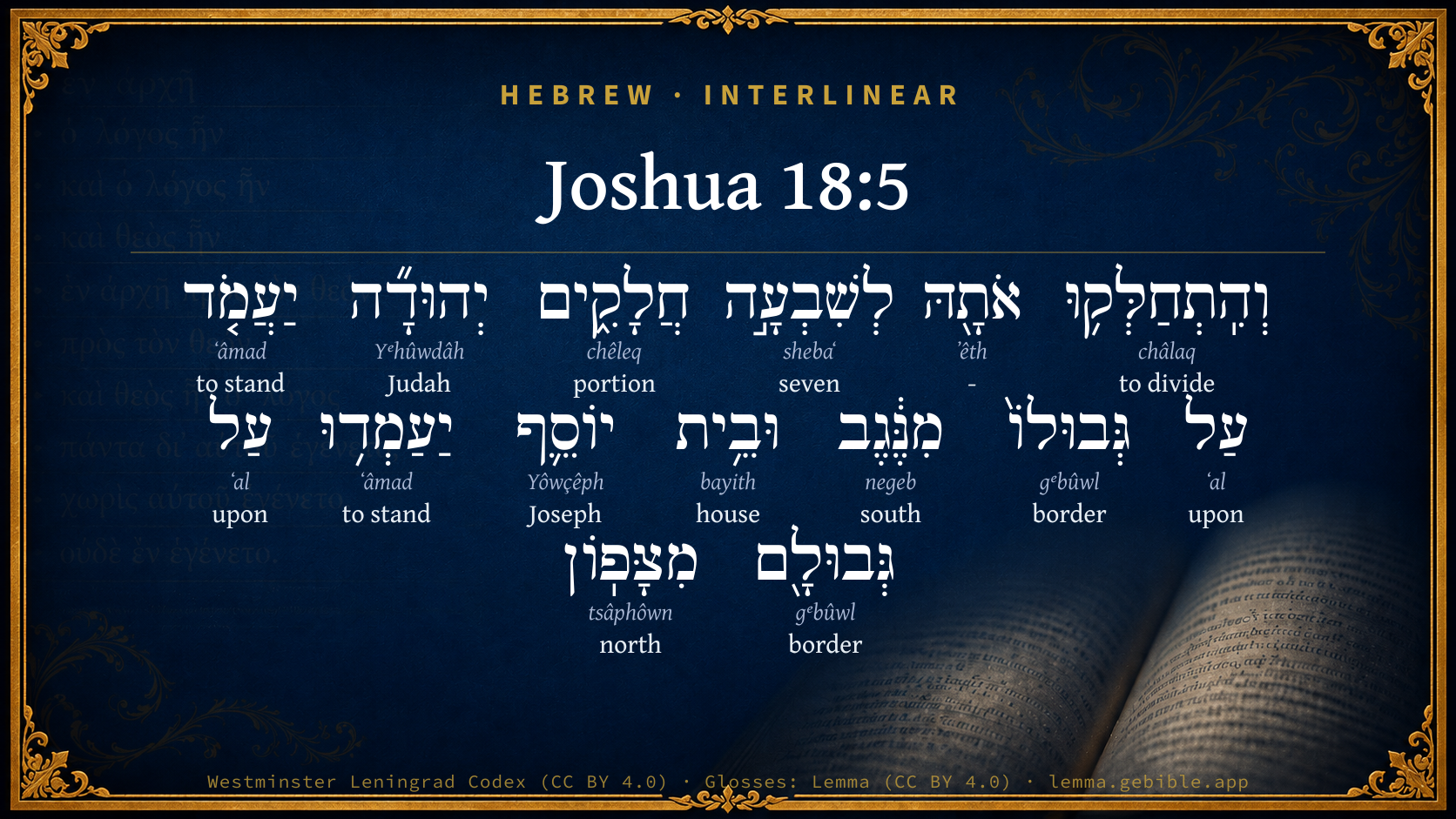
Joshua 18:5

Hebrew (Westminster Leningrad Codex) Joshua 18:5 appears in the Hebrew Old Testament. The text above is from the Westminster Leningrad Codex. Each word links to its Strong’s number, a concise gloss, and parsing drawn from the Open Scriptures Hebrew Bible morphology. Click any word for its full Brown-Driver-Briggs (BDB) entry.
Download image
Cite this verse

Joshua 18:5 (World English Bible). Public Domain. Lemma interlinear Bible study tool, https://lemma.gebible.app/v/joshua/18/5.

Show BibTeX & RIS
BibTeX
RIS
English Translation
They shall divide it into seven portions: Judah shall abide in his border on the south, and the house of Joseph shall abide in their border on the north.
World English Bible · Public Domain
Download a study sheet

One document with this verse’s original text, its word-by-word gloss line, the meaning frame, cross-references with their text, attributed commentary, and full source and license credits — printable, and it pastes into notes with its structure intact.

This verse Autodidact and up

Study sheet (.html) Plain text (.txt)

A passage Seminary Student

Up to 50 verses in one chapter. A passage sheet keeps up to 6 commentary sources and 12 cross-references per verse, in the order this page ranks them, and says so on the sheet whenever that leaves anything out. Ask for a single verse and you get the Autodidact verse sheet above.

Everything on this page stays free to read, with no account — the sheet is a download of what is already on screen, not access to it.

Want to remove ads? Support Godless Engineer
Compare translations 3

The same verse in 3 English versions, stacked beneath the original-language interlinear above. Click any original word for its lexicon entry.

Each is an independent rendering of the whole verse — the interlinear is not word-aligned to these translations.

Highlighted words mark where these versions differ — a whole-verse word diff, not a word-by-word alignment.

  • World English Bible Public Domain
    They shall divide it into seven portions: Judah shall abide in his border on the south, and the house of Joseph shall abide in their border on the north.
  • King James Version Public Domain
    And they shall divide it into seven parts: Judah shall abide in their coast on the south, and the house of Joseph shall abide in their coasts on the north.
  • unfoldingWord Literal Text CC BY-SA 4.0
    And they shall divide it among themselves into seven divisions. Judah will stand on its border from the south, and the house of Joseph will stand on their border from the north.

unfoldingWord Literal Text — © unfoldingWord, licensed CC BY-SA 4.0. Word-aligned USFM3 via Door43 (git.door43.org/unfoldingWord/en_ult).

Versions to compare (up to 4)

3 of 4 selected

Show all 18 translations

Every available English version of this verse, each an independent rendering of the whole verse.

  • World English Bible Public Domain
    They shall divide it into seven portions: Judah shall abide in his border on the south, and the house of Joseph shall abide in their border on the north.
  • Berean Standard Bible Public Domain
    and divide the land into seven portions. Judah shall remain in their territory in the south, and the house of Joseph shall remain in their territory in the north.
  • Majority Standard Bible Public Domain
    and divide the land into seven portions. Judah shall remain in their territory in the south, and the house of Joseph shall remain in their territory in the north.
  • King James Version Public Domain
    And they shall divide it into seven parts: Judah shall abide in their coast on the south, and the house of Joseph shall abide in their coasts on the north.
  • American Standard Version (1901) Public Domain
    And they shall divide it into seven portions: Judah shall abide in his border on the south, and the house of Joseph shall abide in their border on the north.
  • Revised Version (1885) Public Domain
    And they shall divide it into seven portions: Judah shall abide in his border on the south, and the house of Joseph shall abide in their border on the north.
  • Geneva Bible (1599) Public Domain
    And that they may deuide it vnto them into seuen parts, (Iudah shall abide in his coast at the South, and the house of Ioseph shall stand in their coastes at the North)
  • Douay-Rheims (1899) Public Domain
    Choose of every tribe three men, that I may send them, and they may go and compass the land, and mark it out according to the number of each multitude: and bring back to me what they have marked out.
  • Young's Literal Translation Public Domain
    and they have divided it into seven portions -- Judah doth stay by its border on the south, and the house of Joseph do stay by their border on the north --
  • Literal Standard Version CC BY-SA 4.0
    and they have divided it into seven portions—Judah stays by its border on the south, and the house of Joseph stays by their border on the north—
  • Unlocked Literal Bible CC BY-SA 4.0
    They will divide it into seven sections. Judah will remain in their territory on the south, and the house of Joseph will continue in their territory in the north.
  • unfoldingWord Literal Text CC BY-SA 4.0
    And they shall divide it among themselves into seven divisions. Judah will stand on its border from the south, and the house of Joseph will stand on their border from the north.
  • Darby Bible Public Domain
    And they shall divide it into seven portions. Judah shall remain in their border on the south, and the house of Joseph shall remain in their border on the north;
  • World Messianic Bible Public Domain
    They shall divide it into seven portions. Judah shall live in his borders on the south, and the house of Joseph shall live in their borders on the north.
  • Webster's Bible Public Domain
    And they shall divide it into seven parts: Judah shall abide in their border on the south, and the house of Joseph shall abide in their borders on the north.
  • Free Bible Version CC BY-SA 4.0
    They are to divide the land into seven parts, up to the boundary of Judah's land in the south and Joseph's land in the north.
  • Bible in Basic English Public Domain
    And let them make division of it into seven parts: let Judah keep inside his limit on the south, and let the children of Joseph keep inside their limit on the north.
  • JPS Tanakh (1917) Public Domain
    And they shall divide it into seven portions: Judah shall abide in his border on the south, and the house of Joseph shall abide in their border on the north.

Literal Standard Version (2020), Covenant Press — licensed CC BY-SA 4.0. Text via the HelloAO Bible API (eBible.org). Unlocked Literal Bible (unfoldingWord) — licensed CC BY-SA 4.0. Text via the HelloAO Bible API (eBible.org). unfoldingWord Literal Text — © unfoldingWord, licensed CC BY-SA 4.0. Word-aligned USFM3 via Door43 (git.door43.org/unfoldingWord/en_ult). Free Bible Version, Dr. Jonathan Gallagher — licensed CC BY-SA 4.0. Text via the HelloAO Bible API (eBible.org).

Word by word

More ways to search: Search by grammar → Find every occurrence → Compare this word →

Practice this passage: Drill this verse → Learn its vocabulary →

וְהִֽתְחַלְּק֥וּ
châlaq
H2505
“and · to divide”
Conjunction + Verb, Hithpael, Sequential Perfect, 3rd Person, Common, Plural
Part of Speech
Conjunction + Verb
Stem
Hithpael
Form
Sequential Perfect
Person
3rd Person
Gender
Common
Number
Plural
Full BDB Definition

Origin: a primitive root

TWOT: 669

to divide, share, plunder, allot, apportion, assign - (Qal) - to divide, apportion - to assign, distribute - to assign, impart - to share - to divide up, plunder - (Niphal) - to divide oneself - to be divided - to assign, distribute - (Piel) - to divide, apportion - to assign, distribute - to scatter - (Pual) to be divided - (Hiphil) to receive a portion or part - (Hithpael) to divide among themselves - to be smooth, slippery, deceitful - (Qal) to be smooth, slippery - (Hiphil) - to be smooth - to flatter
  1. אֹתָ֖הּ ʼêth H853 “- · her” Particle, Direct Object + Suffix, Personal, 3rd Person, Feminine, Singular
  2. לְשִׁבְעָ֣ה shebaʻ H7651 “to/for · seven” Preposition + Adjective, Cardinal number, Masculine, Singular, Absolute
  3. חֲלָקִ֑ים chêleq H2506 “portions” Noun, Common, Masculine, Plural, Absolute
  4. יְהוּדָ֞ה Yᵉhûwdâh H3063 “Judah” Noun, Proper
  5. יַעֲמֹ֤ד ʻâmad H5975 “to stand” Verb, Qal, Imperfect, 3rd Person, Masculine, Singular
  6. עַל ʻal H5921 “upon” Preposition
  7. גְּבוּלוֹ֙ gᵉbûwl H1366 “border · his” Noun, Common, Masculine, Singular, Construct + Suffix, Personal, 3rd Person, Masculine, Singular
  8. מִנֶּ֔גֶב negeb H5045 “from · south” Preposition + Noun, Common, Masculine, Singular, Absolute
  9. וּבֵ֥ית bayith H1004 “and · house of” Conjunction + Noun, Common, Masculine, Singular, Construct
  10. יוֹסֵ֛ף Yôwçêph H3130 “Joseph” Noun, Proper
  11. יַעַמְד֥וּ ʻâmad H5975 “to stand” Verb, Qal, Imperfect, 3rd Person, Masculine, Plural
  12. עַל ʻal H5921 “upon” Preposition
  13. גְּבוּלָ֖ם gᵉbûwl H1366 “border · their” Noun, Common, Masculine, Singular, Construct + Suffix, Personal, 3rd Person, Masculine, Plural
  14. מִצָּפֽוֹן tsâphôwn H6828 “from · north” Preposition + Noun, Common, Feminine, Singular, Absolute

About this verse

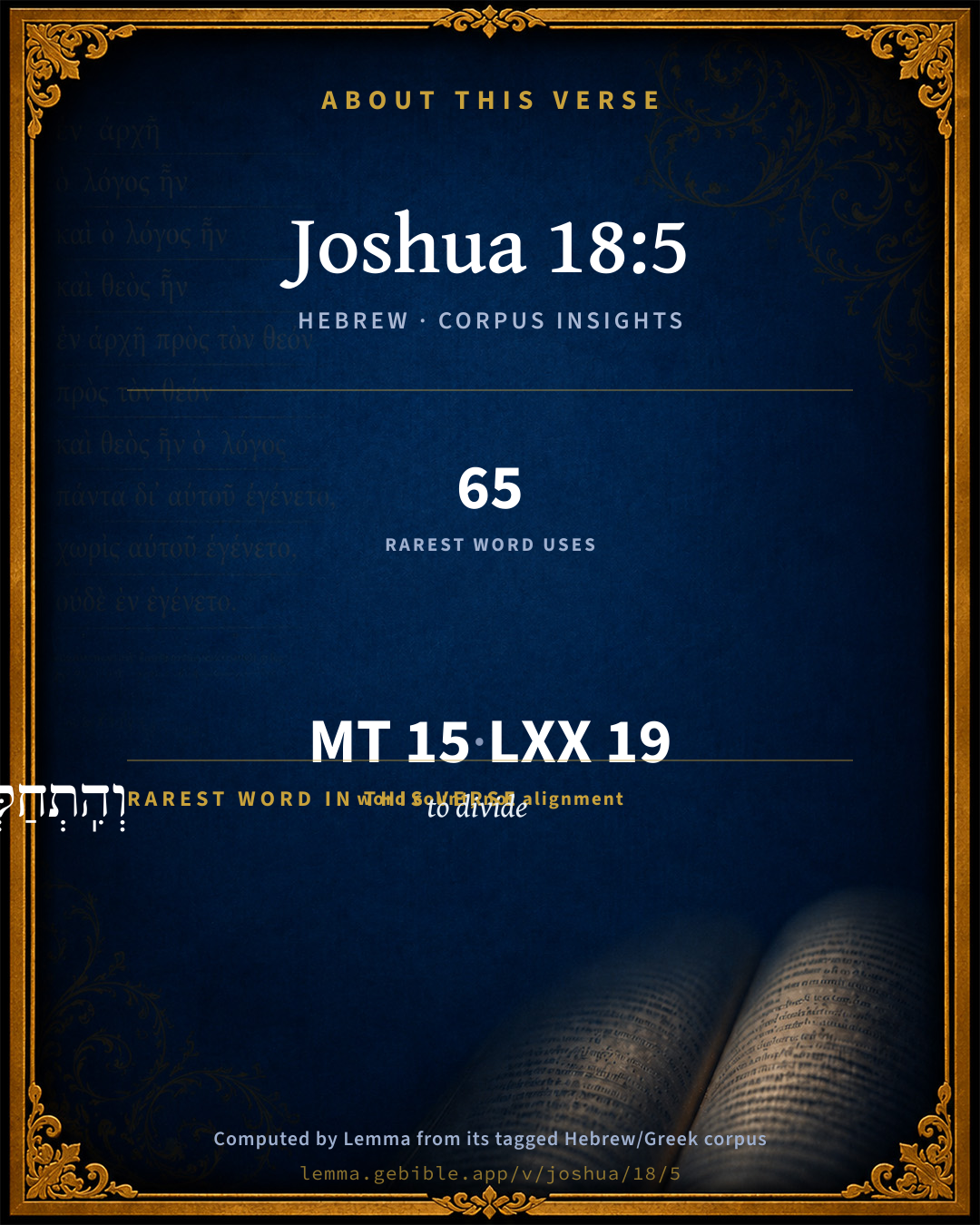
These counts appear in no published source. They are computed here, from the morphology-tagged text and Lemma’s own curated glosses. What Lemma adds →

15
words
12
distinct lemmas
Historical
section

Grammatical profile

  • 3 verbs
  • 8 nouns
  • 1 adjective
  • 2 prepositions
  • 1 particle

Verb forms

  • וְהִֽתְחַלְּק֥וּ Hithpael · Sequential Perfect
  • יַעֲמֹ֤ד Qal · Imperfect
  • יַעַמְד֥וּ Qal · Imperfect

Repetition

Words recur within this verse — often emphatic in Hebrew:

  • יַעֲמֹ֤ד to stand H5975 ×2
  • עַל upon H5921 ×2
  • גְּבוּלוֹ֙ border H1366 ×2

Hebrew & Septuagint length

In English translation the verse runs 29 words from the Hebrew and 31 from the Septuagint (LXX English) — closely comparable.

A rough comparison of the two English renderings, which tokenize alike — not a word-level alignment.

Word counts can differ between the Hebrew and the Greek without any difference in meaning — e.g. the Hebrew direct-object marker אֵת has no separate Greek word, and Greek often adds the article ὁ.

In the original languages it is 15 Hebrew tokens and 19 Greek tokens — but the two are counted differently (Hebrew bundles its prefixes and suffixes into one token; the Greek is in lemma form), so that isn’t a like-for-like length.

Cross-references

3

Topical passages linked to Joshua 18:5 in the Treasury of Scripture Knowledge — connected by theme and wording, ordered by reader-vote popularity; previews shown in the World English Bible.

  • Joshua 15:1–12 The lot for the tribe of the children of Judah according to their families was to the border of Edom, even to the wilderness of Zin southward, at the uttermost part of the south.
  • Joshua 16:1–10 The lot came out for the children of Joseph from the Jordan at Jericho, at the waters of Jericho on the east, even the wilderness, going up from Jericho through the hill-country to Bethel;
  • Joshua 19:1–9 The second lot came out for Simeon, even for the tribe of the children of Simeon according to their families: and their inheritance was in the midst of the inheritance of the children of Judah.

Cross-references courtesy of OpenBible.info (CC BY 4.0).

Hebrew and Greek witnesses Masoretic Hebrew ↔ Greek Septuagint

The same verse in the two great witnesses to the Old Testament, shown verse-for-verse.

These are two independent witnesses, not word-aligned to each other, and the Septuagint is shown in lemma (dictionary) form.

Hebrew Joshua 18:5 Masoretic · Westminster Leningrad Codex

וְהִֽתְחַלְּק֥וּ אֹתָ֖הּ לְשִׁבְעָ֣ה חֲלָקִ֑ים יְהוּדָ֞ה יַעֲמֹ֤ד עַל גְּבוּלוֹ֙ מִנֶּ֔גֶב וּבֵ֥ית יוֹסֵ֛ף יַעַמְד֥וּ עַל גְּבוּלָ֖ם מִצָּפֽוֹן

They shall divide it into seven portions: Judah shall abide in his border on the south, and the house of Joseph shall abide in their border on the north.

World English Bible · Public Domain

Greek LXX Joshua 18:5 Septuagint · lemma form

καί διααἱρέω αὐτός ἑπτά μερίς ἰούδας ἵστημι αὐτός ὅριον ἀπό λίψ καί ὁ υἱός ιωσηφ ἵστημι αὐτός ἀπό βορέας

And they came to him: and he divided to them seven portions, saying, Juda shall stand to them a border southward, and the sons of Joseph shall stand to them northward.

LXX2012 (modern English Septuagint) · Public Domain

Hebrew: Westminster Leningrad Codex (CC BY 4.0). Greek: Septuagint (public domain); English from LXX2012 (modern English Septuagint) (Public Domain). How the Septuagint differs from the Hebrew →

Targum (Aramaic paraphrase)

1

The Targum is the ancient Jewish Aramaic paraphrase of the Hebrew Scriptures — an interpretive translation, not the Hebrew text itself. Onkelos (literal) and Pseudo-Jonathan (expansive) render the Torah, and Jonathan the Prophets. Coverage is partial: where no permissively-licensed English translation exists for a verse, only the Aramaic is shown. This is verse-level text, not a word-by-word alignment to the Hebrew.

  1. Targum Jonathan Prophets (Joshua–Malachi)
    וִיפַלְגוּן יָתָהּ לְשִׁבְעָה חוּלְקִין דְבֵית יְהוּדָה יְקוּמוּן עַל תְּחוּמֵיהוֹן מִדָרוֹמָא וּדְבֵית יוֹסֵף יְקוּמוּן עַל תְּחוּמֵיהוֹן מִצִפּוּנָא:

    (no public-domain English translation for this verse)

    Targum Jonathan — Aramaic: “Mikraot Gedolot” (public domain). English: “Sefaria Community Translation” (CC0 1.0 (public-domain dedication)); “London "Chaldee Paraphrase," 1871” (public domain). Text via Sefaria.

Commentary

Notes on Joshua 18:5 from classic Christian and Jewish commentators (each source and its license shown beneath its notes). The classic Christian expositions comment on the surrounding passage and are grouped to its opening verse, so a note may address several verses; the Jewish commentaries on the Tanakh (Rashi and others) are per-verse, so they appear only where the commentator wrote on this verse.

Lemma curates 59 commentaries, every one of them public domain or Creative Commons licensed, each selected and text-cleaned for this edition rather than reprinted as found. About our sources →

Trapp's Complete Commentary

John Trapp

Jos 18:5 And they shall divide it into seven parts: Judah shall abide in their coast on the south, and the house of Joseph shall abide in their coasts on the north.

Ver. 5. And they shall divide it.] With all indifferency, and so prevent all suspicion of partiality in those that were afterward to divide it by lot. "Provide things honest in the sight of all men." {Rom 12:17} "Give none offence." {1Co 10:32}

John Trapp, A Commentary or Exposition upon All the Books of the Old and New Testament (1647–1656) — public domain. Text from a community e-Sword module.

Joseph Benson's Commentary

Jos 18:5. Into seven parts — Their business was to divide the country into seven portions of equal extent or worth, and leave God to appoint which portion should fall to each tribe; who could have no reason to complain when the division was made by themselves. Indeed, no tribe was so great but one of these parts in its full extent would abundantly suffice them; and there was no reason why the portions should be greater or less according as the tribes at present were more or fewer in number, because of the various changes which happened therein successively; it being usual for one tribe to be more numerous than another in one age, which was fewer in the next. And if the several tribes had increased more, and not diminished their numbers by their sins, they might have sent forth colonies and taken any part of the land, even as far as Euphrates, all which the Lord of the whole earth had given them a right to, and when they pleased they might take possession of it. Judah shall abide on the south — They shall not be disturbed in their possession, but shall keep it, except some part of it shall be adjudged to another tribe. Joseph on the north — In respect of Judah, not of the whole land; for divers other tribes were more northern than they.

Joseph Benson's Commentary on the Old and New Testaments (1811–1818) — public domain. Text from a community e-Sword module.

Tyndale Open Study Notes

Tyndale Open Resources

18:5 The remaining land was divided into seven sections, one for each tribe not yet assigned its territory.

Tyndale Open Study Notes — © Tyndale Open Resources, licensed CC BY-SA 4.0. Text via the HelloAO Bible API.

Geneva Bible (1599)

Geneva Bible translators

For these had their inheritance already appointed.

Geneva Bible (1599) marginal notes — public domain. Text via Bolls.life.

Adam Clarke's Commentary

Verse 5. Judah shall abide - on the south, and the house of Joseph - on the north.] Joshua does not mean that the tribe of Judah occupied the south, and the tribe of Ephraim and Manasseh the north of the promised land; this was not the fact: but being now at Shiloh, a considerable way in the territory of Ephraim, and not far from that of Judah, he speaks of them in relation to the place in which he then was. Calmet considers him as thus addressing the deputies: "Go and examine the whole of the country which remains yet to be possessed; do not take into consideration the tribe of Judah, which is on the south, nor the tribe of Ephraim, which is on the north of where we now are, but carefully divide the remaining land which is not occupied by these tribes into seven equal parts." This makes a very good sense, and frees the place from embarrassment.

Adam Clarke's Commentary on the Bible (1810–1826) — public domain. Text from a community e-Sword/MySword module.

Ellicott's Commentary for English Readers

(5-10) They shall divide it into seven parts.—The several tribes were not permitted to choose their own portions. In Num_26:54-55, we read: “To many thou shalt give the more inheritance, and to few thou shalt give the less inheritance. . . . notwithstanding the land shall be divided by lot.” These words imply that there must be unequal portions of territory for larger and smaller tribes, but that the particular position of each tribe must be settled by the lot, whereof “the whole disposing is of the Lord.” We are not told how this rule was carried out in the case of Judah, Ephraim, and Manasseh, who received their inheritance first. Possibly a sufficient extent of territory was surveyed at first to provide three large allotments. The three tribes might then cast lots, first between Judah and Joseph for the northern or southern portions, and then between Ephraim and Manasseh for the two sections of the northern territory. This would carry out the instructions of Numbers 26. But see above (Jos_15:1).

A Bible Commentary for English Readers, edited by Charles John Ellicott (1878–1897) — public domain. Text from a community e-Sword module.

The Cambridge Bible for Schools and Colleges

gen. ed. J. J. S. Perowne

5. Judah shall abide] The division, which had secured by lot their territory to the tribes of Judah and Joseph, was still to be respected.

The Cambridge Bible for Schools and Colleges (gen. ed. J. J. S. Perowne; Cambridge University Press, 1878–1918) — public domain. Text from a community e-Sword module.

John Gill's Exposition

And they shall divide it into seven parts,.... According to the number of the seven tribes not yet settled; and this they were to describe and divide was all the land subdued, or not subdued, only the following excepted:

Judah shall abide in their coast on the south; on the south of the land of Canaan, where their lot fell, so that needed not to be measured and described; and this tribe was to retain what they were possessed of, unless it should appear they had too much, and others wanted, and they willing to part with some of it to their brethren, as they afterwards did to the tribes of Simeon and Dan:

and the house of Joseph shall abide in their coast on the north; on the north of the tribe of Judah; not of the land of Canaan, for some other tribes lay more northerly.

John Gill's Exposition of the Whole Bible (1746–1763) — public domain (CC PDM 1.0). Text via the HelloAO Bible API.

Haydock's Catholic Bible Commentary

North, with respect to Silo. Juda had taken possession of his territory, as well as the tribes of Joseph.

George Leo Haydock (1774–1849), Haydock's Catholic Family Bible and Commentary, 1859 edition — public domain. Excludes Psalms (Douay-Rheims chapter numbering differs from Protestant) and Deuterocanonical books (Catholic canon only).

Matthew Poole's English Annotations

Seven parts; which were of equal extent or worth; for no tribe was so great but one of these parts in its full extent would abundantly suffice them; and there was no reason why the portions should be greater or less according as the tribes at present were more or fewer in number, because of the various changes which happened therein successively; it being usual for one tribe to be more numerous than another in one age, which was fewer in the next. And if the several tribes had increased more, and not diminished their numbers by their sins, they might have sent forth colonies, and taken any part of the land, even as far as Euphrates, all which the Lord of the whole earth had given them a right to, which when they pleased they might take possession of.

Shall abide in their coast on the south: they shall not be disturbed in their possession, but shall keep it, except some part of it shall be adjudged to another tribe.

On the north; in respect of Judah, not of the whole land; for divers other tribes were more northern than they.

Matthew Poole's English Annotations on the Holy Bible (1683–1685) — public domain. Text from a community e-Sword/MySword module.

Whedon's Commentary on the Bible

Daniel D. Whedon

5. Judah shall abide — That is, shall maintain the same relative position, but not necessarily the same amount. See Jos_19:9, where Simeon’s portion is taken out of Judah’s, to produce equality.

Daniel D. Whedon (gen. ed.), Commentary on the Old and New Testaments (1874–1909) — public domain. Text from a community e-Sword module.

John Wesley's Explanatory Notes

Seven parts - Which were of equal extent or worth: for no tribe was so great, but one of these parts in its full extent would abundantly suffice them; and there was no reason why the portions should be greater or less according as the tribes at present were more or fewer in number, because of the various changes which happened therein successively; it being usual for one tribe to be more numerous than another in one age, which was fewer in the next. And if the several tribes had increased more, and not diminished their numbers by their sins, they might have sent forth colonies, and taken any part of the land, even as far as Euphrates, all which the Lord of the whole earth had given them a right to, which when they pleased they might take possession of. Judah shall abide on the south - They shall not be disturbed in their possession, but shall keep it, except some part of it shall be adjudged to another tribe. Joseph on the north - In respect of Judah, not of the whole land; for divers other tribes were more northern than they.

John Wesley, Explanatory Notes Upon the Whole Bible (1754–1765) — public domain. Text via the GEBible commentary corpus.

unfoldingWord translationNotes

Door43 World Missions Community

General Information:

Joshua is continuing his speech to the children of Israel.

They will divide it

"They will divide the land"

Judah will remain

"The tribe of Judah will remain"

the house of Joseph

Here the word "house" represents the descendants of Joseph. The phrase refers to the tribes of Ephraim and Manasseh. AT: "the tribes of Ephraim and Manasseh" (See: Metonymy and Assumed Knowledge and Implicit Information)

translationWords

Judah

house

Joseph (OT)

lots

unfoldingWord translationNotes — © Distant Shores Media and the Door43 World Missions Community, licensed CC BY-SA 4.0. Source: git.door43.org/Door43/en_tn.

Rashi

Rabbi Shlomo Yitzchaki (Rashi)

And they will divide it into seven parts. Including that which was already conquered and that which was destined to be conquered.

Yehudah will remain at his boundary in the south— of Eretz Yisroel, for there fell to his lot the entire southern boundary.

And the house of Yoseif—in the north. The north of the land already conquered. There is however much more to be conquered: the side of the boundary from Baal-gad to Levo-chamos which is near Hor hoHor in the northern boundary. The seven tribes will divide [the land] between Yehudah and Yoseif, and [the land] which remains to be conquered.

Rashi on the Tanakh — English translations: “The Judaica Press complete Tanach with Rashi, translated by A. J. Rosenberg” (CC BY 4.0); “Pentateuch with Rashi's commentary by M. Rosenbaum and A.M. Silbermann, 1929-1934” (public domain); “The Metsudah Tanach series, Lakewood, N.J” (CC BY 4.0); and “The Book of Joshua, Metsudah Publications, 1997” (CC BY 4.0). Text via Sefaria.

Lesson kit

Teaching starters — assembled from the data on this page, not authored interpretation. Every prompt links to the verse data it draws on. Edit before teaching.

Joshua, in the Historical, opens this verse with 15 words (12 distinct Hebrew lemmas). Its most distinctive word is châlaq (“to divide”). A historical commentator’s framing appears above. Read the whole chapter for the surrounding context.

Discussion questions

  1. What does “to divide” (châlaq) contribute to the verse as a whole?
  2. Joshua 15:1–12 shares this passage’s theme. How do the two illuminate each other?
  3. “to stand” occurs 2× in this one verse. What is the effect of the repetition?
  4. These translations render this verse differently; the difference is in the English rendering, not the original. What questions does that raise?
  5. The verb «וְהִֽתְחַלְּק֥וּ» is Hithpael Sequential Perfect. How does its form color the action?
  6. Reading how Trapp's Complete Commentary and Joseph Benson's Commentary read this verse, where do the two commentators agree and where do they part?

Things to notice

Reading settings

Reading text

Shown beneath each verse's original-language words.

Old Testament
Old Testament edition

Read the OT as the Masoretic Hebrew (MT) or the Greek Septuagint (LXX).

English shown for the Greek Septuagint (in the Hebrew ↔ Greek comparison).

Comparing translations? Open the Compare panel on any verse page to stack up to four side by side.