
Genesis 33:3

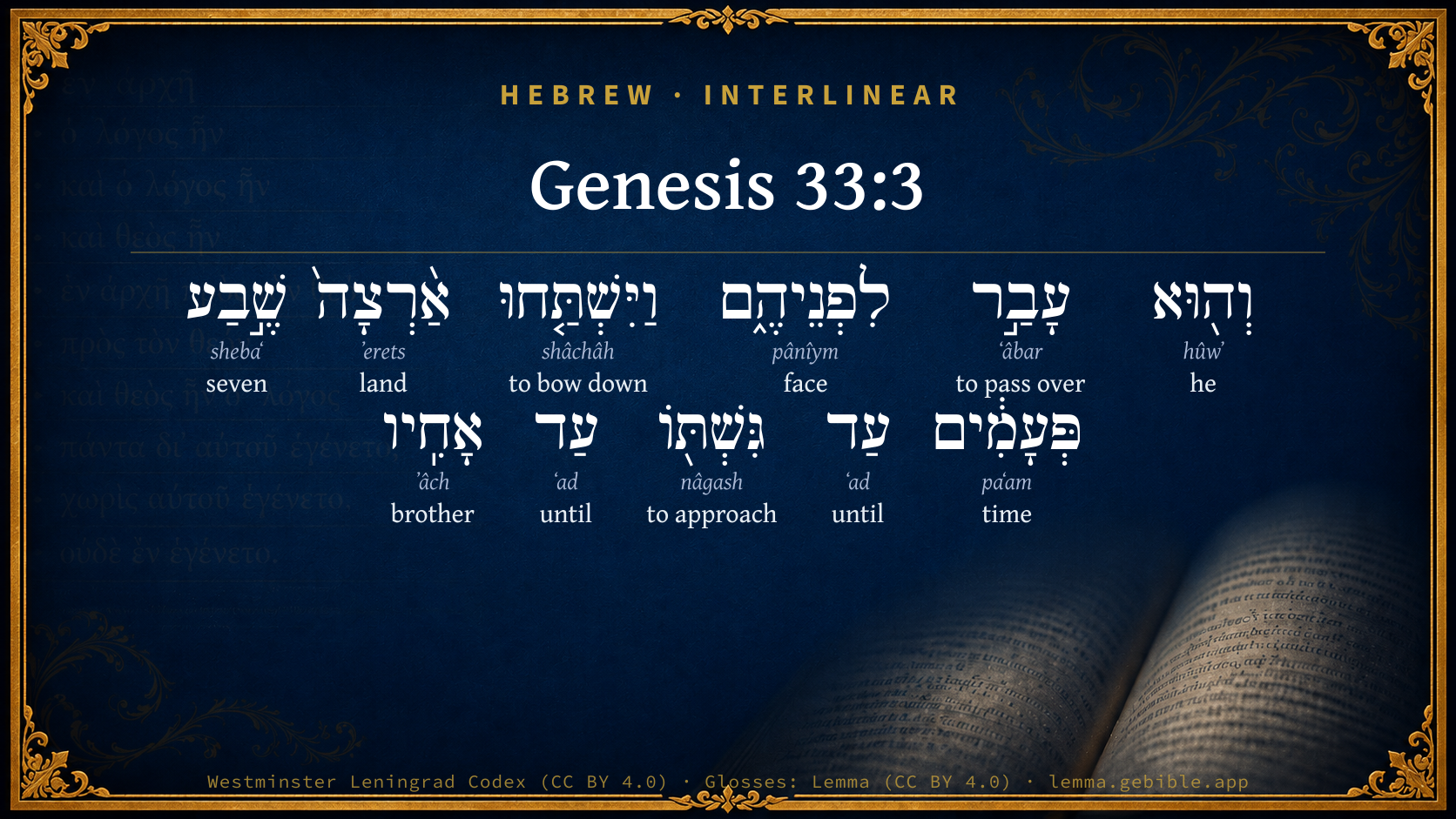
Hebrew (Westminster Leningrad Codex) Genesis 33:3 appears in the Hebrew Old Testament. The text above is from the Westminster Leningrad Codex. Each word links to its Strong’s number, a concise gloss, and parsing drawn from the Open Scriptures Hebrew Bible morphology. Click any word for its full Brown-Driver-Briggs (BDB) entry.
Download image
Cite this verse

Genesis 33:3 (World English Bible). Public Domain. Lemma interlinear Bible study tool, https://lemma.gebible.app/v/genesis/33/3.

Show BibTeX & RIS
BibTeX
RIS
English Translation
He himself passed over in front of them, and bowed himself to the ground seven times, until he came near to his brother.
World English Bible · Public Domain
Download a study sheet

One document with this verse’s original text, its word-by-word gloss line, the meaning frame, cross-references with their text, attributed commentary, and full source and license credits — printable, and it pastes into notes with its structure intact.

This verse Autodidact and up

Study sheet (.html) Plain text (.txt)

A passage Seminary Student

Up to 50 verses in one chapter. A passage sheet keeps up to 6 commentary sources and 12 cross-references per verse, in the order this page ranks them, and says so on the sheet whenever that leaves anything out. Ask for a single verse and you get the Autodidact verse sheet above.

Everything on this page stays free to read, with no account — the sheet is a download of what is already on screen, not access to it.

Want to remove ads? Support Godless Engineer
Compare translations 3

The same verse in 3 English versions, stacked beneath the original-language interlinear above. Click any original word for its lexicon entry.

Each is an independent rendering of the whole verse — the interlinear is not word-aligned to these translations.

Highlighted words mark where these versions differ — a whole-verse word diff, not a word-by-word alignment.

  • World English Bible Public Domain
    He himself passed over in front of them, and bowed himself to the ground seven times, until he came near to his brother.
  • King James Version Public Domain
    And he passed over before them, and bowed himself to the ground seven times, until he came near to his brother.
  • unfoldingWord Literal Text CC BY-SA 4.0
    Then he himself went before them, and he bowed to the ground seven times as he came near to his brother.

unfoldingWord Literal Text — © unfoldingWord, licensed CC BY-SA 4.0. Word-aligned USFM3 via Door43 (git.door43.org/unfoldingWord/en_ult).

Versions to compare (up to 4)

3 of 4 selected

Show all 18 translations

Every available English version of this verse, each an independent rendering of the whole verse.

  • World English Bible Public Domain
    He himself passed over in front of them, and bowed himself to the ground seven times, until he came near to his brother.
  • Berean Standard Bible Public Domain
    But Jacob himself went on ahead and bowed to the ground seven times as he approached his brother.
  • Majority Standard Bible Public Domain
    But Jacob himself went on ahead and bowed to the ground seven times as he approached his brother.
  • King James Version Public Domain
    And he passed over before them, and bowed himself to the ground seven times, until he came near to his brother.
  • American Standard Version (1901) Public Domain
    And he himself passed over before them, and bowed himself to the ground seven times, until he came near to his brother.
  • Revised Version (1885) Public Domain
    And he himself passed over before them, and bowed himself to the ground seven times, until he came near to his brother.
  • Geneva Bible (1599) Public Domain
    So he went before them and bowed him selfe to the ground seuen times, vntill he came neere to his brother.
  • Douay-Rheims (1899) Public Domain
    And he went forward and bowed down with his face to the ground seven times until his brother came near.
  • Young's Literal Translation Public Domain
    And he himself passed over before them, and boweth himself to the earth seven times, until his drawing nigh unto his brother,
  • Literal Standard Version CC BY-SA 4.0
    And he himself passed over before them, and bows himself to the earth seven times, until his drawing near to his brother,
  • Unlocked Literal Bible CC BY-SA 4.0
    He himself went on ahead of them. He bowed toward the ground seven times, until he came near to his brother.
  • unfoldingWord Literal Text CC BY-SA 4.0
    Then he himself went before them, and he bowed to the ground seven times as he came near to his brother.
  • Darby Bible Public Domain
    And he passed on before them, and bowed to the earth seven times, until he came near to his brother.
  • World Messianic Bible Public Domain
    He himself passed over in front of them, and bowed himself to the ground seven times, until he came near to his brother.
  • Webster's Bible Public Domain
    And he passed on before them, and bowed himself to the ground seven times, till he came near to his brother.
  • Free Bible Version CC BY-SA 4.0
    Then Jacob went ahead of them and bowed low to the ground seven times before approaching his brother.
  • Bible in Basic English Public Domain
    And he himself, going before them, went down on his face to the earth seven times till he came near his brother.
  • JPS Tanakh (1917) Public Domain
    And he himself passed over before them, and bowed himself to the ground seven times, until he came near to his brother.

Literal Standard Version (2020), Covenant Press — licensed CC BY-SA 4.0. Text via the HelloAO Bible API (eBible.org). Unlocked Literal Bible (unfoldingWord) — licensed CC BY-SA 4.0. Text via the HelloAO Bible API (eBible.org). unfoldingWord Literal Text — © unfoldingWord, licensed CC BY-SA 4.0. Word-aligned USFM3 via Door43 (git.door43.org/unfoldingWord/en_ult). Free Bible Version, Dr. Jonathan Gallagher — licensed CC BY-SA 4.0. Text via the HelloAO Bible API (eBible.org).

Word by word

More ways to search: Search by grammar → Find every occurrence → Compare this word →

Practice this passage: Drill this verse → Learn its vocabulary →

פְּעָמִ֔ים
paʻam
H6471
“times”
Noun, Common, Feminine, Plural, Absolute
Part of Speech
Noun
Type
Common
Gender
Feminine
Number
Plural
State
Absolute
Full BDB Definition

Origin: from H6470

TWOT: 1793a

stroke, beat, foot, step, anvil, occurrence - foot, hoof-beat, footfall, footstep - anvil - occurrence, time, stroke, beat - one time, once, twice, thrice, as time on time, at this repetition, this once, now at length, now...now, at one time...at another
  1. וְה֖וּא hûwʼ H1931 “and · he” Conjunction + Pronoun, Personal, 3rd Person, Masculine, Singular
  2. עָבַ֣ר ʻâbar H5674 “to pass over” Verb, Qal, Perfect, 3rd Person, Masculine, Singular
  3. לִפְנֵיהֶ֑ם pânîym H6440 “to/for · face(s) · their” Preposition + Noun, Common, Both, Plural, Construct + Suffix, Personal, 3rd Person, Masculine, Plural
  4. וַיִּשְׁתַּ֤חוּ shâchâh H7812 “and · to bow down” Conjunction + Verb, Hithpael, Sequential Imperfect, 3rd Person, Masculine, Singular
  5. אַ֨רְצָה֙ ʼerets H776 “land · toward” Noun, Common, Both, Singular, Absolute + Suffix, Demonstrative
  6. שֶׁ֣בַע shebaʻ H7651 “seven” Adjective, Cardinal number, Feminine, Singular, Absolute
  7. עַד ʻad H5704 “until” Preposition
  8. גִּשְׁתּ֖וֹ nâgash H5066 “to approach · him” Verb, Qal, Infinitive Construct + Suffix, Personal, 3rd Person, Masculine, Singular
  9. עַד ʻad H5704 “until” Preposition
  10. אָחִֽיו ʼâch H251 “brother · his” Noun, Common, Masculine, Singular, Construct + Suffix, Personal, 3rd Person, Masculine, Singular

About this verse

These counts appear in no published source. They are computed here, from the morphology-tagged text and Lemma’s own curated glosses. What Lemma adds →

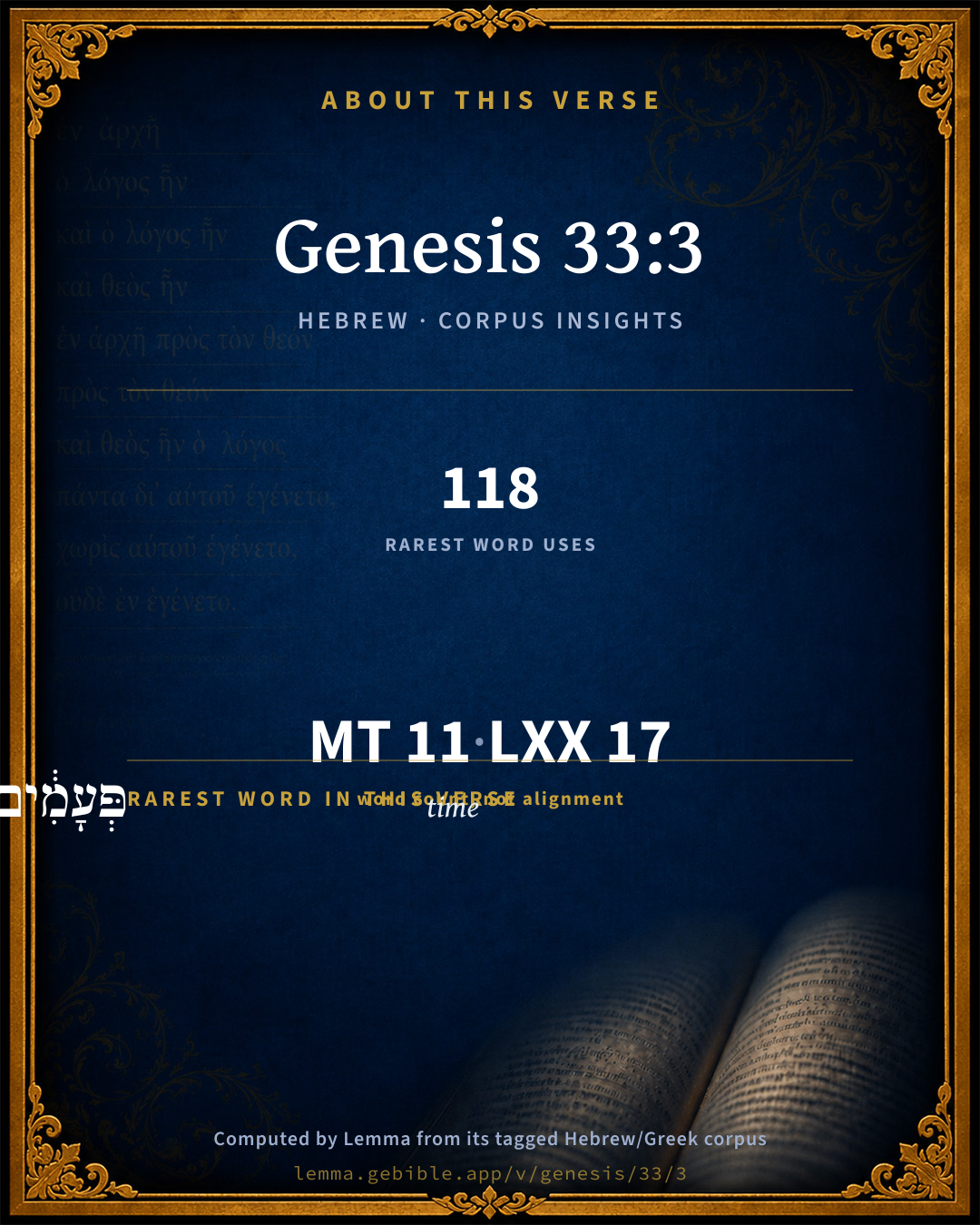
11
words
10
distinct lemmas
Pentateuch
section

Grammatical profile

  • 3 verbs
  • 4 nouns
  • 1 adjective
  • 1 pronoun
  • 2 prepositions

Verb forms

  • עָבַ֣ר Qal · Perfect
  • וַיִּשְׁתַּ֤חוּ Hithpael · Sequential Imperfect
  • גִּשְׁתּ֖וֹ Qal · Infinitive Construct

Repetition

A word recurs within this verse — often emphatic in Hebrew:

Hebrew & Septuagint length

In English translation the verse runs 23 words from the Hebrew and 21 from the Septuagint (LXX English) — closely comparable.

A rough comparison of the two English renderings, which tokenize alike — not a word-level alignment.

Word counts can differ between the Hebrew and the Greek without any difference in meaning — e.g. the Hebrew direct-object marker אֵת has no separate Greek word, and Greek often adds the article ὁ.

In the original languages it is 11 Hebrew tokens and 17 Greek tokens — but the two are counted differently (Hebrew bundles its prefixes and suffixes into one token; the Greek is in lemma form), so that isn’t a like-for-like length.

Cross-references

10

Topical passages linked to Genesis 33:3 in the Treasury of Scripture Knowledge — connected by theme and wording, ordered by reader-vote popularity; previews shown in the World English Bible.

  • Genesis 42:6 Joseph was the governor over the land. It was he who sold to all the people of the land. Joseph's brothers came, and bowed themselves down to him with their faces to the earth.
  • Genesis 18:2 He lifted up his eyes and looked, and saw that three men stood opposite him. When he saw them, he ran to meet them from the tent door, and bowed himself to the earth,
  • Luke 14:11 For everyone who exalts himself will be humbled, and whoever humbles himself will be exalted."
  • Genesis 43:26 When Joseph came home, they brought him the present which was in their hand into the house, and bowed down themselves to him to the earth.
  • 1 Samuel 2:5 Those who were full have hired out themselves for bread; Those who were hungry have ceased [to hunger]: Yes, the barren has borne seven; She who has many children languishes.
  • Proverbs 6:3 Do this now, my son, and deliver yourself, Seeing you have come into the hand of your neighbor. Go, humble yourself. Press your plea with your neighbor.
  • Ecclesiastes 10:4 If the spirit of the ruler rises up against you, don't leave your place; for gentleness lays great offenses to rest.
  • John 10:4 Whenever he brings out his own sheep, he goes before them, and the sheep follow him, for they know his voice.
  • John 10:11–12 I am the good shepherd. The good shepherd lays down his life for the sheep.
  • John 10:15 even as the Father knows me, and I know the Father. I lay down my life for the sheep.

Cross-references courtesy of OpenBible.info (CC BY 4.0).

Hebrew and Greek witnesses Masoretic Hebrew ↔ Greek Septuagint

The same verse in the two great witnesses to the Old Testament, shown verse-for-verse.

These are two independent witnesses, not word-aligned to each other, and the Septuagint is shown in lemma (dictionary) form.

Hebrew Genesis 33:3 Masoretic · Westminster Leningrad Codex

וְה֖וּא עָבַ֣ר לִפְנֵיהֶ֑ם וַיִּשְׁתַּ֤חוּ אַ֨רְצָה֙ שֶׁ֣בַע פְּעָמִ֔ים עַד גִּשְׁתּ֖וֹ עַד אָחִֽיו

He himself passed over in front of them, and bowed himself to the ground seven times, until he came near to his brother.

World English Bible · Public Domain

Greek LXX Genesis 33:3 Septuagint · lemma form

αὐτός δέ προἔρχομαι ἔμπροσθεν αὐτός καί προςκυνέω ἐπί ὁ γῆ ἑπτάκις ἕως ὁ ἐγγίζω ὁ ἀδελφός αὐτός

But he advanced himself before them, and did reverence to the ground seven times, until he drew near to his brother.

LXX2012 (modern English Septuagint) · Public Domain

Hebrew: Westminster Leningrad Codex (CC BY 4.0). Greek: Septuagint (public domain); English from LXX2012 (modern English Septuagint) (Public Domain). How the Septuagint differs from the Hebrew →

Targum (Aramaic paraphrase)

2

The Targum is the ancient Jewish Aramaic paraphrase of the Hebrew Scriptures — an interpretive translation, not the Hebrew text itself. Onkelos (literal) and Pseudo-Jonathan (expansive) render the Torah, and Jonathan the Prophets. Coverage is partial: where no permissively-licensed English translation exists for a verse, only the Aramaic is shown. This is verse-level text, not a word-by-word alignment to the Hebrew.

  1. Targum Onkelos Torah (Genesis–Deuteronomy)
    וְהוּא עֲבַר קֳדָמֵיהוֹן וּסְגִיד עַל אַרְעָא שְׁבַע זִמְנִין עַד מִקְרְבֵהּ עַד (נ''י לְוַת) אֲחוּהִי

    (no public-domain English translation for this verse)

    Targum Onkelos — Aramaic: “Onkelos Genesis” (public domain); “Onkelos Exodus” (public domain); “Onkelos Leviticus” (public domain); “Onkelos Numbers” (public domain); “Onkelos Deuteronomy” (public domain). English: “Sefaria Community Translation” (CC0 1.0 (public-domain dedication)); “J.W. Etheridge. The Targums of Onkelos and Jonathan Ben Uzziel on the Pentateuch. London: Longmans, Green, 1862” (public domain). Text via Sefaria.

  2. Targum Pseudo-Jonathan Torah (Genesis–Deuteronomy)
    וְאִיהוּ עָבַר לְקָדָמֵיהוֹן מַצְלֵי וּבְעֵי רַחֲמִין מִן קֳדָם יְיָ וְגָחַן עַל אַרְעָא שְׁבַע זִמְנִין עַד מִיקְרְבֵיהּ עַד אָחוֹי

    And he himself went over before them, praying and asking mercy before the Lord; and he bowed upon the earth seven times, until he met with his brother.

    Targum Pseudo-Jonathan — Aramaic: “Targum Jonathan on Genesis” (public domain); “Targum Jonathan on Exodus” (public domain); “Targum Jonathan on Leviticus” (public domain); “Targum Jonathan on Numbers” (public domain); “Targum Jonathan on Deuteronomy” (public domain). English: “The Targum of Jonathan ben Uzziel, trans. J. W. Etheridge, London, 1862” (public domain). Text via Sefaria.

Commentary

Notes on Genesis 33:3 from classic Christian and Jewish commentators (each source and its license shown beneath its notes). The classic Christian expositions comment on the surrounding passage and are grouped to its opening verse, so a note may address several verses; the Jewish commentaries on the Tanakh (Rashi and others) are per-verse, so they appear only where the commentator wrote on this verse.

Lemma curates 59 commentaries, every one of them public domain or Creative Commons licensed, each selected and text-cleaned for this edition rather than reprinted as found. About our sources →

Trapp's Complete Commentary

John Trapp

Gen 33:3 And he passed over before them, and bowed himself to the ground seven times, until he came near to his brother.

Ver. 3. And he passed over before them.] As a good captain and shepherd, ready to be sacrificed for the safety of his charge. So the Captain of our salvation, the Arch-shepherd, Christ. So should the under-shepherds, the captains, as ministers are called, fight in the front, and bear the brunt of the battle, "not loving their lives unto the death, so they may finish their course with joy," {Act 20:24} de scuto magis quam de vita solliciti, as Epaminondas. The diamond in the priests’ breastplate showed what should be their hardness and hardiness, for the people’s welfare.

John Trapp, A Commentary or Exposition upon All the Books of the Old and New Testament (1647–1656) — public domain. Text from a community e-Sword module.

Tyndale Open Study Notes

Tyndale Open Resources

33:3-13 Even though Jacob had nothing to fear, he was afraid and tried to appease his brother. He assumed the role of a servant before royalty by bowing (33:3), using an honorific title (33:8, 13), making introductions (33:6-7), and presenting gifts (33:8).

Tyndale Open Study Notes — © Tyndale Open Resources, licensed CC BY-SA 4.0. Text via the HelloAO Bible API.

Geneva Bible (1599)

Geneva Bible translators

By this gesture he partly did reverence to his brother, and partly prayed to God to mitigate Esau’s wrath.

Geneva Bible (1599) marginal notes — public domain. Text via Bolls.life.

Jamieson, Fausset & Brown

Robert Jamieson, A. R. Fausset & David Brown

he bowed himself . . . seven times--The manner of doing this is by looking towards a superior and bowing with the upper part of the body brought parallel to the ground, then advancing a few steps and bowing again, and repeating his obeisance till, at the seventh time, the suppliant stands in the immediate presence of his superior. The members of his family did the same. This was a token of profound respect, and, though very marked, it would appear natural; for Esau being the elder brother, was, according to the custom of the East, entitled to respectful treatment from his younger brother. His attendants would be struck by it, and according to Eastern habits, would magnify it in the hearing of their master.

Jamieson, Fausset & Brown — Commentary Critical and Explanatory on the Whole Bible (1871) — public domain (CC PDM 1.0). Text via the HelloAO Bible API.

John Calvin's Commentaries

3. And bowed himself to the ground seven times. This, indeed, he might do for the sake of giving honor: for we know that the people of the east are addicted to far more ceremonies than are in use with us. To me, however, it seems more probable, that Jacob did not pay this honor simply to his brother, but that he worshipped God, partly to give him thanks, and partly to implore him to render his brother propitious; for he is said to have bowed down seven times before he approached his brother. Therefore, before he came in sight of his brother, he had already given the token of reverence or worship. Hence we may conjecture, as I have said, that this homage was paid to God and not to man: yet this is not at variance with the fact, that he also approached as a suppliant, for the purpose of assuaging his brother’s ferocity by his humiliation. If any one object, that in this manner he depreciated his right of primogeniture; the answer is easy, that the holy man, by the eyes of faith, was looking higher; for he knew that the effect of the benediction was deferred to its proper season, and was, therefore, now like the decaying seed under the earth. Therefore, although he was despoiled of his patrimony, and lay contemptible at his brother’s feet; yet since he knew that his birthright was secured to him, he was contented with this latent right, counted honors and riches as nothing, and did not shrink from being regarded as an inferior in the presence of his brother.

John Calvin's Commentaries (1540-1563) — public domain. Text from the Calvin Translation Society English edition (1840s-50s) via the Christian Classics Ethereal Library (ccel.org). Calvin's coverage is partial (roughly two-thirds of the Bible); uncommented books and verses are honest gaps, never fabricated. The 19th-century editor's footnotes and remarks are omitted so the notes are faithfully Calvin's own voice.

Ellicott's Commentary for English Readers

XXXIII.

(3) He passed over before them.—While providing some small chance of escape for his wives and children, arranged according to their rank, Jacob manfully went first and placed himself entirely in Esau’s power. He endeavoured, nevertheless, by his sevenfold obeisance in acknowledgment of Esau’s superiority, to propitiate him; for the cause of the quarrel had been Jacob’s usurpation of Esau’s right of precedence as the first born. This bowing in the East is made by bending the body forward with the arms crossed, and the right hand held over the heart.

A Bible Commentary for English Readers, edited by Charles John Ellicott (1878–1897) — public domain. Text from a community e-Sword module.

The Cambridge Bible for Schools and Colleges

gen. ed. J. J. S. Perowne

3. before them] Jacob himself goes in front of his household to protect them.

seven times] Jacob prostrates himself before his brother, in token of complete subservience. Not content with one prostration, he bows seven times to the ground, with which has aptly been compared a letter from a Canaanite king to the king of Egypt in the Tel-el-Amarna tablets: “At the feet of the king, my lord, seven times and seven times do I fall.”

The Cambridge Bible for Schools and Colleges (gen. ed. J. J. S. Perowne; Cambridge University Press, 1878–1918) — public domain. Text from a community e-Sword module.

John Gill's Exposition

And he passed over before them,.... At the head of them, as the master of the family, exposing himself to the greatest danger for them, and in order to protect and defend them in the best manner he could, or to endeavour to soften the mind of his brother by an address, should there be any occasion for it:

and bowed himself to the ground seven times; in a civil way, as was the manner in the eastern countries towards great personages; and this he did to Esau as being his elder brother, and as superior to him in grandeur and wealth, being lord of a considerable country; and at the same time religious adoration might be made to God; while he thus bowed to the ground, his heart might be going up to God in prayer, that he would appear for him at this instant, and deliver him and his family from perishing by his brother; and so the Targum of Jonathan introduces this clause,"praying, and asking mercies of the Lord, and bowed, &c.''seven times, perhaps, may not design an exact number, but that he bowed many times as he came along:

until he came near to his brother; he kept bowing all the way he came until they were within a small space of one another.

John Gill's Exposition of the Whole Bible (1746–1763) — public domain (CC PDM 1.0). Text via the HelloAO Bible API.

Haydock's Catholic Bible Commentary

Forward, before his family; like a good father, exposing himself to the greatest danger. (Menochius) --- Seven times, to testify his great humility and respect for his brother. How, then, can any one find fault with Catholics, if they bow down before the cross thrice on Good Friday, to testify their great veneration for their expiring Lord?

George Leo Haydock (1774–1849), Haydock's Catholic Family Bible and Commentary, 1859 edition — public domain. Excludes Psalms (Douay-Rheims chapter numbering differs from Protestant) and Deuterocanonical books (Catholic canon only).

Matthew Poole's English Annotations

He passed over before them, exposing himself to the first and greatest hazard for the security of his wives and children.

Matthew Poole's English Annotations on the Holy Bible (1683–1685) — public domain. Text from a community e-Sword/MySword module.

Whedon's Commentary on the Bible

Daniel D. Whedon

3. Before them — He goes on first to meet whatever evil may be feared.

Bowed… to the ground — Not as in Gen_19:1, “with the face to the ground,” which denotes complete prostration, but groundward, so that though the face does not touch the ground, it is brought low towards it.

Seven times — Such a repetition of these acts of humility would have a likely tendency to disarm Esau’s wrath. And doubtless the lowly obeisance and the lameness of Jacob drove from the generous hearted Esau whatever feeling of hardness or evil purpose he might have entertained towards him until now.

Daniel D. Whedon (gen. ed.), Commentary on the Old and New Testaments (1874–1909) — public domain. Text from a community e-Sword module.

John Wesley's Explanatory Notes

He bowed - Though he feared Esau as an enemy, yet he did obeisance to him as an elder brother.

John Wesley, Explanatory Notes Upon the Whole Bible (1754–1765) — public domain. Text via the GEBible commentary corpus.

Rashi

Rabbi Shlomo Yitzchaki (Rashi)

עבר לפניהם [AND HE HIMSELF] PASSED BEFORE THEM — He thought: if that wicked man comes to fight let him fight me first (Genesis Rabbah 78:8).

Rashi on the Tanakh — English translations: “The Judaica Press complete Tanach with Rashi, translated by A. J. Rosenberg” (CC BY 4.0); “Pentateuch with Rashi's commentary by M. Rosenbaum and A.M. Silbermann, 1929-1934” (public domain); “The Metsudah Tanach series, Lakewood, N.J” (CC BY 4.0); and “The Book of Joshua, Metsudah Publications, 1997” (CC BY 4.0). Text via Sefaria.

Radak

Rabbi David Kimhi (Radak)

והוא עבר לפניהם, as a father who has compassion on his children. He offered himself as the butt of Esau’s anger hoping thereby to save the lives of his children. Either Esau would agree not to harm the children or he would engage Esau in battle to try and save his children if Esau refused his offer of reconciliation.

שבע פעמים. According to Bereshit Rabbah 78,8 the reason why he prostrated himself 7 times before Esau is based on Proverbs 24,16 שבע יפול צדיק, that the righteous fall down seven times before remaining upright after getting up.

Radak on the Tanakh — English translations: “Sefaria Community Translation” (CC0 1.0 (public-domain dedication)); “Eliyahu Munk, HaChut Hameshulash” (CC BY 4.0); “Rabbi Mike Feuer, Jerusalem Anthology” (CC BY 4.0); and “R. David Kimhi on the first book of Psalms, Translated by R.G. Finch, London, 1919” (public domain). Text via Sefaria.

Lesson kit

Teaching starters — assembled from the data on this page, not authored interpretation. Every prompt links to the verse data it draws on. Edit before teaching.

Genesis, in the Pentateuch, opens this verse with 11 words (10 distinct Hebrew lemmas). Its most distinctive word is paʻam (“time”). A historical commentator’s framing appears above. Read the whole chapter for the surrounding context.

Discussion questions

  1. The word paʻam carries the sense “time.” How does it shape the verse?
  2. How does Genesis 42:6, which shares this passage’s theme, read alongside this verse?
  3. What does the repetition of “until” (2× in this one verse) do in this verse?
  4. These translations render this verse differently. What is at stake in choosing one wording over another?
  5. «עָבַ֣ר» is a Qal Perfect verb. How does that grammatical form shape the action described?
  6. Compare how Trapp's Complete Commentary and Tyndale Open Study Notes read this verse. Where do they agree or differ?

Things to notice

Reading settings

Reading text

Shown beneath each verse's original-language words.

Old Testament
Old Testament edition

Read the OT as the Masoretic Hebrew (MT) or the Greek Septuagint (LXX).

English shown for the Greek Septuagint (in the Hebrew ↔ Greek comparison).

Comparing translations? Open the Compare panel on any verse page to stack up to four side by side.