
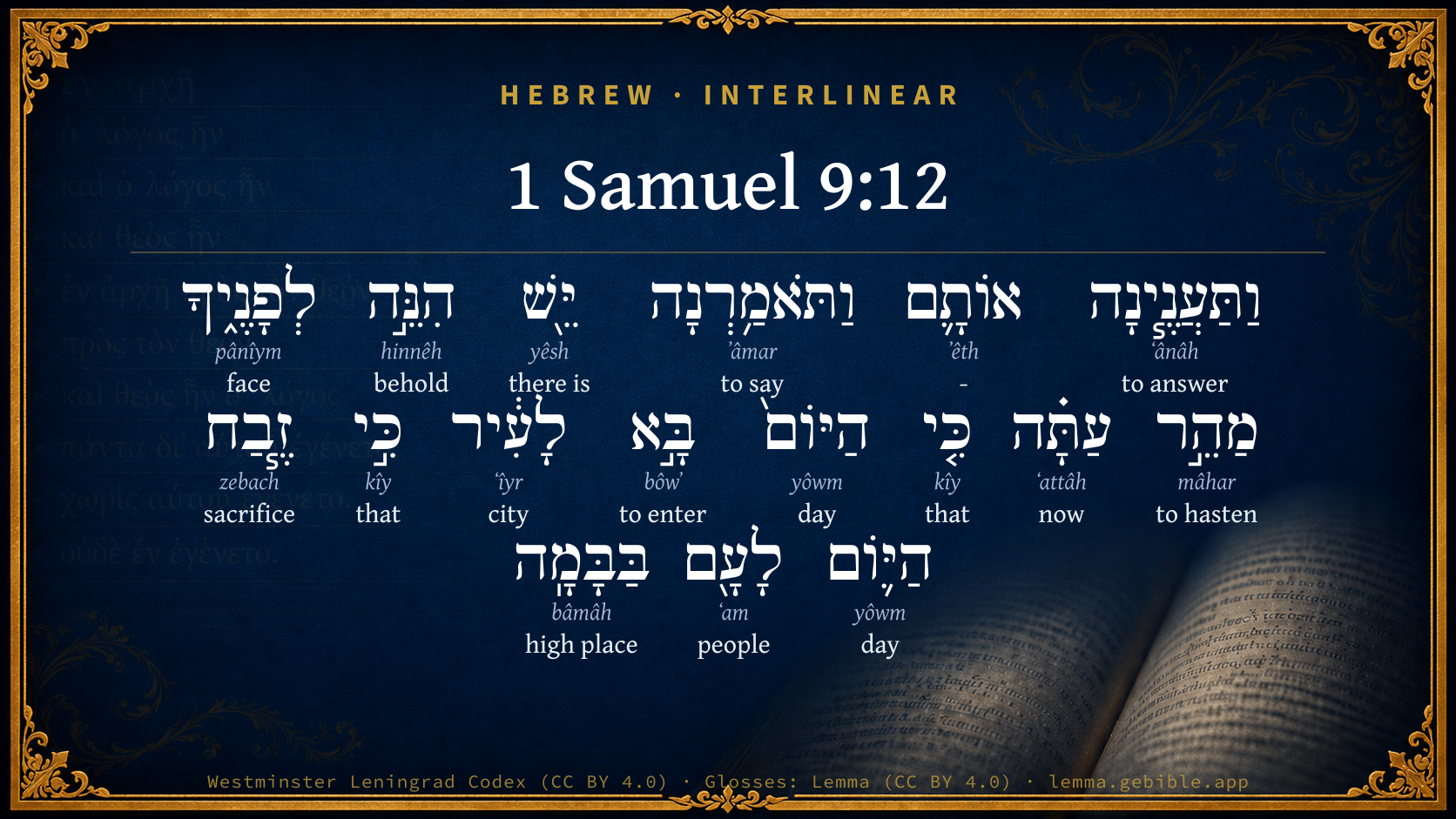
1 Samuel 9:12

Hebrew (Westminster Leningrad Codex) 1 Samuel 9:12 appears in the Hebrew Old Testament. The text above is from the Westminster Leningrad Codex. Each word links to its Strong’s number, a concise gloss, and parsing drawn from the Open Scriptures Hebrew Bible morphology. Click any word for its full Brown-Driver-Briggs (BDB) entry.
Download image
Cite this verse

1 Samuel 9:12 (World English Bible). Public Domain. Lemma interlinear Bible study tool, https://lemma.gebible.app/v/1-samuel/9/12.

Show BibTeX & RIS
BibTeX
RIS
English Translation
They answered them, and said, He is; behold, [he is] before you: make haste now, for he is come today into the city; for the people have a sacrifice today in the high place:
World English Bible · Public Domain
Download a study sheet

One document with this verse’s original text, its word-by-word gloss line, the meaning frame, cross-references with their text, attributed commentary, and full source and license credits — printable, and it pastes into notes with its structure intact.

This verse Autodidact and up

Study sheet (.html) Plain text (.txt)

A passage Seminary Student

Up to 50 verses in one chapter. A passage sheet keeps up to 6 commentary sources and 12 cross-references per verse, in the order this page ranks them, and says so on the sheet whenever that leaves anything out. Ask for a single verse and you get the Autodidact verse sheet above.

Everything on this page stays free to read, with no account — the sheet is a download of what is already on screen, not access to it.

Want to remove ads? Support Godless Engineer
Compare translations 3

The same verse in 3 English versions, stacked beneath the original-language interlinear above. Click any original word for its lexicon entry.

Each is an independent rendering of the whole verse — the interlinear is not word-aligned to these translations.

Highlighted words mark where these versions differ — a whole-verse word diff, not a word-by-word alignment.

  • World English Bible Public Domain
    They answered them, and said, He is; behold, [he is] before you: make haste now, for he is come today into the city; for the people have a sacrifice today in the high place:
  • King James Version Public Domain
    And they answered them, and said, He is; behold, he is before you: make haste now, for he came to day to the city; for there is a sacrifice of the people to day in the high place:
  • unfoldingWord Literal Text CC BY-SA 4.0
    And they answered them and said, “He is, behold, to your face. Hurry now, for he has come to the city today because the sacrifice of the day to the people at the high place.

unfoldingWord Literal Text — © unfoldingWord, licensed CC BY-SA 4.0. Word-aligned USFM3 via Door43 (git.door43.org/unfoldingWord/en_ult).

Versions to compare (up to 4)

3 of 4 selected

Show all 18 translations

Every available English version of this verse, each an independent rendering of the whole verse.

  • World English Bible Public Domain
    They answered them, and said, He is; behold, [he is] before you: make haste now, for he is come today into the city; for the people have a sacrifice today in the high place:
  • Berean Standard Bible Public Domain
    “Yes, he is ahead of you,” they answered. “Hurry now, for today he has come to the city because the people have a sacrifice on the high place.
  • Majority Standard Bible Public Domain
    “Yes, he is ahead of you,” they answered. “Hurry now, for today he has come to the city because the people have a sacrifice on the high place.
  • King James Version Public Domain
    And they answered them, and said, He is; behold, he is before you: make haste now, for he came to day to the city; for there is a sacrifice of the people to day in the high place:
  • American Standard Version (1901) Public Domain
    And they answered them, and said, He is; behold, `he is' before thee: make haste now, for he is come to-day into the city; for the people have a sacrifice to-day in the high place:
  • Revised Version (1885) Public Domain
    And they answered them, and said, He is; behold, he is before thee: make haste now, for he is come today into the city; for the people have a sacrifice today in the high place:
  • Geneva Bible (1599) Public Domain
    And they answered them, and said, Yea: loe, he is before you: make haste nowe, for he came this day to the citie: for there is an offering of the people this day in the hie place.
  • Douay-Rheims (1899) Public Domain
    They answered and said to them: He is: behold he is before you, make haste now: for he came to day into the city, for there is a sacrifice of the people to day in the high place.
  • Young's Literal Translation Public Domain
    And they answer them and say, `He is; lo, before thee! haste, now, for to-day he hath come in to the city, for the people hath a stated sacrifice in a high place.
  • Literal Standard Version CC BY-SA 4.0
    And they answer them and say, “He is; behold, before you! Hurry, now, for he has come to the city today, for the people [have] a sacrifice today in a high place.
  • Unlocked Literal Bible CC BY-SA 4.0
    They answered, and said, “He is; see, he is just ahead of you. Hurry up, for he is coming to the city today, because the people are sacrificing today at the high place.
  • unfoldingWord Literal Text CC BY-SA 4.0
    And they answered them and said, “He is, behold, to your face. Hurry now, for he has come to the city today because the sacrifice of the day to the people at the high place.
  • Darby Bible Public Domain
    And they answered them and said, He is; behold, he is before thee: make haste now, for he came to-day to the city; for the people have a sacrifice to-day in the high place.
  • World Messianic Bible Public Domain
    They answered them and said, “He is. Behold, he is before you. Hurry now, for he has come today into the city; for the people have a sacrifice today in the high place.
  • Webster's Bible Public Domain
    And they answered them, and said, He is; behold, he is before you: make haste now, for he came to-day to the city; for there is a sacrifice of the people to-day in the high place:
  • Free Bible Version CC BY-SA 4.0
    “He is,” they replied, “Up ahead of you. But you'll have to hurry. He's come to town today because the people are having a sacrifice at the high place.
  • Bible in Basic English Public Domain
    And they said, He is; in fact he is before you: go quickly now, for he has come into the town today, for the people are making an offering in the high place today:
  • JPS Tanakh (1917) Public Domain
    And they answered them, and said: 'He is; behold, he is before thee; make haste now, for he is come to-day into the city; for the people have a sacrifice to-day in the high place.

Literal Standard Version (2020), Covenant Press — licensed CC BY-SA 4.0. Text via the HelloAO Bible API (eBible.org). Unlocked Literal Bible (unfoldingWord) — licensed CC BY-SA 4.0. Text via the HelloAO Bible API (eBible.org). unfoldingWord Literal Text — © unfoldingWord, licensed CC BY-SA 4.0. Word-aligned USFM3 via Door43 (git.door43.org/unfoldingWord/en_ult). Free Bible Version, Dr. Jonathan Gallagher — licensed CC BY-SA 4.0. Text via the HelloAO Bible API (eBible.org).

Word by word

More ways to search: Search by grammar → Find every occurrence → Compare this word →

Practice this passage: Drill this verse → Learn its vocabulary →

מַהֵ֣ר
mâhar
H4116
“hasten”
Verb, Piel, Imperative, 2nd Person, Masculine, Singular
Part of Speech
Verb
Stem
Piel
Form
Imperative
Person
2nd Person
Gender
Masculine
Number
Singular
Full BDB Definition

Origin: a primitive root

TWOT: 1152

(Qal) to hasten - (Niphal) to be hurried, be anxious - hasty, precipitate, impetuous - (Piel) - to hasten, make haste - hasten (used as adverb with another verb) - to hasten, prepare quickly, do quickly, bring quickly
  1. וַתַּעֲנֶ֧ינָה ʻânâh H6030 “and · to answer” Conjunction + Verb, Qal, Sequential Imperfect, 3rd Person, Feminine, Plural
  2. אוֹתָ֛ם ʼêth H853 “- · them” Particle, Direct Object + Suffix, Personal, 3rd Person, Masculine, Plural
  3. וַתֹּאמַ֥רְנָה ʼâmar H559 “and · to say” Conjunction + Verb, Qal, Sequential Imperfect, 3rd Person, Feminine, Plural
  4. יֵּ֖שׁ yêsh H3426 “there is” Particle, Demonstrative
  5. הִנֵּ֣ה hinnêh H2009 “behold” Particle, Demonstrative
  6. לְפָנֶ֑יךָ pânîym H6440 “to/for · face(s) · your” Preposition + Noun, Common, Both, Plural, Construct + Suffix, Personal, 2nd Person, Masculine, Singular
  7. עַתָּ֗ה ʻattâh H6258 “now” Adverb
  8. כִּ֤י kîy H3588 “that” Conjunction
  9. הַיּוֹם֙ yôwm H3117 “the · day” Particle, Definite Article + Noun, Common, Masculine, Singular, Absolute
  10. בָּ֣א bôwʼ H935 “to enter” Verb, Qal, Perfect, 3rd Person, Masculine, Singular
  11. לָעִ֔יר ʻîyr H5892 “to/for the · city” Preposition, Determined + Noun, Common, Feminine, Singular, Absolute
  12. כִּ֣י kîy H3588 “that” Conjunction
  13. זֶ֧בַח zebach H2077 “sacrifice of” Noun, Common, Masculine, Singular, Construct
  14. הַיּ֛וֹם yôwm H3117 “the · day” Particle, Definite Article + Noun, Common, Masculine, Singular, Absolute
  15. לָעָ֖ם ʻam H5971 “to/for the · people” Preposition, Determined + Noun, Common, Masculine, Singular, Absolute
  16. בַּבָּמָֽה bâmâh H1116 “in/at the · high place” Preposition, Determined + Noun, Common, Feminine, Singular, Absolute

About this verse

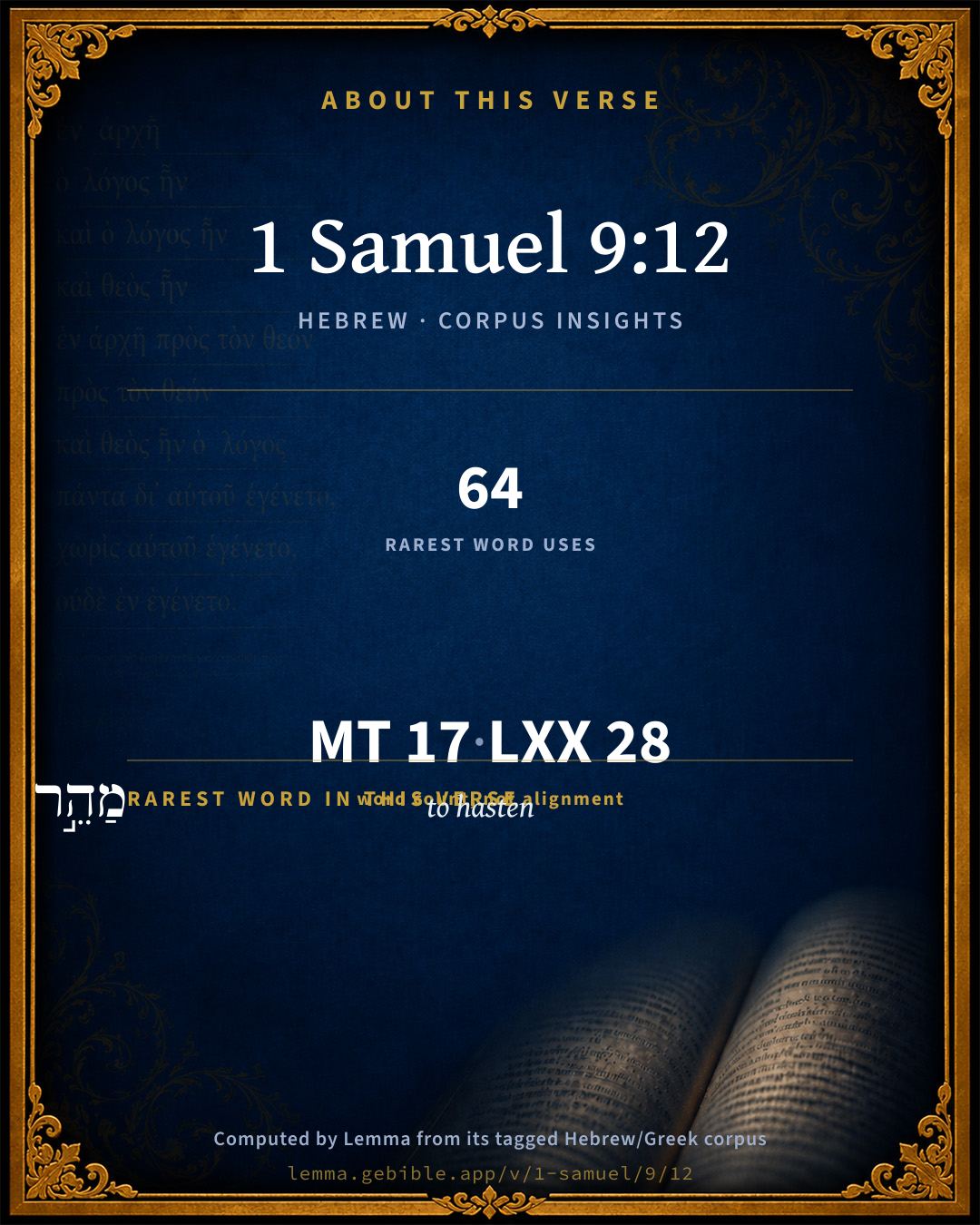
These counts appear in no published source. They are computed here, from the morphology-tagged text and Lemma’s own curated glosses. What Lemma adds →

17
words
15
distinct lemmas
Historical
section

Grammatical profile

  • 4 verbs
  • 7 nouns
  • 2 conjunctions
  • 1 adverb
  • 3 particles

Verb forms

  • וַתַּעֲנֶ֧ינָה Qal · Sequential Imperfect
  • וַתֹּאמַ֥רְנָה Qal · Sequential Imperfect
  • מַהֵ֣ר Piel · Imperative
  • בָּ֣א Qal · Perfect

Repetition

Words recur within this verse — often emphatic in Hebrew:

  • הַיּוֹם֙ day H3117 ×2
  • כִּ֤י that H3588 ×2

Hebrew & Septuagint length

In English translation the verse runs 34 words from the Hebrew and 39 from the Septuagint (LXX English) — closely comparable.

A rough comparison of the two English renderings, which tokenize alike — not a word-level alignment.

Word counts can differ between the Hebrew and the Greek without any difference in meaning — e.g. the Hebrew direct-object marker אֵת has no separate Greek word, and Greek often adds the article ὁ.

In the original languages it is 17 Hebrew tokens and 28 Greek tokens — but the two are counted differently (Hebrew bundles its prefixes and suffixes into one token; the Greek is in lemma form), so that isn’t a like-for-like length.

Cross-references

9

Topical passages linked to 1 Samuel 9:12 in the Treasury of Scripture Knowledge — connected by theme and wording, ordered by reader-vote popularity; previews shown in the World English Bible.

  • Genesis 31:54 Jacob offered a sacrifice in the mountain, and called his relatives to eat bread. They ate bread, and stayed all night in the mountain.
  • 1 Samuel 10:5 After that you shall come to the hill of God, where is the garrison of the Philistines: and it shall happen, when you are come there to the city, that you shall meet a band of prophets coming down from the high place with a psaltery, and a tambourine, and a pipe, and a harp, before them; and they will be prophesying:
  • 1 Samuel 16:2 Samuel said, How can I go? if Saul hear it, he will kill me. Yahweh said, Take a heifer with you, and say, I am come to sacrifice to Yahweh.
  • 1 Kings 3:2–4 Only the people sacrificed in the high places, because there was no house built for the name of Yahweh until those days.
  • Deuteronomy 12:6–7 and there you shall bring your burnt offerings, and your sacrifices, and your tithes, and the heave-offering of your hand, and your vows, and your freewill-offerings, and the firstborn of your herd and of your flock:
  • 1 Corinthians 5:7–8 Purge out the old yeast, that you may be a new lump, even as you are unleavened. For indeed Christ, our Passover, has been sacrificed in our place.
  • Numbers 28:11–15 In the beginnings of your months you shall offer a burnt offering to Yahweh: two young bulls, and one ram, seven he-lambs a year old without blemish;
  • 1 Samuel 7:17 His return was to Ramah, for there was his house; and there he judged Israel: and he built there an altar to Yahweh.
  • 1 Chronicles 16:39 and Zadok the priest, and his brothers the priests, before the tent of Yahweh in the high place that was at Gibeon,

Cross-references courtesy of OpenBible.info (CC BY 4.0).

Hebrew and Greek witnesses Masoretic Hebrew ↔ Greek Septuagint

The same verse in the two great witnesses to the Old Testament, shown verse-for-verse.

These are two independent witnesses, not word-aligned to each other, and the Septuagint is shown in lemma (dictionary) form.

Hebrew 1 Samuel 9:12 Masoretic · Westminster Leningrad Codex

וַתַּעֲנֶ֧ינָה אוֹתָ֛ם וַתֹּאמַ֥רְנָה יֵּ֖שׁ הִנֵּ֣ה לְפָנֶ֑יךָ מַהֵ֣ר עַתָּ֗ה כִּ֤י הַיּוֹם֙ בָּ֣א לָעִ֔יר כִּ֣י זֶ֧בַח הַיּ֛וֹם לָעָ֖ם בַּבָּמָֽה

They answered them, and said, He is; behold, [he is] before you: make haste now, for he is come today into the city; for the people have a sacrifice today in the high place:

World English Bible · Public Domain

Greek LXX 1 Samuel 9:12 Septuagint · lemma form

καί ἀποκρίνω ὁ κοράσιον αὐτός καί λέγω αὐτός εἰμί ἰδού κατά πρόσωπον σύ νῦν διά ὁ ἡμέρα ἥκω εἰς ὁ πόλις ὅτι θυσία σήμερον ὁ λαός ἐν βαμα

And the virgins answered them, and they say to them, He is: behold, he is before you: now he is coming to the city, because of the day, for today there is a sacrifice for the people in Bama.

LXX2012 (modern English Septuagint) · Public Domain

Hebrew: Westminster Leningrad Codex (CC BY 4.0). Greek: Septuagint (public domain); English from LXX2012 (modern English Septuagint) (Public Domain). How the Septuagint differs from the Hebrew →

Targum (Aramaic paraphrase)

1

The Targum is the ancient Jewish Aramaic paraphrase of the Hebrew Scriptures — an interpretive translation, not the Hebrew text itself. Onkelos (literal) and Pseudo-Jonathan (expansive) render the Torah, and Jonathan the Prophets. Coverage is partial: where no permissively-licensed English translation exists for a verse, only the Aramaic is shown. This is verse-level text, not a word-by-word alignment to the Hebrew.

  1. Targum Jonathan Prophets (Joshua–Malachi)
    וַאֲתִיבוּ יַתְהוֹן וַאַמָרָא אִית דָא הָא קֳדָמָךְ אוֹחִי כְעַן אֲרֵי יוֹמָא דֵין עַל לְקַרְתָּא אֲרֵי שֵׁירוּ נִכְסַת קוּדְשַׁיָא יוֹמָא דֵין לְעַמָא בְּבֵית אַסְחֲרוּתָא:

    (no public-domain English translation for this verse)

    Targum Jonathan — Aramaic: “Mikraot Gedolot” (public domain). English: “Sefaria Community Translation” (CC0 1.0 (public-domain dedication)); “London "Chaldee Paraphrase," 1871” (public domain). Text via Sefaria.

Commentary

Notes on 1 Samuel 9:12 from classic Christian and Jewish commentators (each source and its license shown beneath its notes). The classic Christian expositions comment on the surrounding passage and are grouped to its opening verse, so a note may address several verses; the Jewish commentaries on the Tanakh (Rashi and others) are per-verse, so they appear only where the commentator wrote on this verse.

Lemma curates 59 commentaries, every one of them public domain or Creative Commons licensed, each selected and text-cleaned for this edition rather than reprinted as found. About our sources →

Trapp's Complete Commentary

John Trapp

1Sa 9:12 And they answered them, and said, He is; behold, [he is] before you: make haste now, for he came to day to the city; for [there is] a sacrifice of the people to day in the high place:

Ver. 12. And they answered them, and said, He is.] Courtesy to strangers is very commendable. But that these maidens, taken with the beauty of Saul, stayed him a while to look upon him, using more words than needed, is an odd conceit of R. Solomon, cited by Lyra.

For there is a sacrifice.] Or, A feast: first a sacrifice, and then a feast made of part of the peace zofferings, as was usual; and, haply, at this time appointed on purpose by Samuel, for Saul’s better entertainment.

John Trapp, A Commentary or Exposition upon All the Books of the Old and New Testament (1647–1656) — public domain. Text from a community e-Sword module.

Joseph Benson's Commentary

1Sa 9:12-13. He came to-day to the city — He had been travelling abroad, and was now returned to his own house in Ramah. High place — Upon the hill mentioned 1Sa 9:11, and near the altar which Samuel built for this use. Ye shall straightway find him — At home and at leisure. Before he go up to eat — The relics of the sacrifices. Because he doth bless the sacrifice — This was a peace-offering or a thank-offering, and the blessing of it, no doubt, consisted both of thanksgiving to God for mercies received, and of prayer to him that this sacrifice might be accepted. But perhaps it was not what was offered upon the altar, but what the people ate afterward, that he blessed. We may observe here, that by blessing of victuals in Scripture, is meant, chiefly, the giving thanks to God for the food before it be eaten. Instances of which we have in abundance in the New Testament, our Lord and his apostles being continually said to give thanks before any thing was eaten. And here it is said, He doth bless the sacrifice, and afterward they eat that be bidden — It is probable, however, that Samuel both prayed for God’s blessing on what they ate, and gave thanks that they had it to eat. We see here how ancient the custom has been of praying to God, and giving thanks at our meals, and how blameable they are that neglect it.

Joseph Benson's Commentary on the Old and New Testaments (1811–1818) — public domain. Text from a community e-Sword module.

Tyndale Open Study Notes

Tyndale Open Resources

9:12 Leaders of a community would normally convene for business at the town gates (cp. Ruth 4:1-2). • take part in a public sacrifice: Samuel is one of very few individuals in whom prophetic and priestly ministries unite (also Moses, Jeremiah, Ezekiel, and Jesus). • place of worship (literally high place): An open-air altar or platform on a hill near the city gate. High places easily became sites for pagan idolatry (see Num 33:52; 1 Kgs 15:14; 22:43; 2 Kgs 12:3; 14:4; 15:4, 35).

Tyndale Open Study Notes — © Tyndale Open Resources, licensed CC BY-SA 4.0. Text via the HelloAO Bible API.

Geneva Bible (1599)

Geneva Bible translators

That is, a feast after the offering, which should be kept in an high place of the city appointed for that use.

Geneva Bible (1599) marginal notes — public domain. Text via Bolls.life.

Adam Clarke's Commentary

Verse 12. He came to-day to the city] Though Samuel lived chiefly in Ramah, yet he had a dwelling in the country, at a place called Naioth, where it is probable there was a school of the prophets. See 1Sa 19:18-24.

A sacrifice of the people] A great feast. The animals used were first sacrificed to the Lord; that is, their blood was poured out before him; and then all the people fed on the flesh. By high place probably Samuel's altar is alone meant; which no doubt was raised on an eminence.

Adam Clarke's Commentary on the Bible (1810–1826) — public domain. Text from a community e-Sword/MySword module.

Ellicott's Commentary for English Readers

(12) He came to-day.—The little scene—in itself in no way remarkable—is recounted by an eye-witness, evidently as introducing momentous consequences.

Every detail of that day’s proceedings was of deep interest to Israel. Some of the maidens of Raman were at the well side, drawing water for their homes. The two strangers accost them with the words, “Is the seer who dwells among you here just now?” and they eagerly reply, “Yes, this very day he came from his house into the town. It is a festival day—you will find him presiding up there,” pointing, no doubt, to the high place, where the sacrifices were being offered. Every word spoken by the girls of Ramah, loving to chatter and exhibit their local knowledge and their interest in their great fellow-citizen, the seer and judge, to whom they, in common with the inhabitants of Ramah, were, no doubt, much attached, was remembered in after time by Saul and his companion.

A Bible Commentary for English Readers, edited by Charles John Ellicott (1878–1897) — public domain. Text from a community e-Sword module.

The Cambridge Bible for Schools and Colleges

gen. ed. J. J. S. Perowne

12. he is before you] Before thee, addressing the speaker. It is a direction to go straight forward.

he came to day to the city] If “the city” was Ramah, Samuel may have been absent from home on one of his official circuits.

a sacrifice of the people] Possibly at the New Moon (Num_28:11-15) or upon some special occasion of thanksgiving.

in the high place] Here probably was the altar which Samuel had built (1Sa_7:17). A natural instinct among all nations chooses hill-tops as fitting places of worship. Such “high places” were frequently consecrated to the worship of Jehovah in spite of the prohibition implied in the command that there should be only one sanctuary (Deu_12:11-14). That this was the case in the unsettled period of the Judges is not surprising, but even after the building of the temple the high-place worship continued, though it is condemned in the books of Kings as a blot on the character of otherwise good monarchs.

The Cambridge Bible for Schools and Colleges (gen. ed. J. J. S. Perowne; Cambridge University Press, 1878–1918) — public domain. Text from a community e-Sword module.

John Gill's Exposition

And they answered them, and said, he is,.... That is, he is in the city, at home, and to be spoken with:

behold, he is before you; his house is straight before you as you go along, you cannot miss of it. Some Jewish writers say (f) they gave a token to know it by, that there was a cloud at the door, and when they saw that, they might know it was the seer's house:

haste now, for he came today to the city; from the suburbs to it, or from his country house, or from the other Ramah, for there were two of them, one over against the other, see Sa1 1:1, for that he was just now come off a circuit, is not so probable, since he was now old, and past riding his circuits; and indeed the meaning may be no more than as it may be rendered, "today he comes into the city" (g); that is, he comes out of his own house into the city, and was then just coming out; so that, if they made haste, they might meet him in the street before he got to the place of sacrifice and feasting:

for there is a sacrifice of the people today in the high place; whether it was the new moon, or some festival they observed, though the tabernacle was not there, is not certain; at which, besides the offerings required, freewill offerings and peace offerings were brought by the people, on part of which they feasted with their friends; and very probably, as Samuel was acquainted by the Lord that he who was to be king of Israel would be with him that day, he might add to the sacrifices of the people, to make the entertainment the more grand and liberal; since he had a principal concern in ordering the guests, and dividing the portions, as well as blessing the food, which indeed he might take upon him, as being judge, priest, and prophet: this was an high place where this sacrifice or feast was; for Shiloh being destroyed, and the tabernacle removed elsewhere, and that being in one place, and the ark in another, and they not together, no distinction of places was made, none being yet chosen, all were fit; and particularly high places, which were always reckoned the most proper for divine service and sacrifice.

(f) Midrash Schemuel & Pesikta apud Abarbinel in loc. (g) "venit", Pagninus, Montanus.

John Gill's Exposition of the Whole Bible (1746–1763) — public domain (CC PDM 1.0). Text via the HelloAO Bible API.

Haydock's Catholic Bible Commentary

A sacrifice. The law did not allow of sacrifices in any other place, but at the tabernacle, or temple, in which the ark of the covenant was kept; but Samuel, by divine dispensation, offered sacrifices in other places. For which dispensation this reason may be alleged, that the house of God in Silo, having lost the ark, was now cast off; as a figure of the reprobation of the Jews, Psalm lxxvii. 60, 67. And in Cariathiarim, where the ark was, there was neither tabernacle, nor altar. (Challoner) --- At least that of Moses was in the tabernacle. See chap. vi. 21. (Haydock) --- Samuel was just come up to the city, from a place called Naiot, where he instructed some of the prophets, chap. xix. 19. The maids point him out to Saul; and God, at the same time, reveals to his prophet, that the person who addressed him should be king. (Calmet) --- The high place. Excelsum. The excelsa, or high places, so often mentioned in Scripture, were places of worship, in which were altars for sacrifice. These were sometimes employed in the service of the true God, as in the present case: but more frequently in the service of idols, and were called Excelsa, which is commonly (though perhaps not so accurately) rendered high places; not because they were always upon hills, for the very worst of all, which was that of Topheth, or Geennom, (Jeremias xix.) was in a valley; but because of the high altars, and pillars, or monuments erected there, on which were set up the idols, or images of their deities; (Challoner) so that they might be called "the high things." (Haydock) --- Before Solomon built the temple, from the time that the tabernacle was deprived of the honour of having the ark, people immolated on such heights, 3 Kings iii. 2. (Menochius) --- On one of these, at Ramatha, Samuel was going to offer a peace-offering, and to feast with the heads of the city, (Calmet) or perhaps of the nation, who were expecting the result of his consultation of the Lord, respecting their petition of a king. (Haydock)

George Leo Haydock (1774–1849), Haydock's Catholic Family Bible and Commentary, 1859 edition — public domain. Excludes Psalms (Douay-Rheims chapter numbering differs from Protestant) and Deuterocanonical books (Catholic canon only).

Matthew Poole's English Annotations

He came today to the city: she so speaks, though this was his own constant habitation, because he had been travelling abroad, possibly in his circuit, described 1Sa 7:16,17, and was now returned to his own house in Ramah, as he used to do, and so she implies they come in a good and seasonable time to meet with him.

There is a sacrifice, otherwise feast; but it seems to be understood of a sacrifice. First, Because so the Hebrew word signifies most properly, and most frequently. Secondly, Because this eating was in the high place, which was the common place for sacrifices, but not for private feasts. Thirdly, The prophet’s presence was not so necessary for a feast as for a sacrifice. Of the people; so this sacrifice is called, because this was a public solemnity, and possibly the new moon, when the people brought several sacrifices, to wit, peace-offerings, whereof part fell to the offerer’s share; and of those parts united together, they here made a common feast; not without Samuel’s direction, who being forewarned the day before by God, of Saul’s coming, made this feast more solemn for his entertainment, 1Sa 9:22-24.

In the high place; upon the hill mentioned 1Sa 9:11, and near the altar which Samuel built for this kind of use, 1Sa 7:17, by Divine dispensation, as was there noted; otherwise to sacrifice in high places was forbidden by the law, after the building of the tabernacle.

Matthew Poole's English Annotations on the Holy Bible (1683–1685) — public domain. Text from a community e-Sword/MySword module.

Whedon's Commentary on the Bible

Daniel D. Whedon

12. Make haste now — For if ye do not see him before he goes up to the high place to bless the sacrifice and eat, ye may not be able to hold any private interview with him at all. See on 1Sa_9:6.

Sacrifice… in the high place — The law ordained, (Lev_17:3-9; Deu_12:5-14,) and it was remembered in the days of Joshua, (Jos_22:29,) that all burnt offerings must be offered upon one common altar. But the tribes of Israel failed both to drive out their heathen foes from the land, and to ascertain that central seat of worship where it would please Jehovah to record his name. And hence the practice of sacrificing in other places sprang up almost of necessity. The acts of Gideon (Jdg_6:25-26) and of Elijah (1Ki_18:30-32) received the divine approval, for they were to serve special purposes in bringing judgments upon the worship of Baal. But in the days of Samuel, Shiloh was desolate, the ark of the covenant was in Kirjath-jearim, and as yet there was no single place where Jehovah had recorded his name, and which he had designated as the one sole place where he would be pleased with sacrifice. Accordingly Samuel and the people are not to be censured for sacrificing in the high place. See 1Ki_3:2.

Daniel D. Whedon (gen. ed.), Commentary on the Old and New Testaments (1874–1909) — public domain. Text from a community e-Sword module.

John Wesley's Explanatory Notes

Came today to the city - He had been travelling abroad, and was now returned to his own house in Ramah. High place - Upon the hill mentioned ver. 11, and near the altar which Samuel built for this use.

John Wesley, Explanatory Notes Upon the Whole Bible (1754–1765) — public domain. Text via the GEBible commentary corpus.

unfoldingWord translationNotes

Door43 World Missions Community

the people are sacrificing today

These are likely the feast or first-fruit sacrifices, not the sin sacrifices, which must be held at the tabernacle.

translationWords

sacrifice

high place

bless

unfoldingWord translationNotes — © Distant Shores Media and the Door43 World Missions Community, licensed CC BY-SA 4.0. Source: git.door43.org/Door43/en_tn.

Lesson kit

Teaching starters — assembled from the data on this page, not authored interpretation. Every prompt links to the verse data it draws on. Edit before teaching.

1 Samuel, in the Historical, opens this verse with 17 words (15 distinct Hebrew lemmas). Its most distinctive word is mâhar (“to hasten”). A historical commentator’s framing appears above. Read the whole chapter for the surrounding context.

Discussion questions

  1. The word mâhar carries the sense “to hasten.” How does it shape the verse?
  2. Genesis 31:54 shares this passage’s theme. How do the two illuminate each other?
  3. “day” occurs 2× in this one verse. What is the effect of the repetition?
  4. The translations on this page render this verse differently — a whole-verse word diff, not a word-by-word alignment. What might account for the different wordings?
  5. The verb «וַתַּעֲנֶ֧ינָה» is Qal Sequential Imperfect. How does its form color the action?
  6. Reading how Trapp's Complete Commentary and Joseph Benson's Commentary read this verse, where do the two commentators agree and where do they part?

Things to notice

Reading settings

Reading text

Shown beneath each verse's original-language words.

Old Testament
Old Testament edition

Read the OT as the Masoretic Hebrew (MT) or the Greek Septuagint (LXX).

English shown for the Greek Septuagint (in the Hebrew ↔ Greek comparison).

Comparing translations? Open the Compare panel on any verse page to stack up to four side by side.