
Exodus 23:15

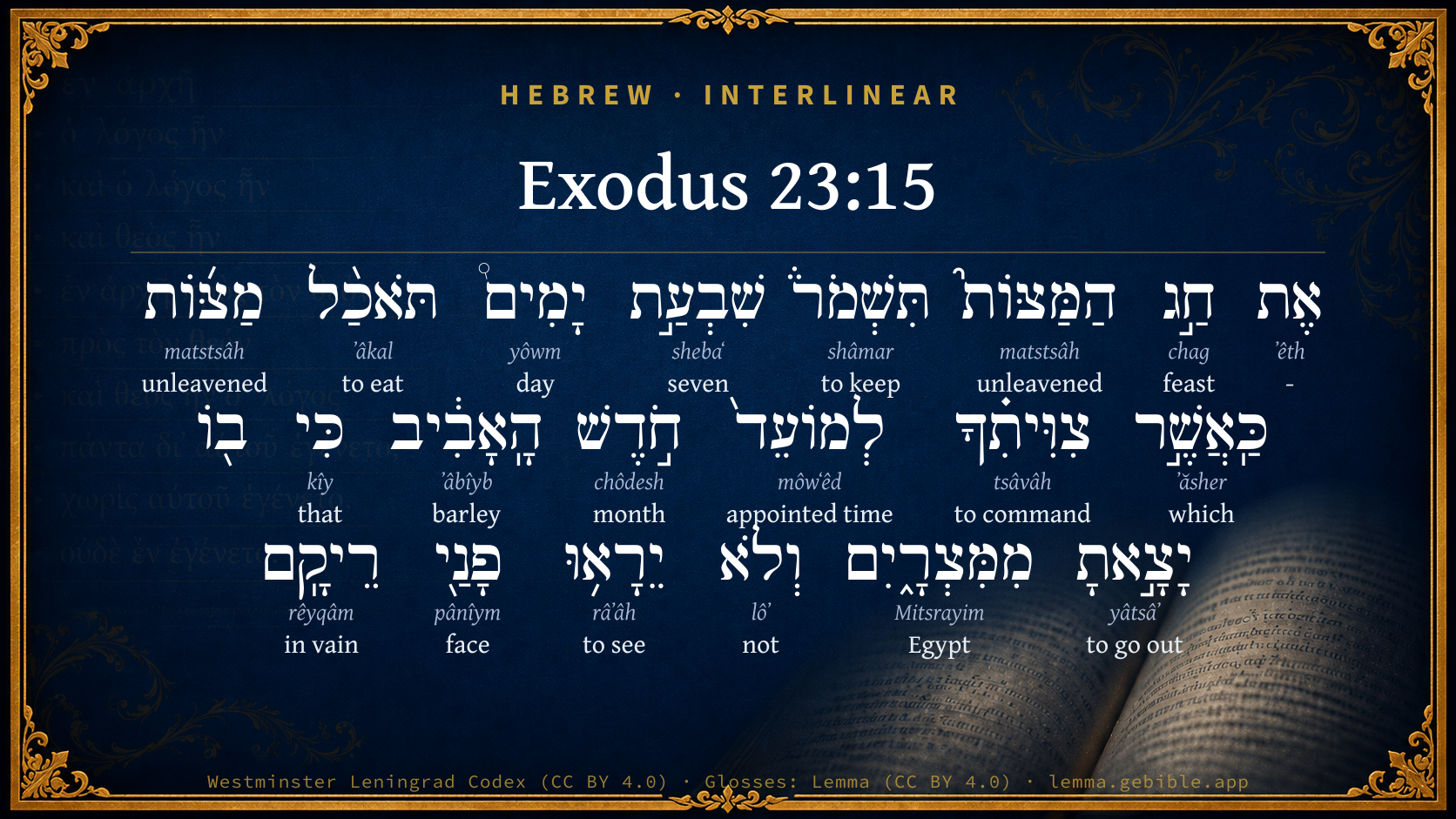
Hebrew (Westminster Leningrad Codex) Exodus 23:15 appears in the Hebrew Old Testament. The text above is from the Westminster Leningrad Codex. Each word links to its Strong’s number, a concise gloss, and parsing drawn from the Open Scriptures Hebrew Bible morphology. Click any word for its full Brown-Driver-Briggs (BDB) entry.
Download image
Cite this verse

Exodus 23:15 (World English Bible). Public Domain. Lemma interlinear Bible study tool, https://lemma.gebible.app/v/exodus/23/15.

Show BibTeX & RIS
BibTeX
RIS
English Translation
You shall observe the feast of unleavened bread. Seven days you shall eat unleavened bread, as I commanded you, at the time appointed in the month Abib (for in it you came out from Egypt), and no one shall appear before me empty.
World English Bible · Public Domain
Download a study sheet

One document with this verse’s original text, its word-by-word gloss line, the meaning frame, cross-references with their text, attributed commentary, and full source and license credits — printable, and it pastes into notes with its structure intact.

This verse Autodidact and up

Study sheet (.html) Plain text (.txt)

A passage Seminary Student

Up to 50 verses in one chapter. A passage sheet keeps up to 6 commentary sources and 12 cross-references per verse, in the order this page ranks them, and says so on the sheet whenever that leaves anything out. Ask for a single verse and you get the Autodidact verse sheet above.

Everything on this page stays free to read, with no account — the sheet is a download of what is already on screen, not access to it.

Want to remove ads? Support Godless Engineer
Compare translations 3

The same verse in 3 English versions, stacked beneath the original-language interlinear above. Click any original word for its lexicon entry.

Each is an independent rendering of the whole verse — the interlinear is not word-aligned to these translations.

Highlighted words mark where these versions differ — a whole-verse word diff, not a word-by-word alignment.

  • World English Bible Public Domain
    You shall observe the feast of unleavened bread. Seven days you shall eat unleavened bread, as I commanded you, at the time appointed in the month Abib (for in it you came out from Egypt), and no one shall appear before me empty.
  • King James Version Public Domain
    Thou shalt keep the feast of unleavened bread: (thou shalt eat unleavened bread seven days, as I commanded thee, in the time appointed of the month Abib; for in it thou camest out from Egypt: and none shall appear before me empty:)
  • unfoldingWord Literal Text CC BY-SA 4.0
    You shall keep the Festival of Unleavened Bread. You shall eat unleavened bread seven days, as I commanded you, at the appointed time, the month of Aviv, for in it you came out from Egypt. And you shall not appear at my face empty-handed.

unfoldingWord Literal Text — © unfoldingWord, licensed CC BY-SA 4.0. Word-aligned USFM3 via Door43 (git.door43.org/unfoldingWord/en_ult).

Versions to compare (up to 4)

3 of 4 selected

Show all 18 translations

Every available English version of this verse, each an independent rendering of the whole verse.

  • World English Bible Public Domain
    You shall observe the feast of unleavened bread. Seven days you shall eat unleavened bread, as I commanded you, at the time appointed in the month Abib (for in it you came out from Egypt), and no one shall appear before me empty.
  • Berean Standard Bible Public Domain
    You are to keep the Feast of Unleavened Bread as I commanded you: At the appointed time in the month of Abib you are to eat unleavened bread for seven days, because that was the month you came out of Egypt. No one may appear before Me empty-handed.
  • Majority Standard Bible Public Domain
    You are to keep the Feast of Unleavened Bread as I commanded you: At the appointed time in the month of Abib you are to eat unleavened bread for seven days, because that was the month you came out of Egypt. No one may appear before Me empty-handed.
  • King James Version Public Domain
    Thou shalt keep the feast of unleavened bread: (thou shalt eat unleavened bread seven days, as I commanded thee, in the time appointed of the month Abib; for in it thou camest out from Egypt: and none shall appear before me empty:)
  • American Standard Version (1901) Public Domain
    The feast of unleavened bread shalt thou keep: seven days thou shalt eat unleavened bread, as I commanded thee, at the time appointed in the month Abib (for in it thou camest out from Egypt); and none shall appear before me empty:
  • Revised Version (1885) Public Domain
    The feast of unleavened bread shalt thou keep: seven days thou shalt eat unleavened bread, as I commanded thee, at the time appointed in the month Abib (for in it thou camest out from Egypt); and none shall appear before me empty:
  • Geneva Bible (1599) Public Domain
    Thou shalt keepe the feast of vnleauened bread: thou shalt eate vnleauened bread seue dayes, as I commanded thee, in the season of the moneth of Abib: for in it thou camest out of Egypt: and none shall appeare before me emptie:
  • Douay-Rheims (1899) Public Domain
    Thou shalt keep the feast of unleavened bread. Seven days shalt thou eat unleavened bread, as I commanded thee, in the time of the month of new corn, when thou didst come forth out of Egypt: thou shalt not appear empty before me.
  • Young's Literal Translation Public Domain
    the Feast of Unleavened things thou dost keep; seven days thou dost eat unleavened things, as I have commanded thee, at the time appointed `in' the month of Abib; for in it thou hast come forth out of Egypt, and ye do not appear `in' My presence empty;
  • Literal Standard Version CC BY-SA 4.0
    you keep the Celebration of Unleavened Things (you eat unleavened things [for] seven days as I have commanded you, at the time appointed [in] the month of Abib; for in it you have come forth out of Egypt, and you do not appear [in] My presence empty);
  • Unlocked Literal Bible CC BY-SA 4.0
    You are to observe the Festival of Unleavened Bread. As I commanded you, you will eat unleavened bread for seven days. At that time, you will appear before me in the month of Aviv, which is fixed for this purpose. It was in this month that you came out from Egypt. But you must not appear before me empty-handed.
  • unfoldingWord Literal Text CC BY-SA 4.0
    You shall keep the Festival of Unleavened Bread. You shall eat unleavened bread seven days, as I commanded you, at the appointed time, the month of Aviv, for in it you came out from Egypt. And you shall not appear at my face empty-handed.
  • Darby Bible Public Domain
    Thou shalt keep the feast of unleavened bread, (thou shalt eat unleavened bread seven days, as I have commanded thee, in the time appointed of the month Abib; for in it thou camest out from Egypt; and none shall appear in my presence empty;)
  • World Messianic Bible Public Domain
    You shall observe the feast of unleavened bread. Seven days you shall eat unleavened bread, as I commanded you, at the time appointed in the month Abib (for in it you came out of Egypt), and no one shall appear before me empty.
  • Webster's Bible Public Domain
    Thou shalt keep the feast of unleavened bread: (thou shalt eat unleavened bread seven days, as I commanded thee, in the time appointed of the month Abib; for in it thou camest out from Egypt: and none shall appear before me empty:)
  • Free Bible Version CC BY-SA 4.0
    You are to observe the Festival of Unleavened Bread as I instructed you. You are to eat bread without yeast for seven days at the appropriate time in the month of Abib, because that was the month you left Egypt. No one can come before me without bringing an offering.
  • Bible in Basic English Public Domain
    You are to keep the feast of unleavened bread; for seven days let your bread be without leaven, as I gave you orders, at the regular time in the month Abib (for in it you came out of Egypt); and let no one come before me without an offering:
  • JPS Tanakh (1917) Public Domain
    The feast of unleavened bread shalt thou keep; seven days thou shalt eat unleavened bread, as I commanded thee, at the time appointed in the month Abib — for in it thou camest out from Egypt; and none shall appear before Me empty;

Literal Standard Version (2020), Covenant Press — licensed CC BY-SA 4.0. Text via the HelloAO Bible API (eBible.org). Unlocked Literal Bible (unfoldingWord) — licensed CC BY-SA 4.0. Text via the HelloAO Bible API (eBible.org). unfoldingWord Literal Text — © unfoldingWord, licensed CC BY-SA 4.0. Word-aligned USFM3 via Door43 (git.door43.org/unfoldingWord/en_ult). Free Bible Version, Dr. Jonathan Gallagher — licensed CC BY-SA 4.0. Text via the HelloAO Bible API (eBible.org).

Word by word

More ways to search: Search by grammar → Find every occurrence → Compare this word →

Practice this passage: Drill this verse → Learn its vocabulary →

הָֽאָבִ֔יב
ʼâbîyb
H24
“the · barley”
Particle, Definite Article + Noun, Common, Masculine, Singular, Absolute
Part of Speech
Particle + Noun
Type
Common
Gender
Masculine
Number
Singular
State
Absolute
Full BDB Definition

Origin: from an unused root (meaning to be tender)

TWOT: 1b

fresh, young barley ears, barley - month of ear-forming, of greening of crop, of growing green Abib, month of exodus and passover (March or April)
  1. אֶת ʼêth H853 “-” Particle, Direct Object
  2. חַ֣ג chag H2282 “feast of” Noun, Common, Masculine, Singular, Construct
  3. הַמַּצּוֹת֮ matstsâh H4682 “the · unleavened bread” Particle, Definite Article + Noun, Common, Feminine, Plural, Absolute
  4. תִּשְׁמֹר֒ shâmar H8104 “to keep” Verb, Qal, Imperfect, 2nd Person, Masculine, Singular
  5. שִׁבְעַ֣ת shebaʻ H7651 “seven” Adjective, Cardinal number, Masculine, Singular, Construct
  6. יָמִים֩ yôwm H3117 “days” Noun, Common, Masculine, Plural, Absolute
  7. תֹּאכַ֨ל ʼâkal H398 “to eat” Verb, Qal, Imperfect, 2nd Person, Masculine, Singular
  8. מַצּ֜וֹת matstsâh H4682 “unleavened bread” Noun, Common, Feminine, Plural, Absolute
  9. כַּֽאֲשֶׁ֣ר ʼăsher H834 “like/as · which” Preposition + Particle, Relative
  10. צִוִּיתִ֗ךָ tsâvâh H6680 “to command · you” Verb, Piel, Perfect, 1st Person, Common, Singular + Suffix, Personal, 2nd Person, Masculine, Singular
  11. לְמוֹעֵד֙ môwʻêd H4150 “to/for · appointed time” Preposition + Noun, Common, Masculine, Singular, Absolute
  12. חֹ֣דֶשׁ chôdesh H2320 “month of” Noun, Common, Masculine, Singular, Construct
  13. כִּי kîy H3588 “that” Conjunction
  14. יָצָ֣אתָ yâtsâʼ H3318 “to go out” Verb, Qal, Perfect, 2nd Person, Masculine, Singular
  15. מִמִּצְרָ֑יִם Mitsrayim H4714 “from · Egypt” Preposition + Noun, Proper
  16. וְלֹא lôʼ H3808 “and · not” Conjunction + Particle, Negative
  17. יֵרָא֥וּ râʼâh H7200 “to see” Verb, Niphal, Imperfect, 3rd Person, Masculine, Plural
  18. פָנַ֖י pânîym H6440 “face(s) · my” Noun, Common, Both, Plural, Construct + Suffix, Personal, 1st Person, Common, Singular
  19. רֵיקָֽם rêyqâm H7387 “in vain” Adverb

About this verse

These counts appear in no published source. They are computed here, from the morphology-tagged text and Lemma’s own curated glosses. What Lemma adds →

21
words
19
distinct lemmas
Pentateuch
section

Notable vocabulary

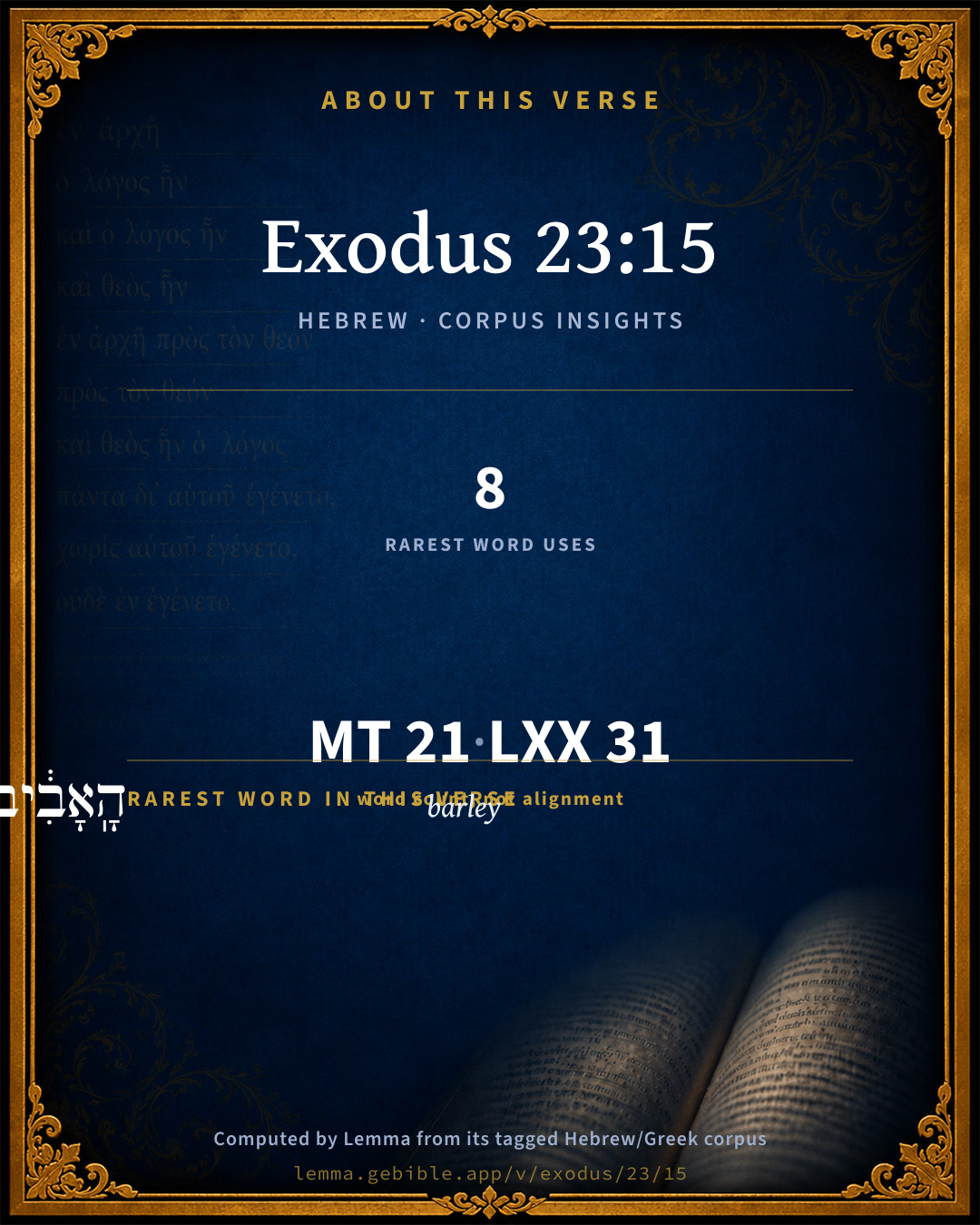
The rarest word here is הָֽאָבִ֔יב barley H24 — appearing just 8 times in the whole Hebrew Bible.

Shared distinctive vocabulary

הָֽאָבִ֔יב barley H24 occurs in 6 verses of the Hebrew Bible. Also found in:

Grammatical profile

  • 5 verbs
  • 9 nouns
  • 1 adjective
  • 1 preposition
  • 1 conjunction
  • 1 adverb
  • 3 particles

Verb forms

  • תִּשְׁמֹר֒ Qal · Imperfect
  • תֹּאכַ֨ל Qal · Imperfect
  • צִוִּיתִ֗ךָ Piel · Perfect
  • יָצָ֣אתָ Qal · Perfect
  • יֵרָא֥וּ Niphal · Imperfect

Repetition

A word recurs within this verse — often emphatic in Hebrew:

  • הַמַּצּוֹת֮ unleavened H4682 ×2

Hebrew & Septuagint length

In English translation the verse runs 43 words from the Hebrew and 44 from the Septuagint (LXX English) — closely comparable.

A rough comparison of the two English renderings, which tokenize alike — not a word-level alignment.

Word counts can differ between the Hebrew and the Greek without any difference in meaning — e.g. the Hebrew direct-object marker אֵת has no separate Greek word, and Greek often adds the article ὁ.

In the original languages it is 21 Hebrew tokens and 31 Greek tokens — but the two are counted differently (Hebrew bundles its prefixes and suffixes into one token; the Greek is in lemma form), so that isn’t a like-for-like length.

Cross-references

18

Topical passages linked to Exodus 23:15 in the Treasury of Scripture Knowledge — connected by theme and wording, ordered by reader-vote popularity; previews shown in the World English Bible.

  • Exodus 34:20 The firstborn of a donkey you shall redeem with a lamb: and if you will not redeem it, then you shall break its neck. All the firstborn of your sons you shall redeem. No one shall appear before me empty.
  • Luke 22:7 The day of unleavened bread came, on which the Passover must be sacrificed.
  • Numbers 28:16–25 In the first month, on the fourteenth day of the month, is Yahweh's Passover.
  • Deuteronomy 16:16 Three times in a year shall all your males appear before Yahweh your God in the place which he shall choose: in the feast of unleavened bread, and in the feast of weeks, and in the feast of tents; and they shall not appear before Yahweh empty:
  • Proverbs 3:9–10 Honor Yahweh with your substance, With the first fruits of all your increase:
  • Leviticus 23:5–8 In the first month, on the fourteenth day of the month in the evening, is Yahweh's Passover.
  • Deuteronomy 16:1–8 Observe the month of Abib, and keep the Passover to Yahweh your God; for in the month of Abib Yahweh your God brought you forth out of Egypt by night.
  • 2 Kings 23:21–23 The king commanded all the people, saying, Keep the Passover to Yahweh your God, as it is written in this book of the covenant.
  • Exodus 12:14–28 This day shall be to you for a memorial, and you shall keep it a feast to Yahweh: throughout your generations you shall keep it a feast by an ordinance forever.
  • Exodus 12:43–49 Yahweh said to Moses and Aaron, "This is the ordinance of the Passover. There shall no foreigner eat of it,
  • Exodus 13:4 This day you go forth in the month Abib.
  • Exodus 13:6–7 Seven days you shall eat unleavened bread, and in the seventh day shall be a feast to Yahweh.
  • Exodus 34:18 "You shall keep the feast of unleavened bread. Seven days you shall eat unleavened bread, as I commanded you, at the time appointed in the month Abib; for in the month Abib you came out from Egypt.
  • Leviticus 23:10 "Speak to the children of Israel, and tell them, 'When you have come into the land which I give to you, and shall reap its the harvest, then you shall bring the sheaf of the first fruits of your harvest to the priest:
  • Joshua 5:10–11 The children of Israel encamped in Gilgal; and they kept the Passover on the fourteenth day of the month at even in the plains of Jericho.
  • Mark 14:12 On the first day of unleavened bread, when they sacrificed the Passover, his disciples asked him, "Where do you want us to go and make ready that you may eat the Passover?"
  • 1 Corinthians 5:7–8 Purge out the old yeast, that you may be a new lump, even as you are unleavened. For indeed Christ, our Passover, has been sacrificed in our place.
  • Numbers 9:2–14 "Moreover let the children of Israel keep the Passover in its appointed season.

Cross-references courtesy of OpenBible.info (CC BY 4.0).

Hebrew and Greek witnesses Masoretic Hebrew ↔ Greek Septuagint

The same verse in the two great witnesses to the Old Testament, shown verse-for-verse.

These are two independent witnesses, not word-aligned to each other, and the Septuagint is shown in lemma (dictionary) form.

Hebrew Exodus 23:15 Masoretic · Westminster Leningrad Codex

אֶת חַ֣ג הַמַּצּוֹת֮ תִּשְׁמֹר֒ שִׁבְעַ֣ת יָמִים֩ תֹּאכַ֨ל מַצּ֜וֹת כַּֽאֲשֶׁ֣ר צִוִּיתִ֗ךָ לְמוֹעֵד֙ חֹ֣דֶשׁ הָֽאָבִ֔יב כִּי ב֖וֹ יָצָ֣אתָ מִמִּצְרָ֑יִם וְלֹא יֵרָא֥וּ פָנַ֖י רֵיקָֽם

You shall observe the feast of unleavened bread. Seven days you shall eat unleavened bread, as I commanded you, at the time appointed in the month Abib (for in it you came out from Egypt), and no one shall appear before me empty.

World English Bible · Public Domain

Greek LXX Exodus 23:15 Septuagint · lemma form

ὁ ἑορτή ὁ ἄζυμος φυλάσσω ποιέω ἑπτά ἡμέρα ἐσθίω ἄζυμος καθάπερ ἐντέλλομαι σύ κατά ὁ καιρός ὁ μήν ὁ νέος ἐν γάρ αὐτός ἐκἔρχομαι ἐκ αἴγυπτος οὐ ὁράω ἐνώπιον ἐγώ κενός

Take heed to keep the feast of unleavened bread: seven days you⌃ shall eat unleavened bread, as I charged you at the season of the month of new corn, for in it you came out of Egypt: you shall not appear before me empty.

LXX2012 (modern English Septuagint) · Public Domain

On this verse, Haydock's Catholic Bible Commentary discusses the Septuagint’s reading. Read the note in Commentary ↓

Hebrew: Westminster Leningrad Codex (CC BY 4.0). Greek: Septuagint (public domain); English from LXX2012 (modern English Septuagint) (Public Domain). How the Septuagint differs from the Hebrew →

Targum (Aramaic paraphrase)

2

The Targum is the ancient Jewish Aramaic paraphrase of the Hebrew Scriptures — an interpretive translation, not the Hebrew text itself. Onkelos (literal) and Pseudo-Jonathan (expansive) render the Torah, and Jonathan the Prophets. Coverage is partial: where no permissively-licensed English translation exists for a verse, only the Aramaic is shown. This is verse-level text, not a word-by-word alignment to the Hebrew.

  1. Targum Onkelos Torah (Genesis–Deuteronomy)
    יָת חַגָא דְפַטִירַיָא תִּטַר שִׁבְעָא יוֹמִין תֵּיכוּל פַּטִירָא כְּמָא דִפַקֵידִתָּךְ לִזְמַן יַרְחָא דַאֲבִיבָא אֲרֵי בֵהּ נְפַקְתָּ מִמִצְרָיִם וְלָא יִתְחֲזוּן קֳדָמַי רֵיקָנוּן:

    (no public-domain English translation for this verse)

    Targum Onkelos — Aramaic: “Onkelos Genesis” (public domain); “Onkelos Exodus” (public domain); “Onkelos Leviticus” (public domain); “Onkelos Numbers” (public domain); “Onkelos Deuteronomy” (public domain). English: “Sefaria Community Translation” (CC0 1.0 (public-domain dedication)); “J.W. Etheridge. The Targums of Onkelos and Jonathan Ben Uzziel on the Pentateuch. London: Longmans, Green, 1862” (public domain). Text via Sefaria.

  2. Targum Pseudo-Jonathan Torah (Genesis–Deuteronomy)
    יַת חַגָּא דְפַטִירַיָיא תִּנְטוֹר שׁוּבְעָא יוֹמִין תֵּיכוֹל פַּטִּירָא הֵיכְמָא דְפַקֵידְתָּךְ לִזְמַן יַרְחָא דְאַבִּיבָא אֲרוּם בֵּיהּ נְפַקְתְּ מִמִּצְרַיִם וְלָא יִתְחַמּוּן קֳדָמַי רֵיקָנִין

    The feast of unleavened cakes thou shalt keep. Seven days thou art to eat unleavened bread, as I have instructed thee, in the time of the month of Abiba, because in it thou camest forth from Mizraim; and you shall not appear before Me empty.

    Targum Pseudo-Jonathan — Aramaic: “Targum Jonathan on Genesis” (public domain); “Targum Jonathan on Exodus” (public domain); “Targum Jonathan on Leviticus” (public domain); “Targum Jonathan on Numbers” (public domain); “Targum Jonathan on Deuteronomy” (public domain). English: “The Targum of Jonathan ben Uzziel, trans. J. W. Etheridge, London, 1862” (public domain). Text via Sefaria.

Commentary

Notes on Exodus 23:15 from classic Christian and Jewish commentators (each source and its license shown beneath its notes). The classic Christian expositions comment on the surrounding passage and are grouped to its opening verse, so a note may address several verses; the Jewish commentaries on the Tanakh (Rashi and others) are per-verse, so they appear only where the commentator wrote on this verse.

Lemma curates 59 commentaries, every one of them public domain or Creative Commons licensed, each selected and text-cleaned for this edition rather than reprinted as found. About our sources →

The Cambridge Bible for Schools and Colleges

gen. ed. J. J. S. Perowne

15a. The first pilgrimage, the seven days’ festival of Maẓẓoth or Unleavened Cakes. Cf. the parallel Exo_34:18; and the later regulations in Deu_16:3-4; Deu_16:8; Lev_23:6-8 (P), 9–14 (H and P); Exo_12:14-20 and Num_28:17-25 (both P). This feast celebrated the beginning of the barley-harvest (which begins in Palestine towards the end of April or the beginning of May, some weeks before the wheat-harvest): cf. Lev_23:10-14 H (the ‘wave-sheaf’ of the first-fruits of the harvest to be presented then to Jehovah). The reason why this spring festival was observed in particular by eating unleavened cakes must remain matter of conjecture: perhaps it was simply because, at a time when men were busy with the harvest, such cakes (cf. on Exo_12:8) were most quickly and easily prepared (Wellh. Hist. p. 87; Nowack, Arch. ii. 146; EB. iii. 3591). Eerdmans (Expositor, Nov. 1909, p. 459 ff.) conjectures that it was to preserve, in accordance with a primitive conception, the ‘soul’ of the corn for the seed of the year to come. The feast is regarded as commemorating the day of the Exodus in Exo_13:3-10 (JE), Deu_16:3, Exo_12:14-20 (P): in Exo_12:34; Exo_12:39 (J) a historical motive for the use of unleavened cakes is suggested; the haste viz. with which the Israelites left Egypt gave them no time to leaven their dough.

seven days … empty] These words, breaking the grammatical connexion between v. 15a and v. 16, have been most probably introduced here by a later hand from Exo_34:18 b, 20c. The words, ‘as I commanded thee,’ refer apparently to Exo_13:6 J (cf. v. 4 ‘Abib’), and are in their proper place in J’s covenant (Exo_34:10-26; see p. 372), but cannot well be original in E.

15b. none shall appear before me empty] So Exo_34:20 c, Deu_16:16 c (with the explanation in v. 17 ‘every man shall give [an offering] as he is able, according to the blessing of Jehovah which he hath given thee,’ i.e. according as he can afford to give, out of the produce of the year). In Deu_16:16 c the clause actually follows the one corresponding to Exo_23:17 = Exo_34:23, so that it refers to all three pilgrimages; and no doubt this was its original place (viz. after Exo_34:23 = Exo_23:17): it would be natural to expect an offering to be prescribed for each pilgrimage.

appear before me] The standing phrase for visiting a sanctuary as a worshipper, esp. at the three great pilgrimages (Exo_34:20; Exo_34:23-24, Deu_31:11, 1Sa_1:22), but also used more generally (Isa_1:12, Psa_42:2). It is however held by many,—on the basis, primarily, of grammatical considerations affecting Exo_23:15; Exo_34:20, Isa_1:12, and Psa_42:2,—that in these and similar passages (Exo_34:23-24,) Deu_16:16 (twice), Exo_31:11) the existing punctuation does not represent the original vocalization, and that the true sense of the phrase is (with other vowel points) see my face, see the face of Yahweh, i.e. visit Him as Sovereign (so Ges., Dillm., Kirkpatrick on Psa_42:1, and others). The usual phrase for admission to the presence of a royal person (2Sa_3:13; 2Sa_14:28; 2Sa_14:32, 2Ki_25:19; cf. Gen_43:3) was applied to visiting the sanctuary; but as objection came to be felt to the expression ‘seeing the face of God’ (cf. Exo_33:20), the vocalization,—and perhaps, in Exo_23:17, 1Sa_1:22, even the consonantal ext,—was altered so as to express the idea of ‘appearing before God.’

The Cambridge Bible for Schools and Colleges (gen. ed. J. J. S. Perowne; Cambridge University Press, 1878–1918) — public domain. Text from a community e-Sword module.

Trapp's Complete Commentary

John Trapp

Exo 23:15 Thou shalt keep the feast of unleavened bread: (thou shalt eat unleavened bread seven days, as I commanded thee, in the time appointed of the month Abib; for in it thou camest out from Egypt: and none shall appear before me empty:)

Ver. 15. Thou shalt keep the feast.] Let us also keep the feast, or holy day. {1Co 5:8} {See Trapp on "1Co 5:8"}

John Trapp, A Commentary or Exposition upon All the Books of the Old and New Testament (1647–1656) — public domain. Text from a community e-Sword module.

Tyndale Open Study Notes

Tyndale Open Resources

23:15 appointed time in early spring, in the month of Abib: See 13:4-5; Lev 23:5-8; Deut 16:1-8.

Tyndale Open Study Notes — © Tyndale Open Resources, licensed CC BY-SA 4.0. Text via the HelloAO Bible API.

Geneva Bible (1599)

Geneva Bible translators

That is, Easter, in remembrance that the Angel passed over and spared the Israelites, when he slew the firstborn of the Egyptians.

Geneva Bible (1599) marginal notes — public domain. Text via Bolls.life.

Ellicott's Commentary for English Readers

(15) The feast of unleavened bread.—See the Notes on Exo_12:15-20.

In the time appointed of the month Abib.—From the 14th day of the month Abib (or Nisan) to the 21st day. (See Exo. Xii. 18, 13:4-7.)

None shall appear before me empty.—Viewed religiously, the festivals were annual national thanks-givings for mercies received, both natural and miraculous—the first for the commencement of harvest and the deliverance out of Egypt; the second for the completion of the grain-harvest and the passage of the Red Sea; the third for the final gathering in of the fruits and the many mercies of the wilderness. At such seasons we must not “appear before God empty,” we must give Him not only “the salves of our lips,” but some substantial acknowledgment of His goodness towards us. The law here laid down with respect to the first feast is afterwards extended to the other two (Deu_16:16).

A Bible Commentary for English Readers, edited by Charles John Ellicott (1878–1897) — public domain. Text from a community e-Sword module.

John Gill's Exposition

Three times in the year all thy males shall appear before the Lord thy God. In the city of Jerusalem, when they were come into the land of Canaan, and the temple was there built: here they were to show themselves before the Lord as being his, and devoted to his service; concerning which the Misnic doctors have the following canon (c),"all are bound to appear except a man deaf and dumb, a fool, a little one, one of neither sex, or of both sexes, women, servants not free, the lame, the blind, the sick, an old man, and he that cannot go on his feet.''

(c) Misn. Chagigah, c. 1. sect. 1.

John Gill's Exposition of the Whole Bible (1746–1763) — public domain (CC PDM 1.0). Text via the HelloAO Bible API.

Haydock's Catholic Bible Commentary

Empty. But shalt offer something in sacrifice, and for the support of the Levites, freely, Deuteronomy xvi. 10. At the Passover, the first-fruits of barley were to be offered, as those of wheat would be ready at Pentecost. The third feast was that of tabernacles, at the conclusion of the civil year. Presents were to be made to God, in testimony of their submission to him; as they were to the kings of the east, by their subjects. (Tavernier, Perse. iv. 16.) See 1 Kings x. 27. and 1 Paralipomenon xviii. 2. --- A sixtieth part of the fruits, at least, was carried to the temple. They consisted of wheat, barley, grapes, figs, apricots, olives, and dates. The king himself carried his basket, and when the solemn procession arrived at the temple, the Levites began to sing Psalm xxix., I will extol thee, O Lord, &c. After which, the people repeated the words of Deuteronomy xxvi. 3; and having given their baskets to the priests, (ver. 4,) recited parts of the 5th, 6th, 7th, 8th, 9th, and 10th verses. (Calmet) --- God. Here the Septuagint add, "For when I shall have cast the Gentiles from before thy face, and extended thy limits."

George Leo Haydock (1774–1849), Haydock's Catholic Family Bible and Commentary, 1859 edition — public domain. Excludes Psalms (Douay-Rheims chapter numbering differs from Protestant) and Deuterocanonical books (Catholic canon only).

Matthew Poole's English Annotations

This may be either,

1. A precept, as it is generally understood, that none should ever come at those times without some offering or other, for the support of the Levites, and of the worship of God; but the determination of this, or what they would give, was left to their choice. Or,

2. A promise to encourage them to come so oft from their remotest habitations to Jerusalem, because

they should never appear before God in vain, i.e. to no purpose, or without some benefit, for so the word rekam oft signifies. So it may be parallel to Isa 45:19, I said not unto the seed of Jacob, Seek ye me in vain. But the former sense is more probable, by comparing this with its parallel place, Deu 16:16,17.

Matthew Poole's English Annotations on the Holy Bible (1683–1685) — public domain. Text from a community e-Sword/MySword module.

The Pulpit Commentary

The feast of unleavened bread. This commenced with the Passover, and continued for the seven days following, with a "holy convocation" on the first of the seven and on the last. (Lev_23:5-8) Unleavened bread was eaten in commemoration of the hasty exodus from. (Exo_12:34) A sheaf of new barley the first-fruits of the harvest was offered as a wave-offering before the Lord. (Lev_23:10-14) Every male Israelite of full age was bound to attend, and to bring with him a free-will offering. In the time appointed of the monthi.e. , on the fourteenth day. (Exo_12:18) None shall appear before me empty. This rule applies, not to the Passover only, but to all the feasts.

The Pulpit Commentary (1880–1919), ed. H.D.M. Spence-Jones & Joseph S. Exell — public domain. Text from a community e-Sword module.

Scofield Reference Notes

C. I. Scofield

Abib

First month, i.e. April.

The Scofield Reference Bible (1917 edition), notes by C. I. Scofield — public domain. Text from a community e-Sword module.

Rashi

Rabbi Shlomo Yitzchaki (Rashi)

חודש האביב THE MONTH OF אביב — it is the month when the grain becomes full in its ripe state (באביה). The word אביב is connected with אַב which signifies maturity, and being the first of the fruit to ripen (cf. Rashi on Exodus 9:31).

ולא יראו פני ריקם AND NONE SHALL APPEAR BEFORE MY FACE EMPTY — When you come to appear before My face on the festivals, bring Me burnt-offerings (Mekhilta; Chagigah 7a).

Rashi on the Tanakh — English translations: “The Judaica Press complete Tanach with Rashi, translated by A. J. Rosenberg” (CC BY 4.0); “Pentateuch with Rashi's commentary by M. Rosenbaum and A.M. Silbermann, 1929-1934” (public domain); “The Metsudah Tanach series, Lakewood, N.J” (CC BY 4.0); and “The Book of Joshua, Metsudah Publications, 1997” (CC BY 4.0). Text via Sefaria.

Lesson kit

Teaching starters — assembled from the data on this page, not authored interpretation. Every prompt links to the verse data it draws on. Edit before teaching.

Exodus, in the Pentateuch, opens this verse with 21 words (19 distinct Hebrew lemmas). Its most distinctive word is ʼâbîyb (“barley”). A historical commentator’s framing appears above. Read the whole chapter for the surrounding context.

Discussion questions

  1. The word ʼâbîyb carries the sense “barley.” How does it shape the verse?
  2. How does Exodus 9:31, which shares the word «barley», read alongside this verse?
  3. What does the repetition of “unleavened” (2× in this one verse) do in this verse?
  4. The translations on this page render this verse differently — a whole-verse word diff, not a word-by-word alignment. What might account for the different wordings?
  5. «תִּשְׁמֹר֒» is a Qal Imperfect verb. How does that grammatical form shape the action described?
  6. Compare how The Cambridge Bible for Schools and Colleges and Trapp's Complete Commentary read this verse. Where do they agree or differ?

Things to notice

Reading settings

Reading text

Shown beneath each verse's original-language words.

Old Testament
Old Testament edition

Read the OT as the Masoretic Hebrew (MT) or the Greek Septuagint (LXX).

English shown for the Greek Septuagint (in the Hebrew ↔ Greek comparison).

Comparing translations? Open the Compare panel on any verse page to stack up to four side by side.