
Deuteronomy 16:4

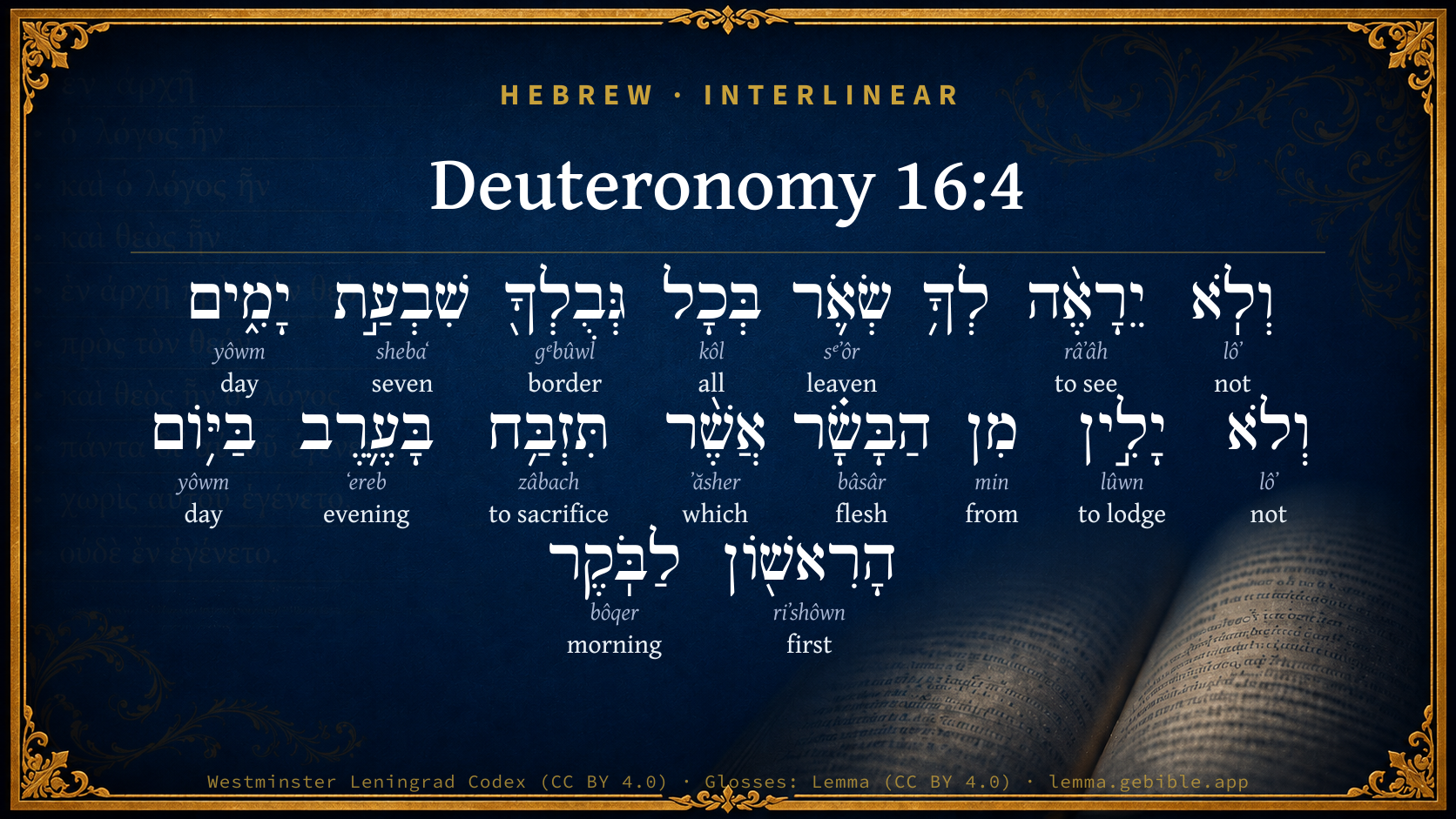
Hebrew (Westminster Leningrad Codex) Deuteronomy 16:4 appears in the Hebrew Old Testament. The text above is from the Westminster Leningrad Codex. Each word links to its Strong’s number, a concise gloss, and parsing drawn from the Open Scriptures Hebrew Bible morphology. Click any word for its full Brown-Driver-Briggs (BDB) entry.
Download image
Cite this verse

Deuteronomy 16:4 (World English Bible). Public Domain. Lemma interlinear Bible study tool, https://lemma.gebible.app/v/deuteronomy/16/4.

Show BibTeX & RIS
BibTeX
RIS
English Translation
There shall be no yeast seen with you in all your borders seven days; neither shall any of the flesh, which you sacrifice the first day at even, remain all night until the morning.
World English Bible · Public Domain
Download a study sheet

One document with this verse’s original text, its word-by-word gloss line, the meaning frame, cross-references with their text, attributed commentary, and full source and license credits — printable, and it pastes into notes with its structure intact.

This verse Autodidact and up

Study sheet (.html) Plain text (.txt)

A passage Seminary Student

Up to 50 verses in one chapter. A passage sheet keeps up to 6 commentary sources and 12 cross-references per verse, in the order this page ranks them, and says so on the sheet whenever that leaves anything out. Ask for a single verse and you get the Autodidact verse sheet above.

Everything on this page stays free to read, with no account — the sheet is a download of what is already on screen, not access to it.

Want to remove ads? Support Godless Engineer
Compare translations 3

The same verse in 3 English versions, stacked beneath the original-language interlinear above. Click any original word for its lexicon entry.

Each is an independent rendering of the whole verse — the interlinear is not word-aligned to these translations.

Highlighted words mark where these versions differ — a whole-verse word diff, not a word-by-word alignment.

  • World English Bible Public Domain
    There shall be no yeast seen with you in all your borders seven days; neither shall any of the flesh, which you sacrifice the first day at even, remain all night until the morning.
  • King James Version Public Domain
    And there shall be no leavened bread seen with thee in all thy coast seven days; neither shall there any thing of the flesh, which thou sacrificedst the first day at even, remain all night until the morning.
  • unfoldingWord Literal Text CC BY-SA 4.0
    And no yeast shall be seen among you in all your borders seven days, and nothing from the meat that you sacrifice in the evening on the first day shall remain until the morning.

unfoldingWord Literal Text — © unfoldingWord, licensed CC BY-SA 4.0. Word-aligned USFM3 via Door43 (git.door43.org/unfoldingWord/en_ult).

Versions to compare (up to 4)

3 of 4 selected

Show all 18 translations

Every available English version of this verse, each an independent rendering of the whole verse.

  • World English Bible Public Domain
    There shall be no yeast seen with you in all your borders seven days; neither shall any of the flesh, which you sacrifice the first day at even, remain all night until the morning.
  • Berean Standard Bible Public Domain
    No leaven is to be found in all your land for seven days, and none of the meat you sacrifice in the evening of the first day shall remain until morning.
  • Majority Standard Bible Public Domain
    No leaven is to be found in all your land for seven days, and none of the meat you sacrifice in the evening of the first day shall remain until morning.
  • King James Version Public Domain
    And there shall be no leavened bread seen with thee in all thy coast seven days; neither shall there any thing of the flesh, which thou sacrificedst the first day at even, remain all night until the morning.
  • American Standard Version (1901) Public Domain
    And there shall be no leaven seen with thee in all thy borders seven days; neither shall any of the flesh, which thou sacrificest the first day at even, remain all night until the morning.
  • Revised Version (1885) Public Domain
    And there shall be no leaven seen with thee in all thy borders seven days; neither shall any of the flesh, which thou sacrificest the first day at even, remain all night until the morning.
  • Geneva Bible (1599) Public Domain
    And there shalbe no leauen seene with thee in all thy coastes seuen dayes long: neither shall there remaine the night any of the flesh vntil the morning which thou offeredst ye first day at euen.
  • Douay-Rheims (1899) Public Domain
    No leaven shall be seen in all thy coasts for seven days, neither shall any of the flesh of that which was sacrificed the first day in the evening remain until morning.
  • Young's Literal Translation Public Domain
    and there is not seen with thee leaven in all thy border seven days, and there doth not remain of the flesh which thou dost sacrifice at evening on the first day till morning.
  • Literal Standard Version CC BY-SA 4.0
    and leaven is not seen with you in all your border [for] seven days, and there does not remain [any] of the flesh which you sacrifice at evening on the first day until morning.
  • Unlocked Literal Bible CC BY-SA 4.0
    No yeast must be seen among you within all your borders during seven days; nor must any of the meat that you sacrifice in the evening on the first day remain until the morning.
  • unfoldingWord Literal Text CC BY-SA 4.0
    And no yeast shall be seen among you in all your borders seven days, and nothing from the meat that you sacrifice in the evening on the first day shall remain until the morning.
  • Darby Bible Public Domain
    And there shall be no leaven seen with thee in all thy borders seven days; neither shall any of the flesh, which thou sacrificedst at even on the first day, be left over night until the morning. --
  • World Messianic Bible Public Domain
    No yeast shall be seen with you in all your borders seven days; neither shall any of the meat, which you sacrifice the first day at evening, remain all night until the morning.
  • Webster's Bible Public Domain
    And there shall be no leavened bread seen with thee in all thy borders seven days; neither shall there any thing of the flesh, which thou didst sacrifice the first day at evening, remain all night until the morning.
  • Free Bible Version CC BY-SA 4.0
    Don't have yeast anywhere in your country for seven days. Don't keep any of the meat that you sacrifice on the evening of the first day until the morning.
  • Bible in Basic English Public Domain
    For seven days let no leaven be used through all your land; and nothing of the flesh which is put to death in the evening of the first day is to be kept through the night till morning.
  • JPS Tanakh (1917) Public Domain
    And there shall be no leaven seen with thee in all they borders seven days; neither shall any of the flesh, which thou sacrificest the first day at even, remain all night until the morning.

Literal Standard Version (2020), Covenant Press — licensed CC BY-SA 4.0. Text via the HelloAO Bible API (eBible.org). Unlocked Literal Bible (unfoldingWord) — licensed CC BY-SA 4.0. Text via the HelloAO Bible API (eBible.org). unfoldingWord Literal Text — © unfoldingWord, licensed CC BY-SA 4.0. Word-aligned USFM3 via Door43 (git.door43.org/unfoldingWord/en_ult). Free Bible Version, Dr. Jonathan Gallagher — licensed CC BY-SA 4.0. Text via the HelloAO Bible API (eBible.org).

Word by word

More ways to search: Search by grammar → Find every occurrence → Compare this word →

Practice this passage: Drill this verse → Learn its vocabulary →

שְׂאֹ֛ר
sᵉʼôr
H7603
“leaven”
Noun, Common, Masculine, Singular, Absolute
Part of Speech
Noun
Type
Common
Gender
Masculine
Number
Singular
State
Absolute
Full BDB Definition

Origin: from H7604

TWOT: 2229a

leaven
  1. וְלֹֽא lôʼ H3808 “and · not” Conjunction + Particle, Negative
  2. יֵרָאֶ֨ה râʼâh H7200 “to see” Verb, Niphal, Imperfect, 3rd Person, Masculine, Singular
  3. בְּכָל kôl H3605 “in/at · all of” Preposition + Noun, Common, Masculine, Singular, Construct
  4. גְּבֻלְךָ֖ gᵉbûwl H1366 “border · your” Noun, Common, Masculine, Singular, Construct + Suffix, Personal, 2nd Person, Masculine, Singular
  5. שִׁבְעַ֣ת shebaʻ H7651 “seven” Adjective, Cardinal number, Masculine, Singular, Construct
  6. יָמִ֑ים yôwm H3117 “days” Noun, Common, Masculine, Plural, Absolute
  7. וְלֹא lôʼ H3808 “and · not” Conjunction + Particle, Negative
  8. יָלִ֣ין lûwn H3885 “to lodge” Verb, Qal, Imperfect, 3rd Person, Masculine, Singular
  9. מִן min H4480 “from” Preposition
  10. הַבָּשָׂ֗ר bâsâr H1320 “the · flesh” Particle, Definite Article + Noun, Common, Masculine, Singular, Absolute
  11. אֲשֶׁ֨ר ʼăsher H834 “which” Particle, Relative
  12. תִּזְבַּ֥ח zâbach H2076 “to sacrifice” Verb, Qal, Imperfect, 2nd Person, Masculine, Singular
  13. בָּעֶ֛רֶב ʻereb H6153 “in/at the · evening” Preposition, Determined + Noun, Common, Masculine, Singular, Absolute
  14. בַּיּ֥וֹם yôwm H3117 “in/at the · day” Preposition, Determined + Noun, Common, Masculine, Singular, Absolute
  15. הָרִאשׁ֖וֹן riʼshôwn H7223 “the · first” Particle, Definite Article + Adjective, Ordinal number, Masculine, Singular, Absolute
  16. לַבֹּֽקֶר bôqer H1242 “to/for the · morning” Preposition, Determined + Noun, Common, Masculine, Singular, Absolute

About this verse

These counts appear in no published source. They are computed here, from the morphology-tagged text and Lemma’s own curated glosses. What Lemma adds →

18
words
15
distinct lemmas
Pentateuch
section

Notable vocabulary

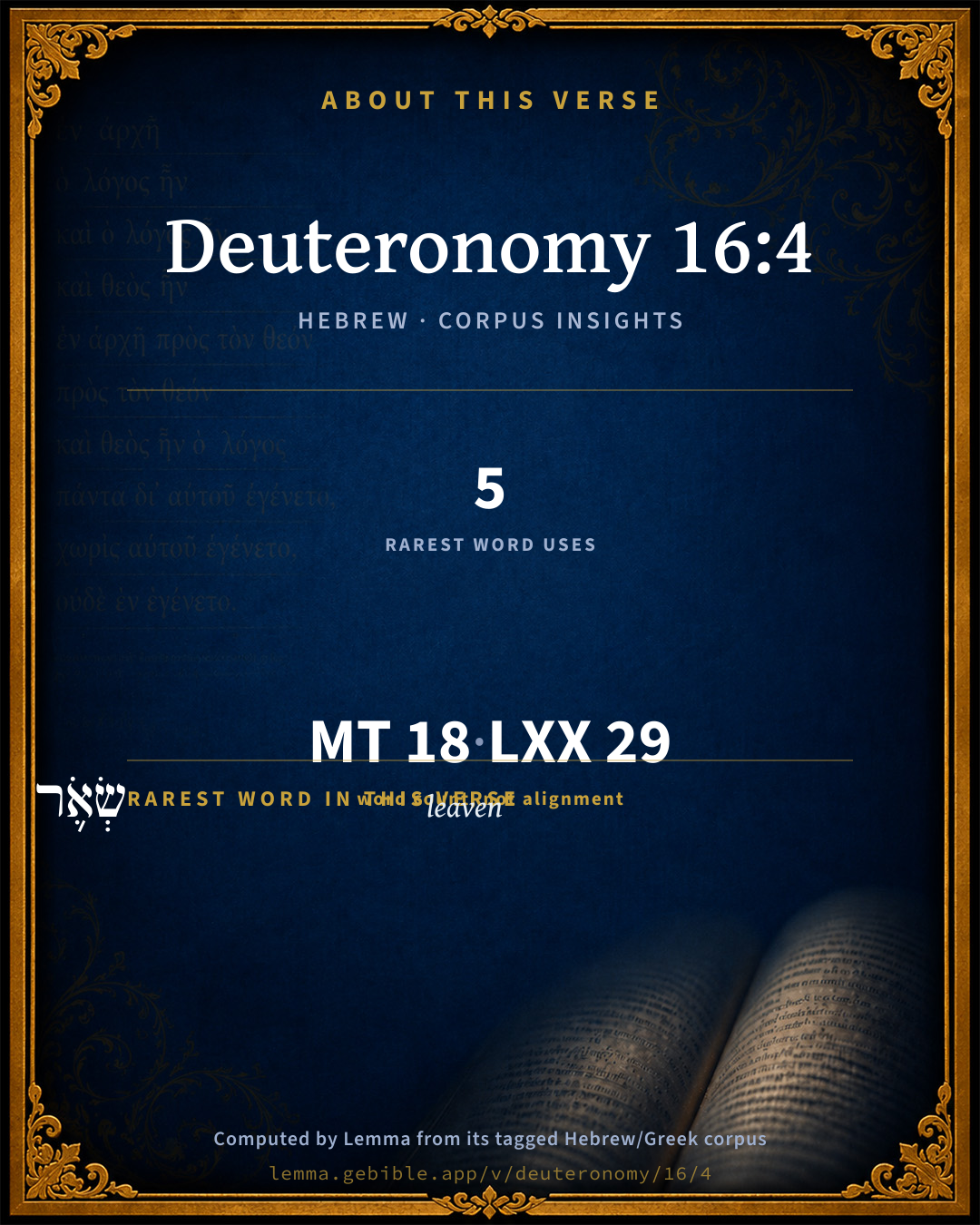
The rarest word here is שְׂאֹ֛ר leaven H7603 — appearing just 5 times in the whole Hebrew Bible.

Shared distinctive vocabulary

שְׂאֹ֛ר leaven H7603 occurs in 5 verses of the Hebrew Bible. Also found in:

Grammatical profile

  • 3 verbs
  • 8 nouns
  • 2 adjectives
  • 2 prepositions
  • 3 particles

Verb forms

  • יֵרָאֶ֨ה Niphal · Imperfect
  • יָלִ֣ין Qal · Imperfect
  • תִּזְבַּ֥ח Qal · Imperfect

Repetition

Words recur within this verse — often emphatic in Hebrew:

  • יָמִ֑ים day H3117 ×2
  • וְלֹֽא not H3808 ×2

Hebrew & Septuagint length

In English translation the verse runs 34 words from the Hebrew and 36 from the Septuagint (LXX English) — closely comparable.

A rough comparison of the two English renderings, which tokenize alike — not a word-level alignment.

Word counts can differ between the Hebrew and the Greek without any difference in meaning — e.g. the Hebrew direct-object marker אֵת has no separate Greek word, and Greek often adds the article ὁ.

In the original languages it is 18 Hebrew tokens and 29 Greek tokens — but the two are counted differently (Hebrew bundles its prefixes and suffixes into one token; the Greek is in lemma form), so that isn’t a like-for-like length.

Cross-references

5

Topical passages linked to Deuteronomy 16:4 in the Treasury of Scripture Knowledge — connected by theme and wording, ordered by reader-vote popularity; previews shown in the World English Bible.

  • Exodus 12:10 You shall let nothing of it remain until the morning; but that which remains of it until the morning you shall burn with fire.
  • Exodus 34:25 "You shall not offer the blood of my sacrifice with leavened bread; neither shall the sacrifice of the feast of the Passover be left to the morning.
  • Exodus 13:7 Unleavened bread shall be eaten throughout the seven days; and no leavened bread shall be seen with you, neither shall there be yeast seen with you, in all your borders.
  • Exodus 12:15 Seven days shall you eat unleavened bread; even the first day you shall put away yeast out of your houses, for whoever eats leavened bread from the first day until the seventh day, that soul shall be cut off from Israel.
  • Exodus 12:8 They shall eat the flesh in that night, roasted with fire, and unleavened bread. They shall eat it with bitter herbs.

Cross-references courtesy of OpenBible.info (CC BY 4.0).

Hebrew and Greek witnesses Masoretic Hebrew ↔ Greek Septuagint

The same verse in the two great witnesses to the Old Testament, shown verse-for-verse.

These are two independent witnesses, not word-aligned to each other, and the Septuagint is shown in lemma (dictionary) form.

Hebrew Deuteronomy 16:4 Masoretic · Westminster Leningrad Codex

וְלֹֽא יֵרָאֶ֨ה לְךָ֥ שְׂאֹ֛ר בְּכָל גְּבֻלְךָ֖ שִׁבְעַ֣ת יָמִ֑ים וְלֹא יָלִ֣ין מִן הַבָּשָׂ֗ר אֲשֶׁ֨ר תִּזְבַּ֥ח בָּעֶ֛רֶב בַּיּ֥וֹם הָרִאשׁ֖וֹן לַבֹּֽקֶר

There shall be no yeast seen with you in all your borders seven days; neither shall any of the flesh, which you sacrifice the first day at even, remain all night until the morning.

World English Bible · Public Domain

Greek LXX Deuteronomy 16:4 Septuagint · lemma form

οὐ ὁράω σύ ζυμή ἐν πᾶς ὁ ὅριον σύ ἑπτά ἡμέρα καί οὐ κοιμάω ἀπό ὁ κρέας ὅς ἐάν θύω ὁ ἑσπέρα ὁ ἡμέρα ὁ πρῶτος εἰς ὁ πρωΐ

Leaven shall not be seen with you in all your borders for seven days, and there shall not be left of the flesh which you shall sacrifice at even on the first day until the morning.

LXX2012 (modern English Septuagint) · Public Domain

Hebrew: Westminster Leningrad Codex (CC BY 4.0). Greek: Septuagint (public domain); English from LXX2012 (modern English Septuagint) (Public Domain). How the Septuagint differs from the Hebrew →

Targum (Aramaic paraphrase)

2

The Targum is the ancient Jewish Aramaic paraphrase of the Hebrew Scriptures — an interpretive translation, not the Hebrew text itself. Onkelos (literal) and Pseudo-Jonathan (expansive) render the Torah, and Jonathan the Prophets. Coverage is partial: where no permissively-licensed English translation exists for a verse, only the Aramaic is shown. This is verse-level text, not a word-by-word alignment to the Hebrew.

  1. Targum Onkelos Torah (Genesis–Deuteronomy)
    וְלָא יִתְחֲזֵי לָךְ חֲמִר בְּכָל תְּחוּמָךְ שִׁבְעָא יוֹמִין וְלָא יְבִית מִן בִּסְרָא דִי תִכּוֹס בְּרַמְשָׁא בְּיוֹמָא קַדְמָאָה לְצַפְרָא

    (no public-domain English translation for this verse)

    Targum Onkelos — Aramaic: “Onkelos Genesis” (public domain); “Onkelos Exodus” (public domain); “Onkelos Leviticus” (public domain); “Onkelos Numbers” (public domain); “Onkelos Deuteronomy” (public domain). English: “Sefaria Community Translation” (CC0 1.0 (public-domain dedication)); “J.W. Etheridge. The Targums of Onkelos and Jonathan Ben Uzziel on the Pentateuch. London: Longmans, Green, 1862” (public domain). Text via Sefaria.

  2. Targum Pseudo-Jonathan Torah (Genesis–Deuteronomy)
    וְתִזְדַהֲרוּן מִקַּמֵּי פִּסְחָא דְלָא יִתְחָמֵי לְכוֹן חֲמִיר בְּכָל תְּחוּמְכוֹן שׁוּבְעָא יוֹמִין וְלָא יְבִית בַּר מִן בִּשְרָא דְתִכְסוּן בְּרַמְשָׁא בְּיוֹמָא קַמָּאָה לְצַפְרָא

    Take heed that in the beginning of the pascha there be no leaven seen among you within all your borders for seven days; and that none of the flesh which you sacrifice in the evening of the first day remain till the morning.

    Targum Pseudo-Jonathan — Aramaic: “Targum Jonathan on Genesis” (public domain); “Targum Jonathan on Exodus” (public domain); “Targum Jonathan on Leviticus” (public domain); “Targum Jonathan on Numbers” (public domain); “Targum Jonathan on Deuteronomy” (public domain). English: “The Targum of Jonathan ben Uzziel, trans. J. W. Etheridge, London, 1862” (public domain). Text via Sefaria.

Commentary

Notes on Deuteronomy 16:4 from classic Christian and Jewish commentators (each source and its license shown beneath its notes). The classic Christian expositions comment on the surrounding passage and are grouped to its opening verse, so a note may address several verses; the Jewish commentaries on the Tanakh (Rashi and others) are per-verse, so they appear only where the commentator wrote on this verse.

Lemma curates 59 commentaries, every one of them public domain or Creative Commons licensed, each selected and text-cleaned for this edition rather than reprinted as found. About our sources →

Trapp's Complete Commentary

John Trapp

Deu 16:4 And there shall be no leavened bread seen with thee in all thy coast seven days; neither shall there [any thing] of the flesh, which thou sacrificedst the first day at even, remain all night until the morning.

Ver. 4. And there shall be.] {See Trapp on "Exo 12:1"} &c

John Trapp, A Commentary or Exposition upon All the Books of the Old and New Testament (1647–1656) — public domain. Text from a community e-Sword module.

John Gill's Exposition

And there shall be no leavened bread seen with thee in all thy coasts seven days,.... For before the passover they were to search diligently every room in the house, and every hole and crevice, that none might remain any where; see Exo 12:15,

neither shall there be anything of the flesh, which thou sacrificedst the first day at even, remain all night until the morning; which may be understood both of the flesh of the passover lamb, as Aben Ezra, according to Exo 12:10 and of the flesh of flocks and herds, or of the Chagigah; according to Jarchi this Scripture speaks of the Chagigah of the fourteenth, which was not to remain on the first day of the feast (the fifteenth) until the morning of the second day (the sixteenth).

John Gill's Exposition of the Whole Bible (1746–1763) — public domain (CC PDM 1.0). Text via the HelloAO Bible API.

Matthew Poole's English Annotations

At even, i.e. of the passover properly so called, and by these words plainly described; which circumlocution may seem to insinuate that the word passover, Deu 16:1, was improperly used, and therefore he chose rather to describe it than to name it, lest the ambiguity of the word should occasion some mistake.

Matthew Poole's English Annotations on the Holy Bible (1683–1685) — public domain. Text from a community e-Sword/MySword module.

Whedon's Commentary on the Bible

Daniel D. Whedon

4. No leavened bread… in all thy coasts seven days — Moses here repeats the requirement of Exo_13:7.

Neither shall… any thing of the flesh… remain… until the morning — Comp. Exo_12:10, Exodus 24:25; Num_9:12. None of the lamb was to be kept, for fear that putrefaction might occur. Stanley, in his description of the Samaritan passover, which is still observed on Gerizim, after narrating the manner in which the victims are slain, roasted, and eaten, says: “The remnants were gathered into mats, and put on a wooden grate or hurdle over the hole where the water had been originally boiled; the fire was again lit and a huge bonfire was kindled. By its blaze, and by candles lighted for the purpose, the ground was searched in every direction for the consecrated particles of sacramental elements; and these fragments of the flesh and bone were thrown upon the burning mass.” — History of the Jewish Church, Am. ed., part i, p. 564.

Daniel D. Whedon (gen. ed.), Commentary on the Old and New Testaments (1874–1909) — public domain. Text from a community e-Sword module.

The Pulpit Commentary

No leavened bread; properly, no leaven (raoc) (cf. Exo_12:15) Not only was no leavened bread (zwXm) or dough (mej) to be used by them, leaven itself was not to be in the house. (cf. 1Co_5:7; see Kitto"s "Cyclop. of Bibl. Lit.," vol. 3. p. 429)

The Pulpit Commentary (1880–1919), ed. H.D.M. Spence-Jones & Joseph S. Exell — public domain. Text from a community e-Sword module.

John Wesley's Explanatory Notes

Any of the flesh - That is, of the passover properly so called.

John Wesley, Explanatory Notes Upon the Whole Bible (1754–1765) — public domain. Text via the GEBible commentary corpus.

Rashi

Rabbi Shlomo Yitzchaki (Rashi)

ולא ילין מן הבשר אשר תזבח בערב ביום הראשון לבקר NEITHER SHALL ANY OF THE FLESH, WHICH THOU HAST SACRIFIED THE FIRST DAY AT EVEN, REMAIN ALL NIGHT UNTIL THE MORNING — This is a prohibition addressed to one who might, in the case of the Passover sacrifice offered in later generations (i.e. after the first that was offered in Egypt), leave over night any of its flesh. And it was necessary to state this because so far it has been mentioned only with regard to that one Passover sacrifice that was offered in Egypt (פסח מצרים) (Exodus 12:10). — The “first day” spoken of here is the fourteenth day of Nisan (not the, fifteenth which is the first day of the Festival), just as you must explain that term in the passage (Exodus 12:15): “even the first day (ביום הראשון) ye shall put away leaven out of your houses” (cf. Rashi on that verse). — And because Scripture has digressed from the subject of the Passover Sacrifice with which this section begins and has begun to speak of the ordinances relating to the seven days of the festival, as, for instance, (v. 3) “seven days thou shalt eat unleavened bread therewith”, and (v. 4) “and there shall be no leaven seen with thee in all thy boundaries [seven days]”, it was compelled to specify with regard to which offering it states the prohibition of leaving the flesh over night. For if it had written only “neither shall any of the flesh which thou sacrificedst at even (not mentioning ביום הראשון) remain all night until the morning”, I might have thought that the peace offerings which are slaughtered during all the seven days all come under the prohibition of “and thou shalt not leave any of it until the morning” (Exodus 12:10), and may therefore be eaten one day and the following night only (which is not so); therefore it wrote “[neither shall any of the flesh, which thou sacrificedst] at even on the first day [remain all night]”. — Another explanation is that Scripture speaks here of the festival offering brought on the fourteenth of Nisan (חגיגת י״ד, not of the קרבן פסח) and that it teaches with reference to it that it may be eaten during two successive days and the intervening night (cf. however, Rashi on Exodus 7:14 and Note 2 thereon). As regards the first day” that is mentioned here — according to this explanation — Scripture is speaking of the first day of the festival (the fifteenth of Nisan), and what the verse implies is the following: None of the flesh of the festival offering which you slaughtered at even (i.e. towards eventide on the fourteenth of Nisan) shall remain on the first day of the festival until the morning of the second day of the festival (the sixteenth of Nisan), but it may be eaten on the fourteenth and the fifteenth (and the intervening night). So is it set forth in Treatise Pesachim 71b.

Rashi on the Tanakh — English translations: “The Judaica Press complete Tanach with Rashi, translated by A. J. Rosenberg” (CC BY 4.0); “Pentateuch with Rashi's commentary by M. Rosenbaum and A.M. Silbermann, 1929-1934” (public domain); “The Metsudah Tanach series, Lakewood, N.J” (CC BY 4.0); and “The Book of Joshua, Metsudah Publications, 1997” (CC BY 4.0). Text via Sefaria.

Ramban (Nachmanides)

Rabbi Moshe ben Nachman (Ramban / Nachmanides)

NEITHER SHALL ANY OF THE FLESH, WHICH ‘TIZBACH’ (THOU SACRIFICEST). THE FIRST DAY AT EVEN, REMAIN ALL NIGHT UNTIL THE MORNING. The meaning thereof is that you are not to leave overnight until morning any of the meat [i.e., the Passover-offering] with which you celebrated the festival is not understood by Ramban in its general sense as “that which you slaughtered” or “sacrificed,” but as “that which you have eaten in celebration of the festival.” The reason for this interpretation will be clarified further in the text. on the evening of the first of the seven days mentioned. This [time of the celebration] was the night, as he stated, the Eternal thy G-d brought thee forth out of Egypt at night. [The word tizbach cannot mean “which thou slaughterest” or “sacrificest”] because he did not mention in this section the fourteenth day [of Nisan] and the slaughtering of the Passover-offering at all [which took place on the afternoon of the fourteenth]. Instead he mentioned the observance of the Passover at night, that is to say, the eating of the Passover-offering and the unleavened bread with it. The reason for [not mentioning the slaughter] is that the slaughtering of the Passover-offering and the burning of its sacrificial portion on the fourteenth day of Nisan are part of the commandment of the offerings, and these have already been mentioned in the law of the offerings; he did not repeat it here just as he did not restate the laws of the rest of the offerings. Neither did he mention here that [special] offerings are brought on the three festivals [because these relate to the laws of offerings], but he did mention to Israel [the laws] concerning the eating of the Passover-offering and the unleavened bread. So also, there ‘tizbach’ the Passover-offering at even, at the going down of the sun means: “there you shall observe the feast of the Passover-offering at night, at the going down of the sun, for it is to be ‘eaten’ at night.” And he stated by way of explanation, And thou shalt roast and eat it in the place which the Eternal thy G-d shall choose; and thou shalt turn in the morning, and go unto thy tents. I have already explained this in the section of This month shall be unto you the beginning of months. It is also possible that we explain [the verse before us], Neither shall any of the flesh, which ‘tizbach’ the first day at ‘erev’ remain until the morning as meaning: “of the flesh which you slaughtered at erev (the afternoon),” this being the afternoon preceding the morning [mentioned in the verse, i.e., the morning of the fifteenth day] which is thus the [afternoon of the] fourteenth day of Nisan. And he states, there ‘tizbach’ (thou shalt sacrifice) the Passover-offering ba’erev [on the afternoon of the fourteenth day], for at the going down of the sun, at the season thou comest forth out of Egypt — then thou shalt roast and eat it. ] refers to the time of eating the Passover-offering, which begins at nightfall. See Vol. II, p. 125, where Ramban’s first interpretation of the verses before us is identical with his second one here. He mentions just u’bishalta [which literally means “and thou shalt boil” or “seethe” — a cooking process forbidden on the Passover-offering], since He has already explained there that it be prepared roast with fire and not boiled at all in water. If so, the expression here u’bishalta means “and you shall cook it on fire according to the ordinance.”

Ramban (Nachmanides) on the Tanakh — English translation: “Commentary on the Torah by Ramban (Nachmanides). Translated and annotated by Charles B. Chavel. New York, Shilo Pub. House, 1971-1976” (CC BY 4.0). Text via Sefaria.

Lesson kit

Teaching starters — assembled from the data on this page, not authored interpretation. Every prompt links to the verse data it draws on. Edit before teaching.

Deuteronomy, in the Pentateuch, opens this verse with 18 words (15 distinct Hebrew lemmas). Its most distinctive word is sᵉʼôr (“leaven”). A historical commentator’s framing appears above. Read the whole chapter for the surrounding context.

Discussion questions

  1. How does “leaven” (sᵉʼôr) shape what this verse is saying?
  2. Exodus 12:15 shares the word «leaven» with this verse. How do the two illuminate each other?
  3. “day” occurs 2× in this one verse. What is the effect of the repetition?
  4. These translations render this verse differently; the difference is in the English rendering, not the original. What questions does that raise?
  5. The verb «יֵרָאֶ֨ה» is Niphal Imperfect. How does its form color the action?
  6. Reading how Trapp's Complete Commentary and John Gill's Exposition read this verse, where do the two commentators agree and where do they part?

Things to notice

Reading settings

Reading text

Shown beneath each verse's original-language words.

Old Testament
Old Testament edition

Read the OT as the Masoretic Hebrew (MT) or the Greek Septuagint (LXX).

English shown for the Greek Septuagint (in the Hebrew ↔ Greek comparison).

Comparing translations? Open the Compare panel on any verse page to stack up to four side by side.