
Numbers 28:11

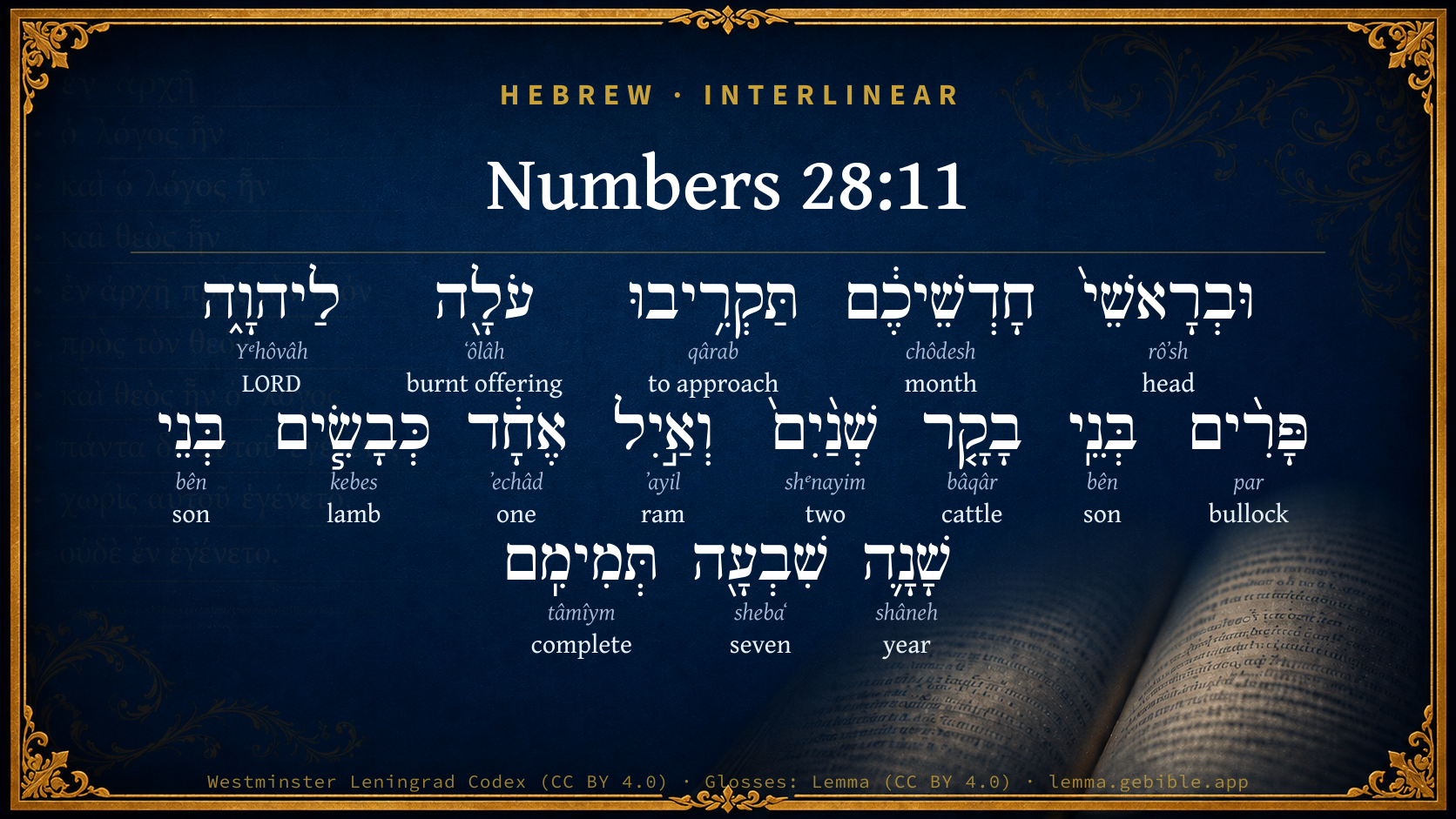
Hebrew (Westminster Leningrad Codex) Numbers 28:11 appears in the Hebrew Old Testament. The text above is from the Westminster Leningrad Codex. Each word links to its Strong’s number, a concise gloss, and parsing drawn from the Open Scriptures Hebrew Bible morphology. Click any word for its full Brown-Driver-Briggs (BDB) entry.
Download image
Cite this verse

Numbers 28:11 (World English Bible). Public Domain. Lemma interlinear Bible study tool, https://lemma.gebible.app/v/numbers/28/11.

Show BibTeX & RIS
BibTeX
RIS
English Translation
In the beginnings of your months you shall offer a burnt offering to Yahweh: two young bulls, and one ram, seven he-lambs a year old without blemish;
World English Bible · Public Domain
Download a study sheet

One document with this verse’s original text, its word-by-word gloss line, the meaning frame, cross-references with their text, attributed commentary, and full source and license credits — printable, and it pastes into notes with its structure intact.

This verse Autodidact and up

Study sheet (.html) Plain text (.txt)

A passage Seminary Student

Up to 50 verses in one chapter. A passage sheet keeps up to 6 commentary sources and 12 cross-references per verse, in the order this page ranks them, and says so on the sheet whenever that leaves anything out. Ask for a single verse and you get the Autodidact verse sheet above.

Everything on this page stays free to read, with no account — the sheet is a download of what is already on screen, not access to it.

Want to remove ads? Support Godless Engineer
Compare translations 3

The same verse in 3 English versions, stacked beneath the original-language interlinear above. Click any original word for its lexicon entry.

Each is an independent rendering of the whole verse — the interlinear is not word-aligned to these translations.

Highlighted words mark where these versions differ — a whole-verse word diff, not a word-by-word alignment.

  • World English Bible Public Domain
    In the beginnings of your months you shall offer a burnt offering to Yahweh: two young bulls, and one ram, seven he-lambs a year old without blemish;
  • King James Version Public Domain
    And in the beginnings of your months ye shall offer a burnt offering unto the LORD; two young bullocks, and one ram, seven lambs of the first year without spot;
  • unfoldingWord Literal Text CC BY-SA 4.0
    And at the heads of your months, you shall offer a burnt offering to Yahweh: two bulls, sons of cattle, and one ram, seven male lambs, sons of a year, unblemished;

unfoldingWord Literal Text — © unfoldingWord, licensed CC BY-SA 4.0. Word-aligned USFM3 via Door43 (git.door43.org/unfoldingWord/en_ult).

Versions to compare (up to 4)

3 of 4 selected

Show all 18 translations

Every available English version of this verse, each an independent rendering of the whole verse.

  • World English Bible Public Domain
    In the beginnings of your months you shall offer a burnt offering to Yahweh: two young bulls, and one ram, seven he-lambs a year old without blemish;
  • Berean Standard Bible Public Domain
    At the beginning of every month, you are to present to the LORD a burnt offering of two young bulls, one ram, and seven male lambs a year old, all unblemished,
  • Majority Standard Bible Public Domain
    At the beginning of every month, you are to present to the LORD a burnt offering of two young bulls, one ram, and seven male lambs a year old, all unblemished,
  • King James Version Public Domain
    And in the beginnings of your months ye shall offer a burnt offering unto the LORD; two young bullocks, and one ram, seven lambs of the first year without spot;
  • American Standard Version (1901) Public Domain
    And in the beginnings of your months ye shall offer a burnt-offering unto Jehovah: two young bullocks, and one ram, seven he-lambs a year old without blemish;
  • Revised Version (1885) Public Domain
    And in the beginnings of your months ye shall offer a burnt offering unto the LORD; two young bullocks, and one ram, seven he-lambs of the first year without blemish;
  • Geneva Bible (1599) Public Domain
    And in the beginning of your moneths, ye shall offer a burnt offring vnto the Lord, two yong bullockes, and a ramme, and seuen lambes of a yeere olde, without spot,
  • Douay-Rheims (1899) Public Domain
    And on the first day of the month you shall offer a holocaust to the Lord, two calves of the herd, one ram, and seven lambs of a year old, without blemish,
  • Young's Literal Translation Public Domain
    `And in the beginnings of your months ye bring near a burnt-offering to Jehovah: two bullocks, sons of the herd, and one ram, seven lambs, sons of a year, perfect ones;
  • Literal Standard Version CC BY-SA 4.0
    And in the beginnings of your months you bring a burnt-offering near to YHWH: two bullocks, sons of the herd, and one ram, seven lambs, sons of a year, perfect ones;
  • Unlocked Literal Bible CC BY-SA 4.0
    At the beginning of each month, you must offer a burnt offering to Yahweh. You must offer two young bulls, one ram, and seven male lambs a year old without blemish.
  • unfoldingWord Literal Text CC BY-SA 4.0
    And at the heads of your months, you shall offer a burnt offering to Yahweh: two bulls, sons of cattle, and one ram, seven male lambs, sons of a year, unblemished;
  • Darby Bible Public Domain
    And in the beginnings of your months ye shall present a burnt-offering to Jehovah: two young bullocks, and one ram, seven yearling lambs without blemish.
  • World Messianic Bible Public Domain
    “‘In the beginnings of your months, you shall offer a burnt offering to the LORD: two young bulls, one ram, seven male lambs a year old without defect,
  • Webster's Bible Public Domain
    And in the beginnings of your months ye shall offer a burnt-offering to the LORD; two young bullocks, and one ram, seven lambs of the first year without spot;
  • Free Bible Version CC BY-SA 4.0
    At the start of every month, you are to present to the Lord a burnt offering of two young bulls, one ram, and seven male lambs a year old, all of them without defects,
  • Bible in Basic English Public Domain
    And on the first day of every month you are to give a burned offering to the Lord; two oxen, one male sheep, and seven he-lambs of the first year, without any mark;
  • JPS Tanakh (1917) Public Domain
    And in your new moons ye shall present a burnt-offering unto the LORD: two young bullocks, and one ram, seven he-lambs of the first year without blemish;

Literal Standard Version (2020), Covenant Press — licensed CC BY-SA 4.0. Text via the HelloAO Bible API (eBible.org). Unlocked Literal Bible (unfoldingWord) — licensed CC BY-SA 4.0. Text via the HelloAO Bible API (eBible.org). unfoldingWord Literal Text — © unfoldingWord, licensed CC BY-SA 4.0. Word-aligned USFM3 via Door43 (git.door43.org/unfoldingWord/en_ult). Free Bible Version, Dr. Jonathan Gallagher — licensed CC BY-SA 4.0. Text via the HelloAO Bible API (eBible.org).

Word by word

More ways to search: Search by grammar → Find every occurrence → Compare this word →

Practice this passage: Drill this verse → Learn its vocabulary →

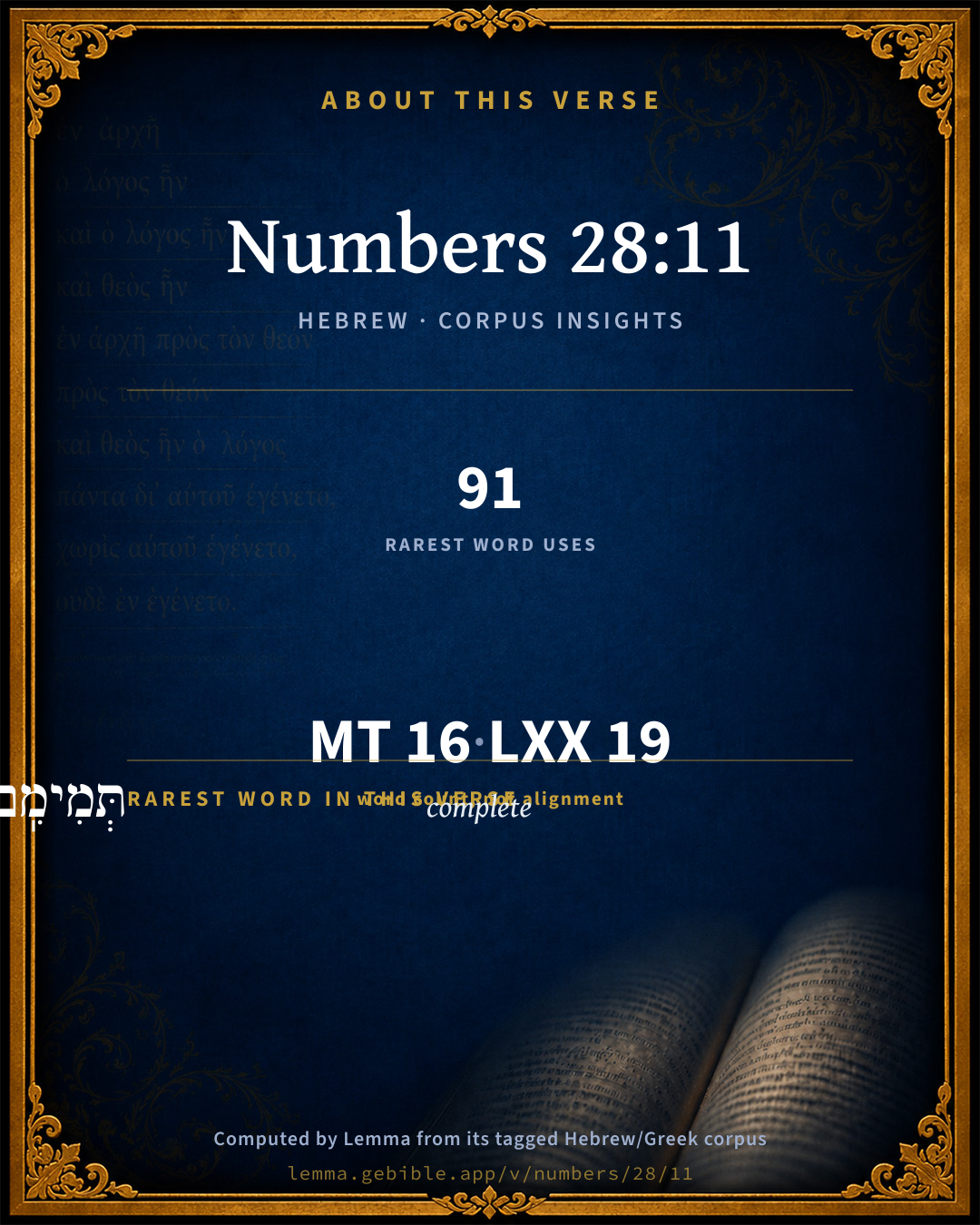
תְּמִימִֽם
tâmîym
H8549
“complete”
Adjective, Adjective, Masculine, Plural, Absolute
Part of Speech
Adjective
Type
Adjective
Gender
Masculine
Number
Plural
State
Absolute
Full BDB Definition

Origin: from H8552

TWOT: 2522d

complete, whole, entire, sound - complete, whole, entire - whole, sound, healthful - complete, entire (of time) - sound, wholesome, unimpaired, innocent, having integrity - what is complete or entirely in accord with truth and fact (neuter adjective/substantive)
  1. וּבְרָאשֵׁי֙ rôʼsh H7218 “and · in/at · heads of” Conjunction + Preposition + Noun, Common, Masculine, Plural, Construct
  2. חָדְשֵׁיכֶ֔ם chôdesh H2320 “months · your” Noun, Common, Masculine, Plural, Construct + Suffix, Personal, 2nd Person, Masculine, Plural
  3. תַּקְרִ֥יבוּ qârab H7126 “to approach” Verb, Hiphil, Imperfect, 2nd Person, Masculine, Plural
  4. עֹלָ֖ה ʻôlâh H5930 “burnt offering” Noun, Common, Feminine, Singular, Absolute
  5. לַיהוָ֑ה Yᵉhôvâh H3068 “to/for · LORD” Preposition + Noun, Proper
  6. פָּרִ֨ים par H6499 “bullocks” Noun, Common, Masculine, Plural, Absolute
  7. בְּנֵֽי bên H1121 “sons of” Noun, Common, Masculine, Plural, Construct
  8. בָקָ֤ר bâqâr H1241 “cattle” Noun, Common, Both, Singular, Absolute
  9. שְׁנַ֨יִם֙ shᵉnayim H8147 “two” Adjective, Cardinal number, Masculine, Dual, Absolute
  10. וְאַ֣יִל ʼayil H352 “and · ram” Conjunction + Noun, Common, Masculine, Singular, Absolute
  11. אֶחָ֔ד ʼechâd H259 “one” Adjective, Cardinal number, Masculine, Singular, Absolute
  12. כְּבָשִׂ֧ים kebes H3532 “lambs” Noun, Common, Masculine, Plural, Absolute
  13. בְּנֵי bên H1121 “sons of” Noun, Common, Masculine, Plural, Construct
  14. שָׁנָ֛ה shâneh H8141 “year” Noun, Common, Feminine, Singular, Absolute
  15. שִׁבְעָ֖ה shebaʻ H7651 “seven” Adjective, Cardinal number, Masculine, Singular, Absolute

About this verse

These counts appear in no published source. They are computed here, from the morphology-tagged text and Lemma’s own curated glosses. What Lemma adds →

16
words
15
distinct lemmas
Pentateuch
section

Grammatical profile

  • 1 verb
  • 11 nouns
  • 4 adjectives

Verb forms

  • תַּקְרִ֥יבוּ Hiphil · Imperfect

Repetition

A word recurs within this verse — often emphatic in Hebrew:

  • בְּנֵֽי son H1121 ×2

Hebrew & Septuagint length

In English translation the verse runs 27 words from the Hebrew and 31 from the Septuagint (LXX English) — closely comparable.

A rough comparison of the two English renderings, which tokenize alike — not a word-level alignment.

Word counts can differ between the Hebrew and the Greek without any difference in meaning — e.g. the Hebrew direct-object marker אֵת has no separate Greek word, and Greek often adds the article ὁ.

In the original languages it is 16 Hebrew tokens and 19 Greek tokens — but the two are counted differently (Hebrew bundles its prefixes and suffixes into one token; the Greek is in lemma form), so that isn’t a like-for-like length.

Cross-references

24

Topical passages linked to Numbers 28:11 in the Treasury of Scripture Knowledge — connected by theme and wording, ordered by reader-vote popularity; previews shown in the World English Bible.

  • Numbers 10:10 Also in the day of your gladness, and in your set feasts, and in the beginnings of your months, you shall blow the trumpets over your burnt offerings, and over the sacrifices of your peace-offerings; and they shall be to you for a memorial before your God: I am Yahweh your God.
  • Ezekiel 46:6 On the day of the new moon it shall be a young bull without blemish, and six lambs, and a ram; they shall be without blemish:
  • Leviticus 1:3 "'If his offering is a burnt offering from the herd, he shall offer a male without blemish. He shall offer it at the door of the Tent of Meeting, that he may be accepted before Yahweh.
  • Numbers 28:19 but you shall offer an offering made by fire, a burnt offering to Yahweh: two young bulls, and one ram, and seven he-lambs a year old; they shall be to you without blemish;
  • 1 Samuel 20:5 David said to Jonathan, Behold, tomorrow is the new moon, and I should not fail to sit with the king at meat: but let me go, that I may hide myself in the field to the third day at evening.
  • 2 Kings 4:23 He said, Why will you go to him today? it is neither new moon nor Sabbath. She said, It shall be well.
  • 1 Chronicles 23:31 and to offer all burnt offerings to Yahweh, on the Sabbaths, on the new moons, and on the set feasts, in number according to the ordinance concerning them, continually before Yahweh;
  • 2 Chronicles 2:4 Behold, I am about to build a house for the name of Yahweh my God, to dedicate it to him, and to burn before him incense of sweet spices, and for the continual show bread, and for the burnt offerings morning and evening, on the Sabbaths, and on the new moons, and on the set feasts of Yahweh our God. This is [an ordinance] forever to Israel.
  • Ezra 3:5 and afterward the continual burnt-offering, and [the offerings] of the new moons, and of all the set feasts of Yahweh that were consecrated, and of everyone who willingly offered a freewill-offering to Yahweh.
  • Nehemiah 10:33 for the show bread, and for the continual meal-offering, and for the continual burnt-offering, for the Sabbaths, for the new moons, for the set feasts, and for the holy things, and for the sin-offerings to make atonement for Israel, and for all the work of the house of our God.
  • Psalms 40:6 Sacrifice and offering you didn't desire. You have opened my ears: Burnt offering and sin offering you have not required.
  • Isaiah 1:13–14 Bring no more vain offerings. Incense is an abomination to me; New moons, Sabbaths, and convocations: I can't bear with evil assemblies.
  • Ezekiel 45:17–18 It shall be the prince's part to give the burnt offerings, and the meal-offerings, and the drink-offerings, in the feasts, and on the new moons, and on the Sabbaths, in all the appointed feasts of the house of Israel: he shall prepare the sin-offering, and the meal-offering, and the burnt offering, and the peace-offerings, to make atonement for the house of Israel.
  • Hosea 2:11 I will also cause all her celebrations to cease: Her feasts, her new moons, her Sabbaths, and all her solemn assemblies.
  • Colossians 2:16 Let no man therefore judge you in eating, or in drinking, or with respect to a feast day or a new moon or a Sabbath day,
  • Hebrews 10:10–14 by which will we have been sanctified through the offering of the body of Jesus Christ once for all.
  • Numbers 15:3–11 and will make an offering by fire to Yahweh, a burnt offering, or a sacrifice, to accomplish a vow, or as a freewill-offering, or in your set feasts, to make a sweet savor to Yahweh, of the herd, or of the flock;
  • Psalms 40:8 I delight to do your will, my God. Yes, your law is within my heart."
  • Psalms 81:3 Blow the trumpet at the New Moon, At the full moon, on our feast day.
  • Isaiah 66:23 It shall happen, that from one new moon to another, and from one Sabbath to another, shall all flesh come to worship before me, says Yahweh.
  • Ezekiel 46:1 Thus says the Lord Yahweh: The gate of the inner court that looks toward the east shall be shut the six working days; but on the Sabbath day it shall be opened, and on the day of the new moon it shall be opened.
  • Amos 3:5 Can a bird fall in a trap on the earth, Where no snare is set for him? Does a snare spring up from the ground, When there is nothing to catch?
  • Galatians 4:10 You observe days, months, seasons, and years.
  • Colossians 2:6 As therefore you received Christ Jesus, the Lord, walk in him,

Cross-references courtesy of OpenBible.info (CC BY 4.0).

Hebrew and Greek witnesses Masoretic Hebrew ↔ Greek Septuagint

The same verse in the two great witnesses to the Old Testament, shown verse-for-verse.

These are two independent witnesses, not word-aligned to each other, and the Septuagint is shown in lemma (dictionary) form.

Hebrew Numbers 28:11 Masoretic · Westminster Leningrad Codex

וּבְרָאשֵׁי֙ חָדְשֵׁיכֶ֔ם תַּקְרִ֥יבוּ עֹלָ֖ה לַיהוָ֑ה פָּרִ֨ים בְּנֵֽי בָקָ֤ר שְׁנַ֨יִם֙ וְאַ֣יִל אֶחָ֔ד כְּבָשִׂ֧ים בְּנֵי שָׁנָ֛ה שִׁבְעָ֖ה תְּמִימִֽם

In the beginnings of your months you shall offer a burnt offering to Yahweh: two young bulls, and one ram, seven he-lambs a year old without blemish;

World English Bible · Public Domain

Greek LXX Numbers 28:11 Septuagint · lemma form

καί ἐν ὁ νουμηνία προςἄγω ὁλοκαύτωμα ὁ κύριος μόσχος ἐκ βοῦς δύο καί κριός εἷς ἀμνός ἐνιαύσιος ἑπτά ἄμωμος

And at the new moons you⌃ shall bring a whole burnt offering to the Lord, two calves of the herd, and one ram, seven lambs of a year old without blemish.

LXX2012 (modern English Septuagint) · Public Domain

Hebrew: Westminster Leningrad Codex (CC BY 4.0). Greek: Septuagint (public domain); English from LXX2012 (modern English Septuagint) (Public Domain). How the Septuagint differs from the Hebrew →

Targum (Aramaic paraphrase)

2

The Targum is the ancient Jewish Aramaic paraphrase of the Hebrew Scriptures — an interpretive translation, not the Hebrew text itself. Onkelos (literal) and Pseudo-Jonathan (expansive) render the Torah, and Jonathan the Prophets. Coverage is partial: where no permissively-licensed English translation exists for a verse, only the Aramaic is shown. This is verse-level text, not a word-by-word alignment to the Hebrew.

  1. Targum Onkelos Torah (Genesis–Deuteronomy)
    וּבְרֵישֵׁי יַרְחֵיכוֹן תְּקַרְבוּן עֲלָתָא קֳדָם יְיָ תּוֹרִין בְּנֵי תּוֹרֵי תְּרֵין וּדְכַר חָד אִימְרִין בְּנֵי שְׁנָא שַׁבְעָא שַׁלְמִין

    (no public-domain English translation for this verse)

    Targum Onkelos — Aramaic: “Onkelos Genesis” (public domain); “Onkelos Exodus” (public domain); “Onkelos Leviticus” (public domain); “Onkelos Numbers” (public domain); “Onkelos Deuteronomy” (public domain). English: “Sefaria Community Translation” (CC0 1.0 (public-domain dedication)); “J.W. Etheridge. The Targums of Onkelos and Jonathan Ben Uzziel on the Pentateuch. London: Longmans, Green, 1862” (public domain). Text via Sefaria.

  2. Targum Pseudo-Jonathan Torah (Genesis–Deuteronomy)
    וּבְרֵישֵׁי יַרְחֵיכוֹן תִּקְרְבוּן עֲלָתָא קֳדָם יְיָ תּוֹרִין בְּנֵי תוֹרֵי דְלָא עֵירוּבִין תְּרֵין וּדְכַר חָד אִמְרִין בְּנֵי שְׁנָא שַׁבְעָא שַׁלְמִין

    And at the beginning of your months you shall offer a burnt sacrifice before the Lord; two young bullocks, without mixture, one ram, lambs of the year seven, unblemished;

    Targum Pseudo-Jonathan — Aramaic: “Targum Jonathan on Genesis” (public domain); “Targum Jonathan on Exodus” (public domain); “Targum Jonathan on Leviticus” (public domain); “Targum Jonathan on Numbers” (public domain); “Targum Jonathan on Deuteronomy” (public domain). English: “The Targum of Jonathan ben Uzziel, trans. J. W. Etheridge, London, 1862” (public domain). Text via Sefaria.

Commentary

Notes on Numbers 28:11 from classic Christian and Jewish commentators (each source and its license shown beneath its notes). The classic Christian expositions comment on the surrounding passage and are grouped to its opening verse, so a note may address several verses; the Jewish commentaries on the Tanakh (Rashi and others) are per-verse, so they appear only where the commentator wrote on this verse.

Lemma curates 59 commentaries, every one of them public domain or Creative Commons licensed, each selected and text-cleaned for this edition rather than reprinted as found. About our sources →

Trapp's Complete Commentary

John Trapp

Num 28:11 And in the beginnings of your months ye shall offer a burnt offering unto the LORD; two young bullocks, and one ram, seven lambs of the first year without spot;

Ver. 11. And in the beginning of your months.] Thus they had their daily, weekly, monthly, yearly addresses unto God, that they might ever be in communion with him, and conformity unto him, by this continual intercourse. On the new moons they rested, {Amo 8:5} feasted, {1Sa 20:5} heard the word, &c.

John Trapp, A Commentary or Exposition upon All the Books of the Old and New Testament (1647–1656) — public domain. Text from a community e-Sword module.

Joseph Benson's Commentary

Num 28:11. In the beginning of your months — The third stated sacrifice was monthly, to be offered on the first day of every month. This sacrifice to God is thought to have been ordained in opposition to the idolatry of the Gentiles, who were wont to worship the new moon with great rejoicings. Besides the celebration of the new moon by sacrifices, and sound of trumpet, (Num 10:10,) the Jews were wont upon those days to assemble for receiving instruction from their prophets, (2Ki 4:23,) and to feast together, 1Sa 20:5; 1Sa 20:18. And it was customary on those days to shut up their shops, and abstain from ordinary and servile labour, as is hinted Amo 8:5.

Joseph Benson's Commentary on the Old and New Testaments (1811–1818) — public domain. Text from a community e-Sword module.

Whedon's Commentary on the Bible

Daniel D. Whedon

LAW OF OFFERINGS AT THE NEW MOONS, Num_28:11-15.

11. Beginnings of… months — The months began with the new moon at the signal of the silver trumpet in the sanctuary. Num_10:10, note; 2Ch_2:4. Then Israel gathered to the prophets, or other teachers, to hear the word of God, (2Ki_4:23,) and kept a religious feast, abstaining from business. 1Sa_20:5-6; Amo_8:5. This was “a shadow of Christ.” Col_2:16-17. This accords with Isa_66:23. The Hebrews say, “As the beginning of the months are sanctified and renewed in this world, so shall Israel be sanctified and renewed in time to come.”

Two young bullocks — A more costly sacrifice than that on the sabbath. Leviticus iv, Concluding Note, (4.) It was an additional offering to the daily sacrifice. All the animals in this verse were for a burnt offering.

Daniel D. Whedon (gen. ed.), Commentary on the Old and New Testaments (1874–1909) — public domain. Text from a community e-Sword module.

Tyndale Open Study Notes

Tyndale Open Resources

28:11-15 The offering of the first day of each month—the New Moon—called for the sacrifice of bulls, rams, and lambs as burnt offerings, along with a male goat as a sin offering.

Tyndale Open Study Notes — © Tyndale Open Resources, licensed CC BY-SA 4.0. Text via the HelloAO Bible API.

Jamieson, Fausset & Brown

Robert Jamieson, A. R. Fausset & David Brown

And in the beginnings of your months ye shall offer a burnt offering unto the Lord--These were held as sacred festivals; and though not possessing the character of solemn feasts, they were distinguished by the blowing of trumpets over the sacrifices (Num 10:10), by the suspension of all labor except the domestic occupations of women (Amo 8:5), by the celebration of public worship (Kg2 4:23), and by social or family feasts (Sa1 20:5). These observations are not prescribed in the law though they obtained in the practice of a later time. The beginning of the month was known, not by astronomical calculations, but, according to Jewish writers, by the testimony of messengers appointed to watch the first visible appearance of the new moon; and then the fact was announced through the whole country by signal-fires kindled on the mountain tops. The new-moon festivals having been common among the heathen, it is probable that an important design of their institution in Israel was to give the minds of that people a better direction; and assuming this to have been one of the objects contemplated, it will account for one of the kids being offered unto the Lord (Num 28:15), not unto the moon, as the Egyptians and Syrians did. The Sabbath and the new moon are frequently mentioned together.

Jamieson, Fausset & Brown — Commentary Critical and Explanatory on the Whole Bible (1871) — public domain (CC PDM 1.0). Text via the HelloAO Bible API.

Ellicott's Commentary for English Readers

(11) In the beginnings of your months . . . —The beginning of the month was announced by the blowing of the silver trumpets (Num_10:10). Increased respect was paid to the beginning of the month in later times. Trade was suspended (Amo_8:5), and religious instruction appears to have been given at this time (2Ki_4:23).

A Bible Commentary for English Readers, edited by Charles John Ellicott (1878–1897) — public domain. Text from a community e-Sword module.

John Gill's Exposition

And in the beginnings of your months ye shall offer a burnt offering unto the Lord,.... On the first day of every month, when the new moon appeared; that this was religiously observed appears from the blowing of the trumpets over the sacrifices on this day, from attendance on the word of the Lord, by his prophets, on this day, and from abstinence from worldly business on it, Num 10:10.

two young bullocks, and one ram, seven rams of the first year without spot; this was the burnt offering, and a very large and costly one it was: more creatures were offered on this day than on a sabbath day; not that this was a more holy day than that, but this was but once a month, and therefore the expense might be the more easily bore, whereas that was every week.

John Gill's Exposition of the Whole Bible (1746–1763) — public domain (CC PDM 1.0). Text via the HelloAO Bible API.

Albert Barnes' Notes on the Bible

The New-moon offering is here also commanded for the first time. The goat as a sin-offering, though mentioned last, would seem in fact to have been offered first (compare the precedents in Exo. 29; Lev. 5; 8; 9; 14; 16). The sin-offering, which Num 15:22-26 had been contemplated in cases where a sin had been committed ignorantly without the knowledge of the congregation, was henceforth not to be offered merely at discretion, as circumstances might seem to require, but to be regularly repeated, not less frequently than once a month.

Albert Barnes' Notes on the Bible (1834–1885) — public domain. Text from a community e-Sword/MySword module.

Haydock's Catholic Bible Commentary

Month. This is not reckoned among the festivals, Leviticus xxiii. The Rabbins look upon it as a day of devotion, particularly for women. (Buxtorf, Syn. xvii.) Spencer (Rit. iii. 1,) maintains, that the Hebrews began their month when the moon first appeared, and that they imitated the pagans in keeping that day holy. But his proofs on both heads are very unsatisfactory. The Hebrews followed the solar year for many ages after Moses, though they might have adopted the lunar towards the close of the republic; and the pagans themselves ridiculed those as vile imitators of the Jews, who kept the new moons as a festival. (Hor.[Horace,?] Sat. i. 9.) Sabbata Vin tu Curtis Judæis oppedere. --- The Greeks, Romans, Egyptians, Arabs, and Turks, have given in to various superstitious practices in honour of the moon. See Macrobius, Sat. i. 15, &c. (Calmet) --- The devil is commonly the ape of God, and teaches his votaries to adopt the ceremonies of the true religion, either to delude them more easily, or to bring those practices into discredit. Thus Middleton has endeavoured to shew the conformity of Pagan and Papal Rome, as if the ceremonies of the Catholic religion were to be rejected because some of them have been in use among the heathens. By the same argument he may ridicule the revelation of God himself, on this subject, and represent vestments, holy water, &c., as superstitious. He may pull down altars, condemn all forms of prayer, abolish all worship, both of soul and body. For such things have all been prostituted to idols! But those who are not totally infatuated by prejudice, will deplore the abuse of these things, and will not refrain from adoring the true God according to his will, with all the faculties both of their soul and body, on account of the devil and his false prophets having extorted similar acts of worship from their followers. It is no wonder that Protestants should ridicule our holy ceremonies, since they scruple not to assign so base an origin to those which God expressly prescribed. (Haydock) --- The sacrifices which were ordered to be offered up on the first day of the month, were probably designed to renew the memory of the world’s creation, or rather of the Divine providence, which regulates the seasons. Nothing was sold on this day, Amos viii. 5. But people went to hear the prophets, (4 Kings iv. 23,) and feasted among themselves, 1 Kings xx. 18. It is thought that many rested also from servile work, though this is no where commanded. (Calmet) --- Tirinus agrees with Tostat and Sanctius, in supposing that servile work was prohibited, for which he refers to 1 Kings xx. 19. He also asserts that the Jews observed the lunar system, and that their months consisted of 29 and 30 days alternately, as 29 days and a half elapse from one moon to another. The sound of trumpets probably announced this solemnity, chap. x. 10., and Leviticus xxiii. (Haydock)

George Leo Haydock (1774–1849), Haydock's Catholic Family Bible and Commentary, 1859 edition — public domain. Excludes Psalms (Douay-Rheims chapter numbering differs from Protestant) and Deuterocanonical books (Catholic canon only).

Matthew Poole's English Annotations

In the beginnings of your months, which though not reckoned among the solemn feasts, Le 23, yet were celebrated as such, by the sound of trumpets, Num 10:10, by extraordinary sacrifices, by abstinence from servile works, Amo 8:5, and by attendance upon the ministry of God’s word, 2Ki 4:23. And God ordained it thus, partly that by giving God the first-fruits of every month they should acknowledge him as the Lord of all their time, and own his providence, by which all times and seasons, and all the fruits and blessings of them, and actions done in them, are ordered; and partly that it might be a type of the future renovation of the world by Christ.

Matthew Poole's English Annotations on the Holy Bible (1683–1685) — public domain. Text from a community e-Sword/MySword module.

The Pulpit Commentary

In the beginnings of your months. The new-moon offering also is here enjoined for the first time, the festival itself having only been incidentally mentioned in Num_10:10. There can be no doubt that this (unlike the sabbath) was a nature-festival, observed more or less by all nations. As such it did not require to be instituted, but only to be regulated and sanctified in order that it might not lend itself to idolatry, as it did among the heathen. (cf. Deu_4:19 Job_31:26, 27 Jer_7:18 Jer_8:2) The new-moon feast, depending upon no calendar but that of the sky, and more clearly marked in that than any other recurring period, was certain to fix itself deeply in the social and religious habits of a simple pastoral or agricultural people. Accordingly we find it incidentally mentioned as a day of social gathering, (1Sa_20:5) and as a day for religious instruction. (2Ki_4:23) From the latter passage, and from such passages as Isa_66:23 Eze_46:1 Amo_8:5, it is evident that the feast of the new moon became to the month exactly what the sabbath was to the week a day of rest and of worship. (see also RAPC Jdt 8:6)

Vers. 11-15. The offering at the new moon.

Here the services rendered to man by God in nature are once again linked in with the duties of religion. As God required offerings in the morning and evening of every day, so on the day when the new moon fell there was an additional and largely increased offering. Why should such special notice be taken of this occasion?

I THE MOON IS OUR OWN SATELLITE AND PECULIAR SERVANT. It has evidently been given for our special benefit. The sun serves us with our share, as it does the other planets that circle round it, but the moon is peculiarly ours. When, therefore, it had passed through all its phases, it was well to mark the renewal of service by a special offering. If it be said that Israel was not aware of this nice distinction between the services of the sun and moon, the distinction is nevertheless real, was known then to God, and is known now to us. The commandments of God took into consideration not only what was known at the time of their announcement, but what would be further discovered in the progress of human inquiry. We can see a propriety in this ordinance of the monthly offering, as we think of the peculiar relation which the moon alone of all the heavenly bodies sustains to our earth.

II THE MOON IS AN EMBLEM OF APPARENT CHANGE AND YET REAL STEADFASTNESS. Thus it is an emblem of the way in which God"s dealings appear often to us. The Unchanging One looks like a changing one, and it takes all our faith to be sure of his faithfulness. We talk of the waxing and the waning moon, but we know that the moon itself remains the same, that the change of appearance arises from change of position, and depends on how it catches the light of the sun. When we do see it, we see the same face always turned towards us, and mysterious as its movements are to the ignorant and the savage, they are nevertheless so regular that all can be predicted beforehand. The moon therefore is a peculiar and suggestive emblem of constancy, if we look on it aright. Juliet, indeed, in her love-sick prattle says, O, swear not by the moon, the inconstant moon, That monthly changes in her circled orb.

But appearance is one thing and reality is another, and we are reminded of one who found a very different emblematic value in the moon when he said, "They shall fear thee as long as the sun and moon endure, throughout all generations." The faithfulness of God is the same, even when his face is hidden, and when his mercy, like the waning moon, seems to diminish before our very eyes. The mysterious hindrances, sorrows, and gloomy peculiarities of our present life would be largely cleared up, if we only knew as much of the wheels within wheels of God"s moral government, as we do of the wheels within wheels in the motions and relations of the heavenly bodies.

III THE CONNECTION OF THE MOON WITH THE MONTH IS ALSO TO BE BORNE IN MIND. Spring, summer, autumn, winter, are. after all, vague terms. We mark the changing phenomena of the year far more accurately by the months than by the longer seasons. We speak of blustering March, showery April, chill October, drear December, and may we not suppose that the Israelites had somewhat of the same way of thinking with regard to their months? each month with its own character and making its own contribution to the fullness of the year. Y. (Deu_17:3 Deu_33:14 1Sa_20:5 2Ki_4:23 Psa_81:1-4 Psa_89:37 Isa_30:26 Isa_60:20 Gal_4:10 Rev_22:2)

The Pulpit Commentary (1880–1919), ed. H.D.M. Spence-Jones & Joseph S. Exell — public domain. Text from a community e-Sword module.

Keil & Delitzsch

C. F. Keil & F. Delitzsch

At the beginnings of the month, i.e., at the new moons, a larger burnt-offering was to be added to the daily or continual burnt-offering, consisting of two bullocks (young oxen), one ram, and seven yearling lambs, with the corresponding meat and drink-offerings, as the "month's burnt-offering in its (i.e., every) month with regard to the months of the year," i.e., corresponding to them. To this there was also to be added a sin-offering of a shaggy goat (see at Lev 4:23). The custom of distinguishing the beginnings of the months of new moon's days by a peculiar festal sacrifice, without their being, strictly speaking, festal days, with sabbatical rest and a holy meeting,

(Note: In later times, however, the new moon grew more and more into a feast-day, trade was suspended (Amo 8:5), the pious Israelite sought instruction from the prophets (Kg2 4:23), many families and households presented yearly thank-offerings (Sa1 20:6, Sa1 20:29), and at a still later period the most devout abstained from fasting (Judith 8:6); consequently it is frequently referred to by the prophets as a feast resembling the Sabbath (Isa 1:13; Hos 2:13; Eze 46:1).)

arose from the relation in which the month stood to the single day. "If the congregation was to sanctify its life and labour to the Lord every day by a burnt-offering, it could not well be omitted at the commencement of the larger division of time formed by the month; on the contrary, it was only right that the commencement of a new month should be sanctified by a special sacrifice. Whilst, then, a burnt-offering, in which the idea of expiation was subordinate to that of consecrating surrender to the Lord, was sufficient for the single day; for the whole month it was necessary that, in consideration of the sins that had been committed in the course of the past month, and had remained without expiation, a special sin-offering should be offered for their expiation, in order that, upon the ground of the forgiveness and reconciliation with God which had been thereby obtained, the lives of the people might be sanctified afresh to the Lord in the burnt-offering. This significance of the new moon sacrifice was still further intensified by the fact, that during the presentation of the sacrifice the priests sounded the silver trumpets, in order that it might be to the congregation for a memorial before God (Num 10:10). The trumpet blast was intended to bring before God the prayers of the congregation embodied in the sacrifice, that God might remember them in mercy, granting them the forgiveness of their sins and power for sanctification, and quickening them again in the fellowship of His saving grace" (see my Archaeologie, i. p. 369).

Keil & Delitzsch — Biblical Commentary on the Old Testament (1861–1891) — public domain (CC PDM 1.0). Text via the HelloAO Bible API. (Old Testament only.)

Kretzmann's Popular Commentary

Paul E. Kretzmann

The Sacrifice of the New Moon

v. 11. And in the beginnings of your months, on the days of the new moon, ye shall offer a burnt offering unto the Lord: two young bullocks and one ram, seven lambs of the first year without spot;

v. 12. and three-tenth deals of flour for a meat-offering (between seven and one half and eight quarts), mingled with oil, for one bullock; and two-tenth deals of flour for a meat-offering, mingled with oil, for one ram;

v. 13. and a several tenth deal of flour, that is, so much for each animal, mingled with oil for a meat-offering unto one lamb; for a burnt offering of a sweet savor, a sacrifice made by fire unto the Lord. The amount of flour and oil was proportional to the size of the animal offered.

v. 14. And their drink-offerings shall be half an hin of wine (a hin being about a quart) unto a bullock, and the third part of an hin unto a ram, and a fourth part of an hin unto a lamb; this is the burnt offering of every month throughout the months of the year.

v. 15. And one kid of the goats for a sin-offering unto the Lord shall be offered beside (in addition to) the continual burnt offering and his drink-offering. Cf Num 15:4-12.

Paul E. Kretzmann, Popular Commentary of the Bible (1921–1924) — public domain. Text from a community e-Sword module.

unfoldingWord translationNotes

Door43 World Missions Community

General Information:

Yahweh continues telling Moses what the people must do.

three-tenths of an ephah

"Three-tenths" means three parts out of ten equal parts. This can be written in modern measurements. AT: "six liters" or "three-tenths of an ephah (which is about six liters)" (See: Fractions and Biblical Volume)

mixed with oil

This can be stated in active form. AT: "which you have mixed with oil" (See: Active or Passive)

two-tenths of fine flour

The words "of an ephah" are understood and may stated clearly. "Two-tenths" means two parts out of ten equal parts. This can be written in modern measurements. AT: "four and a half liters of fine flour" or "two-tenths of an ephah (which is about 4.5 liters) of fine flour" (See: Ellipsis and Fractions and Biblical Volume)

a tenth of an ephah

"A tenth" means one part out of ten equal parts. This can be written in modern measurements. AT: "2 liters" or "a tenth of an ephah (which is about 2 liters)" (See: Fractions and Biblical Volume)

made by fire

This can be stated in active form. AT: "that you burned on the altar" (See: Active or Passive)

translationWords

month

burnt offering

Yahweh

cow

ewe

lamb

year

blemish

tenth

grain offering

oil

sacrifice

unfoldingWord translationNotes — © Distant Shores Media and the Door43 World Missions Community, licensed CC BY-SA 4.0. Source: git.door43.org/Door43/en_tn.

Lesson kit

Teaching starters — assembled from the data on this page, not authored interpretation. Every prompt links to the verse data it draws on. Edit before teaching.

Numbers, in the Pentateuch, opens this verse with 16 words (15 distinct Hebrew lemmas). Its most distinctive word is tâmîym (“complete”). A historical commentator’s framing appears above. Read the whole chapter for the surrounding context.

Discussion questions

  1. The word tâmîym carries the sense “complete.” How does it shape the verse?
  2. Numbers 10:10 shares this passage’s theme. How do the two illuminate each other?
  3. “son” occurs 2× in this one verse. What is the effect of the repetition?
  4. These translations render this verse differently; the difference is in the English rendering, not the original. What questions does that raise?
  5. The verb «תַּקְרִ֥יבוּ» is Hiphil Imperfect. How does its form color the action?
  6. Reading how Trapp's Complete Commentary and Joseph Benson's Commentary read this verse, where do the two commentators agree and where do they part?

Things to notice

Reading settings

Reading text

Shown beneath each verse's original-language words.

Old Testament
Old Testament edition

Read the OT as the Masoretic Hebrew (MT) or the Greek Septuagint (LXX).

English shown for the Greek Septuagint (in the Hebrew ↔ Greek comparison).

Comparing translations? Open the Compare panel on any verse page to stack up to four side by side.