
Exodus 38:24

Hebrew (Westminster Leningrad Codex) Exodus 38:24 appears in the Hebrew Old Testament. The text above is from the Westminster Leningrad Codex. Each word links to its Strong’s number, a concise gloss, and parsing drawn from the Open Scriptures Hebrew Bible morphology. Click any word for its full Brown-Driver-Briggs (BDB) entry.
Download image
Cite this verse

Exodus 38:24 (World English Bible). Public Domain. Lemma interlinear Bible study tool, https://lemma.gebible.app/v/exodus/38/24.

Show BibTeX & RIS
BibTeX
RIS
English Translation
All the gold that was used for the work in all the work of the sanctuary, even the gold of the offering, was twenty-nine talents, and seven hundred thirty shekels, after the shekel of the sanctuary.
World English Bible · Public Domain
Download a study sheet

One document with this verse’s original text, its word-by-word gloss line, the meaning frame, cross-references with their text, attributed commentary, and full source and license credits — printable, and it pastes into notes with its structure intact.

This verse Autodidact and up

Study sheet (.html) Plain text (.txt)

A passage Seminary Student

Up to 50 verses in one chapter. A passage sheet keeps up to 6 commentary sources and 12 cross-references per verse, in the order this page ranks them, and says so on the sheet whenever that leaves anything out. Ask for a single verse and you get the Autodidact verse sheet above.

Everything on this page stays free to read, with no account — the sheet is a download of what is already on screen, not access to it.

Want to remove ads? Support Godless Engineer
Compare translations 3

The same verse in 3 English versions, stacked beneath the original-language interlinear above. Click any original word for its lexicon entry.

Each is an independent rendering of the whole verse — the interlinear is not word-aligned to these translations.

Highlighted words mark where these versions differ — a whole-verse word diff, not a word-by-word alignment.

  • World English Bible Public Domain
    All the gold that was used for the work in all the work of the sanctuary, even the gold of the offering, was twenty-nine talents, and seven hundred thirty shekels, after the shekel of the sanctuary.
  • King James Version Public Domain
    All the gold that was occupied for the work in all the work of the holy place, even the gold of the offering, was twenty and nine talents, and seven hundred and thirty shekels, after the shekel of the sanctuary.
  • unfoldingWord Literal Text CC BY-SA 4.0
    All the gold used for the work, in all the work of the sanctuary—it was the gold from the raised offering— 29 talents and 730 shekels, by the shekel of the sanctuary.

unfoldingWord Literal Text — © unfoldingWord, licensed CC BY-SA 4.0. Word-aligned USFM3 via Door43 (git.door43.org/unfoldingWord/en_ult).

Versions to compare (up to 4)

3 of 4 selected

Show all 18 translations

Every available English version of this verse, each an independent rendering of the whole verse.

  • World English Bible Public Domain
    All the gold that was used for the work in all the work of the sanctuary, even the gold of the offering, was twenty-nine talents, and seven hundred thirty shekels, after the shekel of the sanctuary.
  • Berean Standard Bible Public Domain
    All the gold from the wave offering used for the work on the sanctuary totaled 29 talents and 730 shekels, according to the sanctuary shekel.
  • Majority Standard Bible Public Domain
    All the gold from the wave offering used for the work on the sanctuary totaled 29 talents and 730 shekels, according to the sanctuary shekel.
  • King James Version Public Domain
    All the gold that was occupied for the work in all the work of the holy place, even the gold of the offering, was twenty and nine talents, and seven hundred and thirty shekels, after the shekel of the sanctuary.
  • American Standard Version (1901) Public Domain
    All the gold that was used for the work in all the work of the sanctuary, even the gold of the offering, was twenty and nine talents, and seven hundred and thirty shekels, after the shekel of the sanctuary.
  • Revised Version (1885) Public Domain
    All the gold that was used for the work in all the work of the sanctuary, even the gold of the offering, was twenty and nine talents, and seven hundred and thirty shekels, after the shekel of the sanctuary.
  • Geneva Bible (1599) Public Domain
    All ye gold that was occupied in all ye worke wrought for the holy place (which was the gold of the offring) was nine and twentie talents, and seuen hundreth and thirtie shekels, according to the shekel of the Sanctuarie.
  • Douay-Rheims (1899) Public Domain
    All the gold that was spent in the work of the sanctuary, and that was offered in gifts was nine and twenty talents, and seven hundred and thirty sicles according to the standard of the sanctuary.
  • Young's Literal Translation Public Domain
    All the gold which is prepared for the work in all the work of the sanctuary (and it is the gold of the wave-offering) `is' twenty and nine talents, and seven hundred and thirty shekels, by the shekel of the sanctuary.
  • Literal Standard Version CC BY-SA 4.0
    All the gold which is prepared for the work in all the work of the holy place (and it is the gold of the wave-offering) [is] twenty-nine talents, and seven hundred and thirty shekels, by the shekel of the holy place.
  • Unlocked Literal Bible CC BY-SA 4.0
    All the gold that was used for the project, in all the work connected with the holy place—the gold from the wave offering—was twenty-nine talents and 730 shekels, measured by the standard of the sanctuary shekel.
  • unfoldingWord Literal Text CC BY-SA 4.0
    All the gold used for the work, in all the work of the sanctuary—it was the gold from the raised offering— 29 talents and 730 shekels, by the shekel of the sanctuary.
  • Darby Bible Public Domain
    All the gold that it took for the work in all the work of the sanctuary -- the gold of the wave-offering, was twenty-nine talents, and seven hundred and thirty shekels, according to the shekel of the sanctuary.
  • World Messianic Bible Public Domain
    All the gold that was used for the work in all the work of the sanctuary, even the gold of the offering, was twenty-nine talents and seven hundred thirty shekels, according to the shekel of the sanctuary.
  • Webster's Bible Public Domain
    All the gold that was occupied for the work in all the work of the holy place, even the gold of the offering, was twenty and nine talents, and seven hundred and thirty shekels, after the shekel of the sanctuary.
  • Free Bible Version CC BY-SA 4.0
    The total amount of gold from the offering that was used for the work on the sanctuary was 29 talents and 730 shekels (using the sanctuary shekel standard).
  • Bible in Basic English Public Domain
    The gold used for all the different work done for the holy place, the gold which was given, was twenty-nine talents, and seven hundred and thirty shekels in weight, by the scale of the holy place.
  • JPS Tanakh (1917) Public Domain
    All the gold that was used for the work in all the work of the sanctuary, even the gold of the offering, was twenty and nine talents, and seven hundred and thirty shekels, after the shekel of the sanctuary.

Literal Standard Version (2020), Covenant Press — licensed CC BY-SA 4.0. Text via the HelloAO Bible API (eBible.org). Unlocked Literal Bible (unfoldingWord) — licensed CC BY-SA 4.0. Text via the HelloAO Bible API (eBible.org). unfoldingWord Literal Text — © unfoldingWord, licensed CC BY-SA 4.0. Word-aligned USFM3 via Door43 (git.door43.org/unfoldingWord/en_ult). Free Bible Version, Dr. Jonathan Gallagher — licensed CC BY-SA 4.0. Text via the HelloAO Bible API (eBible.org).

Word by word

More ways to search: Search by grammar → Find every occurrence → Compare this word →

Practice this passage: Drill this verse → Learn its vocabulary →

הַתְּנוּפָ֗ה
tᵉnûwphâh
H8573
“the · wave offering”
Particle, Definite Article + Noun, Common, Feminine, Singular, Absolute
Part of Speech
Particle + Noun
Type
Common
Gender
Feminine
Number
Singular
State
Absolute
Full BDB Definition

Origin: from H5130

TWOT: 1330b

swinging, waving, wave offering, offering - a swinging, brandishing - of God's hand, weapons - waving, wave-offering (technical term of sacrifice) - offering (of gold or brass)
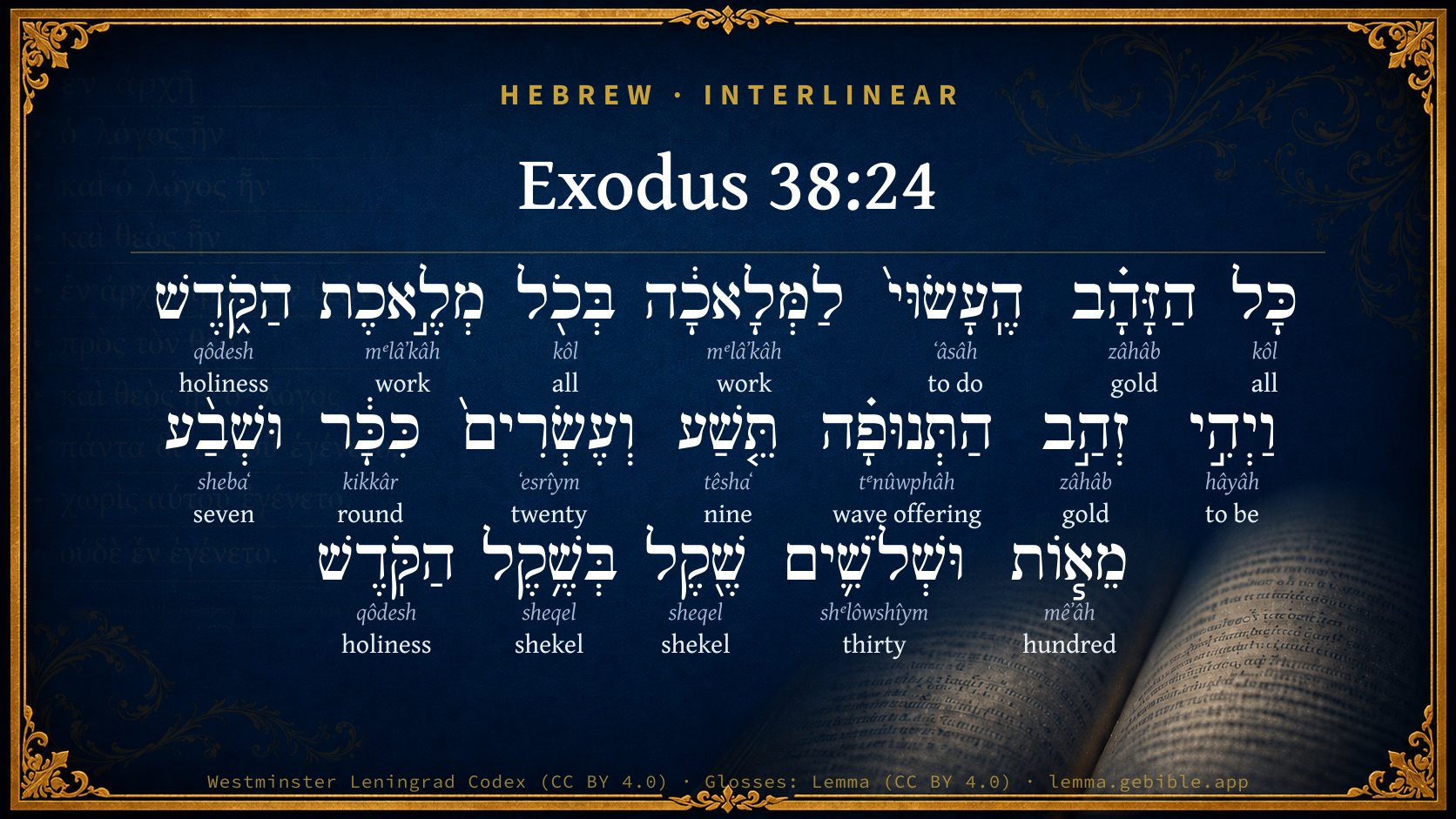
  1. כָּל kôl H3605 “all of” Noun, Common, Masculine, Singular, Construct
  2. הַזָּהָ֗ב zâhâb H2091 “the · gold” Particle, Definite Article + Noun, Common, Masculine, Singular, Absolute
  3. הֶֽעָשׂוּי֙ ʻâsâh H6213 “the · done” Particle, Definite Article + Verb, Qal, Participle Passive, Masculine, Singular, Absolute
  4. לַמְּלָאכָ֔ה mᵉlâʼkâh H4399 “to/for the · work” Preposition, Determined + Noun, Common, Feminine, Singular, Absolute
  5. בְּכֹ֖ל kôl H3605 “in/at · all of” Preposition + Noun, Common, Masculine, Singular, Construct
  6. מְלֶ֣אכֶת mᵉlâʼkâh H4399 “work of” Noun, Common, Feminine, Singular, Construct
  7. הַקֹּ֑דֶשׁ qôdesh H6944 “the · holiness” Particle, Definite Article + Noun, Common, Masculine, Singular, Absolute
  8. וַיְהִ֣י hâyâh H1961 “and · to be” Conjunction + Verb, Qal, Sequential Imperfect, 3rd Person, Masculine, Singular
  9. זְהַ֣ב zâhâb H2091 “gold of” Noun, Common, Masculine, Singular, Construct
  10. תֵּ֤שַׁע têshaʻ H8672 “nine” Adjective, Cardinal number, Feminine, Singular, Absolute
  11. וְעֶשְׂרִים֙ ʻesrîym H6242 “and · twenty” Conjunction + Adjective, Cardinal number, Both, Plural, Absolute
  12. כִּכָּ֔ר kikkâr H3603 “round” Noun, Common, Both, Singular, Absolute
  13. וּשְׁבַ֨ע shebaʻ H7651 “and · seven” Conjunction + Adjective, Cardinal number, Feminine, Singular, Absolute
  14. מֵא֧וֹת mêʼâh H3967 “hundred” Adjective, Cardinal number, Both, Plural, Absolute
  15. וּשְׁלֹשִׁ֛ים shᵉlôwshîym H7970 “and · thirty” Conjunction + Adjective, Cardinal number, Both, Plural, Absolute
  16. שֶׁ֖קֶל sheqel H8255 “shekel” Noun, Common, Masculine, Singular, Absolute
  17. בְּשֶׁ֥קֶל sheqel H8255 “in/at · shekel of” Preposition + Noun, Common, Masculine, Singular, Construct
  18. הַקֹּֽדֶשׁ qôdesh H6944 “the · holiness” Particle, Definite Article + Noun, Common, Masculine, Singular, Absolute

About this verse

These counts appear in no published source. They are computed here, from the morphology-tagged text and Lemma’s own curated glosses. What Lemma adds →

19
words
14
distinct lemmas
Pentateuch
section

Shared distinctive vocabulary

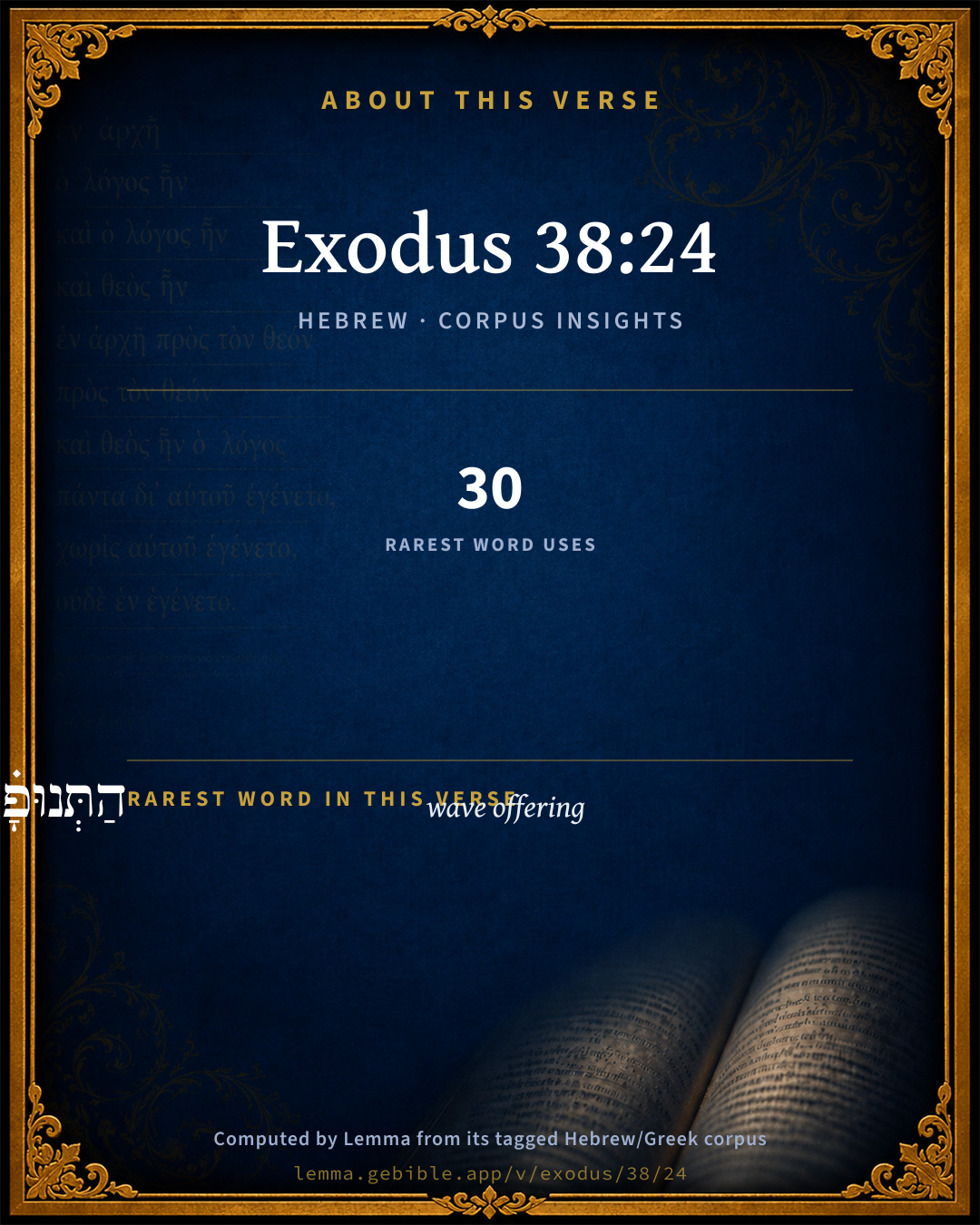
הַתְּנוּפָ֗ה wave offering H8573 occurs in 28 verses of the Hebrew Bible. Also found in:

Grammatical profile

  • 2 verbs
  • 12 nouns
  • 5 adjectives

Verb forms

  • הֶֽעָשׂוּי֙ Qal · Participle Passive
  • וַיְהִ֣י Qal · Sequential Imperfect

Repetition

Words recur within this verse — often emphatic in Hebrew:

  • כָּל all H3605 ×2
  • הַזָּהָ֗ב gold H2091 ×2
  • לַמְּלָאכָ֔ה work H4399 ×2
  • הַקֹּ֑דֶשׁ holiness H6944 ×2
  • שֶׁ֖קֶל shekel H8255 ×2

Hebrew & Septuagint length

In English translation the verse runs 36 words from the Hebrew and 52 from the Septuagint (LXX English) — the Septuagint runs noticeably longer here. See the side-by-side →

A rough comparison of the two English renderings, which tokenize alike — not a word-level alignment.

Word counts can differ between the Hebrew and the Greek without any difference in meaning — e.g. the Hebrew direct-object marker אֵת has no separate Greek word, and Greek often adds the article ὁ.

Cross-references

13

Topical passages linked to Exodus 38:24 in the Treasury of Scripture Knowledge — connected by theme and wording, ordered by reader-vote popularity; previews shown in the World English Bible.

  • Leviticus 27:25 All your valuations shall be according to the shekel of the sanctuary: twenty gerahs to the shekel.
  • Numbers 3:47 you shall take five shekels apiece for each one; after the shekel of the sanctuary you shall take them (the shekel is twenty gerahs):
  • Numbers 18:16 Those who are to be redeemed of them from a month old shall you redeem, according to your estimation, for the money of five shekels, after the shekel of the sanctuary (the same is twenty gerahs).
  • Exodus 25:2 "Speak to the children of Israel, that they take an offering for me. From everyone whose heart makes him willing you shall take my offering.
  • Exodus 29:24 You shall put all of this in Aaron's hands, and in his sons' hands, and shall wave them for a wave-offering before Yahweh.
  • Exodus 30:13–14 They shall give this, everyone who passes over to those who are numbered, half a shekel after the shekel of the sanctuary; (the shekel is twenty gerahs;) half a shekel for an offering to Yahweh.
  • Exodus 30:24 and of cassia five hundred, after the shekel of the sanctuary; and a hin of olive oil.
  • Exodus 35:22 They came, both men and women, as many as were willing-hearted, and brought brooches, ear-rings, signet-rings, and armlets, all jewels of gold; even every man who offered an offering of gold to Yahweh.
  • Leviticus 5:15 "If anyone commits a trespass, and sins unwittingly, in the holy things of Yahweh; then he shall bring his trespass offering to Yahweh, a ram without blemish from the flock, according to your estimation in silver by shekels, after the shekel of the sanctuary, for a trespass offering.
  • Leviticus 27:3 Your valuation shall be of a male from twenty years old even to sixty years old, even your valuation shall be fifty shekels of silver, after the shekel of the sanctuary.
  • 1 Chronicles 29:2–7 Now I have prepared with all my might for the house of my God the gold for the [things of] gold, and the silver for the [things of] silver, and the brass for the [things of] brass, the iron for the [things of] iron, and wood for the [things of] wood; onyx stones, and [stones] to be set, stones for inlaid work, and of various colors, and all manner of precious stones, and marble stones in abundance.
  • Haggai 2:8 The silver is mine, and the gold is mine,' says Yahweh of Hosts.
  • 1 Chronicles 22:14–16 Now, behold, in my affliction I have prepared for the house of Yahweh one hundred thousand talents of gold, and one thousand thousand talents of silver, and of brass and iron without weight; for it is in abundance: timber also and stone have I prepared; and you may add to them.

Cross-references courtesy of OpenBible.info (CC BY 4.0).

Hebrew and Greek witnesses Masoretic Hebrew ↔ Greek Septuagint

The same verse in the two great witnesses to the Old Testament, shown verse-for-verse.

Here the Septuagint runs noticeably longer than the Hebrew — LXX2012 (modern English Septuagint) 52 words vs World English Bible 36. A rough length comparison of the two English translations, not a word-level alignment — read both below.

These are two independent witnesses, not word-aligned to each other, and the Septuagint is shown in lemma (dictionary) form.

Hebrew Exodus 38:24 Masoretic · Westminster Leningrad Codex

כָּל הַזָּהָ֗ב הֶֽעָשׂוּי֙ לַמְּלָאכָ֔ה בְּכֹ֖ל מְלֶ֣אכֶת הַקֹּ֑דֶשׁ וַיְהִ֣י זְהַ֣ב הַתְּנוּפָ֗ה תֵּ֤שַׁע וְעֶשְׂרִים֙ כִּכָּ֔ר וּשְׁבַ֨ע מֵא֧וֹת וּשְׁלֹשִׁ֛ים שֶׁ֖קֶל בְּשֶׁ֥קֶל הַקֹּֽדֶשׁ

All the gold that was used for the work in all the work of the sanctuary, even the gold of the offering, was twenty-nine talents, and seven hundred thirty shekels, after the shekel of the sanctuary.

World English Bible · Public Domain

Greek LXX Exodus 38:24 Septuagint · lemma form

οὗτος ποιέω ὁ θυσιαστήριον παράθεμα ἔργον δικτυωτός κάτωθεν ὁ πυρεῖον ὑπό αὐτός ἕως ὁ ἥμισυς αὐτός καί ἐπιτίθημι αὐτός τέσσαρες δακτύλιος ἐκ ὁ τέσσαρες μέρος ὁ παράθεμα ὁ θυσιαστήριον χαλκοῦς ὁ μοχλός εὐρύς ὥστε αἴρω ὁ θυσιαστήριον ἐν αὐτός

He made an appendage for the altar of network under the grate, beneath it as far as the middle of it; and he fastened to it four brazen rings on the four parts of the appendage of the altar, wide enough for the bars, so as to bear the altar with them.

LXX2012 (modern English Septuagint) · Public Domain

On this verse, Adam Clarke's Commentary discusses the Septuagint’s reading. Read the note in Commentary ↓

Hebrew: Westminster Leningrad Codex (CC BY 4.0). Greek: Septuagint (public domain); English from LXX2012 (modern English Septuagint) (Public Domain). How the Septuagint differs from the Hebrew →

Targum (Aramaic paraphrase)

2

The Targum is the ancient Jewish Aramaic paraphrase of the Hebrew Scriptures — an interpretive translation, not the Hebrew text itself. Onkelos (literal) and Pseudo-Jonathan (expansive) render the Torah, and Jonathan the Prophets. Coverage is partial: where no permissively-licensed English translation exists for a verse, only the Aramaic is shown. This is verse-level text, not a word-by-word alignment to the Hebrew.

  1. Targum Onkelos Torah (Genesis–Deuteronomy)
    כָּל דַהֲבָא דְאִתְעֲבֵד לְעִבִידָא בְּכֹל עִבִידַת קוּדְשָׁא וַהֲוָה דְהַב אֲרָמוּתָא עֶסְרִין וּתְשַׁע כִּכְּרִין וּשְׁבַע מְאָה וּתְלָתִין סִלְעִין בְּסִלְעֵי קוּדְשָׁא:

    (no public-domain English translation for this verse)

    Targum Onkelos — Aramaic: “Onkelos Genesis” (public domain); “Onkelos Exodus” (public domain); “Onkelos Leviticus” (public domain); “Onkelos Numbers” (public domain); “Onkelos Deuteronomy” (public domain). English: “Sefaria Community Translation” (CC0 1.0 (public-domain dedication)); “J.W. Etheridge. The Targums of Onkelos and Jonathan Ben Uzziel on the Pentateuch. London: Longmans, Green, 1862” (public domain). Text via Sefaria.

  2. Targum Pseudo-Jonathan Torah (Genesis–Deuteronomy)
    כָּל דַּהֲבָא דְּאִתְעֲבֵיד לְעִיבִידְתָּא בְּכָל עִיבִידַת קוּדְשָׁא וַהֲוָה סְכוּם דְּהַב אֲרָמוּתָא עַשְרִין וּתְשַׁע קַנְטְרִין וּשְׁבַע מְאָה וּתְלָתִין סִלְעִין בְּסִלְעֵי קוּדְשָׁא דֵין הוּא דְהַב אֲרָמוּתָא דְאַרִימוּ בְּנֵי יִשְרָאֵל כָּל גְּבַר דְּאִתְרְעֵי לִבֵּיהּ לְאַפְרָשָׁא

    All the gold that was used in making the whole work of the sanctuary, and it was the amount of the gold of the oblation, (was) twenty and nine talents, and seven hundred and thirty shekels, in the shekel of the sanc­tuary. This was the gold of the oblation, which every man of the sons of Israel, whose heart was willing, had offered as a separation.

    Targum Pseudo-Jonathan — Aramaic: “Targum Jonathan on Genesis” (public domain); “Targum Jonathan on Exodus” (public domain); “Targum Jonathan on Leviticus” (public domain); “Targum Jonathan on Numbers” (public domain); “Targum Jonathan on Deuteronomy” (public domain). English: “The Targum of Jonathan ben Uzziel, trans. J. W. Etheridge, London, 1862” (public domain). Text via Sefaria.

Commentary

Notes on Exodus 38:24 from classic Christian and Jewish commentators (each source and its license shown beneath its notes). The classic Christian expositions comment on the surrounding passage and are grouped to its opening verse, so a note may address several verses; the Jewish commentaries on the Tanakh (Rashi and others) are per-verse, so they appear only where the commentator wrote on this verse.

Lemma curates 59 commentaries, every one of them public domain or Creative Commons licensed, each selected and text-cleaned for this edition rather than reprinted as found. About our sources →

Jamieson, Fausset & Brown

Robert Jamieson, A. R. Fausset & David Brown

twenty and nine talents, and seven hundred and thirty shekels--equivalent to £150,00 sterling.

Jamieson, Fausset & Brown — Commentary Critical and Explanatory on the Whole Bible (1871) — public domain (CC PDM 1.0). Text via the HelloAO Bible API.

Adam Clarke's Commentary

Verse 24. All the gold that was occupied for the work, c.] To be able to ascertain the quantum and value of the gold, silver, and brass, which were employed in the tabernacle, and its different utensils, altars, c., it will be necessary to enter into the subject in considerable detail.

In the course of my notes on this and the preceding book, I have had frequent occasion to speak of the shekel in use among the ancient Hebrews, which, following Dean Prideaux, I have always computed at 3s. English. As some value it at 2s. 6d., and others at 2s. 4d., I think it necessary to lay before the reader the learned dean's mode of computation as a proper introduction to the calculations which immediately follow.

"Among the ancients, the way of reckoning their money was by talents. So the Hebrews, so the Babylonians, and so the Romans did reckon. And of these talents they had subdivisions which were usually in minas and drachms i.e., of their talents into minas, and their minas into drachms. The Hebrews had, besides these, their shekels and half-shekels, or bekas and the Romans their denarii, which last were very nearly of the same value with the drachms of the Greeks. What was the value of a Hebrew talent appears from Ex 38:25-26, for there 603,550 persons being taxed at half a shekel a head, they must have paid in the whole 301,775 shekels; and that sum is there said to amount to one hundred talents, and 1775 shekels over: if therefore we deduct the 1775 shekels from the number 301,775, and divide the remaining sum, i.e., 300,000, by a hundred, this will prove each of those talents to contain three thousand shekels. Each of these shekels weighed about three shillings of our money; and sixty of them, Ezekiel tells us, Eze 45:12, made a mina; and therefore fifty of those minas made a talent. And as to their drachms, it appears by the Gospel of St. Matthew that it was the fourth part of a shekel, that is, nine-pence of our money. For there (Mt 17:24) the tribute money annually paid to the temple, by every Jew, (Talmud in shekalim,) which was half a shekel, is called διδραχμον (i.e., the two drachm piece;) and therefore, if half a shekel contained two drachms, a drachm must have been the quarter part of a shekel, and every shekel must have contained four of them: and so Josephus tells us it did; for he says, Antiq., lib. iii., c. 9, that a shekel contained four Attic drachms, which is not exactly to be understood according to the weight, but according to the valuation in the currency of common payments. For according to the weight, the heaviest Attic drachms did not exceed eight-pence farthing half-farthing, of our money; and a Hebrew drachm, as I have said, was nine-pence; but what the Attic drachm fell short of the Hebrew in weight might be made up in the fineness, and its ready currency in all countries, (which last the Hebrew drachm could not have,) and so might be made equivalent in common estimation among the Jews. Allowing therefore a drachm, as well Attic as Jewish, as valued in Judea, to be equivalent to nine-pence of our money, a BEKA or half-shekel will be one shilling and six-pence; a SHEKEL, three shillings; a MINA, nine pounds; and a TALENT, four hundred and fifty pounds. So it was in the time of Moses and Ezekiel; and so was it in the time of Josephus among that people, for he tells us, Antiq., lib. xiv., c. 12, that a Hebrew mina contained two LITRAS and a half, which comes exactly to nine pounds of our money: for a litra, being the same with a Roman libra, contained twelve ounces troy weight, that is, ninety-six drachms; and therefore two litras and a half must contain two hundred and forty drachms, which being estimated at nine-pence a drachm, according to the Jewish valuation, comes exactly to sixty shekels, or nine pounds of our money. And this account agrees exactly with that of Alexandria. For the Alexandrian talent contained 12,000 Attic drachms; and 12,000 Attic drachms, according to the Jewish valuation, being 12,000 of our nine-pences, they amount to 450 pounds of sterling money, which is the same in value as the Mosaic talent. But here it is to be observed, that though the Alexandrian talent amounted to 12,000 Attic drachms, yet they themselves reckoned it but at 6000 drachms, because every Alexandrian drachm contained two Attic drachms; and therefore the Septuagint version being made by the Alexandrian Jews, they there render the Hebrew word shekel, by the Greek διδραχμον, which signifies two drachms, because two Alexandrian drachms make a shekel, two of them amounting to as much as four Attic drachms. And therefore computing the Alexandrian money according to the same method in which we have computed the Jewish, it will be as follows: One drachm of Alexandria will be of our money eighteen pence; one didrachm or shekel, consisting of two drachms of Alexandria, or four of Attica, will be three shillings; one mina, consisting of sixty didrachms or shekels, will be nine pounds; and one talent, consisting of fifty minas, will be four hundred and fifty pounds, which is the talent of Moses, Ex 38:25-26: and so also is it the talent of Josephus, Antiq., lib. iii., c. 7; for he tells us that a Hebrew talent contained one hundred Greek (i.e., Attic) minas. For those fifty minas, which here make an Alexandrian talent, would be one hundred Attic minas in the like method of valuation; the Alexandrian talent containing double as much as the Attic talent, both in the whole, and also in all its parts, in whatever method both shall be equally distributed. Among the Greeks the established rule was, Jul. Pollux, Onomast., lib. x., c. 6, that one hundred drachms made a mina, and sixty minas a talent. But in some different states their drachms being different, accordingly their minas and talents were within the same proportion different also. But the money of Attica was the standard by which all the rest were valued, according as they more or less differed from it. And therefore, it being of most note, wherever any Greek historian speaks of talents, minas, or drachms, if they be simply mentioned, it is to be always understood of talents, minas, or drachms of Attica, and never of the talents, minas, or drachms of any other place, unless it be expressed. Mr. Brerewood, going by the goldsmith's weights, reckons an Attic drachm to be the same with a drachm now in use in their shops, that is, the eighth part of an ounce; and therefore lays it at the value of seven-pence halfpenny of our money, or the eighth part of a crown, which is or ought to be an ounce weight. But Dr. Bernard, going more accurately to work, lays the middle sort of Attic drachms at eight-pence farthing of our money, and the minas and talents accordingly, in the proportions above mentioned. The Babylonish talent, according to Pollux, Onomast., lib. x., c. 6, contained seven thousand of those drachms. The Roman talent (see Festus Pompeius) contained seventy-two Italic minas, which were the same with the Roman libras; and ninety-six Roman denariuses, each being of the value of seven-pence halfpenny of our money, made a Roman libra. But all the valuations I have hitherto mentioned must be understood only of silver money, and not of gold; for that was much higher. The proportion of gold to silver was among the ancients commonly as ten to one; sometimes it was raised to be as eleven to one, sometimes as twelve, and sometimes as thirteen to one. In the time of King Edward the First it was here, in England, at the value of ten to one; but it is now gotten at sixteen to one; and so I value it in all the reductions which I make in this history of ancient sums to the present value. But to make the whole of this matter the easier to the reader, I will lay all of it before him for his clear view in this following table of valuations: -

HEBREW money

£

s.

d.

A Hebrew drachm.....................

9

Two drachms made a beka or half-shekel, which was the tribute money paid by every Jew to the temple................

1

6

Two bekas made a shekel.............

3

0

Sixty shekels made a mina...........

9

0

0

Fifty minas made a talent...........

450

0

0

A talent of gold, sixteen to one....

7200

0

0

ATTIC money, according to Mr. BREREWOOD

An Attic drachm....................

7½

A hundred drachms made a mina......

3

2

6

Sixty minas made a talent..........

187

10

0

A talent of gold, sixteen to one...

3000

0

0

ATTIC money, according to Dr. BERNARD

An Attic drachm....................

8¼

A hundred drachms made a mina......

3

8

9

Sixty minas made a talent..........

206

5

0

A talent of gold, sixteen to one...

3300

0

0

BABYLONISH money, according to Mr. BREREWOOD

A Babylonish talent of silver containing seven thousand Attic drachms...........................

218

15

0

A Babylonish talent in gold, sixteen to one....................

3500

0

0

BABYLONISH money, according to Dr. BERNARD

A Babylonish talent in silver......

£240

12

6

A Babylonish talent in gold, sixteen to one...................

3850

0

0

ALEXANDRIAN money

£

s.

d.

A drachm of Alexandria, containing two Attic drachms, as valued by the Jews...........................

1

6

A didrachm of Alexandria, containing two Alexandrian drachms, which was a Hebrew shekel......................

3

0

Sixty didrachms or Hebrew shekels made a mina............

9

0

0

Fifty minas made a talent..........

450

0

0

A talent of gold, sixteen to one...

7200

0

0

ROMAN money

Four sesterciuses made a Roman denarius.....................

7½

Ninety-six Roman denariuses made an Italic mina, which was the same with a Roman libra..........

3

0

0

Seventy-two Roman libras made a talent........................

216

0

0

See the Old and New Testament connected, c. Vol. 1., preface, pp. xx-xxvii.

There were twenty-nine talents seven hundred and thirty shekels of GOLD one hundred talents one thousand seven hundred and seventy-five shekels of SILVER; and seventy talents two thousand four hundred shekels of BRASS.

If with Dean Prideaux we estimate the value of the silver shekel at three shillings English, we shall obtain the weight of the shekel by making use of the following proportion. As sixty-two shillings, the value of a pound weight of silver as settled by the British laws, is to two hundred and forty, the number of penny-weights in a pound troy, so is three shillings, the value of a shekel of silver, to 11 dwts. 14 22/31 grains, the weight of the shekel required.

In the next place, to find the value of a shekel of gold we must make use of the proportion following: As one ounce troy is to 3£. 17s. 10½d., the legal value of an ounce of gold, so is 11 dwts. 14 22/31 grains, the weight of the shekel as found by the last proportion, to 2£. 5s. 2½ 42/93d., the value of the shekel of gold required. From this datum we shall soon be able to ascertain the value of all the gold employed in the work of this holy place, by the following arithmetical process: Reduce 2£. 5s. 2½ 42/93d. to the lowest term mentioned, which is 201,852 ninety-third parts of a farthing. Multiply this last number by 3000, the number of shekels in a talent, and the product by 29, the number of talents; and add in 730 times 201,852, on account of the 730 shekels which were above the 29 talents employed in the work, and we shall have for the last product 17,708,475,960, which, divided successively by 93, 4, 12, and 20, will give 198,347£. 12s. 6d. for the total value of the gold employed in the tabernacle, &c.

The value of the silver contributed by 603,550 Israelites, at half a shekel or eighteen pence per man, may be found by an easy arithmetical calculation to amount to 45,266£. 5s.

The value of the brass at 1s. per pound will amount to 513£. 17s.

The GOLD of the holy place weighed 4245 pounds.

The SILVER of the tabernacle 14,602 pounds.

The BRASS 10,277 pounds troy weight,

The total value of all the gold, silver, and brass of the tabernacle will consequently amount to 244,127£. 14s. 6d. And the total weight of all these three metals amounts to 29,124 pounds troy, which, reduced to avoirdupois weight, is nearly ten tons and a half. When all this is considered, besides the quantity of gold which was employed in the golden calf, and which was all destroyed, it is no wonder that the sacred text should say the Hebrews spoiled the Egyptians, particularly as in those early times the precious metals were probably not very plentiful in Egypt.

Adam Clarke's Commentary on the Bible (1810–1826) — public domain. Text from a community e-Sword/MySword module.

Ellicott's Commentary for English Readers

(24) All the gold that was occupied for the Work.—Rather, that was made use of for the work.

The gold of the offering, was twenty and nine talents.—The gold talent is estimated by Poole as = 10,000 shekels, and the gold shekel as worth about £1 2s. of our money. In this case the gold employed in the Tabernacle would have been worth nearly £320,000. Some, however, reduce the estimate to £175,000 (Cook), and others to £132,000 (Thenius). In any case the amount was remarkable, and indicated at once the liberal spirit which animated the people and the general feeling that a lavish expenditure was required by the occasion. There is no difficulty in supposing that the Israelites possessed at the time gold to the (highest) value estimated, since they had carried with them out of Egypt, besides their ancestral wealth, a vast amount of gold and silver ornaments, freely given to them by the Egyptians (Exo_3:22; Exo_12:35-36).

A Bible Commentary for English Readers, edited by Charles John Ellicott (1878–1897) — public domain. Text from a community e-Sword module.

The Cambridge Bible for Schools and Colleges

gen. ed. J. J. S. Perowne

24. The gold. This amounted to 29 talents, and 730 shekels, or (as the talent contained Exo 3000 shekels) 87,730 shekels, i.e. if the ‘sacred’ shekel (p. 333) weighed 224 grs., c. 40,940 oz. troy,—which, even at the present value of gold, would be worth nearly £ 160,000.

the offering] properly, the wave-offering; see on Exo_35:22. So v. 29.

the sacred shekel] See on Exo_30:13; and cf. DB. iv. 906a.

The Cambridge Bible for Schools and Colleges (gen. ed. J. J. S. Perowne; Cambridge University Press, 1878–1918) — public domain. Text from a community e-Sword module.

John Gill's Exposition

A bekah for every man, that is, half a shekel, after the shekel of the sanctuary,.... A half shekel was called a "bekah", from "bakah", to divide; because it was a shekel divided into two parts:

for everyone that went to be numbered, from twenty years and upwards; in order to give a ransom, and make an atonement for their souls, as was ordered Exo 30:12.

for six hundred thousand and three thousand and five hundred and fifty men; so that from the time of their coming out of Egypt, which was now about six months ago, there was an increase of 3550 of the above age; see Exo 12:37.

John Gill's Exposition of the Whole Bible (1746–1763) — public domain (CC PDM 1.0). Text via the HelloAO Bible API.

Albert Barnes' Notes on the Bible

Of the holy place - Rather, of the sanctuary. The gold was employed not only in the holy place, but in the most holy place and in the entrance to the tent Exo 36:38.

The gold of the offering - The gold of the wave offering.

Talents ... the shekel of the sanctuary - The shekel was the common standard of weight and value with the Hebrews: and is probably to be estimated at 220 English grains (just over half an ounce avoirdupois) and its value in silver as 2s. 7d. The shekel of the sanctuary (or, the holy shekel) would seem to denote no more than an exact shekel, “after the king’s weight” 2Sa 14:26, “current money with the merchant” Gen 23:16.

In the reign of Joash, a collection similar to that here mentioned, apparently at the same rate of capitation, was made for the repairs of the temple 2Ch 24:9. The tax of later times, called didrachma, στατήρ statēr, Mat 17:27, was not, like this and that of Joash, a collection for a special occasion, but a yearly tax, for the support of the temple, of a whole shekel. See also Exo 30:13.

The talent contained 3,000 shekels, as may be gathered from Exo 38:25-26. According to the computation here adopted, the Hebrew talent was 94 2/7 lbs. avoirdupois. The Greek (Aeginetan) talent, from which the Septuagint and most succeeding versions have taken the name “talent,” was 82 1/4 lbs. The original Hebrew word, ככר kı̂kār, would denote a circular mass, and nearly the same word, kerker, was in use among the Egyptians for a mass of metal cast in the form of a massive ring with its weight stamped upon it.

Albert Barnes' Notes on the Bible (1834–1885) — public domain. Text from a community e-Sword/MySword module.

Haydock's Catholic Bible Commentary

Gifts, voluntarily. The following verse mentions what arose from the tax of half a sicle per head, chap xxx. 13.

George Leo Haydock (1774–1849), Haydock's Catholic Family Bible and Commentary, 1859 edition — public domain. Excludes Psalms (Douay-Rheims chapter numbering differs from Protestant) and Deuterocanonical books (Catholic canon only).

Matthew Poole's English Annotations

Every talent contained three thousand shekels. See Gen 23:15; Exo 30:13. It is not said that all this gold and following silver were used about the building of the tabernacle, for the people brought much more than enough, Exo 36:5. And these remains, it is probable, were put into the sacred treasury, to be used as occasion should require.

Matthew Poole's English Annotations on the Holy Bible (1683–1685) — public domain. Text from a community e-Sword/MySword module.

The Pulpit Commentary

The gold. The value of the gold has been estimated by Canon Cook at 13s. 0d. of our money; by Thenius at 877, 300 Prussian thalers, or about It was certainly under De Wette and others have argued that the possession of so large a sum in gold at this time by the Hebrew nation is inconceivable. But most critics are of a different opinion. Gold was very abundant in Egypt at the period, being imported from Ethiopia, a rich gold-producing country (Heb 3:23; Diod. Sic. 3:11), as well as taken in tribute from the nations of Asia. The wealth of Rhampsinitus (Rameses III), a little later than the exodus, was enormous (Heb 2:121; Rawlinson, History of Egypt, vol. 2. pp. 368, 378). According to the preceding narrative (Exo_12:35, Exo_12:36) much of the wealth of Egypt had, at the moment of their quitting the country, passed from the Egyptians to the Hebrews. If they numbered two millions of souls, their gold ornaments are likely to have been worth very much more than of our money. On the shekel of the sanctuary, see the comment upon Exo_30:13.

HOMILETICS.

Vers. 24-31. Great wealth worthily employed.

I THE AMOUNT EXPENDED BY THE ISRAELITES WAS GREAT ABSOLUTELY. Although the materials contributed for the construction of the tabernacle are quite within the estimate which would reasonably be formed of the wealth of the Israelites from the general tenor of the narrative, yet they certainly reach altogether to such an amount of value as would constitute a very serious call on the resources of such a people. The worth of the metals alone was not far short of a quarter of a million of our money. (Gold, silver, bronze (say) total, The precious stones, the spices, the wood-work, the raw material for the cloths, the dyed rams" skins and seals" skins, have to be added, and would raise the sum total to at least This was contributed by a population of about two millions; which may be regarded as equivalent to 10s. a family, or half-a-crown a head. Now the entire taxation for imperial purposes of each British subject is about a head, of which the amount paid in direct taxation is not more than 5s. a head. So that the Israelite of the 13th or 14th century, B.C., paid at one time for church purposes of his own free will, half as much as the British subject of the present day pays directly for State purposes in the whole course of the year. Thus the amount was great absolutely, and showed a noble spirit in those who contributed.

II THE AMOUNT EXPENDED WAS ALSO GREAT RELATIVELY TO THE PURPOSE OF THE EXPENDITURE. What was required was a structure sixty feet long by thirty, with a skirting for a court or precinct 150 feet long by seventy-five. The main structure, or tabernacle, would be about the size of a small college chapel. The precinct would be smaller than most churchyards. Yet upon these two objects, without making any estimate for labour, a quarter of a million of money was spent. On the first blush, one asks, how was it possible for so enormous an outlay to be made? The answer is, by the lavish use of the precious metals, especially gold. That the structure might be rich, splendid, magnificent, gold and silver were lavished upon it, both externally and internally scarcely any wood was seen nothing caught the eye but costly fabrics of rich colour, and masses of silver or gold. A warm, harmonious, rich result was no doubt produced; and nomadic Israel, unable to compete with the settled nations in the size and grandeur of its "holy place," erected for itself a sanctuary, which in its own way was unequalled and unique.

III THE OBJECT OF THE EXPENDITURE WAS A WORTHY ONE. If a people have temples at all, men will always judge their religious views, more or less, by them. If Israel was to have a place of worship and it may be doubted whether any race of men will ever be able to do without one it would certainly be subjected to rough criticism and comparison. The Egyptian temples were magnificent of vast size, of the most solid construction, of handsome material, elaborately painted and adorned; they delighted those who worshipped in them, and challenged the admiration of extraneous beholders. Israel, in the desert, could not possibly vie with these. But it might construct a work perfect in its kind, of a different class, which would compensate for smallness of size by richness of material and artistic elaboration. It could show in this way its sense that men should give to God of their best. It could secure an extraordinary degree of beauty, finish, and elegance. The nations among which the tabernacle passed even those who heard an account of it must have been impressed with the feeling that here was a people which thoroughly believed in its God; which thought nothing too good for him; which was ready for his sake to submit to much self-sacrifice. And the people itself must also have been impressed by its own work. No such apostasy as the worship of the calf ever took place after the tabernacle had been constructed. It was no longer faith, but sight, which told them, that "God was in the midst of them." The sense of this begat a courage and a confidence, which supported the nation under many trials, and many temptations. They had never to regret the outlay which they had made upon their "tent-temple.

Application. There has been much church-building in modern times, but in no instance such a lavish outlay as that here held up to our imitation. Germany, indeed, has completed the Dom of Cologne; but not much of the money was subscribed; for the most part, it came out of the general taxation of the country. Glasgow, Edinburgh, Calcutta, have raised cathedrals; but the cost has not been very considerable. The spirit of munificence has been shown rather by individuals than by any nation; and, in England at any rate, the nineteenth century will not, it is to be feared, be signalised among others by the completion of any really first-rate ecclesiastical edifice. New dioceses are formed; but new cathedrals, worthy of taking rank with the masterpieces of former times, do not arise. The prevailing practice is to convert a parish church into a cathedral. May it not be hoped that ere long some new diocese, where wealth abounds, will devote to its cathedral some such amount as the Israelites in the desert contributed towards their tabernacle, and raise an edifice which will prove to the world that Post-Reformation England does not yield to the England of the Middle Ages in the virtue of Christian munificence?

The Pulpit Commentary (1880–1919), ed. H.D.M. Spence-Jones & Joseph S. Exell — public domain. Text from a community e-Sword module.

unfoldingWord translationNotes

Door43 World Missions Community

All the gold that was used for the project

This can be stated in active form. AT: "All the gold that the people used for the project" (See: Active or Passive)

twenty-nine talents ... one hundred talents

"29 talents ... 100 talents." A talent is about 33 kilograms. AT: "29 talents ... 100 talents" or "about 960 kilograms ... about 330 kilograms" (See: Numbers and Biblical Weight)

730 shekels ... 1,775 shekels

"Seven hundred and thirty shekels ... one thousand seven hundred and seventy-five shekels." A shekel is 11 grams. (See: Numbers and Biblical Weight)

measured by the standard of the sanctuary shekel

There were evidently shekels of more than one weight at the time. This specified which one was to be used. See how you translated this in Exodus 30:13. (See: Biblical Weight)

The silver given by the community

This can be stated in active form. AT: "The silver which the community gave" (See: Active or Passive)

one beka

A beka is 1/2 a shekel. (See: Biblical Weight)

half a shekel

A shekel is 11 grams. AT: "1/2 a shekel" or "five and a half grams" or "5 1/2 grams" (See: Biblical Weight and Fractions)

This figure was reached on the basis of every person who was counted in the census

Every man who was 20 years old or older was included in the census and was required to give half a shekel.

twenty years old

"20 years old" (See: Numbers)

translationWords

gold

works

holy place

sacrifice

silver

census

year

unfoldingWord translationNotes — © Distant Shores Media and the Door43 World Missions Community, licensed CC BY-SA 4.0. Source: git.door43.org/Door43/en_tn.

Rashi

Rabbi Shlomo Yitzchaki (Rashi)

ככר [TWENTY NINE] TALENTS — A common kikkar contains sixty common manehs, and the maneh of the Sanctuary (that used for purposes connected with the Temple) was double the common maneh. Consequently the kikkar here mentioned was 120 common manehs. Now a common maneh contained 25 Sela’im (or shekels), and the kikkar of the Sanctuary equals three thousand shekels. That is why Scripture counts (mentions the number of) all the shekels that are fewer than 3,000 as a separate item, because these do not together amount to a kikkar (cf. Bekhorot 5a).

Rashi on the Tanakh — English translations: “The Judaica Press complete Tanach with Rashi, translated by A. J. Rosenberg” (CC BY 4.0); “Pentateuch with Rashi's commentary by M. Rosenbaum and A.M. Silbermann, 1929-1934” (public domain); “The Metsudah Tanach series, Lakewood, N.J” (CC BY 4.0); and “The Book of Joshua, Metsudah Publications, 1997” (CC BY 4.0). Text via Sefaria.

Sforno

Rabbi Ovadia Sforno

All the gold. The amount of gold, silver and copper mentioned here is far less than the amount mentioned in the book of Melachim in connection with the First Holy Temple, which still does not compare with the amount used in Herod’s Temple. Nevertheless, Hashem’s glory appeared on a more constant basis in the Tabernacle than in the First Temple and it did not appear at all in the Second Temple. This demonstrates that it is not wealth and grandeur that cause the Shechinah to dwell on earth but righteous deeds.

Sforno on the Tanakh — English translation: “Yalkut, Sifsei Chachomim Chumash, Metsudah Publications, 2009” (CC BY 4.0). Text via Sefaria.

Lesson kit

Teaching starters — assembled from the data on this page, not authored interpretation. Every prompt links to the verse data it draws on. Edit before teaching.

Exodus, in the Pentateuch, opens this verse with 19 words (14 distinct Hebrew lemmas). Its most distinctive word is tᵉnûwphâh (“wave offering”). The Greek Septuagint runs longer here. A historical commentator’s framing appears above. Read the whole chapter for the surrounding context.

Discussion questions

  1. What does “wave offering” (tᵉnûwphâh) contribute to the verse as a whole?
  2. How does Exodus 29:24, which shares the word «wave offering», read alongside this verse?
  3. What does the repetition of “all” (2× in this one verse) do in this verse?
  4. The Septuagint runs longer here than the Hebrew. What might account for the difference?
  5. The translations on this page render this verse differently — a whole-verse word diff, not a word-by-word alignment. What might account for the different wordings?
  6. «הֶֽעָשׂוּי֙» is a Qal Participle Passive verb. How does that grammatical form shape the action described?
  7. Compare how Jamieson, Fausset & Brown and Adam Clarke's Commentary read this verse. Where do they agree or differ?

Things to notice

Reading settings

Reading text

Shown beneath each verse's original-language words.

Old Testament
Old Testament edition

Read the OT as the Masoretic Hebrew (MT) or the Greek Septuagint (LXX).

English shown for the Greek Septuagint (in the Hebrew ↔ Greek comparison).

Comparing translations? Open the Compare panel on any verse page to stack up to four side by side.