
Numbers 31:19

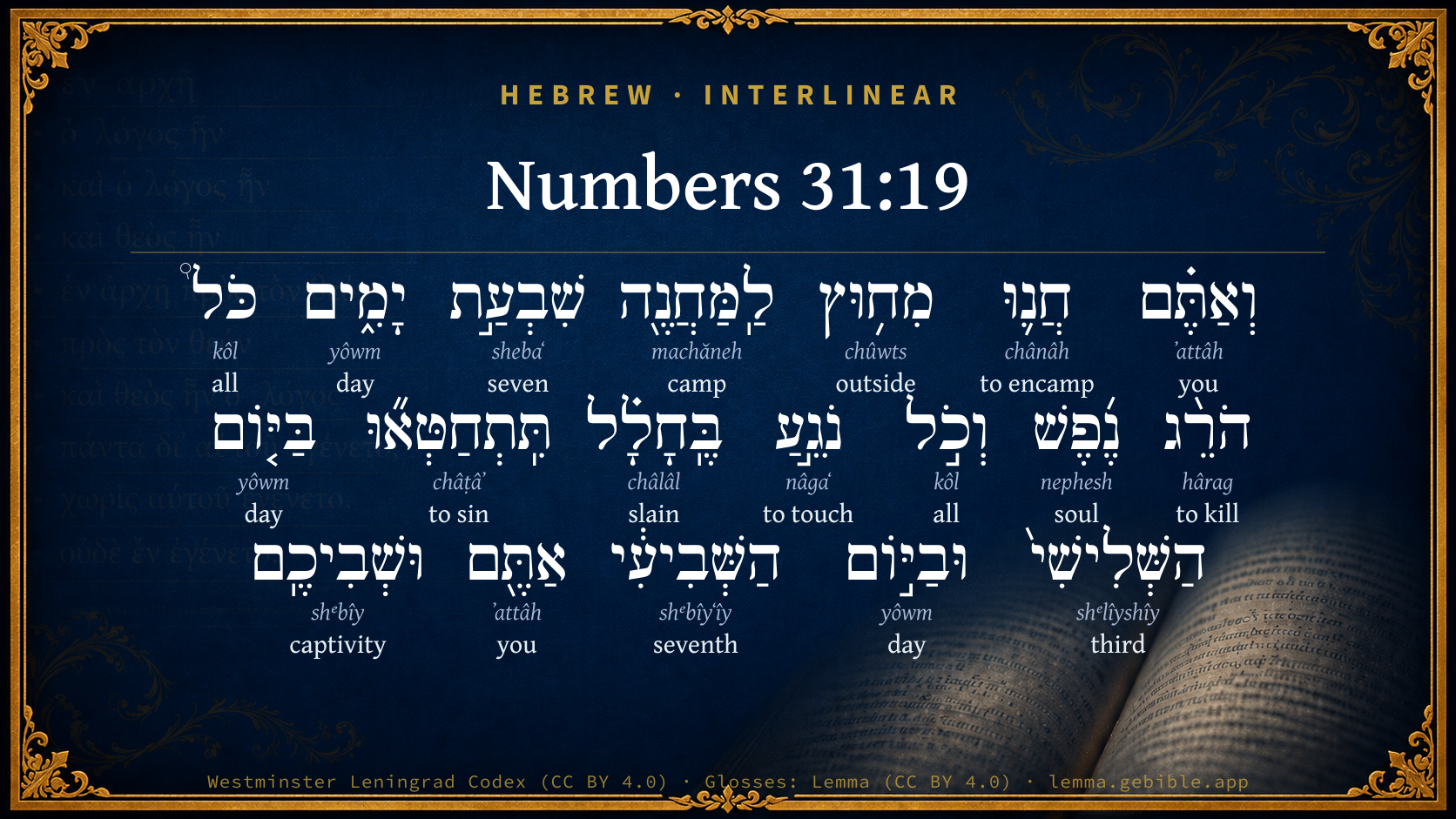
Hebrew (Westminster Leningrad Codex) Numbers 31:19 appears in the Hebrew Old Testament. The text above is from the Westminster Leningrad Codex. Each word links to its Strong’s number, a concise gloss, and parsing drawn from the Open Scriptures Hebrew Bible morphology. Click any word for its full Brown-Driver-Briggs (BDB) entry.
Download image
Cite this verse

Numbers 31:19 (World English Bible). Public Domain. Lemma interlinear Bible study tool, https://lemma.gebible.app/v/numbers/31/19.

Show BibTeX & RIS
BibTeX
RIS
English Translation
Encamp you outside of the camp seven days: whoever has killed any person, and whoever has touched any slain, purify yourselves on the third day and on the seventh day, you and your captives.
World English Bible · Public Domain
Download a study sheet

One document with this verse’s original text, its word-by-word gloss line, the meaning frame, cross-references with their text, attributed commentary, and full source and license credits — printable, and it pastes into notes with its structure intact.

This verse Autodidact and up

Study sheet (.html) Plain text (.txt)

A passage Seminary Student

Up to 50 verses in one chapter. A passage sheet keeps up to 6 commentary sources and 12 cross-references per verse, in the order this page ranks them, and says so on the sheet whenever that leaves anything out. Ask for a single verse and you get the Autodidact verse sheet above.

Everything on this page stays free to read, with no account — the sheet is a download of what is already on screen, not access to it.

Want to remove ads? Support Godless Engineer
Compare translations 3

The same verse in 3 English versions, stacked beneath the original-language interlinear above. Click any original word for its lexicon entry.

Each is an independent rendering of the whole verse — the interlinear is not word-aligned to these translations.

Highlighted words mark where these versions differ — a whole-verse word diff, not a word-by-word alignment.

  • World English Bible Public Domain
    Encamp you outside of the camp seven days: whoever has killed any person, and whoever has touched any slain, purify yourselves on the third day and on the seventh day, you and your captives.
  • King James Version Public Domain
    And do ye abide without the camp seven days: whosoever hath killed any person, and whosoever hath touched any slain, purify both yourselves and your captives on the third day, and on the seventh day.
  • unfoldingWord Literal Text CC BY-SA 4.0
    And you, camp outside of the camp seven days, all who have slain a person and all who have touched a pierced one. Purify yourselves on the third day and on the seventh day, you and your captives,

unfoldingWord Literal Text — © unfoldingWord, licensed CC BY-SA 4.0. Word-aligned USFM3 via Door43 (git.door43.org/unfoldingWord/en_ult).

Versions to compare (up to 4)

3 of 4 selected

Show all 18 translations

Every available English version of this verse, each an independent rendering of the whole verse.

  • World English Bible Public Domain
    Encamp you outside of the camp seven days: whoever has killed any person, and whoever has touched any slain, purify yourselves on the third day and on the seventh day, you and your captives.
  • Berean Standard Bible Public Domain
    All of you who have killed a person or touched the dead are to remain outside the camp for seven days. On the third day and the seventh day you are to purify both yourselves and your captives.
  • Majority Standard Bible Public Domain
    All of you who have killed a person or touched the dead are to remain outside the camp for seven days. On the third day and the seventh day you are to purify both yourselves and your captives.
  • King James Version Public Domain
    And do ye abide without the camp seven days: whosoever hath killed any person, and whosoever hath touched any slain, purify both yourselves and your captives on the third day, and on the seventh day.
  • American Standard Version (1901) Public Domain
    And encamp ye without the camp seven days: whosoever hath killed any person, and whosoever hath touched any slain, purify yourselves on the third day and on the seventh day, ye and your captives.
  • Revised Version (1885) Public Domain
    And encamp ye without the camp seven days: whosoever hath killed any person, and whosoever hath touched any slain, purify yourselves on the third day and on the seventh day, ye and your captives.
  • Geneva Bible (1599) Public Domain
    And ye shall remaine without the host seuen dayes, all that haue killed any person, and all that haue touched any dead, and purifie both your selues and your prisoners the third day and the seuenth.
  • Douay-Rheims (1899) Public Domain
    And stay without the camp seven days. He that hath killed a man, or touched one that is killed, shall be purified the third day and the seventh day.
  • Young's Literal Translation Public Domain
    `And ye, encamp ye at the outside of the camp seven days -- any who hath slain a person, and any who hath come against a pierced one, ye cleanse yourselves on the third day, and on the seventh day -- ye and your captives;
  • Literal Standard Version CC BY-SA 4.0
    And you, encamp at the outside of the camp [for] seven days; any who has slain a person, and any who has come against a pierced one, cleanse yourselves on the third day and on the seventh day—you and your captives;
  • Unlocked Literal Bible CC BY-SA 4.0
    You must camp outside the camp of Israel for seven days. All of you who have killed anyone and or have touched any dead person—you must purify yourselves on the third day and on the seventh day—you and your prisoners.
  • unfoldingWord Literal Text CC BY-SA 4.0
    And you, camp outside of the camp seven days, all who have slain a person and all who have touched a pierced one. Purify yourselves on the third day and on the seventh day, you and your captives,
  • Darby Bible Public Domain
    And encamp outside the camp seven days; whoever hath killed a person, and whoever hath touched any slain; ye shall purify yourselves on the third day, and on the seventh day, you and your captives.
  • World Messianic Bible Public Domain
    “Encamp outside of the camp for seven days. Whoever has killed any person, and whoever has touched any slain, purify yourselves on the third day and on the seventh day, you and your captives.
  • Webster's Bible Public Domain
    And do ye abide without the camp seven days: whoever hath killed any person, and whoever hath touched any slain, purify both yourselves and your captives on the third day, and on the seventh day.
  • Free Bible Version CC BY-SA 4.0
    All those of you who killed someone or touched a dead body must stay outside the camp for seven days. Purify yourselves and your prisoners on the third day and the seventh day.
  • Bible in Basic English Public Domain
    You yourselves will have to keep outside the tent-circle for seven days, anyone of you who has put any person to death or come near a dead body; and on the third day and on the seventh day make yourselves and your prisoners clean.
  • JPS Tanakh (1917) Public Domain
    And encamp ye without the camp seven days; whosoever hath killed any person, and whosoever hath touched any slain, purify yourselves on the third day and on the seventh day, ye and your captives.

Literal Standard Version (2020), Covenant Press — licensed CC BY-SA 4.0. Text via the HelloAO Bible API (eBible.org). Unlocked Literal Bible (unfoldingWord) — licensed CC BY-SA 4.0. Text via the HelloAO Bible API (eBible.org). unfoldingWord Literal Text — © unfoldingWord, licensed CC BY-SA 4.0. Word-aligned USFM3 via Door43 (git.door43.org/unfoldingWord/en_ult). Free Bible Version, Dr. Jonathan Gallagher — licensed CC BY-SA 4.0. Text via the HelloAO Bible API (eBible.org).

Word by word

More ways to search: Search by grammar → Find every occurrence → Compare this word →

Practice this passage: Drill this verse → Learn its vocabulary →

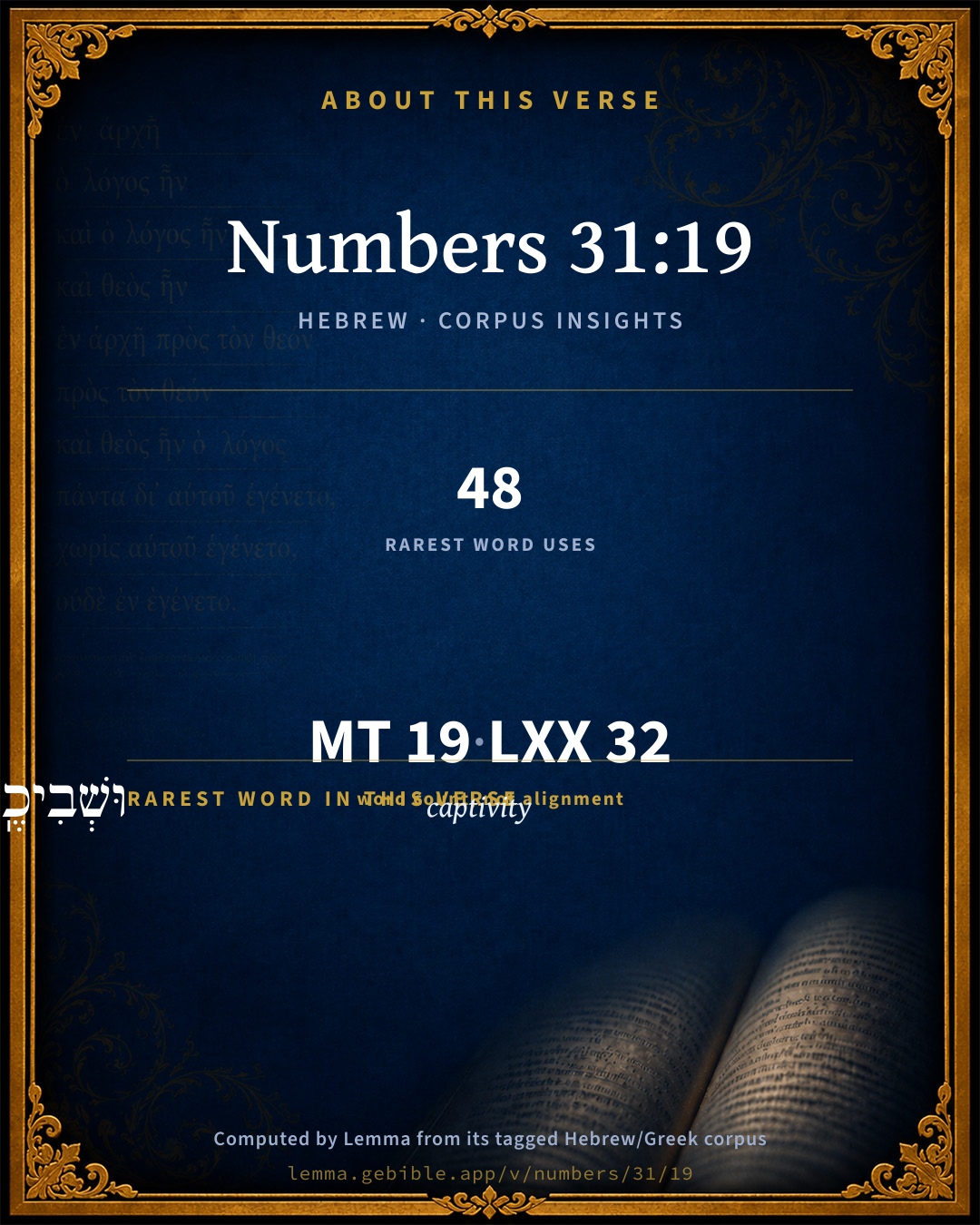
וּשְׁבִיכֶֽם
shᵉbîy
H7628
“and · captivity · your”
Conjunction + Noun, Common, Both, Singular, Construct + Suffix, Personal, 2nd Person, Masculine, Plural
Part of Speech
Conjunction + Noun
Type
Common
Gender
Both
Number
Singular
State
Construct
Full BDB Definition

Origin: from H7618

TWOT: 2311a

captivity, captives (noun masculine) - (state of) captivity - (act of) capture - captives - captive (noun feminine)
  1. וְאַתֶּ֗ם ʼattâh H859 “and · you” Conjunction + Pronoun, Personal, 2nd Person, Masculine, Plural
  2. חֲנ֛וּ chânâh H2583 “encamp” Verb, Qal, Imperative, 2nd Person, Masculine, Plural
  3. מִח֥וּץ chûwts H2351 “from · outside” Preposition + Noun, Common, Masculine, Singular, Absolute
  4. לַֽמַּחֲנֶ֖ה machăneh H4264 “to/for the · camp” Preposition, Determined + Noun, Common, Both, Singular, Absolute
  5. שִׁבְעַ֣ת shebaʻ H7651 “seven” Adjective, Cardinal number, Masculine, Singular, Construct
  6. יָמִ֑ים yôwm H3117 “days” Noun, Common, Masculine, Plural, Absolute
  7. כֹּל֩ kôl H3605 “all” Noun, Common, Masculine, Singular, Absolute
  8. הֹרֵ֨ג hârag H2026 “killing” Verb, Qal, Participle Active, Masculine, Singular, Absolute
  9. נֶ֜פֶשׁ nephesh H5315 “soul” Noun, Common, Both, Singular, Absolute
  10. וְכֹ֣ל kôl H3605 “and · all” Conjunction + Noun, Common, Masculine, Singular, Absolute
  11. נֹגֵ֣עַ nâgaʻ H5060 “touching” Verb, Qal, Participle Active, Masculine, Singular, Absolute
  12. בֶּֽחָלָ֗ל châlâl H2491 “in/at the · slain” Preposition, Determined + Adjective, Adjective, Masculine, Singular, Absolute
  13. תִּֽתְחַטְּא֞וּ châṭâʼ H2398 “to sin” Verb, Hithpael, Imperfect, 2nd Person, Masculine, Plural
  14. בַּיּ֤וֹם yôwm H3117 “in/at the · day” Preposition, Determined + Noun, Common, Masculine, Singular, Absolute
  15. הַשְּׁלִישִׁי֙ shᵉlîyshîy H7992 “the · third” Particle, Definite Article + Adjective, Ordinal number, Masculine, Singular, Absolute
  16. וּבַיּ֣וֹם yôwm H3117 “and · in/at the · day” Conjunction + Preposition, Determined + Noun, Common, Masculine, Singular, Absolute
  17. הַשְּׁבִיעִ֔י shᵉbîyʻîy H7637 “the · seventh” Particle, Definite Article + Adjective, Ordinal number, Masculine, Singular, Absolute
  18. אַתֶּ֖ם ʼattâh H859 “you” Pronoun, Personal, 2nd Person, Masculine, Plural

About this verse

These counts appear in no published source. They are computed here, from the morphology-tagged text and Lemma’s own curated glosses. What Lemma adds →

19
words
15
distinct lemmas
Pentateuch
section

Shared distinctive vocabulary

וּשְׁבִיכֶֽם captivity H7628 occurs in 46 verses of the Hebrew Bible. Also found in:

Grammatical profile

  • 4 verbs
  • 9 nouns
  • 4 adjectives
  • 2 pronouns

Verb forms

  • חֲנ֛וּ Qal · Imperative
  • הֹרֵ֨ג Qal · Participle Active
  • נֹגֵ֣עַ Qal · Participle Active
  • תִּֽתְחַטְּא֞וּ Hithpael · Imperfect

Repetition

Words recur within this verse — often emphatic in Hebrew:

  • יָמִ֑ים day H3117 ×3
  • כֹּל֩ all H3605 ×2
  • וְאַתֶּ֗ם you H859 ×2

Hebrew & Septuagint length

In English translation the verse runs 34 words from the Hebrew and 40 from the Septuagint (LXX English) — closely comparable.

A rough comparison of the two English renderings, which tokenize alike — not a word-level alignment.

Word counts can differ between the Hebrew and the Greek without any difference in meaning — e.g. the Hebrew direct-object marker אֵת has no separate Greek word, and Greek often adds the article ὁ.

In the original languages it is 19 Hebrew tokens and 32 Greek tokens — but the two are counted differently (Hebrew bundles its prefixes and suffixes into one token; the Greek is in lemma form), so that isn’t a like-for-like length.

Cross-references

3

Topical passages linked to Numbers 31:19 in the Treasury of Scripture Knowledge — connected by theme and wording, ordered by reader-vote popularity; previews shown in the World English Bible.

  • Numbers 5:2 "Command the children of Israel that they put out of the camp every leper, and everyone who has an issue, and whoever is unclean by the dead.
  • Numbers 19:11–22 He who touches the dead body of any man shall be unclean seven days:
  • 1 Chronicles 22:8 But the word of Yahweh came to me, saying, You have shed blood abundantly, and have made great wars: you shall not build a house to my name, because you have shed much blood on the earth in my sight.

Cross-references courtesy of OpenBible.info (CC BY 4.0).

Hebrew and Greek witnesses Masoretic Hebrew ↔ Greek Septuagint

The same verse in the two great witnesses to the Old Testament, shown verse-for-verse.

These are two independent witnesses, not word-aligned to each other, and the Septuagint is shown in lemma (dictionary) form.

Hebrew Numbers 31:19 Masoretic · Westminster Leningrad Codex

וְאַתֶּ֗ם חֲנ֛וּ מִח֥וּץ לַֽמַּחֲנֶ֖ה שִׁבְעַ֣ת יָמִ֑ים כֹּל֩ הֹרֵ֨ג נֶ֜פֶשׁ וְכֹ֣ל נֹגֵ֣עַ בֶּֽחָלָ֗ל תִּֽתְחַטְּא֞וּ בַּיּ֤וֹם הַשְּׁלִישִׁי֙ וּבַיּ֣וֹם הַשְּׁבִיעִ֔י אַתֶּ֖ם וּשְׁבִיכֶֽם

Encamp you outside of the camp seven days: whoever has killed any person, and whoever has touched any slain, purify yourselves on the third day and on the seventh day, you and your captives.

World English Bible · Public Domain

Greek LXX Numbers 31:19 Septuagint · lemma form

καί σύ παρα ἐνβάλλω ἔξω ὁ παρεμβολή ἑπτά ἡμέρα πᾶς ὁ ἀνααἱρέω καί ὁ ἅπτομαι ὁ τιτρώσκω ἁγνίζω ὁ ἡμέρα ὁ τρίτος καί ὁ ἡμέρα ὁ ἕβδομος σύ καί ὁ αἰχμαλωσία σύ

And you⌃ shall encamp outside the great camp seven days; every one who has slain and who touches a dead body, shall be purified on the third day, and you⌃ and your captivity shall purify yourselves on the seventh day.

LXX2012 (modern English Septuagint) · Public Domain

Hebrew: Westminster Leningrad Codex (CC BY 4.0). Greek: Septuagint (public domain); English from LXX2012 (modern English Septuagint) (Public Domain). How the Septuagint differs from the Hebrew →

Targum (Aramaic paraphrase)

2

The Targum is the ancient Jewish Aramaic paraphrase of the Hebrew Scriptures — an interpretive translation, not the Hebrew text itself. Onkelos (literal) and Pseudo-Jonathan (expansive) render the Torah, and Jonathan the Prophets. Coverage is partial: where no permissively-licensed English translation exists for a verse, only the Aramaic is shown. This is verse-level text, not a word-by-word alignment to the Hebrew.

  1. Targum Onkelos Torah (Genesis–Deuteronomy)
    וְאַתּוּן שְׁרוֹ מִבָּרָא לְמַשְׁרִיתָא שַׁבְעָא יוֹמִין כָּל דִי קְטַל נַפְשָׁא וְכֹל דִי קְרַב בְּקָטִילָא תַּדוּן עֲלוֹהִי בְּיוֹמָא תְלִיתָאָה וּבְיוֹמָא שְׁבִיעָאָה אַתּוּן וּשְׁבִיכוֹן

    (no public-domain English translation for this verse)

    Targum Onkelos — Aramaic: “Onkelos Genesis” (public domain); “Onkelos Exodus” (public domain); “Onkelos Leviticus” (public domain); “Onkelos Numbers” (public domain); “Onkelos Deuteronomy” (public domain). English: “Sefaria Community Translation” (CC0 1.0 (public-domain dedication)); “J.W. Etheridge. The Targums of Onkelos and Jonathan Ben Uzziel on the Pentateuch. London: Longmans, Green, 1862” (public domain). Text via Sefaria.

  2. Targum Pseudo-Jonathan Torah (Genesis–Deuteronomy)
    וְאַתּוּן שְׁרוּ לְמִבָּרָא לְמַשְׁרִיתָא שׁוּבְעָא יוֹמִין כָּל דְקָטִיל בַּר נַשׁ וְכָל דְיִקְרַב בִּקְטִילָא תַּדוּן עֲלוֹי בְּיוֹמָא תְלִיתָאָה וּבְיוֹמָא שְׁבִיעָאָה אַתּוּן וּשְׁבִיכוֹן

    But as for you, abide without the camp seven days; whoever hath slain a man, or touched the dead, you shall sprinkle on the third; and on the seventh day both you and your captives,

    Targum Pseudo-Jonathan — Aramaic: “Targum Jonathan on Genesis” (public domain); “Targum Jonathan on Exodus” (public domain); “Targum Jonathan on Leviticus” (public domain); “Targum Jonathan on Numbers” (public domain); “Targum Jonathan on Deuteronomy” (public domain). English: “The Targum of Jonathan ben Uzziel, trans. J. W. Etheridge, London, 1862” (public domain). Text via Sefaria.

Commentary

Notes on Numbers 31:19 from classic Christian and Jewish commentators (each source and its license shown beneath its notes). The classic Christian expositions comment on the surrounding passage and are grouped to its opening verse, so a note may address several verses; the Jewish commentaries on the Tanakh (Rashi and others) are per-verse, so they appear only where the commentator wrote on this verse.

Lemma curates 59 commentaries, every one of them public domain or Creative Commons licensed, each selected and text-cleaned for this edition rather than reprinted as found. About our sources →

Trapp's Complete Commentary

John Trapp

Num 31:19 And do ye abide without the camp seven days: whosoever hath killed any person, and whosoever hath touched any slain, purify [both] yourselves and your captives on the third day, and on the seventh day.

Ver. 19. Whosoever hath killed any person.] War, though never so just, is the slaughter house of mankind, and the hell of this world. Homer brings in Mars, the god of battle, as most hated of Jupiter. Bellum per antlphrasin, quia minime bellum. "For every battle of the warrior is with confused noise, and garments rolled in blood." {Isa 9:5} What a strange man then was Pyrrhus, King of the Epirotes, of whom Justin reports, that he took more pleasure in fighting than in reigning! And what a hard heart had Hannibal, who, when he saw a pit full of man’s blood which he had spilt, cried out, O formosum spectaculum! O brave sight! So, O rem regiam, said Valesus, i.e., O kingly act! when he had slain three hundred persons. And what a strange hell-hag was that queen, who, when she saw some of her Protestant subjects lying dead and stripped upon the earth, cried out, The goodliest tapestry that ever she beheld! God, that he might teach his people not to have "feet swift to shed blood," tells them here of a ceremonial uncleanness, contracted by killing, though an enemy, devoted by him to destruction.

John Trapp, A Commentary or Exposition upon All the Books of the Old and New Testament (1647–1656) — public domain. Text from a community e-Sword module.

Joseph Benson's Commentary

Num 31:19-20. Abide without the camp seven days — According to the law, Lev 15:13. Purify yourselves — With the water of sprinkling, Num 19:9. Your raiment — Namely, your spoil and prey. All work — All which had contracted some ceremonial uncleanness, either from the dead bodies which wore them, or the tents or houses where they were, in which such dead bodies lay, or from the touch of the Israelitish soldiers, who were legally defiled by the slaughters they made.

Joseph Benson's Commentary on the Old and New Testaments (1811–1818) — public domain. Text from a community e-Sword module.

Whedon's Commentary on the Bible

Daniel D. Whedon

THE SOLDIERS, PRISONERS, AND SPOILS CEREMONIALLY CLEANSED, Num_31:19-24.

19. Without the camp seven days — The duration of pollution by the dead. Num_19:11, note.

Any person — Hebrew, soul. Num_5:2, note.

Purify — With the water of separation. Captives were not rendered unclean by contact with the dead until they were incorporated into Israel as lawful possessions. Then they must be purified on the third and on the seventh day. Num_19:12, note.

Daniel D. Whedon (gen. ed.), Commentary on the Old and New Testaments (1874–1909) — public domain. Text from a community e-Sword module.

Tyndale Open Study Notes

Tyndale Open Resources

31:19-24 Israelite warriors who had contact with corpses subjected themselves and their equipment to routine, but important, purification rituals (see 5:1-4; 19:1-22).

Tyndale Open Study Notes — © Tyndale Open Resources, licensed CC BY-SA 4.0. Text via the HelloAO Bible API.

Jamieson, Fausset & Brown

Robert Jamieson, A. R. Fausset & David Brown

abide without the camp seven days: whosoever hath killed any person . . . purify both yourselves and your captives--Though the Israelites had taken the field in obedience to the command of God, they had become defiled by contact with the dead. A process of purification was to be undergone, as the law required (Lev 15:13; Num 19:9-12), and this purifying ceremony was extended to dress, houses, tents, to everything on which a dead body had lain, which had been touched by the blood-stained hands of the Israelitish warriors, or which had been the property of idolaters. This became a standing ordinance in all time coming (Lev 6:28; Lev 11:33; Lev 15:12).

Jamieson, Fausset & Brown — Commentary Critical and Explanatory on the Whole Bible (1871) — public domain (CC PDM 1.0). Text via the HelloAO Bible API.

The Cambridge Bible for Schools and Colleges

gen. ed. J. J. S. Perowne

19. purify yourselves] The same word as in Num_8:21, ‘unsin yourselves.’ Purification after battle is a custom found among various primitive tribes. The Hebrews had not yet received the higher teaching that only ‘the things which proceed out of the man are those that defile the man’ (Mar_7:15).

19–24. The purification necessary after contact with the dead. Moses bids all who are defiled to remain outside the camp for seven days and perform the requisite ritual of purification.

The Cambridge Bible for Schools and Colleges (gen. ed. J. J. S. Perowne; Cambridge University Press, 1878–1918) — public domain. Text from a community e-Sword module.

John Gill's Exposition

And Eleazar the priest said unto the men of war, which went to the battle,.... To all the soldiers, officers, and common men:

this is the ordinance of the law, which the Lord commanded Moses; concerning the purification of unclean persons and things, hereby confirming what Moses had said.

John Gill's Exposition of the Whole Bible (1746–1763) — public domain (CC PDM 1.0). Text via the HelloAO Bible API.

Haydock's Catholic Bible Commentary

Shall be. Hebrew, "purify yourselves and your captives on the," &c. The girls, and all the booty, might probably be rendered unclean by the presence of a corpse, &c., chap xix. 14.

George Leo Haydock (1774–1849), Haydock's Catholic Family Bible and Commentary, 1859 edition — public domain. Excludes Psalms (Douay-Rheims chapter numbering differs from Protestant) and Deuterocanonical books (Catholic canon only).

Matthew Poole's English Annotations

Seven days; according to the law, Lev 15:13; Num 19:11,12.

Purify with the water of sprinkling, Num 19:9.

Matthew Poole's English Annotations on the Holy Bible (1683–1685) — public domain. Text from a community e-Sword/MySword module.

The Pulpit Commentary

Do ye abide without the comp. In this case at any rate the law of lmArsmli 19:11 sq. was to be strictly enforced. And your captives, i.e., the women and children who were spared. No peculiar rites are here prescribed for the reception of these children of idolaters into the holy nation with which they were to be incorporated beyond the usual lustration with the water of separation. In after times they would have been baptized.

The Pulpit Commentary (1880–1919), ed. H.D.M. Spence-Jones & Joseph S. Exell — public domain. Text from a community e-Sword module.

Keil & Delitzsch

C. F. Keil & F. Delitzsch

Purification of the Warriors, the Prisoners, and the Booty. - Moses commanded the men of war to remain for seven days outside the camp of the congregation, to carry out upon the third and seventh day the legal purification of such persons and things as had been rendered unclean through contact with dead bodies. Every one who had slain a soul (person), or touched one who had been slain, was to be purified, whether he were a warrior or a prisoner. And so also were all the clothes, articles of leather, materials of goats' hair, and all wooden things.

Keil & Delitzsch — Biblical Commentary on the Old Testament (1861–1891) — public domain (CC PDM 1.0). Text via the HelloAO Bible API. (Old Testament only.)

Kretzmann's Popular Commentary

Paul E. Kretzmann

The Purification of the Army

v. 19. And do ye abide without the camp seven days, because they had touched the bodies of slain people and must be purified, Num 19:11; whosoever hath killed any person and whosoever hath touched any slain, purify both yourselves and your captives on the third day and on the seventh day, Num 19:9.

v. 20. And purify all your raiment, and all that is made of skins, the vessels and the coverings made of skins, and all work of goats’ hair, garments woven out of this hair, and all things made of wood. Cf Numbers 19.

v. 21. And Eleazar, the priest, said unto the men of war which went to the battle, This is the ordinance of the law which the Lord commanded Moses, a further extension and application of the precepts of purification of Chapter 19;

v. 22. only the gold and the silver, the brass, the iron, the tin, and the lead,

v. 23. everything that may abide the fire, all metals that could withstand the power of the fire as they were placed in it for purposes of purification, ye shall make it go through the fire, and it shall be clean; nevertheless it shall be purified with the water of separation, in addition to the outward cleansing by fire, for the Levitical cleansing was an essential part of the ceremony; and all that abided not the fire, such as wood, cloth, and skins, ye shall make go through the water.

v. 24. And ye shall wash your clothes on the seventh day, as was usually done in the ceremony of purification, and ye shall be clean, and afterward ye shall come into the camp. To this day God can bear no uncleanness, no sinfulness, and He is very earnestly concerned lest the believers become contaminated by contact with the world.

Paul E. Kretzmann, Popular Commentary of the Bible (1921–1924) — public domain. Text from a community e-Sword module.

Rashi

Rabbi Shlomo Yitzchaki (Rashi)

מחוץ למחנה [AND ABIDE YE] OUTSIDE THE CAMP — This means that they should not enter the forecourt of the Sanctuary (the מחנה שכינה cf. Rashi on 5:2).

כל הרג נפש WHOSOEVER HATH KILLED A PERSON — Rabbi Meir said: Scripture is speaking of one who killed a person with a weapon receptive of uncleanness, and Scripture teaches you that “a vessel“ (any object) makes a man unclean through the connection thus formed with the corpse just as though he were actually in contact with the corpse itself. Or perhaps one might think that even though he had shot an arrow and killed him (in which case he was not “connected” by means of the arrow with the man he killed) he was to remain outside the camp as being unclean. It, however, says immediately afterwards “and whosoever hath touched anyone slain”; it compares the person who kills to one who touches a slain person. How is it in the case of one who touches a corpse? He becomes unclean in consequence of the connection with it! So, too, one who kills becomes unclean only through some connection with it (the corpse) (Sifrei Bamidbar 127:1 on Numbers 19:16).

תתחטאו PURIFY YOURSELVES by means of the waters of sprinkling, as is the law in the case of other people who have become unclean by reason of a corpse. For even according to the opinion of those who say that the graves of heathens do not render Israelites unclean if they are under the same tent (roof) with them (i.e. the graves), because it is said, (Ezekiel 34:31) “And ye, My sheep, the sheep of My pasture, are men”, which is explained to mean: You alone come under the term “men” (Yevamot 61a) — even such will admit that the corpses of heathens render an Israelite unclean through contact with and through carrying them, because the term אדם, man, is only used in reference to uncleanness caused by a “tent”, since it states, (Numbers 19:14) “If a man (אדם) die in a tent".

אתם ושביכם [PURIFY] BOTH YOURSELVES AND YOUR CAPTIVES — Not that heathens are receptive of uncleanness and therefore require sprinkling, but such captives are intended as are of the same category as yourselves. What is the case with you yourselves? You are people in covenant with God! So, too, your captives when they come into the covenant with God, if they become unclean they require sprinkling (Sifrei Bamidbar 157:7).

Rashi on the Tanakh — English translations: “The Judaica Press complete Tanach with Rashi, translated by A. J. Rosenberg” (CC BY 4.0); “Pentateuch with Rashi's commentary by M. Rosenbaum and A.M. Silbermann, 1929-1934” (public domain); “The Metsudah Tanach series, Lakewood, N.J” (CC BY 4.0); and “The Book of Joshua, Metsudah Publications, 1997” (CC BY 4.0). Text via Sefaria.

Ramban (Nachmanides)

Rabbi Moshe ben Nachman (Ramban / Nachmanides)

WHOSOEVER HATH KILLED ANY PERSON, AND WHOSOEVER HATH TOUCHED ANY SLAIN, [PURIFY YOURSELVES ON THE THIRD DAY AND ON THE SEVENTH DAY]. “Rabbi Meir says: Scripture is speaking about someone who killed with an object which is susceptible of impurity, and the verse [here] teaches you that the object [i.e., the weapon] renders the person impure through [indirect] contact with the corpse as if he had touched the corpse itself., Note 40. I might think that even if he shot an arrow at him and killed him [the same law applies]; Scripture therefore says, and whosoever hath killed any person [and whosoever hath touched any slain]. Thus it compares a person who kills to a person who touches. Just as he who touches [is rendered impure] by virtue of that contact [with the corpse], so is the person who kills [rendered impure] by virtue of his contact [with the corpse, effected through the weapon he holds in his hand, which contact is non-existent when he shoots an arrow and kills him].” Thus far is the language of Rashi.But his words are not clear to me. For if he killed with an object which is susceptible to impurity but can be [made pure] by immersion, then the person touching it does not contract the seven-day period of impurity, nor does he require the sprinkling [of the waters of purification], since the object [with which he killed] becomes “a father of impurity,”, Note 40, for an explanation of this subject. and the person who becomes impure through it, becomes a “first degree of impurity” [who is only required to immerse himself in a ritual pool and he becomes pure the evening of that same day; and since the verse here requires a seven-day period of impurity, it cannot be referring to such a case]. And if [he killed him] with a metal instrument, we have already been taught that a sword [or any metal object with which a person is killed] is exactly the same degree of impurity as the dead person himself, Note 40. and therefore conveys a seven-days’ impurity [to anyone who touches it, so there is no need for our verse to repeat this principle]. And if the Rabbi [Rashi] is of the opinion that since he [the killer] touched the instrument whilst it was itself still in contact with the corpse [then even if it was not a metal object] it renders him impure for a seven-day period just as [if he had touched] the corpse itself — such [conveyance of a stricter degree of] impurity through [indirect] contact is only a law of the Rabbis when the contact is that of objects with a corpse, as is explained in Tractate Neziruth, Chapter Shloshah Minim. verses here cannot be speaking of such a case. Hence Rashi’s comment “that the verse [here] teaches you that the object renders the person impure through contact etc.” cannot be the correct explanation of this verse.But the language of the Rabbis in the Sifre is as follows: 127. “Rabbi Meir says: Scripture is speaking about someone who killed with an object which is susceptible to impurity, and [teaches us that] it conveys impurity by moving [the corpse, as will be explained further on]. Or I might think that even if he shot an arrow at him and killed him [the same law applies]; Scripture therefore says etc.”. Thus it compares etc. “[as quoted by Ramban from Rashi’s commentary]. And the meaning of [this Sifre] is that Rabbi Meir came to deduce from here [the principle] that a human corpse conveys impurity when carried. Thus if he killed him with a walking-stick or a spear, even if it did not consist of metal, and he was “carried,” [i.e., the slain person was moved] through them, — “the impurity caused by shaking” an impure object [such as n’veilah, or a human corpse] so as to move it from its place. Such movement, even if done in an indirect manner, is sufficient to convey impurity, just as if it had been carried directly. at the time of death, the corpse conveys impurity of seven-days’ duration to the person who “carried” [i.e., moved] it. And when [using the phrase] “an object which is susceptible to impurity,” Rabbi Meir was not referring to a vessel which forms a receptacle [and is therefore susceptible to impurity] but to an object through which the person receives impurity [directly] from the corpse itself, forming a receptacle but to an object through which the person becomes impure from the corpse itself by shifting or shaking it, even if the person did not touch or carry the corpse at all, since causing an impure object to move or to shake is subject to the same law as carrying it. This interpretation of Rabbi Meir’s meaning is made clear by the first part of the Beraitha, which Ramban now brings, and which Rashi did not quote. Ramban in conclusion proceeds to explain that although the anonymous opinion in the first part of the Beraitha agrees with Rabbi Meir on the main principle referred to here, that causing a corpse to move also conveys impurity of seven-days’ duration — they disagree on the process of reasoning which establishes this principle, as Ramban explains. such as by “carrying” [i.e., moving it]. And the beginning of this Beraitha there [in the Sifre] states as follows: 127. “Whence do we know that it [a corpse] conveys impurity by shaking it? You make use of a kal vachomer: argument]. See Ramban, Vol. II, p. 133, Note 208. If a dead animal that conveys a non-stringent form of impurity [since it conveys impurity only until the evening of the same day] nonetheless conveys impurity by being moved, is it not logical that a human corpse that conveys a stringent form of impurity [i.e., an impurity of seven-days’ duration] should convey impurity by being moved! But if so [you might argue] that just as there, the impurity conveyed [by moving the dead animal] is only until the evening, so here also [in the case of the human corpse], the impurity conveyed [by moving or shaking it] is only until the evening [of that day! You must say that this cannot be so. Rather,] you must say that the law of moving it is the same as touching it. Where touching [the source of impurity] renders one impure for a seven-days’ duration [as does touching a corpse], so also does moving it render one impure for a seven-days’ duration, and where touching renders one only impure until the evening [as does touching a dead animal], moving it also renders one impure only until the evening. Rabbi Meir says etc.” From here then, the meaning of the Beraitha becomes apparent, as we have explained it above: forming a receptacle but to an object through which the person becomes impure from the corpse itself by shifting or shaking it, even if the person did not touch or carry the corpse at all, since causing an impure object to move or to shake is subject to the same law as carrying it. This interpretation of Rabbi Meir’s meaning is made clear by the first part of the Beraitha, which Ramban now brings, and which Rashi did not quote. Ramban in conclusion proceeds to explain that although the anonymous opinion in the first part of the Beraitha agrees with Rabbi Meir on the main principle referred to here, that causing a corpse to move also conveys impurity of seven-days’ duration — they disagree on the process of reasoning which establishes this principle, as Ramban explains. Thus the First Sage [i.e., the anonymous Sage of the first part of the Sifre] deduced from a kal vachomer argument]. See Ramban, Vol. II, p. 133, Note 208. the principle that carrying [or moving] a corpse [without touching it] conveys impurity even for a seven-days’ duration, because he does not adopt [the principle of] dayo, as that law, but it cannot be stricter than the law from which it is derived. Thus, in the case before us, the law that causing a corpse to move conveys impurity, is derived — according to the First Sage of the Beraitha — from the law causing a dead animal to move. Hence if we apply the principle of dayo we must conclude that the impurity conveyed to one by causing a corpse to move is only as strict as causing a dead animal to move, namely, until the same evening. But since the anonymous First Sage recorded in the first half of the Beraitha clearly states that causing a corpse to move conveys a seven-days’ duration of impurity, it is clear that he does not accept the principle of dayo. On the other hand, Rabbi Meir who accepts this principle of dayo, cannot therefore derive the law that causing a corpse to move conveys a seven-days’ duration of impurity from the kal vachomer of the law of causing a dead animal to move. Hence he derives it from our verse which expressly likens the law of causing a corpse to move with that of touching it, in which latter case the impurity conveyed is that of a seven-days’ duration. This is the gist of Ramban’s explanation. whereas Rabbi Meir derived it from this verse [before us], because since he follows the principle of dayo, as that law, but it cannot be stricter than the law from which it is derived. Thus, in the case before us, the law that causing a corpse to move conveys impurity, is derived — according to the First Sage of the Beraitha — from the law causing a dead animal to move. Hence if we apply the principle of dayo we must conclude that the impurity conveyed to one by causing a corpse to move is only as strict as causing a dead animal to move, namely, until the same evening. But since the anonymous First Sage recorded in the first half of the Beraitha clearly states that causing a corpse to move conveys a seven-days’ duration of impurity, it is clear that he does not accept the principle of dayo. On the other hand, Rabbi Meir who accepts this principle of dayo, cannot therefore derive the law that causing a corpse to move conveys a seven-days’ duration of impurity from the kal vachomer of the law of causing a dead animal to move. Hence he derives it from our verse which expressly likens the law of causing a corpse to move with that of touching it, in which latter case the impurity conveyed is that of a seven-days’ duration. This is the gist of Ramban’s explanation. therefore he cannot derive it by a kal vachomer argument]. See Ramban, Vol. II, p. 133, Note 208. [from dead animals], as is stated in Tractate Baba Kamma, Chapter Keitzad Haregel., although Rabbi Meir’s name is not specifically mentioned.

YE AND YOUR CAPTIVES. [This means that] the captives also have to purify their garments Ramban therefore explains that this refers to their garments, as explained in the text. which touched the slain, and every garment and every vessel of skin which were in their possession, just as was the law with regard to the Israelites, in order that they would not defile the people with their garments and their vessels.

Ramban (Nachmanides) on the Tanakh — English translation: “Commentary on the Torah by Ramban (Nachmanides). Translated and annotated by Charles B. Chavel. New York, Shilo Pub. House, 1971-1976” (CC BY 4.0). Text via Sefaria.

Ibn Ezra

Rabbi Abraham ibn Ezra

You and your captives. [You should purify yourselves] in honor of the One Who dwells among you.

Ibn Ezra on the Tanakh — English translations: “Sefaria Community Translation” (CC0 1.0 (public-domain dedication)); “Yalkut, Sifsei Chachomim Chumash, Metsudah Publications, 2009” (CC BY 4.0); and “Commentary of Ibn Ezra on Isaiah - trans. by M. Friedlander, 1873” (public domain). Text via Sefaria.

Lesson kit

Teaching starters — assembled from the data on this page, not authored interpretation. Every prompt links to the verse data it draws on. Edit before teaching.

Numbers, in the Pentateuch, opens this verse with 19 words (15 distinct Hebrew lemmas). Its most distinctive word is shᵉbîy (“captivity”). A historical commentator’s framing appears above. Read the whole chapter for the surrounding context.

Discussion questions

  1. What does “captivity” (shᵉbîy) contribute to the verse as a whole?
  2. Exodus 12:29 shares the word «captivity» with this verse. How do the two illuminate each other?
  3. “day” occurs 3× in this one verse. What is the effect of the repetition?
  4. These translations render this verse differently. What is at stake in choosing one wording over another?
  5. The verb «חֲנ֛וּ» is Qal Imperative. How does its form color the action?
  6. Reading how Trapp's Complete Commentary and Joseph Benson's Commentary read this verse, where do the two commentators agree and where do they part?

Things to notice

Reading settings

Reading text

Shown beneath each verse's original-language words.

Old Testament
Old Testament edition

Read the OT as the Masoretic Hebrew (MT) or the Greek Septuagint (LXX).

English shown for the Greek Septuagint (in the Hebrew ↔ Greek comparison).

Comparing translations? Open the Compare panel on any verse page to stack up to four side by side.