
Leviticus 22:27

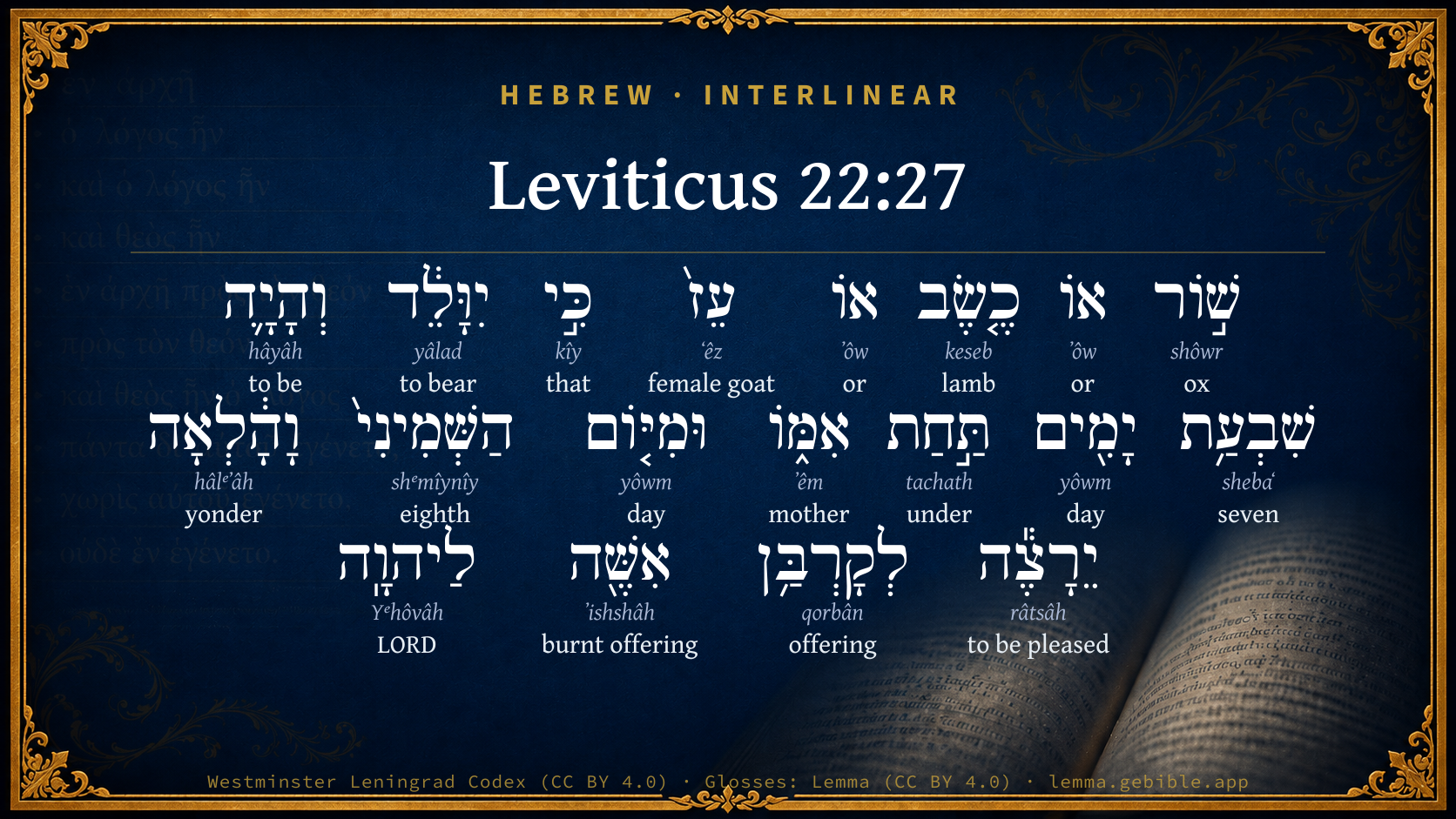
Hebrew (Westminster Leningrad Codex) Leviticus 22:27 appears in the Hebrew Old Testament. The text above is from the Westminster Leningrad Codex. Each word links to its Strong’s number, a concise gloss, and parsing drawn from the Open Scriptures Hebrew Bible morphology. Click any word for its full Brown-Driver-Briggs (BDB) entry.
Download image
Cite this verse

Leviticus 22:27 (World English Bible). Public Domain. Lemma interlinear Bible study tool, https://lemma.gebible.app/v/leviticus/22/27.

Show BibTeX & RIS
BibTeX
RIS
English Translation
"When a bull, or a sheep, or a goat, is born, then it shall remain seven days with its mother; and from the eighth day and thenceforth it shall be accepted for the offering of an offering made by fire to Yahweh.
World English Bible · Public Domain
Download a study sheet

One document with this verse’s original text, its word-by-word gloss line, the meaning frame, cross-references with their text, attributed commentary, and full source and license credits — printable, and it pastes into notes with its structure intact.

This verse Autodidact and up

Study sheet (.html) Plain text (.txt)

A passage Seminary Student

Up to 50 verses in one chapter. A passage sheet keeps up to 6 commentary sources and 12 cross-references per verse, in the order this page ranks them, and says so on the sheet whenever that leaves anything out. Ask for a single verse and you get the Autodidact verse sheet above.

Everything on this page stays free to read, with no account — the sheet is a download of what is already on screen, not access to it.

Want to remove ads? Support Godless Engineer
Compare translations 3

The same verse in 3 English versions, stacked beneath the original-language interlinear above. Click any original word for its lexicon entry.

Each is an independent rendering of the whole verse — the interlinear is not word-aligned to these translations.

Highlighted words mark where these versions differ — a whole-verse word diff, not a word-by-word alignment.

  • World English Bible Public Domain
    "When a bull, or a sheep, or a goat, is born, then it shall remain seven days with its mother; and from the eighth day and thenceforth it shall be accepted for the offering of an offering made by fire to Yahweh.
  • King James Version Public Domain
    When a bullock, or a sheep, or a goat, is brought forth, then it shall be seven days under the dam; and from the eighth day and thenceforth it shall be accepted for an offering made by fire unto the LORD.
  • unfoldingWord Literal Text CC BY-SA 4.0
    “An ox or a lamb or a goat, when it is born, then it shall be seven days under its mother. And from the eighth day and beyond, it may be accepted as an offering, a gift to Yahweh.

unfoldingWord Literal Text — © unfoldingWord, licensed CC BY-SA 4.0. Word-aligned USFM3 via Door43 (git.door43.org/unfoldingWord/en_ult).

Versions to compare (up to 4)

3 of 4 selected

Show all 18 translations

Every available English version of this verse, each an independent rendering of the whole verse.

  • World English Bible Public Domain
    "When a bull, or a sheep, or a goat, is born, then it shall remain seven days with its mother; and from the eighth day and thenceforth it shall be accepted for the offering of an offering made by fire to Yahweh.
  • Berean Standard Bible Public Domain
    “When an ox, a sheep, or a goat is born, it must remain with its mother for seven days. From the eighth day on, it will be acceptable as an offering made by fire to the LORD.
  • Majority Standard Bible Public Domain
    “When an ox, a sheep, or a goat is born, it must remain with its mother for seven days. From the eighth day on, it will be acceptable as a food offering presented to the LORD.
  • King James Version Public Domain
    When a bullock, or a sheep, or a goat, is brought forth, then it shall be seven days under the dam; and from the eighth day and thenceforth it shall be accepted for an offering made by fire unto the LORD.
  • American Standard Version (1901) Public Domain
    When a bullock, or a sheep, or a goat, is brought forth, then it shall be seven days under the dam; and from the eighth day and thenceforth it shall be accepted for the oblation of an offering made by fire unto Jehovah.
  • Revised Version (1885) Public Domain
    When a bullock, or a sheep, or a goat, is brought forth, then it shall be seven days under the dam; and from the eighth day and thenceforth it shall be accepted for the oblation of an offering made by fire unto the LORD.
  • Geneva Bible (1599) Public Domain
    When a bullocke, or a sheepe, or a goate shall be brought foorth, it shalbe euen seuen daies vnder his damme: and from the eight day forth, it shalbe accepted for a sacrifice made by fire vnto the Lord.
  • Douay-Rheims (1899) Public Domain
    When a bullock, or a sheep, or a goat, is brought forth, they shall be seven days under the udder of their dam: but the eighth day, and thenceforth, they may be offered to the Lord.
  • Young's Literal Translation Public Domain
    `When ox or lamb or goat is born, and it hath been seven days under its dam, then from the eighth day and henceforth, it is pleasing for an offering, a fire-offering to Jehovah;
  • Literal Standard Version CC BY-SA 4.0
    “When ox, or lamb, or goat is born, and it has been under its mother [for] seven days, then from the eighth day and from now on, it is pleasing for an offering, a fire-offering to YHWH;
  • Unlocked Literal Bible CC BY-SA 4.0
    “When a calf or a sheep or a goat is born, it must remain seven days with its mother. Then from the eighth day on, it may be accepted as a sacrifice for an offering made by fire to Yahweh.
  • unfoldingWord Literal Text CC BY-SA 4.0
    “An ox or a lamb or a goat, when it is born, then it shall be seven days under its mother. And from the eighth day and beyond, it may be accepted as an offering, a gift to Yahweh.
  • Darby Bible Public Domain
    An ox, or a sheep, or a goat, when it is brought forth, shall be seven days under its dam; and from the eighth day and thenceforth it shall be accepted for an offering by fire to Jehovah.
  • World Messianic Bible Public Domain
    “When a bull, a sheep, or a goat is born, it shall remain seven days with its mother. From the eighth day on it shall be accepted for the offering of an offering made by fire to the LORD.
  • Webster's Bible Public Domain
    When a bullock, or a sheep, or a goat is brought forth, then it shall be seven days under the dam; and from the eighth day and thenceforth it shall be accepted for an offering made by fire to the LORD.
  • Free Bible Version CC BY-SA 4.0
    “When a bull, a sheep, or a goat is born, it must stay with its mother for seven days. After eight days it can be accepted as a food offering to the Lord.
  • Bible in Basic English Public Domain
    When an ox or a sheep or a goat is given birth, let it be with its mother for seven days; and after the eighth day it may be taken as an offering made by fire to the Lord.
  • JPS Tanakh (1917) Public Domain
    When a bullock, or a sheep, or a goat, is brought forth, then it shall be seven days under the dam; but from the eighth day and thenceforth it may be accepted for an offering made by fire unto the LORD.

Literal Standard Version (2020), Covenant Press — licensed CC BY-SA 4.0. Text via the HelloAO Bible API (eBible.org). Unlocked Literal Bible (unfoldingWord) — licensed CC BY-SA 4.0. Text via the HelloAO Bible API (eBible.org). unfoldingWord Literal Text — © unfoldingWord, licensed CC BY-SA 4.0. Word-aligned USFM3 via Door43 (git.door43.org/unfoldingWord/en_ult). Free Bible Version, Dr. Jonathan Gallagher — licensed CC BY-SA 4.0. Text via the HelloAO Bible API (eBible.org).

Word by word

More ways to search: Search by grammar → Find every occurrence → Compare this word →

Practice this passage: Drill this verse → Learn its vocabulary →

כֶ֤שֶׂב
keseb
H3775
“lamb”
Noun, Common, Masculine, Singular, Absolute
Part of Speech
Noun
Type
Common
Gender
Masculine
Number
Singular
State
Absolute
Full BDB Definition

Origin: apparently by transposition for H3532

TWOT: 949

lamb, young ram, sheep
  1. שׁ֣וֹר shôwr H7794 “ox” Noun, Common, Masculine, Singular, Absolute
  2. אוֹ ʼôw H176 “or” Conjunction
  3. אוֹ ʼôw H176 “or” Conjunction
  4. עֵז֙ ʻêz H5795 “female goat” Noun, Common, Feminine, Singular, Absolute
  5. כִּ֣י kîy H3588 “that” Conjunction
  6. יִוָּלֵ֔ד yâlad H3205 “to bear” Verb, Niphal, Imperfect, 3rd Person, Masculine, Singular
  7. וְהָיָ֛ה hâyâh H1961 “and · to be” Conjunction + Verb, Qal, Sequential Perfect, 3rd Person, Masculine, Singular
  8. שִׁבְעַ֥ת shebaʻ H7651 “seven” Adjective, Cardinal number, Masculine, Singular, Construct
  9. יָמִ֖ים yôwm H3117 “days” Noun, Common, Masculine, Plural, Absolute
  10. תַּ֣חַת tachath H8478 “under” Preposition
  11. אִמּ֑וֹ ʼêm H517 “mother · his” Noun, Common, Feminine, Singular, Construct + Suffix, Personal, 3rd Person, Masculine, Singular
  12. וּמִיּ֤וֹם yôwm H3117 “and · from · day of” Conjunction + Preposition + Noun, Common, Masculine, Singular, Construct
  13. הַשְּׁמִינִי֙ shᵉmîynîy H8066 “the · eighth” Particle, Definite Article + Adjective, Ordinal number, Masculine, Singular, Absolute
  14. וָהָ֔לְאָה hâlᵉʼâh H1973 “and · yonder” Conjunction + Adverb
  15. יֵרָצֶ֕ה râtsâh H7521 “to be pleased” Verb, Niphal, Imperfect, 3rd Person, Masculine, Singular
  16. לְקָרְבַּ֥ן qorbân H7133 “to/for · offering of” Preposition + Noun, Common, Masculine, Singular, Construct
  17. אִשֶּׁ֖ה ʼishshâh H801 “burnt offering” Noun, Common, Masculine, Singular, Absolute
  18. לַיהוָֽה Yᵉhôvâh H3068 “to/for · LORD” Preposition + Noun, Proper

About this verse

These counts appear in no published source. They are computed here, from the morphology-tagged text and Lemma’s own curated glosses. What Lemma adds →

19
words
17
distinct lemmas
Pentateuch
section

Notable vocabulary

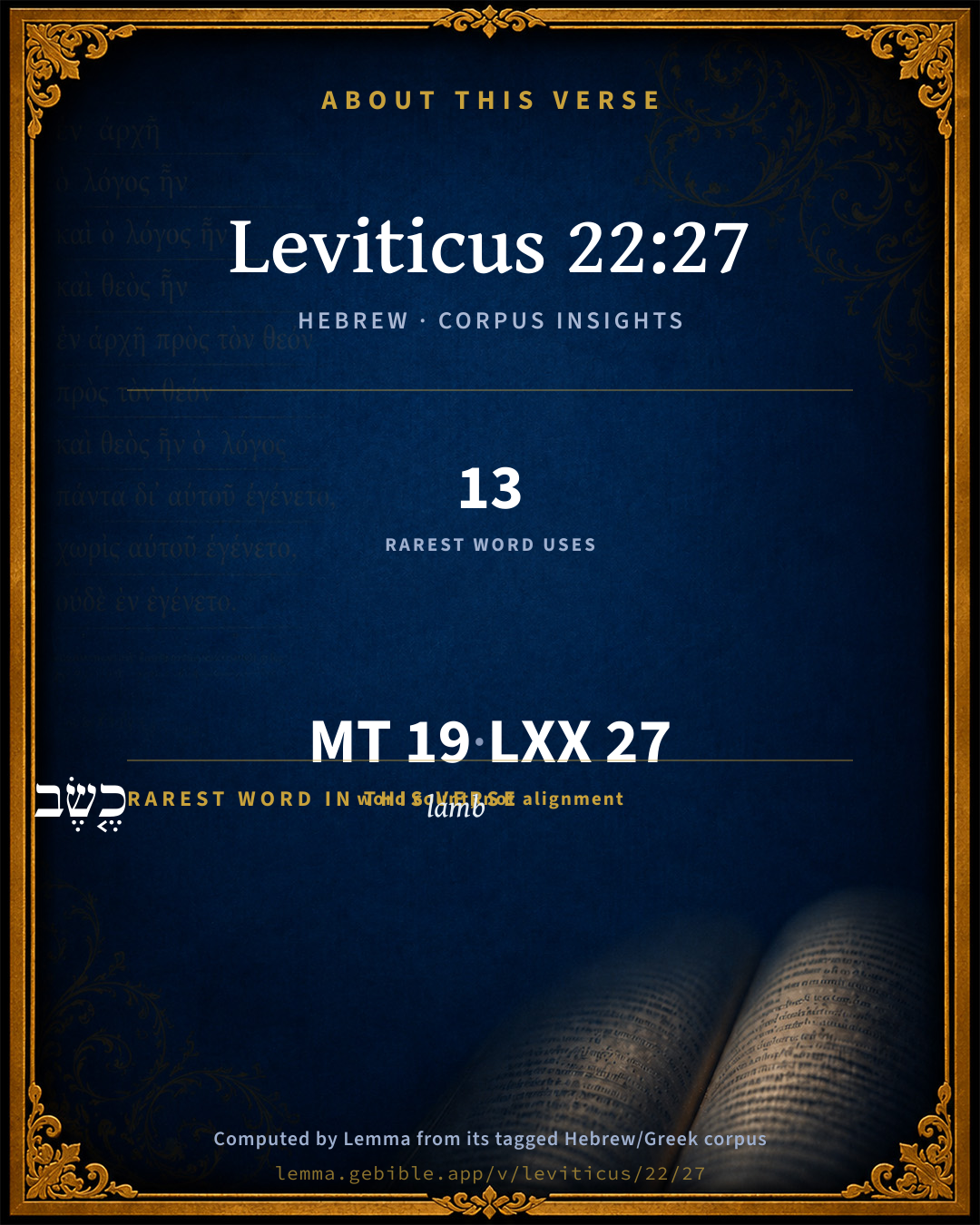
The rarest word here is כֶ֤שֶׂב lamb H3775 — appearing just 13 times in the whole Hebrew Bible.

Shared distinctive vocabulary

כֶ֤שֶׂב lamb H3775 occurs in 13 verses of the Hebrew Bible. Also found in:

Grammatical profile

  • 3 verbs
  • 9 nouns
  • 2 adjectives
  • 1 preposition
  • 3 conjunctions
  • 1 adverb

Verb forms

  • יִוָּלֵ֔ד Niphal · Imperfect
  • וְהָיָ֛ה Qal · Sequential Perfect
  • יֵרָצֶ֕ה Niphal · Imperfect

Repetition

Words recur within this verse — often emphatic in Hebrew:

  • יָמִ֖ים day H3117 ×2
  • אוֹ or H176 ×2

Hebrew & Septuagint length

In English translation the verse runs 42 words from the Hebrew and 42 from the Septuagint (LXX English) — the same length.

A rough comparison of the two English renderings, which tokenize alike — not a word-level alignment.

Word counts can differ between the Hebrew and the Greek without any difference in meaning — e.g. the Hebrew direct-object marker אֵת has no separate Greek word, and Greek often adds the article ὁ.

In the original languages it is 19 Hebrew tokens and 27 Greek tokens — but the two are counted differently (Hebrew bundles its prefixes and suffixes into one token; the Greek is in lemma form), so that isn’t a like-for-like length.

Cross-references

4

Topical passages linked to Leviticus 22:27 in the Treasury of Scripture Knowledge — connected by theme and wording, ordered by reader-vote popularity; previews shown in the World English Bible.

  • Exodus 22:30 You shall do likewise with your oxen and with your sheep. Seven days it shall be with its mother, then on the eighth day you shall give it me.
  • Leviticus 12:2–3 "Speak to the children of Israel, saying, 'If a woman conceives, and bears a male child, then she shall be unclean seven days; as in the days of her monthly period she shall be unclean.
  • Leviticus 19:23–24 "'When you come into the land, and have planted all kinds of trees for food, then you shall count their fruit as forbidden. Three years shall they be forbidden to you. It shall not be eaten.
  • Leviticus 22:25 Neither from the hand of a foreigner shall you offer the bread of your God of any of these; because their corruption is in them. There is a blemish in them. They shall not be accepted for you.'"

Cross-references courtesy of OpenBible.info (CC BY 4.0).

Hebrew and Greek witnesses Masoretic Hebrew ↔ Greek Septuagint

The same verse in the two great witnesses to the Old Testament, shown verse-for-verse.

These are two independent witnesses, not word-aligned to each other, and the Septuagint is shown in lemma (dictionary) form.

Hebrew Leviticus 22:27 Masoretic · Westminster Leningrad Codex

שׁ֣וֹר אוֹ כֶ֤שֶׂב אוֹ עֵז֙ כִּ֣י יִוָּלֵ֔ד וְהָיָ֛ה שִׁבְעַ֥ת יָמִ֖ים תַּ֣חַת אִמּ֑וֹ וּמִיּ֤וֹם הַשְּׁמִינִי֙ וָהָ֔לְאָה יֵרָצֶ֕ה לְקָרְבַּ֥ן אִשֶּׁ֖ה לַיהוָֽה

"When a bull, or a sheep, or a goat, is born, then it shall remain seven days with its mother; and from the eighth day and thenceforth it shall be accepted for the offering of an offering made by fire to Yahweh.

World English Bible · Public Domain

Greek LXX Leviticus 22:27 Septuagint · lemma form

μόσχος ἤ πρόβατον ἤ αἴξ ὡς ἄν τίκτω καί εἰμί ἑπτά ἡμέρα ὑπό ὁ μήτηρ ὁ δέ ἡμέρα ὁ ὄγδοος καί ἐπέκεινα δέχομαι εἰς δῶρον κάρπωμα κύριος

As for a calf, or a sheep, or a goat, whenever it is born, then shall it be seven days under its mother; and on the eighth day and after they shall be accepted for sacrifices, a burnt offering to the Lord.

LXX2012 (modern English Septuagint) · Public Domain

Hebrew: Westminster Leningrad Codex (CC BY 4.0). Greek: Septuagint (public domain); English from LXX2012 (modern English Septuagint) (Public Domain). How the Septuagint differs from the Hebrew →

Targum (Aramaic paraphrase)

2

The Targum is the ancient Jewish Aramaic paraphrase of the Hebrew Scriptures — an interpretive translation, not the Hebrew text itself. Onkelos (literal) and Pseudo-Jonathan (expansive) render the Torah, and Jonathan the Prophets. Coverage is partial: where no permissively-licensed English translation exists for a verse, only the Aramaic is shown. This is verse-level text, not a word-by-word alignment to the Hebrew.

  1. Targum Onkelos Torah (Genesis–Deuteronomy)
    תּוֹר אוֹ אִמָר אוֹ עִזָא אֲרֵי יִתְיְלִיד וִיהֵי שִׁבְעָא יוֹמִין בָּתַר אִמֵהּ וּמִיוֹמָא תְמִינָאָה וּלְהַלָא יִתִּרְעִי לְקָרָבָא קֻרְבָּנָא קֳדָם יְיָ

    (no public-domain English translation for this verse)

    Targum Onkelos — Aramaic: “Onkelos Genesis” (public domain); “Onkelos Exodus” (public domain); “Onkelos Leviticus” (public domain); “Onkelos Numbers” (public domain); “Onkelos Deuteronomy” (public domain). English: “Sefaria Community Translation” (CC0 1.0 (public-domain dedication)); “J.W. Etheridge. The Targums of Onkelos and Jonathan Ben Uzziel on the Pentateuch. London: Longmans, Green, 1862” (public domain). Text via Sefaria.

  2. Targum Pseudo-Jonathan Torah (Genesis–Deuteronomy)
    עִידַן דְתִידְכַּר לָן סִדְרֵי קוּרְבָּנֵינָן מַה דְהַוֵינָן מְקַרְבִין בְּכָל שְׁנָא וּשְׁנָא הֲווֹ קוּרְבָּנֵינָן מְכַפְּרִין עַל חוֹבֵינָן וּכְדוּ דִי גָרְמוּ חוֹבַיָא וְלֵית לָן מַה נַקְרְבָא מִן עֶדְרֵי עֲנֵינָן תּוֹרָא אִיתְבְּחַר קֳדָמוֹי בְּגִין מַדְכַּר זְכוּת סָבָא דְאָתָא מִמַדִינְחָא פַּטִיר כּוּלֵיהּ קָרֵיב לִשְׁמָךְ בַּר תּוֹרִין רַכִּיךְ שָׁמִין אִימְרָא אִיתְבְּחַר תִּנְיָין בְּגִין מַדְכַּר זַכְוָותֵיהּ דִשְיֵיהּ דְאִתְעֲקַד עַל גַבֵּי מַדְבְּחָא וּפְשַׁט צַוְארֵיהּ בְּגִין שְׁמָךְ שְׁמַיָא מָכוּ וּנְחָתוּ וַחֲמָא יִצְחָק יַת שַׁכְלוּלֵיהוֹן וְכַהֲיָין עֵינוֹי מִמְרוֹמַיָא מִן בְּגִין כְּדֵין זָכָה וְאִזְדַמַן לֵיהּ אִימְרָא תְּחוֹתוֹי לְעָלָתָא גְדִי בַּר עִזֵי אִתְבְּחַר תְּחוֹתָא בְּגִין מַדְכַּר זְכוּת שְׁלֵימָא דְעָבַד גַדְיֵי בַּר עִזֵי תַּבְשִׁילִין וְאוֹבִיל לְאָבוֹי וְזָכָה לִמְקַבְּלָא סְדַר בִּרְכָתָא בְּגִין כֵּן פָּרֵישׁ משֶׁה נְבִיָא וַאֲמַר עַמִי בְּנֵי יִשְרָאֵל תּוֹר אוֹ אִימַר אוֹ גַדְיָא אֲרוּם יִתְיְלִיד כְּאוֹרַח עַלְמָא וִיהֵי שַׁבְעָתָא יוֹמִין בָּתַר אִמֵיהּ מְטוּל דְיִשְׁתְּמוֹדַע דְלָא נָפִיל וּמִיוֹמָא תְמִינָאָה וּלְהָלְאָה יִתְרְעֵי לְקָרָבָא קוּרְבָּנָא לִשְׁמָא דַיְיָ

    (to the effect that): What time thou callest to our mind the order of our oblations, as they shall be offered year by year, being our expiatory offering for our sins, when on account of our sins (such sacrifices are required), and we have none to bring from our flocks of sheep, then shall a bullock be chosen before him, in memorial of the righteousness of the elder who came from the cast, the sincere one who brought the calf, fat and tender, to Thy Name. A sheep is to be chosen, secondly, in memory of the righteousness of him who was bound as a lamb on the altar, and who stretched forth his neck for Thy Name's sake, while the heavens stooped down and condescended, and Izhak beheld their foundations, and his eyes were blinded by the high things; on which account he was reckoned to be worthy that a lamb should be provided for him as a burnt offering. A kid of the goats is to be chosen likewise, in memorial of the righteousness of that perfect one who made the savoury meat of the kid, and brought it to his father, and was made worthy to receive the order of the blessing: wherefore Mosheh the prophet explaineth, saying: Sons of Israel, my people, When a bullock, or a lamb, or a kid is brought forth according, to the manner of the world, it shall be seven days after its dam, that there may be evidence that it is not imperfect; and on the eighth day and thenceforth, it is acceptable to be offered an oblation to the Name of the Lord.

    Targum Pseudo-Jonathan — Aramaic: “Targum Jonathan on Genesis” (public domain); “Targum Jonathan on Exodus” (public domain); “Targum Jonathan on Leviticus” (public domain); “Targum Jonathan on Numbers” (public domain); “Targum Jonathan on Deuteronomy” (public domain). English: “The Targum of Jonathan ben Uzziel, trans. J. W. Etheridge, London, 1862” (public domain). Text via Sefaria.

Commentary

Notes on Leviticus 22:27 from classic Christian and Jewish commentators (each source and its license shown beneath its notes). The classic Christian expositions comment on the surrounding passage and are grouped to its opening verse, so a note may address several verses; the Jewish commentaries on the Tanakh (Rashi and others) are per-verse, so they appear only where the commentator wrote on this verse.

Lemma curates 59 commentaries, every one of them public domain or Creative Commons licensed, each selected and text-cleaned for this edition rather than reprinted as found. About our sources →

Trapp's Complete Commentary

John Trapp

Lev 22:27 When a bullock, or a sheep, or a goat, is brought forth, then it shall be seven days under the dam; and from the eighth day and thenceforth it shall be accepted for an offering made by fire unto the LORD.

Ver. 27. It shall be seven days.] As not being man’s meat, till then: but legally impure, and in their blood, as were likewise infants.

John Trapp, A Commentary or Exposition upon All the Books of the Old and New Testament (1647–1656) — public domain. Text from a community e-Sword module.

Tyndale Open Study Notes

Tyndale Open Resources

22:27 Leaving a newborn animal with its mother for seven days allowed time to determine the animal’s health (see Exod 22:30).

Tyndale Open Study Notes — © Tyndale Open Resources, licensed CC BY-SA 4.0. Text via the HelloAO Bible API.

Jamieson, Fausset & Brown

Robert Jamieson, A. R. Fausset & David Brown

it shall be seven days under the dam--Animals were not considered perfect nor good for food till the eighth day. As sacrifices are called the bread or food of God (Lev 22:25), to offer them immediately after birth, when they were unfit to be eaten, would have indicated a contempt of religion; and besides, this prohibition, as well as that contained in Lev 22:28, inculcated a lesson of humanity or tenderness to the dam, as well as secured the sacrifices from all appearance of unfeeling cruelty.

Next: Leviticus Chapter 23

Jamieson, Fausset & Brown — Commentary Critical and Explanatory on the Whole Bible (1871) — public domain (CC PDM 1.0). Text via the HelloAO Bible API.

Adam Clarke's Commentary

Verse 27. When a bullock - is brought forth] This is a most unfortunate as well as absurd translation. The creature called an ox is a bull castrated; surely then a bullock was never yet brought forth! The original word שור shor signifies a bull, a bullock, or indeed any thing of the neat kind: here, even common sense required that it should be translated calf; and did I not hold myself sacredly bound to print the text of the common version with scrupulous exactness, I should translate the former clause of this verse thus, and so enter it into the text: When a CALF, or a LAMB, or a KID is brought forth, instead of, When a bullock, a sheep, or a goat is brought forth, the absurdity of which is glaring.

Seven days under the dam] In vindication of the propriety of this precept it may be justly asserted, that the flesh of very young animals is comparatively innutritive, and that animal food is not sufficiently nourishing and wholesome till the animal has arrived at a certain growth, or acquired the perfection of its nature. There is something brutish in eating the young of beast or fowl before the hair and hoofs are perfect in the one, and the feathers and claws in the other. Before this period their flesh is not good for food. See Clarke on Le 9:1.

Adam Clarke's Commentary on the Bible (1810–1826) — public domain. Text from a community e-Sword/MySword module.

Ellicott's Commentary for English Readers

(27) When a bullock, or a sheep, or a goat—The three sacrificial quadrupeds. (See Lev_22:19 and Lev_17:3-6.)

Is brought forth.—From this expression it was enacted during the second Temple that the animal fit for a sacrifice had to be born naturally. One brought into the world by artificial aid was disqualified for the altar.

It shall be seven days under the dam.—Under seven days the animal is extremely weak, and unfit for human food, and hence must not be offered as the food of God, as sacrifices are called. (See Lev_22:25.) For the same reason children could not be circumcised before the eighth day from their birth. (See Exo_22:29.) Because the text here says that the newly born animal is to be with the dam seven days, it was enacted that if the mother died before the seven days (in which case it could not be with the dam seven days), it was for ever disqualified for a sacrifice.

A Bible Commentary for English Readers, edited by Charles John Ellicott (1878–1897) — public domain. Text from a community e-Sword module.

The Cambridge Bible for Schools and Colleges

gen. ed. J. J. S. Perowne

27. For the regulation cp. Exo_22:30 [Heb. 29].

The Cambridge Bible for Schools and Colleges (gen. ed. J. J. S. Perowne; Cambridge University Press, 1878–1918) — public domain. Text from a community e-Sword module.

John Gill's Exposition

And whether it be cow or ewe,.... Or "an ox or sheep" (f), for this law, as Aben Ezra says, respects both male and female, and neither the one nor the other with their young might be slain; though Jarchi says, the custom is concerning the female, for it is forbidden to slay the dam and its son, or daughter; but it is not the custom concerning males, wherefore it is lawful to slay the father and the son:

ye shall not kill it and her young both in one day; or, "it and its son" (g), the young, whether of a cow or ewe, and whether it be male or female; though Gersom observes, that this law takes place only in the dam and its female young, and not in the father and the son; for it is not manifest, in many animals, who is their father, wherefore he is not guilty of stripes, if the father and his son are slain in one day, even though it is known it is its father: the reason of the law seems to be, to encourage mercy and pity, and to discourage cruelty: hence the Targum of Jonathan is,"and my people, the children of Israel, as our Father is merciful in heaven, so be ye merciful on earth: a cow, or a sheep, &c.''

(f) "bovem vel pecus", Pagninus, Montanus, &c. (g) "ipsum et filium ejus", Pagninus, Montanus, &c.

John Gill's Exposition of the Whole Bible (1746–1763) — public domain (CC PDM 1.0). Text via the HelloAO Bible API.

Albert Barnes' Notes on the Bible

No victim was to be offered in sacrifice until it was a week old. The meaning of this law appears to be that the animal should realise a distinct existence in becoming less dependent on its mother, and able to provide for its own wants.

Albert Barnes' Notes on the Bible (1834–1885) — public domain. Text from a community e-Sword/MySword module.

Haydock's Catholic Bible Commentary

Lord. In this and the following verses, we are taught a lesson of humanity. (Tertullian) --- The Romans did not offer sheep or goats till they were eight days old: though the Jews were at liberty to sacrifice them after that term, they generally waited till they were thirty days old. (Calmet)

George Leo Haydock (1774–1849), Haydock's Catholic Family Bible and Commentary, 1859 edition — public domain. Excludes Psalms (Douay-Rheims chapter numbering differs from Protestant) and Deuterocanonical books (Catholic canon only).

Matthew Poole's English Annotations

From the eighth day. See on Exo 23:30; 23:19.

Matthew Poole's English Annotations on the Holy Bible (1683–1685) — public domain. Text from a community e-Sword/MySword module.

Whedon's Commentary on the Bible

Daniel D. Whedon

27. From the eighth day… accepted — Both men and animals were unclean till the eighth day, when the child must be sealed to the Lord by circumcision, and the clean animal might be offered on the altar. The age limit was necessary, since in most sacrifices a portion was to be eaten. In many civilized states the killing for the market of a calf less than four weeks old is prohibited.

Daniel D. Whedon (gen. ed.), Commentary on the Old and New Testaments (1874–1909) — public domain. Text from a community e-Sword module.

Keil & Delitzsch

C. F. Keil & F. Delitzsch

A young ox, sheep, or goat was to be seven days under its mother, and could only be sacrificed from the eighth day onwards, according to the rule laid down in Exo 22:29 with regard to the first-born. The reason for this was, that the young animal had not attained to a mature and self-sustained life during the first week of its existence.

(Note: For this reason the following rule was also laid down by the Romans: Suis faetus sacrificio die quinto purus est, pecoris die octavo, bovis tricesimo (Plin. h. n. 8, 51).)

This maturity was not reached till after the lapse of a week, that period of time sanctified by the creation. There is no rule laid down in the law respecting the age up to which an animal was admissible in sacrifice. Bullocks, i.e., steers or young oxen of more than a year old, are frequently mentioned and prescribed for the festal sacrifices (for the young ox of less than a year old is called עגל; Lev 9:3), viz., as burnt-offerings in Lev 23:18; Num 7:15, Num 7:21, Num 7:27, Num 7:33, Num 7:39.; Num 8:8; Num 15:24; Num 28:11, Num 28:19, Num 28:27; Num 29:2, Num 29:8, and as sin-offerings in Lev 4:3, Lev 4:14; Lev 16:3; - sheep (lambs) of one year old are also prescribed as burnt-offerings in Lev 9:3; Lev 12:6; Lev 23:12; Exo 29:38; Num 6:14; Num 7:17, Num 7:21, Num 7:27, Num 7:33, Num 7:39., Num 28:3, Num 28:9, Num 28:19, Num 28:27; Num 29:2, Num 29:8, Num 29:13, Num 29:17., as peace-offerings in Num 7:17, Num 7:23; Num 29:35., and as trespass-offerings in Num 6:12; also a yearling ewe as a sin-offering in Lev 14:10 and Num 6:14, and a yearling goat in Num 15:27. They generally brought older oxen or bullocks for peace-offerings (Num 7:17; Num 23:29.), and sometimes as burnt-offerings. In Jdg 6:25 an ox of seven years old is said to have been brought as a burnt-offering; and there can be no doubt that the goats and rams presented as sin-offerings and trespass-offerings were more than a year old.

Keil & Delitzsch — Biblical Commentary on the Old Testament (1861–1891) — public domain (CC PDM 1.0). Text via the HelloAO Bible API. (Old Testament only.)

Rashi

Rabbi Shlomo Yitzchaki (Rashi)

כי יולד WHEN [ANY OX etc.] IS BORN… [FROM THE EIGHTH DAY, AND THENCEFORTH, IT SHALL BE FAVOURABLY ACCEPTED AS A FIRE OFFERING…] — The expression יולד “that is born” excludes the case of an animal delivered through the abdominal wall (i. e. by Caesarian section) (Chullin 38b).

Rashi on the Tanakh — English translations: “The Judaica Press complete Tanach with Rashi, translated by A. J. Rosenberg” (CC BY 4.0); “Pentateuch with Rashi's commentary by M. Rosenbaum and A.M. Silbermann, 1929-1934” (public domain); “The Metsudah Tanach series, Lakewood, N.J” (CC BY 4.0); and “The Book of Joshua, Metsudah Publications, 1997” (CC BY 4.0). Text via Sefaria.

Lesson kit

Teaching starters — assembled from the data on this page, not authored interpretation. Every prompt links to the verse data it draws on. Edit before teaching.

Leviticus, in the Pentateuch, opens this verse with 19 words (17 distinct Hebrew lemmas). Its most distinctive word is keseb (“lamb”). A historical commentator’s framing appears above. Read the whole chapter for the surrounding context.

Discussion questions

  1. How does “lamb” (keseb) shape what this verse is saying?
  2. How does Genesis 30:32, which shares the word «lamb», read alongside this verse?
  3. What does the repetition of “day” (2× in this one verse) do in this verse?
  4. These translations render this verse differently. What is at stake in choosing one wording over another?
  5. «יִוָּלֵ֔ד» is a Niphal Imperfect verb. How does that grammatical form shape the action described?
  6. Compare how Trapp's Complete Commentary and Tyndale Open Study Notes read this verse. Where do they agree or differ?

Things to notice

Reading settings

Reading text

Shown beneath each verse's original-language words.

Old Testament
Old Testament edition

Read the OT as the Masoretic Hebrew (MT) or the Greek Septuagint (LXX).

English shown for the Greek Septuagint (in the Hebrew ↔ Greek comparison).

Comparing translations? Open the Compare panel on any verse page to stack up to four side by side.