
Numbers 12:14

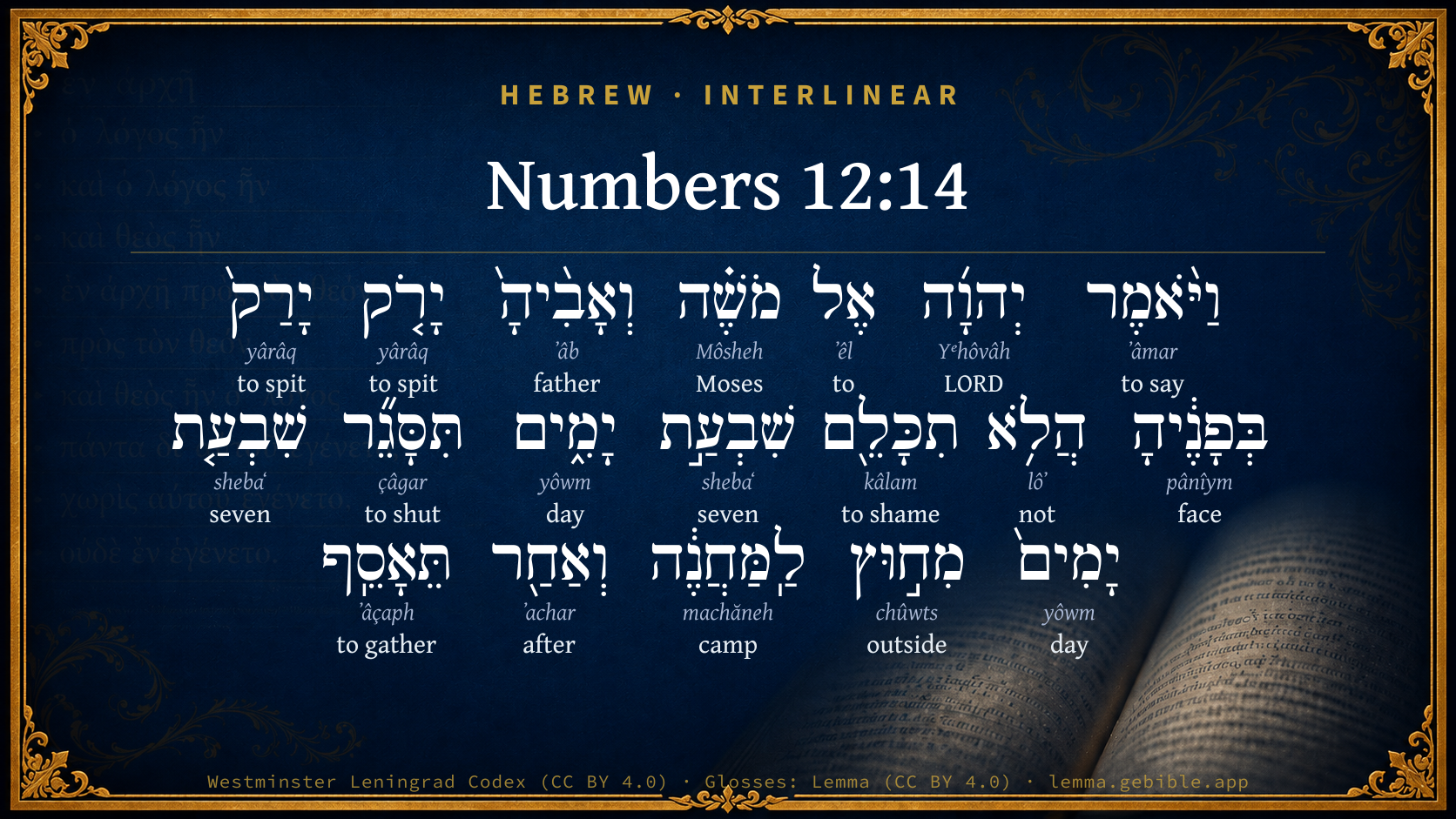
Hebrew (Westminster Leningrad Codex) Numbers 12:14 appears in the Hebrew Old Testament. The text above is from the Westminster Leningrad Codex. Each word links to its Strong’s number, a concise gloss, and parsing drawn from the Open Scriptures Hebrew Bible morphology. Click any word for its full Brown-Driver-Briggs (BDB) entry.
Download image
Cite this verse

Numbers 12:14 (World English Bible). Public Domain. Lemma interlinear Bible study tool, https://lemma.gebible.app/v/numbers/12/14.

Show BibTeX & RIS
BibTeX
RIS
English Translation
Yahweh said to Moses, If her father had but spit in her face, shouldn't she be ashamed seven days? let her be shut up outside of the camp seven days, and after that she shall be brought in again.
World English Bible · Public Domain
Highlights
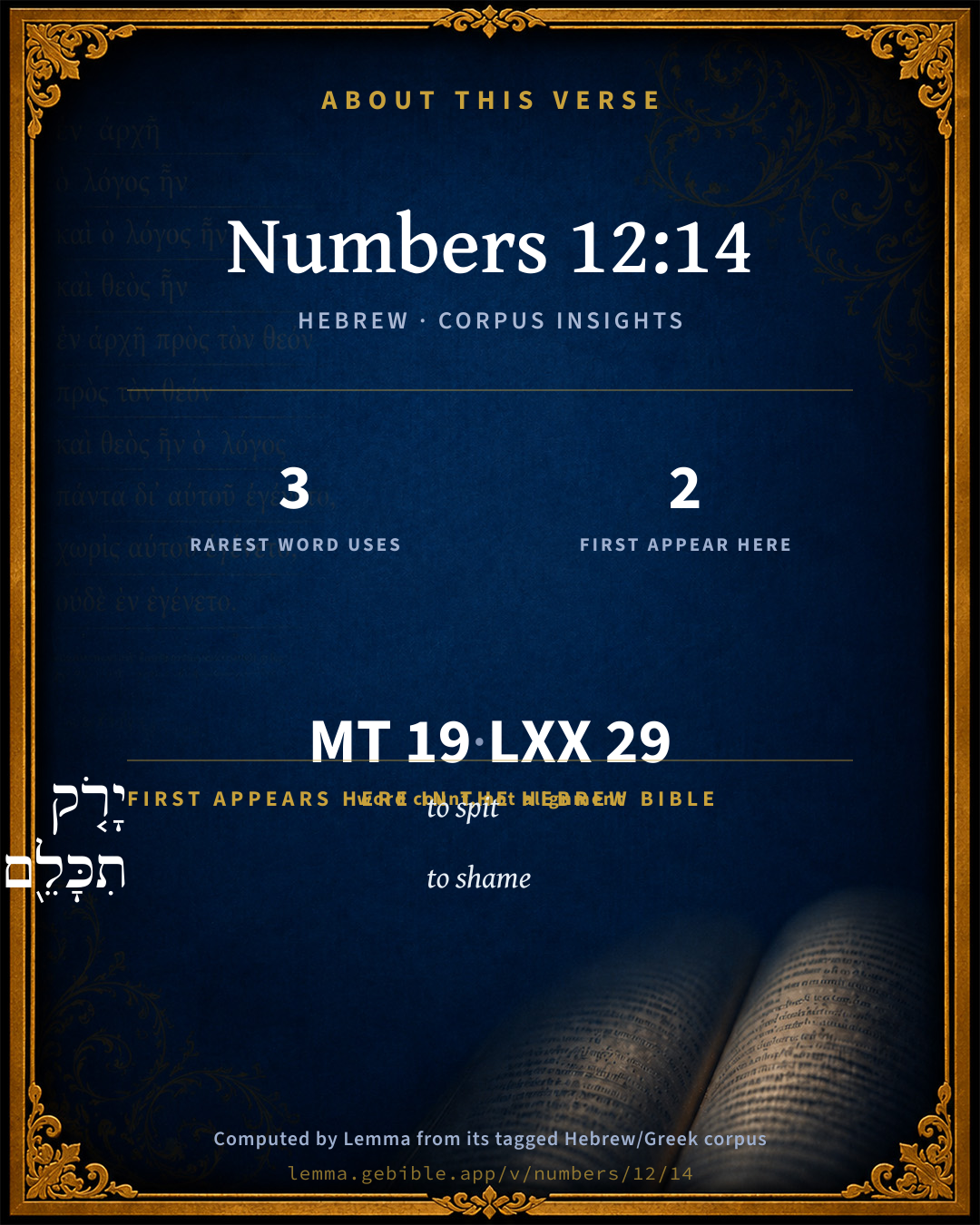
  • 2 first appearances in the Hebrew Bible
Full analysis ↓
Download a study sheet

One document with this verse’s original text, its word-by-word gloss line, the meaning frame, cross-references with their text, attributed commentary, and full source and license credits — printable, and it pastes into notes with its structure intact.

This verse Autodidact and up

Study sheet (.html) Plain text (.txt)

A passage Seminary Student

Up to 50 verses in one chapter. A passage sheet keeps up to 6 commentary sources and 12 cross-references per verse, in the order this page ranks them, and says so on the sheet whenever that leaves anything out. Ask for a single verse and you get the Autodidact verse sheet above.

Everything on this page stays free to read, with no account — the sheet is a download of what is already on screen, not access to it.

Want to remove ads? Support Godless Engineer
Compare translations 3

The same verse in 3 English versions, stacked beneath the original-language interlinear above. Click any original word for its lexicon entry.

Each is an independent rendering of the whole verse — the interlinear is not word-aligned to these translations.

Highlighted words mark where these versions differ — a whole-verse word diff, not a word-by-word alignment.

  • World English Bible Public Domain
    Yahweh said to Moses, If her father had but spit in her face, shouldn't she be ashamed seven days? let her be shut up outside of the camp seven days, and after that she shall be brought in again.
  • King James Version Public Domain
    And the LORD said unto Moses, If her father had but spit in her face, should she not be ashamed seven days? let her be shut out from the camp seven days, and after that let her be received in again.
  • unfoldingWord Literal Text CC BY-SA 4.0
    And Yahweh said to Moses, “And her father, spitting, spit in her face, would she not be humiliated seven days? She shall be shut up seven days from outside to the camp, and after she shall be gathered.”

unfoldingWord Literal Text — © unfoldingWord, licensed CC BY-SA 4.0. Word-aligned USFM3 via Door43 (git.door43.org/unfoldingWord/en_ult).

Versions to compare (up to 4)

3 of 4 selected

Show all 18 translations

Every available English version of this verse, each an independent rendering of the whole verse.

  • World English Bible Public Domain
    Yahweh said to Moses, If her father had but spit in her face, shouldn't she be ashamed seven days? let her be shut up outside of the camp seven days, and after that she shall be brought in again.
  • Berean Standard Bible Public Domain
    But the LORD answered Moses, “If her father had but spit in her face, would she not have been in disgrace for seven days? Let her be confined outside the camp for seven days; after that she may be brought back in.”
  • Majority Standard Bible Public Domain
    But the LORD answered Moses, “If her father had but spit in her face, would she not have been in disgrace for seven days? Let her be confined outside the camp for seven days; after that she may be brought back in.”
  • King James Version Public Domain
    And the LORD said unto Moses, If her father had but spit in her face, should she not be ashamed seven days? let her be shut out from the camp seven days, and after that let her be received in again.
  • American Standard Version (1901) Public Domain
    And Jehovah said unto Moses, If her father had but spit in her face, should she not be ashamed seven days? let her be shut up without the camp seven days, and after that she shall be brought in again.
  • Revised Version (1885) Public Domain
    And the LORD said unto Moses, If her father had but spit in her face, should she not be ashamed seven days? let her be shut up without the camp seven days, and after that she shall be brought in again.
  • Geneva Bible (1599) Public Domain
    And the Lord said vnto Moses, If her father had spit in her face, shoulde she not haue bene ashamed seuen dayes? let her be shut out of the hoste seuen dayes, and after she shall bee receiued.
  • Douay-Rheims (1899) Public Domain
    And the Lord answered him: If her father had spitten upon her face, ought she not to have been ashamed for seven days at least? Let her be separated seven days without the camp, and after wards she shall be called again.
  • Young's Literal Translation Public Domain
    And Jehovah saith unto Moses, `And her father had but spat in her face -- is she not ashamed seven days? she is shut out seven days at the outside of the camp, and afterwards she is gathered.'
  • Literal Standard Version CC BY-SA 4.0
    And YHWH says to Moses, “But [if] her father had but spat in her face—is she not ashamed [for] seven days? She is shut out [for] seven days at the outside of the camp, and afterward she is gathered.”
  • Unlocked Literal Bible CC BY-SA 4.0
    Yahweh said to Moses, “If her father had spit in her face, she would be disgraced for seven days. Shut her outside the camp for seven days. After that bring her in again.”
  • unfoldingWord Literal Text CC BY-SA 4.0
    And Yahweh said to Moses, “And her father, spitting, spit in her face, would she not be humiliated seven days? She shall be shut up seven days from outside to the camp, and after she shall be gathered.”
  • Darby Bible Public Domain
    And Jehovah said to Moses, But had her father anyways spat in her face, should she not be shamed seven days? She shall be shut outside the camp seven days, and afterwards she shall be received in [again].
  • World Messianic Bible Public Domain
    The LORD said to Moses, “If her father had but spit in her face, shouldn’t she be ashamed seven days? Let her be shut up outside of the camp seven days, and after that she shall be brought in again.”
  • Webster's Bible Public Domain
    And the LORD said to Moses, If her father had but spit in her face, should she not be ashamed seven days? let her be shut out from the camp seven days, and after that let her be received again.
  • Free Bible Version CC BY-SA 4.0
    But the Lord replied to Moses, “If her father had spit in her face wouldn't she have been disgraced for seven days? Keep her in isolation outside the camp for seven days, and then she can be taken back in.”
  • Bible in Basic English Public Domain
    And the Lord said to Moses, If her father had put a mark of shame on her, would she not be shamed for seven days? Let her be shut up outside the tent-circle for seven days, and after that she may come in again.
  • JPS Tanakh (1917) Public Domain
    And the LORD said unto Moses: 'If her father had but spit in her face, should she not hide in shame seven days? let her be shut up without the camp seven days, and after that she shall be brought in again.'

Literal Standard Version (2020), Covenant Press — licensed CC BY-SA 4.0. Text via the HelloAO Bible API (eBible.org). Unlocked Literal Bible (unfoldingWord) — licensed CC BY-SA 4.0. Text via the HelloAO Bible API (eBible.org). unfoldingWord Literal Text — © unfoldingWord, licensed CC BY-SA 4.0. Word-aligned USFM3 via Door43 (git.door43.org/unfoldingWord/en_ult). Free Bible Version, Dr. Jonathan Gallagher — licensed CC BY-SA 4.0. Text via the HelloAO Bible API (eBible.org).

Word by word

More ways to search: Search by grammar → Find every occurrence → Compare this word →

Practice this passage: Drill this verse → Learn its vocabulary →

יָרֹ֤ק
yârâq
H3417
“to spit”
Verb, Qal, Infinitive Absolute
Part of Speech
Verb
Stem
Qal
Form
Infinitive Absolute
Full BDB Definition

Origin: a primitive root

TWOT: 918 , 919

(Qal) to spit
  1. וַיֹּ֨אמֶר ʼâmar H559 “and · to say” Conjunction + Verb, Qal, Sequential Imperfect, 3rd Person, Masculine, Singular
  2. יְהוָ֜ה Yᵉhôvâh H3068 “LORD” Noun, Proper
  3. אֶל ʼêl H413 “to” Preposition
  4. מֹשֶׁ֗ה Môsheh H4872 “Moses” Noun, Proper
  5. וְאָבִ֨יהָ֙ ʼâb H1 “and · father · her” Conjunction + Noun, Common, Masculine, Singular, Construct + Suffix, Personal, 3rd Person, Feminine, Singular
  6. יָרַק֙ yârâq H3417 “to spit” Verb, Qal, Perfect, 3rd Person, Masculine, Singular
  7. בְּפָנֶ֔יהָ pânîym H6440 “in/at · face(s) · her” Preposition + Noun, Common, Both, Plural, Construct + Suffix, Personal, 3rd Person, Feminine, Singular
  8. הֲלֹ֥א lôʼ H3808 “not” Particle, Interrogative + Particle, Negative
  9. תִכָּלֵ֖ם kâlam H3637 “to shame” Verb, Niphal, Imperfect, 3rd Person, Feminine, Singular
  10. שִׁבְעַ֣ת shebaʻ H7651 “seven” Adjective, Cardinal number, Masculine, Singular, Construct
  11. יָמִ֑ים yôwm H3117 “days” Noun, Common, Masculine, Plural, Absolute
  12. תִּסָּגֵ֞ר çâgar H5462 “to shut” Verb, Niphal, Imperfect, 3rd Person, Feminine, Singular
  13. שִׁבְעַ֤ת shebaʻ H7651 “seven” Adjective, Cardinal number, Masculine, Singular, Construct
  14. יָמִים֙ yôwm H3117 “days” Noun, Common, Masculine, Plural, Absolute
  15. מִח֣וּץ chûwts H2351 “from · outside” Preposition + Noun, Common, Masculine, Singular, Absolute
  16. לַֽמַּחֲנֶ֔ה machăneh H4264 “to/for the · camp” Preposition, Determined + Noun, Common, Both, Singular, Absolute
  17. וְאַחַ֖ר ʼachar H310 “and · after” Conjunction + Adverb
  18. תֵּאָסֵֽף ʼâçaph H622 “to gather” Verb, Niphal, Imperfect, 3rd Person, Feminine, Singular

About this verse

These counts appear in no published source. They are computed here, from the morphology-tagged text and Lemma’s own curated glosses. What Lemma adds →

19
words
16
distinct lemmas
Pentateuch
section

Notable vocabulary

The rarest word here is יָרֹ֤ק to spit H3417 — appearing just 3 times in the whole Hebrew Bible.

First appearance in Scripture

These words make their first canonical appearance in the Hebrew Bible here:

  • יָרֹ֤ק to spit H3417
  • תִכָּלֵ֖ם to shame H3637

Shared distinctive vocabulary

יָרֹ֤ק to spit H3417 occurs in 2 verses of the Hebrew Bible. Also found in:

Grammatical profile

  • 6 verbs
  • 8 nouns
  • 2 adjectives
  • 1 preposition
  • 1 adverb
  • 1 particle

Verb forms

  • וַיֹּ֨אמֶר Qal · Sequential Imperfect
  • יָרֹ֤ק Qal · Infinitive Absolute
  • יָרַק֙ Qal · Perfect
  • תִכָּלֵ֖ם Niphal · Imperfect
  • תִּסָּגֵ֞ר Niphal · Imperfect
  • תֵּאָסֵֽף Niphal · Imperfect

Repetition

Words recur within this verse — often emphatic in Hebrew:

  • יָרֹ֤ק to spit H3417 ×2
  • שִׁבְעַ֣ת seven H7651 ×2
  • יָמִ֑ים day H3117 ×2

Hebrew & Septuagint length

In English translation the verse runs 39 words from the Hebrew and 38 from the Septuagint (LXX English) — closely comparable.

A rough comparison of the two English renderings, which tokenize alike — not a word-level alignment.

Word counts can differ between the Hebrew and the Greek without any difference in meaning — e.g. the Hebrew direct-object marker אֵת has no separate Greek word, and Greek often adds the article ὁ.

In the original languages it is 19 Hebrew tokens and 29 Greek tokens — but the two are counted differently (Hebrew bundles its prefixes and suffixes into one token; the Greek is in lemma form), so that isn’t a like-for-like length.

Cross-references

10

Topical passages linked to Numbers 12:14 in the Treasury of Scripture Knowledge — connected by theme and wording, ordered by reader-vote popularity; previews shown in the World English Bible.

  • Deuteronomy 25:9 then his brother's wife shall come to him in the presence of the elders, and loose his shoe from off his foot, and spit in his face; and she shall answer and say, So shall it be done to the man who does not build up his brother's house.
  • Job 30:10 They abhor me, they stand aloof from me, And don't hesitate to spit in my face.
  • Isaiah 50:6 I gave my back to the strikers, and my cheeks to those who plucked off the hair; I didn't hide my face from shame and spitting.
  • Numbers 5:2–3 "Command the children of Israel that they put out of the camp every leper, and everyone who has an issue, and whoever is unclean by the dead.
  • Leviticus 13:45–46 "The leper in whom the plague is shall wear torn clothes, and the hair of his head shall hang loose. He shall cover his upper lip, and shall cry, 'Unclean! Unclean!'
  • Leviticus 14:8 "He who is to be cleansed shall wash his clothes, and shave off all his hair, and bathe himself in water; and he shall be clean. After that he shall come into the camp, but shall dwell outside his tent seven days.
  • 2 Chronicles 26:20–21 Azariah the chief priest, and all the priests, looked on him, and, behold, he was leprous in his forehead, and they thrust him out quickly from there; yes, himself hurried also to go out, because Yahweh had struck him.
  • Job 17:6 "But he has made me a byword of the people. They spit in my face.
  • Matthew 26:67 Then they spit in his face and beat him with their fists, and some slapped him,
  • Hebrews 12:9 Furthermore, we had the fathers of our flesh to chasten us, and we paid them respect. Shall we not much rather be in subjection to the Father of spirits, and live?

Cross-references courtesy of OpenBible.info (CC BY 4.0).

Hebrew and Greek witnesses Masoretic Hebrew ↔ Greek Septuagint

The same verse in the two great witnesses to the Old Testament, shown verse-for-verse.

These are two independent witnesses, not word-aligned to each other, and the Septuagint is shown in lemma (dictionary) form.

Hebrew Numbers 12:14 Masoretic · Westminster Leningrad Codex

וַיֹּ֨אמֶר יְהוָ֜ה אֶל מֹשֶׁ֗ה וְאָבִ֨יהָ֙ יָרֹ֤ק יָרַק֙ בְּפָנֶ֔יהָ הֲלֹ֥א תִכָּלֵ֖ם שִׁבְעַ֣ת יָמִ֑ים תִּסָּגֵ֞ר שִׁבְעַ֤ת יָמִים֙ מִח֣וּץ לַֽמַּחֲנֶ֔ה וְאַחַ֖ר תֵּאָסֵֽף

Yahweh said to Moses, If her father had but spit in her face, shouldn't she be ashamed seven days? let her be shut up outside of the camp seven days, and after that she shall be brought in again.

World English Bible · Public Domain

Greek LXX Numbers 12:14 Septuagint · lemma form

καί εἶπον κύριος πρός μωυσῆς εἰ ὁ πατήρ αὐτός πτύω ἐνπτύω εἰς ὁ πρόσωπον αὐτός οὐ ἐντρέπω ἑπτά ἡμέρα ἀποὁρίζω ἑπτά ἡμέρα ἔξω ὁ παρεμβολή καί μετά οὗτος εἰςἔρχομαι

And the Lord said to Moses, If her father had only spit in her face, would she not be ashamed seven days? let her be set apart seven days without the camp, and afterwards she shall come in.

LXX2012 (modern English Septuagint) · Public Domain

On this verse, The Pulpit Commentary discusses the Septuagint’s reading. Read the note in Commentary ↓

Hebrew: Westminster Leningrad Codex (CC BY 4.0). Greek: Septuagint (public domain); English from LXX2012 (modern English Septuagint) (Public Domain). How the Septuagint differs from the Hebrew →

Targum (Aramaic paraphrase)

2

The Targum is the ancient Jewish Aramaic paraphrase of the Hebrew Scriptures — an interpretive translation, not the Hebrew text itself. Onkelos (literal) and Pseudo-Jonathan (expansive) render the Torah, and Jonathan the Prophets. Coverage is partial: where no permissively-licensed English translation exists for a verse, only the Aramaic is shown. This is verse-level text, not a word-by-word alignment to the Hebrew.

  1. Targum Onkelos Torah (Genesis–Deuteronomy)
    וַאֲמַר יְיָ לְמשֶׁה וְאִלוּ אָבוּהָא מִנְזַף נְזִיף בָּהּ הֲלָא תִתְכְּלֵם שַׁבְעָא יוֹמִין תִּסְתַּגֵר שַׁבְעָא יוֹמִין מִבָּרָא לְמַשְׁרִיתָא וּבָתַר כֵּן תִּתְכְּנֵשׁ

    (no public-domain English translation for this verse)

    Targum Onkelos — Aramaic: “Onkelos Genesis” (public domain); “Onkelos Exodus” (public domain); “Onkelos Leviticus” (public domain); “Onkelos Numbers” (public domain); “Onkelos Deuteronomy” (public domain). English: “Sefaria Community Translation” (CC0 1.0 (public-domain dedication)); “J.W. Etheridge. The Targums of Onkelos and Jonathan Ben Uzziel on the Pentateuch. London: Longmans, Green, 1862” (public domain). Text via Sefaria.

  2. Targum Pseudo-Jonathan Torah (Genesis–Deuteronomy)
    וַאֲמַר יְיָ לְמשֶׁה וְאָבִיהָ אִילוּ מַנְזִיף נְזַף בְּאַנְפָּהּ הֲלָא הֲוָה מִכְסְפָה וּמִיטַרְדָא שִׁבְעָתֵי יוֹמִין וּכְדֵין דְנַזְפָה בָּהּ מִן דִינָא דְתִכְסוֹף אַרְבֵּיסַר יוֹמִין אֱלָהֵן מִסְתְּיָה דְתִטְרַד שִׁבְעָתֵי יוֹמִין מִבָּרָא לְמַשְׁרִיתָא וַאֲנָא מְעַכֵּב בְּגִין זְכוּתָךְ עֲנָנֵי יְקָרִי וּמַשְׁכְּנָא וַאֲרוֹנָא וְכָל יִשְרָאֵל עַד זְמַן דְתִיתְּסֵי וּמִבָּתַר כְּדֵין תִּתְכְּנַשׁ

    And the Lord said to Mosheh, If her father had corrected her, would she not have been disgraced, and secluded seven days? But today, when I correct her, much more right is it that she should be dishonoured fourteen days: yet shall it suffice to seclude her seven days without the camp; and for thy righteousness will I make the Cloud of My Glory, the tabernacle, the ark, and all Israel, tarry until the time that she is healed, and then re-admitted.

    Targum Pseudo-Jonathan — Aramaic: “Targum Jonathan on Genesis” (public domain); “Targum Jonathan on Exodus” (public domain); “Targum Jonathan on Leviticus” (public domain); “Targum Jonathan on Numbers” (public domain); “Targum Jonathan on Deuteronomy” (public domain). English: “The Targum of Jonathan ben Uzziel, trans. J. W. Etheridge, London, 1862” (public domain). Text via Sefaria.

Commentary

Notes on Numbers 12:14 from classic Christian and Jewish commentators (each source and its license shown beneath its notes). The classic Christian expositions comment on the surrounding passage and are grouped to its opening verse, so a note may address several verses; the Jewish commentaries on the Tanakh (Rashi and others) are per-verse, so they appear only where the commentator wrote on this verse.

Lemma curates 59 commentaries, every one of them public domain or Creative Commons licensed, each selected and text-cleaned for this edition rather than reprinted as found. About our sources →

Trapp's Complete Commentary

John Trapp

Num 12:14 And the LORD said unto Moses, If her father had but spit in her face, should she not be ashamed seven days? let her be shut out from the camp seven days, and after that let her be received in [again].

Ver. 14. Let her be shut out.] That her sorrow for her sin may be sound and soaking, deep and downright.

John Trapp, A Commentary or Exposition upon All the Books of the Old and New Testament (1647–1656) — public domain. Text from a community e-Sword module.

Joseph Benson's Commentary

Num 12:14. If her father had but spit in her face — That is, had expressed some eminent token of indignation and contempt, in consequence of her having provoked him to anger by some undutiful behaviour. See Job 30:10; Isa 50:6. Should she not be ashamed seven days — And withdraw herself from her father’s presence, as Jonathan did on a like occlusion? 1Sa 20:34. And how much more ought she to be ashamed when she lies under this severe mark of the divine displeasure! So, though God had healed her according to Moses’s request yet he would have her publicly bear the shame of her sin, and be a warning to others to keep them from the same transgression.

Joseph Benson's Commentary on the Old and New Testaments (1811–1818) — public domain. Text from a community e-Sword module.

Tyndale Open Study Notes

Tyndale Open Resources

12:14 Miriam was required to follow the normal procedure for achieving ritual purity after a skin disease (5:2-4; Lev 13–14).

Tyndale Open Study Notes — © Tyndale Open Resources, licensed CC BY-SA 4.0. Text via the HelloAO Bible API.

Geneva Bible (1599)

Geneva Bible translators

In his displeasure.

Geneva Bible (1599) marginal notes — public domain. Text via Bolls.life.

Jamieson, Fausset & Brown

Robert Jamieson, A. R. Fausset & David Brown

her father had but spit in her face, should she not be ashamed seven days?--The Jews, in common with all people in the East, seem to have had an intense abhorrence of spitting, and for a parent to express his displeasure by doing so on the person of one of his children, or even on the ground in his presence, separated that child as unclean from society for seven days.

Jamieson, Fausset & Brown — Commentary Critical and Explanatory on the Whole Bible (1871) — public domain (CC PDM 1.0). Text via the HelloAO Bible API.

Adam Clarke's Commentary

Verse 14. If her father had but spit in her face] This appears to have been done only in cases of great provocation on the part of the child, and strong irritation on the side of the parent. Spitting in the face was a sign of the deepest contempt. See Job 30:10; Isa 50:6; Mr 14:65. In a case where a parent was obliged by the disobedient conduct of his child to treat him in this way, it appears he was banished from the father's presence for seven days. If then this was an allowed and judged case in matters of high provocation on the part of a child, should not the punishment be equally severe where the creature has rebelled against the Creator? Therefore Miriam was shut out of the camp for seven days, and thus debarred from coming into the presence of God her father, who is represented as dwelling among the people. To a soul who knows the value and inexpressible blessedness of communion with God, how intolerable must seven days of spiritual darkness be! But how indescribably wretched must their case be who are cast out into outer darkness, where the light of God no more shines, and where his approbation can no more be felt for ever! Reader, God save thee from so great a curse!

Several of the fathers suppose there is a great mystery hidden in the quarrel of Miriam and Aaron with Moses and Zipporah. Origen (and after him several others) speaks of it in the following manner: -

"1. Zipporah, a Cushite espoused by Moses, evidently points out the choice which Jesus Christ has made of the Gentiles for his spouse and Church.

2. The jealousy of Aaron and Miriam against Moses and Zipporah signifies the hatred and envy of the Jews against Christ and the apostles, when they saw that the mysteries of the kingdom of heaven had been opened to the Gentiles, of which they had rendered themselves unworthy.

3. The leprosy with which Miriam was smitten shows the gross ignorance of the Jews, and the ruinous, disordered state of their religion, in which there is neither a head, a temple, nor a sacrifice.

4. Of none but Jesus Christ can it be said that he was the most meek and patient of men; that he saw God face to face; that he had every thing clearly revealed without enigmatical representations; and that he was faithful in all the house of God." This, and much more, Origen states in the sixth and seventh homilies on the book of Numbers, and yet all this he considers as little in comparison of the vast mysteries that lie hidden in these accounts; for the shortness of the time, and the magnitude of the mysteries, only permit him "to pluck a few flowers from those vast fields - not as many as the exuberance of those fields afford, but only such as by their odour he was led to select from the rest." Licebat tamen ex ingentibus campis paucos flosculos legere, et non quantum ager exuberet, sed quantum ordoratui supiciat, carpere.

Adam Clarke's Commentary on the Bible (1810–1826) — public domain. Text from a community e-Sword/MySword module.

Ellicott's Commentary for English Readers

(14) If her father had but spit in her face.—Or, in her presence. Spitting in the presence of any one, much more spitting in the face of any one, is regarded in the East as an indication of the utmost degree of abhorrence and indignation. Comp. Deu_25:9; Job_30:10; Isa_1:6; Mat_26:67.

Seven days.—This was the time during which the person suspected of being leprous was to be shut up in the first instance (Lev_13:4; Lev_13:21, &c.); and this was also the time during which the leper, when cleansed, was to “tarry abroad out of his tent,” after he had come into the camp, before the appointed sacrifices were offered on his behalf (Lev_14:8; Lev_14:10). It was thus that she who had placed herself on a level with the divinely-appointed head and ruler of her nation was to be excluded for seven days from any part or lot in the privileges which were enjoyed by the humblest member of the congregation.

A Bible Commentary for English Readers, edited by Charles John Ellicott (1878–1897) — public domain. Text from a community e-Sword module.

The Cambridge Bible for Schools and Colleges

gen. ed. J. J. S. Perowne

14. I beseech thee] A single exclamatory particle, which is rendered ‘I pray thee’ in Num_12:11, and ‘I pray’ in Num_12:12. We must probably read ’al for ’çl (‘O God’)—Nay, I pray, heal her I pray.

spit in her face] Cf. Deu_25:9, Job_30:10, Isa_50:6. Possibly a reference to a custom, which is said to exist among the Arabs of to-day, by which the disgrace was inflicted as a punishment for a misdemeanour. It is implied, though not stated, that Miriam was healed at once, but the pollution of the leprosy remained.

The Cambridge Bible for Schools and Colleges (gen. ed. J. J. S. Perowne; Cambridge University Press, 1878–1918) — public domain. Text from a community e-Sword module.

John Gill's Exposition

And the Lord said unto Moses,.... By a voice out of the cloud, though at a distance; unless it was by a secret impulse upon his spirit, darting such words into his mind as if he heard an audible voice:

if her father had but spit in her face; or, "in spitting spitted" (l); spit much, and continued spitting till he had covered her face with spittle; which, as it would have been a token of anger and displeasure in him, an earthly father, who is meant, and of shame and disgrace to her; so there is some likeness in spittle to leprosy, both being white, and in such a case to the abundance of it, her thee being covered with leprosy; and which came as it were from the mouth of the Lord, by his order and appointment, immediately, as spittle from a man, and like that, in a way of detestation and contempt, and to make abhorred and despised:

should she not be ashamed seven days? hide herself, and never appear in the family, and especially in her father's presence, because of the shame she was put unto, for the space of seven days; how much more ashamed then should she be, now her heavenly Father did spit in her face, and covered it with a white leprosy and for as long a time at least, or indeed longer? fourteen days, say the Targum of Jonathan, and Jarchi, but no more than seven are required, when more might have justly been, for her separation and shutting up from company and conversation:

let her be shut out from the camp seven days; for so long the leper was to be shut up at the trial of his leprosy, and so long he was to be out of his tent at the cleansing of him, Lev 13:5,

and after that let her be received again; into the camp and into society with her relations and friends.

(l) "spuendo spuisset", Pagninus, Montanus, Fagius, Drusius.

John Gill's Exposition of the Whole Bible (1746–1763) — public domain (CC PDM 1.0). Text via the HelloAO Bible API.

Haydock's Catholic Bible Commentary

Answered him. The force of this reply must be very obvious. If a father had been so irritated by his daughter, as to shew his indignation in the strongest manner, (see Job xxx. 10.; Mark xiv. 65,) she would surely keep out of sight for a time: and can she complain, if I, who have been more injured in the person of my minister, exclude her from society seven days, after having covered her with the leprosy as with spittle. (Calmet) --- The excommunication, in the Christian Church, bears some resemblance with this exclusion. Mary did not undergo all the legal purifications, (Leviticus xxxiv.) as the miraculous cure dispensed her from them. (Menochius) --- Origen (hom. vi. 7,) and other Fathers, explain the mystery of this historical event. Moses, taking to wife the Ethiopian, represents Christ calling the Gentiles, which excites the murmurs of the synagogue. Mary shews the deformity of the latter religion at the present day, without head or sacrifice. The encomiums bestowed upon the Jewish legislator, belong in a still stricter sense to Jesus Christ, the mildest of men, fully acquainted with all the secrets of God, and the most faithful in all his house. (St. Jerome, ep. ad Fab. mansion xiv.)

George Leo Haydock (1774–1849), Haydock's Catholic Family Bible and Commentary, 1859 edition — public domain. Excludes Psalms (Douay-Rheims chapter numbering differs from Protestant) and Deuterocanonical books (Catholic canon only).

Matthew Poole's English Annotations

Spit in her face, i.e. expressed some eminent token of indignation and contempt, which this was, Job 30:10; Isa 1:6.

Should she not be ashamed, and withdraw herself from her father’s presence? as Jonathan did upon a like occasion, 1Sa 20:34. So though God healed her according to Moses’s request, yet he would have her publicly bear the shame of her sin, and be a warning to others to keep them firm the same transgression.

Seven days, the time appointed for cleansing the unclean. See Num 6:9; 31:19.

Matthew Poole's English Annotations on the Holy Bible (1683–1685) — public domain. Text from a community e-Sword/MySword module.

Whedon's Commentary on the Bible

Daniel D. Whedon

14. Spit in her face — “Spitting at or upon a person or thing has been the mode of expressing the utmost contempt from very ancient times. It is still an intolerable insult, and you may thus interpret the spitting upon the ground by fanatical Moslems as we pass them. They dare not do more, or we would have it in our faces! Many years ago I saw a woman in great rage pluck off her old shoe, and, spitting on the sole of it, shake it frantically in the face of her antagonist.” — Dr. W.M. Thomson.

Ashamed seven days — The humiliating indignity and defilement of the father’s spitting in a child’s face would cause her to hide seven days from the presence of Jehovah at the tabernacle. Much more ought she to be banished from the holy God and his holy people, after receiving so striking evidence of Jehovah’s displeasure, infinitely more polluting than the contempt of her supposed father.

Daniel D. Whedon (gen. ed.), Commentary on the Old and New Testaments (1874–1909) — public domain. Text from a community e-Sword module.

The Pulpit Commentary

The Lord said unto Moses. Presumably in the tabernacle, whither Moses would have returned to supplicate God. If her father had but spit in her face. The "but" is superfluous, and obscures the sense; the act mentioned is referred to not as something trifling, but as something in its way very serious. The Septuagint renders it correctly ei o pathr ... ptuwn eneptusen . The Targums have, "if her father had corrected her." Probably they used this euphemism from a sense of a certain want of dignity and propriety in the original expression, considered as coming from the mouth of God. The act in question was, however, not uncommon in itself, and in significance clearly marked. (see Deu_25:9) It was the distinctive note of public disgrace inflicted by one who had a right to inflict it. In the case of a father, it meant that he was thoroughly ashamed of his child, and judged it best (which would be only in extreme cases) to put his child to shame before all the world. So public a disgrace would certainly be felt in patriarchal times as a most severe calamity, and entailed by ordinary custom (as we learn here) retirement and mourning for seven days at least. How much more, when her heavenly Father had been driven to inflict a public disgrace upon her for perverse behavior, should the shame and the sorrow not be lightly put away, but patiently endured for a decent period! (cf. Heb_12:9)

The Pulpit Commentary (1880–1919), ed. H.D.M. Spence-Jones & Joseph S. Exell — public domain. Text from a community e-Sword module.

John Wesley's Explanatory Notes

Spit in her face - That is, expressed some eminent token of indignation and contempt, which was this, Job xxx, 10 Isaiah l, 6. Ashamed - And withdraw herself, from her father's presence, as Jonathan did upon a like occasion, 1 Sam. xx, 34. So though God healed her according to Moses's request, yet he would have her publickly bear the shame of her sin, and be a warning to others to keep them from the same transgression.

John Wesley, Explanatory Notes Upon the Whole Bible (1754–1765) — public domain. Text via the GEBible commentary corpus.

Keil & Delitzsch

C. F. Keil & F. Delitzsch

Jehovah hearkened to His servant's prayer, though not without inflicting deep humiliation upon Miriam. "If her father had but spit in her face, would she not be ashamed seven days?" i.e., keep herself hidden from Me out of pure shame. She was to be shut outside the camp, to be excluded from the congregation as a leprous person for seven days, and then to be received in again. Thus restoration and purification from her leprosy were promised to her after the endurance of seven days' punishment. Leprosy was the just punishment for her sin. In her haughty exaggeration of the worth of her own prophetic gift, she had placed herself on a par with Moses, the divinely appointed head of the whole nation, and exalted herself above the congregation of the Lord. For this she was afflicted with a disease which shut her out of the number of the members of the people of God, and thus actually excluded from the camp; so that she could only be received back again after she had been healed, and by a formal purification. The latter followed as a matter of course, from Lev 13 and 14, and did not need to be specially referred to here.

Num 12:15-16

The people did not proceed any farther till the restoration of Miriam. After this they departed from Hazeroth, and encamped in the desert of Paran, namely at Kadesh, on the southern boundary of Canaan. This is evident from ch. 13, more especially v. 26, as compared with Deu 1:19., where it is stated not merely that the spies, who were sent out from this place of encampment to Canaan, returned to the congregation at Kadesh, but that they set out from Kadesh-barnea for Canaan, because there the Israelites had come to the mountains of the Amorites, which God had promised them for an inheritance.

With regard to the situation of Kadesh, it has already been observed at Gen 14:7, that it is probably to be sought for in the neighbourhood of the fountain of Ain Kades, which was discovered by Rowland, to the south of Bir Seba and Khalasa, on the heights of Jebel Helal, i.e., at the north-west corner of the mountain land of Azazimeh, which is more closely described at Num 10:12, where the western slopes of this highland region sink gently down into the undulating surface of the desert, which stretches thence to El Arish, with a breadth of about six hours' journey, and keeps the way open between Arabia Petraea and the south of Palestine. "In the northern third of this western slope, the mountains recede so as to leave a free space for a plain of about an hour's journey in breadth, which comes towards the east, and to which access is obtained through one or more of the larger wadys that are to be seen here (such as Retemat, Kusaimeh, el Ain, Muweileh)." At the north-eastern background of this plain, which forms almost a rectangular figure of nine miles by five, or ten by six, stretching from west to east, large enough to receive the camp of a wandering people, and about twelve miles to the E.S.E. of Muweileh, there rises, like a large solitary mass, at the edge of the mountains which run on towards the north, a bare rock, at the foot of which there is a copious spring, falling in ornamental cascades into the bed of a brook, which is lost in the sand about 300 or 400 yards to the west. This place still bears the ancient name of Kudēṡ. There can be no doubt as to the identity of this Kudēṡ and the biblical Kadesh. The situation agrees with all the statements in the Bible concerning Kadesh: for example, that Israel had then reached the border of the promised land; also that the spies who were sent out from Kadesh returned thither by coming from Hebron to the wilderness of Paran (Num 13:26); and lastly, according to the assertions of the Bedouins, as quoted by Rowland, this Kudes was ten or eleven days' journey from Sinai (in perfect harmony with Deu 1:2), and was connected by passable wadys with Mount Hor. The Israelites proceeded, no doubt, through the wady Retemat, i.e., Rithmah (see at Num 33:18), into the plain of Kadesh. (On the town of Kadesh, see at Num 20:16.)

(Note: See Kurtz, History of the Old Covenant, vol. iii. p. 225, where the current notion, that Kadesh was situated on the western border of the Arabah, below the Dead Sea, by either Ain Hasb or Ain el Weibeh, is successfully refuted.)

Keil & Delitzsch — Biblical Commentary on the Old Testament (1861–1891) — public domain (CC PDM 1.0). Text via the HelloAO Bible API. (Old Testament only.)

Rashi

Rabbi Shlomo Yitzchaki (Rashi)

ואביה ירק ירק בפניה IF HER FATHER HAD BUT SPIT IN HER FACE — i.e. if he had shown her an angry face (if he was offended with her), הלא תכלם שבעת ימים SHOULD SHE NOT BE PUT TO SHAME FOR SEVEN DAYS? — It follows therefore à fortiori with respect to the Shechinah (i.e. in the case where God rebukes her in such a stern way) that she ought to be put to shame for fourteen days!) But since there is a rule דין לבא מן הדין להיות כנדון “It is sufficient for a law that is derived by a conclusion a fortiori (הבא מן הדין) to be only as strict as the law from which it is derived (נדון), and not go beyond it, therefore even as a consequence of My reprimand, תסגר שבעת ימים LET HER BE SHUT OUT [FROM THE CAMP] SEVEN DAYS only (Sifrei Bamidbar 106; Bava Kamma 25a).

ואחר תאסף AND AFTER THAT LET HE BE GATHERED IN AGAIN — I say that all the different forms of the root אסף which are employed in reference to lepers (cf. e. g. 2 Kings 5:6, 11) are used because he (the leper) is sent forth from the camp and when he becomes healed he is taken again into the camp; — on this account it uses of him the term אסיפה, which has the meaning of “taking in” something that was outside.

Rashi on the Tanakh — English translations: “The Judaica Press complete Tanach with Rashi, translated by A. J. Rosenberg” (CC BY 4.0); “Pentateuch with Rashi's commentary by M. Rosenbaum and A.M. Silbermann, 1929-1934” (public domain); “The Metsudah Tanach series, Lakewood, N.J” (CC BY 4.0); and “The Book of Joshua, Metsudah Publications, 1997” (CC BY 4.0). Text via Sefaria.

Lesson kit

Teaching starters — assembled from the data on this page, not authored interpretation. Every prompt links to the verse data it draws on. Edit before teaching.

Numbers, in the Pentateuch, opens this verse with 19 words (16 distinct Hebrew lemmas). Its most distinctive word is yârâq (“to spit”). A historical commentator’s framing appears above. Read the whole chapter for the surrounding context.

Discussion questions

  1. How does “to spit” (yârâq) shape what this verse is saying?
  2. 2 words here appear for the first time in Scripture. What is being introduced at this debut?
  3. Deuteronomy 25:9 shares the word «to spit» with this verse. How do the two illuminate each other?
  4. “to spit” occurs 2× in this one verse. What is the effect of the repetition?
  5. These translations render this verse differently. What is at stake in choosing one wording over another?
  6. The verb «וַיֹּ֨אמֶר» is Qal Sequential Imperfect. How does its form color the action?
  7. Reading how Trapp's Complete Commentary and Joseph Benson's Commentary read this verse, where do the two commentators agree and where do they part?

Things to notice

Reading settings

Reading text

Shown beneath each verse's original-language words.

Old Testament
Old Testament edition

Read the OT as the Masoretic Hebrew (MT) or the Greek Septuagint (LXX).

English shown for the Greek Septuagint (in the Hebrew ↔ Greek comparison).

Comparing translations? Open the Compare panel on any verse page to stack up to four side by side.