
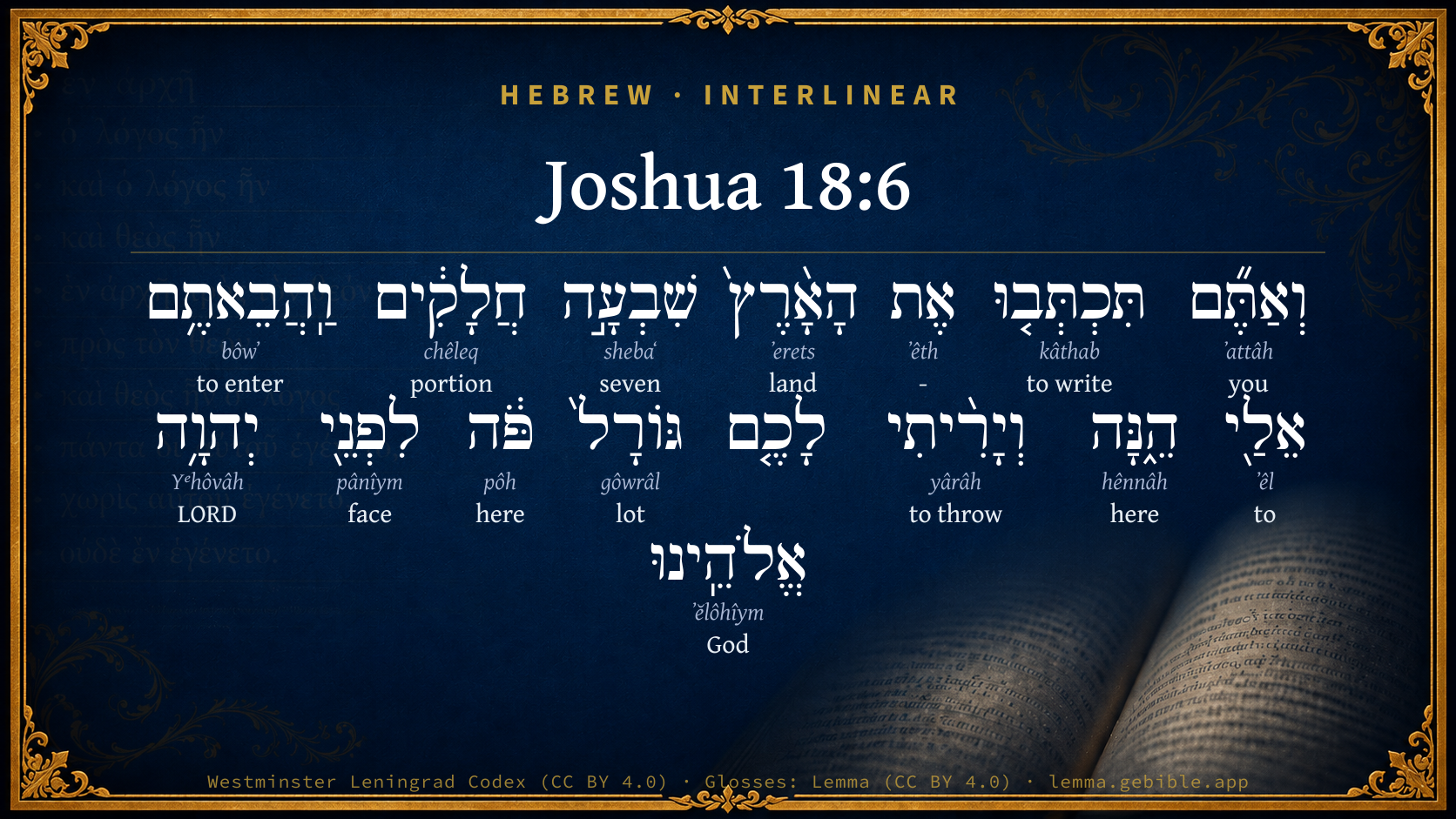
Joshua 18:6

Hebrew (Westminster Leningrad Codex) Joshua 18:6 appears in the Hebrew Old Testament. The text above is from the Westminster Leningrad Codex. Each word links to its Strong’s number, a concise gloss, and parsing drawn from the Open Scriptures Hebrew Bible morphology. Click any word for its full Brown-Driver-Briggs (BDB) entry.
Download image
Cite this verse

Joshua 18:6 (World English Bible). Public Domain. Lemma interlinear Bible study tool, https://lemma.gebible.app/v/joshua/18/6.

Show BibTeX & RIS
BibTeX
RIS
English Translation
You shall describe the land into seven portions, and bring [the description] here to me; and I will cast lots for you here before Yahweh our God.
World English Bible · Public Domain
Download a study sheet

One document with this verse’s original text, its word-by-word gloss line, the meaning frame, cross-references with their text, attributed commentary, and full source and license credits — printable, and it pastes into notes with its structure intact.

This verse Autodidact and up

Study sheet (.html) Plain text (.txt)

A passage Seminary Student

Up to 50 verses in one chapter. A passage sheet keeps up to 6 commentary sources and 12 cross-references per verse, in the order this page ranks them, and says so on the sheet whenever that leaves anything out. Ask for a single verse and you get the Autodidact verse sheet above.

Everything on this page stays free to read, with no account — the sheet is a download of what is already on screen, not access to it.

Want to remove ads? Support Godless Engineer
Compare translations 3

The same verse in 3 English versions, stacked beneath the original-language interlinear above. Click any original word for its lexicon entry.

Each is an independent rendering of the whole verse — the interlinear is not word-aligned to these translations.

Highlighted words mark where these versions differ — a whole-verse word diff, not a word-by-word alignment.

  • World English Bible Public Domain
    You shall describe the land into seven portions, and bring [the description] here to me; and I will cast lots for you here before Yahweh our God.
  • King James Version Public Domain
    Ye shall therefore describe the land into seven parts, and bring the description hither to me, that I may cast lots for you here before the LORD our God.
  • unfoldingWord Literal Text CC BY-SA 4.0
    And you shall write down the land seven divisions and bring them to me here. And I will throw a lot for you here to the face of Yahweh our God.

unfoldingWord Literal Text — © unfoldingWord, licensed CC BY-SA 4.0. Word-aligned USFM3 via Door43 (git.door43.org/unfoldingWord/en_ult).

Versions to compare (up to 4)

3 of 4 selected

Show all 18 translations

Every available English version of this verse, each an independent rendering of the whole verse.

  • World English Bible Public Domain
    You shall describe the land into seven portions, and bring [the description] here to me; and I will cast lots for you here before Yahweh our God.
  • Berean Standard Bible Public Domain
    When you have mapped out the seven portions of land and brought it to me, I will cast lots for you here in the presence of the LORD our God.
  • Majority Standard Bible Public Domain
    When you have mapped out the seven portions of land and brought it to me, I will cast lots for you here in the presence of the LORD our God.
  • King James Version Public Domain
    Ye shall therefore describe the land into seven parts, and bring the description hither to me, that I may cast lots for you here before the LORD our God.
  • American Standard Version (1901) Public Domain
    And ye shall describe the land into seven portions, and bring `the description' hither to me; and I will cast lots for you here before Jehovah our God.
  • Revised Version (1885) Public Domain
    And ye shall describe the land into seven portions, and bring the description hither to me: and I will cast lots for you here before the LORD our God.
  • Geneva Bible (1599) Public Domain
    Ye shall describe the land therefore into seuen partes, and shall bring them hither to me, and I will cast lottes for you here before the Lord our God.
  • Douay-Rheims (1899) Public Domain
    Divide to yourselves the land into seven parts: let Juda be in his bounds on the south side, and the house of Joseph on the north.
  • Young's Literal Translation Public Domain
    and ye describe the land `in' seven portions, and have brought `it' in unto me hither, and I have cast for you a lot here before Jehovah our God;
  • Literal Standard Version CC BY-SA 4.0
    and you describe the land [in] seven portions, and have brought [it] to me here, and I have cast a lot for you here before our God YHWH;
  • Unlocked Literal Bible CC BY-SA 4.0
    You will describe the land in seven sections and bring the description here to me. I will cast lots for you here before Yahweh our God.
  • unfoldingWord Literal Text CC BY-SA 4.0
    And you shall write down the land seven divisions and bring them to me here. And I will throw a lot for you here to the face of Yahweh our God.
  • Darby Bible Public Domain
    and *ye* shall describe the land into seven portions, and bring [the description] hither to me, and I will cast lots for you here before Jehovah our God.
  • World Messianic Bible Public Domain
    You shall survey the land into seven parts, and bring the description here to me; and I will cast lots for you here before the LORD our God.
  • Webster's Bible Public Domain
    Ye shall therefore describe the land in seven parts, and bring the description hither to me, that I may cast lots for you here before the LORD our God.
  • Free Bible Version CC BY-SA 4.0
    Once you have written the description about the land, divided into seven parts, you will bring it to me here and I will cast lots for you in the presence of the Lord our God.
  • Bible in Basic English Public Domain
    And you are to have the land marked out in seven parts, and come back to me with the record; and I will make the distribution for you here by the decision of the Lord our God.
  • JPS Tanakh (1917) Public Domain
    And ye shall describe the land into seven portions, and bring the description hither to me; and I will cast lots for you here before the LORD our God.

Literal Standard Version (2020), Covenant Press — licensed CC BY-SA 4.0. Text via the HelloAO Bible API (eBible.org). Unlocked Literal Bible (unfoldingWord) — licensed CC BY-SA 4.0. Text via the HelloAO Bible API (eBible.org). unfoldingWord Literal Text — © unfoldingWord, licensed CC BY-SA 4.0. Word-aligned USFM3 via Door43 (git.door43.org/unfoldingWord/en_ult). Free Bible Version, Dr. Jonathan Gallagher — licensed CC BY-SA 4.0. Text via the HelloAO Bible API (eBible.org).

Word by word

More ways to search: Search by grammar → Find every occurrence → Compare this word →

Practice this passage: Drill this verse → Learn its vocabulary →

הֵ֑נָּה
hênnâh
H2008
“here”
Adverb
Part of Speech
Adverb
Full BDB Definition

Origin: from H2004

TWOT: 510b

here, there, now, hither
  1. וְאַתֶּ֞ם ʼattâh H859 “and · you” Conjunction + Pronoun, Personal, 2nd Person, Masculine, Plural
  2. תִּכְתְּב֤וּ kâthab H3789 “to write” Verb, Qal, Imperfect, 2nd Person, Masculine, Plural
  3. אֶת ʼêth H853 “-” Particle, Direct Object
  4. הָאָ֨רֶץ֙ ʼerets H776 “the · land” Particle, Definite Article + Noun, Common, Both, Singular, Absolute
  5. שִׁבְעָ֣ה shebaʻ H7651 “seven” Adjective, Cardinal number, Masculine, Singular, Absolute
  6. חֲלָקִ֔ים chêleq H2506 “portions” Noun, Common, Masculine, Plural, Absolute
  7. וַֽהֲבֵאתֶ֥ם bôwʼ H935 “and · to enter” Conjunction + Verb, Hiphil, Sequential Perfect, 2nd Person, Masculine, Plural
  8. אֵלַ֖י ʼêl H413 “to · me” Preposition + Suffix, Personal, 1st Person, Common, Singular
  9. וְיָרִ֨יתִי yârâh H3384 “and · to throw” Conjunction + Verb, Qal, Sequential Perfect, 1st Person, Common, Singular
  10. גּוֹרָל֙ gôwrâl H1486 “lot” Noun, Common, Masculine, Singular, Absolute
  11. פֹּ֔ה pôh H6311 “here” Adverb
  12. לִפְנֵ֖י pânîym H6440 “to/for · face(s) of” Preposition + Noun, Common, Both, Plural, Construct
  13. יְהוָ֥ה Yᵉhôvâh H3068 “LORD” Noun, Proper
  14. אֱלֹהֵֽינוּ ʼĕlôhîym H430 “God(s) · our” Noun, Common, Masculine, Plural, Construct + Suffix, Personal, 1st Person, Common, Plural

About this verse

These counts appear in no published source. They are computed here, from the morphology-tagged text and Lemma’s own curated glosses. What Lemma adds →

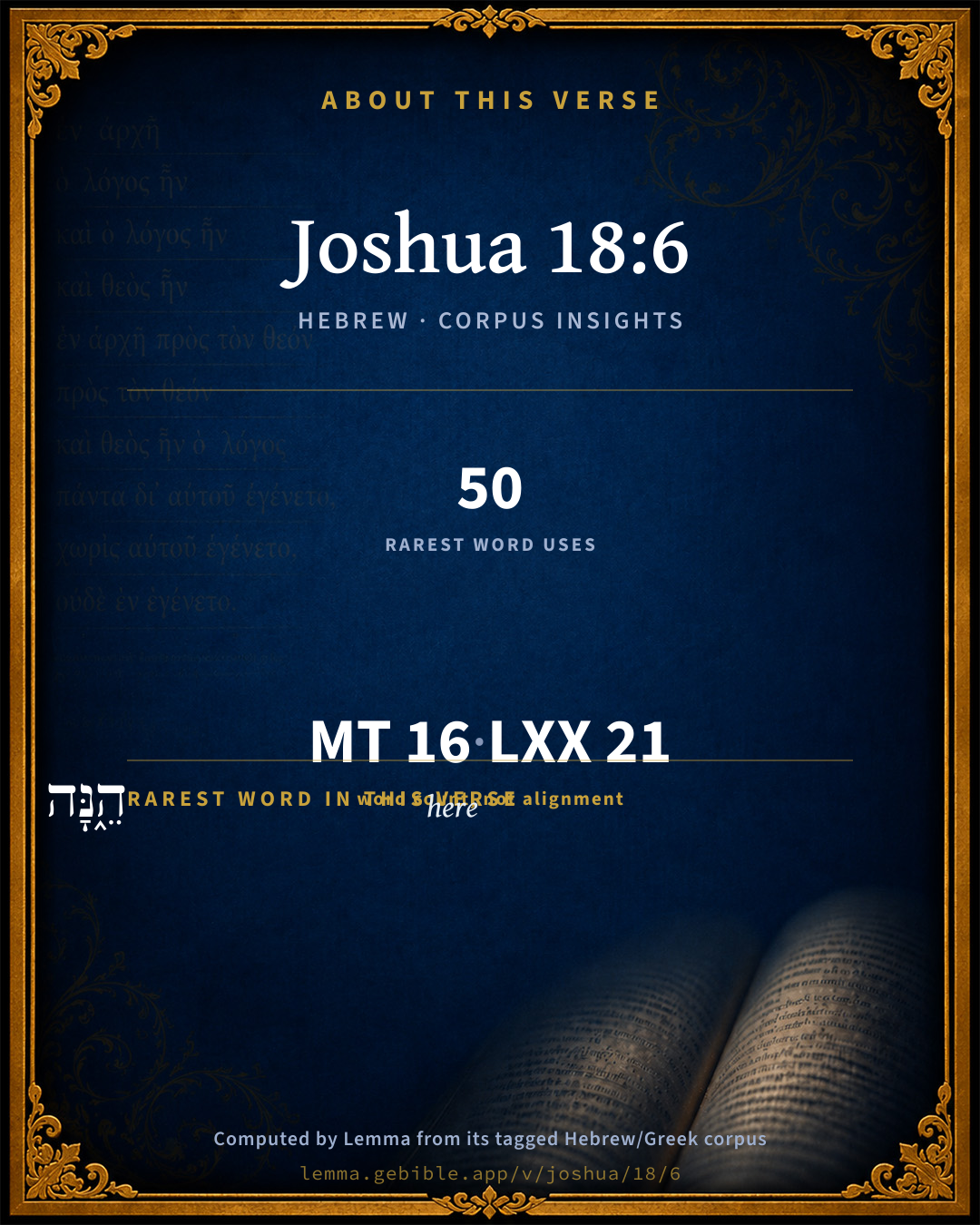
16
words
15
distinct lemmas
Historical
section

Shared distinctive vocabulary

הֵ֑נָּה here H2008 occurs in 42 verses of the Hebrew Bible. Also found in:

Grammatical profile

  • 3 verbs
  • 6 nouns
  • 1 adjective
  • 1 pronoun
  • 2 prepositions
  • 2 adverbs
  • 1 particle

Verb forms

  • תִּכְתְּב֤וּ Qal · Imperfect
  • וַֽהֲבֵאתֶ֥ם Hiphil · Sequential Perfect
  • וְיָרִ֨יתִי Qal · Sequential Perfect

Hebrew & Septuagint length

In English translation the verse runs 27 words from the Hebrew and 28 from the Septuagint (LXX English) — closely comparable.

A rough comparison of the two English renderings, which tokenize alike — not a word-level alignment.

Word counts can differ between the Hebrew and the Greek without any difference in meaning — e.g. the Hebrew direct-object marker אֵת has no separate Greek word, and Greek often adds the article ὁ.

In the original languages it is 16 Hebrew tokens and 21 Greek tokens — but the two are counted differently (Hebrew bundles its prefixes and suffixes into one token; the Greek is in lemma form), so that isn’t a like-for-like length.

Cross-references

10

Topical passages linked to Joshua 18:6 in the Treasury of Scripture Knowledge — connected by theme and wording, ordered by reader-vote popularity; previews shown in the World English Bible.

  • Joshua 14:2 by the lot of their inheritance, as Yahweh commanded by Moses, for the nine tribes, and for the half-tribe.
  • Joshua 18:10 Joshua cast lots for them in Shiloh before Yahweh: and there Joshua divided the land to the children of Israel according to their divisions.
  • Acts 13:19 When he had destroyed seven nations in the land of Canaan, he gave them their land for an inheritance, for about four hundred fifty years.
  • Numbers 26:54–55 To the more you shall give the more inheritance, and to the fewer you shall give the less inheritance: to everyone according to those who were numbered of him shall his inheritance be given.
  • Numbers 33:54 You shall inherit the land by lot according to your families; to the more you shall give the more inheritance, and to the fewer you shall give the less inheritance: wherever the lot falls to any man, that shall be his; according to the tribes of your fathers shall you inherit.
  • Numbers 34:13 Moses commanded the children of Israel, saying, This is the land which you shall inherit by lot, which Yahweh has commanded to give to the nine tribes, and to the half-tribe;
  • Joshua 18:8 The men arose, and went: and Joshua charged those who went to describe the land, saying, Go and walk through the land, and describe it, and come again to me; and I will cast lots for you here before Yahweh in Shiloh.
  • Psalms 105:11 Saying, "To you I will give the land of Canaan, The lot of your inheritance;"
  • Proverbs 16:33 The lot is cast into the lap, But its every decision is from Yahweh.
  • Proverbs 18:18 The lot settles disputes, And keeps strong ones apart.

Cross-references courtesy of OpenBible.info (CC BY 4.0).

Hebrew and Greek witnesses Masoretic Hebrew ↔ Greek Septuagint

The same verse in the two great witnesses to the Old Testament, shown verse-for-verse.

These are two independent witnesses, not word-aligned to each other, and the Septuagint is shown in lemma (dictionary) form.

Hebrew Joshua 18:6 Masoretic · Westminster Leningrad Codex

וְאַתֶּ֞ם תִּכְתְּב֤וּ אֶת הָאָ֨רֶץ֙ שִׁבְעָ֣ה חֲלָקִ֔ים וַֽהֲבֵאתֶ֥ם אֵלַ֖י הֵ֑נָּה וְיָרִ֨יתִי לָכֶ֤ם גּוֹרָל֙ פֹּ֔ה לִפְנֵ֖י יְהוָ֥ה אֱלֹהֵֽינוּ

You shall describe the land into seven portions, and bring [the description] here to me; and I will cast lots for you here before Yahweh our God.

World English Bible · Public Domain

Greek LXX Joshua 18:6 Septuagint · lemma form

σύ δέ μερίζω ὁ γῆ ἑπτά μερίς καί φέρω πρός ἐγώ ὧδε καί ἐκφέρω σύ κλῆρος ἔναντι κύριος ὁ θεός ἐγώ

And do you⌃ divide the land into seven parts, and bring the description hither to me, and I will give you a lot before the Lord our God.

LXX2012 (modern English Septuagint) · Public Domain

Hebrew: Westminster Leningrad Codex (CC BY 4.0). Greek: Septuagint (public domain); English from LXX2012 (modern English Septuagint) (Public Domain). How the Septuagint differs from the Hebrew →

Targum (Aramaic paraphrase)

1

The Targum is the ancient Jewish Aramaic paraphrase of the Hebrew Scriptures — an interpretive translation, not the Hebrew text itself. Onkelos (literal) and Pseudo-Jonathan (expansive) render the Torah, and Jonathan the Prophets. Coverage is partial: where no permissively-licensed English translation exists for a verse, only the Aramaic is shown. This is verse-level text, not a word-by-word alignment to the Hebrew.

  1. Targum Jonathan Prophets (Joshua–Malachi)
    וְאַתּוּן תִּכְתְּבוּן יַת אַרְעָא לְשִׁבְעָא חוּלְקִין וְתַיְתוּן לְוָתִי הַלְכָא וְאַרְמֵי לְכוֹן עַדְבָא הַלְכָא קֳדָם יְיָ אֱלָהָנָא:

    (no public-domain English translation for this verse)

    Targum Jonathan — Aramaic: “Mikraot Gedolot” (public domain). English: “Sefaria Community Translation” (CC0 1.0 (public-domain dedication)); “London "Chaldee Paraphrase," 1871” (public domain). Text via Sefaria.

Commentary

Notes on Joshua 18:6 from classic Christian and Jewish commentators (each source and its license shown beneath its notes). The classic Christian expositions comment on the surrounding passage and are grouped to its opening verse, so a note may address several verses; the Jewish commentaries on the Tanakh (Rashi and others) are per-verse, so they appear only where the commentator wrote on this verse.

Lemma curates 59 commentaries, every one of them public domain or Creative Commons licensed, each selected and text-cleaned for this edition rather than reprinted as found. About our sources →

Trapp's Complete Commentary

John Trapp

Jos 18:6 Ye shall therefore describe the land [into] seven parts, and bring [the description] hither to me, that I may cast lots for you here before the LORD our God.

Ver. 6. That I may cast lots here for you before the Lord.] He it is that must judge of your proceedings, and to whom you must approve yourselves: see therefore that ye deal uprightly and impartially; since to God you must be accountable. Cave, spectat Cato, was a watchword among the Romans.

John Trapp, A Commentary or Exposition upon All the Books of the Old and New Testament (1647–1656) — public domain. Text from a community e-Sword module.

Joseph Benson's Commentary

Jos 18:6. That I may cast lots for you here before the Lord — That is, before the ark or tabernacle, that God may be witness and judge, and be acknowledged to be the author of the division, and each tribe may be contented with its lot, as being appointed by divine authority, and that your several possessions may be secured to you as things sacred.

Joseph Benson's Commentary on the Old and New Testaments (1811–1818) — public domain. Text from a community e-Sword module.

Tyndale Open Study Notes

Tyndale Open Resources

18:6 Joshua publicly cast sacred lots to eliminate envy or suspicion (see also study note on 7:16-18).

Tyndale Open Study Notes — © Tyndale Open Resources, licensed CC BY-SA 4.0. Text via the HelloAO Bible API.

Geneva Bible (1599)

Geneva Bible translators

Before the Ark of the Lord.

Geneva Bible (1599) marginal notes — public domain. Text via Bolls.life.

The Cambridge Bible for Schools and Colleges

gen. ed. J. J. S. Perowne

6. before the Lord our God] i.e. before the “Tabernacle of Meeting,” where Jehovah manifested His presence to the people, enthroned above the Cherubim of the Ark of the Covenant.

The Cambridge Bible for Schools and Colleges (gen. ed. J. J. S. Perowne; Cambridge University Press, 1878–1918) — public domain. Text from a community e-Sword module.

John Gill's Exposition

Ye shall therefore describe the land into seven parts,.... Or ye shall describe the land, even the seven parts of it when divided; it seems as if they were first to describe in general all the land not disposed of, and then divide it into seven parts, and make a particular description of each part, or form a plan, or draw a map of every part:

and bring the description hither to me; not by word of mouth, but as written in a book, or marked out in a map, and laid before him, see Jos 18:9,

that I may cast lots for you here before the Lord your God; in Shiloh, at the door of the tabernacle, and so before the Lord who dwelt in it, at whose disposal the lot was, and by which everyone of the seven tribes would have their part and portion assigned them most fitting and convenient for them, according to the will and counsel of God, in which it became them to acquiesce.

John Gill's Exposition of the Whole Bible (1746–1763) — public domain (CC PDM 1.0). Text via the HelloAO Bible API.

Haydock's Catholic Bible Commentary

The land in the midst, between these mark ye out into seven parts: that is to say the rest of the land, which is not already assigned to Juda or Joseph. (Challoner) --- For we must not suppose that Joseph occupied the most northern parts of the country, so as, with Juda on the south, to enclose all the other tribes. (Haydock) --- Hebrew, "As for you, you shall describe the land into seven parts." (Calmet) --- Only the tribe of Benjamin was between these two tribes, (ver. 11,) so that Serarius thinks that mediam had been substituted for aliam, "the other." (Menochius) --- Lots. The deputies divided the country into seven portions, equal in goodness, though not in extent. After the lots were drawn, some alterations might be made by common consent, and those tribes which were too much straitened for room, received what was requisite among those who had too large a territory. Hence we find Joseph occupying the cities of Issachar, &c., chap xvii. 10. It was equally inconvenient to have too much or too little.

George Leo Haydock (1774–1849), Haydock's Catholic Family Bible and Commentary, 1859 edition — public domain. Excludes Psalms (Douay-Rheims chapter numbering differs from Protestant) and Deuterocanonical books (Catholic canon only).

Matthew Poole's English Annotations

i.e. Before the ark or tabernacle, that God may be witness, and judge, and author of the division, that each may be contented with his lot, and that your several possessions may be secured to you as things sacred, and not to be alienated.

Matthew Poole's English Annotations on the Holy Bible (1683–1685) — public domain. Text from a community e-Sword/MySword module.

Whedon's Commentary on the Bible

Daniel D. Whedon

6. Before the Lord — Before the tabernacle at Shiloh, (Jos_18:10,) in which dwelt the Shekinah, the Divine Presence.

Daniel D. Whedon (gen. ed.), Commentary on the Old and New Testaments (1874–1909) — public domain. Text from a community e-Sword module.

The Pulpit Commentary

Ye shall therefore describe the land into seven parts. Literally, ye shall write the land, seven parts. Similarly in ver. 8. That is to say, a written report was to be brought up in seven parts, a fair and equal division of the land having previously been agreed upon among the commissioners. This report having been accepted, division was afterwards made (ver. 10) by lot. Bishop Horsley and Houbigant here, as elsewhere, would rearrange the chapter, supposing it to have been accidentally transposed. But there seems no ground for the supposition. The repetition, with its additional particulars at each repetition, is quite in the style of the author (see Jos 2 and notes). That I may cast lots. Or, and I will cast a lot. The somewhat unusual word hry to throw, is used here. The more usual word is lyPh caused to fall, though other expressions are also used.

The Pulpit Commentary (1880–1919), ed. H.D.M. Spence-Jones & Joseph S. Exell — public domain. Text from a community e-Sword module.

John Wesley's Explanatory Notes

Before the Lord - That is, before the ark or tabernacle, that God may be witness and judge, and author of the division, that each may be contented with his lot, and that your several possessions may be secured to you as things sacred.

John Wesley, Explanatory Notes Upon the Whole Bible (1754–1765) — public domain. Text via the GEBible commentary corpus.

Rashi

Rabbi Shlomo Yitzchaki (Rashi)

I will cast.—I will throw, similar to, ‘He threw into the sea.’

Rashi on the Tanakh — English translations: “The Judaica Press complete Tanach with Rashi, translated by A. J. Rosenberg” (CC BY 4.0); “Pentateuch with Rashi's commentary by M. Rosenbaum and A.M. Silbermann, 1929-1934” (public domain); “The Metsudah Tanach series, Lakewood, N.J” (CC BY 4.0); and “The Book of Joshua, Metsudah Publications, 1997” (CC BY 4.0). Text via Sefaria.

Lesson kit

Teaching starters — assembled from the data on this page, not authored interpretation. Every prompt links to the verse data it draws on. Edit before teaching.

Joshua, in the Historical, opens this verse with 16 words (15 distinct Hebrew lemmas). Its most distinctive word is hênnâh (“here”). A historical commentator’s framing appears above. Read the whole chapter for the surrounding context.

Discussion questions

  1. What does “here” (hênnâh) contribute to the verse as a whole?
  2. How does Genesis 15:16, which shares the word «here», read alongside this verse?
  3. The translations on this page render this verse differently — a whole-verse word diff, not a word-by-word alignment. What might account for the different wordings?
  4. «תִּכְתְּב֤וּ» is a Qal Imperfect verb. How does that grammatical form shape the action described?
  5. Compare how Trapp's Complete Commentary and Joseph Benson's Commentary read this verse. Where do they agree or differ?

Things to notice

Reading settings

Reading text

Shown beneath each verse's original-language words.

Old Testament
Old Testament edition

Read the OT as the Masoretic Hebrew (MT) or the Greek Septuagint (LXX).

English shown for the Greek Septuagint (in the Hebrew ↔ Greek comparison).

Comparing translations? Open the Compare panel on any verse page to stack up to four side by side.