
Isaiah 11:15

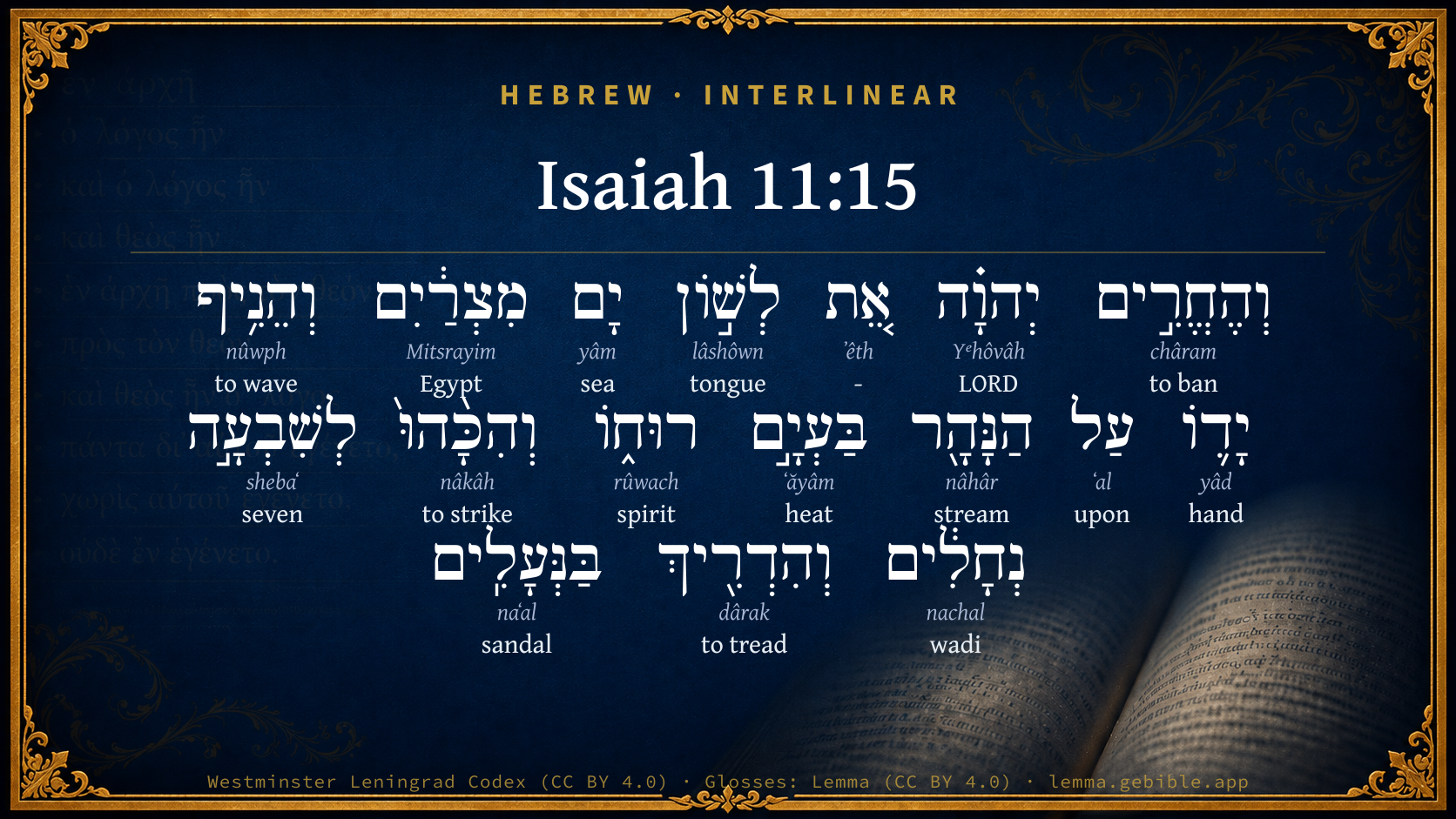
Hebrew (Westminster Leningrad Codex) Isaiah 11:15 appears in the Hebrew Old Testament. The text above is from the Westminster Leningrad Codex. Each word links to its Strong’s number, a concise gloss, and parsing drawn from the Open Scriptures Hebrew Bible morphology. Click any word for its full Brown-Driver-Briggs (BDB) entry.
Download image
Cite this verse

Isaiah 11:15 (World English Bible). Public Domain. Lemma interlinear Bible study tool, https://lemma.gebible.app/v/isaiah/11/15.

Show BibTeX & RIS
BibTeX
RIS
English Translation
Yahweh will utterly destroy the tongue of the Egyptian sea; and with his scorching wind will he wave his hand over the River, and will strike it into seven streams, and cause men to march over in sandals.
World English Bible · Public Domain
Highlights
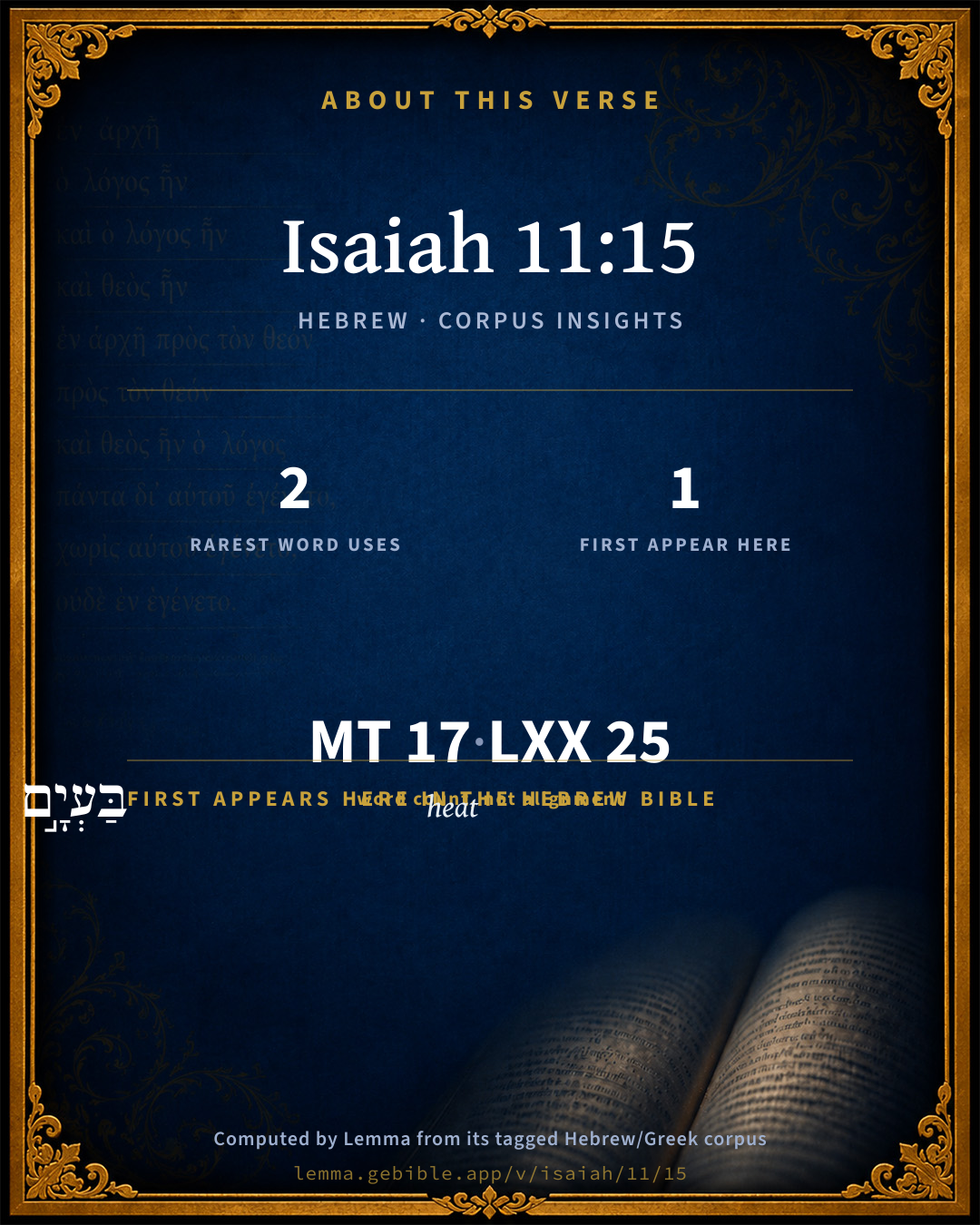
  • 1 first appearance in the Hebrew Bible
Full analysis ↓
Download a study sheet

One document with this verse’s original text, its word-by-word gloss line, the meaning frame, cross-references with their text, attributed commentary, and full source and license credits — printable, and it pastes into notes with its structure intact.

This verse Autodidact and up

Study sheet (.html) Plain text (.txt)

A passage Seminary Student

Up to 50 verses in one chapter. A passage sheet keeps up to 6 commentary sources and 12 cross-references per verse, in the order this page ranks them, and says so on the sheet whenever that leaves anything out. Ask for a single verse and you get the Autodidact verse sheet above.

Everything on this page stays free to read, with no account — the sheet is a download of what is already on screen, not access to it.

Want to remove ads? Support Godless Engineer
Compare translations 3

The same verse in 3 English versions, stacked beneath the original-language interlinear above. Click any original word for its lexicon entry.

Each is an independent rendering of the whole verse — the interlinear is not word-aligned to these translations.

Highlighted words mark where these versions differ — a whole-verse word diff, not a word-by-word alignment.

  • World English Bible Public Domain
    Yahweh will utterly destroy the tongue of the Egyptian sea; and with his scorching wind will he wave his hand over the River, and will strike it into seven streams, and cause men to march over in sandals.
  • King James Version Public Domain
    And the LORD shall utterly destroy the tongue of the Egyptian sea; and with his mighty wind shall he shake his hand over the river, and shall smite it in the seven streams, and make men go over dryshod.
  • unfoldingWord Literal Text CC BY-SA 4.0
    And Yahweh will devote the tongue of the Sea of Egypt, and he will wave his hand over the River with the dryness of his wind, and he will strike it into seven streams, and he will make walk in sandals.

unfoldingWord Literal Text — © unfoldingWord, licensed CC BY-SA 4.0. Word-aligned USFM3 via Door43 (git.door43.org/unfoldingWord/en_ult).

Versions to compare (up to 4)

3 of 4 selected

Show all 18 translations

Every available English version of this verse, each an independent rendering of the whole verse.

  • World English Bible Public Domain
    Yahweh will utterly destroy the tongue of the Egyptian sea; and with his scorching wind will he wave his hand over the River, and will strike it into seven streams, and cause men to march over in sandals.
  • Berean Standard Bible Public Domain
    The LORD will devote to destruction the gulf of the Sea of Egypt; with a scorching wind He will sweep His hand over the Euphrates. He will split it into seven streams for men to cross with dry sandals.
  • Majority Standard Bible Public Domain
    The LORD will devote to destruction the gulf of the Sea of Egypt; with a scorching wind He will sweep His hand over the Euphrates. He will split it into seven streams for men to cross with dry sandals.
  • King James Version Public Domain
    And the LORD shall utterly destroy the tongue of the Egyptian sea; and with his mighty wind shall he shake his hand over the river, and shall smite it in the seven streams, and make men go over dryshod.
  • American Standard Version (1901) Public Domain
    And Jehovah will utterly destroy the tongue of the Egyptian sea; and with his scorching wind will he wave his hand over the River, and will smite it into seven streams, and cause men to march over dryshod.
  • Revised Version (1885) Public Domain
    And the LORD shall utterly destroy the tongue of the Egyptian sea; and with his scorching wind shall he shake his hand over the River, and shall smite it into seven streams, and cause men to march over dryshod.
  • Geneva Bible (1599) Public Domain
    The Lord also shall vtterly destroy the tongue of the Egyptians sea, and with his mightie winde shall lift vp his hand ouer the riuer, and shall smite him in his seuen streames, and cause men to walke therein with shooes.
  • Douay-Rheims (1899) Public Domain
    And the Lord shall lay waste the tongue of the sea of Egypt, and shall lift up his hand over the river in the strength of his spirit: and he shall strike it in the seven streams, so that men may pass through it in their shoes.
  • Young's Literal Translation Public Domain
    And Jehovah hath devoted to destruction The tongue of the sea of Egypt, And hath waved His hand over the river, In the terror of his wind, And hath smitten it at the seven streams, And hath caused `men' to tread `it' with shoes.
  • Literal Standard Version CC BY-SA 4.0
    And YHWH has devoted to destruction || The tongue of the Sea of Egypt, || And has waved His hand over the river, || In the terror of His wind, || And has struck it at the seven streams, || And has caused [men] to tread [it] with shoes.
  • Unlocked Literal Bible CC BY-SA 4.0
    Yahweh will completely destroy the gulf of the Sea of Egypt. With his scorching wind he will wave his hand over the Euphrates River and will divide it into seven streams, so it can be crossed over in sandals.
  • unfoldingWord Literal Text CC BY-SA 4.0
    And Yahweh will devote the tongue of the Sea of Egypt, and he will wave his hand over the River with the dryness of his wind, and he will strike it into seven streams, and he will make walk in sandals.
  • Darby Bible Public Domain
    And Jehovah will utterly destroy the tongue of the Egyptian sea; and with his mighty wind will he shake his hand over the river, and will smite it into seven streams, and make [men] go over dryshod.
  • World Messianic Bible Public Domain
    The LORD will utterly destroy the tongue of the Egyptian sea; and with his scorching wind he will wave his hand over the River, and will split it into seven streams, and cause men to march over in sandals.
  • Webster's Bible Public Domain
    And the LORD will utterly destroy the tongue of the Egyptian sea; and with his mighty wind will he shake his hand over the river, and will smite it in the seven streams, and make men go over dry shod.
  • Free Bible Version CC BY-SA 4.0
    The Lord will divide the Gulf of Suez; he will wave his hand over the Euphrates River creating a scorching wind. He will split it into seven streams so that people can cross easily on foot.
  • Bible in Basic English Public Domain
    And the Lord will make the tongue of the Egyptian sea completely dry; and with his burning wind his hand will be stretched out over the River, and it will be parted into seven streams, so that men may go over it with dry feet.
  • JPS Tanakh (1917) Public Domain
    And the LORD will utterly destroy the tongue of the Egyptian sea; and with His scorching wind will He shake His hand over the River, and will smite it into seven streams, and cause men to march over dry-shod.

Literal Standard Version (2020), Covenant Press — licensed CC BY-SA 4.0. Text via the HelloAO Bible API (eBible.org). Unlocked Literal Bible (unfoldingWord) — licensed CC BY-SA 4.0. Text via the HelloAO Bible API (eBible.org). unfoldingWord Literal Text — © unfoldingWord, licensed CC BY-SA 4.0. Word-aligned USFM3 via Door43 (git.door43.org/unfoldingWord/en_ult). Free Bible Version, Dr. Jonathan Gallagher — licensed CC BY-SA 4.0. Text via the HelloAO Bible API (eBible.org).

Word by word

More ways to search: Search by grammar → Find every occurrence → Compare this word →

Practice this passage: Drill this verse → Learn its vocabulary →

בַּעְיָ֣ם
ʻăyâm
H5868
“in/at · heat of”
Preposition + Noun, Common, Masculine, Singular, Construct
Part of Speech
Preposition + Noun
Type
Common
Gender
Masculine
Number
Singular
State
Construct
Full BDB Definition

Origin: of doubtful origin and authenticity

TWOT: 1611

glow, heat - meaning dubious
  1. וְהֶחֱרִ֣ים châram H2763 “and · to ban” Conjunction + Verb, Hiphil, Sequential Perfect, 3rd Person, Masculine, Singular
  2. יְהוָ֗ה Yᵉhôvâh H3068 “LORD” Noun, Proper
  3. אֵ֚ת ʼêth H853 “-” Particle, Direct Object
  4. לְשׁ֣וֹן lâshôwn H3956 “tongue of” Noun, Common, Both, Singular, Construct
  5. יָם yâm H3220 “sea of” Noun, Common, Masculine, Singular, Construct
  6. מִצְרַ֔יִם Mitsrayim H4714 “Egypt” Noun, Proper
  7. וְהֵנִ֥יף nûwph H5130 “and · to wave” Conjunction + Verb, Hiphil, Sequential Perfect, 3rd Person, Masculine, Singular
  8. יָד֛וֹ yâd H3027 “hand · his” Noun, Common, Both, Singular, Construct + Suffix, Personal, 3rd Person, Masculine, Singular
  9. עַל ʻal H5921 “upon” Preposition
  10. הַנָּהָ֖ר nâhâr H5104 “the · stream” Particle, Definite Article + Noun, Common, Masculine, Singular, Absolute
  11. רוּח֑וֹ rûwach H7307 “spirit · his” Noun, Common, Both, Singular, Construct + Suffix, Personal, 3rd Person, Masculine, Singular
  12. וְהִכָּ֨הוּ֙ nâkâh H5221 “and · to strike · him” Conjunction + Verb, Hiphil, Sequential Perfect, 3rd Person, Masculine, Singular + Suffix, Personal, 3rd Person, Masculine, Singular
  13. לְשִׁבְעָ֣ה shebaʻ H7651 “to/for · seven” Preposition + Adjective, Cardinal number, Masculine, Singular, Absolute
  14. נְחָלִ֔ים nachal H5158 “wadis” Noun, Common, Masculine, Plural, Absolute
  15. וְהִדְרִ֖יךְ dârak H1869 “and · to tread” Conjunction + Verb, Hiphil, Sequential Perfect, 3rd Person, Masculine, Singular
  16. בַּנְּעָלִֽים naʻal H5275 “in/at the · sandals” Preposition, Determined + Noun, Common, Feminine, Plural, Absolute

About this verse

These counts appear in no published source. They are computed here, from the morphology-tagged text and Lemma’s own curated glosses. What Lemma adds →

17
words
17
distinct lemmas
Prophets
section

Notable vocabulary

The rarest word here is בַּעְיָ֣ם heat H5868 — appearing just 2 times in the whole Hebrew Bible.

First appearance in Scripture

This word makes its first canonical appearance in the Hebrew Bible here:

  • בַּעְיָ֣ם heat H5868

Shared distinctive vocabulary

בַּעְיָ֣ם heat H5868 occurs in 2 verses of the Hebrew Bible. Also found in:

Grammatical profile

  • 4 verbs
  • 10 nouns
  • 1 adjective
  • 1 preposition
  • 1 particle

Verb forms

  • וְהֶחֱרִ֣ים Hiphil · Sequential Perfect
  • וְהֵנִ֥יף Hiphil · Sequential Perfect
  • וְהִכָּ֨הוּ֙ Hiphil · Sequential Perfect
  • וְהִדְרִ֖יךְ Hiphil · Sequential Perfect

Hebrew & Septuagint length

In English translation the verse runs 38 words from the Hebrew and 38 from the Septuagint (LXX English) — the same length.

A rough comparison of the two English renderings, which tokenize alike — not a word-level alignment.

Word counts can differ between the Hebrew and the Greek without any difference in meaning — e.g. the Hebrew direct-object marker אֵת has no separate Greek word, and Greek often adds the article ὁ.

In the original languages it is 17 Hebrew tokens and 25 Greek tokens — but the two are counted differently (Hebrew bundles its prefixes and suffixes into one token; the Greek is in lemma form), so that isn’t a like-for-like length.

Cross-references

12

Topical passages linked to Isaiah 11:15 in the Treasury of Scripture Knowledge — connected by theme and wording, ordered by reader-vote popularity; previews shown in the World English Bible.

  • Zechariah 10:11 He will pass through the sea of affliction, And will strike the waves in the sea, And all the depths of the Nile will dry up; And the pride of Assyria will be brought down, And the scepter of Egypt will depart.
  • Revelation 16:12 The sixth poured out his bowl on the great river, the Euphrates. Its water was dried up, that the way might be made ready for the kings that come from the sunrise.
  • Isaiah 50:2 Why, when I came, was there no man? when I called, was there none to answer? Is my hand shortened at all, that it can't redeem? or have I no power to deliver? Behold, at my rebuke I dry up the sea, I make the rivers a wilderness: their fish stink, because there is no water, and die for thirst.
  • Isaiah 7:20 In that day the Lord will shave with a razor that is hired in the parts beyond the River, even with the king of Assyria, the head and the hair of the feet; and it shall also consume the beard.
  • Isaiah 19:16 In that day shall the Egyptians be like women; and they shall tremble and fear because of the shaking of the hand of Yahweh of Hosts, which he shakes over them.
  • Isaiah 19:5–10 The waters shall fail from the sea, and the river shall be wasted and become dry.
  • Isaiah 51:9–10 Awake, awake, put on strength, arm of Yahweh; awake, as in the days of old, the generations of ancient times. Isn't it you who did cut Rahab in pieces, who pierced the monster?
  • Ezekiel 29:10 therefore, behold, I am against you, and against your rivers, and I will make the land of Egypt an utter waste and desolation, from the tower of Seveneh even to the border of Ethiopia.
  • Ezekiel 30:12 I will make the rivers dry, and will sell the land into the hand of evil men; and I will make the land desolate, and all that is therein, by the hand of strangers: I, Yahweh, have spoken it.
  • Exodus 7:19–21 Yahweh said to Moses, "Tell Aaron, 'Take your rod, and stretch out your hand over the waters of Egypt, over their rivers, over their streams, and over their pools, and over all their ponds of water, that they may become blood; and there shall be blood throughout all the land of Egypt, both in vessels of wood and in vessels of stone.'"
  • Exodus 14:21 Moses stretched out his hand over the sea, and Yahweh caused the sea to go back by a strong east wind all the night, and made the sea dry land, and the waters were divided.
  • Psalms 74:13–15 You divided the sea by your strength. You broke the heads of the sea monsters in the waters.

Cross-references courtesy of OpenBible.info (CC BY 4.0).

Hebrew and Greek witnesses Masoretic Hebrew ↔ Greek Septuagint

The same verse in the two great witnesses to the Old Testament, shown verse-for-verse.

These are two independent witnesses, not word-aligned to each other, and the Septuagint is shown in lemma (dictionary) form.

Hebrew Isaiah 11:15 Masoretic · Westminster Leningrad Codex

וְהֶחֱרִ֣ים יְהוָ֗ה אֵ֚ת לְשׁ֣וֹן יָם מִצְרַ֔יִם וְהֵנִ֥יף יָד֛וֹ עַל הַנָּהָ֖ר בַּעְיָ֣ם רוּח֑וֹ וְהִכָּ֨הוּ֙ לְשִׁבְעָ֣ה נְחָלִ֔ים וְהִדְרִ֖יךְ בַּנְּעָלִֽים

Yahweh will utterly destroy the tongue of the Egyptian sea; and with his scorching wind will he wave his hand over the River, and will strike it into seven streams, and cause men to march over in sandals.

World English Bible · Public Domain

Greek LXX Isaiah 11:15 Septuagint · lemma form

καί ἐρημόω κύριος ὁ θάλασσα αἴγυπτος καί ἐπιβάλλω ὁ χείρ αὐτός ἐπί ὁ ποταμός πνεῦμα βίαιος καί πατάσσω ἑπτά φάραγξ ὥστε διαπορεύομαι αὐτός ἐν ὑπόδημα

And the Lord shall make desolate the sea of Egypt; and he shall lay his hand on the river with a strong wind, and he shall strike the seven channels, so that men shall pass through it dry-shod.

LXX2012 (modern English Septuagint) · Public Domain

On this verse, Adam Clarke's Commentary discusses the Septuagint’s reading. Read the note in Commentary ↓

Hebrew: Westminster Leningrad Codex (CC BY 4.0). Greek: Septuagint (public domain); English from LXX2012 (modern English Septuagint) (Public Domain). How the Septuagint differs from the Hebrew →

Targum (Aramaic paraphrase)

1

The Targum is the ancient Jewish Aramaic paraphrase of the Hebrew Scriptures — an interpretive translation, not the Hebrew text itself. Onkelos (literal) and Pseudo-Jonathan (expansive) render the Torah, and Jonathan the Prophets. Coverage is partial: where no permissively-licensed English translation exists for a verse, only the Aramaic is shown. This is verse-level text, not a word-by-word alignment to the Hebrew.

  1. Targum Jonathan Prophets (Joshua–Malachi)
    וְיַבֵּשׁ יְיָ יַת לִישָׁן יַמָא דְמִצְרַיִם וִירֵים מְחַת גְבוּרְתֵּיהּ עַל פְּרָת בְּמֵימַר נְבִיוֹהִי וְיַמְחִינֵיהּ לְשַׁבְעָא נַחְלִין וִיהָכוּן בֵּיהּ בְּסַנְדָלִין:

    And the Lord shall dry up the tongue of the Egyptian sea, and shall lift the stroke of His strength upon Euphrates by the word of His prophets, and shall smite it in seven streams, and men shall walk through it dryshod.

    Targum Jonathan — Aramaic: “Mikraot Gedolot” (public domain). English: “Sefaria Community Translation” (CC0 1.0 (public-domain dedication)); “London "Chaldee Paraphrase," 1871” (public domain). Text via Sefaria.

Commentary

Notes on Isaiah 11:15 from classic Christian and Jewish commentators (each source and its license shown beneath its notes). The classic Christian expositions comment on the surrounding passage and are grouped to its opening verse, so a note may address several verses; the Jewish commentaries on the Tanakh (Rashi and others) are per-verse, so they appear only where the commentator wrote on this verse.

Lemma curates 59 commentaries, every one of them public domain or Creative Commons licensed, each selected and text-cleaned for this edition rather than reprinted as found. About our sources →

Trapp's Complete Commentary

John Trapp

Isa 11:15 And the LORD shall utterly destroy the tongue of the Egyptian sea; and with his mighty wind shall he shake his hand over the river, and shall smite it in the seven streams, and make [men] go over dryshod.

Ver. 15. And the Lord shall utterly destroy the tongue of the Egyptian Sea.] That is, by drying up, or driving away the waters, he shall open a way through the Red Sea, which representeth the form and fashion of a tongue. He alludeth to Exo 14:22; for Christ being our Conduct, we do enter by baptism, as by the Red Sea, into the Church, and after this life present into the kingdom of heaven.

He shall shake his hand over the river.] The river Nile. The sense is, he shall remove all obstacles and impediments. This was fulfilled. {Act 2:41}

With his mighty wind.] The Chaldee paraphraseth in eloquio prophetarum suorum, by the word of his prophets; quod apostolis non parum congruit, saith Oecolampadius, which very well agreeth to the apostles converting the elect, whom neither height nor depth could keep from "the love of God which is in Christ Jesus our Lord." {Rom 8:39} The Jews expect, but in vain, that all these things should be fulfilled unto them in the letter by their Messiah, as once they were by Moses at the Red Sea.

And make men go over dryshod.] Without boat or boot.

John Trapp, A Commentary or Exposition upon All the Books of the Old and New Testament (1647–1656) — public domain. Text from a community e-Sword module.

The Biblical Illustrator

Joseph S. Exell

Isa_11:15

The Lord shall utterly destroy the tongue of the Egyptian sea.

The Egyptian sea and the river

The tongue, i.e., the bay (cf. Jos_15:2)

of the Red Sea (the Gulf of Suez) will be banned, i.e., rendered harmless to those who would cross it, by being dried up; the river (the Euphrates), swift and too deep to be forded as it is, will be split into seven separate channels, which separately may be forded without danger. (Prof. Driver, D. D.)

.

The Biblical Illustrator, edited by Joseph S. Exell (c. 1880s–1900s) — public domain. Text from a community e-Sword module.

Joseph Benson's Commentary

Isa 11:15-16. And the Lord shall utterly destroy — Shall not only divide it, as of old, but shall quite dry it up, that it may be a highway; the tongue of the Egyptian sea — The Red sea, which may well be called the Egyptian sea, both because it borders upon Egypt, and because the Egyptians were drowned in it. It is called a tongue, both here and in the Hebrew text, (Jos 15:2; Jos 15:5,) as having some resemblance to a tongue; and for a similar reason the name of tongue has been given by geographers to promontories of land which shoot forth into the sea, as this sea shoots out of the main ocean into the land. Bishop Lowth renders the clause, Jehovah shall smite with a drought the tongue, &c., following the Chaldee, which, instead of החרים, he destroyed, reads החריב, he dried up. And the next clause, which he understands, not of the river Nile, but of the Euphrates, the bishop very properly translates, “And he shall shake his hand over the river with his vehement wind; and he shall strike it into seven streams, and make them pass over it dry-shod.” Thus also Dr. Waterland, after Vitringa: “He shall shake his hand over the Euphrates, and shall smite it into seven outlets;” that is, he shall divide or separate it into seven small rivers, so as to render it easy to be passed over. What is thus expressed metaphorically in this clause, is declared in plain words in the next verse: And there shall be a highway for the remnant of his people, &c. — As there shall be a highway from Egypt, the Red sea being dried up, so shall there be from Assyria, the river Euphrates being rendered fordable. In other words, and without a figure, all impediments shall be removed, and a way shall be made for the return of God’s Israel from all parts of the world. He mentions Egypt and Assyria particularly, because they were then two flourishing kingdoms which bordered upon Judea, and by turns were the great oppressors of God’s people. And the ten tribes having been carried captive to Assyria, their case especially seemed desperate. But these two kingdoms stand here, in the prophetic style, for the adverse empires in general, especially those of idolatry and superstition, which shall be either destroyed or reduced to such a state of weakness as not to be able to hinder the progress of the conversion of the Jews and Gentiles. “My belief,” says Vitringa, “upon the strength of this prophecy is, that all the impediments of the great empires of the world being removed, which yet delay the perfect completion of the great and excellent promises made to the church, and hinder the calling and collection of the Jews and Gentiles, the empire of the kingdom of Christ will extend itself over the whole world, according to the remarkable prediction of Daniel, chap. 2:35, &c.”

Joseph Benson's Commentary on the Old and New Testaments (1811–1818) — public domain. Text from a community e-Sword module.

Tyndale Open Study Notes

Tyndale Open Resources

11:15-16 Using imagery from Israel’s past exodus, Isaiah encouraged his listeners by promising that God would bring his people out of Assyria the way he brought them out of Egypt (Exod 14:29–15:18; see also Rev 16:12).

Tyndale Open Study Notes — © Tyndale Open Resources, licensed CC BY-SA 4.0. Text via the HelloAO Bible API.

Geneva Bible (1599)

Geneva Bible translators

Meaning, a corner of the sea, that entereth into the land, and hath the form of a tongue.

To wit, Nile, the great river of Egypt, which entereth into the sea with seven streams.

Geneva Bible (1599) marginal notes — public domain. Text via Bolls.life.

Jamieson, Fausset & Brown

Robert Jamieson, A. R. Fausset & David Brown

There shall be a second exodus, destined to eclipse even the former one from Egypt in its wonders. So the prophecies elsewhere (Psa 68:22; Exo 14:22; Zac 10:11). The same deliverance furnishes the imagery by which the return from Babylon is described (Isa 48:20-21).

destroy--literally, "devote," or "doom," that is, dry up; for what God dooms, perishes (Psa 106:9 Nah 1:4).

tongue--the Bubastic branch of the Nile [VITRINGA]; but as the Nile was not the obstruction to the exodus, it is rather the west tongue or Heroöpolite fork of the Red Sea.

with . . . mighty wind--such as the "strong east wind" (Exo 14:21), by which God made a way for Israel through the Red Sea. The Hebrew for "mighty" means terrible. MAURER translates, "With the terror of His anger"; that is, His terrible anger.

in the seven streams--rather, "shall smite it (divide it by smiting) into seven (many) streams, so as to be easily crossed" [LOWTH]. So Cyrus divided the river Gyndes, which retarded his march against Babylon, into three hundred sixty streams, so that even a woman could cross it [HERODOTUS, 1.189]. "The river" is the Euphrates, the obstruction to Israel's return "from Assyria" (Isa 11:16), a type of all future impediments to the restoration of the Jews.

dry shod--Hebrew, "in shoes." Even in sandals they should be able to pass over the once mighty river without being wet (Rev 16:12).

Jamieson, Fausset & Brown — Commentary Critical and Explanatory on the Whole Bible (1871) — public domain (CC PDM 1.0). Text via the HelloAO Bible API.

Adam Clarke's Commentary

Verse 15. The Lord - shall smite it in the seven streams - "Smite with a drought"] The Chaldee reads החריב hecherib; and so perhaps the Septuagint, who have ερημωσει, the word by which they commonly render it. Vulg. desolabit; "shall desolate." The Septuagint, Vulgate, and Chaldee read הדריכהו hidrichahu, "shall make it passable," adding the pronoun, which is necessary: but this reading is not confirmed by any MS.

Here is a plain allusion to the passage of the Red Sea. And the Lord's shaking his hand over the river with his vehement wind, refers to a particular circumstance of the same miracle: for "he caused the sea to go back by a strong east wind all that night, and made the sea dry land," Ex 14:21. The tongue; a very apposite and descriptive expression for a bay such as that of the Red Sea. It is used in the same sense, Jos 15:2; Jos 15:5; Jos 18:19. The Latins gave the same name to a narrow strip of land running into the sea: tenuem producit in aequora linguam. LUCAN. ii. 613. He shall smite the river to its seven streams. This has been supposed to refer to the Nile, because it falls into the Mediterranean Sea by seven mouths: but R. Kimchi understands it of the Euphrates, which is the opinion of some good judges. See the Targum. See below.

Herodotus, lib. i, 189, tells a story of his Cyrus, (a very different character from that of the Cyrus of the Scriptures and Xenophon,) which may somewhat illustrate this passage, in which it is said that God would inflict a kind of punishment and judgment on the Euphrates, and render it fordable by dividing it into seven streams. "Cyrus, being impeded in his march to Babylon by the Gyndes, a deep and rapid river which falls into the Tigris, and having lost one of his sacred white horses that attempted to pass it, was so enraged against the river that he threatened to reduce it, and make it so shallow that it should be easily fordable even by women, who should not be up to their knees in passing it. Accordingly he set his whole army to work, and cutting three hundred and sixty trenches, from both sides of the river, turned the waters into them, and drained them off."

Adam Clarke's Commentary on the Bible (1810–1826) — public domain. Text from a community e-Sword/MySword module.

Ellicott's Commentary for English Readers

(15) The tongue . . .—Better, as in Jos_15:2; Jos_15:5; Jos_18:19, the “bay” or “gulf.” The “Egyptian sea” is the Gulf of Suez, and the prophet pictures to himself another marvel like the passage of the Red Sea in Exo_14:22. The “river,” on the other hand, is the word Commonly used for the Euphrates (Gen_31:21; Jos_24:2), and that meaning is assigned to it here by most commentators, who refer to Isa_44:27 as a parallel. In Isa_19:5, however, it is found, as here, in parallelism with the “sea” of Egypt, and as it there refers to the Nile, that meaning may well be accepted here. The prophet describes, in language which almost excludes the thought of a merely literal fulfilment, a renewal of wonders transcending those of the Exodus, and it was natural that his description should bear the local colouring of the region. He contemplates a return from Egypt as much as from Assyria (Isa_11:11). On this view the words that follow, “will smite it in the seven streams,” refer naturally enough to the seven mouths that enclose and intersect the Delta of the Nile. On the other view, the words may be interpreted as meaning literally, “I will smite it [Euphrates] into seven streams,” and figuratively, “I will reduce the power of Assyria [or Babylon, as an Assyrian city] to insignificance.”

A Bible Commentary for English Readers, edited by Charles John Ellicott (1878–1897) — public domain. Text from a community e-Sword module.

The Cambridge Bible for Schools and Colleges

gen. ed. J. J. S. Perowne

15. Cf. Zec_10:10 f. shall utterly destroy] lit. “lay under the ban.” But the reading of several ancient versions (heḥìrîb for heḥìrîm) gives a better sense: dry up; cf. ch. Isa_50:2. the tongue of the Egyptian sea is the Gulf of Suez (cf. Jos_15:2; Jos_15:5; Jos_18:19).

with his mighty wind] Perhaps with the fierce heat of his breath. The word rendered “fierce heat” does not occur again in Hebrew, but a similar Arabic word is used of internal heat (either physical or mental). The phrase seems misplaced; it belongs to the figure of the drying up of the sea, not to that of shaking the hand. over the river] the Euphrates, as in ch. Isa_7:20, Isa_8:7. smile it in the seven streams] R.V. into seven streams. dryshod] lit. “in sandals.”

15, 16. A miraculous passage prepared for the return of the exiles. The allusions to the Exodus are palpable and extend to the next chapter.

The Cambridge Bible for Schools and Colleges (gen. ed. J. J. S. Perowne; Cambridge University Press, 1878–1918) — public domain. Text from a community e-Sword module.

John Gill's Exposition

And the Lord shall utterly destroy the tongue of the Egyptian sea,.... Which Kimchi and Abarbinel interpret of the Egyptian river Sichor, or the Nile; others of a bay of the Egyptian sea, so called because in the form of a tongue; the destroying of it designs the drying of it up, so that people might pass over it dry shod; the allusion is to the drying up of the Red Sea, when the Israelites came out of Egypt, and passed through it, as on dry land; and it intends the destruction of Egypt itself, not literally by the Romans, in the times of Augustus Caesar, as Jerom thinks, who interprets the "strong wind", in the following clause, of them; but figuratively, the destruction of Rome, which is spiritually called Egypt, Rev 11:8 and the utter destruction of it, by an anathema, and with a curse, from the Lord himself; as the word here used signifies; and which will take place upon the battle at Armageddon, Rev 16:16 which has its name from the word in the text:

and with his mighty wind shall he shake his hand over the river; in allusion to Moses's stretching out his hand over the Red sea, and the Lord's causing it to go back with a strong east wind, Exo 14:21. Some understand this of the river Nile as before, and that because of what follows; but Jarchi and Kimchi interpret it of the river Euphrates, which is commonly understood in Scripture when "the river", without any explication, is made mention of; and so the Targum,

"and the Lord shall dry up the tongue of the Egyptian sea, and shall lift up the stroke of his strength upon Euphrates, by the word of his prophets;''

and this designs the destruction of the Turks, or the Ottoman empire, which is signified by the drying up of the river Euphrates, Rev 16:12 where it is thought by some there is an allusion to the words here:

and shall smite it in the seven streams; which have made some think the river Nile is meant, because that had its seven streams, or gates, as Juvenal calls (o) them, or mouths, by which the sea issued into it; which are called (p) the Canopic or Heracleotic, the Bolbitine or Bolbitic, the Sebennitic, the Phatnitic, the Mendesian, the Tanitic or Saitic, and the Pelusian or Bubastic, from the cities Canopus and Heracleum, Bolbitine, Sebennytus, Phatnus, Mendes, Tanis or Sais, Pelusium, and Bubastus, built on the shore of these entrances; but it may be observed, that the river Euphrates was drained by seven ditches or rivulets by Cyrus, when Babylon was taken, by which means his soldiers entered the city dry shod, to which the allusion may be here; and it may denote the entire destruction of the Turkish empire, in all its branches; for "seven", as Kimchi observes, may signify a multitude, even the many kingdoms, people, and nations, under that jurisdiction:

and make men go over dryshod; or "with shoes", with them on, there being no need to pluck them off, the river and its streams being dried up; by the "men" are, meant the "kings of the east", of which See Gill on Rev 16:12 all these phrases denote the removal of all impediments out of the way of God's people in those parts, in coming over to the Christian religion, and their embracing and professing that.

(o) Satyr. 13. (p) Vid. Plin. Nat. Hist. l. 5. c. 10.

John Gill's Exposition of the Whole Bible (1746–1763) — public domain (CC PDM 1.0). Text via the HelloAO Bible API.

Albert Barnes' Notes on the Bible

And the Lord - The prophet goes on with the description of the effect which shall follow the return of the scattered Jews to God. The language is figurative, and is here drawn from that which was the great storehouse of all the imagery of the Jews - the deliverance of their fathers from the bondage of Egypt. The general sense is, that all the embarrassments which would tend to impede them would be removed; and that God would make their return as easy and as safe, as would have been the journey of their fathers to the land of Canaan, if the ‘Egyptian Sea’ had been removed entirely, and if the ‘river,’ with its ‘seven streams,’ by nature so formidable a barrier, had been dried up, and a path had been made to occupy its former place. Figuratively, the passage means, that all the obstructions to the peace and safety of the people of God would be removed, and that their way would be easy and safe.

The tongue - The Hebrews applied the word ‘tongue’ to anything that resembled a tongue - to a bar of gold Jos 7:21, Jos 7:24; to a flame of fire (note, Isa 5:24; compare Act 2:3); to a bay of the sea, or a gulf, from its shape Jos 15:5; Jos 18:19. So we speak of a tongue of land. When it is said that the Lord would ‘utterly destroy’ it, it is equivalent to saying that it would be entirely dried up; that is, so as to present no obstruction.

Of the Egyptian Sea - Some interpreters, among whom is Vitringa, have supposed that by the tongue of the Egyptian Sea mentioned here, is meant the river Nile, which flows into the Mediterranean, here called, as they suppose, the Egyptian Sea. Vitringa observes that the Nile, before it flows into the Mediterranean, is divided into two streams or rivers, which form the Delta or the triangular territory lying between these two rivers, and bounded on the north by the Mediterranean. The eastern branch of the Nile being the largest, he supposes is called the tongue or “bay” of the Egyptian Sea. But to this interpretation there are obvious objections:

(1) It is not known that the Mediterranean is elsewhere called the Egyptian Sea.

(2) This whole description pertains to the departure of the children of Israel from Egypt The imagery is all drawn from that. But, in their departure, the Nile constituted no obstruction. Their place of residence, in Goshen, was east of the Nile. All the obstruction that they met with, from any sea or river, was from the Red Sea.

(3) The Red Sea is divided, at its northern extremity, into two bays, or forks, which may be called the “tongues” of the sea, and across one of which the Israelites passed in going from Egypt. Of these branches, the western one was called the Heroopolite branch, and the eastern, the Elanitic branch. It was across the western branch that they passed. When it is said that Yahweh would ‘destroy’ this, it means that he would dry it up so that it would be no obstruction; in other words, he would take the most formidable obstructions to the progress of his people out of the way.

And with his mighty wind - With a strong and powerful wind. Michaelis supposes that by this is meant a tempest. But there is, more probably, a reference to a strong and steady hot wind, such as blows over burning deserts, and such as would have a tendency to dry up even mighty waters. The illustration is, probably, derived from the fact that a strong east wind was employed to make a way through the Red Sea Exo 14:21. If the allusion here be rather to a mighty wind or a tempest, than to one that is hot, and that tends to evaporate the waters even of the rivers, then it means that the wind would be so mighty as to part the waters, and make a path through the river, as was done in the Red Sea and at the Jordan. The “idea” is, that God would remove the obstructions to the rapid and complete deliverance and conversion of people.

Shall he shake his hand - This is to indicate that the mighty wind will be sent from God, and that it is designed to effect this passage through the rivers. The shaking of the band, in the Scripture, is usually an indication of anger, or of strong and settled purpose (see Isa 10:32; Isa 13:2; Zec 2:9).

Over the river - Many have understood this as referring to the Nile; but two considerations show that the Euphrates is rather intended:

(1) The term ‘the river’ (הנהר hanâhâr) is usually applied to the Euphrates, called the river, by way of eminence; and when the term is used without any qualification, that river is commonly intended (see the notes at Isa 7:20; Isa 8:7; compare Gen 31:21; Gen 36:37; 1Ki 4:21; Ezr 4:10, Ezr 4:16; Ezr 5:3).

(2) the effect of this smiting of the river is said to be Isa 11:16 that there would be a highway for the people “from Assyria,” which could be caused only by removing the obstruction which is produced by the Euphrates lying between Judea and some parts of Assyria.

And shall smite it - That is to dry it up, or to make it pasable.

In the seven streams - The word ‘streams’ here (נחלים nechâlı̂ym) denotes streams of much less dimensions than a river. It is applied to a “valley” with a brook running through it Gen 26:19; and then to any small brook or stream, or rivulet Gen 32:24; Psa 74:15. Here it denotes brooks or streams that would be fordable. When it is said that the river should be smitten ‘in the seven streams,’ the Hebrew does not mean that it was “already” divided into seven streams, and that God would smite “them,” but it means, that God would smite it “into” seven streams or rivulets; that is, into “many” such rivulets (for the number seven is often used to denote a large indefinite number, Note, Isa 4:1); and the expression denotes, that though the river presented an obstruction, in its natural size, which they could not overcome, yet God would make new channels for it, and scatter it into innumerable rivulets or small streams, so that they could pass ever it dry-shod.

A remarkable illustration of this occurs in Herodotus (i. 189): ‘Cyrus, in his march to Babylon, arrived at the river Gyndes, which, rising in the mountains of Matiene, and passing through the country of the Darneans, loses itself in the Tigris; and this, after flowing by Opis, is finally discharged into the Red Sea. While Cyrus was endeavoring to pass this river, which could not be perfomed without boats, one of the white consecrated horses boldly entering the stream, in his attempts to cross it, was borne away by the rapidity of the current, and totally lost. Cyrus, exasperated by the accident, made a vow that he would render this stream so very insignificant, that women should hereafter be able to cross it without so much as wetting their feet. He accordingly suspended his designs on Babylon, and divided his forces into two parts; he then marked out with a line on each side of the river, one hundred and eighty trenches; these were dug according to his orders, and so great a number of people were employed that he accomplished his purpose; but he thus wasted the whole of that summer’ (see also Seneca, “De Ira.” iii. 21).

Go over dry-shod - Hebrew, ‘In shoes, or sandals.’ The waters in the innumerable rivulets to which the great river should be reduced, would be so shallow, that they could even pass them in their sandals without wetting their feet - a strong figurative expression, denoting that the obstruction would be completely removed. ‘The prophet, under these metaphors, intends nothing else than that there would be no impediment to God when he wished to deliver his people from captivity.’ - (Calvin.)

Albert Barnes' Notes on the Bible (1834–1885) — public domain. Text from a community e-Sword/MySword module.

Haydock's Catholic Bible Commentary

Tongue. Gulf of the Mediterranean, near Pelusium, or the seven mouths of the river Nile. The country was ravaged by Sennacherib, Cambyses, Alex.[Alexander the Great?], and Epiphanes, chap. xix. 4., &c. The Jewish captives shall return thence, chap. l. 3., and Zacharias x. 10.

George Leo Haydock (1774–1849), Haydock's Catholic Family Bible and Commentary, 1859 edition — public domain. Excludes Psalms (Douay-Rheims chapter numbering differs from Protestant) and Deuterocanonical books (Catholic canon only).

Matthew Poole's English Annotations

Shall utterly destroy; shall not only divide it, as of old, but will quite dry it up, that it may be a highway, as it is explained in the next verse.

The tongue of the Egyptian sea; the Red Sea, which may well be called the Egyptian sea, both because it borders upon Egypt, and because the Egyptians were drowned in it, which is called a tongue in the Hebrew text, Jos 15:2,5, as having some resemblance with a tongue; for which reason the name of hath been given by geographers to promontories of land which shoot forth into the sea, as this sea did shoot out of the main ocean into the laud.

Shake his hand; he alludes to Moses’s shaking of his hand with the rod of God in it over the sea;

over the river, to wit, of Egypt, Nilus, as appears both from the foregoing and from the following words.

The seven streams; for which Nilus is famous in all authors, and by which it emptieth itself into the sea.

Matthew Poole's English Annotations on the Holy Bible (1683–1685) — public domain. Text from a community e-Sword/MySword module.

Whedon's Commentary on the Bible

Daniel D. Whedon

15, 16. The wonders which Jehovah wrought for Israel in his escape from Egypt, and will yet work in his deliverances from Assyria, are to be repeated essentially, but in the spiritual sense, in behalf of the dispersed of Israel, or at least the Israel that shall return to Jehovah in those lands. The whole description is exaltedly figurative and the poetry wonderful, considering the small physical scope from within which the terms and vocables are drawn as signs of the prophet’s overflowing conceptions.

And the Lord shall utterly destroy — Shall lay the ban upon the Sea of Egypt: — that which lies between Egypt and Arabia, the Gulf of Suez or the Red Sea, which the children of Israel passed. Jehovah smites it with the ban; he makes it dry again for passage to converted ones out of Egypt toward Zion.

With his mighty wind — With his heated, glowing breath, and wave of hand, as employing mediate agency over the Euphrates. Observe the attention, as before, first on the two great world-kingdoms.

Smite it in the seven streams — Jehovah splinters the great river into seven, or an indefinite number of shallow streams to become, through God’s heated air, dry wadys for an unobstructed highway to the saints from Assyria, as well as in old time there was to God’s typical people out of Egypt. In these terms no literal history is asserted for the future Messianic people, but merely a gradual disappearing of the whole circle of heathendom comes to pass, and tropically the Holy Land is the centre of Messiah’s kingdom.

Daniel D. Whedon (gen. ed.), Commentary on the Old and New Testaments (1874–1909) — public domain. Text from a community e-Sword module.

The Pulpit Commentary

The Lord shall utterly destroy; rather, shall lay under a curse (Aquila, anayematisei ). The tongue of the Egyptian sea. Either the Gulf of Suez or that of Akabah. God shall do away with those obstacles which keep the nations apart and prevent ready intercourse. Both gulfs are thought to have extended anciently considerably further inland than they do at present. With his mighty wind; rather, with the might of his breath (in fortitudine spiritus sui, Vulgate). Shall he shake his hand. A gesture of menace. (comp. Isa_10:32) Over the river. "The river" (hun-unbar) is, as usually, the Euphrates, the great river of Western Asia. And smite it in the seven streams; rather, and smite it into seven streams; i.e. divide its waters among seven channels, so that it may be readily forded, and cease to be a barrier. Dry-shod; literally, in their shoes; i.e. without taking them off;

The Pulpit Commentary (1880–1919), ed. H.D.M. Spence-Jones & Joseph S. Exell — public domain. Text from a community e-Sword module.

John Wesley's Explanatory Notes

Destroy - Shall not only divide it, as of old, but dry it up, that it may be an high-way. The sea - The Red Sea, which may well be called the Egyptian sea, both because it borders upon Egypt, and because the Egyptians were drowned in it, which is called a tongue in the Hebrew text, Josh. xv, 2, 5, as having some resemblance with a tongue: for which reason the name of tongue hath been given by geographers to promontories of land which shoot forth into the sea, as this sea did shoot out of the main ocean into the land. Rivers - Nile. Seven streams - For which it is famous in all authors.

John Wesley, Explanatory Notes Upon the Whole Bible (1754–1765) — public domain. Text via the GEBible commentary corpus.

Keil & Delitzsch

C. F. Keil & F. Delitzsch

He dwells still longer upon the miracles in which the antitypical redemption will resemble the typical one. "And Jehovah pronounces the ban upon the sea-tongue of Egypt, and swings His hand over the Euphrates in the glow of His breath, and smites it into seven brooks, and makes it so that men go through in shoes. And there will be a road for the remnant of His people that shall be left, out of Asshur, as it was for Israel in the day of its departure out of the land of Egypt." The two countries of the diaspora mentioned first are Asshur and Egypt. And Jehovah makes a way by His miraculous power for those who are returning out of both and across both. The sea-tongue of Egypt, which runs between Egypt and Arabia, i.e., the Red Sea (sinus Heroopolitanus, according to another figure), He smites with the ban (hecherim, corresponding in meaning to the pouring out of the vial of wrath in Rev 16:12 -a stronger term than gâ‛ar, e.g., Psa 106:9); and the consequence of this is, that it affords a dry passage to those who are coming back (though without there being any necessity to read hecherı̄b, or to follow Meier and Knobel, who combine hecherı̄m with chârūm, Lev 21:18, in the precarious sense of splitting). And in order that the dividing of Jordan may have its antitype also, Jehovah swings His hand over the Euphrates, to smite, breathing upon it at the same time with burning breath, so that it is split up into seven shallow brooks, through which men can walk in sandals. בּעים stands, according to the law of sound, for בּעים; and the ἁπ λεγ עים (with a fixed kametz), from עום = חום, חמם, to glow, signifies a glowing heat - a meaning which is also so thoroughly supported by the two Arabic verbs med. Ye ‛lm and glm (inf. ‛aim, gaim, internal heat, burning thirst, also violent anger), that there is no need whatever for the conjecture of Luzzatto and Gesenius, בעתסם. The early translators (e.g., lxx πνεύματι βιαίῳ, Syr. beuchdono, with a display of might) merely give conjectural renderings of the word, which had become obsolete before their time; Saadia, however, renders it with etymological correctness suchūn, from sachana, to be hot, or set on fire. Thus, by changing the Euphrates in the (parching) heat of His breath into seven shallow wadys, Jehovah makes a free course for His people who come out of Asshur, etc. This was the idea which presented itself to the prophet in just this shape, though it by no means followed that it must necessarily embody itself in history in this particular form.

Keil & Delitzsch — Biblical Commentary on the Old Testament (1861–1891) — public domain (CC PDM 1.0). Text via the HelloAO Bible API. (Old Testament only.)

J. A. Alexander on Isaiah

Joseph Addison Alexander

To the destruction of the enemies of Israel is added a prediction that all obstacles, even the most formidable, to the restoration of God’s people, shall be overcome or taken away by His almighty power. This idea is naturally expressed by the dividing of the Red Sea and Euphrates, because Egypt and Assyria are the two great powers from which Israel had suffered and was yet to be delivered. “And Jehovah will destroy (by drying up) the tongue (or bay) of the sea of Egypt (i.e., the Red Sea), and He will wave His hand (as a gesture of menace or a symbol of miraculous power) over the river (Euphrates), in the violence of His wind (or breath), and smite it (the Euphrates) into seven streams, and make (His people) tread (it) in shoes (i.e., dry-shod).” ‘Tongue’, which is applied in other languages to projecting points of land, is here descriptive of a bay or indentation in a shore. The sea of Egypt is not the Nile, as some suppose, although the name sea has been certainly applied to it from the earliest times, but the Red Sea, called the Sea of Egypt for the same reason that it is called the Arabian Gulf. The tongue of this sea is the narrow gulf or bay in which it terminates to the north-west near Suez, called by the old writers the Sinus Heroopolitanus, to distinguish it from the Sinus Elaniticus, the north-east extremity. Through the former the Israelites passed when they left Egypt, and it is now predicted that it shall be utterly destroyed, (i.e., dried up). At the same time the Euphrates is to be smitten into seven streams, and so made fordable, as Cyrus is said to have reduced the Gyndes {River} by diverting its water into many artificial channels. The terms are probably strong figures drawn from the early history and experience of Israel.

Joseph Addison Alexander, The Prophecies of Isaiah (1846–1847; New York: Scribner, 1870–1878) — public domain. Text from a community e-Sword module.

Rashi

Rabbi Shlomo Yitzchaki (Rashi)

And...shall dry up [lit. shall cut off] to dry it, so that the exiles of Israel will pass through it from Egypt.

over the river The Euphrates River, for the exiles from Assyria to cross.

with the strength of His wind Heb. בַּעְיָם. This is hapax legomenon in Scripture, and according to the context it can be interpreted as “with the strength of His wind.”

into seven streams into seven segments, for the aforementioned seven exiles: from Assyria and from Egypt, etc. Those from the islands of the sea are not from that side.

and He shall lead the exiles within it.

with shoes on dry land.

Rashi on the Tanakh — English translations: “The Judaica Press complete Tanach with Rashi, translated by A. J. Rosenberg” (CC BY 4.0); “Pentateuch with Rashi's commentary by M. Rosenbaum and A.M. Silbermann, 1929-1934” (public domain); “The Metsudah Tanach series, Lakewood, N.J” (CC BY 4.0); and “The Book of Joshua, Metsudah Publications, 1997” (CC BY 4.0). Text via Sefaria.

Ibn Ezra

Rabbi Abraham ibn Ezra

והחרים And shall utterly destroy. Comp. חרם doomed to destruction (Lev. 27:29). The Israelites shall then cross upon dry land, and the sea shall not hinder them by rapidly returning to its bed.

בעים Hapax legomenon. ם is part of the root. The meaning of the word is, with strength. Those that compare it with תבעיון בעיו (21:12) have no knowledge in grammar.

הנהר The Nile.

והדריך And make go over. It is a verb with two accusatives.

Ibn Ezra on the Tanakh — English translations: “Sefaria Community Translation” (CC0 1.0 (public-domain dedication)); “Yalkut, Sifsei Chachomim Chumash, Metsudah Publications, 2009” (CC BY 4.0); and “Commentary of Ibn Ezra on Isaiah - trans. by M. Friedlander, 1873” (public domain). Text via Sefaria.

Lesson kit

Teaching starters — assembled from the data on this page, not authored interpretation. Every prompt links to the verse data it draws on. Edit before teaching.

Isaiah, in the Prophets, opens this verse with 17 words (17 distinct Hebrew lemmas). Its most distinctive word is ʻăyâm (“heat”). A historical commentator’s framing appears above. Read the whole chapter for the surrounding context.

Discussion questions

  1. What does “heat” (ʻăyâm) contribute to the verse as a whole?
  2. This is the first place “heat” appears in Scripture (first appears here). What does its debut here establish?
  3. How does Hosea 10:10, which shares the word «heat», read alongside this verse?
  4. These translations render this verse differently; the difference is in the English rendering, not the original. What questions does that raise?
  5. «וְהֶחֱרִ֣ים» is a Hiphil Sequential Perfect verb. How does that grammatical form shape the action described?
  6. Compare how Trapp's Complete Commentary and The Biblical Illustrator read this verse. Where do they agree or differ?

Things to notice

Reading settings

Reading text

Shown beneath each verse's original-language words.

Old Testament
Old Testament edition

Read the OT as the Masoretic Hebrew (MT) or the Greek Septuagint (LXX).

English shown for the Greek Septuagint (in the Hebrew ↔ Greek comparison).

Comparing translations? Open the Compare panel on any verse page to stack up to four side by side.