
Numbers 29:12

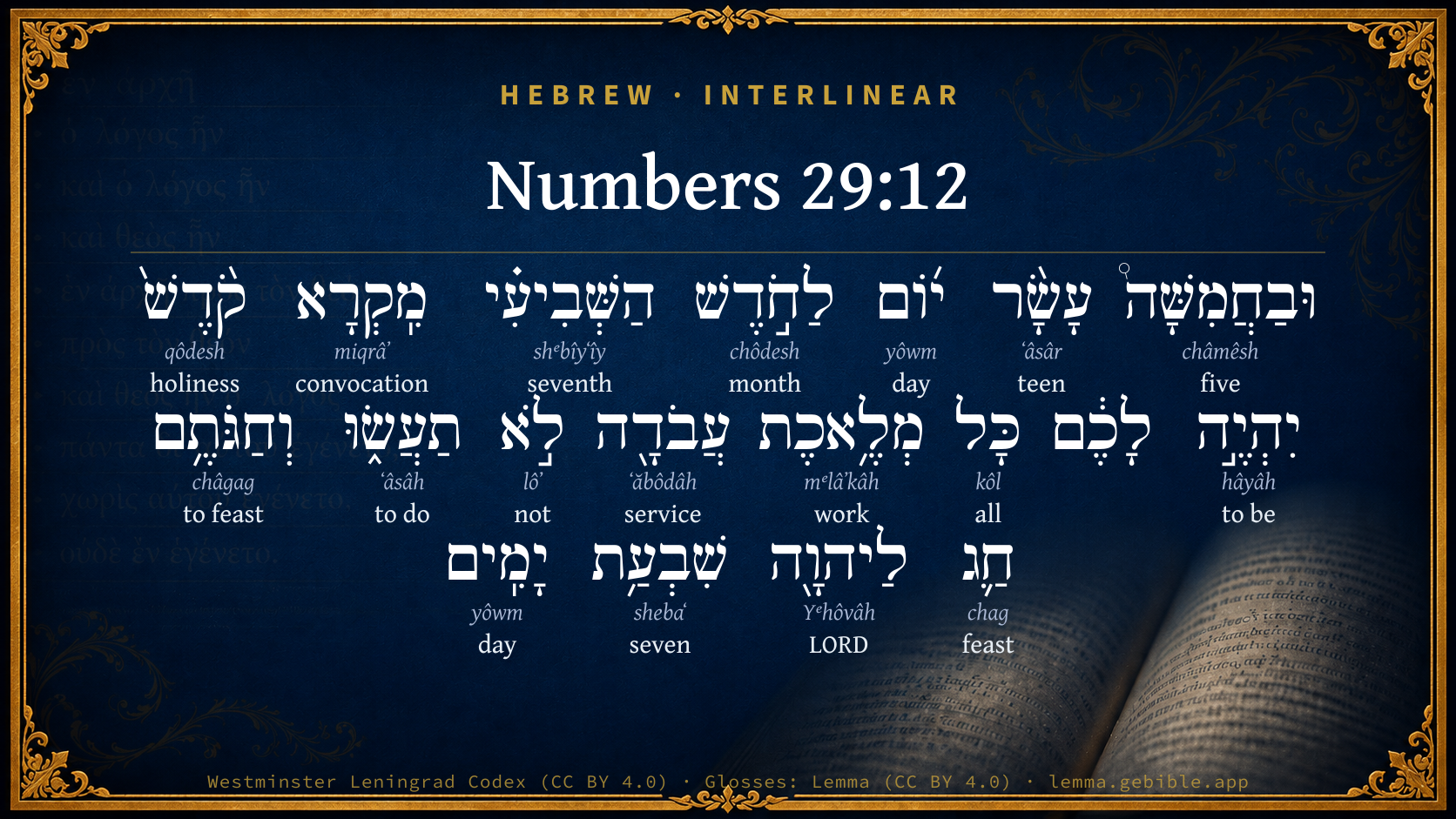
Hebrew (Westminster Leningrad Codex) Numbers 29:12 appears in the Hebrew Old Testament. The text above is from the Westminster Leningrad Codex. Each word links to its Strong’s number, a concise gloss, and parsing drawn from the Open Scriptures Hebrew Bible morphology. Click any word for its full Brown-Driver-Briggs (BDB) entry.
Download image
Cite this verse

Numbers 29:12 (World English Bible). Public Domain. Lemma interlinear Bible study tool, https://lemma.gebible.app/v/numbers/29/12.

Show BibTeX & RIS
BibTeX
RIS
English Translation
On the fifteenth day of the seventh month you shall have a holy convocation; you shall do no servile work, and you shall keep a feast to Yahweh seven days:
World English Bible · Public Domain
Download a study sheet

One document with this verse’s original text, its word-by-word gloss line, the meaning frame, cross-references with their text, attributed commentary, and full source and license credits — printable, and it pastes into notes with its structure intact.

This verse Autodidact and up

Study sheet (.html) Plain text (.txt)

A passage Seminary Student

Up to 50 verses in one chapter. A passage sheet keeps up to 6 commentary sources and 12 cross-references per verse, in the order this page ranks them, and says so on the sheet whenever that leaves anything out. Ask for a single verse and you get the Autodidact verse sheet above.

Everything on this page stays free to read, with no account — the sheet is a download of what is already on screen, not access to it.

Want to remove ads? Support Godless Engineer
Compare translations 3

The same verse in 3 English versions, stacked beneath the original-language interlinear above. Click any original word for its lexicon entry.

Each is an independent rendering of the whole verse — the interlinear is not word-aligned to these translations.

Highlighted words mark where these versions differ — a whole-verse word diff, not a word-by-word alignment.

  • World English Bible Public Domain
    On the fifteenth day of the seventh month you shall have a holy convocation; you shall do no servile work, and you shall keep a feast to Yahweh seven days:
  • King James Version Public Domain
    And on the fifteenth day of the seventh month ye shall have an holy convocation; ye shall do no servile work, and ye shall keep a feast unto the LORD seven days:
  • unfoldingWord Literal Text CC BY-SA 4.0
    And on day 15 of the seventh month there shall be for you a convocation of holiness. You shall not do any work of labor, and you shall feast a feast to Yahweh seven days.

unfoldingWord Literal Text — © unfoldingWord, licensed CC BY-SA 4.0. Word-aligned USFM3 via Door43 (git.door43.org/unfoldingWord/en_ult).

Versions to compare (up to 4)

3 of 4 selected

Show all 18 translations

Every available English version of this verse, each an independent rendering of the whole verse.

  • World English Bible Public Domain
    On the fifteenth day of the seventh month you shall have a holy convocation; you shall do no servile work, and you shall keep a feast to Yahweh seven days:
  • Berean Standard Bible Public Domain
    On the fifteenth day of the seventh month, you are to hold a sacred assembly; you must not do any regular work, and you shall observe a feast to the LORD for seven days.
  • Majority Standard Bible Public Domain
    On the fifteenth day of the seventh month, you are to hold a sacred assembly; you must not do any regular work, and you shall observe a feast to the LORD for seven days.
  • King James Version Public Domain
    And on the fifteenth day of the seventh month ye shall have an holy convocation; ye shall do no servile work, and ye shall keep a feast unto the LORD seven days:
  • American Standard Version (1901) Public Domain
    And on the fifteenth day of the seventh month ye shall have a holy convocation; ye shall do no servile work, and ye shall keep a feast unto Jehovah seven days:
  • Revised Version (1885) Public Domain
    And on the fifteenth day of the seventh month ye shall have an holy convocation; ye shall do no servile work, and ye shall keep a feast unto the LORD seven days:
  • Geneva Bible (1599) Public Domain
    And in the fifteenth day of the seuenth moneth ye shall haue an holie conuocation: ye shall do no seruile worke therein, but yee shall keepe a feast vnto the Lord seuen daies.
  • Douay-Rheims (1899) Public Domain
    And on the fifteenth day of the seventh month, which shall be unto you holy and venerable, you shall do no servile work, but shall celebrate a solemnity to the Lord seven days.
  • Young's Literal Translation Public Domain
    `And on the fifteenth day of the seventh month a holy convocation ye have; ye do no servile work; and ye have celebrated a festival to Jehovah seven days,
  • Literal Standard Version CC BY-SA 4.0
    And on the fifteenth day of the seventh month you have a holy convocation; you do no servile work; and you have celebrated a festival to YHWH [for] seven days,
  • Unlocked Literal Bible CC BY-SA 4.0
    On the fifteenth day of the seventh month you must have a holy assembly to honor Yahweh. You must not do regular work on that day, and you must keep the festival for him seven days.
  • unfoldingWord Literal Text CC BY-SA 4.0
    And on day 15 of the seventh month there shall be for you a convocation of holiness. You shall not do any work of labor, and you shall feast a feast to Yahweh seven days.
  • Darby Bible Public Domain
    And on the fifteenth day of the seventh month ye shall have a holy convocation: no manner of servile work shall ye do; and ye shall celebrate a feast to Jehovah seven days;
  • World Messianic Bible Public Domain
    “‘On the fifteenth day of the seventh month you shall have a holy convocation. You shall do no regular work. You shall keep a feast to the LORD seven days.
  • Webster's Bible Public Domain
    And on the fifteenth day of the seventh month ye shall have a holy convocation; ye shall do no servile work, and ye shall keep a feast to the LORD seven days:
  • Free Bible Version CC BY-SA 4.0
    Hold a holy meeting on the fifteenth day of the seventh month. Don't do any of your normal work. You are to celebrate a festival dedicated to the Lord for seven days.
  • Bible in Basic English Public Domain
    And on the fifteenth day of the seventh month let there be a holy meeting; do no field-work, and keep a feast to the Lord for seven days;
  • JPS Tanakh (1917) Public Domain
    And on the fifteenth day of the seventh month ye shall have a holy convocation: ye shall do no manner of servile work, and ye shall keep a feast unto the LORD seven days;

Literal Standard Version (2020), Covenant Press — licensed CC BY-SA 4.0. Text via the HelloAO Bible API (eBible.org). Unlocked Literal Bible (unfoldingWord) — licensed CC BY-SA 4.0. Text via the HelloAO Bible API (eBible.org). unfoldingWord Literal Text — © unfoldingWord, licensed CC BY-SA 4.0. Word-aligned USFM3 via Door43 (git.door43.org/unfoldingWord/en_ult). Free Bible Version, Dr. Jonathan Gallagher — licensed CC BY-SA 4.0. Text via the HelloAO Bible API (eBible.org).

Word by word

More ways to search: Search by grammar → Find every occurrence → Compare this word →

Practice this passage: Drill this verse → Learn its vocabulary →

וְחַגֹּתֶ֥ם
châgag
H2287
“and · to feast”
Conjunction + Verb, Qal, Sequential Perfect, 2nd Person, Masculine, Plural
Part of Speech
Conjunction + Verb
Stem
Qal
Form
Sequential Perfect
Person
2nd Person
Gender
Masculine
Number
Plural
Full BDB Definition

Origin: a primitive root [compare H2283 , H2328 ]

TWOT: 602

to hold a feast, hold a festival, make pilgrimage, keep a pilgrim-feast, celebrate, dance, stagger - (Qal) - to keep a pilgrim-feast - to reel
  1. וּבַחֲמִשָּׁה֩ châmêsh H2568 “and · in/at the · five” Conjunction + Preposition, Determined + Adjective, Cardinal number, Feminine, Singular, Absolute
  2. עָשָׂ֨ר ʻâsâr H6240 “teen” Adjective, Cardinal number, Masculine, Singular, Absolute
  3. י֜וֹם yôwm H3117 “day” Noun, Common, Masculine, Singular, Absolute
  4. לַחֹ֣דֶשׁ chôdesh H2320 “to/for the · month” Preposition, Determined + Noun, Common, Masculine, Singular, Absolute
  5. הַשְּׁבִיעִ֗י shᵉbîyʻîy H7637 “the · seventh” Particle, Definite Article + Adjective, Ordinal number, Masculine, Singular, Absolute
  6. מִֽקְרָא miqrâʼ H4744 “convocation of” Noun, Common, Masculine, Singular, Construct
  7. קֹ֨דֶשׁ֙ qôdesh H6944 “holiness” Noun, Common, Masculine, Singular, Absolute
  8. יִהְיֶ֣ה hâyâh H1961 “to be” Verb, Qal, Imperfect, 3rd Person, Masculine, Singular
  9. כָּל kôl H3605 “all of” Noun, Common, Masculine, Singular, Construct
  10. מְלֶ֥אכֶת mᵉlâʼkâh H4399 “work of” Noun, Common, Feminine, Singular, Construct
  11. עֲבֹדָ֖ה ʻăbôdâh H5656 “service” Noun, Common, Feminine, Singular, Absolute
  12. לֹ֣א lôʼ H3808 “not” Particle, Negative
  13. תַעֲשׂ֑וּ ʻâsâh H6213 “to do” Verb, Qal, Imperfect, 2nd Person, Masculine, Plural
  14. חַ֛ג chag H2282 “feast” Noun, Common, Masculine, Singular, Absolute
  15. לַיהוָ֖ה Yᵉhôvâh H3068 “to/for · LORD” Preposition + Noun, Proper
  16. שִׁבְעַ֥ת shebaʻ H7651 “seven” Adjective, Cardinal number, Masculine, Singular, Construct
  17. יָמִֽים yôwm H3117 “days” Noun, Common, Masculine, Plural, Absolute

About this verse

These counts appear in no published source. They are computed here, from the morphology-tagged text and Lemma’s own curated glosses. What Lemma adds →

19
words
17
distinct lemmas
Pentateuch
section

Notable vocabulary

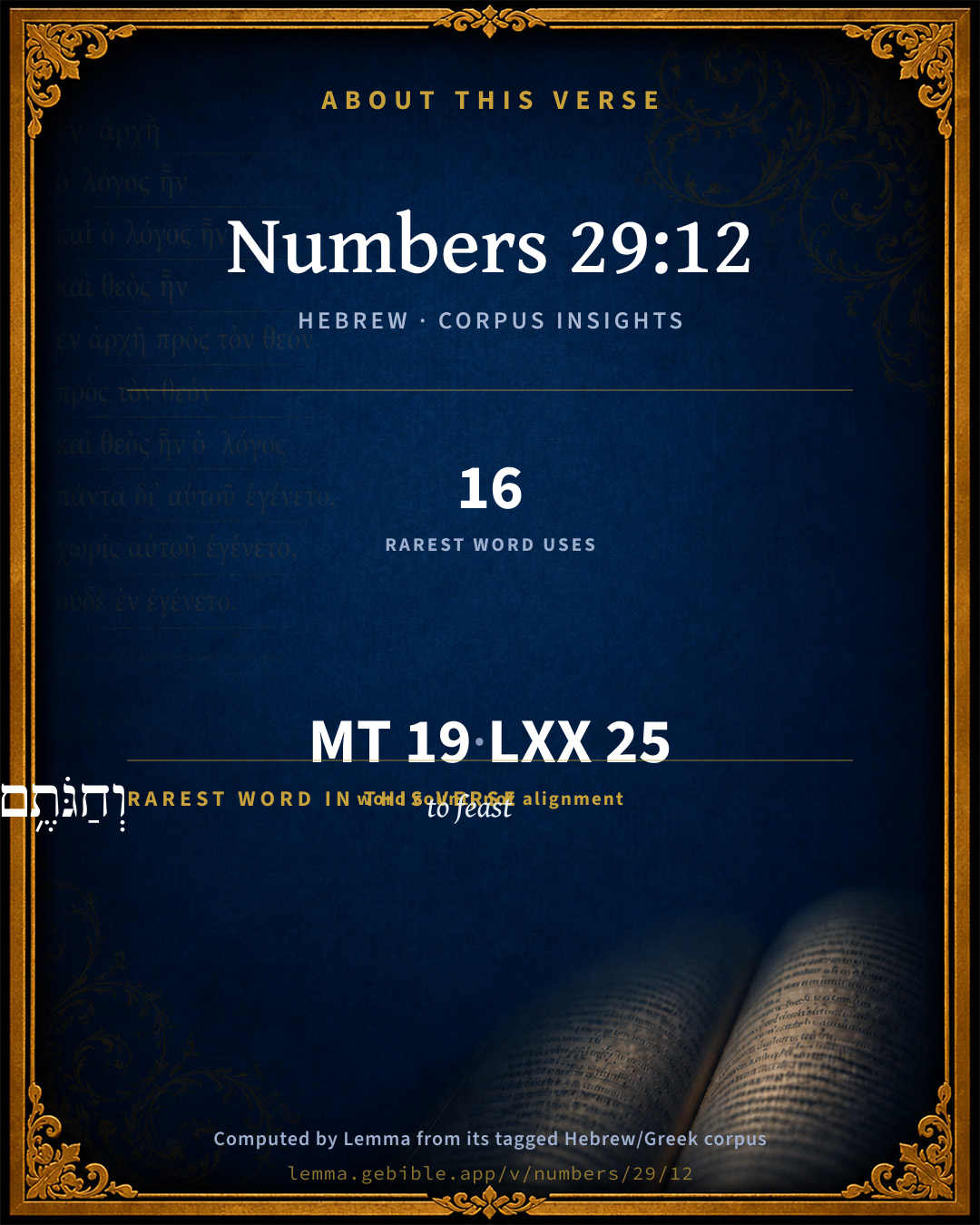
The rarest word here is וְחַגֹּתֶ֥ם to feast H2287 — appearing just 16 times in the whole Hebrew Bible.

Shared distinctive vocabulary

וְחַגֹּתֶ֥ם to feast H2287 occurs in 14 verses of the Hebrew Bible. Also found in:

Grammatical profile

  • 3 verbs
  • 10 nouns
  • 4 adjectives
  • 1 preposition
  • 1 particle

Verb forms

  • יִהְיֶ֣ה Qal · Imperfect
  • תַעֲשׂ֑וּ Qal · Imperfect
  • וְחַגֹּתֶ֥ם Qal · Sequential Perfect

Repetition

A word recurs within this verse — often emphatic in Hebrew:

  • י֜וֹם day H3117 ×2

Hebrew & Septuagint length

In English translation the verse runs 30 words from the Hebrew and 33 from the Septuagint (LXX English) — closely comparable.

A rough comparison of the two English renderings, which tokenize alike — not a word-level alignment.

Word counts can differ between the Hebrew and the Greek without any difference in meaning — e.g. the Hebrew direct-object marker אֵת has no separate Greek word, and Greek often adds the article ὁ.

In the original languages it is 19 Hebrew tokens and 25 Greek tokens — but the two are counted differently (Hebrew bundles its prefixes and suffixes into one token; the Greek is in lemma form), so that isn’t a like-for-like length.

Cross-references

10

Topical passages linked to Numbers 29:12 in the Treasury of Scripture Knowledge — connected by theme and wording, ordered by reader-vote popularity; previews shown in the World English Bible.

  • Deuteronomy 16:13–14 You shall keep the feast of tents seven days, after that you have gathered in from your threshing floor and from your winepress:
  • Exodus 23:16 And the feast of harvest, the first fruits of your labors, which you sow in the field: and the feast of harvest, at the end of the year, when you gather in your labors out of the field.
  • Exodus 34:22 You shall observe the feast of weeks with the first fruits of wheat harvest, and the feast of harvest at the year's end.
  • Leviticus 23:33–43 Yahweh spoke to Moses, saying,
  • Nehemiah 8:14 They found written in the law, how that Yahweh had commanded by Moses, that the children of Israel should dwell in booths in the feast of the seventh month;
  • Nehemiah 8:18 Also day by day, from the first day to the last day, he read in the book of the law of God. They kept the feast seven days; and on the eighth day was a solemn assembly, according to the ordinance.
  • Ezekiel 45:25 In the seventh [month], in the fifteenth day of the month, in the feast, shall he do the like the seven days; according to the sin-offering, according to the burnt offering, and according to the meal-offering, and according to the oil.
  • Zechariah 14:16–19 It will happen that everyone who is left of all the nations that came against Jerusalem will go up from year to year to worship the King, Yahweh of Hosts, and to keep the feast of tents.
  • John 1:14 The Word became flesh, and lived among us. We saw his glory, such glory as of the one and only Son of the Father, full of grace and truth.
  • Hebrews 11:9–13 By faith, he lived as an alien in the land of promise, as in a land not his own, dwelling in tents, with Isaac and Jacob, the heirs with him of the same promise.

Cross-references courtesy of OpenBible.info (CC BY 4.0).

Hebrew and Greek witnesses Masoretic Hebrew ↔ Greek Septuagint

The same verse in the two great witnesses to the Old Testament, shown verse-for-verse.

These are two independent witnesses, not word-aligned to each other, and the Septuagint is shown in lemma (dictionary) form.

Hebrew Numbers 29:12 Masoretic · Westminster Leningrad Codex

וּבַחֲמִשָּׁה֩ עָשָׂ֨ר י֜וֹם לַחֹ֣דֶשׁ הַשְּׁבִיעִ֗י מִֽקְרָא קֹ֨דֶשׁ֙ יִהְיֶ֣ה לָכֶ֔ם כָּל מְלֶ֥אכֶת עֲבֹדָ֖ה לֹ֣א תַעֲשׂ֑וּ וְחַגֹּתֶ֥ם חַ֛ג לַיהוָ֖ה שִׁבְעַ֥ת יָמִֽים

On the fifteenth day of the seventh month you shall have a holy convocation; you shall do no servile work, and you shall keep a feast to Yahweh seven days:

World English Bible · Public Domain

Greek LXX Numbers 29:12 Septuagint · lemma form

καί ὁ πεντεκαιδέκατος ἡμέρα ὁ μήν ὁ ἕβδομος οὗτος ἐπίκλητος ἅγιος εἰμί σύ πᾶς ἔργον λατρευτός οὐ ποιέω καί ἑορτάζω αὐτός ἑορτή κύριος ἑπτά ἡμέρα

And on the fifteenth day of this seventh month you⌃ shall have a holy convocation; you⌃ shall do no servile work; and you⌃ shall keep it a feast to the Lord seven days.

LXX2012 (modern English Septuagint) · Public Domain

Hebrew: Westminster Leningrad Codex (CC BY 4.0). Greek: Septuagint (public domain); English from LXX2012 (modern English Septuagint) (Public Domain). How the Septuagint differs from the Hebrew →

Targum (Aramaic paraphrase)

2

The Targum is the ancient Jewish Aramaic paraphrase of the Hebrew Scriptures — an interpretive translation, not the Hebrew text itself. Onkelos (literal) and Pseudo-Jonathan (expansive) render the Torah, and Jonathan the Prophets. Coverage is partial: where no permissively-licensed English translation exists for a verse, only the Aramaic is shown. This is verse-level text, not a word-by-word alignment to the Hebrew.

  1. Targum Onkelos Torah (Genesis–Deuteronomy)
    וּבְחַמְשַׁת עַשְׂרָא יוֹמָא לְיַרְחָא שְׁבִיעָאָה מְעָרַע קַדִישׁ יְהֵי לְכוֹן כָּל עִבִידַת פּוּלְחַן לָא תַעַבְדוּן וּתְחַגוּן חַגָא קֳדָם יְיָ שַׁבְעָא יוֹמִין

    (no public-domain English translation for this verse)

    Targum Onkelos — Aramaic: “Onkelos Genesis” (public domain); “Onkelos Exodus” (public domain); “Onkelos Leviticus” (public domain); “Onkelos Numbers” (public domain); “Onkelos Deuteronomy” (public domain). English: “Sefaria Community Translation” (CC0 1.0 (public-domain dedication)); “J.W. Etheridge. The Targums of Onkelos and Jonathan Ben Uzziel on the Pentateuch. London: Longmans, Green, 1862” (public domain). Text via Sefaria.

  2. Targum Pseudo-Jonathan Torah (Genesis–Deuteronomy)
    וּבַחֲמֵיסַר יוֹמָא לְיַרְחָא שְׁבִיעָאָה מְאָרַע קַדִישׁ יְהֵי לְכוֹן כָּל עִיבִידַת פּוּלְחָנָא לָא תַעַבְדוּן וּתְחַגוּן חַגָא דִמְטָלַיָא קֳדָם יְיָ שׁוּבְעָא יוֹמִין

    And on the fifteenth day of the seventh month you shall have a holy convocation, no servile work shall you do; but shall celebrate the Feast of Tabernacles before the Lord seven days,

    Targum Pseudo-Jonathan — Aramaic: “Targum Jonathan on Genesis” (public domain); “Targum Jonathan on Exodus” (public domain); “Targum Jonathan on Leviticus” (public domain); “Targum Jonathan on Numbers” (public domain); “Targum Jonathan on Deuteronomy” (public domain). English: “The Targum of Jonathan ben Uzziel, trans. J. W. Etheridge, London, 1862” (public domain). Text via Sefaria.

Commentary

Notes on Numbers 29:12 from classic Christian and Jewish commentators (each source and its license shown beneath its notes). The classic Christian expositions comment on the surrounding passage and are grouped to its opening verse, so a note may address several verses; the Jewish commentaries on the Tanakh (Rashi and others) are per-verse, so they appear only where the commentator wrote on this verse.

Lemma curates 59 commentaries, every one of them public domain or Creative Commons licensed, each selected and text-cleaned for this edition rather than reprinted as found. About our sources →

Trapp's Complete Commentary

John Trapp

Num 29:12 And on the fifteenth day of the seventh month ye shall have an holy convocation; ye shall do no servile work, and ye shall keep a feast unto the LORD seven days:

Ver. 12. And on the fifteenth.] See Lev 23:34-35, &c., {See Trapp on "Lev 23:34"} &c There the feasts were prescribed, and here the sacrifices belonging to them are described.

John Trapp, A Commentary or Exposition upon All the Books of the Old and New Testament (1647–1656) — public domain. Text from a community e-Sword module.

The Biblical Illustrator

Joseph S. Exell

Num_29:12-40

The fifteenth day of the seventh month.

The Feast of Tabernacles

It is called the Feast of Tabernacles because during the days of this feast they were to live in tents or tabernacles, it being a memorial of Gods preserving of them in the wilderness where was no house for them in which to rest. This was a most holy feast to remember them when they had no dwellings, and therefore Moses doth so largely dwell upon the solemnities of it ; then they were especially enjoined to read the Law at this feast, when all Israel was to appear before the Lord (Deu_31:10; 2Ch_8:13; Ezr_3:4; Neh_8:14-15; Joh_7:2). This feast is now abrogated, and belonged not to the Gentiles that were converted to the faith, after the passion and ascension of Christ (Col_2:17; Act_15:10; Heb_10:1-39). Notwithstanding we must consider the inward signification of this ceremony, and see what uses remain thereof to ourselves. And therefore the prophet Zechariah (Zec_14:16), describing the calling of the Gentiles to the true God, and their gathering into the true Church, setteth it forth according to the manner of Gods service used in the law, that they should go up from year to year to worship the Lord of hosts, and to keep the Feast of Tabernacles: alluding to the ceremony of the law, as our Saviour doth (Mat_5:23-24), meaning that they should worship God according to His commandments, and not after their own fancies.

1. First, we learn hereby that it is a duty belonging to all to remember the days of their troubles and afflictions, from which God in great mercy hath delivered us. We ought also to consider what we have been in regard of temporal deliverances, and in regard of spiritual deliverances from the bondage of sin (Eph_2:1-4; Eph_2:11-13), for their deliverance from the slavery of Egypt did figure out our deliverance by Christ from the bondage of sin, Satan, and hell itself.

2. Secondly, observe from this feast that God evermore preserveth His Church, even when it is oppressed with greatest dangers and troubles, nay, then His power and mercy is made most manifest; His power shineth brightest in our weakness, and His mercy appeareth most of all in our misery.

3. Thirdly, though the Feast of Tabernacles be not any longer in use, that we should be bound to the keeping of it, yet the doctrine arising from it concerneth us as much as ever it did the Jews. Our keeping of this feast must not be for a week or twain, but all our life, so long as we live upon the earth. We must acknowledge that we are pilgrims in this world (Heb_11:16), and if we be not strangers in this present world we have no part in the kingdom of heaven. If, then, we will have God to accept us for His children, we must assure ourselves that this life is nothing to us but a way, or rather, indeed, a race, toward our heavenly country. It is not enough for us to go fair and softly, but we must always run apace, pressing forward with all our strength and force, holding on our way, and straining ourselves to attain to the end of our course.

4. Lastly, we are hereby put in mind of the shortness of this life; we are here for a season, and by and by gone. And albeit we make our houses never so strong, and build them up with brick and stone to continue, yet our bodies are all as tabernacles, always decaying. Let us therefore learn the doctrine of the apostle (2Co_5:1), If our outward man decay we have a building prepared for us in heaven. And we must say with Peter, I must shortly put off this my tabernacle, as our Lord Jesus Christ hath showed me (2Pe_1:14). When this lodging of ours shall decay we shall dwell in an house incorruptible. Our bodies are but as arbours made of green leaves, which are of no continuance, one blast of wind is strong enough to blow them away (Isa_40:6). Every man hath some disease or other about him that will not suffer him to endure long. And if he had no disease or distemper, yet wait but a while, and age itself will be a disease, and as the messenger of death unto him, that even without sickness he slideth away, as the fruit of a tree, when it is ripe, falleth down of itself, though there be no hand to pluck it, or wind to shake it, or thief to steal it, or tempest to drive it. When we diligently consider this, then we have indeed learned to keep this Feast of the Tabernacles spiritually. To conclude, therefore, let every man beware that he seek not his own ease over much. This is one rule, that we do not pamper our own flesh in the lusts thereof (Rom_13:14). Secondly, such as are planted commodiously in this world must beware that they do not forget the world to come; and they that enjoy the earth at will must remember the kingdom of heaven, wherein they must only place the top of their happiness. If we seek heaven upon earth we shall never find it in the next life. Thirdly, let us use this world as though we used it not; rejoice as though we rejoice not, and weep as though we weep not, considering that the fashion of this world vanisheth away (1Co_7:30-31). (W. Attersoll.)

.

The Biblical Illustrator, edited by Joseph S. Exell (c. 1880s–1900s) — public domain. Text from a community e-Sword module.

Joseph Benson's Commentary

Num 29:12. The eighth and last of these national sacrifices, which was also annual, was to be at the feast of tabernacles, to be observed on the fifteenth day of this same seventh month, in solemn commemoration of their travels in the wilderness, and as a thanksgiving for their happy settlement in the land of Canaan: see Lev 23:34. Seven days — Not by abstaining so long from all servile work, but by offering extraordinary sacrifices each day. For all the seven days of their dwelling in booths they were to offer sacrifices. And while we are in these tabernacles, it is our duty and interest to keep up our communion with God. Nor will the unsettledness of our outward condition excuse our neglect of God’s worship.

Joseph Benson's Commentary on the Old and New Testaments (1811–1818) — public domain. Text from a community e-Sword module.

Whedon's Commentary on the Bible

Daniel D. Whedon

THE FEAST OF TABERNACLES — SACRIFICES, Num_29:12-40.

The cycle of Jewish feasts culminated in this, the grandest and most joyful of all. While the number of lambs and rams was double the number offered at the passover and feast of Pentecost, the number of oxen was fivefold; for, instead of fourteen, there were seventy offered during the week, so distributed that there were thirteen offered on the first day, twelve on the second, and so on, till there were only seven, the sacred number, on the seventh day. This multiplication of sacrifices was adapted to the rich harvest of splendid and costly fruits which they had just gathered: it constituted a suitable expression of the nation’s gratitude to Jehovah, the bountiful Giver. The burnt offerings, symbols of the people’s blessedness, all rested on the basis of the sin offering, prefiguring that all acceptable praise must rest upon the great sin offering, Jesus Christ. Eph_5:20; Heb_13:5.

Daniel D. Whedon (gen. ed.), Commentary on the Old and New Testaments (1874–1909) — public domain. Text from a community e-Sword module.

Tyndale Open Study Notes

Tyndale Open Resources

29:12-38 The Festival of Shelters began on the fifteenth day of the seventh month. It was an eight-day harvest celebration (29:12, 35; Exod 34:22) that required an enormous number of offerings. This harvest festival was an especially joyous occasion and a time for thanksgiving (see Neh 8:13-18). The shelters also reminded the Israelites of dwelling in tents during their wilderness sojourn (see also Lev 23:33-43; 1 Kgs 8:1-2).

Tyndale Open Study Notes — © Tyndale Open Resources, licensed CC BY-SA 4.0. Text via the HelloAO Bible API.

Geneva Bible (1599)

Geneva Bible translators

Meaning, the feast of the Tabernacles.

Geneva Bible (1599) marginal notes — public domain. Text via Bolls.life.

Matthew Henry's Commentary

Soon after the day of atonement, that day in which men were to afflict their souls, followed the feast of tabernacles, in which they were to rejoice before the Lord; for those that sow in tears shall soon reap in joy. To the former laws about this feast, which we had, Lev 23:34, etc., here are added directions about the offerings by fire, which they were to offer unto the Lord during the seven days of that feast, Lev 23:36. Observe here, 1. Their days of rejoicing were to be days of sacrifices. A disposition to be cheerful does us no harm, nor is any bad symptom, when it is so far from unfitting us for the duties of God's immediate service that it encourages and enlarges our hearts in them. 2. All the days of their dwelling in booths they must offer sacrifices. While we are here in a tabernacle-state, it is our interest as well as duty constantly to keep up communion with God; nor will the unsettledness of our outward condition excuse us in our neglect of the duties of God's worship. 3. The sacrifices for each of the seven days, though differing in nothing but the number of the bullocks, are severally and particularly appointed, which yet is no vain repetition; for God would thus teach them to be very exact in those observances, and to keep an eye of faith fixed upon the institution in every day's work. It likewise intimates that the repetition of the same services, if performed with an upright heart, and with a continued fire of pious and devout affection, is no weariness to God, and therefore we ought not to snuff at it, or to say, Behold, what a weariness it is to us! 4. The number of bullocks (which were the most costly part of the sacrifice) decreased every day. On the first day of the feast they were to offer thirteen, on the second day but twelve, on the third day eleven, etc. So that on the seventh they offered seven; and the last day, though it was the great day of the feast, and celebrated with a holy convocation, yet they were to offer but one bullock; and, whereas on all the other days they offered two rams and fourteen lambs, on this they offered but one ram and seven lambs. Such was the will of the Law-maker, and that is reason enough for the law. Some suggest that God herein considered the infirmity of the flesh, which is apt to grudge the charge and expense of religion; it is therefore ordered to grow less and less, that they might not complain as if God had made them to serve with an offering, Isa 43:23. Or it is hereby intimated to them that the legal dispensation should wax old, and vanish away at last; and the multitude of their sacrifices should end in one great sacrifice, infinitely more worthy than all of them. It was on the last day of the feast, after all these sacrifices had been ordered, that our Lord Jesus stood and cried to those who still thirsted after righteousness (being sensible of the insufficiency of these sacrifices to justify them) to come unto him and drink, Joh 7:37. 5. The meat-offerings and drink-offerings attended all the sacrifices, according to their number, after the manner. Be there ever so much flesh, it is no feast without bread and drink, therefore these must never be omitted at God's altar, which was his table. We must not think that doing much in religion will be accepted if we do not do it well, and after the manner that God has appointed. 6. Every day there must be a sin-offering presented, as we observed in the other feasts. Our burnt-offerings of praise cannot be accepted of God unless we have an interest in the great sacrifice of propitiation which Christ offered when for us he made himself a sin-offering. 7. Even when all these sacrifices were offered, yet the continual burnt-offering must not be omitted either morning or evening, but each day this must be offered first in the morning and last in the evening. No extraordinary services should jostle out our stated devotions. 8. Though all these sacrifices were required to be presented by the body of the congregation, at the common charge, yet, besides these, particular persons were to glorify God with their vows and their free-will offerings, Num 29:39. When God commanded that this they must do, he left room for the generosity of their devotion, a great deal more they might do, not inventing other worships, but abounding in these, as Ch2 30:23, Ch2 30:24. Large directions had been given in Leviticus concerning the offerings of all sorts that should be brought by particular persons according to the providences of God concerning them and the graces of God in them. Though every Israelite had an interest in these common sacrifices, yet he must not think that these will serve instead of his vows and his free-will offerings. Thus our ministers' praying with us and for us will not excuse us from praying for ourselves.

Matthew Henry's Commentary on the Whole Bible (1708–1710) — public domain (CC PDM 1.0). Text via the HelloAO Bible API.

Jamieson, Fausset & Brown

Robert Jamieson, A. R. Fausset & David Brown

on the fifteenth day--was to be held the feast of booths or tabernacles. (See Lev 23:34-35). The feast was to last seven days, the first and last of which were to be kept as Sabbaths, and a particular offering was prescribed for each day, the details of which are given with a minuteness suited to the infant state of the church. Two things are deserving of notice: First, that this feast was distinguished by a greater amount and variety of sacrifices than any other--partly because, occurring at the end of the year, it might be intended to supply any past deficiencies--partly because, being immediately after the ingathering of the fruits, it ought to be a liberal acknowledgment--and partly, perhaps, because God consulted the weakness of mankind, who naturally grow weary both of the charge and labor of such services when they are long-continued, and made them every day less toilsome and expensive [PATRICK]. Secondly, it will be remarked that the sacrifices varied in a progressive ratio of decrease every day.

Jamieson, Fausset & Brown — Commentary Critical and Explanatory on the Whole Bible (1871) — public domain (CC PDM 1.0). Text via the HelloAO Bible API.

Adam Clarke's Commentary

Verse 12. On the fifteenth day of the seventh month] On this day there was to be a solemn assembly, and for seven days sacrifices were to be offered; on the first day thirteen young bullocks, two rams, and fourteen lambs. On each succeeding day one bullock less, till on the seventh day there were only seven, making in all seventy. What an expensive service! How should we magnify God for being delivered from it! Yet these were all the taxes they had to pay. At the public charge there were annually offered to God, independently of trespass-offerings and voluntary vows, fifteen goats, twenty-one kids, seventy-two rams, one hundred and thirty-two bullocks, and eleven hundred and one lambs! But how little is all this when compared with the lambs slain every year at the passover, which amounted in one year to the immense number of 255,600 slain in the temple itself, which was the answer that Cestius, the Roman general, received when he asked the priests how many persons had come to Jerusalem at their annual festivals; the priests, numbering the people by the lambs that had been slain, said, "twenty-five myriads, five thousand and six hundred." - For an account of the feast of tabernacles, See Clarke on Le 23:34.

Adam Clarke's Commentary on the Bible (1810–1826) — public domain. Text from a community e-Sword/MySword module.

Ellicott's Commentary for English Readers

(12) And on the fifteenth day of the seventh month . . . —See Lev_23:33-36; Lev_23:39-43. A larger number of burnt offerings was appointed for this feast than for any other festival. Seventy oxen in all were to be offered on the seven days of the feast, the number being diminished by one daily—viz., thirteen on the first day, twelve on the second, eleven on the third, and in like manner until the seventh day, on which seven oxen, the perfect number, were to be offered. In addition to the oxen, two rams and fourteen lambs were to be offered daily as burnt offerings, and a he-goat as a sin offering, in addition to the daily burnt offering. The appointed meal offerings and drink offerings were to be offered with all the burnt offerings. The large number of the sacrifices offered at this time may be accounted for from the consideration that at this feast the people not only expressed their gratitude for the Divine presence and protection, but also for the rich fruits of the harvest which had been recently ingathered.

A Bible Commentary for English Readers, edited by Charles John Ellicott (1878–1897) — public domain. Text from a community e-Sword module.

John Gill's Exposition

On the eighth day ye shall have a solemn assembly,.... The day after the seven days of the feast of tabernacles were ended; for this was not properly a part of that feast, but was a sort of appendage to it:

ye shall do no servile work therein; See Gill on Lev 23:36.

John Gill's Exposition of the Whole Bible (1746–1763) — public domain (CC PDM 1.0). Text via the HelloAO Bible API.

Albert Barnes' Notes on the Bible

Feast of tabernacles: compare Lev 23:33 ff. The offerings required at this feast were the largest of all. It was especially one of thankfulness to God for the gift of the fruits of the earth; and the quantity and the nature of the offerings (see Num 29:7-11) were determined accordingly.

Num 29:32

Stress is laid on the number seven, the holy symbolic covenant number, by way of intimation that the mercies of the harvest accrued by virtue of God’s covenant. The diminishing number of bullocks sacrificed on the preceding days of the Feast (compare Num 29:13, Num 29:17, etc.), is adjusted simply to obtain the coincidence before us on the seventh day; but some have thought that the gradual evanescence of the Law until the time of its absorption in the Gospel is here presignified in the Law itself.

Albert Barnes' Notes on the Bible (1834–1885) — public domain. Text from a community e-Sword/MySword module.

Haydock's Catholic Bible Commentary

Seven days, not refraining indeed all that time from servile work, but remaining under tents, and daily performing what is required, ver. 13., &c.

George Leo Haydock (1774–1849), Haydock's Catholic Family Bible and Commentary, 1859 edition — public domain. Excludes Psalms (Douay-Rheims chapter numbering differs from Protestant) and Deuterocanonical books (Catholic canon only).

Matthew Poole's English Annotations

The feast of booths; of which see Lev 23:34,35; Deu 16:13.

Seven days; not by abstaining so long from all servile works, but by offering extraordinary sacrifices each day.

Matthew Poole's English Annotations on the Holy Bible (1683–1685) — public domain. Text from a community e-Sword/MySword module.

The Pulpit Commentary

On the fifteenth day. The first day of the feast of tabernacles, which commenced at sunset on the fourteenth. (Lev_23:35)

The Pulpit Commentary (1880–1919), ed. H.D.M. Spence-Jones & Joseph S. Exell — public domain. Text from a community e-Sword module.

John Wesley's Explanatory Notes

Seven days - Not by abstaining so long from all servile work, but by offering extraordinary sacrifices each day. This was the Feast of Tabernacles. And all the days of their dwelling in booths, they must offer sacrifices. While we are in these tabernacles, 'tis our interest as well as duty, to keep up our communion with God. Nor will the unsettledness of our outward condition, excuse our neglect of God's worship.

John Wesley, Explanatory Notes Upon the Whole Bible (1754–1765) — public domain. Text via the GEBible commentary corpus.

Keil & Delitzsch

C. F. Keil & F. Delitzsch

The feast of Tabernacles, the special regulations for the celebration of which are contained in Lev 23:34-36 and Lev 23:39-43, was distinguished above all the other feasts of the year by the great number of burnt-offerings, which raised it into the greatest festival of joy. On the seven feast-days, the first of which was to be celebrated with sabbatical rest and a holy meeting, there were to be offered, in addition to the daily burnt-offering, every day a he-goat for a sin-offering, and seventy oxen in all for a burnt-offering during the seven days, as well as every day two rams and fourteen yearling lambs, with the requisite meat-offerings and drink-offerings. Whilst, therefore, the number of rams and lambs was double the number offered at the Passover and feast of Pentecost, the number of oxen was fivefold; for, instead of fourteen, there were seventy offered during the seven days. This multiplication of the oxen was distributed in such a way, that instead of there being ten offered every day, there were thirteen on the first day, twelve on the second, and so on, deducting one every day, so that on the seventh day there were exactly seven offered; the arrangement being probably made for the purpose of securing the holy number seven for this last day, and indicating at the same time, through the gradual diminution in the number of sacrificial oxen, the gradual decrease in the festal character of the seven festal days. The reason for this multiplication in the number of burnt-offerings is to be sought for in the nature of the feast itself. Their living in booths had already visibly represented to the people the defence and blessing of their God; and the foliage of these booths pointed out the glorious advantages of the inheritance received from the Lord. But this festival followed the completion of the ingathering of the fruits of the orchard and vineyard, and therefore was still more adapted, on account of the rich harvest of splendid and costly fruits which their inheritance had yielded, and which they were about to enjoy in peace now that the labour of agriculture was over, to fill their hearts with the greatest joy and gratitude towards the Lord and Giver of them all, and to make this festival a speaking representation of the blessedness of the people of God when resting from their labours. This blessedness which the Lord had prepared for His people, was also expressed in the numerous burnt-offerings that were sacrificed on every one of the seven days, and in which the congregation presented itself soul and body to the Lord, upon the basis of a sin-offering, as a living and holy sacrifice, to be more and more sanctified, transformed, and perfected by the fire of His holy love (see my Archol. i. p. 416).

Keil & Delitzsch — Biblical Commentary on the Old Testament (1861–1891) — public domain (CC PDM 1.0). Text via the HelloAO Bible API. (Old Testament only.)

Kretzmann's Popular Commentary

Paul E. Kretzmann

of the feast of tabernacles

v. 12. And on the fifteenth day of the seventh month, when the festival of thanksgiving for the entire harvest was celebrated, ye shall have an holy convocation. Ye shall do no servile work, and ye shall keep a feast unto the Lord seven days;

v. 13. and ye shall offer a burnt offering, on the first day, in addition to the regular daily sacrifices, a sacrifice made by fire, of a sweet savor unto the Lord: thirteen young bullocks, two rams, and fourteen lambs of the first year; they shall be without blemish;

v. 14. and their meat-offering shall be of flour mingled with oil, three-tenth deals unto every bullock of the thirteen bullocks, two-tenth deals to each ram of the two rams,

v. 15. and a several tenth deal to each lamb of the fourteen lambs;

v. 16. and one kid of the goats for a sin-offering; beside the continual burnt offering, his meat-offering, and his drink-offering.

v. 17. And on the second day ye shall offer twelve young bullocks, two rams, fourteen lambs of the first year without spot;

v. 18. and their meat-offering and their drink-offerings for the bullocks, tor the rams, and for the lambs shall be according to their number, after the manner;

v. 19. and one kid of the goats for a sin-offering, beside the continual burnt offering, and the meat-offering thereof, and their drink-offerings.

v. 20. And on the third day eleven bullocks, two rams, fourteen lambs of the first year without blemish;

v. 21. and their meat-offering and their drink-offerings for the bullocks, for the rams, and for the lambs, shall be according to their number, after the manner;

v. 22. and one goat for a sin-offering; beside the continual burnt offering, and his meat-offering, and his drink-offering.

v. 23. And on the fourth day ten bullocks, two rams, and fourteen lambs of the first year without blemish;

v. 24. their meat-offering and their drink-offerings for the bullocks, for the rams, and for the lambs shall be according to their number, after the manner;

v. 25. and one kid of the goats for a sin-offering; beside the continual burnt offering, his meat-offering, and his drink-offering.

v. 26. And on the fifth day nine bullocks, two rams, and fourteen lambs of the first year without spot;

v. 27. and their meat-offering and their drink-offerings for the bullocks, for the rams, and for the lambs shall be according to their number, after the manner;

v. 28. and one goat for a sin-offering; beside the continual burnt offering, and his meat-offering, and his drink-offering.

v. 29. And on the sixth day eight bullocks, two rams, and fourteen lambs of the first year without blemish;

v. 30. and their meat-offering and their drink-offerings for the bullocks, for the rams, and for the lambs shall be according to their number, after the manner;

v. 31. and one goat for a sin-offering; beside the continual burnt offering, his meat-offering, and his drink-offering.

v. 32. And on the seventh day seven bullocks, two rams, and fourteen lambs of the first year without blemish;

v. 33. and their meat-offering and their drink-offerings for the bullocks, for the rams, and for the lambs shall be according to their number, after the manner;

v. 34. and one goat for a sin-offering; beside the continual burnt offering, his meat-offering, and his drink-offering.

v. 35. On the eighth day ye shall have a solemn assembly, Lev 23:36. Ye shall do no servile work therein,

v. 36. but ye shall offer a burnt offering, a sacrifice made by fire, of a sweet savor unto the Lord: one bullock, one ram, seven lambs of the first year without blemish;

v. 37. their meat offering and their drink-offerings for the bullock, for the ram, and for the lambs shall be according to their number, after the manner;

v. 38. and one goat for a sin-offering; beside the continual burnt offering, and his meat-offering, and his drink-offering. The special sacrifices of this festival, which stamped it as a feast of the greatest joy, thus consisted in double the number of rams and lambs for each of the seven days, and in a total of seventy bullocks, the number being distributed to begin with thirteen and to end with seven. All this set the Festival of Tabernacles apart in the year as one on which the hearts of the people were filled with the greatest joy and gratitude, just as all the other ceremonies expressed the same thought. Lev 23:34-36; Lev 23:39-43. The eighth day, as the conclusion of the festival cycle, was placed on a level with the other festivals.

v. 39. These things ye shall do unto the Lord in your set feasts, at the times which were set apart for that purpose by Him, beside your vows, and your free-will offerings, for your burnt offerings, and for your meat-offerings, and for your drink-offerings, and for your peace-offerings. Cf Lev 23:37-38.

v. 40. And Moses told the children of Israel according to all that the Lord commanded Moses. Although the festivals of the New Testament are not celebrated by God’s express command, it pleases Him nevertheless that we set aside days for solemn assemblies, to extol the great deeds of God and to praise His wisdom and mercy.

Paul E. Kretzmann, Popular Commentary of the Bible (1921–1924) — public domain. Text from a community e-Sword module.

unfoldingWord translationNotes

Door43 World Missions Community

General Information:

Yahweh continues telling Moses what the people must do.

the fifteenth day of the seventh month

"day 15 of month 7." The word "month" refer to those in the Hebrew calendar. (See: Hebrew Months and Ordinal Numbers)

have a holy assembly to honor Yahweh

"gather together to worship and honor Yahweh." The phrase "a holy assembly" means the people gather together to worship Yahweh. Worshiping Yahweh is a holy event.

you must keep the festival for him

This is an idiom. Here the word "keep" means to observe or celebrate. The word "him" refers to Yahweh. AT: "you must observe the festival for Yahweh" or "you must celebrate the festival for Yahweh" (See: Idiom)

a sacrifice made by fire

This can be stated in active form. "you must burn it on the altar" (See: Active or Passive)

thirteen young bulls, two rams, and fourteen male lambs

"13 young bulls, 2 rams, and 14 male lambs" (See: Numbers)

translationWords

day

festival

burnt offering

year

unfoldingWord translationNotes — © Distant Shores Media and the Door43 World Missions Community, licensed CC BY-SA 4.0. Source: git.door43.org/Door43/en_tn.

Lesson kit

Teaching starters — assembled from the data on this page, not authored interpretation. Every prompt links to the verse data it draws on. Edit before teaching.

Numbers, in the Pentateuch, opens this verse with 19 words (17 distinct Hebrew lemmas). Its most distinctive word is châgag (“to feast”). A historical commentator’s framing appears above. Read the whole chapter for the surrounding context.

Discussion questions

  1. What does “to feast” (châgag) contribute to the verse as a whole?
  2. Exodus 5:1 shares the word «to feast» with this verse. How do the two illuminate each other?
  3. “day” occurs 2× in this one verse. What is the effect of the repetition?
  4. These translations render this verse differently; the difference is in the English rendering, not the original. What questions does that raise?
  5. The verb «יִהְיֶ֣ה» is Qal Imperfect. How does its form color the action?
  6. Reading how Trapp's Complete Commentary and The Biblical Illustrator read this verse, where do the two commentators agree and where do they part?

Things to notice

Reading settings

Reading text

Shown beneath each verse's original-language words.

Old Testament
Old Testament edition

Read the OT as the Masoretic Hebrew (MT) or the Greek Septuagint (LXX).

English shown for the Greek Septuagint (in the Hebrew ↔ Greek comparison).

Comparing translations? Open the Compare panel on any verse page to stack up to four side by side.